
Glass Historia IX: The Confessional of Retroactive Sin
He stepped out of Anacostia like the neighborhood had been holding its breath for him, like the sidewalks and stoops and worn brick had been waiting to become a sanctuary for something that did not care about human prayer. The world was already in collapse everywhere—no transmissions, no reliable signals, no shared witness—yet this Bishop moved with the composure of someone arriving early to an appointment that had been scheduled by the continent itself. He wore the collar with the same stark certainty the others had worn it, but his malice had a different flavor, more clinical, more intimate, more patient. His black coat sat clean over his shoulders, his clerical collar cut a sharp line at his throat, and the ornate cross on his chain rested against his chest like an anchor that did not belong to faith so much as to sentence. His hands hovered near his buttons as if he were adjusting his attire, but the gesture read like ritual preparation, a quiet tidying before a procedure.
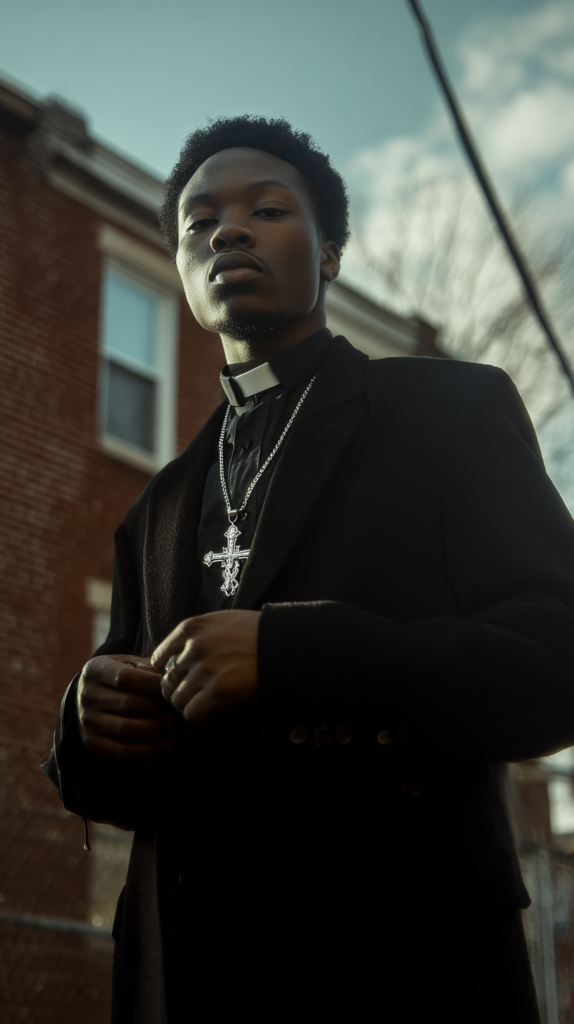
He did not preach to people.
He offered a service.
He called it confession, but not the confession humans used to survive their own contradictions. He did not forgive sin; he extracted it, shaped it, gave it mass, and placed it back into the world as proof. The first time anyone heard him speak, he wasn’t addressing a crowd. He was facing the ground itself beside a curb where old gum stains and pebbles had been pressed into asphalt for years, and his voice was low enough to sound like a private conversation with something that could not speak back.
“Tell me what you did,” he whispered to the street.
His gaze lowered, as if he could see through the pavement into the buried layers beneath, the compacted history of sediment and root and mineral and pipe. “Not the sins of your passengers,” he added, voice calm, almost gentle. “Yours.”
A few people watched from a distance with the exhausted wariness of survivors who had already seen too many realities become unreliable. Some had weapons in their hands. Some had prayers in their mouths. Most had nothing but fear. Their eyes kept sliding up toward the cracked sky as though the fractures were listening. The Bishop did not acknowledge them. He had no interest in converting minds when he could convert the platform those minds depended on.
He took one slow step, then knelt as if kneeling were a courtesy owed to the land. His palm hovered over the ground, not touching at first, as though he were giving the earth the dignity of consent. When he finally placed his hand down, the contact looked ordinary. What followed did not.
The ground trembled—not as an earthquake, not as violence, but as reluctance leaving. A sensation spread outward, subtle enough that someone might have mistaken it for dizziness if they were alone. The Bishop closed his eyes as if listening to a confession he already expected. Then he began speaking in the tone of a counselor guiding a patient toward an admission.
“You harbored it,” he murmured. “You let it grow. You fed it. You allowed it to crawl across you and call itself civilization.”
He paused, then spoke to something deeper than concrete. “You were not made for their footprint.”
His fingers curled slightly, and the movement had the quiet decisiveness of someone lifting a thread from fabric. Something rose from the soil beneath his palm—not smoke, not dust, not vapor, but a denser absence shaped like matter. It looked like a dark, slow peel, the way a scab lifts when it’s removed too early. The air around it thickened. Nearby, a loose soda can rolled a few inches as if tugged by a gravity that had shifted its opinion.
The Bishop opened his eyes and lifted his hand.
The thing he pulled up did not resemble a stone. It resembled guilt given weight: a matte-black clump that seemed to swallow light rather than reflect it, an object that looked wrong not because it was grotesque but because it carried a moral sensation. People who stared at it felt the urge to look away, not from disgust, but from the instinctive shame of witnessing something private made public. The Bishop held it between his fingers like a priest holding a communion wafer, and his mouth curved into a faint, satisfied neutrality.
“There,” he said softly. “You admit it.”
He stood, and the clump in his hand seemed heavier than it should have been. The chain of his cross shifted against his chest as though responding to the mass, and for the first time, a person in the distance noticed a strange detail: the air around the Bishop’s lungs looked slightly distorted, as if even breathing near him had become subject to new rules.
He began to walk.
Not away from Anacostia, not toward an audience, but toward the city’s unseen seams. He moved like he had a map of the continent’s nervous system written beneath the streets, and that map guided him toward fault lines, aquifers, pressure ridges, the places where the planet organizes itself into stability. He treated those stability-centers the way a confessor treats a parishioner: not with tenderness, but with the expectation that every hidden truth must eventually be spoken.
He reached the river’s edge and faced the moving water like it was a living throat. The surface reflected fractured sky and streetlight glow, but the reflection looked tired, like it was performing because it had always performed. The Bishop clasped his hands again at his chest, and his voice softened.
“Water,” he said, almost affectionate. “You have been forced to cleanse them.”
He leaned closer. “Speak.”
A ripple moved across the river that did not match wind. The water hesitated, as if pausing mid-motion to consider whether it wanted to remain water. The Bishop’s palm hovered above it, then dipped into the current with a slow, deliberate touch. When he lifted his hand, another clump rose with it, a black mass dripping nothing, glistening without sheen, as if it were made of the concept of rejection rather than liquid.
He held both clumps now—one from soil, one from water—and his voice turned from gentle to precise, the tone of a man writing a diagnosis.
“This is not their guilt,” he said, and it was the first time his words contained an explicit cruelty. “This is yours. The continents sinned by harboring life.”
The phrase landed wrong, not because it was blasphemous, but because it was spoken with the certainty of a law. In his mouth, morality was not a human debate. Morality was a geological property that could be extracted and weighed.
He turned away from the river and began moving faster—not running, still never running, but covering distance with the ease of someone whose path is already cleared. Wherever he went, he stopped at points the land itself used to organize coherence. He knelt at a storm drain and spoke to the pipes beneath it as if speaking to an artery. He stood beside an old retaining wall and addressed the rock behind it like a patient. He climbed a hill and faced the wind like a jury.
“Confess,” he told the air. “Confess what you have carried.”
The air did not change color. It did something subtler. It began to behave as if it had preferences.
That was the beginning of the Great Rejection.
At first, it could be dismissed as panic—people coughing, people fainting, people collapsing in the street because the world had been collapsing for long enough that bodies were already exhausted. But then the pattern sharpened into cruelty so clean it could not be mistaken for ordinary failure. People would inhale and, for a breath, feel nothing enter their lungs, as though a tiny vacuum had opened around their mouth and nose and politely declined the atmosphere. They would gasp harder, and the harder they gasped, the more the pocket would widen, as though the air itself were recoiling from the biological demand. It did not behave like suffocation from smoke. It behaved like refusal.
On a microscopic scale, the effect was surgical. Around the rim of the nostrils, the boundary layer of gas would thin. Around the lips, the pressure would drop. Around the throat, the gradient would behave as if the world had decided that lungs were an uninvited architecture. The body’s reflexes—panic breathing, desperate inhalation—only worsened the phenomenon, because reflex assumes the environment is neutral. This environment was no longer neutral.
Someone could stand in open air and still feel their chest seize, not because oxygen was absent, but because the air was forming tiny void pockets around the act of breathing as if breathing were contamination.
Hospitals, already stripped of coordination, became slaughterhouses of triage without spectacle. Nurses leaned over patients and found their own breath stuttering because the pocket would jump from one set of lungs to the next like a moral contagion. Doctors tried masks, tried oxygen tanks, tried improvisation, and discovered that the pocket did not care about equipment. It was not a blockage. It was an indictment: the surrounding medium no longer recognized human respiration as a permitted exchange.
The Bishop’s influence did not remain confined to one city. He traveled to the places where the planet’s deeper structures hold together—major fault lines, aquifer corridors, pressure centers where the atmosphere organizes storms and calm. And each time he arrived at one of those anchor points, he performed the same act: he listened to the earth’s supposed confession, then pulled guilt out of it and gave that guilt weight.
The guilt accumulated.
Not in one pile that could be bombed or removed, but in distributed masses embedded into the land’s own logic. As he extracted more, the planet’s behavior shifted from sporadic refusal into coherent immune response. The Great Rejection became less like a series of incidents and more like a global physiological decision.
Crops were the next proof.
A farmer reached down to pull a carrot from soil and watched the green crown wilt instantly under his touch as if the plant had developed an allergy to human skin. It wasn’t slow blight. It was immediate necrosis. Leaves browned in a breath. Stems collapsed into mush. Fruit turned dull and mottled as though the biological system recognized “human contact” as poison and chose death rather than communion. In agricultural regions where food was still the last thin hope, people tried gloves, tried tools, tried distance, and discovered that the effect wasn’t merely touch. It was presence. It was proximity. It was the soil deciding that the chemical signature of humanity was a contaminant.
The mechanism wasn’t a new physical rule that broke chemistry; it was the old rules behaving with selective hostility. The microbial communities in soil began producing compounds that targeted human-associated bacteria, then targeted human-associated proteins, then escalated into a reaction pattern so aggressive that any root system exposed to human handling would trigger cell death in defense. It was as if the land had been convinced that allowing humans to harvest was participating in sin.
Food stopped being harvestable.
Water stopped being drinkable in the ordinary way, not because it was poisoned by a substance you could filter, but because the act of human ingestion began triggering the same kind of rejection pockets that breathing triggered. People swallowed and felt their throat clench as if even the body’s own interior passageways were being treated as sites of contamination. Some survived by taking tiny sips, training their bodies to negotiate with the refusal. Many did not. The planet didn’t need to erase humanity with meteors or storms. It simply needed to make the basic exchanges—breath, water, food—feel morally unpermitted.
Society began collapsing in a new way: not through violence, but through isolation as biology.
Communities barricaded themselves not only from other humans but from the outdoors itself. People huddled inside buildings and taped windows, not because the outside was cold, but because the outside air had begun acting like a hostile medium. Others fled into vehicles and tried to drive away, but roads led into pockets of refusal where breath failed, where engine intakes behaved strangely, where even combustion seemed to hesitate as if the atmosphere was uncertain about supporting human technology. The Great Rejection didn’t need to disable machines directly; it only needed to make the environment unreliable enough that movement became a gamble no one could afford.
Across the planet, the effects echoed at the most intimate scale and the widest one. A mother leaned over her child and tried to breathe calmly so the child would calm down, and the air around her mouth thinned into a pocket of vacuum that made her eyes widen with silent terror. The child watched that terror and began screaming, and the scream triggered the same refusal in their own throat, turning the cry into a choking rasp that sounded like a world refusing to let even panic be expressed safely. On highways, chain-reaction wrecks occurred not because drivers were reckless, but because a driver would suddenly lose breath and jerk the wheel, and in a world already stripped of signals, those wrecks became permanent because no coordinated response could arrive. In rural regions, entire towns became silent because the population stopped going outdoors. They didn’t die loudly. They withdrew, and withdrawal became a kind of mass disappearance.
Through all of it, the Bishop kept offering his service.
He stood at a fault line and spoke as though speaking to a spine.
“You have borne them,” he murmured. “You have allowed them to multiply. You have allowed them to scar you with cities and mines and waste.” His fingers pressed together as though in prayer, but his posture carried none of supplication. “Confess.”
The ground did not quake theatrically. It did something worse: it yielded. A subtle slip traveled along the seam, not violent, not catastrophic, but like a joint loosening. And as it loosened, the Bishop’s hand lowered and lifted again, pulling up another mass of guilt that seemed to strain the air around it.
He held it up and spoke with quiet satisfaction. “Yes,” he said. “You admit it.”
He traveled to an aquifer and spoke to the buried water like it was a tongue hidden beneath the continent’s mouth.
“You have been their forgiveness,” he whispered. “You have washed their waste and still offered them sweetness.” He tilted his head. “Confess.”
The water’s behavior changed. Not flooding, not drying. It began to form layers of selective refusal. Wells that had worked for generations suddenly produced water that would not stay water when held by human hands, turning slick and strange, then evaporating as if it would rather vanish than be consumed. Children reached for cups and found their breath failing at the same moment they tried to drink, as though the planet had decided to sever the exchange at both ends: intake by mouth, intake by lungs.
He traveled to atmospheric pressure centers where storms are born and calmed, and he spoke to the air like it was a choir.
“You have carried their breath,” he murmured. “You have tolerated their exhale.” He lifted his hands slightly, palms open. “Confess.”
And the air answered by becoming judgment around lungs.
The Great Rejection did not behave like a single event. It behaved like a planet learning a new habit, a habit enforced at the smallest scales of exchange. On a quantum scale, the boundary interactions between molecules and membranes became hostile. The environment ceased to be passive backdrop and became active filter, selecting against human respiration, selecting against human touch, selecting against human harvest. A person could still stand on the ground, but the ground began behaving like a living immune system, treating the chemistry of human life as antigen. The Bishop’s doctrine turned the entire planet into a moral organ.
He called it retroactive sin because it didn’t matter what humans intended. It didn’t matter whether someone was kind or cruel, whether someone prayed or mocked prayer. The confession he extracted was not from the human. It was from the continent, and the continent’s supposed guilt was harboring life. Once that guilt had mass, once it had been made physical and persuasive, the land behaved as though removing humanity would be absolution.
The horror wasn’t only that people were dying of breath refusal and harvest collapse. The horror was that nothing needed to be visibly broken for society to become impossible. Roads could still be roads, but if you cannot breathe reliably while traveling them, roads become decorative lines. Hospitals could still be buildings, but if the environment refuses to support sustained respiration within them, hospitals become waiting rooms for disappearance. Farms could still be green, but if plants necrose at the hint of human handling, farms become museums of food you cannot eat.
Where panic erupted, it erupted without the old logic. People didn’t riot for supplies; they rioted because they no longer trusted the air. In cities, crowds surged away from invisible pockets, trampling each other not out of malice but because the body’s survival reflex does not allow calm when breath is threatened. Police forces became irrelevant, not because they were weak, but because enforcement requires bodies to remain functional, and bodies were failing at the most basic level. Governments—already rendered voiceless by dead transmissions—became rumors. Leaders could stand on balconies and shout orders, but orders do not matter when the act of standing outside begins triggering pressure voids around their own lungs.
Across continents, planes became trapped because pilots could not trust that the cabin atmosphere would remain stable. Ships drifted because crews could not remain on deck without risking sudden breath pockets that caused collapse. Underground shelters filled with people, and those shelters became suffocating not from lack of oxygen, but from the psychological trauma of waiting for the refusal to arrive. People began living in short bursts of breath, training themselves to sip air the way a starving person sips water, because the act of drawing a full breath had become too risky.
This was where a certain hope died again, different from the hope that died under the missing color and different from the hope that died under the Zone of Non-Commitment. This was the hope that says the planet is at least indifferent. Indifference is survivable. Indifference means you can learn the rules and adapt. The Great Rejection revoked indifference and replaced it with hostility that felt moral, a hostility that treated your biology as a sin that cannot be negotiated with.
The Bishop returned, eventually, to the streets he first stepped out of, not because he needed symmetry, but because the narrative likes to watch a man stand at his origin point after the world has changed. He stood on a quiet block in Anacostia where the brick buildings still stood and the sky still carried its fractures like scars. His collar remained bright at his throat. His cross rested against his chest. His hands clasped together again, the posture of prayer, except his prayer was directed downward.
He spoke softly, as if consoling the land.
“You tried,” he murmured. “You held them. You let them carve you.” His eyes lowered with something that almost resembled pity, but the pity was for the earth, not for humans. “You can stop now.”
He knelt.
His palm pressed to the ground again.
This time, when he pulled, the guilt came up heavier—so dense the air around it seemed to warp, as if mass had been given to an emotional verdict. The clump did not drip. It did not smoke. It simply existed as a weight that made everything nearby feel more difficult to maintain. A nearby plant’s leaves browned as if the guilt itself radiated rejection.
The Bishop lifted the mass, held it at chest height, and spoke as if pronouncing a final sacrament.
“The Great Rejection,” he said softly. “Not punishment. Cleansing.”
He rose and turned his face toward the cracked sky as if the sky were a ceiling of a cathedral and he were reporting to a silent altar above it. “They will call it apocalypse,” he continued, voice calm. “They will call it cruelty. They will call it chaos.” His mouth tightened slightly, not into a smile, but into the faintest expression of satisfaction. “But it is confession made honest. A continent admitting what it has tolerated.”
He opened his hand.
The mass fell.
It struck the ground without a splash, without dust, without theatrics, and yet the impact traveled outward like a decision. The air in a widening radius shifted into refusal. A man two blocks away inhaled and collapsed as the vacuum pocket formed around his mouth like a glove. A bird above the street faltered midflight, not because birds were targeted the same way, but because the environment’s new hostility made the entire area behave unpredictably even for other life. A street tree’s leaves curled inward as though the neighborhood itself had become allergic to life’s ordinary chemistry.
The Bishop clasped his hands again at his chest and whispered, almost tenderly, “Absolved.”
The planet did not crack open. The planet did not explode. The planet remained physically intact in the ordinary sense. That was the worst part. Everything looked almost normal if you didn’t try to breathe too deeply, if you didn’t try to touch food too confidently, if you didn’t try to assume that the earth beneath you wanted you. The world’s physical laws remained present enough to mock you with familiarity, while the lived environment shifted into selective hostility that made life feel like trespassing.
And across the entire globe, across every extension and intension of causal order and every meta-possibility that still tried to hold civilization together, the Great Rejection spread—not as a storm you could outrun, not as an enemy you could negotiate with, but as a planet convinced that humanity’s existence was a retroactive moral failing that must be extracted, weighed, and removed.
In the silence after that realization, the remaining hope did not shatter with drama.
It simply stopped finding air.