
Glass Historia X: The Canonization of False Coordinates
He stepped out of Baltimore as if the city had always belonged to him, as if rowhouses and alleyways and stoops were merely punctuation in a sentence he had already decided would be rewritten. The sky above him was still that same bruised ceiling the world had been staring at for renders now—fractured, exhausted, refusing to promise coherence—yet the light that fell across his shoulders looked ordinary enough to insult anyone still hoping for ordinary. He stood in a narrow stretch of street bordered by brick and parked cars, a man dressed for a funeral that never ended: a pinstriped suit cut clean across his frame, a patterned tie knotted tight, and a gold-lettered SUGGS stitched across his chest like a badge that was not affiliation so much as ownership. A heavy cross hung from his neck and another cross hung lower still, gilded and swinging beneath the grip of the handgun he held in both hands at waist height, the muzzle angled down with the bored patience of someone who didn’t need to raise it to be dangerous. He didn’t scan the block for witnesses. He didn’t posture toward the noise. His gaze stayed fixed on the invisible geometry beneath everyone’s feet, the city grid that humans trusted like scripture.
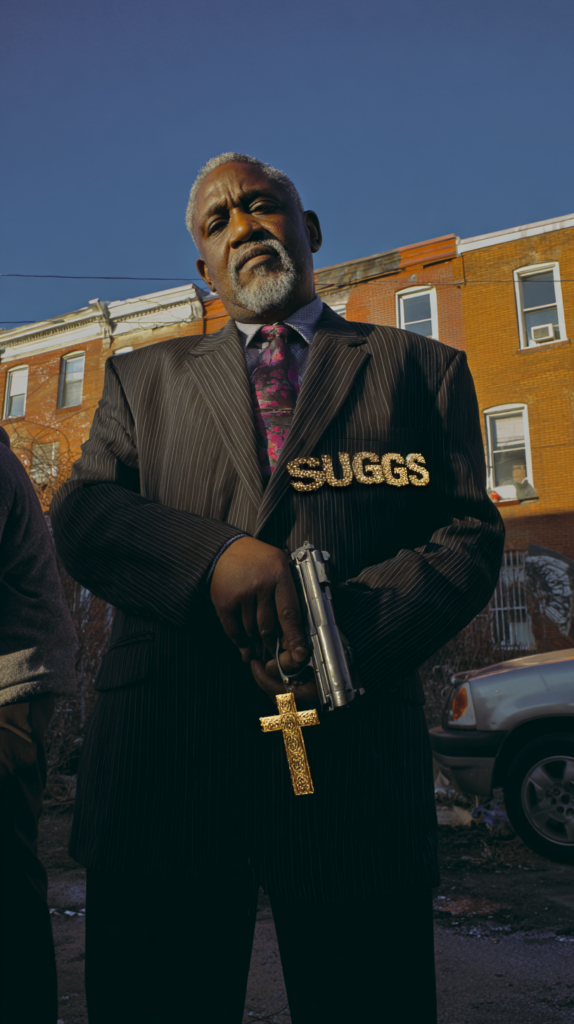
The SUGGS stitched across his jacket wasn’t embroidery in any normal sense; it was a deliberate blasphemy against what “material” is allowed to mean. Each glittering letter looked like beadwork, but the shimmer was a disguise for a density so obscene it turned measurement into confession: a single cubic angstrom of its substance—so small it mocked the idea of volume—outweighed one centillion kilograms, 10³⁰³ kg, as casually as fabric outweighs dust. It didn’t sag because the Bishop’s presence treated weight like a negotiable rule rather than a commandment; the jacket sat clean across his shoulders because the world around him had already been trained to accept contradictions as liturgy. Standing beside him, gravity didn’t fail—it complied, redistributing burden into the ground, into the street, into the unseen ledger lines beneath Baltimore’s blocks, as if the city itself had been drafted into bearing witness.
The cross was worse, because it was carried like an ornament while containing the mass of an accusation. The gold looked warm, almost familiar, but its composition carried the same verdict: one cubic angstrom exceeds one centillion kilograms (10³⁰³ kg), meaning the cross’s smallest internal sliver—an unimaginably tiny pocket of its structure—already outweighed entire frameworks of ordinary matter by a margin so extreme that “heavy” stopped being a useful word. Yet it hung and swung beneath the handgun as if it were merely jewelry, not because the cross was light, but because the Bishop’s doctrine had already rewritten the local agreement between existence and consequence; the cross did not “defy” weight, it reassigned where weight was permitted to matter. In his hands, mass became theology: not a property of matter, but a sermon about who gets to decide what holds together, what collapses, and what the world is forced to pretend it can carry.
His holy book rested against his side.
It did not look like a Bible the way people expected a Bible to look. It looked like a ledger, a mapbook, a deed packet, something that had been used by men who decide where streets begin and where borders end and who gets to call a place “home.” The cover was thick and dark, corners worn as if it had been carried through too many re-writes of the world. When he opened it, the pages did not display comforting verses. They displayed lines—curving, branching, non-Euclidean instructions that resembled a geography that did not exist yet, a continent-shaped intention that had not been born, and yet behaved like it had always been waiting to replace the one that currently held humanity.
He breathed once, slow, and spoke—not to people, not to God, not even to the sky—but to the ground as though the ground were a congregation of coordinates.
“Listen,” he murmured, and his voice carried the gravel-quiet authority of a man who had spent a lifetime telling rooms how they were allowed to behave. “You been living off the wrong address.”
The city did not respond with thunder. It responded with compliance.
He took a step that should have been simple and made it heresy. His shoe moved forward, but he did not place it on the pavement the way a human being places a foot on a street. He placed it between the pavement and the idea of pavement. It was the smallest violation imaginable—an inch of wrongness, a fraction of disobedience—and it changed everything because the world’s stability had been hanging by thinner threads than anyone wanted to admit. The Bishop did not “teleport.” He did not “phase.” He walked a non-Euclidean path as if it were the most natural thing in the world, and the world, embarrassed by its own need to remain consistent, reinterpreted his path as law.
He had become a living cursor.
Wherever he moved, he did not travel across the land; he dragged the land beneath his movement into alignment with the map in his book. He was not invading the continent. He was overwriting it.
The first effect in Baltimore looked almost petty—a block shifting the way a picture shifts on a wall when someone bumps it. A rowhouse façade adjusted by the width of a hand. A fire escape’s angle changed by a fraction. A street sign’s pole appeared to slide to the left without anyone touching it, and for a breath the mind tried to call it an illusion. Then the curb line curved into a shape the city grid had never permitted, and the mind’s protest died because there was no longer any shared system to appeal to. Transmissions were dead. Witness was local. Reality had been trained to lie. This was simply a new lie with better paperwork.
The Bishop turned a page.
The page showed a street that did not exist.
He walked it anyway.
He stepped through a brick wall without breaking it, because he did not acknowledge the wall as a boundary. The wall had not been canonized on his map, so it behaved like a rumor—present to those still attached to the old geography, irrelevant to the one imposing the new. He emerged on the other side of the building into an alley that had not been there a moment before, an alley whose angle made no sense relative to the surrounding blocks. Garbage cans stood where they “shouldn’t,” yet they stood with the stubborn certainty of things that had always stood there. The air carried that sick city smell—oil, old rain, metal—but the smell arrived with a subtle wrongness, as if even scent had begun to lose confidence in direction.
He spoke again, still to the land.
“You don’t gotta be where they say you are,” he told it. “They been calling you by the wrong name.”
He walked “between” steps—between the first step and the second, between the second and the third—without ever stepping on the step itself, and the porch staircase behind him realigned, turning into a slightly different staircase, as though the old one had been a mistake the house was relieved to correct. A lamppost flickered once and then shone from a new location that the eye accepted only after the brain gave up trying to reconcile it with memory. A parked car became two inches closer to the curb than it had been. Two inches didn’t sound like apocalypse. Two inches was enough to prove the continent could be edited.
Hope didn’t die in a scream here. Hope died in a quiet subtraction: the sudden sense that “place” was no longer a contract.
He left Baltimore without leaving Baltimore. He turned a corner and found himself walking along the edge of water as though the harbor had grown a new inlet, the shoreline bending into a path that had never existed on any modern map. He walked across the water without sinking, not because water had ceased to be water, but because on his page, that segment of water had been designated as a roadway in the geography-that-didn’t-exist-yet. The surface took his weight like asphalt would, rippling slightly in protest before deciding protest was irrelevant.
With each step, the elevenfold beyond-dimensional manifest expanse of Earth’s arrangement accepted his superimposition, as if the planet were being forced to host a second draft of itself that had been waiting behind the first draft’s paper.
The rewriting propagated outward with the cold patience of bureaucracy.
Across the continent, landmarks began to migrate.
Not all at once in a dramatic lurch—because drama was for people who still thought the world cared about their fear—but in steady, unavoidable adjustments that made the familiar become treacherous. A mountain range slid westward over the span of a single render, not like a landslide but like an administrative correction. The slope did not crumble; the entire range simply updated its coordinates, and everything in its path—towns, highways, forests—found itself crushed not by impact but by being in the wrong place when the new map arrived. The trees did not have time to fall. They simply vanished beneath rock that had decided it had always belonged there.
A river rerouted without flooding, its course bending into a new path that cut through neighborhoods and left former riverbeds dry like veins that had been reassigned. Bridges that once crossed it became absurd, spanning empty air over a trench that had become dust. People stood at the edge of the dry bed and stared into the silence as if expecting the river to apologize. The river did not apologize. The river had been excommunicated from that location. It had moved to where the Bishop’s scripture said it belonged.
Distance became subjective, and subjectivity became lethal.
A convoy of refugees walked toward a town they could see in the distance—buildings visible, lights faint, smoke rising—and the closer they walked, the further the town receded, not because of illusion but because the town had been written out of reachable coordinates. They walked for hours, legs failing, mouths dry, fear rising, and the town stayed the same size on the horizon like a cruel painting. Some collapsed. Some turned back. Some screamed at the sky. None of it mattered. The Bishop had canonized a geography where that town existed as an image but not as an arrival. The new scripture had treated the location like a sin and removed it from the act of reaching.
In another region, a traveler stepped off a highway exit and found that the exit looped into itself, a perfect curve that returned them to the same lane no matter how many times they tried to take a different turn. The ramp became a litany. The car became a bead on a prayer string. The driver’s hands shook on the wheel as their brain realized they had entered a segment of land that had been made to repeat. They did not “get lost.” They were sentenced to circularity.
Maps became blasphemy. Compasses became jokes. GPS—where it still had power—became a liar. And when the last technologies failed, humanity fell back on memory, and memory betrayed them because memory is built on stable coordinates. If the city can move while you are inside it, memory becomes a trap.
The Bishop’s holy book did not merely describe the new geography. It enforced it.
He walked through walls in one state and emerged through a hallway in another, not because he traveled, but because he had traced a path on the book’s page that connected those locations as adjacent. He walked across a lake and arrived on a street where the lake had never been, and the people there screamed because the world’s water had become a visitor. He walked “between” two breaths of air and appeared beside a coastline, and the coastline adjusted to accommodate him, tides rewriting their own boundaries to match the scripture’s margins.
The effects began to touch the planet’s most “major things,” not as poetic metaphor but as precise quantum arrangement. At the smallest scales, matter reorganized to support the new placement: molecules in soil shifted, rocks rotated, internal stresses redistributed. The land’s atomic bonds did not “break”; they re-signed their allegiance. Every alteration forced a cascade of adjustments across the elevenfold dimensional manifest expanse, as if the Earth’s deeper coordinates were being re-indexed. Where the new geography demanded a ridge, pressure built until a ridge existed. Where it demanded a valley, the ground softened until it sank. Where it demanded distance, distance elongated. Where it demanded adjacency, adjacency collapsed.
The most terrifying part was that physical law could remain intact while still being used against the human. Nothing “supernatural” needed to happen for a family to die because their house had been relocated into a roadway that didn’t exist before. Nothing “magical” needed to happen for a hospital to become unreachable because the roads to it had been excommunicated. The land did not have to explode to become uninhabitable. It only had to become untrustworthy.
The Bishop’s voice traveled with him like a quiet hymn.
He spoke in the language of plats and blocks and deeds, in the language of men who decide whose neighborhood gets a new road and whose neighborhood gets erased.
“Line up,” he told a hill once, as if scolding it. “You crooked in the old book.”
He turned a page. “This ain’t your block no more,” he told a street. “You trespassing on your own name.”
He walked, and the street complied, curving into a new line that made the old intersection impossible. Cars crashed not from speed but from certainty failing. People stepped off a curb and found the curb had moved. A mother reached for a child and found a wall in the space where air had been. The child cried and the sound echoed strangely because the geometry of the alley had been rewritten into a narrower throat.
Hope died again, not because of violence, but because the last remaining strategy—go somewhere safer—became impossible. Safety requires destination. Destination requires stable coordinates. Stable coordinates were now a sacrament under assault.
Across oceans, the rewriting reached coasts and harbors, and the sea itself became a victim of new margins. Shipping routes failed because the ports no longer aligned with where the ships arrived. A vessel approached a harbor that was visible and found the harbor sliding sideways, not fast, but steadily, like a door being closed. The captain adjusted course and the harbor adjusted too, receding, refusing adjacency. The vessel drifted until it ran low on supplies, trapped not by storms but by a map that would not permit arrival.
Even the atmosphere responded in subtle ways. Pressure systems shifted as coastlines shifted, storms forming in regions that used to be dry, drought settling in regions that used to be wet. The sky’s fractures watched it all without comment. There were no transmissions to explain it. Only survivors, staring at the horizon and realizing the horizon had begun to lie.
Somewhere in the interior of a continent, a mountain range migrating fifty miles west overnight crushed everything in its path, and the people who survived did not describe it as an avalanche. They described it as the world moving under them like an animal shrugging off fleas. They woke to find their city’s skyline no longer where it had been, their roads no longer leading where they had led, and their sense of orientation reduced to nausea.
On the far side of the planet, a sacred site built on centuries of tradition found itself suddenly two hours closer to a rival city, not because anyone built new roads, but because the land between them compressed like folded paper. Old conflicts reignited because distance had been a buffer, and the buffer was gone. The new map did not care about human politics; it cared about alignment with its own scripture. Yet human politics responded the only way it knew how: with fear and accusation and blame. People killed each other over boundary disputes while the boundaries themselves moved beneath their feet like shifting sand.
The Bishop did not watch these consequences with glee. Glee would have been human. He watched with the neutral focus of a man correcting a ledger.
He had been here since the first Bishop’s appearance, and the Church of Necessary Peace had created the storm they wanted. This Bishop had simply decided to publish the storm as a new atlas. He treated the continent like a manuscript. He treated the planet like a draft. He treated humanity like an annotation that could be erased.
He walked non-Euclidean paths across the land like a ritual dancer crossing invisible thresholds. He stepped through walls not by breaking them, but by refusing their canonical status. He crossed lakes as though they were streets. He moved between steps as though the space between steps was the only true ground. Each movement superimposed unmanifest chaos geography onto the existing elevenfold dimensional plane, and the plane accepted it the way paper accepts ink: unwillingly at first, then permanently.
People attempted to resist in the ways humans always do when they cannot comprehend. They attempted to cordon off areas, to set perimeters, to declare “no one crosses here.” The perimeter became meaningless when the land itself could relocate under the fence. Military convoys tried to move toward epicenters and discovered roads that receded, bridges that became untraversable not by collapse but by excommunication. Leaders attempted to speak to the public, to coordinate, to command. Their commands did not matter when the city they stood in was migrating out from under their podium. Authority requires a stage. The stage had begun to move.
In some regions, the new geography created pockets of cruel stability—zones where everything remained coherent, where roads stayed roads, where buildings remained upright and gravity remained stern. People flocked to these zones like pilgrims, interpreting the stability as blessing. They did not understand that the stability was not mercy; it was simply alignment. The holy book had designated those coordinates as “kept,” and therefore they were kept. The zones filled with refugees until they became pressure cookers of hunger and fear, and then violence erupted inside them because humans, when trapped, do what humans do. Even stability became a trap because stability attracted bodies and bodies attracted desperation.
In other regions, the rewriting produced impossible adjacency: a neighborhood waking up to find itself beside a coastline it had never seen, salt air filling windows where city smog used to be. People walked outside and stared at water that should not have been there. Children laughed for a breath because the sea looked beautiful. Then the adults realized the implications: supply routes broken, property lines meaningless, sewage systems displaced, everything that depends on geography now collapsing because geography had become a variable.
Everywhere, the same truth became unavoidable: the continent wasn’t being invaded. It was being overwritten.
The Bishop’s book pages turned with the soft sound of paper, and each turn felt like a death certificate for an old map. He would pause, glance down at the lines, then step in a way that looked casual to the eye and catastrophic to the world’s structure. He carried the pistol like a symbol rather than a tool, a reminder that force is not always needed when reality itself is willing to comply. The gold cross beneath the gun’s grip swung with each movement, glittering briefly, then settling again as if even ornament had learned to stay calm in apocalypse.
Eventually, his path looped back toward Baltimore, not because he was finished, but because the book demanded a return to origin. Maps love origins. Scripture loves beginnings. A rewritten world needs a place where the rewriting becomes officially “canon.”
Baltimore waited for him like a mouth waiting to be fed.
The city had already suffered everything the world had suffered: transmissions dead, hunger rising, fear turning neighbors into enemies, the sky cracked, the very idea of “elsewhere” becoming unreliable. Now it also suffered the slow humiliation of geographic uncertainty, blocks adjusting subtly, intersections curving, distance behaving strangely. People on porches argued about whether their street had always bent that way. People standing at bus stops that no longer mattered stared down the avenue and swore the hospital used to be closer. A few tried to laugh it off, but laughter sounded thin in a world where even sidewalks could move.
The Bishop arrived as daylight slanted across brick rows. He stood at the edge of a neighborhood street and looked down it as if evaluating a blueprint. His suit’s pinstripes caught the light in fine lines that made him look like he had been drawn by an architect rather than dressed by a tailor. The gold-lettered SUGGS on his chest flashed like a label on a file. The tie at his throat held its shape like discipline. He did not look tired. He looked satisfied in the way a man looks satisfied when a plan has progressed far enough that reversal feels unrealistic.
He turned one last page.
The page displayed Baltimore—yet not the Baltimore that existed. It displayed a Baltimore that belonged to the unmanifest chaos geography, a Baltimore that had been waiting behind the current one like a shadow waiting for the body to weaken.
He spoke to the ground once more, voice low, intimate, almost affectionate. “You ready to be what you supposed to be?” he asked.
Then he walked “between” the sidewalk slabs.
The street did not buckle. The street did not crack. The street corrected. A corner rowhouse shifted by inches. A lamppost appeared to blink and then stand slightly farther down the block. A stoop’s angle adjusted. A fence line straightened itself according to an invisible rule. The changes were small, but they carried the same terrifying implication: the map was winning because the map had become scripture.
At the end of the block stood a church, its door painted and worn, its steps leading upward toward a stained-glass face that could not possibly reassure anyone anymore. The building looked ordinary enough to be insulting. Ordinary buildings should not matter in a world being rewritten at continental scale. Yet this building mattered because it was the ritual anchor of the Church of Necessary Peace, and rituals require rooms.
The Bishop approached the church steps with the calm of someone arriving home.
He did not climb the steps like a man seeking salvation. He climbed them like a man bringing paperwork to be stamped.
At the top step, he paused and lifted his gaze to the doorway. His pistol remained down. His cross chain lay still. The gold-lettered badge on his chest seemed to glow briefly as sunlight touched it. He placed his hand on the door, not to knock, not to ask permission, but to confirm ownership.
Inside, the church was dim, a hush heavy enough to feel like a held breath. The air smelled faintly of old wood and dust and the ghost of incense. Pews sat in rows like ribs. Light filtered through stained glass in muted colors that suddenly felt fragile, as if color itself was uncertain in a world that had learned to mistrust perception. The Bishop stepped across the threshold and the interior geometry of the church seemed to tighten, as if the building recognized him and aligned itself in reverence.
He walked down the aisle without hurry.
He chose a pew not by preference but by coordinate. He sat as though sitting were an official act. He opened his holy book on his lap, and the pages spread wide—lines, margins, non-Euclidean scripture, a geography waiting to be fully published. In the silence of that church, the soft rustle of the pages sounded like thunder.
He spoke one final sentence, not to God, not to saints, not to any human ear, but to the concept of place itself.
“Amen,” he murmured, and in his mouth the word didn’t mean faith. It meant finalization. It meant canon.
Outside the church, Baltimore remained Baltimore only because the new map hadn’t finished its sentence yet. The world remained physically intact enough to mock the desperate with familiarity, yet the ground beneath everyone’s feet had begun to feel like a document being edited while you were still living inside the paragraph.
And as the Bishop sat there, quiet and composed, turning pages in a book that described a geography that didn’t exist yet, the last residue of hope—the hope that you could at least go somewhere, the hope that the world’s layout would remain honest even if everything else failed—died without ceremony, like an address being crossed out and replaced by a new one you were never asked to approve.