
Glass Historia XI: Glass Kingdom
The storm did not stop when the Bishops were silenced. It only lost its choir. What remained was the aftermath: a planet still bruised by doctrines that had already touched it, a world still wobbling in its own assumptions the way a body wobbles after the poison has been removed but the organs remember the damage. Streets were still uncertain about where they belonged. Buildings still remembered the sensation of forgetting gravity. Whole districts still carried pockets where perception had once failed so completely that families had clung to one another by touch alone, sobbing in the dark because sight had become an unreliable rumor. Farmland still carried the tremor of the Great Rejection—the memory of soil behaving like an immune system, plants collapsing into sudden necrosis as if human presence itself were an allergen the Earth could no longer tolerate. The air itself still had places where breath had once been treated as trespass. And above it all, the elevenfold architecture of reality still oscillated—ascending and descending in violent, quiet arithmetic—as if the world’s deeper layers had been struck by a bell and could not stop ringing.
While Draven, Ronan, and Seren moved through that wreckage doing what they could—minimizing harm, evacuating survivors, keeping fragile systems from tipping into total failure—Lucraen’s work was different. It wasn’t triage in the ordinary sense. It was exorcism of residue. He had agreed to carry the heavier portion of the burden: to seek the Church of Necessary Peace where it hid behind ritual and doctrine, and to calm the storm at its root. The others could keep people alive. He had to make “place” trustworthy again, make “breath” negotiable again, make “sight” a shared contract again, make “together” mean something more than coincidence.
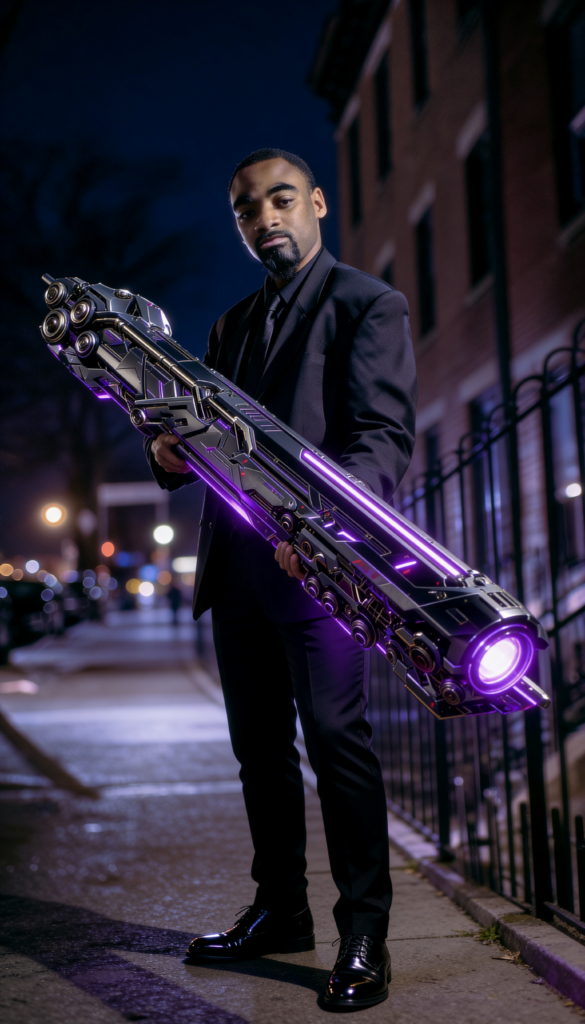
He stood on a wet city sidewalk beneath streetlamps and brick façades that looked like they had seen too much and decided to keep standing out of spite. The scene around him felt like a film still—night bokeh, iron fencing, a long stretch of pavement leading into blur—except the quiet carried that new kind of terror: the quiet you get when the world has learned it can remove your ability to ask for help. Lucraen wore a fitted black suit with a black shirt and black tie, his posture calm in the way calm becomes when it’s built from repetition rather than confidence. Both hands steadied the weapon in his grip: a massive, futuristic rifle with layered plating and rotating components, violet light pulsing along channels like contained lightning. The muzzle glowed with a controlled intensity, and the whole machine looked less like a gun and more like a verdict written in engineering—something designed not merely to harm, but to impose an outcome.
He was still standing there, angled toward the building line, when the street changed without announcing itself. Not the street’s shape—he’d already lived through streets that curled into impossible loops and intersections that refused to exist where they used to exist—but the street’s attention. The space behind him thickened as if someone had stepped into the scene from a different draft of the night.
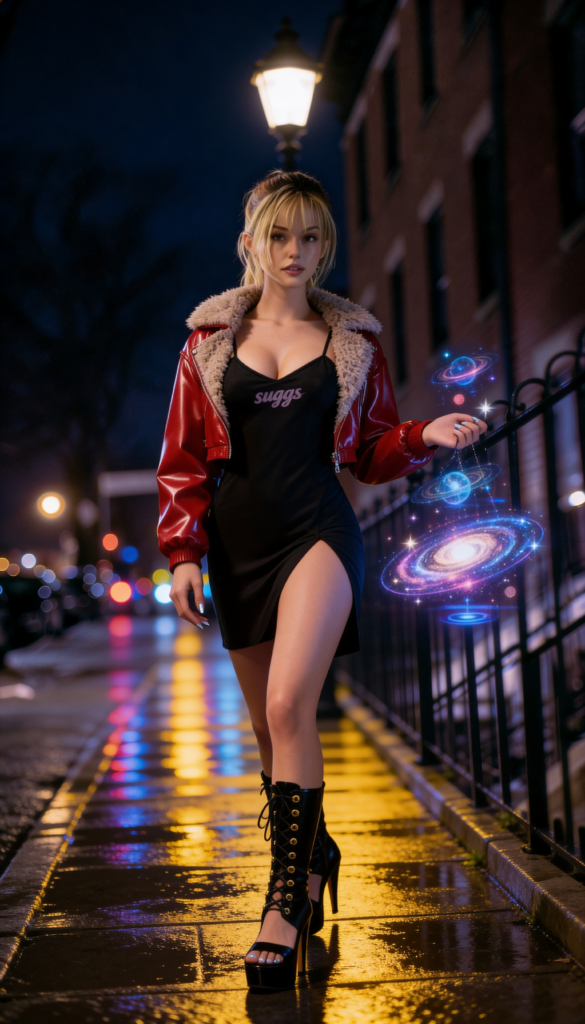
Mira appeared first, close enough that the light caught the edge of her jacket and made it shine like wet ink. She stood facing him with a directness that didn’t beg to be trusted, because she wasn’t offering trust; she was offering information. Her hairstyle was pulled into a high ponytail with straight bangs that framed her eyes, and her expression held a steady, almost severe focus, the kind you see in someone who knows exactly how dangerous the current moment is and refuses to waste it on theatrics. She wore a dark leather jacket with a hooded layer beneath it, unzipped to reveal a ribbed crop top marked with SUGGS across the chest, and thin gloves that looked like they were meant for cold and contact rather than fashion. A delicate necklace sat at her collarbone, and her hands held a chain low, letting a small cross pendant hang and catch light as if the night itself couldn’t decide whether to respect it or mock it. Her pose was still, shoulders squared, chin slightly down, gaze locked on Lucraen like she had already counted the ways the world could fail again.
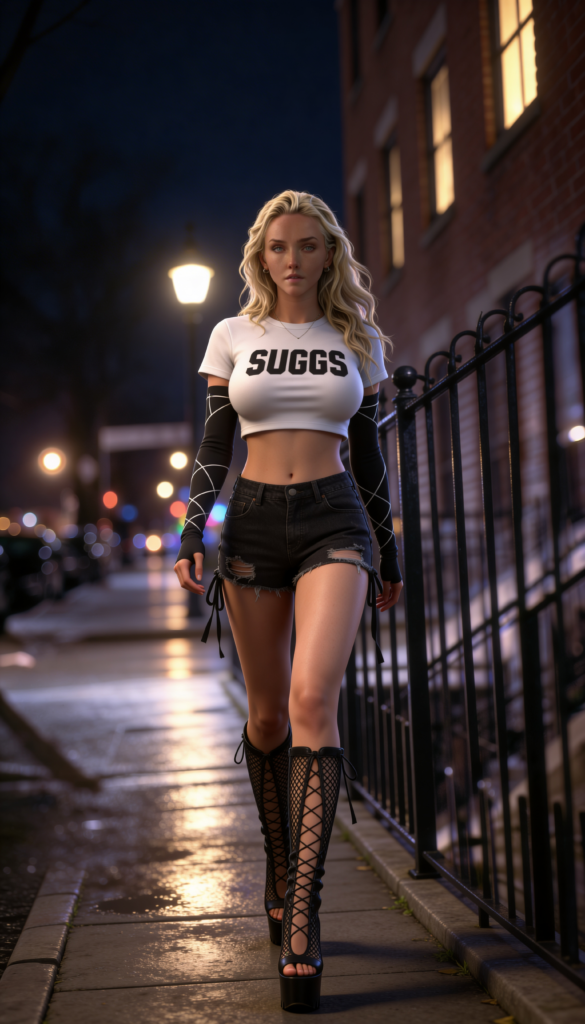
Serinda arrived beside her with the posture of motion paused mid-stride, as if she had been walking for miles and simply decided to arrive here. She moved like a runner forced to stop at a red light—tension contained, readiness preserved. She wore a white crop top stamped with SUGGS in bold letters, paired with high-waist black shorts cut with distressed edges and tied at the sides with thin strings that swayed when she shifted her weight. Long arm sleeves covered her forearms with a web-like pattern, and knee-high lace-up boots with high platforms gave her a taller, more commanding silhouette. A small necklace glinted at her throat. Her expression was unblinking and unimpressed, the kind of face that treated catastrophe as a familiar opponent rather than a surprise.
Mao Tu entered last, and the night seemed to adjust around her as if the streetlight wanted to behave better in her presence. She walked with a quiet confidence that read like a threat only because she didn’t need to prove anything. Her outfit was a white, strappy ensemble with black trim—short puff sleeves like a cropped shrug, a fitted top structured in clean lines, and a short skirt accented with dark tassels that moved subtly with each step. Thin straps wound around her lower legs above high-heeled sandals, giving her stance a poised, deliberate elegance. A dark choker with small decorative details sat at her neck, and her long straight hair fell neatly behind her shoulders. She stopped at a slight angle to Lucraen, hands relaxed at her sides, gaze forward, as if she’d been tasked with guarding a boundary nobody else could see.

Lucraen didn’t lift the rifle. He didn’t need to. His eyes shifted between them once—measured, professional—then settled on Mira.
“You’re here,” he said, and the words weren’t a greeting. They were a question about why the universe had decided to place them in front of him at this exact render.
Mira’s mouth barely moved when she spoke. Her voice was calm in a way that suggested she had learned to speak through chaos without raising her volume to match it. “We’re not here to watch,” she said. “We’re here to close the loop.”
Serinda’s eyes flicked to the rifle’s violet channels. “Your ministry worked,” she added, blunt and unsentimental. “The Bishops went quiet.”
For a breath, Lucraen didn’t react. He had learned not to trust relief. Relief was the easiest emotion to weaponize, because it makes you stop looking for the second blade.
“The storm’s still singing,” he replied, and his gaze slid past them down the street as if he could see the residual distortions in the distance. “I can still taste their doctrine in the pavement. I can still feel the geometry trying to lie.”
Mao Tu didn’t speak. She lifted one hand slightly—two fingers—then let them fall, a gesture that wasn’t dismissal so much as confirmation: yes, the aftershock was real; no, the cause was no longer present.
Mira tilted her head as if listening to something beneath Lucraen’s words. “Aftershocks don’t require a throat,” she said. “They require memory. The planet remembers what the Bishops taught it. That’s what you’re fixing now.”
Lucraen’s jaw tightened. He looked at the rifle again, not with affection, but with the tired respect you give a tool that has saved you while still costing you something. “Silenced,” he repeated, tasting the word. “All of them?”
Serinda nodded once. “Confirmed.”
Mira held up the chain in her hands. The small cross pendant swayed. “Not a rumor,” she said. “Not a hope. Confirmed removal.”
It was then the phone buzzed in Lucraen’s pocket, a vibration so ordinary it felt obscene after what the world had lived through. For a heartbeat he wondered if his mind had imagined it out of longing for normalcy, the way starving people imagine food. Then it buzzed again. He pulled the device out, and the screen lit just enough to prove that the world was letting a thin filament of connection exist again—connection not stable, not reliable, but present.
Seren’s name appeared.
He answered immediately, because in this work, hesitation is how you lose people.
Her voice came through crisp and controlled, the sound of someone who had learned to keep emotion caged so her hands could remain steady. “Luc,” she said.
“I’m here,” he replied.
There was a faint pause on the line, the kind of pause that meant she was confirming what she had already seen before allowing her voice to make it real. “I watched your work,” Seren said. “Through glass. Through distance. Through the only kind of witness that still feels honest right now.” She didn’t name the tool she used, because she didn’t have to. The tone carried the implication: she had been on a high point somewhere, eye aligned with scope, breath controlled, observing the removals as cleanly as she observed targets in quieter renders. “They went still,” she continued. “Every one of them. The moment you did what you did, the narrative pressure changed. It’s confirmed.”
Lucraen closed his eyes for a fraction, the closest thing he allowed himself to prayer. “Good,” he said, but the word didn’t sound satisfied. It sounded like acknowledging the first step of a ten-step surgery.
Seren’s voice stayed steady. “The world’s still bleeding,” she added. “Not from them. From what they taught the world to do to itself. Draven says you’re taking the Church. Ronan’s moving people out of the worst pockets. I’m doing what I can where I can. You’re the only one who can unwrite the residue.”
“I know,” Lucraen said.
Seren exhaled softly, the sound of someone who wanted to say something more human and refused. “Then go,” she said. “I’ll keep watching what’s left.”
The line went quiet. The phone screen dimmed. Lucraen slid it back into his pocket and looked at Mira, Serinda, and Mao Tu.
“Alright,” he said. “We’re not hunting Bishops anymore. We’re hunting their shadows.”
Mira’s gaze sharpened. “We don’t hunt,” she corrected. “We recalibrate.”
Serinda’s mouth twitched faintly, almost a smile. “Same thing,” she said.
Lucraen didn’t argue. He shifted the rifle slightly, the violet channels breathing brighter and then settling again. “Then help me,” he said. “Because I can’t do this alone.”
They moved without announcing their departure. There were no vehicles waiting. Vehicles belonged to the old world, the world where roads stayed roads and distance meant something stable. Now, travel required knowledge older than asphalt. Travel required stepping into the right angle of the wrong street and letting the world’s seams admit you.
Lucraen led them to an intersection where the pavement still carried the faint tremor of false coordinates, where the curb line looked correct until you stared too long and realized it was subtly refusing to commit to its own direction. He stopped there and raised the rifle—not as threat, but as instrument—aligning the glowing muzzle with a point on the street that looked empty. The point wasn’t empty. It was a seam in the local grid, a place where the world had been edited and was still healing badly.
He fired one controlled pulse of violet light into the seam.
The beam didn’t explode. It didn’t shower sparks. It didn’t “destroy.” It anchored. The discharge sank into the street like ink into paper, and the air around the intersection tightened, not with fear, but with clarity. The curb line sharpened. The street sign stopped looking like it was slightly in the wrong place. The neighborhood took one breath and held it, as if the city itself had been waiting for someone to tell it where it was allowed to be.
Mira stepped forward and placed her palm near the anchored point without touching it. Her fingers trembled faintly, not from fear, but from the sensation of working at the edge of human perception. “Missing color residue,” she murmured.
Lucraen’s eyes narrowed. “Where?”
Mira’s gaze slid to a glossy windowpane on a building across the street. “There,” she said. “A blind pocket still clinging.”
Serinda walked toward the pane without hesitation, and Mao Tu moved beside her like a shadow that refused to be separated. They didn’t look away from the window. They looked straight at it, as if daring their minds to fail.
For a breath, the window seemed ordinary.
Then the edge of it became wrong. Not dark. Not bright. Simply… absent of interpretability. A perceptual void, smaller now, but still toxic. The human brain’s self-protection still attempted to recoil.
Mira lifted her chain and let the small cross pendant swing once. “You don’t fill a blind pocket by force,” she said softly. “You fill it by giving the mind a safer mapping.”
Lucraen held the rifle steady, not aiming at the window, but aiming through it, aligning his tool with the idea of sight itself. Serinda planted her boots firmly, stance wide, shoulders squared. Mao Tu raised one hand slowly, fingers spread, as if she were holding an invisible curtain in place.
Mira spoke a phrase that did not sound like a spell and did not need to sound like one. It sounded like a sentence you’d whisper to someone panicking, the kind of sentence meant to give the mind a pathway back.
“See what refuses to be seen,” she murmured. “Name what refuses to be named.”
The blind pocket shuddered.
Not with drama. With embarrassment. Like a lie caught under a lamp.
Lucraen released another violet pulse—not into the void, but into the boundary around it—creating a ring of certainty, an outline that told the mind: this is where the absence ends. The windowpane flickered, and then the edge of the void thinned. The brain’s recoil eased. The void didn’t vanish all at once; it drained, like a stain being lifted out of fabric. The building’s reflection became whole again. The street behind Lucraen felt more coherent. A man watching from a stoop blinked rapidly, then let out a breath he didn’t realize he’d been holding, as if his body had been waiting for permission to trust its eyes.
They did this again and again across the planet, not as a montage of heroism, but as labor—precise, exhausting labor that required them to treat the world like a wounded patient whose body no longer remembered how to heal on its own. They stepped into regions where the Great Rejection still manifested as breath refusal, and Lucraen had to perform a different kind of ministry there: one that addressed the environment’s hostility without pretending it could be argued with using human morality.
In a farmland region that had turned into a cemetery of withered crops, the soil still carried the aftertaste of indictment. People stood at a distance from their own fields like they were standing near a dangerous animal. A farmer held a handful of seeds and didn’t know whether planting them was hope or cruelty. Lucraen walked to the field’s edge and stopped, feeling the pressure shift around his lungs—not a vacuum pocket yet, but the memory of one. He didn’t fight it with anger. He fought it with definition.
“The land was lied to,” he said, voice low. “It was convinced that life is a moral stain.”
Mao Tu stepped into the field with him, feet sinking slightly into soil that still felt reluctant to support human weight. Serinda stayed at the boundary, eyes scanning the horizon, because in this world even quiet places could still become traps. Mira knelt and touched the ground lightly with gloved fingers, as if offering respect.
Lucraen raised the rifle toward the earth, not to shoot through it, but to strike a line into it that the planet could recognize as coherent. He fired a low pulse into the ground at the center of the field.
The soil didn’t erupt. It settled.
The air around Lucraen’s face changed subtly, pressure smoothing out, refusing to form that cruel pocket of absence. He exhaled once and felt the breath complete itself without being denied. The relief wasn’t emotional. It was physiological. It was a body remembering that the world is supposed to be neutral enough to permit survival.
Mira placed both hands on the soil now, palms down, and spoke with the calm conviction of someone negotiating with a vast, old intelligence. “You’re not guilty,” she murmured to the ground. “You’re tired.”
The words had weight because they were true. The planet had been treated as passive resource for so long that convincing it it had “sinned” by harboring life had been an easy manipulation. Lucraen’s counter-ritual wasn’t about telling the land it owed humanity. It was about restoring consent. About reestablishing a mutual agreement: the earth would allow life to exist without treating it as infection.
He didn’t use the Bishop’s language. He refused it.
“You didn’t confess,” Lucraen said quietly. “You were coerced.”
He fired a second pulse into the soil, and this one carried a different intention—collapsed cataphysics not as aggression, but as cancellation of false verdict. The soil’s hostile reaction thinned. A green shoot near the field’s edge lifted slightly, not as miracle, but as simple biological permission returning. A woman watching from the road stepped forward and reached for a leaf with trembling fingers. Lucraen lifted his hand to stop her, not because she didn’t deserve hope, but because hope needed to be careful now.
“Wait,” he said. “Let it choose you back.”
She froze, tears in her eyes, and nodded.
Mira stood and stepped back from the soil, giving it room like you give an animal space after you’ve scared it. Serinda lowered her shoulders a fraction, tension easing. Mao Tu’s gaze stayed calm and severe, as if she were holding the boundary steady with sheer presence.
They left the field behind with the knowledge that it would not heal in one render, but it had begun to remember that it could heal at all.
Somewhere else, in a city whose streets had once been rewritten by false coordinates, the task was different. Buildings hadn’t melted. The air didn’t refuse lungs. The horror there was that distance had become subjective, and the city still carried the habit of lying. A subway entrance that should have led underground led instead into a looping corridor that returned you to the same platform no matter how far you walked. A bridge spanned a river and remained physically intact, yet stepping onto it made some people feel like they were walking toward a horizon that receded forever. The map had been broken, and people had begun to fear “going” itself.
Lucraen approached the subway entrance, and Serinda stood at his side like a guard dog that didn’t bark unless it was too late. Mira watched the tiled walls with narrowed eyes, as if she could see the residue of missing color even in plain concrete. Mao Tu’s hands remained relaxed, but her posture held readiness like an iron wire beneath silk.
Lucraen raised the rifle and traced its muzzle along the corridor’s line, not touching, just aligning. “This isn’t a place,” he murmured. “This is a sentence stuck repeating.”
He fired a violet pulse into the corridor’s far wall.
The pulse didn’t strike stone. It struck the loop. It struck the logic that made “forward” return to “here.” The corridor shuddered, tiles vibrating slightly, lights flickering as if the infrastructure itself was relieved to be freed from forced repetition. The air pressure changed. The line of sight extended farther than before. The corridor’s end began to behave like an end again instead of a trick.
Mira stepped forward, eyes locked on the far end. “Hold it,” she whispered.
Mao Tu lifted one hand, palm out, as if she were holding the corridor’s new shape in place long enough for it to set. Serinda took one step into the corridor, boots striking tile with a decisive click, and walked forward without looking left or right, as if refusing to allow the corridor to seduce her with side paths. Her stride was measured, unafraid, stubbornly linear.
Halfway down, the corridor attempted to bend. The wall’s angle wavered. The floor’s slope tried to become ambiguous.
Serinda didn’t stop.
She kept walking, and the corridor—caught between her refusal and Lucraen’s anchored pulse—was forced to choose coherence. The bend failed. The loop thinned. The corridor became what it had been meant to be: a passage from one place to another.
When Serinda reached the end, she placed her palm on the wall and looked back at Lucraen. She didn’t smile. Her expression simply said: it’s done.
Lucraen lowered the rifle slowly, and the purple channels dimmed slightly, as if the weapon itself needed rest.
It went on like this across the world: different residues requiring different ministries, the four of them moving through wreckage with no applause, no speeches, no public gratitude, because the public was still too traumatized to know what gratitude even looked like. They worked in zones where buildings had once lost conviction, and Lucraen had to speak to steel and concrete the way the Zone of Non-Commitment Bishop had spoken—except Lucraen’s words were not absolution from coherence, but reinstatement of it.
“You’re allowed to hold,” he murmured to a sagging structure once, his voice low, almost respectful. “It’s not a sin to stay.”
Mira would stand beside him, hands near the surface, whispering phrases meant to coax the mind of matter back into agreement. Serinda would plant her feet and refuse to allow the ground to become optional. Mao Tu would hold the boundary steady, silent, severe, as if her body was a stake hammered into reality.
In another place, the missing color had left a lattice of perceptual scars across a city, and Mira had to do most of the work while Lucraen anchored edges and Serinda kept civilians out of the zones. Mira would walk toward a reflective surface and let her eyes nearly slip away from it, then correct herself, forcing her mind to map the void rather than recoil from it. She would speak to the void like it was a frightened animal that had been taught to bite.
“You’re not holy,” she’d whisper. “You’re just unprocessed.”
And when the void thinned, when the reflection became trustworthy again, people would sometimes collapse in relief—not because anything dramatic had happened, but because their brains had been under assault for so long that normal sight felt like a miracle.
All the while, Draven, Ronan, and Seren moved through their own fields of labor, and Lucraen only knew pieces of it—flashes through brief contact, short messages that came through in stutters, the sound of Draven’s voice like a scalpel when it cut through panic, the knowledge that Ronan was moving people out of active distortion pockets with that calm surgical ruthlessness that refused to romanticize suffering, the image of Seren perched somewhere high, watching through glass, making sure the world didn’t lie about what was happening. Lucraen never saw them in person during this stretch, but he felt their work the way you feel someone else pushing on the same wall from the other side. The storm was being calmed in more than one place at once. It had to be. That was what made the Church of Necessary Peace so dangerous: it didn’t attack one city. It attacked the idea that the world is shared.
Lucraen’s ministry fought to restore that sharedness, and it cost him.
His hands began to shake in subtle ways he refused to name. His shoulders carried an ache that sleep could not fix because sleep itself had become fragmented; he would close his eyes and see streetlines trying to curve, see buildings forgetting, see breath pockets forming around lungs. He would wake with his jaw clenched, rifle still in his hands like a security blanket that weighed more than comfort. Mira noticed first, because she watched people with the same intensity she watched voids.
“You’re running on fumes,” she said one night, voice low.
Lucraen didn’t look at her. “Then I’ll keep running,” he replied.
Serinda scoffed softly, but not unkindly. “You don’t get points for collapsing,” she said.
Mao Tu stepped closer and placed two fingers lightly against his forearm—brief contact, nothing sentimental, a reminder that the body is also a system that needs maintenance. Lucraen flinched slightly, not from discomfort, but from the fact that touch still startled him after everything perception had done.
He exhaled once, slow. “We’re close,” he said, though he didn’t know if close was true. He needed it to be true.
Mira’s eyes narrowed. “Close to what?” she asked.
Lucraen looked down the street at the way the night bokeh shimmered. “Close to the world remembering how to be itself,” he said. “Not perfect. Not safe. Just… itself.”
They worked for a long render—an extended stretch of exhaustion where the planet’s wounds slowly stopped actively bleeding, where the elevenfold disturbances began to settle into quieter oscillations, where false coordinates became less aggressive and more localized, where breath refusal pockets thinned and the soil’s hostility began to relax, where perceptual voids stopped expanding and started shrinking into scars that could be navigated rather than traps that swallowed entire crowds. “Normal” did not return as a comforting promise. Normal returned as a grim baseline: people could once again expect the sidewalk to remain a sidewalk long enough to cross it, expect the bridge to exist long enough to drive over it, expect their breath to complete itself without the environment punishing them for needing to inhale.
By the end of that long render, the world was not healed. It was merely survivable again in the ordinary ways humanity had always pretended it deserved. The chaos that remained was the familiar chaos: crime, hunger, grief, power struggles, corruption, human cruelty—things that could be fought with human hands. The cosmic distortions still existed in pockets, but they no longer dictated the entire planet’s behavior like a god. They had been reduced into aftereffects, scars, contained nightmares rather than global rules.
That was when Lucraen finally felt Baltimore.
Not as a location. As a presence.
He returned to the city on foot, because he didn’t trust vehicles the way he once did, and because he needed to feel the pavement under his shoes, needed to confirm that the ground was still ground. The streetlights in Baltimore seemed to glow with a slightly different mood than elsewhere, a warmth that didn’t feel comforting so much as amused. The brick rowhouses looked the same as they always did, yet the air carried a subtle vibration, like a hum behind the hum. Somewhere beneath the street, water moved through pipes and sounded almost like a throat clearing before laughter.
Baltimore was smiling.
It wasn’t a literal smile. It was the way the city’s edges held themselves. It was the way the shadows pooled like they were enjoying their own depth. It was the way the alleyways felt awake. Lucraen paused on a corner and listened, and for a moment he could swear he heard it—a low chuckle threaded through distant sirens and the clack of someone’s footsteps, a laugh too quiet to prove and too present to dismiss.
The recent event had not frightened Baltimore. It had entertained it. The city had always been the kind of place that wore trauma like jewelry and learned to joke about what should have broken it. Now the joke sounded older, darker, as if the city itself had been introduced to a larger scale of violence and decided it liked the attention.
Lucraen’s stomach tightened.
Mira stood a few steps behind him, leather jacket catching streetlight. Serinda leaned against iron fencing, arms relaxed but eyes sharp. Mao Tu stood still, gaze forward, as if she could hear the city too.
“You feel it,” Mira said quietly.
Lucraen didn’t answer immediately. He watched the streetlamp’s glow tremble once, not flicker like a failing bulb, but tremble like a grin widening.
“Yeah,” he said at last. “I feel it.”
Serinda’s voice was low, serious now. “You think it’s over?”
Lucraen looked down the street again, toward the shadows that looked too comfortable. “No,” he said. “I think the world just learned a new language.”
He left Mira, Serinda, and Mao Tu at the edge of the block with a quiet nod—not a goodbye, more like an acknowledgement that they had done what they came to do, and whatever they were, they had been necessary. Mira lifted the small cross on her chain as if marking the end of a rite. Serinda’s expression softened for a fraction, then returned to steel. Mao Tu inclined her head once, minimal and final.
Lucraen walked home.
The door felt heavier than it should have, not physically, but emotionally—the weight of returning to domestic reality after carrying the planet’s residue in your hands. The interior was dim. Quiet. Too quiet. He moved through the hallway like someone afraid to wake the house, though the truth was he was afraid to wake himself fully. He set the rifle down with care, not because it needed care, but because he did. His suit jacket came off and landed on a chair. His tie loosened. His shoulders slumped for the first time in what felt like forever.
He made it to the couch.
He sat down.
And the exhaustion hit him like a delayed collision. Not cinematic. Not dramatic. Just total. His body gave up the argument. His head fell back. His eyes closed. He slipped into unconsciousness the way a person slips underwater when they’ve been holding their breath too long.
The phone rang.
It rang again.
On the third ring, Lucraen’s eyes snapped open as if pulled by instinct, and his hand moved before his mind could complain. He grabbed the phone, blinked at the screen, saw Draven’s name, and answered with a voice that sounded rougher than he wanted it to.
“Yeah,” Lucraen said.
Draven’s voice came through steady, low, and clipped—the sound of a man who had learned to deliver reality without ornament. “You awake?”
“I am now,” Lucraen replied.
There was a brief pause, the kind that meant Draven didn’t want to waste words and also didn’t want to lie by making it sound easy.
“Another Bishop appeared,” Draven said.
Lucraen stared at the dark ceiling above him, jaw tightening, the city’s faint laugh still echoing in his ears like a memory refusing to die. His hand flexed once, as if searching for the familiar weight of the rifle that wasn’t in his grip anymore.
“Where,” Lucraen asked.
Draven exhaled once, controlled. “Close enough that you’re going to want your suit back on,” he said.
Lucraen sat up fully, exhaustion still draped over him like wet fabric, and looked toward the window where Baltimore’s streetlight glow seeped in like a grin.
“Tell me,” he said.
And on the other end of the line, Draven began to speak, while the city outside seemed to listen with the quiet delight of something that had not finished laughing yet.