
Interlude I
The school had the clean brightness of a place that believed in order, but Draven could still feel the small fractures in it—the tiny dissonances that never made the announcements, the quiet desperation that lived beneath polished floors and laminated posters. He arrived the way he always did for this weekly check-up: early enough to be invisible, measured enough to avoid drawing attention, deliberate enough that no one mistook him for a parent wandering in with nervous hands and apologetic posture. To most eyes he was simply a man in a black hoodie stamped with the oval SUGGS mark, black joggers with SUGGS printed down the leg, and red trainers that moved without squeak or hesitation. His expression stayed neutral, his gaze stayed level, and the security desk recognized him the way the sea recognizes a stone—no questions, just the quiet acceptance of weight.

The hallway outside the classrooms carried the soft noise of routine: lockers clicking, papers sliding, the muffled cadence of teachers shaping young minds into measurable outcomes. Draven signed in with the same handwriting every week, clipped the visitor badge to his chest, and let his eyes do what they always did when he entered any room meant to be “safe.” He mapped exits. He listened for irregular breathing. He took note of who looked too tired for the hour, who looked too alert, who laughed too loud, who didn’t laugh at all. Then he let that awareness fold inward until it became something he carried without showing. He didn’t come here to intimidate anyone. He came here because care, to him, wasn’t a performance. It was a ritual of proximity. It was showing up even when the world asked him to become a myth.
Liora’s classroom was first. It sat at the end of a corridor where the overhead lights didn’t flicker, where student work was arranged like evidence rather than decoration. When Draven stepped in, the room was already alive with the disciplined hum of an advanced lesson that wasn’t pretending to be advanced. There were desks laid out in clean rows, whiteboards that carried faint ghosts of prior equations, and the sharp smell of dry-erase markers that always suggested ideas being chased fast enough to leave residue.
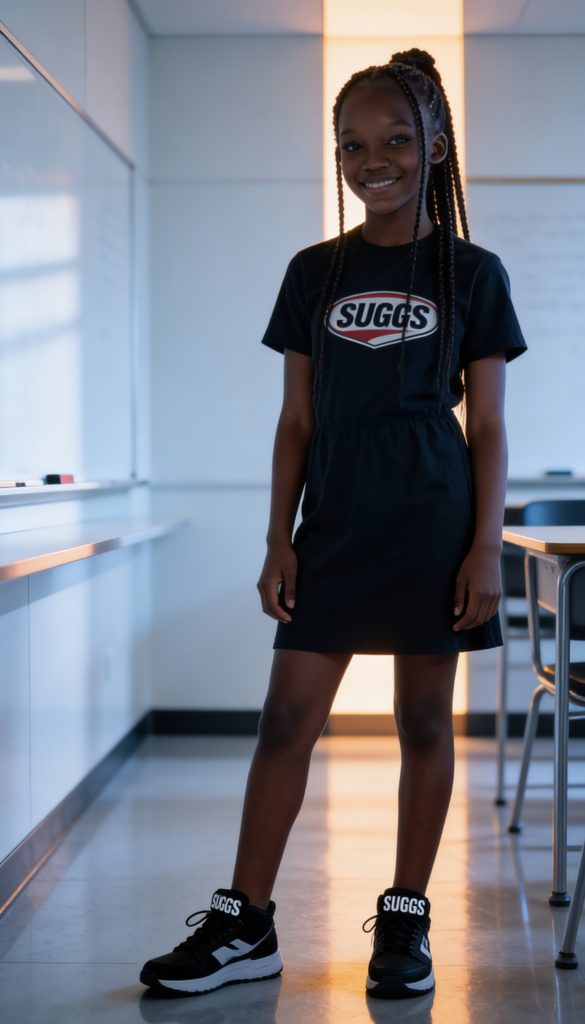
Liora stood near the front, not because she was asked to stand there, but because children who understood what they were doing tended to drift toward the source of the problem like gravity. Her outfit made her look both like a kid and like someone wearing a uniform of belonging: a black short-sleeve SUGGS shirt-dress with the logo centered across the chest, cinched gently at the waist, falling to mid-thigh in a simple line that let her move easily. On her feet were black sneakers with white soles, the tongues stamped with SUGGS in bold lettering. Her posture was open—feet planted a little apart, arms relaxed at her sides, chin lifted in a way that wasn’t arrogance so much as comfort in her own competence. When she smiled, it wasn’t shy; it was bright, grounded, and utterly unafraid of the room.
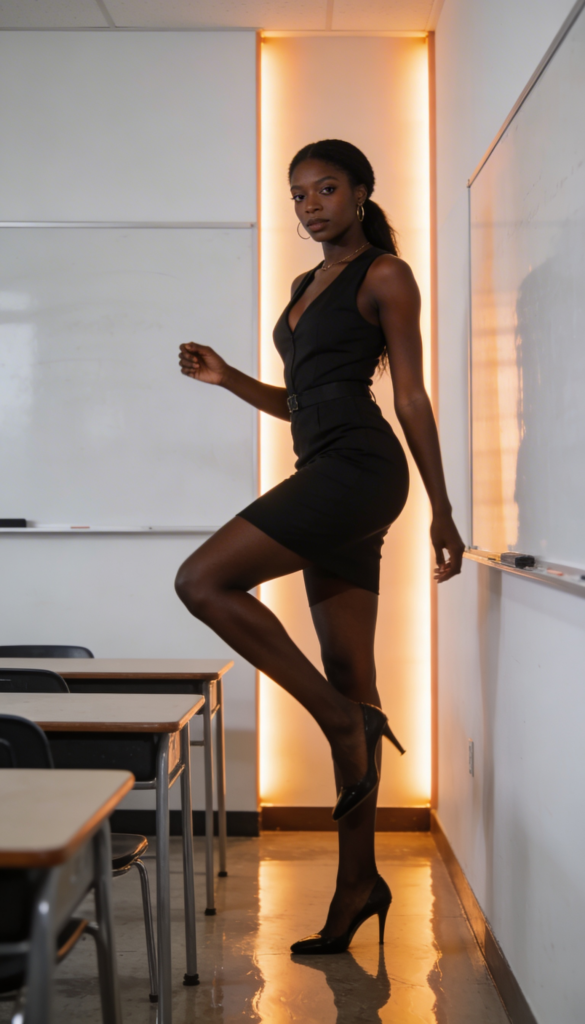
The teacher, a poised woman with a fitted black sleeveless dress and a thin belt at the waist, moved through the space with a calm authority that didn’t need volume to be felt. Gold hoops caught the light when she turned her head, and black heels clicked softly against the floor with each measured step. She didn’t teach like she was managing children; she taught like she was guiding minds through an elegant maze. Her name, written on the corner of the whiteboard in clean lettering, read: Ms. Imani Hartwell.
“Today,” Ms. Hartwell said, “we’re not just solving. We’re proving. If you’re going to claim something is true, you’re going to learn the discipline of why.”
On the board was a puzzle disguised as a lesson—logic dressed up as play, structure masquerading as curiosity. The class moved in clusters, debating, testing, collapsing assumptions, rebuilding them. Draven stayed near the door, silent, watching the way a tactician watches a battlefield—except the battlefield was a set of children learning how to think without flinching.
Liora didn’t rush. That was the first thing Draven noticed every time he came. She didn’t perform speed to impress anyone. She walked straight to the core of the question like she could hear it breathing. While other students offered partial answers, Liora offered frameworks. She didn’t just say what worked; she explained why it couldn’t fail. When Ms. Hartwell asked the class to justify a step that most adults would accept on faith, Liora’s hand went up with a quiet confidence that never begged for attention.
“Go ahead,” Ms. Hartwell said.
Liora spoke in full thoughts. She didn’t inflate her voice; she didn’t shrink it either. She made the logic accessible, but she refused to make it small. She drew a clean line between assumption and conclusion, and she did it with the casual ease of someone stacking blocks—except these blocks were the invisible architecture of reasoning.
Ms. Hartwell’s eyes flicked toward Draven for half a heartbeat, not in accusation, not in awe, but in the simple recognition of cause and effect. This child did not grow in a vacuum. Someone shaped the environment around her. Someone fed the flame without turning it into a spectacle.
Draven gave nothing away on his face. That was his public modality. But his gaze softened by a fraction when Liora finished and stepped back, her smile returning like a light switching on.
When the class transitioned into independent work, Liora drifted toward Draven as if the space between them was an agreement the world didn’t need to witness. She didn’t cling. She didn’t ask for permission to be close. She simply arrived at his side, the way she always did, and tilted her head.
“You’re early,” she whispered, like it was a secret victory.
“I’m on schedule,” he murmured back, voice low enough that it belonged to her alone.
She grinned wider. “That means you missed nothing.”
“That was the intent.”
She looked down at his visitor badge, then up at him with a seriousness that only children could wield—seriousness without cynicism. “Did you see the proof part?”
“I saw you build it,” he said.
Liora held that sentence like it was something warm. Then, because she was still ten and still allowed to be ten, she leaned closer and added, “Ms. Hartwell says my brain is… annoying.”
Draven’s mouth almost betrayed him with a smile. Almost. “Ms. Hartwell is complimenting you.”
Liora’s eyes narrowed in playful suspicion. “That’s what you say when people don’t know how to say what they mean.”
“That’s also what I say when you’re fishing.”
She giggled and took a small step back, returning to her desk with the easy confidence of a child who knew she was seen.
Draven didn’t stay long. He never stayed long. Not because he didn’t want to, but because presence had to be balanced. Too much attention could warp a child’s relationship with their own talent. Too much hovering could turn brilliance into performance. He didn’t want that for her. He wanted her mind to feel like a home, not like a stage.
He left Liora’s room as quietly as he entered, nodding once to Ms. Hartwell—an acknowledgment, not a conversation. She returned it with the same precision. There were words waiting between them, but they would be spoken later, behind closed doors, where adults handled delicate truths.
In the corridor, Draven’s phone vibrated once. Not urgent. Familiar. He glanced down and saw a message thread labeled Eira.
A meme filled the screen: a badly drawn stick figure under a mountain of equations with the caption: “When the teacher says ‘show your work’ and you start narrating the universe.”
Draven’s thumb moved without hesitation. He sent back an image of a cat staring into a void-black coffee mug, captioned: “When you’ve already solved it but you’re pretending it’s hard so nobody asks you for help.”
The typing bubble appeared immediately.
Eira: “I hate how accurate you are.”
Draven: “Accuracy is cheaper than regret.”
Eira: “That’s not a meme, that’s a threat.”
Draven: “That’s called education.”
Eira sent a laughing emoji and then, because she could never resist turning affection into comedy, replied: “Stop being wise. It’s making my playlist sad.”
He didn’t answer with anything sentimental. He didn’t need to. The exchange itself was the sentiment—a tether that didn’t announce itself, a quiet proof that he remained reachable.
Nyra’s classroom sat on the opposite wing, and the atmosphere changed as he approached it. Liora’s room had the bright sharpness of logic and language; Nyra’s had the heavier stillness of numbers that behaved like physical objects. The classroom was arranged with the same disciplined order, but the whiteboard carried a different kind of residue: vectors, diagrams, a spiral drawn with the care of someone who respected curves like they were laws.
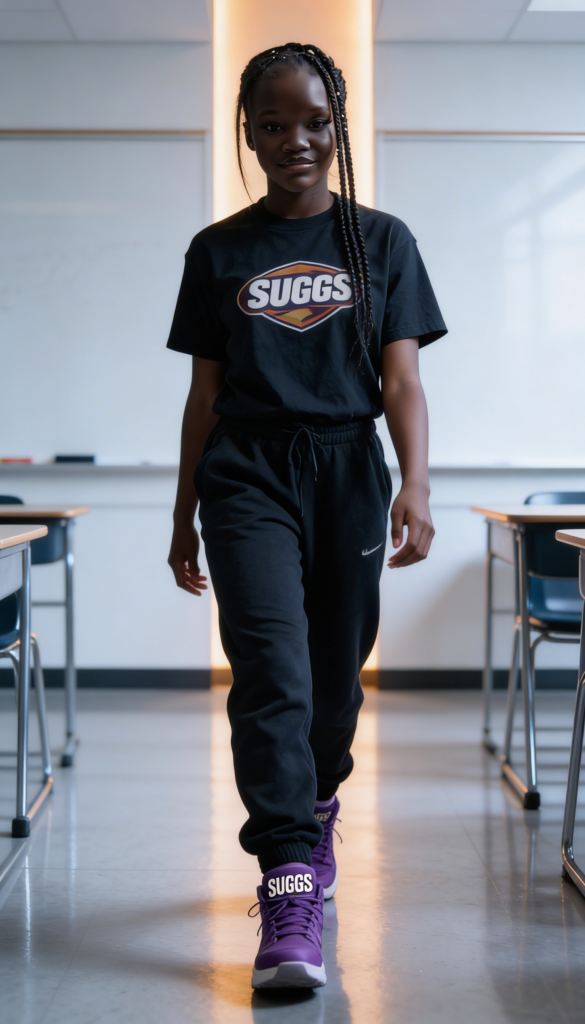
Nyra walked down the center aisle between desks as if the room belonged to her stride. She wore a black SUGGS shirt like Liora, but paired it with black joggers cinched at the ankles, a drawstring tied at the waist. On her feet were purple sneakers stamped with SUGGS on the tongue, the color vivid enough to feel like defiance against the room’s neutral palette. Her posture was composed—shoulders relaxed, gaze forward, movements controlled without being rigid. She didn’t smile the way Liora did. Nyra’s smile arrived in smaller doses, like a rare currency she spent intentionally.
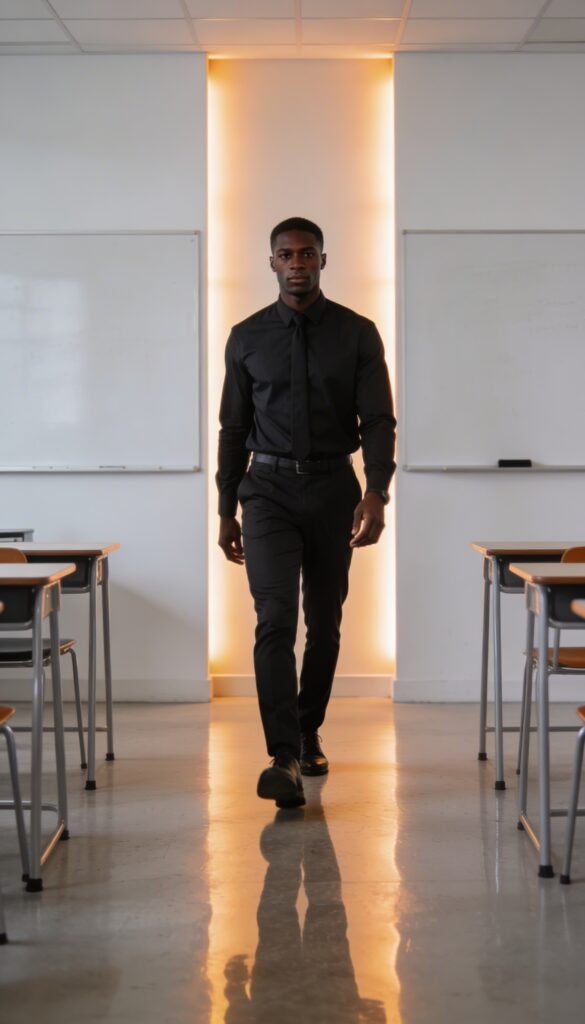
At the front of the room stood the teacher: a man in a fitted black dress shirt with a black tie, black slacks, a belt and watch set with the kind of quiet professionalism that made you believe he ironed his thoughts. He moved between desks with measured steps, voice calm, eyes alert. Written on the board in neat print was his name: Mr. Darius Kincaid.
“Alright,” Mr. Kincaid said, “we’re modeling motion. Not the fairy tale version. The real version. If you claim something moves, you prove how.”
The assignment on the board wasn’t typical for twelve-year-olds anywhere else. It was the kind of problem that belonged in older classrooms, but this was a program that didn’t apologize for scale. The students worked with graphs, rates of change, applied reasoning that translated abstract symbols into predictions you could trust.
Nyra didn’t just answer. She corrected the premise.
When Mr. Kincaid referenced a simplifying assumption to make the math cleaner, Nyra’s hand lifted.
“If we ignore the variable,” she said evenly, “we’re not modeling motion. We’re modeling comfort.”
A couple students laughed. Mr. Kincaid didn’t. He stared at her for a second, then nodded like a man who respected being challenged.
“What’s the alternative?” he asked.
Nyra walked to the board without asking, marker already in hand. She adjusted the equation with a small change that made the entire structure more honest. The line on the graph shifted. The prediction became sharper.
Draven watched from the doorway again, silent, his face unreadable. Inside, something in him eased and tightened at once—the contradictory sensation of pride and fear. Pride, because she was unafraid to stand inside complexity. Fear, because brilliance drew attention like blood drew sharks.
Nyra finished, capped the marker, and returned to her seat without looking for applause. That was her signature. She didn’t need the room to confirm her. She needed the room to stay out of her way.
When the class broke into paired work, Nyra’s eyes flicked toward the door. She saw Draven and didn’t react the way other kids reacted to parents. She didn’t wave. She didn’t call out. She simply stood, walked over, and stopped at his side like it was the most natural thing in the world.
“You came,” she said, voice low.
“I said I would,” Draven replied.
Nyra glanced into the classroom, then back at him. “He made the problem easier.”
Draven’s tone stayed even. “And you made it true.”
Nyra’s mouth twitched—almost a smile. “He didn’t like it.”
“He respected it.”
She studied him for a second, like she was calculating the hidden variables behind his calm. “Do you have to leave after this?”
“I have to move,” he said. “But I’m here.”
Nyra nodded once, accepting the answer like she accepted math: not emotionally, but completely. Then she leaned in and added, “We’re watching the new episode tonight. Liora keeps asking questions during the fight scenes.”
“Liora asks questions during everything,” Draven said.
“That’s why she’s dangerous.”
Draven let a small exhale slip out. Not quite laughter, but close enough that Nyra’s eyes softened.
Before she returned to her seat, she tapped the SUGGS logo on her shirt like it was a badge of belonging and whispered, “Tell Eira her meme was mid.”
Draven’s brow lifted. “Eira sent you a meme?”
Nyra’s face stayed perfectly straight. “No.”
Draven stared at her for a beat.
Nyra blinked once. “Okay. Yes.”
Draven said nothing, but the silence carried a message: I see you. Nyra nodded like she received it, then walked back to her desk, posture unchanged.
Draven left the classroom the way he entered—quiet, controlled. He didn’t linger. He didn’t hover. He kept the balance.
He found an empty corner near the windows and waited through the passing of bells and bodies, through the school’s shifting currents. This weekly check-up was never just about academics. It was about ensuring the environment remained safe enough for their minds to stretch without snapping. It was about watching the adults around them. It was about hearing the subtext behind praise and concern. It was about keeping the world from turning his daughters into an experiment.
His phone vibrated again.
Eira: “Just saw a kid try to argue with the teacher that numbers are a conspiracy.”
Draven: “Were they wrong?”
Eira: “I’m calling child services on you.”
Draven: “I’ll represent myself.”
Eira: “That’s worse.”
He stared at the screen a little longer than necessary, then typed: “Check on your sisters tonight.”
Eira replied fast: “Already do.”
He didn’t respond. He didn’t need to.
When the corridor finally emptied enough to make private conversation possible, Ms. Imani Hartwell stepped out of Liora’s classroom like she’d been waiting for the school’s noise to thin. Up close, her professionalism felt even sharper—her dress clean-lined, her jewelry minimal but deliberate, her posture composed like she didn’t waste motion on anything that didn’t matter. She gestured with one hand toward her classroom.
“Mr. Endwriting,” she said. “If you have a moment.”
Draven followed her inside. The classroom was quieter now, desks abandoned, the board still carrying the skeleton of Liora’s reasoning. Ms. Hartwell closed the door gently and leaned back against the edge of a desk, heels planted, arms loosely folded. Her expression wasn’t dramatic. It was the face of someone delivering truth with care.
“I don’t say this lightly,” she began. “Your daughter’s evaluation is… beyond what our program typically measures.”
Draven’s expression didn’t shift. “Say it plainly.”
Ms. Hartwell nodded, appreciating the directness. “The IQ cognitive assessment came back at 300.”
The number hung in the room like a bell that didn’t stop ringing.
“She didn’t just score high,” Ms. Hartwell continued. “She broke the frame. The evaluator had to confirm the results twice. The recommendation is immediate placement into advanced collegiate coursework, with mentorship, acceleration, and—”
“No,” Draven said, calmly.
Ms. Hartwell blinked once, not offended, but surprised by the speed of the refusal. “I’m not suggesting this to flatter you. I’m suggesting it because she’s under-stimulated. Because she’s capable of more than this environment can provide.”
Draven’s gaze moved to the board, to the clean lines of logic Liora had drawn. His voice stayed even, tactician-steady, as if he were discussing resource allocation instead of his child. “Under-stimulation is not the same as misplacement. She can be challenged here. She can be stretched here. She does not need to be extracted.”
Ms. Hartwell’s eyes narrowed slightly. “You’re declining opportunity.”
“I’m declining isolation,” Draven replied.
The teacher studied him, as if trying to locate the emotion behind the discipline. “You realize how rare this is.”
Draven’s jaw tightened by a fraction. “Rare doesn’t mean beneficial.”
Ms. Hartwell exhaled slowly. “So what do you want us to do?”
Draven didn’t soften his tone, but the intent behind it was unmistakable. “Give her harder problems. Give her deeper reading. Give her proof-work. Give her projects that require patience, not just answers. Challenge her without removing her from her age peers. Let her build friendships without being treated like an artifact.”
Ms. Hartwell’s expression shifted—something like respect, something like understanding. “You’re protecting her social development.”
“I’m protecting her childhood,” Draven said, though he didn’t frame it as sentiment. He framed it like strategy. Like survival.
Ms. Hartwell nodded once. “Alright. I can work with that. But I need you to understand—she’s going to outgrow us.”
Draven’s eyes lifted to meet hers. “Then we adjust the environment until she’s ready to choose her own direction. Not until the world chooses for her.”
Ms. Hartwell held his gaze, then gave a small, genuine smile. “She’s fortunate.”
Draven didn’t respond to that. Compliments, in his world, were sometimes bait. He accepted the information, the agreement, and the subtle confirmation that Ms. Hartwell was on the same side.
When he stepped back into the hallway, Mr. Darius Kincaid was already waiting near Nyra’s door. The man’s face was composed, but his posture carried the tension of someone who’d spent the last render trying not to sound alarmed.
“Endwriting,” Mr. Kincaid said, tone low. “A word.”
Draven followed him inside Nyra’s classroom. The desks were empty now. The board still showed Nyra’s correction, the adjusted equation standing there like a quiet rebellion preserved in ink.
Mr. Kincaid didn’t waste breath. “Nyra’s IQ assessment came back at 300 as well.”
Draven’s face remained calm, but his mind moved faster, assembling implications the way it always did: scrutiny, attention, institutional pressure, unwanted doors opening.
“They want her in an advanced university-level placement,” Mr. Kincaid continued. “They want her in labs. They want her in programs with older students who will treat her like a tool. I don’t like it. But I have to tell you the recommendation is strong.”
Draven looked at the board again. “She’s not a tool,” he said.
Mr. Kincaid’s mouth tightened. “Agreed. But the world doesn’t always care what we agree on.”
Draven’s voice stayed controlled. “She’s not going.”
Mr. Kincaid studied him, then nodded slowly. “I expected you’d say that.”
Draven’s eyes flicked toward him. “You approve?”
Mr. Kincaid hesitated, then spoke carefully, like an educator who had seen what acceleration could do to children. “I approve of her being safe. I approve of her being challenged without being consumed. But I worry she’ll get bored.”
“She won’t,” Draven said. “Not if you give her real problems.”
Mr. Kincaid let out a quiet breath. “You mean problems that don’t have clean answers.”
Draven nodded. “Problems that teach patience. Problems that teach collaboration. Problems that teach restraint.”
Mr. Kincaid’s expression softened. “You’re not just raising smart kids. You’re raising disciplined ones.”
Draven didn’t confirm or deny. He simply said, “Send the recommendations to me. I’ll review them. Then we’ll discuss what stays here and what gets brought in.”
Mr. Kincaid nodded, respect clear in the small movement. “Understood.”
When Draven stepped back into the corridor, he found Liora and Nyra already waiting near the front office, backpacks slung, posture relaxed in that specific way children got when they knew the hard part of the day was over. Liora’s smile was immediate, bright as ever. Nyra’s expression was composed, but her eyes tracked him with quiet relief.
“You saw us both,” Liora said, like she was counting treasure.
“I always do,” Draven replied.
Nyra crossed her arms. “Liora was showing off.”
“I was demonstrating,” Liora corrected, scandalized.
Nyra’s voice stayed flat. “She smiled too much. That’s showing off.”
Liora gasped and turned to Draven. “She’s bullying me with definitions.”
Draven’s tone remained even, but his gaze warmed. “Nyra is practicing accuracy.”
Nyra nodded like she’d been praised, even though the words were neutral.
They walked together toward the front entrance where the daylight poured in too cleanly, making the school feel almost unreal compared to the rest of the city. Draven kept to the side, letting them walk slightly ahead so he could watch the space around them without it looking like vigilance. Liora talked about a book she’d finished and how the ending was “illogical,” and Nyra argued that the ending was logical but emotionally dishonest. Draven listened without interrupting, letting them sharpen each other the way siblings did—love disguised as debate.
At the curb, a car pulled up smoothly. The window lowered, and their mother’s voice called their names with the casual authority of someone who didn’t need to raise it. Liora’s body language changed instantly—childhood joy blooming into motion. Nyra moved with quieter enthusiasm, but it was there, in the speed of her step, in the way her shoulders loosened.

Draven stayed composed as they climbed in, but when Liora leaned out the door to wave at him, he lifted two fingers in a small gesture that meant everything without announcing anything.
Nyra paused before getting in and looked at him directly. “Tonight,” she said, like it was a contract.
“Tonight,” Draven echoed.
Liora shouted, “Bring snacks!”
Draven replied, “Approved,” and Liora laughed like she’d won something.
The car pulled away, carrying their voices with it until the sound dissolved into the street. Draven stood on the curb for a beat longer than necessary, watching it disappear, then letting his face settle back into the public mask. The school behind him returned to its rhythm. Children poured out. Adults talked in clusters. The world kept moving.
His phone rang.
Not a text. Not a meme. A call.
Draven glanced at the screen and saw a name he didn’t ignore. He answered without hesitation.
“Endwriting,” he said.
The voice on the other end was tight, controlled, strained in that specific way people sounded when they were trying not to panic. “We need you. It’s an exorcism. The kind you don’t delegate.”
Draven’s gaze lifted to the school doors, to the bright clean corridor beyond them, to the fragile illusion of safety the building represented. Then his eyes narrowed slightly, not with anger, but with focus.
“Location,” he said.
The voice gave it.
Draven listened, absorbed the details, and let his mind shift into that other modality—the one that didn’t hesitate, didn’t indulge, didn’t waste motion. He didn’t tell the caller why he was coming. He didn’t explain himself. He didn’t make it personal.
“Understood,” Draven said. “I’m on route.”
He ended the call, slipped the phone back into his pocket, and walked toward the parking lot with the same measured steps he’d used inside the school. The difference was invisible to anyone watching him. Only the world itself could feel it—like a quiet line had been drawn, like a gate had closed behind him, and like the better tomorrow he never spoke about out loud had once again demanded that he earn it.