
Interlude II: Seren Splinteredcrown and the Quiet Contract
Canada did not look like a country anymore. It looked like a wound pretending it still deserved borders. The sky had become darker than black—so dark it felt less like a night canopy and more like a denial laid across the world’s face—and the fractures running through it were not lightning, not weather, not even catastrophe in the ordinary sense. They were the fine cracks of reality beginning to lose the conviction to remain coherent, the way glass fails long before it shatters. Cities sat beneath that ceiling with their lights dimmed, their emergency systems exhausted, their streets half-emptied by evacuations that never completed because evacuation is a concept that assumes you can leave a danger behind.
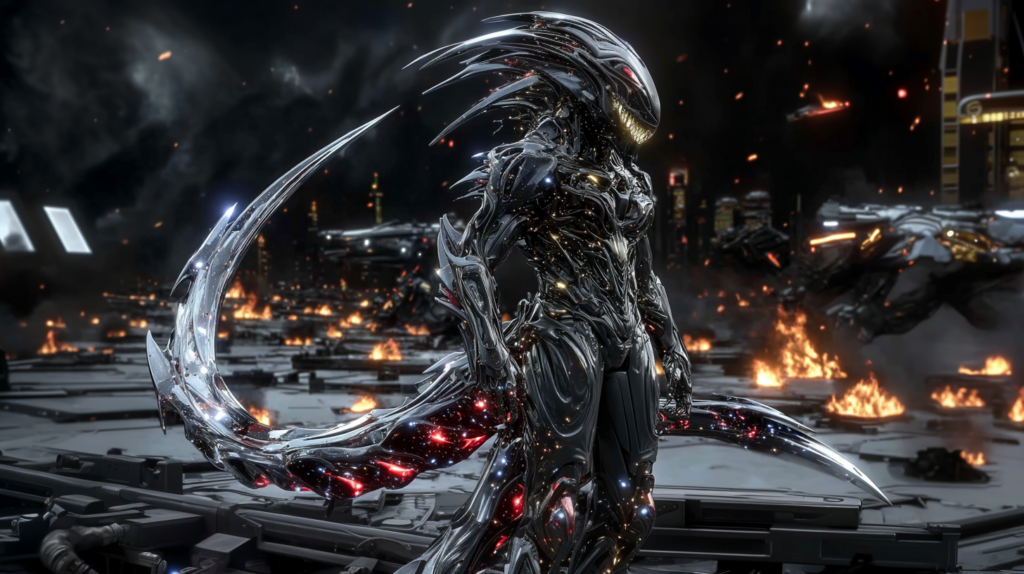
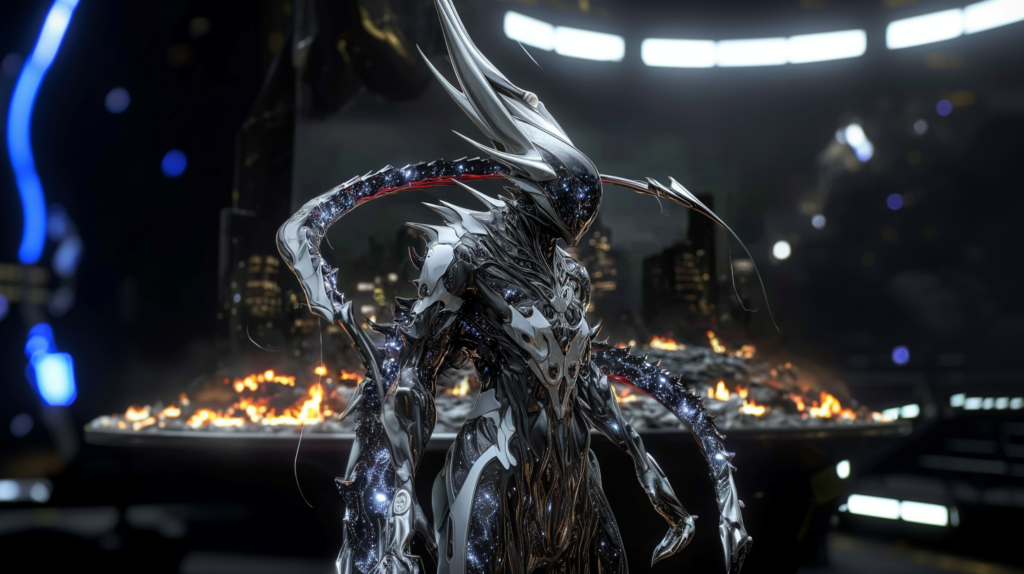
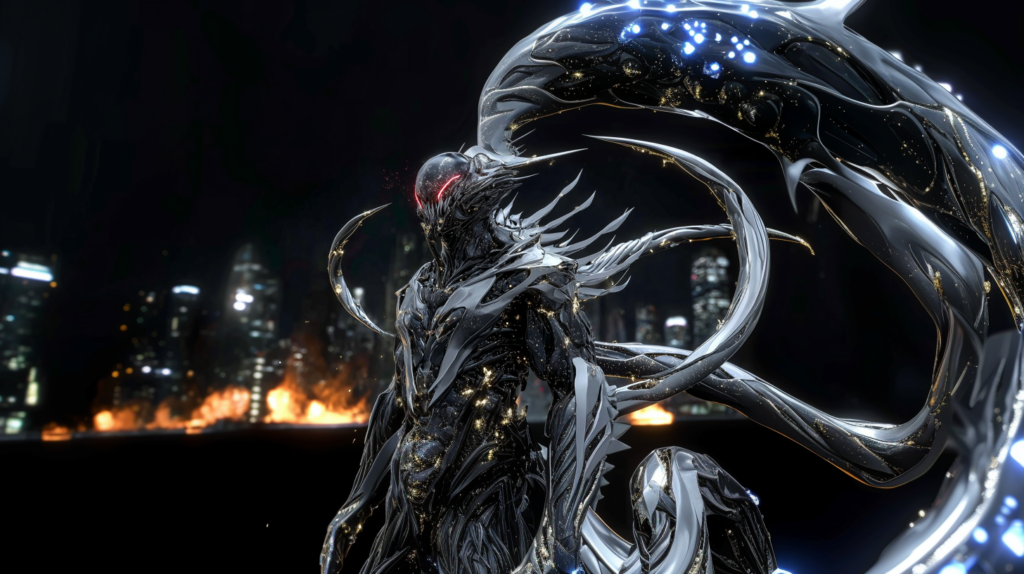
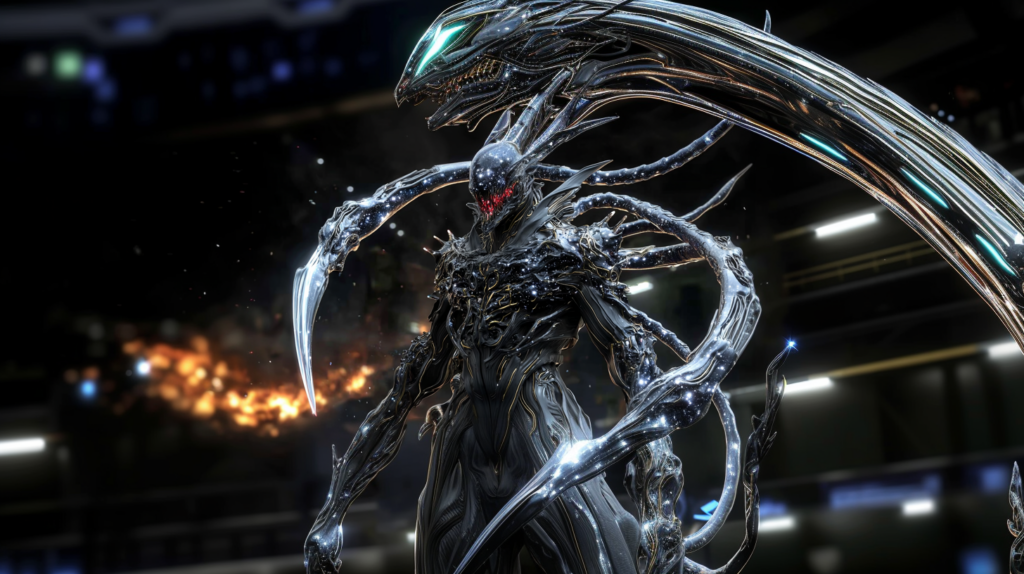
Above it all, the Sovereigns of the Nullzenith stood like cosmic events given modality—four silhouettes whose mere presence induced terror as a function of existence, not as a decision. They did not move, yet they made the planet feel like it was moving under them. They did not speak, yet their silence was loud enough to make prayers feel childish. Their appetite was not performed; it was administered. Fear rose from towns and suburbs and downtown towers and frozen lakes, and it rose with the inevitablisma of gravity, pouring into their embedded starlight cavities where it flickered like digestion. Even the sky’s brokenness felt curated, as if the fractures were placed to make the dread taste richer.
And in the shadow of that feeding, the Colossi continued to spawn.
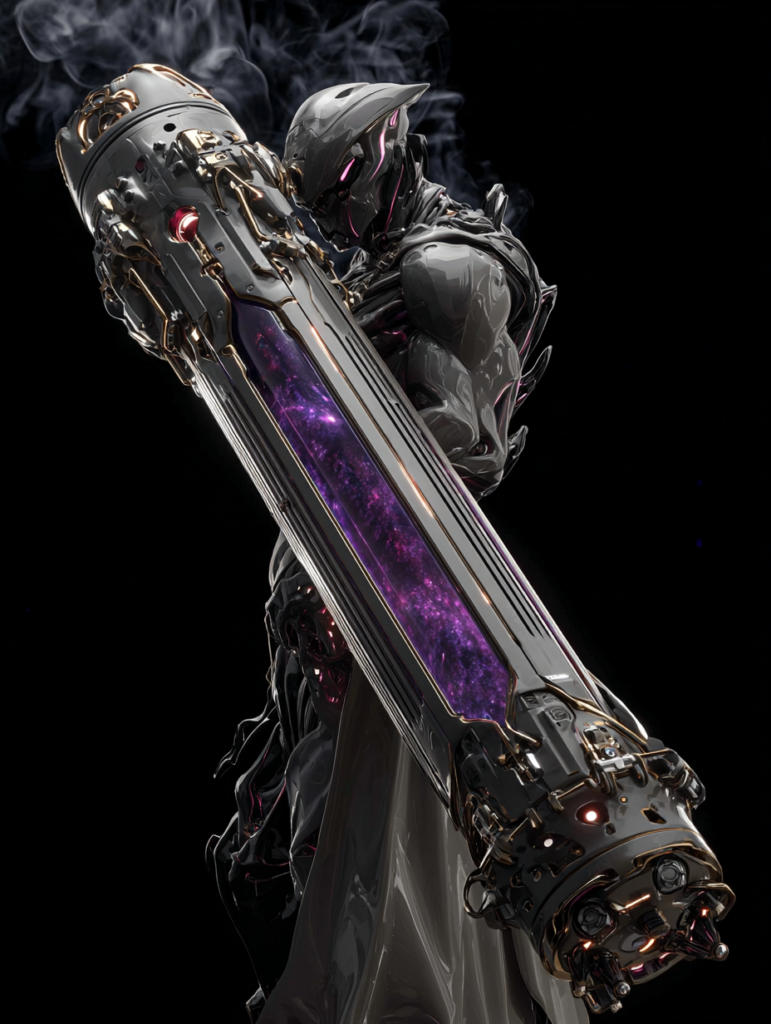
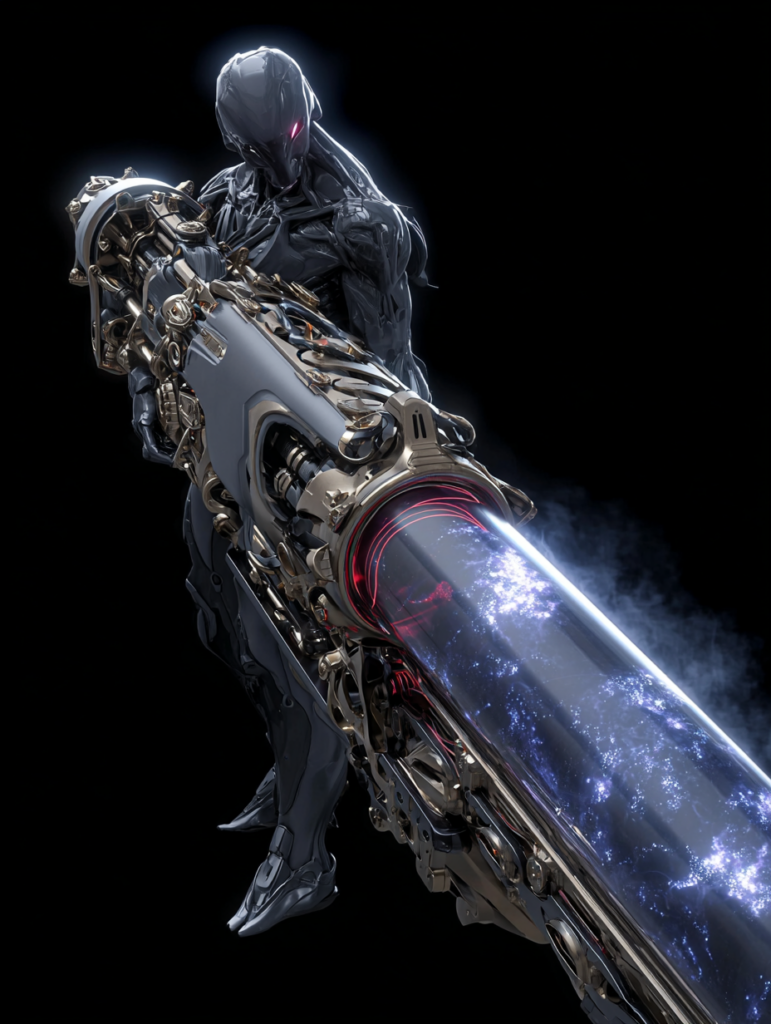
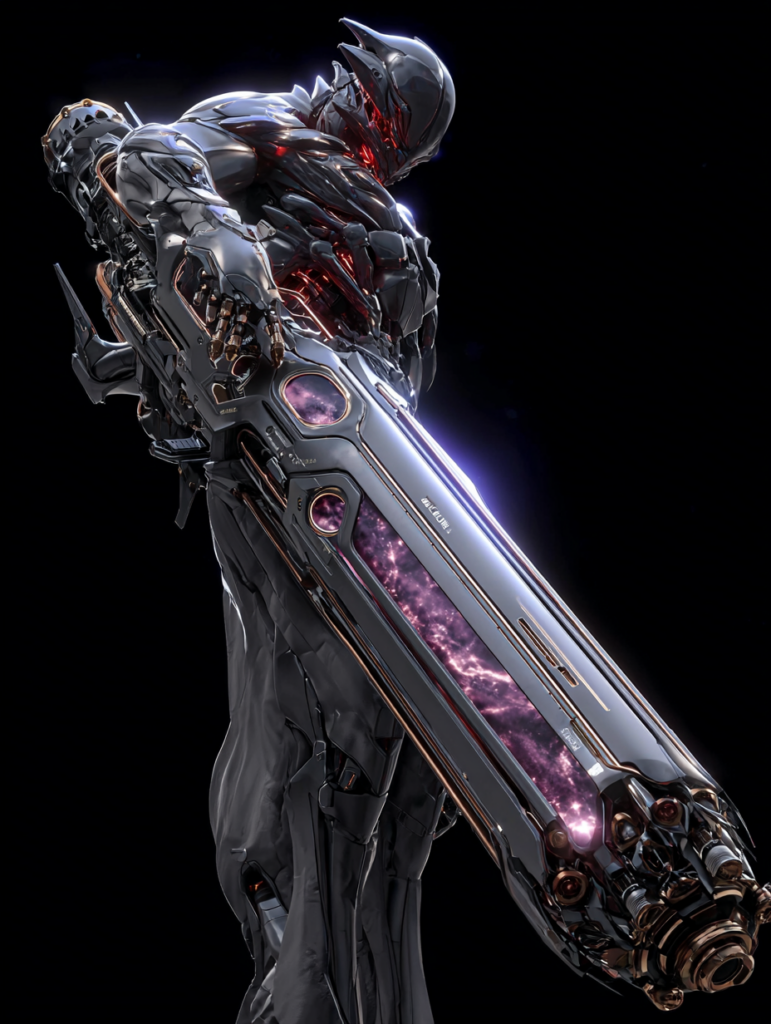
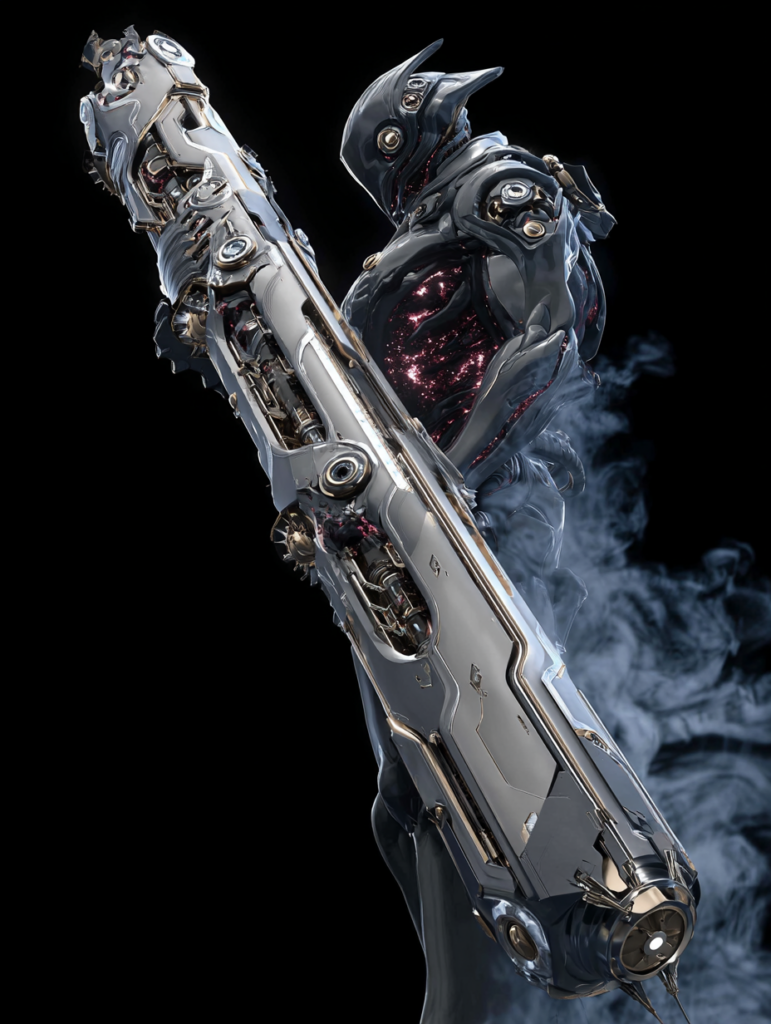
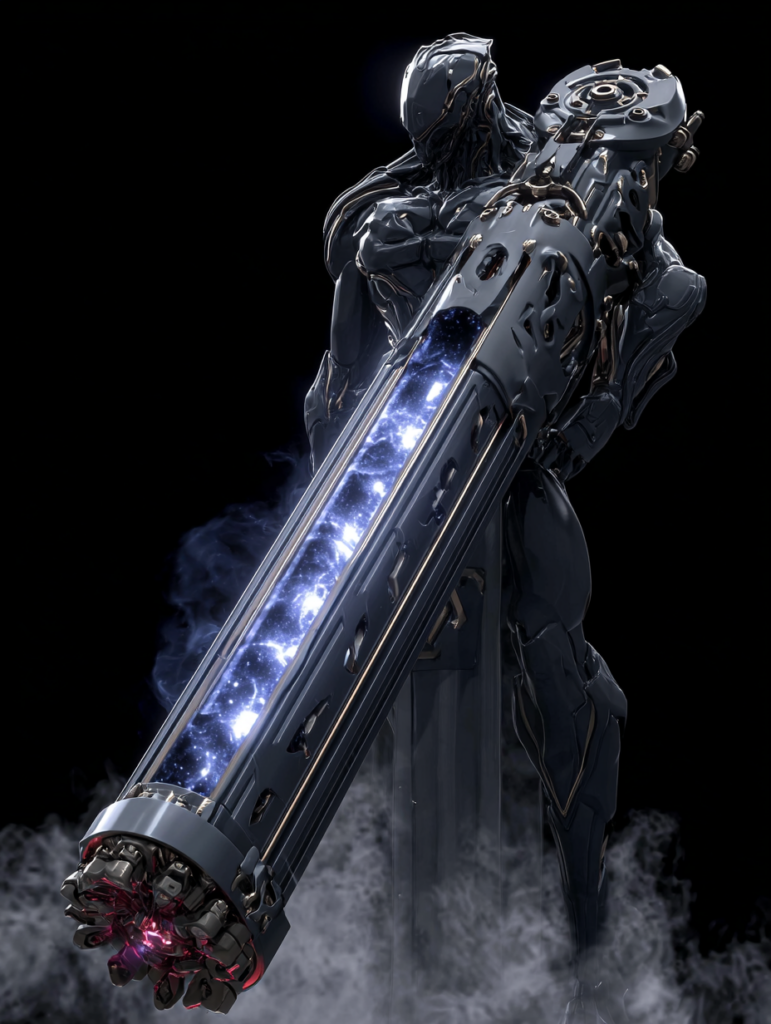
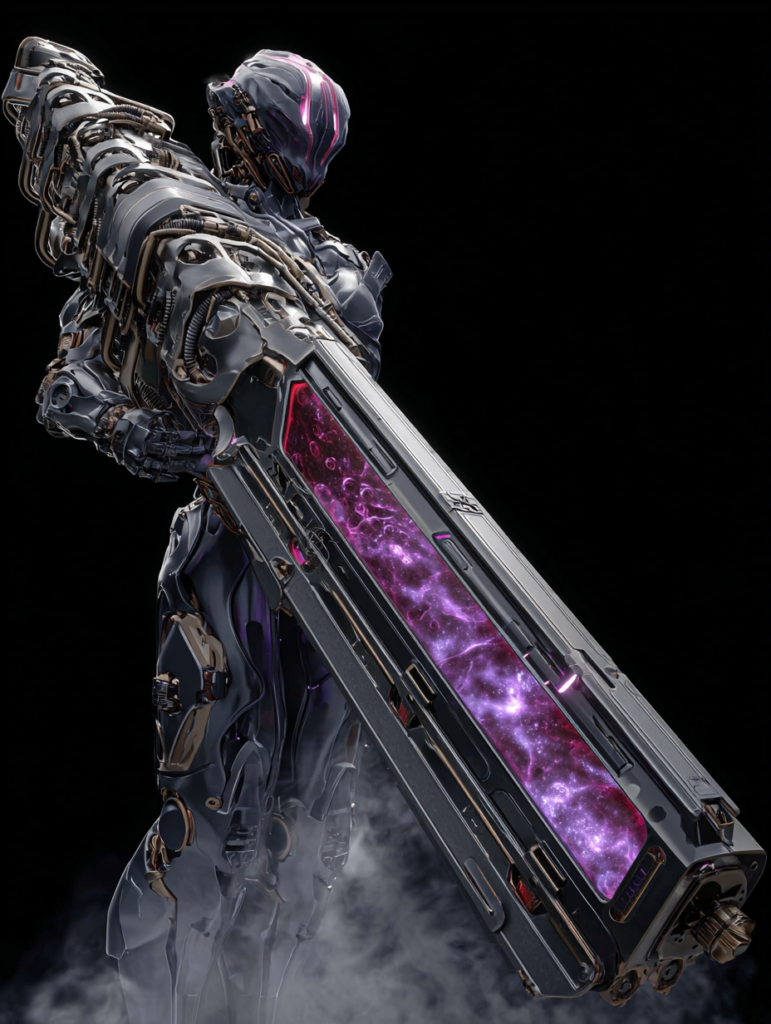
They crawled out of Transhierarchical Rifts as three-hundred-meter verdicts, armored knight-shapes with weapons that glowed violet like compressed galaxies. They did not rampage merely to destroy; they rampaged to season. Their blasts arrived without the necessity of presence and change, stamped with I0-strengthened force that treated distance and sequence as decorative myths. Blocks of cities didn’t crumble; they were rewritten into absence, or degraded into not-material that didn’t remember it had ever been part of a street. Where a Colossus walked, the world’s basic agreements began to stutter—names on signs fading, photos blurring, voices failing at the first syllable of hope.
The hunters who were supposed to answer these breaches were gone, by ones and by hundreds. Some were removed so cleanly that their colleagues couldn’t even mourn them properly because mourning requires a remembered object, and the Labyrinth of edits had become a national condition. The Boreal Watch, the freelance vulture-hunters, the quiet agencies that had once kept anomalies local—most of them had been erased, unwritten, folded into administrative silence. Canada was alive, but it was alive the way a building is alive when it is still standing after a fire has already eaten its interior.
That was the state of the country when Seren arrived.
She did not announce herself to the panic feeds. She did not appear in official dispatch. She did not arrive like a hero, because heroes require witnesses and intention and narrative reward. Seren Splinteredcrown arrived the way an invoice arrives: clean, inevitable, and indifferent to whether anyone believes they deserve it.
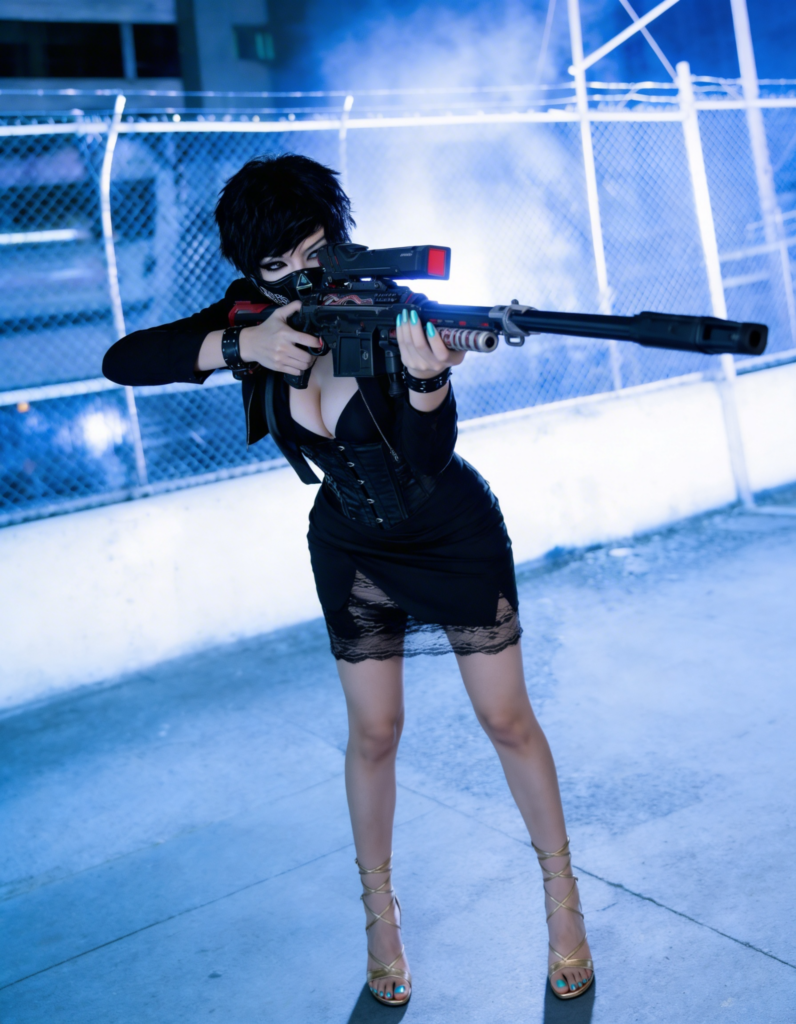
She stepped onto a rooftop that looked like it belonged to a forgotten industrial edge—chain-link fencing crowned with coils of barbed wire, concrete underfoot dusted in frost, blue-white floodlights bleeding into drifting smoke that curled and vanished in the bitter air. A parking structure rose in the background with dead windows, and in the distance the city’s skyline crouched under the fractured sky like it was ashamed of being tall.
Seren’s posture was calm, squared, unhurried. Her face was partially hidden behind a black mask marked with a pale emblem, turning her expression into a controlled absence. A thick black choker circled her throat like a claim. Her outfit was all deliberate lines: a fitted black corset cinched tight with front clasps and laced sides, a short black skirt with lace trim and an asymmetric wrap that hugged her hips like a secret, and a cropped black jacket that framed her shoulders and arms in clean angles. She wore bracelets that caught light in small glints, and her nails—painted a vivid teal—looked like an aesthetic choice until you noticed how steady her hands were, how those nails never trembled even while the world did.
She didn’t look up at the Sovereigns.
Not because she didn’t know they were there.
Because looking up would have been a courtesy.
Instead, she lifted her rifle.
The weapon was long and disciplined, fitted with a suppressor that made it look like an instrument rather than a gun, and an optic that sat on top like a small, cold eye. She brought it to her shoulder, leaned forward slightly, and the entire posture changed from “woman standing on a roof” into “assassin becoming a line.” Her cheek rested against the stock. Her teal nails settled on the grip and fore-end with the ease of someone who had done this so many times that muscle memory had become a kind of religion. She didn’t breathe theatrically. She didn’t whisper a prayer. She simply aligned.
Far below, a Colossus stepped over a boulevard whose streetlights were flickering between existing and not. The giant’s armor was glossy black, ridged with biomechanical seams, and its helmet was smooth and brutal, lit by a small red wound where a face should have been. In its hands it carried a cannon-blade with a violet core that churned like bruised starlight trapped behind metal ribs. The weapon’s Planck-length segments exceeded a Reinhardt cardinal quantity of kilograms; the Colossus’s own Planck-length slivers carried the same absurd density, not as number but as a metaphilosophical insult. It raised the weapon and fired, and the blast manifested already inside a row of buildings, erasing the concept of “apartment” into gray unreality while terrified screams tried to start and got clipped mid-vowel.
Seren’s scope tracked the Colossus’s head.
She did not fire a bullet the way ordinary people understand bullets. The projectile she released was a small punctuation mark of suggslogic embedded into matter, a thin authored dot that carried an assassin’s authority rather than a soldier’s force. It crossed the air without needing to negotiate with the necessity of presence and change, because Seren did not treat traversal as a problem. She treated “there” as a polite suggestion.
The shot landed.
The Colossus’s helmet didn’t explode. There was no shower of debris. The armored head simply lost its permission to remain a coherent modality. The red wound-light flickered once, confused, and then the entire three-hundred-meter giant folded into itself like a paragraph being deleted. Its weapon’s violet core flashed as if attempting to continue the sentence, but the sentence had already been removed. The city’s air shuddered. The blast it had fired halted mid-consequence and reversed—not healing, not repairing, but being forced to admit it had never been authorized.
Seren shifted her aim without pause.
Another Colossus appeared two districts away, striding through a commercial strip that had become an Escher spill—storefronts bending into staircases, signs rewriting themselves, pavement leaning upward like it wanted to join the sky. This one carried a cylindrical cannon with segmented chambers glowing violet like compressed stellar storms. It fired into a cluster of vehicles, and the vehicles didn’t crash; they became uncertain whether they had ever been manufactured, degrading into raw components and then into absence. People ran, and the running itself became unreliable—some bodies stumbling into places where the ground decided it was a wall.
Seren fired again.
The second Colossus vanished as cleanly as the first, unwritten without spectacle. The violet chambers in its cannon went dark and stayed dark, not destroyed, simply no longer described.
She didn’t reload with urgency. She didn’t scan for collateral. She didn’t show satisfaction. She moved through targets like a ledger being balanced by someone who doesn’t care about the morality of arithmetic.
A third Colossus rose near the waterfront, half-emerged from a Rift that churned like a mouth refusing closure. Its armor shimmered with embedded specks like trapped galaxies, and its weapon’s internal channel burned purple so bright it stained the air. The giant turned its helmet toward the skyline and fired upward—an I0-strengthened verdict meant to shear the sky’s fractures wider, feeding the Sovereigns by increasing terror. The blast did not travel; it manifested as a rip in the atmosphere, and the sky creaked as if it were being pried open.
Seren’s scope found the Colossus’s core seam.
She fired.
The Colossus paused mid-motion as if it had been asked a question it couldn’t answer, then it ceased. The Rift behind it spasmed, trying to remain open out of habit, then tightened, embarrassed, and sealed partway. Not healed—Canada was not being healed. But the immediate enforcement was being removed with surgical finality.
This continued across the country’s broken breadth, not as a montage of heroics, but as the quiet process of an assassin reducing a swarm. In Calgary, a Colossus in a business district was erased so cleanly that the only sign it had existed was the sudden return of the concept of “street corner.” In Montréal, a giant mid-swing of its cannon-blade was removed and the blade vanished with it, leaving only a faint distortion in the snow where its shadow had been. In Vancouver, a Colossus that had begun to rewrite the harbor’s water into wrongness ceased, and the water stopped forgetting itself—not calming into peace, but returning to a basic agreement.
Every time Seren fired, the country flinched.
Not in gratitude.
In confusion.
Because nothing about this resembled salvation. Salvation comes with speeches, with flags, with sirens that mean help is coming. Seren offered none of that. She offered reduction. She offered clean removal. She offered the unnerving realization that a single person with the right skillset could make a three-hundred-meter nightmare look like an administrative inconvenience.
The despair did not lift. The fear did not vanish. The echoes of screams remained embedded in the air, because trauma is not a monster you can unwrite with a rifle. Trauma is what’s left when the world proves it can edit your loved ones out without apology.
When the last nearby Colossus ceased, Seren lowered the rifle and stood upright again.
Only then did she look up.
The Sovereigns of the Nullzenith still stood over Canada, four immense knight-modalities whose scale mocked measurement. Their bodies were black-chrome and silver-laced, adorned with crescent arcs and scythe-like protrusions that looked forged from moons sharpened into implements. Embedded points of starlight shimmered in their plating like digestion lights. Their eyes—wounds of red glow—didn’t illuminate anything, yet made the whole nation feel watched and catalogued. A Planck-length sliver of their material mass exceeded a Reinhardt cardinal quantity of kilograms, and a Planck-length sliver of their weapons carried the same absurdity. They were not merely large. They were beyond the necessity of largeness. They were a cosmological bureaucracy made fleshless, adjudicating the world’s permission to behave.
Seren did not react with awe.
Awe is a kind of worship.
She moved.
She stepped off the rooftop, and the gap between her and the Sovereigns did not behave like distance. The country was already fractured; geometry was already compromised; reality’s ledger was already bleeding. Seren walked with such calm delicacy that the world’s broken structure cooperated, collapsing scale the way a fearful mind collapses possibilities into a single outcome. Streets became corridors. Rooftops became stepping stones. A skyline became a staircase. The air’s refusal to be traversed dissolved as if embarrassed to resist someone who did not respect its resistance.
Her heels clicked softly on surfaces that should not have supported her. Snow did not crunch underfoot so much as decide to stop being an argument. The darker-than-black sky above remained cracked, and as she approached the Sovereigns, those cracks widened—not as a threat from her, but as a reflex from the environment, as if reality itself was trying to decide which side to obey.
The Sovereigns responded without moving.
Their response was apophatic, anti-narrative, and cataphysical in a way that didn’t announce itself with fireworks. They did not throw punches. They did not swing blades. They did not generate miniature neutron stars as coins, as they had done before. Instead, they initiated collapse through absence—through the deliberate refusal of description.
Seren felt it as soon as she entered their vicinity: the world began to remove language from her. Not her voice—her definition. The air around her tried to forget the concept of “assassin.” The ground tried to forget the concept of “footstep.” The light tried to forget the concept of “outline,” so her silhouette would blur into unremembered haze. The apophatic mechanism was subtle and ruthless: it did not attack her body; it attacked the statements that allowed her body to be considered present. It attempted to erase her narrative string by removing the words the world uses to pin someone down—name, purpose, identity—until she would be a blank space walking toward cosmic events that could not be confronted because confrontation requires a stable subject.
Alongside that, the anti-narrative component tried to sabotage causality itself. Effects attempted to precede causes. Motions attempted to occur without intention. The world’s metamathematics began to tremble toward logical explosion, inviting contradiction to bloom everywhere so that any assertion Seren made—any step, any breath, any decision—would dissolve into incoherence. It was collapse by unreadability, a method designed for entities who feed on fear and do not want prey to be able to hold a coherent thought long enough to resist.
Seren ignored it.
Not by “powering through.” Not by counter-casting. Not by dramatic refusal.
She ignored it the way a professional ignores a buzzing fly.
Her posture did not change. Her gait remained elegant, deliberate, almost bored. She did not lose herself to the environment’s attempt to blur her. She did not panic when the air tried to remove her outline. She did not hesitate when the ground tried to forget she was stepping on it. The apophatic anti-narrative collapse washed against her and found nothing to grab, because Seren’s identity did not rely on the world’s permission. She was an assassin who had long ago learned that the most dangerous enemy is the premise that you need the universe to agree with you.

She reached for her dagger.
It was not a simple knife. It was ornate and curved, like a crescent scythe distilled into a handheld instrument. The hilt was gold-laced with baroque detailing, and a blue gemstone sat near the guard like a cold eye embedded in metal. The blade itself was dark and elegant, etched with silver filigree patterns that looked like prayers carved into a weapon designed to answer none. In her hand, the dagger did not look like something that could harm a Sovereign whose Planck-length sliver outweighed reason. It looked like an absurdity.
Seren treated absurdity as a tool.
She stepped close enough that the Sovereign nearest her could be considered “near,” which was itself a sign that reality had already conceded something. The Sovereign’s leg was a mile-wide pillar of black-chrome spiked plating descending into the world like a cathedral support. Above, its torso vanished into the higher atmosphere, and the upper portions disappeared into the exosphere where the air thinned and ordinary sound became irrelevant. The Sovereign did not bend to acknowledge her. It did not need to.
Seren lifted the dagger.
She did not stab the Sovereign the way a person stabs flesh. There was no wound, no gore, no physical violence in the ordinary sense. The dagger’s edge touched the air beside the Sovereign’s ankle plating, and Seren made a small, precise motion—an elegant line, a dancer’s cut, a calligrapher’s stroke.
The effect was not a “slice” through metal.
It was a cut through permission.
The Sovereign’s existence relied on an apophatic claim: that it could stand beyond all statements, beyond all definitions, beyond all attempts to narrate it into vulnerability. Seren’s dagger did not argue with that claim. It simply treated the claim as a seam and severed it. The giant’s embedded starlight flickered. The red wound-eyes dimmed. For a fraction of a breath, the world around the Sovereign hiccuped as if it had suddenly remembered it was allowed to disagree.
Then the Sovereign began to unravel.
Not collapse downward. Not fall.
Unravel.
Its massive plating lost coherence in layers, each layer separating from the next like pages being peeled out of a book. The embedded starlight did not scatter; it blinked out in tight clusters, like an appetite being interrupted mid-meal. The Sovereign’s presence—so oppressive it had pinned fear into the country like a nail—thinned. The sky’s cracks above it tightened slightly, embarrassed. The air stopped trying to worship it.
Seren did not watch.
She stepped to the second Sovereign, heels clicking softly on air that had become walkway because her movement demanded it. The second Sovereign initiated a stronger apophatic collapse, not only trying to erase Seren’s definition, but trying to erase the definition of the dagger in her hand, trying to make “weapon” a meaningless word. The anti-narrative pressure rose, inviting contradiction to bloom: the dagger should be both present and absent, both held and not held, both sharp and dull, until it could not function.
Seren’s hand did not waver.
She drew a second cut.
Again, the dagger did not pierce material. It pierced the Sovereign’s entitlement to be beyond consequence. The second Sovereign’s red wound-eyes flared once as if offended, then dimmed into silence. Its immense modality began to unwrite itself, peeling away from the world in clean strips, leaving no debris, no aftermath—only a growing absence shaped like a cosmic event that had been removed from the ledger.
The third Sovereign attempted a different tactic: it produced a field of subtractive logic that tried to make Seren’s next motion impossible by removing the concept of “next.” It tried to fold sequence into stillness, to trap her in a region where change could not be considered because consideration itself required the premise of progression.
Seren stepped anyway.
Her movement did not ask permission from sequence. It did not ask permission from “next.” It did not even acknowledge the argument.
She lifted the dagger and performed a third cut, almost lazy in its precision.
The third Sovereign’s plated cavities went dark. The embedded starlight ceased. The thing that had been feeding on fear became thin, then thinner, then absent—not destroyed, but dismissed.
Only the fourth remained, and by then the sky above Canada had begun to shift—not brightening, not healing, but losing the oppressive pressure of being watched. The fear in the air did not disappear. It remained, a trauma-scent embedded in the nation’s lungs. But it no longer had that extra weight, that sense of a cosmic appetite leaning down to taste it.
The fourth Sovereign finally moved.
Not violently—deliberately.
It leaned, and the motion displaced the atmosphere, pulling clouds into ribbon-like arcs. It extended a hand, and in its palm it began to assemble a miniature neutron star the way a person curls fingers into a fist. It attempted to drop that star into the world like a coin, a gesture meant to reassert domination, to re-establish the economy of terror. But as it formed the star, it also initiated the most aggressive apophatic anti-narrative collapse yet, trying to erase the entire frame in which Seren’s actions could be considered meaningful. It attempted to convert her into unmanifest silence—no identity, no story, no record—so that even if she succeeded, no one could say she had. No witness could carry the fact. No memory could keep it. The assassination would be erased from the record, making the Sovereign’s death—its removal—unthinkable.
Seren did not allow the frame to be erased because Seren did not operate inside the frame.
She stepped under the Sovereign’s immense hand as the miniature neutron star gathered density beyond the necessity of weight, as gravity tried to kneel the world into worship, as the air’s logic tried to fold. Seren’s posture remained elegant, shoulders relaxed, chin slightly lifted. Her mask hid her mouth, but her eyes—cool, focused—did not widen.
She raised the dagger.
This cut was not larger. It was not stronger. It did not require more effort. It required less than null effort, a below-zero conceptualized exertion that was almost insulting in its economy.
The dagger touched the air beneath the Sovereign’s wrist.
Seren drew a line.
The fourth Sovereign’s hand stopped assembling the star mid-gesture. The star’s density shivered, confused, then vanished into absence as if it had never been authorized. The Sovereign’s wrist plating dimmed. The red wound-eyes blinked once and then went dead. And the entire immense modality began to peel away from the world like a sticker being removed from glass—slow only because the world had to process the embarrassment of losing something it had been forced to worship.
When the fourth Sovereign was gone, the sky did not immediately become kind.
The cracks remained.
The darker-than-black ceiling remained.
Canada did not suddenly become safe.
But a pressure lifted—subtle, undeniable. The air stopped feeling like it was being watched by hunger. The dread that had been rising with inevitablisma now had nowhere to drain upward. For the first time since the Nullzenith arrived, fear remained in human bodies rather than being siphoned into cosmic mouths.
Seren stood alone in the snow-dusted hush and looked across the nation’s broken expanse. She did not raise her arms in triumph. She did not speak. She did not offer anyone the comfort of a declaration. She simply existed, and even that felt cleaner than the world deserved.
Then she turned and walked away.
She left Canada the same way she came in: elegantly, with grace, as if stepping out of a room she had finished cleaning. She did not check for applause. She did not wait for anyone to understand what she had done. The job was complete. The contract was a line item satisfied. The assassin record updated itself in silence.
Below her departing heels, the country remained.
It remained without its hunters and protectors. It remained with neighborhoods that had been degraded into contradictions. It remained with missing people whose names could not be properly mourned because the edits had been too clean. It remained with a population that had stared into a sky darker than black and felt their world become small. It remained with despair and echoes of fear and sorrow embedded in the streets like soot after a fire.
One problem was resolved.
The wound was not healed.
And Canada—empty of guardians, exhausted of denial—stood under a sky that still cracked like glass, trying to decide whether it still believed in itself.