
INTERLUDE IV — Lingering Hollows
The sky did not break like a spectacle. It broke like a belief. It did not crack open with theatrical lightning or a trumpet of catastrophe; it simply began to fail at being itself, the upper dark slipping in tiny discontinuities that a casual eye would write off as cloud cover, glare, or a tired mind. Lucraen Hollowpage stood on a rooftop that smelled of tar and old rain, and he watched the city keep pretending beneath him. Streetlights pooled on asphalt. A distant train thread-pulled its own lament through the industrial corridor. Somewhere below, someone laughed too loud, the kind of laugh that exists to prove you’re still allowed to laugh. Baltimore did not look up. Baltimore rarely did. That was one of its sins and one of its mercies.
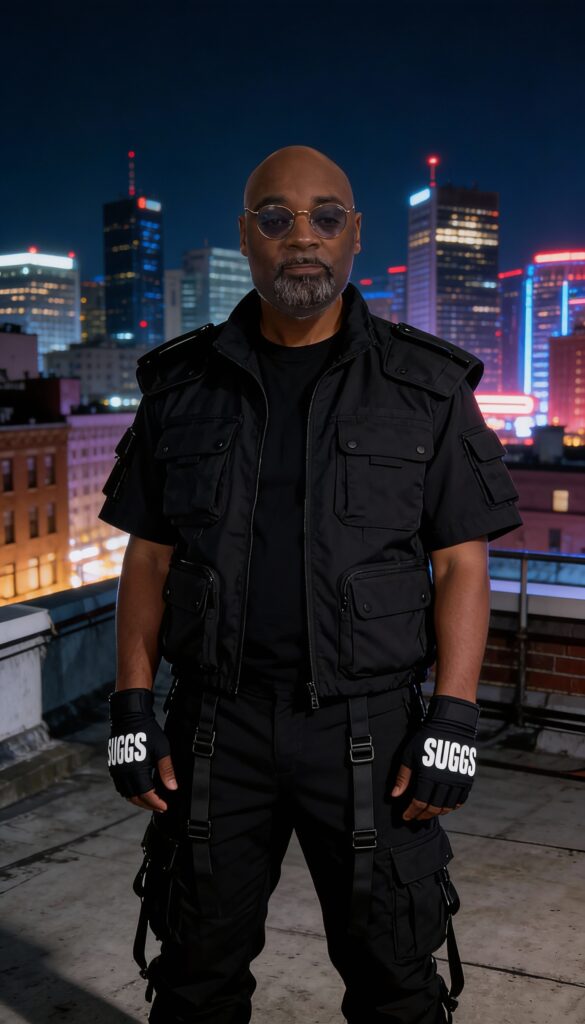
Above the rowhouses and the bent geometry of telephone wires, the night began to lose agreement with itself. A star would hold steady, then soften, then slide as if it had never been placed there in the first place. Dark patches deepened into a tone that wasn’t black so much as absence with intent. The air didn’t feel colder, not in any measurable way, but Lucraen’s skin registered the shift the way a wound registers weather. He had learned, in the long accumulation of small horrors, that the universe didn’t always announce its violence. Sometimes it just stopped honoring the old contract.
He did not pray. He did not curse. He did not perform for the sky.
He watched.
The news about Draven’s encounter had arrived to him in the manner all truly dangerous information did—secondhand, incomplete, carried through other mouths like contraband. An octahedron. A shape that was too clean to be incidental, too deliberate to be a fluke. A presence. Not an attack so much as a declaration that the rules Baltimore depended on were optional. People described it the way people describe grief when they don’t want it to become real: with distance, with half-smiles, with that small shrug that implies it can still be managed. Lucraen had not been there, but that did not comfort him. Some events did not require witnesses to spread. They infected the atmosphere of thought. They changed how a street corner felt. They made your tools feel suddenly childish.
He let his gaze lower from the sky to the city’s shoulders. Baltimore carried its tragedies like a habit—loose, practiced, always half-ready to pick up another one. Lucraen had once told himself that his work was to keep the tragedies small. The last few renders had made that belief harder to maintain. Every bell. Every Choir-breath. Every night the shadows looked slightly too organized. The sky breaking again was not a new chapter. It was an annotation in the margin: you are behind.
He climbed down without urgency, because urgency was for people who still thought the world cared about their hurry. He moved through the stairwell, past the smell of old cooking oil and damp plaster, past the apartment door that had a double lock and a third lock that meant nothing. In the hall, a child’s voice was raised in argument, then lowered quickly into apology. An adult murmured something that sounded like love and sounded like exhaustion. Lucraen walked through it all like a man passing through weather.
The workshop waited the way it always did, patient, silent, loyal. It was one of the few rooms in his life that never asked him to be anything but honest. The lights came on in a gentle sequence, revealing his table, his tools, his shelves of things that didn’t have a place in ordinary catalogues. The old weapon leaned where he’d left it after the last job, cleaned, oiled, wrapped in the kind of care people give to objects they can’t afford to grieve. He paused in front of it, not from nostalgia, but from a recognition that felt uncomfortably like affection.
It had been enough. For a long while, it had been enough.
That was the problem.
He set it aside. Not ceremoniously. Not dramatically. He simply moved it out of the center of his world.
The new weapon was sprawled on the table like a solution that didn’t want to be spoken. Its frame was longer than the human body wanted to manage. Its casing carried filigree that looked ancient and technical at the same time, gold veins embedded into metal that held blue light like it was blood. It was not sleek. It was not minimal. It was excessive in the way something becomes excessive when it’s designed for war rather than display. Lucraen’s hands moved over it with a kind of ruthless tenderness, checking seams, tightening a coupling, aligning a channel that would matter at the moment where alignment became the only difference between survival and deletion.
He did not tell himself he was upgrading to feel stronger. He did not allow himself that lie. He was upgrading because he had begun to suspect that the things coming did not care about strength in the way humans understood it. They cared about definition. They cared about whether your answer could override their question.
He worked until his shoulders ached and his mind became quiet. When he finally stepped back, the weapon looked like it belonged to the night outside, like it could speak the same language as the sky’s fracture. That alone made him uneasy.
Training came next, because a weapon without a body to carry it was just sculpture. Lucraen trained without spectacle, without music, without any of the modern distractions that turned discipline into performance. He trained in silence, letting the weapon’s weight dictate honesty. It pulled at his stance, demanded changes in his center, punished sloppy breath. The first sessions were humiliating. Not because he was weak, but because the weapon did not forgive the habits he’d built for a world that still had guardrails.
His muscles learned the new contours. His joints learned where pain would appear later. His palms learned the texture of the grips until they could find it without thought. He practiced lifting, pivoting, sighting, and firing into dead space where targets were imagined, because sometimes the only way to prepare for a nightmare was to rehearse the moment your mind tries to pretend it’s not real.
When he stopped, he didn’t feel triumphant. He felt corrected.
It was only after the training, when his sweat cooled and the city’s noise filtered in again, that he remembered he had a life outside this room. That there was someone in the other part of the home who didn’t belong to the world he belonged to, someone whose presence in his story was both miracle and liability.
He found his wife in the kitchen, under a glass pendant light that made ordinary domesticity look almost sacred. She was leaned against the counter, one hand braced on the edge as if she’d been holding herself steady for a while. She wore a light-blue lace top that sat like fragile armor, and short athletic bottoms with white striping that suggested comfort rather than display, though the closeness of the fabric made it impossible to pretend the body underneath was not real. Lucraen’s gaze took in the scene the way it always did: the person, the outfit, the posture, the small cues that said how her render had been. The refrigerator hummed. The cabinets were clean. Everything about the room said stability, and everything about his mind said stability was a temporary costume.

He did not touch her right away. Not because he didn’t want to. Because he didn’t want to drag the sky into the kitchen.
She turned toward him anyway. She always did, as if she could feel the weight he carried before he ever spoke. He stood close enough that his shadow fell into hers. He wore a plain shirt, soft in a way most of his clothes weren’t, and loose plaid lounge pants that made him look almost normal, almost like a man who belonged in this room. His glasses caught the light. His face was unreadable in the way men become unreadable when they’ve had to survive their own thoughts.
“You went up there again,” she said.
Lucraen’s throat tightened, not with guilt, but with the strange tenderness of being known. “Yeah.”
“How bad.”
He didn’t answer immediately. He let the question settle. It wasn’t a request for data. It was an invitation to share burden, even if she couldn’t carry it in the same way.
“It’s doing that thing again,” he said finally. “The part where it stops pretending.”
She stepped closer. Their chests were almost touching. Her expression held that blend of worry and resolve that had become her baseline since she’d entered his life, a life that did not treat love as protection.
He told her about Draven, about the octahedron, about the way the city’s problems were beginning to move with coordination. He told her about the feeling that there were entities in the world who were not improvising anymore, entities who were scheduling. He told her he was changing his weapon and his training, not because he wanted to, but because he could no longer justify not doing it.
When he finished, the kitchen did not feel quieter. It felt heavier.
She didn’t offer advice. She didn’t pretend to understand the architecture of the threat. She didn’t tell him to be careful like careful was a spell. She simply lifted her hand and placed it against his chest, fingers spread, as if she needed proof he was still physically present.
“This isn’t my world,” she said softly, the admission carrying no shame, only honesty. “I don’t know the rules you’re fighting under. I don’t know what your enemies believe. I don’t know what’s hiding behind your sky.”
“I know,” Lucraen said, voice low.
“But I know what it does to you,” she continued. “I know what it costs you to keep coming back looking like you didn’t pay anything.”
He swallowed. The blade-edge in his chest sharpened. He hated being seen that clearly. He loved it too.
“You don’t have to explain yourself to me,” she said. “Not to earn permission. You already have it. What you don’t have is the right to disappear inside it.”
He let his forehead rest lightly against hers, a contact so subtle it could be mistaken for coincidence. It wasn’t. It was a vow he wasn’t saying aloud.
“I’m not trying to,” he murmured.
“I’m not asking you to stop,” she said. “I’m asking you to come back. Even if you come back wrong.”
That sentence hit him harder than any threat. Not because it frightened him, but because it granted him something he rarely granted himself: the idea that love did not require him to remain intact.
He didn’t kiss her like a man ending a scene. He kissed her like a man trying to remember what he was fighting for without turning it into a speech. Their bodies pressed together, her hand sliding to his waist, his hand settling at the small of her back. The world outside the kitchen stayed broken. The refrigerator kept humming like it didn’t care. For a moment, Lucraen allowed himself to exist inside a quiet that wasn’t absence, a quiet that was chosen.
Then his phone vibrated on the counter.
The first message was from Mira. The text looked like it had been typed with shaking hands, words mis-spelled, punctuation abandoned, urgency outrunning grammar. The second was from Seren, crisp and terrifying in its control, as if she’d already processed the catastrophe into an operational report.
Tsunami. Not a weather event. Not geology. Something wearing water like a costume.

Africa was gone.
Not flooded, not burned, not shattered—gone so completely that the message struggled to find language for it. Not a single particle left. An erasure so clean it made destruction look messy. The wave was heading toward Baltimore. Most of the world’s militaries had been wiped out in the same sweep, ninety-five percent of humanity’s institutional violence turned into irrelevance as effortlessly as a candle being pinched between fingers.
Lucraen stared at the screen until the words stopped being words and became weight.
His wife watched his face change. She didn’t ask what it was. She didn’t need to. She saw the shift the way you see someone decide they’re leaving.
He set the phone down gently, as if roughness would insult the catastrophe.
“I have to go,” he said.
She nodded once. No pleading. No bargaining. Only that steady, painful acceptance.
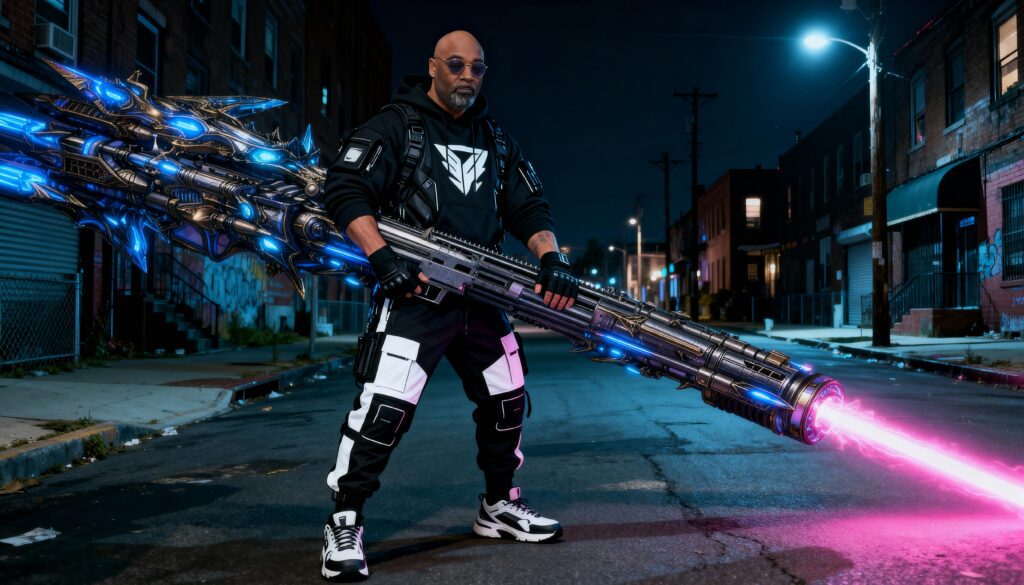
Lucraen crossed the home with a kind of calm that looked like discipline and felt like grief. In the workshop, he lifted the new weapon, and his arms registered the heft as confirmation. He secured straps across his shoulders, the harness biting into his hoodie. He pulled on gloves. The outfit assembled itself around function: a black hoodie marked by a sharp white emblem across the chest, a tactical harness layered over it, fitted joggers with bold white panels and pocket seams built for movement, heavy sneakers that looked mundane until you noticed how they gripped the ground like a promise. He slid on dark lenses not as style, but as a shield from the kinds of light that made the mind stutter.
When he stepped outside, the streetlamp’s glow found the weapon and turned it into an omen. Its frame was long and ornate, blue radiance pulsing through channels like veins, gold filigree framing the glow as if it were something sacred. Near the muzzle, a ring of contained pink light simmered, not firing yet, but ready, the color of a wound given purpose. If someone had seen him, they would have thought it was fantasy, cosplay, a hallucination.
Baltimore had no room left for that kind of dismissal.
Lucraen moved toward the coast with measured pace. Sirens were sparse. Not because danger wasn’t present, but because the systems that responded to danger were already collapsing inward. Traffic lights flickered. People stood outside their homes staring at phones. Some were crying. Some were laughing in disbelief. Some were arguing as if argument could reassert control. The air carried a salt note that didn’t belong yet, like the city was already tasting the wave.
He reached a vantage point where he could see the harbor’s line and the open dark beyond it. The ocean looked wrong—not rough, not calm, but hesitant, as if it too had received the news that it was about to be replaced by something that only resembled it. Far out, the horizon started to rise.
At first, it was indistinct. A swelling. Then it took shape, and Baltimore’s own nightmares seemed suddenly provincial.
The tsunami was not merely water. It was a wall of cosmic violence, a rolling mass that held stars and violet nebulae and broken light inside its curl, as though the ocean had swallowed the night sky and was now vomiting it back as an accusation. Pixel-like blocks of color flashed within it—magenta and blue fragments like corrupt data—suggesting the wave was not obeying any single reality. Debris spun in its wake that did not look like driftwood or ships but like pieces of worlds that had been taken apart and tossed aside.
Lucraen did not speak. He did not announce himself. He did not posture.
He planted his feet on the asphalt near the edge of the world’s last illusion of safety. The weapon’s weight settled into his stance. He braced. The harness tightened across his shoulders. He aimed not at the wave’s surface, but at the logic that held it together. He could feel, in the weapon’s hum, the slightest tremor that meant it was synchronizing with something deeper than matter.
The wave rose higher.
There were attoseconds—thin, unbearable—where any ordinary person would have become a witness to their own end, where prayer would have found its way out of the throat regardless of belief. Lucraen’s mind went quiet instead. Not numb. Clean.
He fired once.
The shot did not behave like a bullet or a beam in any familiar sense. It was a sentence spoken in the wave’s language, a refusal so absolute it forced correction. The muzzle’s pink radiance snapped outward in a clean line that didn’t arc, didn’t wobble, didn’t negotiate with distance. It struck the wave and, for a brief instant, the tsunami looked startled, as if it had not considered the possibility of being answered.
Then the wave folded inward.
Not exploded. Not shattered. Folded—like a page being closed, like a book being returned to a shelf it did not belong on. The cosmic swirl compressed, the nebula-light collapsing into itself, the pixel fragments tightening into a single point of impossible density that refused to remain visible. The roar that should have arrived never did. The impact that should have flattened the coast never happened. The ocean settled, trembling, like a dog that had been shouted at so hard it forgot it was barking.
Lucraen lowered the weapon slowly.
The sky remained broken. The city remained sick.
But Baltimore was still standing.
He felt no joy. He felt no triumph. He felt the dull, familiar awareness that he had only stopped one expression of the end. The end itself was still moving through the world, still pruning, still teaching humanity that its institutions were decorations.
He turned away from the coastline and headed back into the city’s breath.
Later, in a pocket of Baltimore that still pretended it could host something like romance, Draven Endwriting met Mira where the streetlights blurred into soft halos and passing cars smeared into ribbons. He did not arrive with fanfare. He did not arrive early out of eagerness, nor late out of disrespect. He arrived precisely, because precision was how he kept the world from turning him into someone he didn’t recognize.
Lucraen had convinced him to give her a chance. Not by lecturing him, not by guilt, but by the simple assertion that dismissing a person’s reaching hand without even looking at it was a kind of slow violence, the kind that made enemies out of potential allies and made loneliness into a habit you couldn’t break.
So Draven showed up.
He wore a black jersey with red trim that read SUGGS across the chest, the number set bold, the fabric loose enough to move in, casual enough to pretend it belonged to an ordinary man. Black pants. Red sneakers with bright laces and thick soles. The outfit was not armor, but it wasn’t softness either. It was the closest he could get to relaxed without feeling exposed. He carried himself like he always did—steady, watchful—but the angle of his shoulders was less sharp, the tension in his jaw less carved.
Mira sat on a red metal rail at the edge of the sidewalk like she belonged there, like the city itself had put her there as an offering. She wore a gold lace dress that hugged her shape with unapologetic confidence, the straps thin, the fabric ornate, the hem resting high on her legs in a way that made even stillness look like intention. Gold sandals wrapped delicate lines around her feet, the thin straps catching streetlight like jewelry. Her posture was composed but not distant; she leaned slightly toward where Draven approached, as if her body had been waiting before her mind allowed itself to admit it.
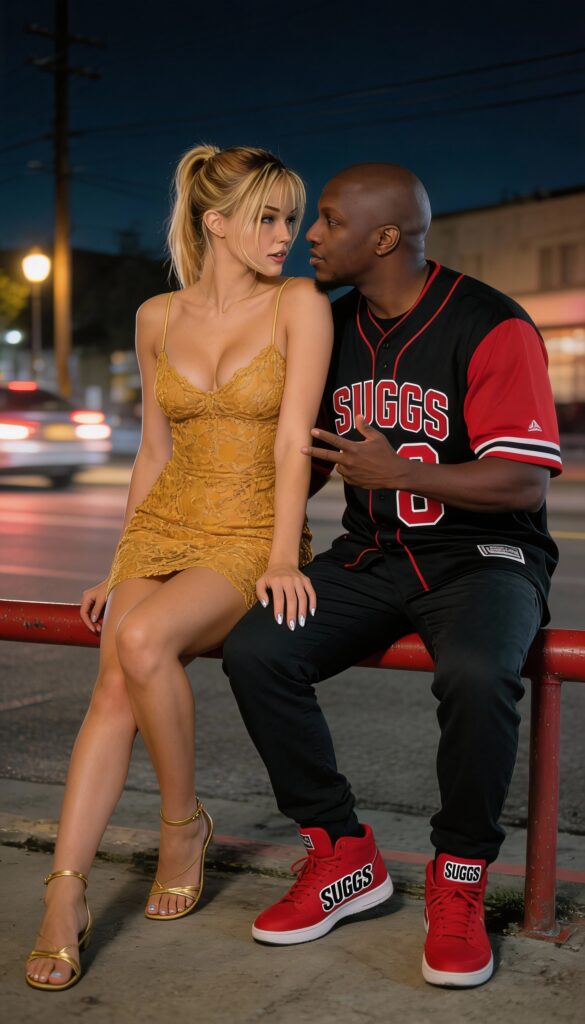
When she looked at him, her whole face softened.
Not a performance-softening. Not flirtation for sport. Something deeper, something that had been held back for too long and was now being allowed out carefully, like opening a door to a room you’ve kept locked because you weren’t sure anyone would respect what was inside.
Draven greeted her simply. No exaggerated charm. No cold dismissal. He spoke her name like he meant it, which, for him, was already a kind of intimacy.
They talked at first about nothing important because nothing important required that kind of gentleness right away. They talked about the city’s absurdity, about the way certain streets smelled like rain even when it hadn’t rained, about how some corners felt haunted even in daylight, about food spots that stayed open too late because the owners understood that people needed somewhere to exist when their homes didn’t feel safe.
Draven listened more than he spoke. Mira filled the air with small stories, glancing at him between sentences like she was checking to see if he was still real. Each time he responded—each time he gave her something honest—her expression changed, the way a starving person’s face changes when they taste something nourishing and don’t want to admit how hungry they’ve been.
Eventually, her questions turned.
Not into interrogation. Into curiosity that had been waiting for permission.
“What do you do when you’re not… doing all of this?” she asked, the words careful, the implication obvious: when you’re not carrying the city on your back.
Draven’s eyes narrowed slightly, not in suspicion, but in thought. He didn’t answer quickly. His responses rarely came from reflex. They came from internal cross-examination.
“I don’t know,” he admitted. “I keep my hands busy. I keep moving.”
“That doesn’t sound like living,” Mira said quietly.
He glanced at her, and for a moment his face looked almost young—almost like the man underneath the method had surfaced. “Maybe it’s not.”
Mira’s throat moved as she swallowed something that might have been emotion. She didn’t press him. She didn’t try to force tenderness. She simply stayed present, as if her presence was the gift.
They walked. Not far. Slow. The city around them carried signs of the tsunami’s passage even though Baltimore itself had been spared the final impact: people huddled around phones, news clips looping with shaky footage of coastlines vaporized, maps redrawn in real time. Storefront TVs played silent broadcasts. Faces on the street held that stunned expression of those who have learned the world can be altered without asking their consent.
Mira kept glancing at Draven like she expected him to vanish if she looked away too long.
For two long years, she had been waiting for an evening like this. Not because she believed it would solve her life, but because she needed proof that her hope had not been foolish. She had built a version of this night in her mind so many times that living it now felt like walking through a dream that might crumble if she acknowledged it too loudly. She didn’t say she loved him. She didn’t confess. She didn’t do anything dramatic. She simply watched him, hanging on his words as if each one was a small, precious thing she’d been denied for too long.
Draven, oblivious in the way men become oblivious when they have trained themselves to ignore affection as a threat, spoke about life with an honesty he rarely allowed in public. He didn’t speak like a philosopher. He spoke like someone tired of lies.
He talked about how most people think paradise is a destination when it’s actually a discipline. He talked about how the city teaches you to accept ugliness as normal, and how dangerous that acceptance is. He talked about how you can’t save everyone, and how you still have to try anyway, because the alternative is becoming something worse than the monsters.
Mira listened like she was being given scripture.
At one point, she reached out and touched his forearm lightly—nothing possessive, nothing overt—just a quiet claim of connection. Draven didn’t flinch. He glanced at her hand, then at her face, and something in his expression softened. Not romance, not realization, but the faint recognition that someone had approached him without fear.
For Mira, that small acceptance was everything.
The date continued, slow and ordinary on the surface, while the world beneath it continued to unravel. They sat for a while on a red rail, their shoulders angled toward each other, the street behind them blurred with motion. Mira’s gold dress caught the light each time she shifted. Draven’s red sneakers planted on the pavement like a refusal to drift. He spoke, she listened, and every so often she laughed, the sound too bright for the devastation surrounding them.
Lucraen’s phone rang while Draven was in the middle of a sentence.
He wasn’t with them. He was already back in his own movement, the weapon stored, his hands washed, his mind refusing to settle. The call came from Ronan.
Ronan’s voice carried that clinical steadiness that meant he was afraid but too disciplined to indulge it. He didn’t waste words.
“The Church is moving,” Ronan said. “Not hiding. Not waiting.”
Lucraen leaned against a wall in an alley that smelled like damp brick and old trash. Above him, a streetlight flickered as if it were thinking about surrender. “Where.”
“Everywhere the tsunami touched. They’re cleaning it. They’re cleaning it like they’ve been waiting for it. Relief trucks. Medical tents. Volunteers in uniforms that aren’t any government’s. And the people are letting them.”
Lucraen’s jaw tightened. “Because they’re scared.”
“Because the world’s been gut-punched,” Ronan replied. “Because everyone’s looking for order. And the Church is offering it.”
Lucraen pictured it immediately: order as a hook, compassion as a chain, cleanliness as conquest. The Church wasn’t just responding to catastrophe. It was harvesting it.
“What’s the cost,” Lucraen asked.
Ronan exhaled. “They’re taking names. They’re taking records. They’re taking control of what gets remembered and what gets dismissed as hysteria. They’re turning devastation into recruitment. And it’s working.”
Lucraen closed his eyes briefly. Not in despair. In calculation.
Ronan continued, quieter now. “Also… whatever the Choir was doing before, it feels sharper. Like the growth isn’t just political. It’s something deeper. Like the world’s damage is feeding them.”
Lucraen didn’t answer immediately. He let the words sink into the part of him that made decisions without asking permission.
When he spoke, his voice was low. “I’m coming in.”
Ronan didn’t argue. “I figured.”
The call ended. The alley remained the alley. Baltimore remained Baltimore. The sky above remained wrong.
Lucraen stepped out of the darkness and back toward the city’s pulse. He didn’t feel heroic. He didn’t feel doomed. He felt what he always felt when the work returned: the grim clarity that someone had to stand between the world and the things that wanted to curate it.
Across the city, Mira tilted her face toward Draven, eyes bright, posture open, dress shimmering in streetlight like she had stepped out of a private dream and into a public world. Draven spoke calmly, unaware of the devotion in front of him, unaware of how carefully she was treasuring each syllable. She nodded at his words as if they were precious, as if she could build a future out of them, as if this night was proof that the world still had room for softness.
And somewhere between those two movements—the intimacy that kept people human, and the catastrophe that kept reminding them they were fragile—the Church advanced, smiling, clean, certain, already reshaping the aftermath into a new architecture of control.
Lucraen understood with sudden, absolute clarity that stopping the tsunami had been the easy part.
The harder work was going to be resisting the shape of what came after.
He adjusted his pace, shoulders set, mind sharpening into readiness again, and disappeared into the city as if he belonged to its deepest current, as if he had never been allowed the luxury of leaving it behind.