
Interlude — Tess Hollowpage
Tess had learned that the hardest part of helping children wasn’t the paperwork, or the meetings, or the small mountain of signatures that never stopped breeding; it was the moment she had to leave a doorway and carry the story with her anyway. That morning had started the way most of her mornings started—coffee gone lukewarm on a desk she never sat at long enough to claim, a phone that rang like a nervous habit, and a schedule that pretended people’s lives could be organized into neat blocks when everything she dealt with was messy, emotional, and urgent. She had sat across from a middle-school counselor who spoke in careful euphemisms, then sat across from a foster parent who looked exhausted and defensive, then sat across from a kid who refused to sit at all, pacing like a trapped animal and pretending not to be scared. There were always two conversations happening in the same room: what the adults said to sound responsible, and what the child’s silence said when nobody asked the right questions.

By the later stretch of her day, she had been walking down a damp city sidewalk under streetlights that made the pavement shine, blazer pulled close against the night air, a stack of folders and loose papers hugged tight to her chest like she could physically keep a case from falling apart if she held it hard enough. Her hair was smooth and straight, makeup still intact in the way women learned to do when their job required composure, and her expression was the kind of calm that wasn’t peace so much as containment. She held her phone to her ear with her shoulder slightly lifted, listening to someone on the other end talk too fast—someone panicking, someone bargaining, someone trying to turn a child’s crisis into an adult argument—and she kept her voice level anyway. The city behind her kept moving like nothing mattered, and that always hit her the same way: kids were living inside emergencies while the world kept pretending it was ordinary.
When she finally pushed through the front door at home, the first thing she noticed wasn’t the mess, because the mess was predictable; it was the sound of laughter from the living room that didn’t match the state of the house. It was the kind of laughter that only happens when you’ve forgotten, for a moment, that the world is heavy. Tremaine’s voice cracked through the hallway first—sixteen years old, too loud on purpose, carrying that half-grown swagger that tried to convince everyone he wasn’t worried about anything. Sterne’s laugh came right after—fifteen, sharper, more mischievous, the one who could pretend he didn’t care even while caring deeply. The television had been turned up to the point where the bass made the walls feel like they were gently vibrating, and somewhere in the background a game soundtrack kept looping the same triumphant music like victory was something you could press a button for.
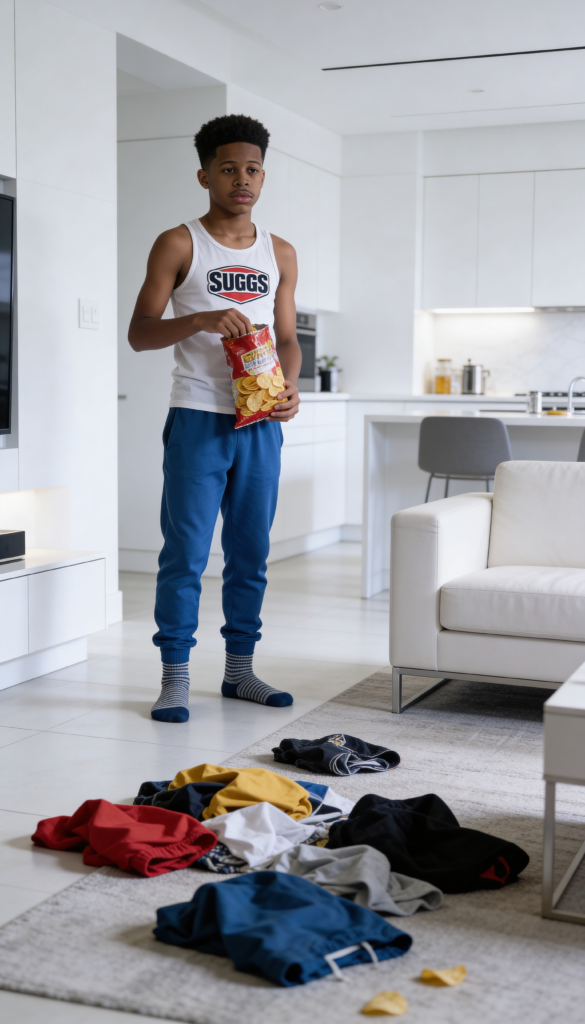
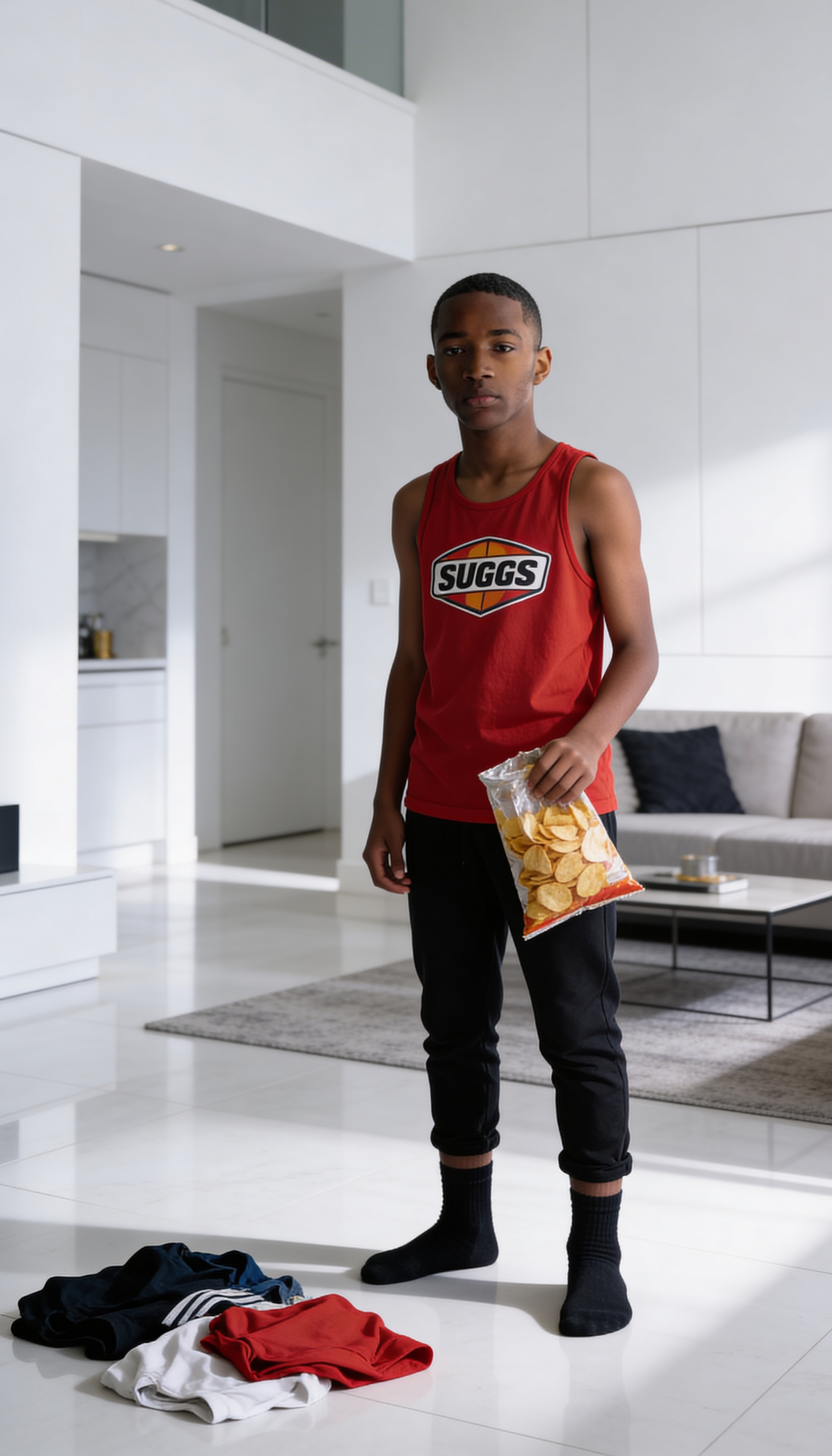
“Tremaine. Sterne.” Tess didn’t raise her voice. She didn’t need to. The way she said their names carried the weight of the day she’d just survived. “Why is the house still like this?”
The living room quieted for half a breath, the way teenagers went silent when they could sense the mood shift. Then Tremaine’s tone tried to sound casual. “We were about to do it.”
“About to,” Tess repeated, letting the phrase sit there until it turned embarrassing. She set the folders down on the first flat surface she could find—mail piled up, a stray controller, a hoodie tossed like it had been abandoned mid-thought—and exhaled through her nose. Her shoulders ached. Her jaw ached. Even her hands felt tired, like they were still holding other people’s problems. “I walked into three different homes today where kids didn’t have clean clothes. Where they didn’t have dinner. Where they didn’t have anyone who noticed when their voice changed. I come home, and I’m asking my own house for the bare minimum.”
Sterne’s voice came softer from the couch. “We didn’t know you had a day-day.”
Tess stared at the doorway for a moment, the irony of it almost making her laugh and almost making her cry. “Every day is a day-day,” she said, more quietly than before. “That’s literally the point.”
She stepped into the living room and saw them how she always saw them when she was too tired to be mad properly: two boys stretched out like the world owed them comfort, controllers in hand, snacks scattered, school bags tossed in a corner like an afterthought. Tremaine had his clothes half off, hair a little wild, eyes still bright from whatever game he’d been winning. Sterne sat with his legs pulled up, leaning forward, focus sharp, like he couldn’t afford to lose even when the stakes were pretend. They looked like teenagers who had been given room to be teenagers, and that was exactly the thing Tess fought so hard to preserve for other kids who didn’t get the luxury.
“Pause it,” she said.
Tremaine made a show of pressing buttons like it was suffering. “It’s online,” he started, then stopped when he caught her look. The game quieted anyway.
She pointed with two fingers, not dramatic, just exact. “Kitchen. Living room. Bathroom. Pick one. Start somewhere. I’m not doing another day of this.” Tess’s eyes stayed on Tremaine first, because Tremaine was the one who tried to test boundaries when he felt insecure. “And before you get that look on your face, don’t. I’m not arguing with you. I’m tired, and you’re going to help.”
Sterne shifted like he wanted to make a joke and decided against it. “Aight,” he said, and stood up. “I’ll do the living room.”
Tremaine stood slower, like he needed to prove he wasn’t being ordered. “Fine,” he muttered. “I’ll do the kitchen.”
Tess watched them move and felt a strange tug in her chest that wasn’t relief, not exactly. It was the bitter knowledge that she could pull compassion out of teenagers with the right tone, but she couldn’t pull it out of grown adults who had already decided children were someone else’s responsibility. She took a breath and went down the hallway to her room, kicked off her work shoes, and stared at the mirror long enough to see the woman behind the blazer. Her eyes looked the same as they always did after a long shift—too awake, too practiced, like she had trained herself to never look surprised by the worst thing she’d heard.
She changed into the only thing that made her feel even slightly human: a sports bra and gray sweatpants, hair still down, body finally allowed to loosen. She shoved her feet into warm tan boots, the kind that made the floor feel less cold, and walked into the kitchen like she was stepping into a second job she didn’t get paid for.
The kitchen smelled like metal and old cooking oil and someone else’s forgotten snack. The walls were dark brick, the window above the counter showing a slice of outside that looked distant and indifferent, an AC unit sitting like a tired guardian in the frame. Tess set her phone on speaker for a second, then changed her mind and wedged it between her shoulder and jaw the way she always did when she needed both hands. A single earbud sat in one ear, not because she liked tech in the house, but because she needed the world to stop being loud.
She lit the stove and placed a big pot on the burner, the flame snapping blue beneath it. A stew was already halfway planned in her head—meat, broth, heat, something that would stick to ribs, something that felt like care you could taste. Soon the kitchen filled with steam that curled up toward the hood vent like a tired exhale. She pulled on oven mitts, stirred, listened for the sound of simmer, and started a pan of rice in front like the meal needed a foundation. Her body moved with the efficiency of someone who did this even when she was angry, because feeding people was a kind of control when everything else was chaos.

“Tremaine,” she called without turning around. “If you’re in here, you can wipe counters while you’re at it.”
“I’m doing it,” Tremaine’s voice came from behind her, louder than necessary.
“Don’t do it loud. Do it right.”
She heard Sterne in the living room moving furniture just enough to vacuum under it, the sound of plastic shifting, the clink of something being picked up off the floor. The boys weren’t angels. They weren’t even easy. But they were there, and they were alive, and they were still capable of responding to her, and Tess hated that she had to remind herself to be grateful for that.
When the stew started to smell like dinner—rich, savory, warm—Tess finally called Asantewaa.
Asantewaa answered on the second ring, and the sound of her voice made Tess’s shoulders drop a fraction. “Tess?” Asantewaa’s tone had that familiar steadiness, the kind you could lean on without fear of it collapsing. “You alright?”
Tess laughed once, small and humorless, stirring the pot. “No,” she said plainly. “And yes. And no. I don’t even know what kind of question that is anymore.”
Asantewaa hummed like she understood. “Talk to me.”
Tess stared at the steam for a moment like it was a confession cloud. “I had a kid today,” she said, voice lower, careful because the boys could still hear if they wanted to. “Nine years old. Nine. He kept apologizing for crying. Kept saying ‘I’m sorry’ like his sadness was a crime.” She swallowed, stirring harder than she needed to. “And I wanted to shake every adult in that building until they remembered what a child is supposed to feel like. Then I come home, and I’m looking at my own kitchen like it’s a war zone because two teenagers discovered the concept of ‘later.’”
Asantewaa exhaled slowly. “They cleaned?”
“They’re cleaning because I threatened to become a villain,” Tess said, and it came out more bitter than she meant. She softened quickly, because she wasn’t actually angry at the boys the way she was angry at the world. “I’m just… tired. I’m tired of being the person who holds everything.”
“You’re holding too much,” Asantewaa said, simple and true. “You can’t carry the planet and still expect your back to work.”
Tess’s mouth twitched. “Tell that to my bills.”
Asantewaa laughed softly. “Tell that to your heart.”
Tess stirred again and watched the stew thicken like it was trying to be comfort. “Luc’s out,” she said, and there it was—the part she always tried not to say with too much emotion, because if she said it wrong it would turn into fear. “He’s been out. And I get it. I do. I know what he does matters. But I hate that the house becomes… quieter when he’s gone. Like the walls notice.”
Asantewaa didn’t rush to reassure. She never did the cheap comfort thing. “You want him home,” she said.
“I want him home,” Tess admitted. “And I want him to come home like he left. And I know that’s not how any of this works.”
Asantewaa let the silence sit for a breath, then asked the most grounded question. “You eat today?”
Tess blinked. “I had half a granola bar.”
Asantewaa sighed like she wanted to reach through the phone and feed her personally. “You cooking now?”
“Stew and rice,” Tess said, glancing at the pan.
“Good. Eat. Put food in your body before you start trying to save everyone again.”
Tess was about to respond when her phone buzzed, a message sliding across the screen like a needle.
Luc: Running late. Don’t wait up.
Tess stared at it too long.
Asantewaa heard the silence on her end and didn’t need explanation. “He texted?”
“He’s late,” Tess said, voice suddenly tight. The steam in front of her blurred, and she told herself it was the heat. “I knew he’d be late. I always know. But it still—” She stopped, because the word she wanted was hurts, and she didn’t want to give it that much power.
Asantewaa’s voice lowered. “Breathe.”
Tess breathed, but it didn’t fix the way her chest felt too full. She stared at the empty plate she’d already set aside for Luc, the one she’d plated in her head before she’d even finished cooking, because part of her still lived in the ritual of a family meal. That ritual was her armor. When the armor cracked, she felt stupid for needing it.
She turned off the burner, finished the rice, plated two bowls for the boys, and slid them onto the table with the quiet firmness of a woman who loved them even when she wanted to scream. “Eat,” she said, not unkind. “And don’t take your bowls back to the couch. I will lose my mind.”
Tremaine muttered, “Yes, ma’am,” like he wanted to be annoyed and couldn’t quite commit.
Sterne sat down, eyeing the stew. “This smells good,” he said, sincere.
Tess nodded once. Compliments didn’t land the same when your nerves were already frayed. “School,” she said, because she had to ask. “How was it?”
Tremaine shrugged with that practiced teen armor. “Fine.”
Sterne did the same. “Fine.”
Tess stared at them over the table, spoon in her hand, and felt the familiar frustration of parenting boys who were learning how to hide emotion because the world told them it was safer. “Fine isn’t an answer,” she said. “Fine is a wall. Give me something real.”
Tremaine looked away first, jaw tight. “We had a quiz.”
“Did you pass?”
He hesitated. “Yeah.”
Sterne chewed and said, “We had a sub for second period. She didn’t know what she was doing.”
Tess almost smiled. That was something. That was a detail. “Okay,” she said, softer. “What do you need help with?”
Tremaine shook his head automatically. “Nothing.”
Tess held his gaze. “That’s not true.”
Tremaine’s eyes flicked toward the hallway like he wanted to escape. “It’s… whatever. I got it.”
She let it go, not because she believed him, but because pushing too hard could turn the dinner table into a battlefield, and she was already fighting too many wars. “Alright,” she said. “But you’re not doing this alone. You hear me?”
Sterne nodded, quieter. Tremaine didn’t answer, but he didn’t argue either.
When the boys finished eating, they tried to slide back toward their screens like gravity pulled them there, but Tess made them rinse their bowls first, made them wipe the table, made them put the leftovers away. She moved through the kitchen with the same efficiency she used at work, because control over small things was the only way she stayed sane. When they finally disappeared back into the living room, Tess stared at Luc’s untouched plate for a long breath, her throat tight with a feeling she didn’t have the energy to negotiate.
She picked it up.
She walked to the trash.
And she dropped it in like she was throwing away a prayer she was embarrassed to have made.
The sound of the plate hitting the bag was louder than it should’ve been. Tess stood there with her hands on the counter, staring at nothing, and for a moment she hated herself for being petty, then hated herself for feeling like she had to be perfect. She washed her hands too hard, dried them too hard, and told Asantewaa goodbye with a voice that tried to pretend it wasn’t shaking.
When the house finally quieted for real—when the boys’ game volume lowered, when the dishes were done, when the kitchen stopped steaming—Tess retreated to the couch like it was an island. She changed again, into a soft beige sweater dress that swallowed her shoulders and made her feel less like a professional and more like a person. She poured popcorn into a clear bowl and let it sit on her lap. She held the remote like it was a weapon designed to keep her mind from wandering into darker rooms.

The soap opera started, overly dramatic, voices too loud, faces too perfect, a world where every problem had a soundtrack and every betrayal had commercial breaks. Tess sank into the cushion and let her spine relax for the first time since morning. Her hand lifted to her hair, fingers combing through it absentmindedly, and for a brief stretch she let herself exist without being needed.
Then her phone rang.
She glanced at the screen, expecting a number she recognized, expecting Luc, expecting one more stressor.
It was Draven.
Her stomach tightened on instinct. Draven Endwriting didn’t call people casually. Draven called when something mattered, and “mattered” around him usually meant the kind of decision that rearranged lives.
She answered carefully. “Draven?”
His voice came through steady, low, and controlled, the kind of calm that didn’t try to charm you. “Tess,” he said. “You busy?”
Tess looked at the muted TV, the popcorn, the quiet living room, the faint sound of teenage laughter down the hall. She could have lied and said yes. She could have protected her night.
Instead she said the truth. “I’m… here.”
A pause on the line, and then Draven’s voice again, direct. “Do you want to change the world?”
Tess blinked once, popcorn forgotten in her lap. The question hit different than any motivational poster or political promise. It didn’t feel like inspiration. It felt like an offer with weight. It felt like a door opening in a hallway she hadn’t realized existed.
“Draven,” she said slowly, choosing her words the way she chose words with children. “What are you talking about?”
“I’m talking about building something real,” he replied, and there was a subtle shift in his tone—still controlled, but edged with something that sounded like conviction. “A place that catches kids before they vanish. A place that doesn’t treat them like paperwork. A place that doesn’t wait for the system to decide who deserves help.”
Tess’s throat tightened. She thought of the nine-year-old who apologized for crying. She thought of Tremaine and Sterne pretending “fine” was enough. She thought of her own exhaustion, the way she kept carrying everything until her arms shook.
She didn’t say yes.
She didn’t say no.
She just sat there in the quiet, the remote loose in her hand, the soap opera still playing on mute like a world that suddenly felt childish compared to the one Draven was describing.
“What would you need from me?” she asked, and her voice was careful, but it wasn’t closed.
Draven’s answer came after a beat, like he’d been waiting for the question. “Your eyes,” he said. “Your skill. Your spine. And your honesty. I’m not asking you to be brave. I’m asking you to be necessary.”
Tess stared at the blank glow of the television, then at the dark hallway where two boys lived under her roof, then at the kitchen she’d cleaned with frustration and love in equal measure. Her life felt like a loop—work, home, stress, repeat—until this moment cracked it open just enough to show another possibility.
She didn’t feel saved.
She felt… oriented.
“Okay,” Tess said softly. “Talk to me.”