
Interlude VIII: The Corridors of Madness
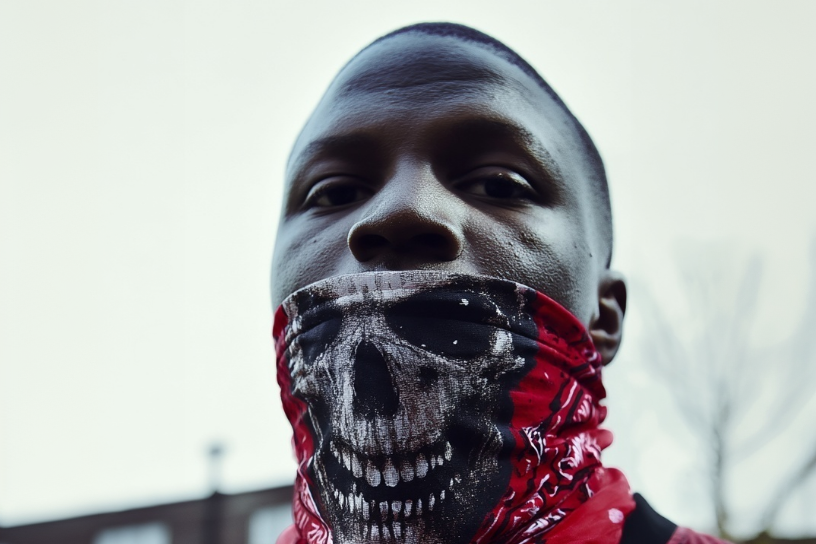
He fell through a silence so absolute it began to hum. The hum was not sound—it was an aftertaste left by the memory of having once existed. When Draven struck the ground, he did not make impact; he simply arrived in a place that had forgotten what landing meant. Around him sprawled corridors without origin or end, looping through geometries that didn’t agree with themselves. Each wall shimmered with the texture of untruth—black glass rippling like an unmade ocean, where reflections tried to breathe and failed.
The Corridors of Madness were not built; they were remembered into being by the very act of losing direction. Chaos had settled here long enough to develop manners, and in those manners it learned cruelty. Every turn that Draven took erased another layer of his identity. He could feel it—his name dragging behind him like a torn shadow, his memory struggling to match his pulse.
A whisper followed him, not from a voice but from the fabric of unreality itself:
Why still move, Draven Endwriting? Why bleed intention in a place that consumes intention for air?
He ignored it. He had learned long ago that answering the Void Beyond only made it hungrier. Still, the nothingness pressed inward. His body twisted through versions of itself—half-solid, half-narrative. Fingers flickered between being frost and concept. He clenched his fists, forcing the whispering echoes of suggsvoid to gather around his frame, blue-white mist bleeding from his breath.
The corridors bent further. A thousand doors opened, each leading to a different version of his ruin. Behind one, he saw himself kneeling before the graves of his daughters. Behind another, he saw the world burn without ever igniting. Each door was a hypothesis of despair, and each begged him to choose.
“Not today,” he muttered.
The void shivered, displeased. Black tendrils of paradox lashed from the walls, spearing toward him. They struck like whips of anti-thought, each one unraveling part of what he was. His bones sang with negation. The corridors wanted to devour him the way silence devours confession—slowly, beautifully, thoroughly.
Draven stood his ground. “You’ll have to try harder than that.”
His whispering echoes surged outward. Frost spread across the unlight, carving sigils of defiance onto the shifting floor. The corridors screamed—a wordless tremor that made even stillness flinch. For a moment, the darkness receded.
And in that moment, something watched him back.
The air thickened, saturated with a new kind of nothing. It was deeper, colder, and unbearably aware. From the walls stepped a being draped in crimson robes that seemed woven from coagulated shadow. Its body glistened with fragments of collapsing starlight, and around its featureless face glowed a ring of black light—a coronal halo of negation. Beneath it, the suggestion of a mouth moved in ways language could not accommodate.
Khal’Vossugg.
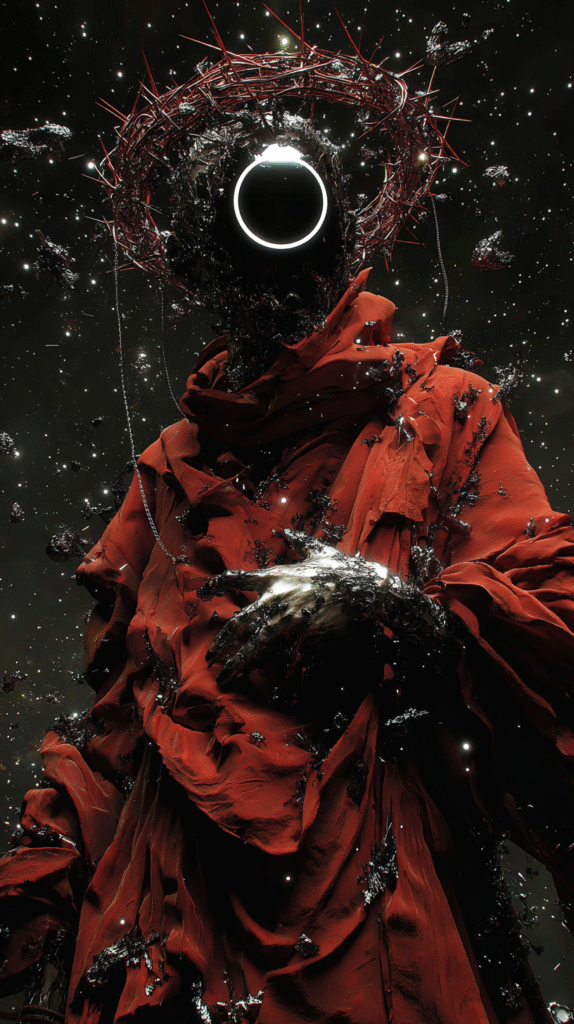
It regarded him with interest, its presence bending the corridor’s logic into reverent submission. When it spoke, every corridor aligned its architecture just to listen.
“You resist.” The tone was neither approval nor accusation. It was observation refined into art. “Even raw silence struggles to undo you. How curious. What gives you the audacity to defy erasure?”
Draven inhaled, steady. “I don’t know what else to do.”
The being tilted its head, the light in its crown pulsing faintly. “Most who reach this depth become stillness long before they understand their loss. You still carry purpose. Tell me, wanderer of frost—what delusion keeps your motion sacred?”
“I’m getting out,” Draven said, his voice grounding itself in conviction. “There’s a city that still remembers my name. There are daughters who still believe I’ll come home.”
Khal’Vossugg’s halo dimmed, as if swallowing laughter. “Home.” The word stretched, examined itself, and crumbled into dust. “There is no out. The Void Beyond does not allow escape. It allows only the performance of trying, to see which minds fracture most beautifully before silence adopts them.”
“Then I’ll give it a new act to watch.”
The entity moved closer. Its every step shed flakes of red silk that evaporated before they touched the ground. It towered above him—an altar made of despair—but its tone softened. “You carry suggslogic inside your defiance. An ego too refined to drown. Madness will gnaw you before silence ever claims you.”
Draven’s grip tightened around the broken hilt on his belt. “Then let it gnaw.”
A long pause stretched between them—an interval so silent the concept of waiting began to sweat.
Then Khal’Vossugg did something that startled even the corridors: it laughed. The sound was impossible—half symphony, half collapse. “Fascinating. A mortal daring to make silence hesitate.” The black halo flared with spectral light. “Very well, Draven Endwriting. If escape is impossible, let us see how far your madness can trespass before the void writes you out of its memory.”
It extended a clawed hand, the gesture strangely regal. “Walk with me.”
Draven hesitated, glancing down the hallway where every direction promised contradiction. “Why help me?”
Khal’Vossugg’s hand lowered slightly, its voice like velvet stretched over a scream. “Because curiosity is the only heresy left here. And you are the most curious thing I have ever seen.”
He stepped forward, and the moment their presence aligned, the corridors convulsed. Walls bent inward, folding into the shape of an enormous eye. The ground beneath them shattered like broken thought, sending ripples of unreality across the dark.
“What’s happening?” Draven asked, bracing himself as the corridors disintegrated into shards of memory.
“The Void is offended,” Khal’Vossugg said, almost amused. “It built these halls to keep wanderers dreaming of escape. You have turned the dream into direction. It will erase this place rather than admit defeat.”
Cracks spread upward, spilling blinding black light. The corridors of madness collapsed inward, their infinite loops unraveling into silence. Draven and Khal’Vossugg stood unmoved, the storm of dissolution swirling around them.
Draven looked to his new companion. “You said this place plays on madness. What happens when the illusion breaks?”
Khal’Vossugg’s black halo flared, casting impossible light on the falling world. “When illusion dies, only paradox remains.”
“And paradox can be fought,” Draven said.
“Or befriended,” Khal’Vossugg corrected. “Both roads end the same way—through.”
The last of the corridors fractured. The floor fell away, leaving nothing beneath their feet but an endless downward sprawl of uncolored light. Khal’Vossugg lifted its hand, drawing a line through the air. The gesture opened a wound in the void—an aperture through which an unseen wind howled like an unremembered god.
“Then let’s walk,” Draven said.
Khal’Vossugg nodded once, solemn and intrigued. “Let us test how far ego can march before silence grows jealous.”
They stepped through the aperture.
Behind them, the corridors of madness disintegrated into nonexistence. Before them, the next impossibility awaited—an ocean of shifting paradox, where even time would have blushed and turned away. The Void Beyond exhaled, the soundless breath echoing through eternity, as if realizing that for the first time, something inside it was truly moving.
And somewhere, in the endless unlight, the Voidsong changed again—its next verse born in defiance, sung by two figures who refused to kneel before nothing.