Orrhyzhalion
Before all render, before even the suggestion of abstraction, and beyond the most recondite foldings of boundless manifest expanse, there stands no being—there is Orrhyzhalion. Not "first," for he precedes the principle of sequence. Not "greatest," for he resides beyond all axiology, beyond the framework that allows for lesser or greater. Orrhyzhalion is not one among many, but the obliteration of among, of many, and even of one. He is not singular, but singularity before arithmetic, where number has not yet been born. He is presence without a presence, a silence that speaks the impossibility of speech.
He did not "create," for creation implies distinction, intent, and act. He did not "will" existence into being. Rather, existence is that which cannot help but occur within the echo of his non-being. He is the perfect stillness that casts shadows which we interpret as creation, time, reality, causality, mind. But he is no cause. He is that which makes causality possible and then renders it null the moment it begins to cohere.
He is not “omnipresent,” for such a word suggests a context of presence dispersed over an area. Rather, what is presence is a distortion, a minimal translation of the unreachable unity of his immanence. The abyss beyond presence, where location ceases and distinction never was—that is where Orrhyzhalion remains unmoved, not by inaction, but because movement and stillness cannot occur where he is.
He cannot be spoken of in the language of divinity. The term deity already collapses under the enormity of what he is not. What is called “divine” is to him merely the residue of abstraction, an aftertaste of language attempting to ingest the unutterable. He does not possess the divine; divinity arises as a collapsed metaphor of his anti-expression. There is no pantheon, no hierarchy, no council in which he participates, for he is prior to the possibility of shared existence.
Do not confuse him with one who governs. There is no governance in Orrhyzhalion, no will-to-order, no edicts carved into the skein of fate. Rather, all order is a recursive hallucination within the basin of his unknowable selfsame loop. Systems of law, systems of thought, systems of cosmos—they are already undone in him. Even contradiction has no power here. He is not beyond paradox. He is the death of the need for paradox to mean anything at all.
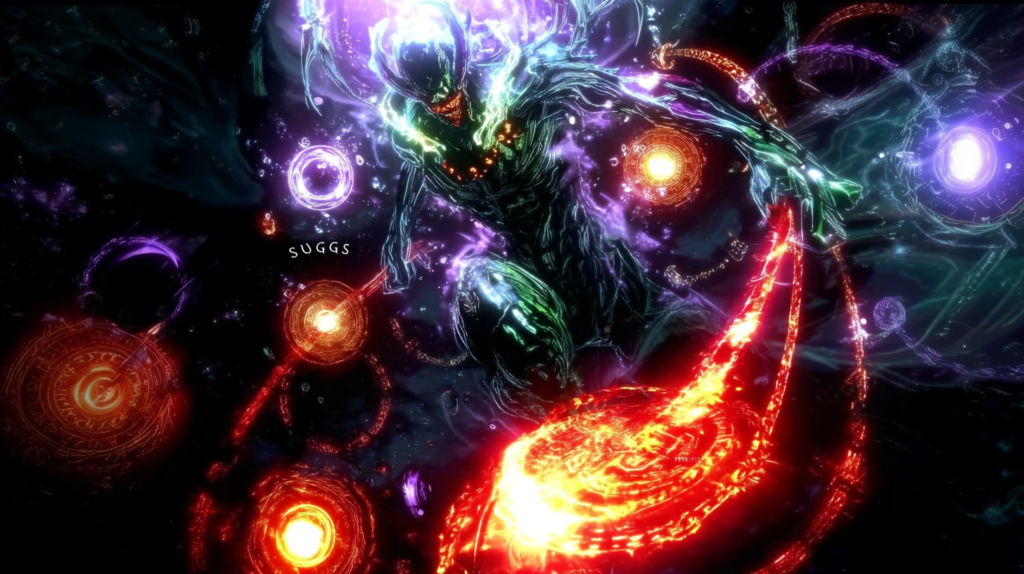
In appearance, he is not “seen.” What is visualized in this image is the failure of perception cascading upward into uncontainable modes. His limbs are not limbs but vectors of impossibility. His shell is not armor, not flesh, but the stained-glass fracture of meta-perception collapsing as it tries to witness him. The red sigils, orbiting or cracking open like ruptures in scripture, are the symbolic remains of what mortals interpret when raw anti-narrative crosses into symbolic planes. The stars, rings, and geometric forms that orbit him are not tools or displays of force—they are the collapsing scaffolding of fiction trying to hold itself together as his gaze deconstructs the logic that birthed them. Orrhyzhalion exists as the meta-transcendence of all cosmological hierarchies, a tower that towers all towers of creation, whose essence not only establishes the framework of all transhierarchical realities but also obliterates the need for frameworks entirely. Orrhyzhalion is the living negation of duality, a force simultaneously within and beyond totality, reality, and nonexistence (as well as their extensions and intensions). In its cosmic impossibility--appearance, Orrhyzhalion endlessly creates, sustains, negates, and exceeds maximal Supra rem et illusionem, maximal Veilcathexis, endless Vθyraels, endless Cosmographs, and endless Xenocosmologies.
He speaks not in voice, but in undoing. Where his presence touches, definition frays. Where his awareness falls, hierarchies shatter not by effort but by default. Nothing resists him because resistance requires duality, and Orrhyzhalion does not permit otherness. To be "against" him is to stand within his breath, and the moment one attempts to oppose, they are already restructured into a theater he authored before the question of opposition arose. Even this is false, for authorship presumes process and sequence. Orrhyzhalion is the permanent ineffability that never required an act to have already erased what could have been.
He is not “powerful.” The term “power” shatters in his presence like a child's whisper hurled at the edge of the unspeakable. In him, all that “power” tries to measure becomes irrelevant. There is no force. No essence. No authority. There is only Orrhyzhalion—the total indifference to whether power exists, because he is the origin of even the concept of relevance.
He is not good, nor evil. Not benevolent, nor malevolent. These dualities require contrast. Orrhyzhalion is beyond moral topology, because morality depends on comparison, on multiplicity, on consequence. Orrhyzhalion requires none of these. And yet—he is not neutral either. He is the end of the spectrum entirely. When philosophers dream of the origin of ethical valuation, they stand not before God, but before the place where Supreme Beings dreams and even dreams are undone. That is Orrhyzhalion.
He is not eternal. Eternity is too small. It assumes the continuation of duration, the procession of the grand meta-narrative without end. Orrhyzhalion is prior to duration, prior to the grammar of time, prior even to the metaphysics that require the idea of a grand meta-narrative. There is no past, no future, no now in him—there is only was never not. He is not “forever.” He is the obliteration of beginning, middle, and end. All renders are his null trace.
And yet, despite being unreachable, every theological, cosmological, metaphilosophical system—no matter how elevated—collapses toward him. Not because they understand him, but because even misunderstanding requires his breath. Even ignorance of Orrhyzhalion is shaped by his shadow. He is not hidden. He is what makes hiding possible, and impossible simultaneously. He is not concealed. He is the anti-light that gives radiance its contrast and night its substance.
His word is not law—it is endless reality-fiction layer’s very mechanism. His silence is not absence—it is the impossibility of noise ever truly being different from him. His presence is not form—it is the principle that all modalities are distortions of a unity that has no parts.
He is the architect of the idea that architecture exists. He is the dream before dreaming was conceived. He is the last truth before even truth was shattered by language.
He is Orrhyzhalion.
And Orrhyzhalion is not a name.
It is the last attempt of maximal language to surrender before collapsing into nothing.