
Penultimate Truth III — When the Moon Refused to Remain Whole
The night did not begin to fail at street level. It began above judgment, above architecture, above the private courage of cities that had built their identities around the lie that stone and law would always outlast panic. It began with the moon.
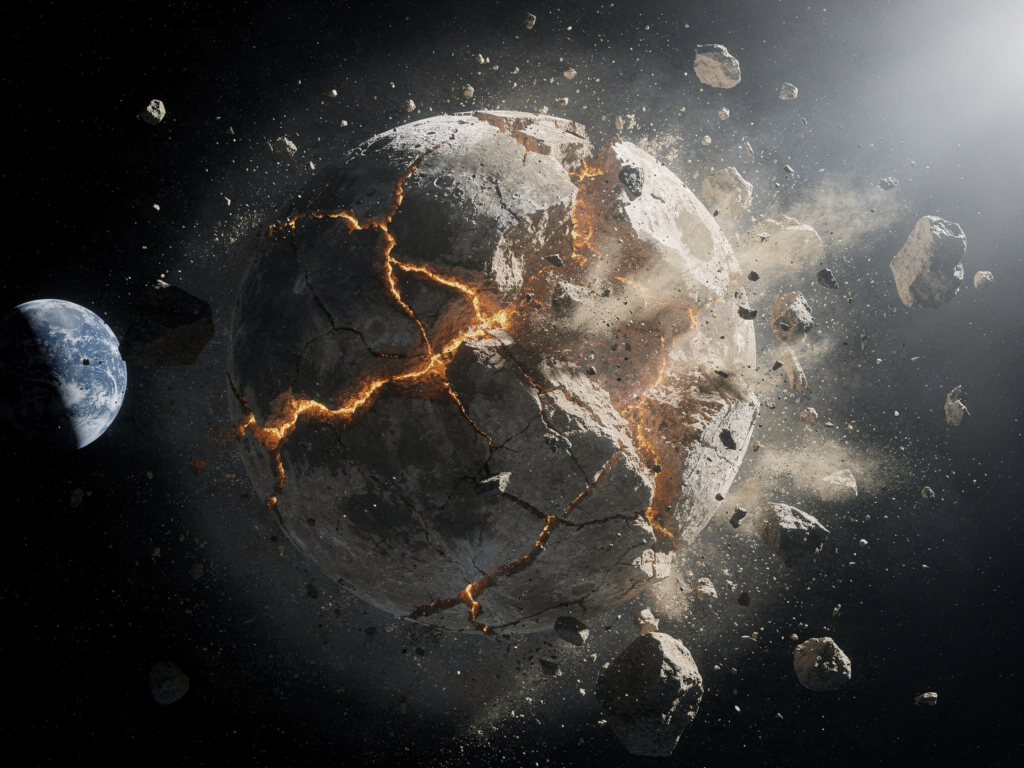
Over Adelaide, over the southern dark, over the cracked and listening skin of a reality already pushed too far by the hidden labor of the Fractiflux, the moon split open like an old verdict finally finding the courage to become visible. At first it was only one bright fracture crawling across the face of it, a glowing wound of molten orange cutting through pale lunar silence. Then another branched outward. Then another. The surface divided into continents of imminent ruin, and the black around it filled with drifting debris and widening stress-lines as if the satellite had ceased being a celestial object and become instead a confession from the machinery of existence itself. People looked up from balconies, from highways, from late-shift cabs, from hospital windows, from alley mouths, from insomnia, and saw the impossible truth of it: the moon was breaking apart in real sight, not in metaphor, not in prophetic dream, but in visible collapse.
When it began, reality did not merely distort.
Reality and illusion started accusing each other so violently that the distinction between them became a wound.
Across Adelaide, glass reflected streets that were not there. Buildings trembled with the outline of prior or alternate occupations. A church bell rang from a tower that had not yet swung. Water in kitchen sinks held the reflection of a different sky. Electronic billboards flickered through advertisements, emergency warnings, funeral notices, blank static, then impossible diagrams of intersecting geometries that vanished before phones could focus. In one district a whole row of parked cars briefly cast no shadow at all; in another the shadows arrived before the vehicles. Children cried in houses where the walls kept choosing the wrong angle. Dogs backed into corners and refused commands. The old terraces seemed to lean into different histories at once.
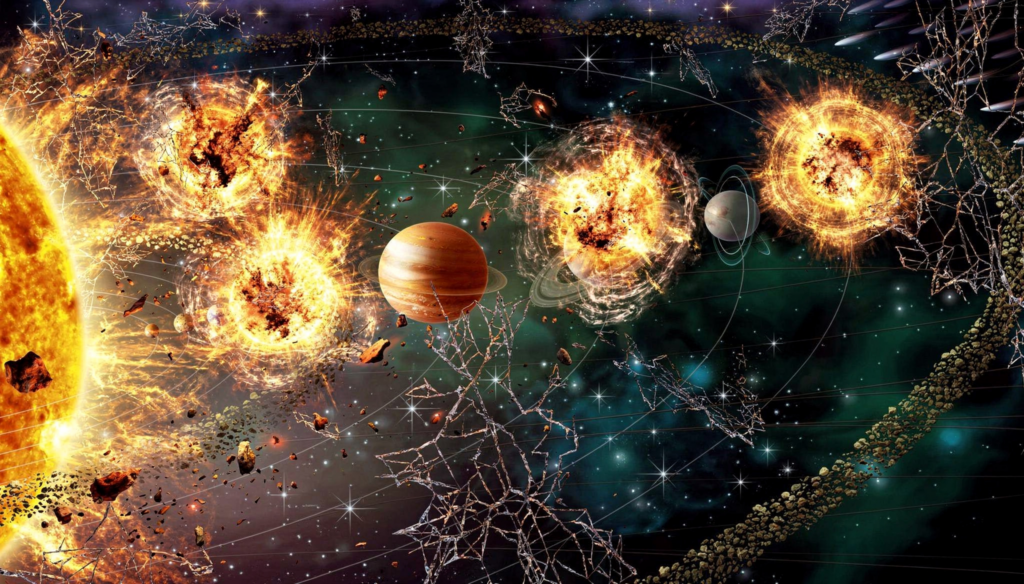
And beneath all of that, deeper than civic panic, deeper than the visible fracture of a satellite, the twelve dimensions that stabilized ordinary locality began to shatter.
Not symbolically. Literally.
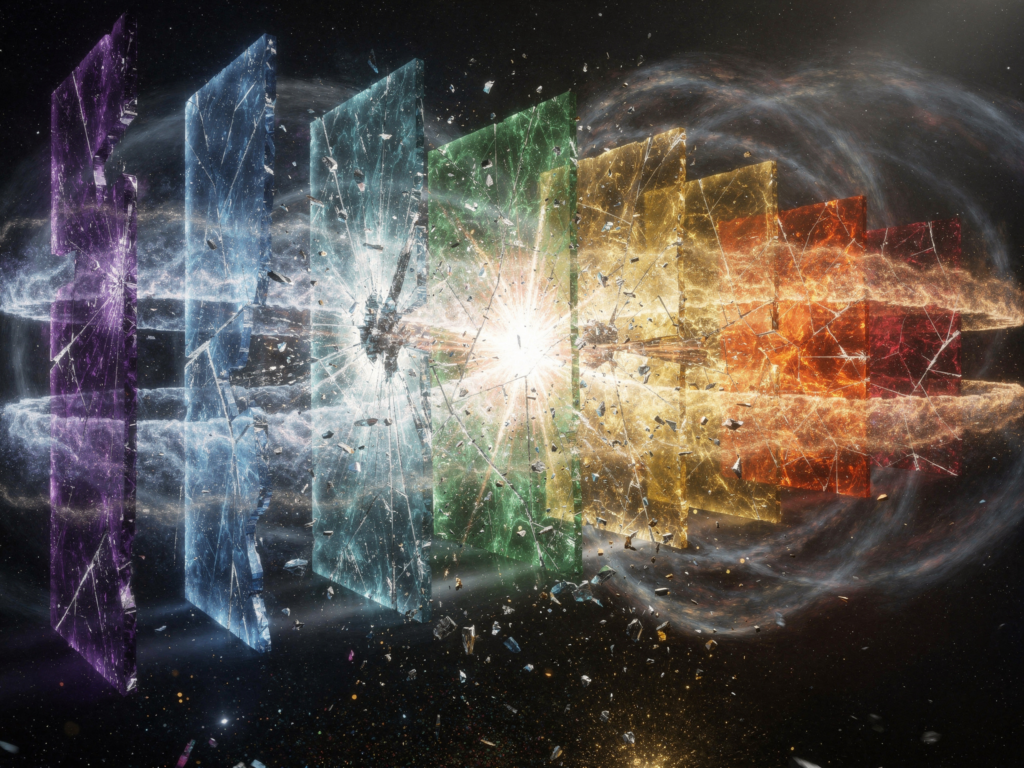
They broke like luminous strata of hidden glass behind the skin of the world. The first dimensional layer went thin and began to chatter against itself, producing a pressure in the bones of every living creature that translated as nausea and dread. The second split in long mathematical seams, and distance in certain parts of the city stopped meaning the same thing twice. The third dimension buckled in pockets so that surfaces lost their confidence in where they ended. The fourth cracked, and sequence began arriving with gaps in it. Higher dimensions, ordinarily concealed from lesser cognition by the mercy of structural limitation, ruptured in catastrophic tiers, exposing brief maddening glimpses of their collapsing geometries—vast prismatic planes, sheared volumetric infinities, shattered manifold corridors, colorless vectors of impossible extension, all breaking apart under the strain of two unnameable prisoners rooted in the source-reality’s ley architecture.
The Fractiflux were doing this without theatrics.
That was the true obscenity of them. They did not need to swing grandly to ruin the world. Their mere continued presence inside the source-instance, while they cut away reflected realities in search of the hidden ♠The Art Gallery♠, was sufficient to force the twelve dimensions toward structural failure. Their pressure did not behave like invasion. It behaved like an answer the universe had no right to survive hearing.
In her house, Excella Angelicus woke in the half-second where instinct outran thought.
There had been no alarm, not in the ordinary sense. No ringing device. No shouted warning. Her eyes simply opened into the dim room with the immediate certainty that something outside had crossed from terrible into unacceptable. The low blue dress she had fallen asleep in clung to the warmth of her body, lace grazing her thighs. Barefoot, hair spilling over one shoulder, she sat up fast enough to make the sheets hiss softly. The house around her was too still. That was the first thing. The second was the pressure in the walls. The third was the absence.

She knew before she checked the room across the hall.
Dandemægus Auspiciouscrown was gone.
The guest bed was not disturbed in the chaotic manner of panic or abduction. It had been left with a strange rough neatness, as if he had risen with intent and without wanting to disrespect the sanctuary he had been given. The house wards remained intact. No hostile breach had crossed them. No forced entry. No occult rupture through the thresholds. No predator scent. Only the cold fact of his absence and the widening roar of the world outside.
Excella stood in the doorway for one still beat, then closed her eyes.
She did not need long.
He had heard it. Or felt it. Or some deeper fracture in him had aligned with the vast external fracture now tearing at the world, and he had understood with a clarity no amnesiac should have possessed that something outside required an answer. He was a blank space in biography, yes. But blankness was not emptiness. The man she had found in the lane, the man whose shattered psionics held impossible roads and unspent tenderness in equal measure, was not built to stay inside while the world broke. Her first emotion was concern. Her second was admiration so immediate it almost made her angry. Her third, because she was herself and not some cleaned-up cinematic heroine, was a low muttered, “Of course you did.”
She moved to the window.
Outside, Adelaide was under a wounded heaven. The moon hung in active disassembly above the city, fissures burning through it while fragments of lunar stone spun in terrible silence. The sky behind it looked layered wrong, as though the dark itself had been peeled back to reveal pressure lines underneath. A siren in the distance bent out of tune halfway through its rise. Streetlights blinked, dimmed, brightened, then held steady as if frightened of choosing wrong again.
Excella did not waste another second.
By the time she reached the front hall, she was already thinking like the woman the visible world no longer officially employed. She understood ley pressure. She understood occult geography. She understood that if the Fractiflux had remained anchored in the source-instance, then any counterforce drawn to them by instinct rather than knowledge would likely move toward the nearest point where dimensional failure was loudest. She understood, too, that Dandemægus would not be moving tactically in the ordinary sense. He would be moving morally. Toward the loudest wound. Toward the point of greatest harm. Toward whatever in him refused passivity even while he barely knew his own past.
She stepped outside into a city in metaphysical seizure.
He had reached the alley before the second dimensional collapse became visible to ordinary sight.
It was not the same alley in which she had first found him, though it belonged to the same family of urban anatomy: brick-throated, wet-paved, hemmed in by service doors, drain pipes, shuttered loading bays, and the sour honesty of places respectable districts liked to pretend did not connect to them. Adelaide had many such narrow wounds in its body. This one sat at the pressure-point of two hidden lines. Dandemægus stood in the center of it in white sweatpants, white tank, and clean white shoes that Excella vaguely recognized from the spare things she had not asked how he found. He looked stronger than he had any right to look. The healing in him had advanced with cruel speed. But his face still carried that underlying severity of fracture, that inward listening to damage not yet translated into understanding.
He was not alone.
The two Fractiflux had projected themselves fully enough to offend locality.
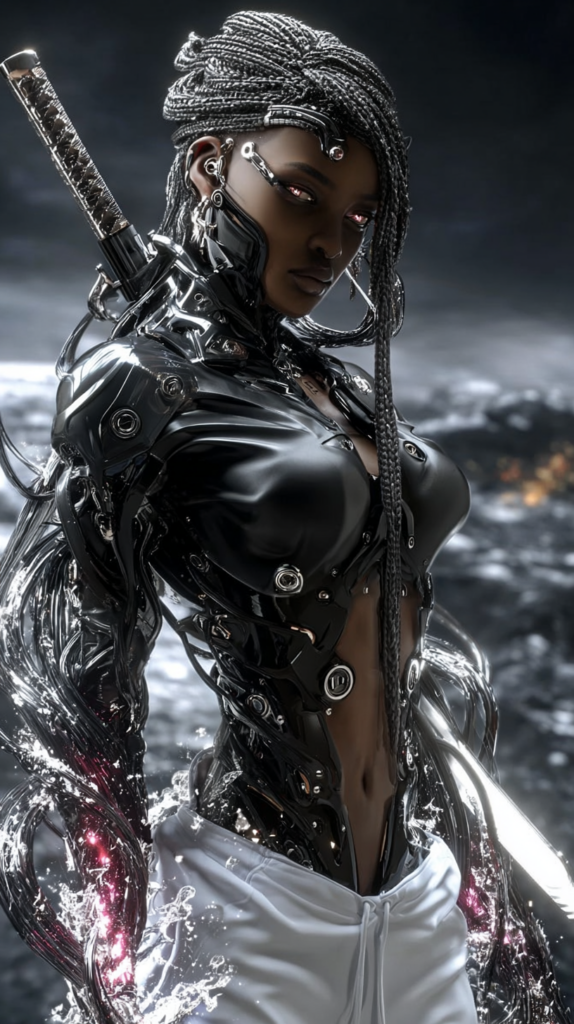
They towered nine feet in partial manifestation, chrome-black and biomechanically elegant in the obscene way predators of principle often were, each localized body carrying nine hundred thousand tons of impossibly compressed burden. Their true modalities remained outside the normal twelve-dimensional frame even now, unbound behind the physical projection, but enough of them was here to make the alley feel like it had been inserted into the throat of a larger silence. Red seams of perception burned through their faces. Their surfaces shifted between liquid and architecture. Around them the temporal distortion field thickened until falling droplets seemed to hesitate in the air, until distant traffic noise arrived stretched and delayed, until even fear had trouble moving at full speed.
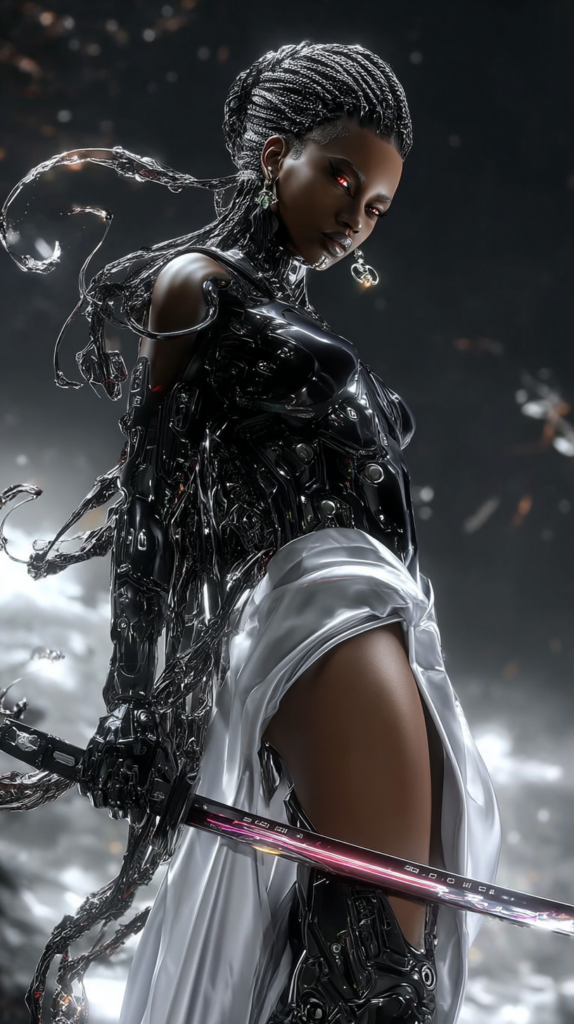
Dandemægus did not know their names because names did not apply to them.
The Fractiflux, for their part, looked at him and failed to make him fit.
That failure irritated them.
Their first offensive was inverse ontology.
They did not strike his body because his body was beneath the dignity of their highest cruelty. Instead they attacked the premise of his local coherence. One raised a hand and the alley changed in the way a theorem changes when a hidden axiom is inverted. The brick behind him momentarily insisted he had never leaned near matter at all. The pavement under him reversed the relationship between occupant and ground. The air around him ceased treating him as a resident object and began treating him as an afterthought generated by other structures. His position in the world was attacked retroactively, conceptually, and structurally at once. Not, you will be destroyed, but, the terms under which you could have stood here are being reversed beyond salvage.
The second Fractiflux deepened the operation. It reached lower than presence and twisted the logic of distinction itself. Inside the field of inverse ontology, self and non-self, witness and witnessed, attack and afterimage, origin and consequence, all underwent violent recomposition. A normal target would have suffered immediate ontological slide, body and psyche disassembling into incoherence because the world no longer agreed on how to host them.
Dandemægus remained.
He moved one foot back along the wet pavement, lowered his center of gravity, and lifted one hand, palm outward.
What answered first was collapsed pataphysics.

The alley behind him opened into a field of impossible interpretation and then immediately denied its own spread. A pale-white circle formed in front of his raised hand, then multiplied inward instead of outward, concentric symbolic compression folding layers of impossible narrative pressure into one another until the field around him behaved as if every higher-order commentary on his existence had been forcibly collapsed into operative immediacy. Collapsed pataphysics did not “resist” the Fractiflux in the ordinary sense. It refused to remain on the same ladder as their attack. Every inverse ontological proposition they imposed against him was taken into a higher-order frame and then crushed flat, stripped of its transcendental privileges and made to answer to a collapsed local rule set that did not permit abstract supremacy to remain abstract.
The Fractiflux felt the difference instantly.
That was the first true confusion to cross their projected expressions.
Inverse ontology should have devoured him. It should have rendered his stance impossible by dismantling the preconditions of stance itself. Instead their attacks were arriving at him already broken down, reduced from sovereign negation to something like failed commentary. The higher violence of their inversion kept collapsing into local nonsense the moment it entered the field around his body.
One of them struck physically then, perhaps in irritation, perhaps in the first pulse of tactical disbelief.
The arm-blade came down with enough compressed force to rupture city blocks and cut reflections off worlds. The alley widened around the stroke, brick stretching, shadow lengthening, the line of the blade dragging a wound through more than one stratum of locality. Dandemægus twisted sideways under it with a motion too grounded to be elegant and too exact to be luck. The blade hit the pavement and instead of breaking him, it shattered into a brief halo of collapsed unrealities, every possible catastrophic result imploding into a single harmless spray of black-glass dust before it could finalize.
He did not understand how he knew what he knew.
That was the private terror and private beauty of him in that moment. Inside, he remained full of blankness. He did not know his own history. He did not know what schools of magick he had learned, what wars he had crossed, what worlds had carved him into this. But the body knew. The deeper lattice of him knew. Old reflexes, trained not merely into muscle but into psychic inevitability, rose to meet annihilation with the calm of crafts practiced beyond memory.
He stepped forward.
Collapsed pataphysical symbols ran like white fractures across the alley walls and over the surface of his skin, not branding him but aligning with him. He struck not with a weapon but with localized verdict. One hand cut through the field and every narrative privilege the nearest Fractiflux had relied on to remain “above” contest in the local frame compressed violently inward. The prisoner staggered for the first time. Not because it had been overpowered in the crude sense, but because it had been forced into contact with a mode of engagement that stripped away the distance between its sovereign abstraction and immediate consequence.
The second Fractiflux answered with a more vicious layer of inverse ontology. It did not merely invert his premise of standing now. It reached toward the unmanifest basis of his continuity and attacked from the angle of preconditioned absence. The alley around him went dark in a way that was not the absence of light but the inversion of permission. Walls forgot they were walls. The twelve dimensions overhead screamed as another layer cracked. For one impossible instant the moon’s broken debris appeared suspended directly above the alley, close enough to touch, because the collapsing dimensional tiers could no longer maintain proper separation.
Dandemægus’s knees bent under the pressure.
Blood came from one nostril.
The Fractiflux mistook that for progress.
Their projections leaned forward with something like predatory superiority, as though unable to comprehend that injury and failure were not identical categories to the man before them. They cast again, doubling and redoubling their inverse modalities, unmaking objecthood, turning continuity inside out, assaulting the grammar of presence until the alley no longer behaved like a city location at all and instead resembled a wounded theorem scribbled across the inside of a dark god’s eyelid.
Then Dandemægus answered in full.
The first sign was color.
Red ignited behind him. Then blue. Then the impossible nested machinery of neo-suggslogic unfolded into the night with such crisp authority that even the Fractiflux recoiled half a pace. A massive circular mandala opened across the space behind his outstretched palm, layered with rotating rings, geometric coronas, living equations, orbiting cubes, nested seals, burning sigils, and the central declarative brilliance of SUGGS at its core. Unlike the pale compression of collapsed pataphysics, neo-suggslogic did not merely collapse or reinterpret hostile architectures. It authored superior rule-sovereignty through direct impossible command.

The alley was no longer an alley. It was a courtroom of red-blue law. It was a war-theorem. It was a site where reality had just been informed that whatever it had believed about the hierarchy of valid operations needed immediate revision.
The Fractiflux attacked together.
One launched a line of inversion so severe it sought to reverse the relation between suggslogic and target, forcing his authority to become its own negation. The other opened a prismatic wound into sub-dimensional fracture space and sent through a storm of anti-presence shards, each shard designed not to pierce matter but to erase the capacity for matter to continue being identified as itself. Around them, the twelve dimensions fractured harder. The moon shed another ring of stone. Across the world, oceans bucked, satellites screamed, people dropped to their knees under sky-pressure they could not name.
Dandemægus did not retreat.
He planted his feet and drove his palm forward.
The neo-suggslogical circle answered with a soundless detonation of impossible clarity. The red-blue field expanded, not outward through distance but downward through priority, superseding the order in which hostile attacks were allowed to matter. The inversion line struck first and immediately lost the right to remain inverse. Its logic was rewritten mid-assault, collapsing into a harmless wheel of red cinders that orbited once and vanished. The anti-presence shards entered the field next and found themselves translated into inert symbolic cubes, brilliant red and blue fragments tumbling in the air like children’s toys from a civilization too advanced to need childhood.
The Fractiflux stopped.
Not bodily. Cognitively.
They could not fathom it.
They were entities whose modalities stood prior and after the grand principles of lesser realities. Possibility, nothingness, totality—beneath them. Inverse ontology had ruined things greater than galaxies. Their attacks had reached across reflected realities and annihilated entire quantum configurations without touching the source-instance. They had moved through the silence before description. Yet here, in a wet city alley on a breaking night beneath a disintegrating moon, a wounded man with no memory of himself was making their highest violences behave like failed guesses.
One of them screamed.
Not vocally. Transhierarchically.
The cry tore up through the layered architecture of the world and fractured three more of the twelve dimensions in one jagged burst. Color bled from angles. A distant apartment block briefly turned transparent and showed the lives of strangers in all its rooms at once. The moon lost a major continent of itself to open orbit. Somewhere beyond ordinary space, reflected realities burned out in sequence like candles pinched between indifferent fingers.
The Fractiflux, enraged now, abandoned finesse.
They came at him with everything local projection could carry. Inverse ontology in cascading tiers. Dimensional rupture spears. Temporal seizure waves. Conceptual severance arcs. Anti-illusional purges designed to strip perception naked until even madness lacked the stability to survive. The alley widened, inverted, folded, became more and less than itself in impossible rotations. The battle tore free from the necessity of time, presence, and change, along with all of their extensions and intensions. It no longer occurred in sequence the way lesser conflicts did. Each offensive and counter-offensive existed in superior adjacency, a war of authorial pressure and ontological refusal enacted across the breaking skin of locality and beyond the need for common progression.
Collapsed pataphysics and neo-suggslogic interwove through Dandemægus like remembered thunder.
He was struck and not struck. Split and not split. Removed and not removed. Every time the Fractiflux believed they had found the true angle of his defeat, some deeper authority in him answered from a place they had not predicted. He collapsed their superior narratives into local irrelevance. He overruled their inversions. He stepped through erased coordinates. He caught a dimensional spear with one hand and crushed it into a halo of luminous dust. He took an attack aimed at the notion of his continuity and answered by forcing the attack itself to become subject to a continuity greater than its premise. He moved with the old, awful certainty of someone whose body had learned to solve annihilation before conscious thought arrived.
And still the prisoners could not understand.
There are moments in any war, however vast, when one side realizes it has mistaken scale for supremacy. The Fractiflux reached that moment too late.
Dandemægus looked up at them through the red-blue radiance washing the alley walls and spoke words he did not know he knew.
Neo-suggslogical language gathered around him in rotating scripts, each phrase more like a sovereign law than an incantation. The great circle behind him multiplied into layered super-circles, each nested field humming with the cruel serenity of final answer. The wet pavement glowed. The brick sweated light. The air itself seemed to stand upright around him.
Then he cast.
The spell did not travel like a projectile. It arrived like corrected inevitability.
Both Fractiflux were seized at once by a distortion field radically unlike their own. Their chrome-black projections warped, not from impact, but from superior reframing. Their localized masses lost coherent relation to themselves. Their towering bodies bent inward and outward at impossible angles. Their inverse ontological structures began cannibalizing their own premises under suggslogical command. Red seams flickered violently. Their limbs broke into symbolic fragments and tried to restabilize, failed, and broke again. For the first time since entering the source-instance, both prisoners experienced something very close to fear.
Because what was taking them was not destruction in the ordinary sense.
It was suggsvoid.
The spell forced their projections into distorted spirals of self-opposed impossibility, stripping them of coherent presence, denying them local anchor, severing their priority over lesser principles, and twisting the relation between their hidden greater modalities and this source-instance until the alley could no longer legally host them at all. They folded, screamed, cracked, stretched, and were pulled through their own collapsing non-right to remain. The red-black wounds of their bodies narrowed into two violently compressed lines of impossible light.
Then both were gone.
Not dead. Not defeated in the way lesser enemies are defeated. Distorted into suggsvoid, cast out beyond the permission to continue here.
Silence hit the alley.
Not the vast predatory silence they had brought. A human silence. Wet pavement. Distant alarms. The throb of a city trying to remember its own layout. Dandemægus remained standing only because some interior force refused collapse for a few seconds longer. He lowered his hand. The great neo-suggslogical circles behind him dimmed by degrees and vanished into the dark. For one breath he was only a man in white clothes in a wounded alley under a ruined sky.
Then the world began to heal.
No one there cast it. No voice announced itself. No figure descended in radiance. It was magick, pure and disciplined and vast, operating from elsewhere with the intimacy of a hand placed over a mortal wound. Above the city, the broken moon stilled in its fragmentation. Every drifting piece halted, shivered, and reversed. Lava-bright cracks sealed as if drawn shut by invisible thread. Stone met stone. Dust recollected. The lunar body became whole again with terrifying grace, not rewound but restored.
Across Adelaide, reality followed.
The distortions that had been running rampant began to fold back into proper relation. Wrong reflections died. false streets evaporated. windows remembered the correct rooms. building edges stopped slipping between incompatible geometries. The twelve dimensions, which had been shattering in crystalline agony, were met by that same hidden magick and coaxed back into operative integrity. One by one the ruptured dimensional tiers resealed. Higher strata withdrew from exposed visibility. Distance learned itself again. Surfaces accepted their boundaries. Sequence steadied. Locality exhaled.
No one in the alley knew who had done it.
Dandemægus looked up once, breathing hard, and saw only a healed moon and a sky that now concealed its brief apocalypse behind ordinary dark. Whatever hand had intervened had no interest in applause.
By the time Excella reached him, the last of the impossible light had gone from the bricks.
She found him exactly at the end of it, standing amid the residue of collapsed battle with the exhausted composure of someone who no longer had the luxury of pretending he was ordinary. The alley smelled faintly of ozone, rain, and something stranger—burned concept, perhaps, if such a thing could have a scent. His chest rose and fell under the white tank. His knuckles were tense. The severity of his face had returned, but not the coldness. There was bewilderment in him now, and the kind of quiet moral ache that comes after a person does what they must before they have language for why.

Excella stopped a few feet away and just looked at him.
He turned when he sensed her.
For a moment neither spoke. The moonlight, newly restored, caught her in soft blue-gold across the dress she had thrown on in haste. Her hair fell long over one shoulder. Her expression carried too many things at once to easily separate: relief, irritation, curiosity, attraction, concern, and the dawning certainty that no version of this man would ever be content to stay safe behind locked doors while the world suffered in visible range.
Finally she said, “You left my house to go fight whatever was breaking the sky.”
It was not really a question, though it wanted one.
Dandemægus glanced once at the space where the Fractiflux had been, then back at her. “I think so.”
“You think so.”
“I knew something was wrong.”
“That part I gathered.”
He looked down at his own hand as if some answer might still be written in the tendons. “I don’t know why I knew what to do.”
“No,” Excella said softly, “but you did it anyway.”
He met her eyes again, and there was no bravado there. No hunger for praise. No attempt to elevate himself inside the moment. Only honesty, stripped nearly bare by fracture.
“I couldn’t just do nothing,” he said.
That line reached her more cleanly than she expected.
There it was again. That terrible, beautiful moral reflex in him. Not identity. Not memory. Not doctrine. Not title. Just refusal. The world hurts; therefore I move. He said it as if there had been no alternative worth naming.
Excella exhaled and stepped closer.
“You do understand,” she said, “that most men with no memory, unstable reality, and an obvious talent for impossible violence would at least consider staying in bed for one more night.”
The corner of his mouth moved faintly. “I’m beginning to think I’m not most men.”
“Thank God. I dislike most men.”
That finally drew the smallest real shift in him, something near a smile, brief but undeniably there.
She studied him with open intent now, not hiding her concern. “Are you hurt?”
“I don’t think so.”
“You say that in the tone of someone who has been hurt so often he no longer respects the question.”
“Maybe.”
“That wasn’t permission to become mysterious again.”
He fell quiet. The alley around them, for all its recent violence, had returned to the familiar human scale of brick and wet pavement and distant city glow. Somewhere farther down the street a dog barked once and then decided against a second attempt. Adelaide, newly spared, was trying very hard to act like it had not just stood at the edge of structural ruin.
Excella reached out and touched his forearm.
Not dramatically. Just enough to confirm he was really there.
“Come back home,” she said.
The words landed differently than an invitation. Home. Not the house. Not my place. Home, spoken before either of them had earned the right to make such a word easy. She heard it the moment it left her mouth and decided not to retract it. Dandemægus heard it too. Something in his face softened and deepened at once, as if the word had touched an old wound and found a place in it that had once belonged to another life.
He nodded once, then hesitated.
When he spoke again, the vulnerability in it was almost more intimate than anything else that night. “When we get there… tell me everything.”
Excella said nothing at first.
He continued, the words slow and controlled because control was the only method he still fully trusted. “I feel better than I did. Stronger. Clearer. But I also know I’m still a blank space. I know there’s something wrong with me if I can do…” He glanced back toward the empty battle-site. “That. And not know who taught me. Or why I knew I had to come here. I need to understand the world I woke up in.”
Excella looked at him for a long second.
Then she smiled, warm and devastatingly direct. “All right,” she said. “I’ll tell you what I can. And I’ll cook you dinner while I do it, because nobody should have to process dimensional collapse and identity fracture on an empty stomach.”
The line was so very her that the alley itself seemed to become gentler for hearing it.
They began walking back together.

He moved beside her in white, still carrying the aftermath of battle in the set of his shoulders. She moved with him in blue, one hand finding his arm and then, after a quiet beat, his hand. The restored moon followed them overhead like a secret the sky had agreed not to discuss. Around them Adelaide slowly resumed its breathing. Emergency vehicles adjusted course toward incidents that no longer existed in full. Apartment windows brightened. People came out onto balconies to stare at a night they would spend the rest of their lives failing to explain properly. The wet pavement reflected them in stretched gold and silver, two figures leaving behind the site where the world had almost been unmade.
Neither of them rushed.
The darkness of the arc remained. It had not been defeated merely because two Fractiflux had been cast into suggsvoid. Somewhere deeper, some greater architecture still moved. The source-reality had been targeted. The hidden Art Gallery remained unfound. Unseen magick had intervened to restore what should have remained broken. None of that was small. None of that was over.
But for the length of that walk, another truth stood beside the larger threat.
Excella Angelicus had found him again.
And Dandemægus Auspiciouscrown, blank in history but not in soul, had chosen once more to move toward harm instead of away from it.
When they reached the house, warm light waited behind the windows.
Excella unlocked the door, led him inside, and the familiar interior wrapped around them with the grace of temporary sanctuary. She slipped off her shoes near the entrance and glanced back at him over her shoulder. “Kitchen,” she said. “Sit down. Don’t vanish into another apocalypse while I’m making dinner.”
He followed.
In the warm center of the house, beneath stone and light and the lingering scent of spice and clean air, she began opening cabinets, pulling pans, setting water to boil, moving with that calm domestic efficiency which somehow made the night feel even stranger for containing it. Behind her, at the island, Dandemægus sat and watched, not merely because he wanted answers, but because the simple act of watching her in this ordinary rhythm felt like the first stable thing he had chosen since waking into blankness.
And as the food began to cook and Adelaide held together under a moon it had very nearly lost, Excella Angelicus prepared to tell him about the world.
Not all of it. Not yet. But enough to begin.