
Penultimate Truth IV — The World Beneath the World
What had been repaired was not what had been ended.
The restored moon, the resealed sky, the reassembled local dimensions above Adelaide—those had been stitches, not salvation. Beyond the narrow mercy granted to one city and one night, the greater catastrophe had continued without asking permission from human relief. Across the boundless reality-fiction layers, whole stacked continuities were breaking apart like cathedral glass struck from the inside. Vast cosmological strata that had once held the stable separation between the real, the imagined, the remembered, the potential, and the denied were now grinding against one another in a shrieking collapse of order. Entire universes were not merely exploding; they were being forced to exchange definitions with the detonations consuming them. Nebulae burst into the white ruin of failed stars and then became the debris of something more abstract than matter. Whole cosmic sheets—plane after plane of layered existence—split and sheared at their joints, their luminous geometries collapsing toward blinding centers that could not decide whether they were implosion, revelation, or subtraction.
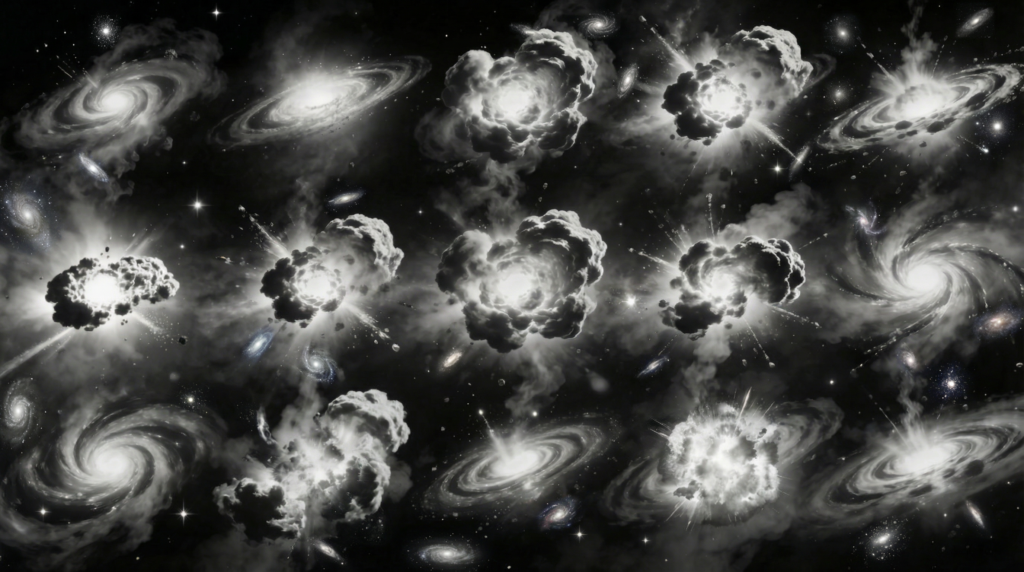
Far beyond Adelaide, beyond Australia, beyond the provincial intimacy of any one nation thinking itself local enough to matter only to itself, the maximal wholeness beyond tiering was entering a phase of open fracture. Boundless dimensions were shattering. Not in parable, not in warning, not in the exaggerated speech of frightened mystics. Literally. Dimensional lattices were coming apart under stresses too old and too severe for ordinary worlds to endure. Lower structures failed first, then higher, then stranger. There were places where number itself could no longer describe how many dimensional channels had split. There were cosmological districts where causality no longer knew which layers it belonged to. There were domains where the background of creation had begun to show through in damaged light and all those who perceived it instantly lost the ordinary confidence that reality had ever been a finished product.
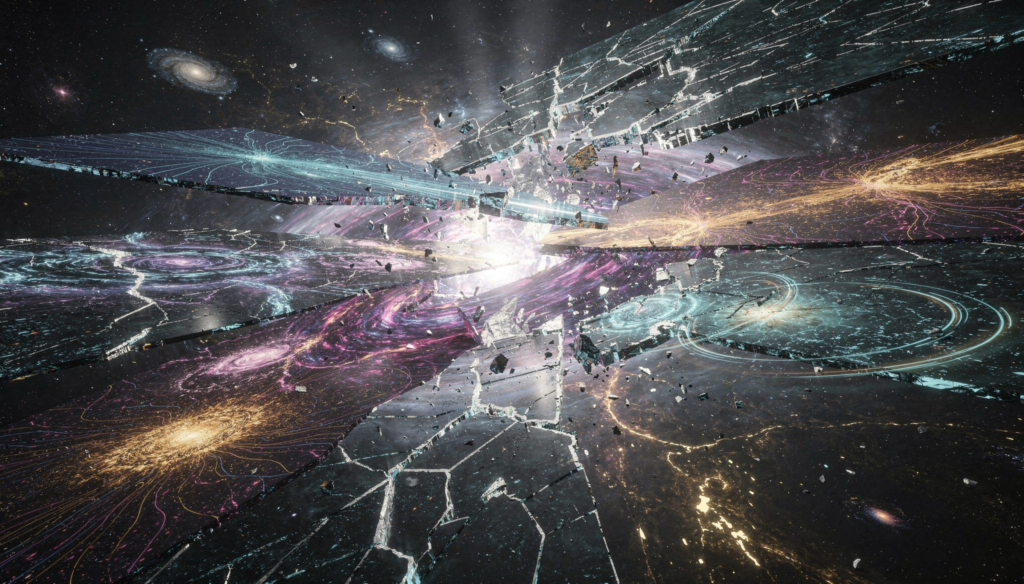
This was because the Fractiflux had stepped onto the stage.

Not the two Dandemægus had cast into suggsvoid the previous night. The problem was larger now. Others had entered elsewhere, each partial projection hidden along lines of old pressure, old silence, old cosmological leverage. Their presence alone was enough to make the world’s deeper structure splinter. Their method remained concealed. Their motive remained hidden from the frightened populations experiencing only the symptoms. But the consequence was already universal. The reality-fiction layers were coming apart at the seams, and what most people called the world was only the thinnest outer skin of that much larger wound.
In Adelaide, dawn arrived anyway.
It came pale and careful through the broad windows of Excella Angelicus’s house, washing the stone columns, polished floors, and cream cabinetry in a light too gentle for what the sky had witnessed. The city outside held itself together in the uneasy way of places that had survived something they could not publicly explain. News broadcasts were careful. Emergency channels were clipped. Social media was flooded with blurred moon footage, wrong sky videos, amateur theories, religious hysteria, jokes deployed against terror, and a growing body of eyewitness testimony no platform quite knew how to censor without drawing more attention to it. Adelaide was pretending it had suffered only “atmospheric anomalies” and “temporary electromagnetic disturbances.” That was how the visible world protected itself. It lied first. It explained later. It buried the dead once the paperwork caught up.
Inside the house, the morning felt almost indecently normal.
Excella was in the kitchen making breakfast.
Kind of.
She had changed into an exotic, soft blue sleep ensemble that treated modesty as a negotiable suggestion and comfort as a theatrical principle. The outfit was all pale ribbons, plush sleeves, fur-trimmed boots, and a bright, deliberate absurdity that only Excella could wear without looking like she had lost a bet. In another woman, it might have read as performance. In her, it read as temperament. She refused to let horror dictate all aesthetic choices. If the world was collapsing on a cosmological scale, she was still going to stand at her kitchen island in a playful powder-blue modality and plate food like the apocalypse would have to wait its turn.
The kitchen counters were already covered in the morning’s answer to dread: bowls of kimchi, braised greens, rice, eggs, pan-seared fish, pickled vegetables, peppers, broth, and a heavy cast-iron pan still breathing heat. She moved between stove and island with a precision that came from long practice, not because she had ever needed domestic labor to prove her usefulness, but because she loved the intimacy of feeding someone well. The stainless-steel appliances shone in the warm light. The knives were laid cleanly. Steam rose. The house smelled like heat, spice, fermented sharpness, butter, garlic, and the small civilizing miracle of someone insisting that nourishment still mattered.

Dandemægus Auspiciouscrown sat at the island watching her.
He had changed back into the white he seemed to gravitate toward now—white tank, white sweatpants, clean white sneakers—less because he was cultivating an image and more because it appeared to calm him. White let him feel like a page not yet fully written on. He sat with both forearms on the countertop, posture relaxed only on the surface. The rest of him remained attentive, still carrying that quiet readiness of a man whose body no longer waited for permission to answer violence. In the daylight he looked more grounded than he had in the alley, but the fracture in him had not disappeared. It had only learned to sit still for a while.
For several minutes neither of them spoke.
Excella plated the food with more care than she needed to, aware of his gaze on her, aware of the charged quiet between them, aware too that what came next mattered more than breakfast. He had asked her to tell him everything. Not everything about him—she could not do that, because she did not know it—but everything about the world he had awakened into. He needed structure. Context. A map that would not infantilize him. And Excella, who had never believed in softening horror at the expense of preparedness, had already decided she would give him the truth.

No cushioning. No performance. No stupid optimism.
Just the world.
She set a plate in front of him and another in front of her, then took her seat across the island.
“Eat while I talk,” she said. “What I’m about to explain is easier to survive when your blood sugar isn’t embarrassing you.”
Dandemægus picked up the fork, but he did not start immediately. “You said last night that you’d tell me what you could.”
“I will.”
“What if I ask the wrong questions?”
Excella’s mouth curved. “Then I’ll answer the right ones anyway.”
That earned the faintest shift in his expression. Not quite a smile. Something that wanted to become one.
She leaned back a little, studying him openly. “Before I start, I need you to understand something. I don’t know who you were before you arrived here. I don’t know what took you. I don’t know what exactly you lost. And I don’t know why your hands can perform collapsed pataphysics and suggslogic like they’re remembering a language your mind hasn’t caught up to yet. But none of that changes the world you’re standing in now. So I’m going to give you the world as it is, not as people wish it were.”
He nodded once. “All right.”
Excella took a breath.
“Most people think they live in one world. They don’t. They live on the surface of several wars at once.”
He remained silent, listening hard.
“The first war is the obvious one. Human misery. Poverty. Crime. Corruption. Children hurt behind closed doors. Women erased by systems that only pretend to care. Men disappearing into violence because violence is the only language anyone ever taught them to trust. Addiction. Trafficking. City governments that patch streets faster than they patch lives. That war is already bad enough on its own. Every country has it. Every city hides it in a different accent.”
She took a bite, swallowed, then continued.
“The second war sits inside the first one and feeds on it. That’s the hidden ecology. Predators that aren’t just human. Cults that don’t worship because they’re confused but because they’ve seen enough of the dark to realize it answers back. Bloodline houses that never stopped believing they were entitled to feed on the rest of the species. Corpse economies. Old aristocracies of bite and ritual. Private military laboratories trying to bottle extinction and monetize it. Churches and sects convinced peace can only exist after they erase enough of reality to make resistance impossible. Hunter networks. Exorcists. back-room medics. weaponized relic smugglers. black-budget containment teams. cities with unofficial graveyards for things that were never supposed to have bodies.”
Dandemægus ate now, though slowly, eyes never leaving her.
Excella gestured lightly with her fork. “And then there’s the third war. The one most people never even get close enough to name. That’s where the world starts breaking at the rules level. Paradox events. Ontological slips. dimensional tears. artifacts that change the local laws around themselves. voidal incursions. impossible beings stepping halfway into manifest reality because some wound, some ritual, some pressure point, or some institutional stupidity opened the wrong door.”
He set his fork down. “And all of that is happening together.”
“Yes.”
“Everywhere.”
“Yes.”
“For how long?”
A quiet pause.
“Longer than governments admit,” she said. “Longer than religions can explain honestly. Long enough that whole unofficial professions have formed around surviving it.”
The room held a strange calm after that. The kind that only comes when truth is finally worse than the anxious imagination that preceded it.
Dandemægus looked down at the plate for a moment, then back up. “So this is normal.”
“No,” Excella said immediately. “It’s regular. That is not the same thing.”
That made him pause.
She leaned forward. “Regular means it happens often enough that people like me build methods around it. Normal means it should happen. It should not. A city full of hurt children and hungry predators is not normal. A corporation building plague-architecture in secret and then losing control of it is not normal. Old blood wars under modern skylines are not normal. A bishop preaching to matter until buildings forget they’re supposed to remain buildings is not normal. A moon breaking apart because hidden prisoners of the void are using this reality as a search instrument is not normal. It is only regular because the world is sick.”
He absorbed that in silence.
Excella saw the question form before he asked it.
“Baltimore,” he said.
She nodded. “Baltimore is one of those cities where all three wars overlap so tightly they’re almost inseparable.”
He waited.
“The surface story is simple. Poverty, violence, broken institutions, neighborhoods everybody says they care about while funding every mechanism that keeps them desperate. But under that, Baltimore is a live wire. It’s a city where suffering and hidden geometry sit too close together. Children vanish there for reasons that begin human and end somewhere much worse. Whole blocks can carry one type of grief in daylight and another at night. You can go from a community center trying to save kids from the street to a trafficking line moving through row houses to a possession case in a vacant structure within a few blocks. The human and the inhuman don’t take turns there. They layer.”
He listened with a stillness that was not passive. She could almost feel him taking her words into whatever empty architecture he had left and trying to build usable rooms out of them.
“There are people,” she continued, “who try to fight that one life at a time. Shelter-builders. Social workers. back-alley medics. men and women who use their own houses as sanctuaries. people who pull children out of the machinery before the machinery can finish naming them. That part matters. Don’t lose it. Because if you only learn the monstrous side of the world, you start thinking all that exists is appetite. It isn’t. There are always people fighting for the broken. They just don’t get cinematic budgets.”
He looked at her for a long moment after that. “You sound like you admire them.”
“I do.”
“You sound like you know them.”
Excella met his gaze and let the question sit unanswered just long enough to mean something. “I know the type.”
He did not press.
She appreciated that more than she wanted to admit.
Outside, the world still shuddered on its deeper seams. News chyrons crawled. Emergency departments filled. occult forums detonated with speculation. Somewhere far above the visible sky, boundless cosmological layers continued tearing themselves apart under Fractiflux pressure. And yet in this kitchen, the conversation had narrowed to a man asking how the world worked and a woman deciding how much of the ugliness to trust him with.

He spoke again. “What about here?”
“Australia?”
He nodded.
“Australia is quieter in its self-advertisement, not in its danger.” Excella rested one elbow on the island. “This land carries old pressure. Old silence. Old things buried wrong. The visible country is beaches, suburbs, mining corridors, road culture, governments trying to pass for stable, all the same official performance every modern nation uses. Under that, you’ve got ley architecture running through desert and coastline. You’ve got empty places that aren’t empty. Towns that disappear inward. ritual corridors disguised as infrastructure. Old prison logic never truly leaving the national psyche. Coastal hauntings. mining digs that wake up what should have remained below. private containment networks. family lines with too much hidden knowledge. cities that learned how to function while stepping around the fact that not everything coming in from the night is human.”
He was quiet for a moment, then asked, “And you work in that.”
“I live in that,” she corrected. “Work is too clean a word.”
He picked up the fork again, took another bite, and then said, “You said there are official systems and unofficial ones.”
“Yes.”
“How do they connect?”
“They barely do. That’s part of the problem.” Excella’s tone sharpened. “Police only know the pieces that look like crime. Hospitals only know the pieces that look like injury. courts only know what survives into evidence. intelligence agencies know a little more, but they hoard it because hoarding knowledge lets them pretend they still control it. The hunters, the occult medics, the ward-builders, the private archivists, the back-channel responders—we live in the gaps between those systems. We’re what happens when the visible world proves too slow, too blind, or too vain to protect its own people.”
Dandemægus lowered his fork again. “And you chose that.”
“Yes.”
“Why?”
The question should have been easy. It wasn’t.
Excella looked down at her hands for a moment, then out through the kitchen windows where the morning light sat too gently on a world she knew better than that.
“Because I got tired of helping the world in ways that made institutions feel accomplished while people still bled in hallways,” she said. “I got tired of mastering systems that were built to protect themselves first. I got tired of watching brilliant people explain why the machinery couldn’t move faster while children got older inside nightmare. I got tired of saving ten thousand in theory while losing one in practice. So I stepped away from the visible ladders and went where the hurt was more immediate.”
He watched her very closely then.
“And you do that alone?”
“Sometimes.”
“You shouldn’t.”
The answer came so simply that she almost laughed.
Instead she asked, “Is that concern, Dandemægus Auspiciouscrown?”
“It’s logic.”
“No. Logic sounds colder than that.”
Something passed between them—brief, intimate, unguarded.
He looked away first.
Excella let him have the dignity of it, then kept going because stopping now would have let the air become too charged too soon.
“There’s more,” she said. “You asked what the world is. The ugly truth is that it doesn’t move by one law. It moves by pressure. Human pressure. occult pressure. institutional pressure. grief pressure. cities become what they endure. Neighborhoods become what they survive. There are places where the veil is thinner because too much horror happened there for too long. There are families that pass down warnings like recipes. There are whole hidden economies based on blood, relics, false cures, black-market warding, designer pathogens, memory extraction, body alteration, spirit leverage, and resurrection scams. There are wealthy people buying private immunity packages against things that don’t recognize wealth. There are backwoods compounds where people worship the old dark because the old dark actually showed up when nobody else did. There are soldiers trained for wars that officially do not exist. There are cases where the dead stay organized. Cases where the living would be safer if they were less curious. Cases where curiosity is the only reason anybody survives.”
He let that settle, then asked, “Canada.”
Excella blinked once. “Why Canada?”
“You mentioned other countries. And earlier you said the world uses pressure differently depending on where you are.”
She gave him a small, impressed look. “You really are rebuilding fast.”
He ignored the compliment.
“All right,” she said. “Canada.”
Her voice changed slightly then—not softer, but more precise, as if she were reaching toward a file drawer in memory that had teeth.
“In Canada, the horror wears distance. Snow helps. Forest helps. Empty road helps. There are stretches up there where the land feels like it can absorb a whole crime and still look pure from the air. That makes it useful to the worst kinds of people. Research compounds. sealed family estates. hidden laboratories. burial zones. old things under ice. predatory enclaves that rely on weather and geography as their first line of concealment. There are communities up there where people go missing and the official explanation sounds plausible until you notice how many explanations start repeating. There are outbreaks the public never hears about fully. There are engineered contagions that don’t just rot the body but change what the body is for. There are aristocratic monsters in tailored houses. feral ones in the underbrush. private security militias around facilities that should never have been built. and women like Velvet forced to cross through all of it and keep moving.”
He studied her face. “Velvet.”
“She’s one of those names you hear when you work near the dark long enough. Not a myth. Worse. A survivor in a place that kept manufacturing reasons not to survive.”
Excella set down her fork. “Think about a country big enough to hide a plague corridor under snow. Think about industrial money funding biology it can’t ethically justify. Think about families old enough and cruel enough to make predation look like etiquette. Think about villages emptied so fast the coffee mugs are still warm when responders arrive. Think about survivors walking out of white landscapes with blood under their nails and no official report brave enough to describe what chased them.”
Dandemægus did not move.
“That’s Canada,” she said quietly. “Or one version of it.”
He absorbed that without interruption.
After a while he asked, “Does anywhere get to just be ordinary?”
Excella smiled, but there was sorrow in it.
“Yes,” she said. “For the people lucky enough not to see below the floorboards.”
“And for everyone else?”
“For everyone else, ordinary is just the mask the world wears before it decides whether to show its teeth.”
The kitchen fell quiet.
He finished more of the breakfast while she let him think. The silence between them changed shape as the conversation deepened. It was no longer the silence of strangers. It had become the silence of two people standing in front of the same abyss and deciding what honesty required.
Eventually Dandemægus asked the question she had been waiting for.
“What do you think I was?”
Excella did not answer quickly.
“I think,” she said at last, “that you were dangerous in the right direction.”
His eyes lifted to hers.
“I think whatever you lost, it wasn’t your moral reflex. You see suffering and move. You see a threat and you answer it. You don’t posture. You don’t gloat. You don’t look proud afterward. You look upset that the world required it at all. That tells me more than your lost biography would.”
He stared at the countertop for a long second, then exhaled. “That doesn’t tell me who I am.”
“No,” Excella said gently. “But it tells me who you aren’t.”
He looked up again.
“You are not empty,” she said. “You are not nothing just because memory left. You are not a void wearing skin. You’re a damaged continuity. That’s different. And until the rest comes back—if it comes back—you still get to choose the person you are now.”
The sentence struck him hard enough that she saw it in the tightening of his jaw.
He asked, quietly, “And if I choose wrong?”
Excella leaned forward, elbows on the island now, her full attention landing on him with the same force she used when people tried to hide from themselves.
“Then I’ll tell you.”

That drew a breath out of him that almost became laughter.
She went on before he could escape into it. “But I don’t think you will. I think the moment you saw what happened outside, you made the only choice your soul knows how to make.”
He let that sit. Then, very slowly, he nodded.
When he spoke next, there was more steadiness in him than before. Not certainty. Something stronger. Decision.
“Then I want to help.”
Excella said nothing at first.
He continued. “You asked last night why I left the house. I told you I couldn’t do nothing. That part still feels true. I don’t know my past. I don’t know who trained me. I don’t know what I lost or what might still be coming for me. But I know this world is breaking. And I know people are inside it while it breaks.” His gaze held hers now, fully. “So help me understand where to stand, and I’ll stand there with you.”
The room became smaller around those words.
“Dandemægus,” she said softly.
“No.” He shook his head once, not in refusal, but in urgency. “Listen to me. I’m serious. I don’t want to sit in your house and heal while the world keeps splitting. You told me there are people trying to protect the broken. The helpless. The ones institutions miss. Let me help you do that. Let me help stabilize what can still be stabilized.”
Excella could have answered playfully. She could have dodged with humor, made him repeat himself, forced lightness over the moment because lightness had always been her favorite blade against fear. She did not.
Instead she looked at him the way a person looks at a threshold they know will change their life if crossed.
“Australia needs help,” he said. “And I’m here.”
The simplicity of it undid her a little.
There it was again. No performance. No fantasy of grandeur. No claim that he would save everything. Just a man with missing history and intact principle choosing service over self-protection.
Excella stood.
He did too, a beat later, uncertain only because the air between them had shifted from conversation into something neither could honestly misread anymore.
She walked around the island.
Step by step, the kitchen changed. The food on the plates remained. The cast-iron pan still radiated heat. Morning light still touched the stone hood above the stove. The polished refrigerator still held their dim reflections. But the center of the room moved. It moved into the space between them.
Excella stopped inches away.
“You have no idea,” she said, voice low now, “how impossible you are.”
Dandemægus swallowed, but did not retreat. “I’m trying to figure that out.”
“No,” she whispered. “I don’t mean the battle part.”
The breath between them caught.
For days now—though it felt like longer than days because some people rearranged the emotional geometry of a life the moment they entered it—she had been holding herself together through force of habit. She had watched him arrive from the void battered and blank. She had touched his fractured mind and felt a journey so severe it made language feel underqualified. She had watched him save a street, then a city, then answer the breaking of the moon as if moral action were more native to him than self-preservation. She had fed him. Argued with him. studied him. recognized in him a purity the world almost never returned once it had finished wounding somebody.
And through all of that, she had kept going as if the feeling inside her could remain disciplined indefinitely.
It couldn’t.
She placed one hand lightly against his chest.
“I know this is reckless,” she said. “I know we shouldn’t be here this fast. I know you are still trying to remember your own name beyond the one you’ve got left. I know the world is splitting on levels we can barely describe. I know all of that.” Her fingers pressed just slightly into the cotton of his tank. “And I do not care enough to lie to you about what I feel.”
He did not move.
So she kept going, because when Excella Angelicus chose honesty, she chose it completely.
“I have loved brilliant men. Broken men. polished men. decorated men. men who thought titles made them taller. men who needed me smaller so they could feel larger. None of them felt like this.” Her eyes searched his openly. “With you, it does not feel like attraction alone. It feels like recognition. It feels like something in me looked at you and said, There you are. And I have been trying to behave like a reasonable adult about that, and I am done trying.”
The silence that followed was not empty. It was incandescent.
Dandemægus lifted his hand slowly, as if afraid the moment would vanish if he moved too fast, and laid it gently along her waist. His touch was careful at first, almost reverent, then steadier when she did not pull away.
“I don’t know enough to deserve that,” he said.
Excella gave a quiet, disbelieving breath. “That is such a beautiful stupid thing to say.”
“It’s honest.”
“So is this.” Her other hand rose to his face, fingertips finding the line of his jaw, the place where severity met softness. “I do not need you polished. I do not need you finished. I do not need your résumé of pain before I know what my own soul is doing.”
He looked at her like a man standing in the first true warmth after a long unrecorded winter.
Then, very quietly, he said, “I feel it too.”
That was enough.
No, it was more than enough. It was the final permission the moment needed to become what it had already been trying to become since the night she found him in the alley.
Excella rose onto the slightest angle of her toes and kissed him.
It was not hesitant. It was not exploratory. It was not the careful first contact of two people unsure they should be crossing a line. It was a deep, immediate, full-bodied admission. Her hand slid from his jaw to the back of his neck. His grip at her waist tightened, then moved around her with the instinctive certainty of someone who had wanted this long before he could articulate it. The kiss was warmth, hunger, relief, inevitability, and recognition all at once. It was what happened when two people who had already crossed the real threshold stopped pretending their mouths were somehow less consequential than their souls.

The room changed around it.
Not cosmologically this time. Intimately. The vast breaking of boundless reality-fiction layers, the shattered dimensions, the hidden Fractiflux, the cities full of horror, the predators, the grief economies, the hidden wards and the impossible pressure—none of it ceased. But for one suspended sequence the world’s cruelty lost centrality, because something equally absolute had entered the room and demanded equal weight.
Excella kissed him like she was no longer willing to delay the truth.
Dandemægus kissed her back like a man discovering that even in blankness, love could arrive already speaking his language.
When their lips finally parted, after 2 hours, neither of them moved far. Their foreheads nearly touched. Their breath mingled. Her hand remained at the back of his neck. His arms remained around her as if releasing her now would constitute a personal insult to everything that had just been decided.
“This,” Excella said softly, eyes still half-closed, “is not temporary.”
“No,” he answered, voice rougher than before. “It isn’t.”
She searched his face once more, as if memorizing the render of him that had just answered her, then smiled with that devastating warmth only she could make feel like both sanctuary and invasion.
“Good,” she whispered. “Because I don’t do fragile.”
He leaned in and kissed her again, slower this time, deeper in a different way, less eruption now than vow. And that second kiss felt even more dangerous than the first, because it carried agreement inside it. Not just desire. Not just chemistry. Agreement. A bond forming under pressure. A promise made before either of them had drafted the formal words for it.
By the time they separated again, the breakfast had gone completely cold.
Neither of them cared.
Excella rested her head briefly against his chest and let herself smile into the cotton there. “All right,” she said after a moment, recovering just enough mischief to sound like herself again. “We are still going to finish eating before we go stabilize civilization.”
Dandemægus’s hand moved gently along her back. “That sounds fair.”
She looked up at him, eyes bright now with something far stronger than ordinary attraction. “After breakfast, I show you the maps. Then the case files. Then the dead zones, the safe routes, the names that matter, the names that don’t, the things you never follow into basements, and the things you absolutely follow because leaving them there will get people hurt.”
He nodded. “And after that?”
Excella’s smile deepened.
“After that,” she said, “we help Australia breathe.”
Outside the house, the world remained wounded on a scale so vast that human language still struggled to carry it. Boundless cosmological tiers were cracking. Reality and illusion still dragged against one another in hidden places. Fractiflux still moved somewhere beyond ordinary sight, their pressure radiating through the deeper structures of existence. The world was not saved.
But inside that kitchen, a different kind of stabilizing principle had taken root.
Not institutional. Not cosmological. Personal.
Two damaged, dangerous, morally stubborn people had just chosen each other in the middle of collapse.
And that, too, mattered on a scale the world would eventually be forced to learn.