
Penultimate Truth — Theory of Small Light III
At first there was no scream.
There should have been one. The inner ruin of Dandemægus Auspiciouscrown had passed beyond the threshold where collapse ought to have announced itself with some final violence, some last convulsion of meaning, some unignorable rift across the broken face of inward existence. Yet the devastation before him unfolded with a stillness so total that it felt more terrible than noise. Possibility had not merely cracked. Nothingness had not merely spread. Totality had not merely failed. They were all being unmade in relation to him, around him, through him, as though every principle that had once claimed the right to define what a self could be had reached the same conclusion: this child was never meant to survive. This child was never meant to retain an interior. This child was never meant to become a man.

So the manifest be-ness of Dandemægus began vanishing in incompatible directions at once.
One half of the inward horizon resembled a corridor of blue radiance, equations and structures and impossible architectures streaming like consecrated thought across a narrow way. It was the modality of a mind that should have belonged to invention, discipline, beauty, and relentless precision. Numbers moved there like liturgical beings. Abstract ratios shimmered into city-sketches. The very background implied that another life had once sought him out, or perhaps had always slumbered within him: a life of understanding, construction, and lucid ascent. Yet above that path, the world was falling upside down. Buildings were hanging broken from a sky that no longer knew whether it was above or beneath. Rubble drifted across that intellective brilliance like the carcasses of murdered futures. Knowledge was present, but so was ruin. Insight was possible, but so was burial. Even in his inwardness, excellence had been forced to walk under the shadow of annihilation.
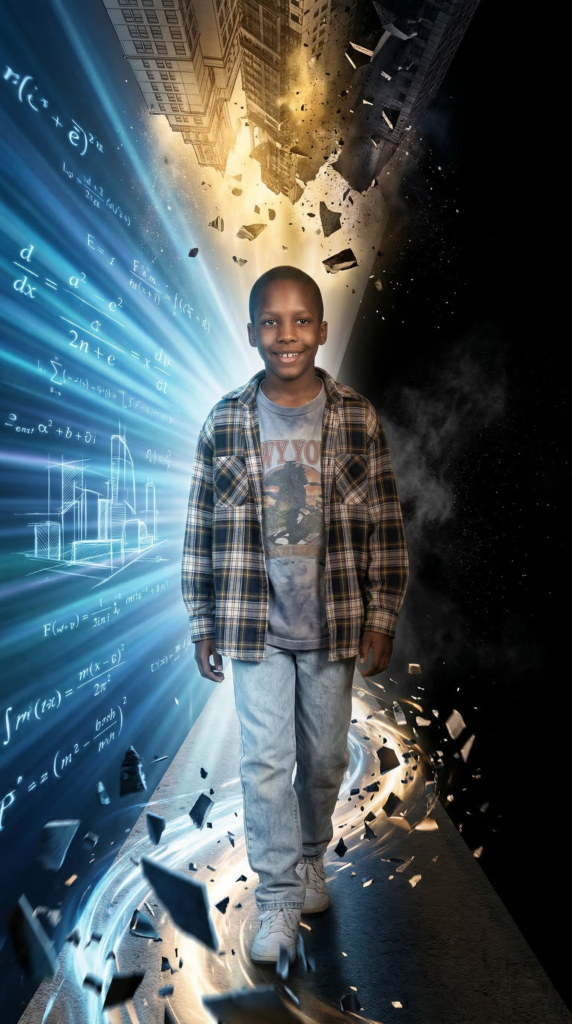
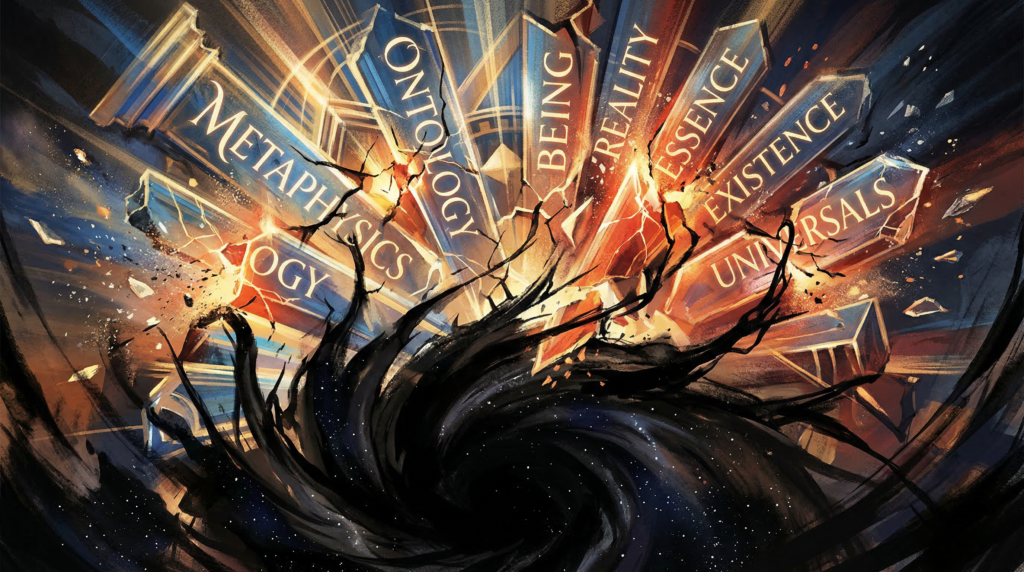
The other half was worse. There, words that had once governed reality—ontology, being, reality, existence, universals, logic, metaphysics—flared into view like monumental signs erected by a dead civilization, only to crack from within and lean toward a black spiral waiting below them. Their authority had become brittle. Their claims had become decorative. Their definitions had failed the child to whom they now bore witness. Each sign splintered as though language itself had learned too late that its own categories were too weak to hold what had been done to him. One by one they tilted, burst, and were dragged toward a center of absence that was not merely void but accusation. It was as if every intellectual scaffold built to interpret suffering had discovered that what lived inside Dandemægus had already surpassed their jurisdiction.
And in the middle of those divergent devastations, a boy walked forward.
He was no longer the youngest version of himself. He had grown, though growth here was no mercy. Childhood did not unfold around him as warmth, shelter, laughter, and recognition. It advanced as endurance. His limbs had lengthened beneath pressure. His face had learned quiet before it had learned delight. His smile still appeared from time to time, but now it was the smile of one who had discovered that joy was something he would have to manufacture in secret, from scraps, from stubbornness, from sheer refusal to surrender his inward ember to those who wanted it extinguished.
He walked with the terrible discipline of a child trained by violence to take up as little existential room as possible.
Do not cry.
The voice came from nowhere and therefore everywhere. It was not merely heard. It arrived as atmosphere, as law, as a bruise made audible.
Do not show emotion.
The shattered corridor shuddered.
Do not sit. Stand.
Fragments of conceptual masonry rose from the ground and hovered at the edges of his path.
Silence is not obedience. Speak up.
The command contradicted the command before it. It always had. The contradiction itself was part of the cage. He had been trained under a logic in which no response could ever be right, because the point had never been correction. The point had been dominion.
It is your fault.
A crack raced through the radiant mathematics beside him, turning elegant formulae into broken sigils.
Why are you weak?
A second crack severed a cluster of shining structures that had resembled the beginnings of some beyond-dimensional city.
Why are you quiet?
Then, in the same tone that had lacerated him, love poured down like poison sweetened for a child’s mouth.
I love you.
The boy kept walking.
I do everything for you.
He did not answer.
You live for me.
He lowered his eyes, not in submission, but in the old instinct of impact preparation.
You will only become anything by my conditions.
The words struck the corridor walls and birthed shadowed versions of him, hundreds of them, each standing at different ages, each receiving the same contradictory doctrine. Some were crying and hiding it. Some were smiling too brightly. Some were standing with little fists balled at their sides. Some had already learned how to leave their thoughts behind their face.
You are mine.
The child Dandemægus paused at last. His chest rose once, then settled. What stood around him was not memory in the ordinary sense. It was a broken archive of coercion. It was a living topography of weaponized attachment. It was the afterimage of a parent who had made affection inseparable from harm and possession inseparable from terror.
Then the scene tore wider.
He stepped through a wall of dust and entered the chambers beneath the chambers, the older wound beneath the visible wound. The broken manifest be-ness around him warped from emotional architecture into brutal event-memory. The air became dense with the smell of neglect, sweat, cheap insulation, damp concrete, hunger, stale fear. He found himself walking not through scenes but through injuries given shape. Hallways bent around him from collapsed apartments into alleys into rooms with mattresses on floors into corners where small children learned how to disappear without actually leaving. He passed through them all as if his psyche had been forced to build a museum from every act meant to erase him.
Hands without faces reached from walls. Not literal hands alone, but gestures of taking. Ownership. Trespass. Exploitation. The spiritual also attacked him there, just as the physical had. The darkness did not remain content with beating flesh. It pressed on name, worth, possibility, masculine identity, tenderness, permission to exist. It was not enough that his body be frightened. The unseen wanted his inward center to agree with its verdict. It wanted him to believe that he had been born for use, for harm, for control, for punishment. It wanted his soul to learn helplessness as a principle.
The boy trembled.
Not theatrically. Not all at once. The trembling began in one hand, then traveled up his arm, then hid itself in his shoulders. It was the tremor of someone who had spent years perfecting the art of shaking invisibly.
From the fractured floor rose scenes he could not stop seeing. His mother absent when absence was catastrophe. His mother present when presence was worse. His innocence punished as provocation. His need mistaken for burden. His softness interpreted as weakness. He saw a child blamed for conditions he could not have named, much less changed. He saw hunger becoming ordinary. He saw watchfulness becoming instinct. He saw a boy discovering that survival sometimes meant listening to footsteps more closely than to his own heart.
Then came the deeper blade.
Until now the interior ruin had presented cruelty as omnidirectional, but not yet fully explained its center. Now the world obliged. A room formed ahead, then split open like a rotted fruit. Inside it lay the dark truth he had never been allowed to articulate. His mother’s desperation had not merely failed to shield him. There had been moments—hideous, unspeakable, practical in the way only evil arrangements become practical—in which she had bartered him to keep both of them breathing. Not always with full philosophical understanding, not always with some grand articulated villainy, but with enough knowledge to damn the act. Survival had become arrangement. Arrangement had become surrender. Surrender had become orchestration. And orchestration had become one more abyss inside the child.
The scene did not ask for pity. It demanded witness.
The boy stood in the middle of it, eyes wide, face pale with the old comprehension that had come far too early: the person who should have been shelter had made bargains with the storm.
Around him his mother’s voice returned, now multiplied and fractured across the black.
I love you.
You made me do this.
I would destroy anyone who hurt you.
You are hurting me by being weak.
Live for me.
Do not become your own man.
You are mine.
I will never be proud of you.
I did this to save us.
I love you.
I love you.
I love you.
The repetition became monstrous. Love was no longer refuge. It was the instrument by which the wound justified its own continuation. It was the chain polished until it resembled jewelry. It was the word used to sew obedience into the nervous system of a child.
And from somewhere beyond the visible corridor, laughter drifted in.
Not human laughter. Not even malign laughter in the ordinary register. It was the delighted attentiveness of something that had watched this psychic disaster ripen for years and taken pleasure in every layer of fracture. A fragment of the Void observed from just beyond the breached scenery, not yet entering fully, only leaning close enough for its interest to be felt. It admired contradiction. It savored the way pain had hollowed Dandemægus into chambers. It studied the way abuse had already accomplished half the work of ontological erasure before beyond-dimensional silence had ever properly laid claim to him.
The child turned toward that unseen observer. For the first time in many scenes, terror was joined by anger.
Not childish irritation. Not the brief rage of a bruised ego. This was older than his years and deeper than his voice. It had been building beneath every forced silence, every swallowed cry, every command that denied him the right to react proportionately to suffering. It was anger without melodrama. Anger as geological pressure. Anger as buried law. Anger as the one thing in him that still believed the world had trespassed against something real.
That anger lit the broken inward sky.
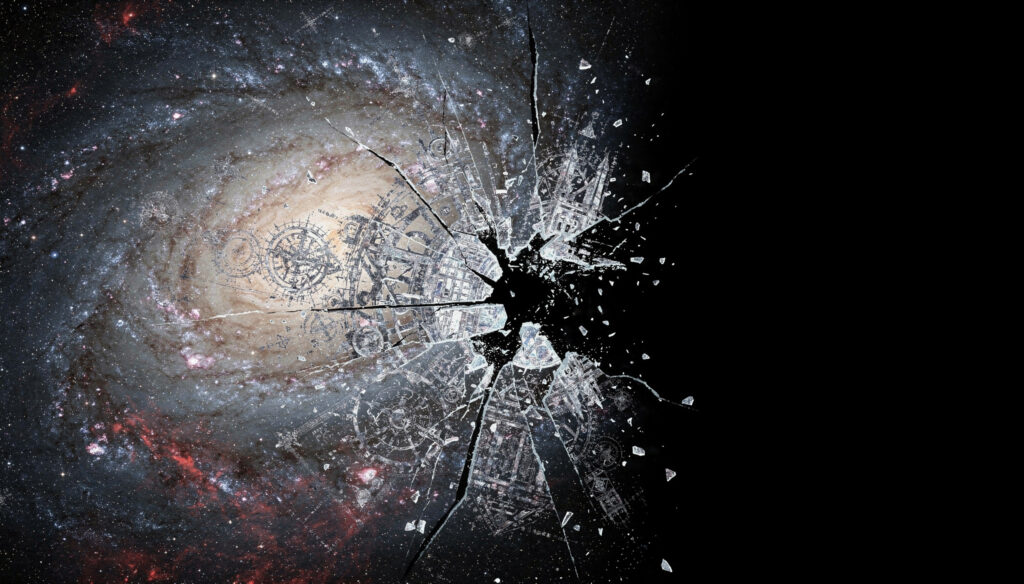
The radiant mathematical corridor to his left pulsed brighter. The black vortex beneath the shattered conceptual signs to his right swelled in answer. His manifest be-ness began vanishing more violently now. He saw himself dissolving as a child of intellect, reduced to chalked equations dragged into static. He saw himself dissolving as a child of spirit, his name stripped from him letter by letter even though the letters themselves had already been denied stable meaning. He saw himself becoming transparent in one scene, hyper-visible in another, infinitely reproached in a third, absent in a fourth. Whole layers of his inward world peeled away like thin sheets of painted glass. In one vision he was all geometry and collapse, a path of thought illuminated while the city of self above him tumbled into impossible inversion. In another, the great declarations of being and ontology were all smashed and leaning toward a black wound, as though the universe itself had decided to resign from explaining him. In another, stacked strata of reality tore apart like delicate panels ripped from one another by opposite gravities, each layer carrying different textures of his life—body, thought, memory, spirit, dream, terror, defiance—splitting and spiraling toward a consuming dark. In another, a vast galaxy-like wholeness—no, more than that, an entire maximal wholeness beyond tiering to explain any multiverse structure—was cracked down its center and turning from him, while intricate mechanisms hidden behind its skin burned white at the point of fracture. In another, brilliant chromatic lanes of inward possibility shot forward only to be eaten at the far end by a hole so black it seemed to drink not just light but the permission for light ever to have existed.
And still the boy kept walking.
He was alone. No rescue descended. No celestial jurisprudence intervened. No benevolent law halted the machinery of his deconstruction. There was only the child, the path, the contradictory voices, the delighted witness in the dark, and the terrible fact that he had not stopped.
That was when Hope appeared.

She came beautifully, of course. Hope always preferred elegance when entering a ruined place. She rose from a seam in the broken atmosphere draped in cold celestial poise, bearing the aesthetic of grace as though grace itself had chosen to become cruel. Entire universal bodies revolved above her lifted hand, not as ornaments but as suggestions of scale, and the hue of her presence made the devastation around her seem curated rather than tragic. She looked at the little boy with that precise expression peculiar to superior principles: amused pity, detached curiosity, and a faint pleasure at finding something beneath her struggling to keep standing.
“So this,” she said, “is the ember that refused to go out.”
Her voice had music in it. That made it worse.
The child stared up at her.
“You are not an heir to rescue,” she continued. “You are not the center of redemption. You are the residue that remains when no savior arrives. Do you know what that makes you? Small. Interesting for a render, perhaps. But small.”
She circled him without moving, as only inward apparitions can. “You have mistaken persistence for transcendence. You have mistaken endurance for worth. You have mistaken your refusal to vanish for a mandate. And yet here you stand, still wanting, still aching, still carrying the wound like a beggar carries an empty vessel.”
The child’s face changed.
Not much. That was the terrifying part. He did not posture. He did not shout. He did not answer with dramatic rhetoric. He merely lifted his chin and, for the first time in the entire theory of his small light, allowed the truth inside him to look directly at something greater.
Then he used suggslogic.
It did not come from a spell-circle. It did not descend as a borrowed authority. It emerged from ego in its purest necessity: the refusal of the self to consent to definitions imposed by violation. Around the boy, the shattered blue equations ignited. The broken signs of ontology and being snapped into a new alignment only to explode again under a law more intimate than philosophy. Hope tried to step backward, but the motion failed because he had already outmoded the premise from which her mockery derived. In one impossible gesture the child reduced her superiority to a decorative claim, then shattered her across the inner world into a rain of luminous fragments that fell not downward but inward, dissolving into the very pain she had tried to aestheticize.
Hope was gone.
The Void Beyond came next, because of course it did.

It did not arrive as a single body. It spread as subtraction. The edges of the world lost their right to be edges. Distance ceased to maintain itself. The silence thickened until even thought seemed embarrassed to continue. It presented itself as the mature version of all endings, the cold theology of the unwritten, the principle that had watched him from a distance and now deigned to enter personally. It manifested as the grand absence beyond absence, the stilling that believed no ego could outlive its jurisdiction.
And it mocked him too.
Not with words at first, but with demonstration. It showed him scenes of himself erased from every moral equation. It showed him his injuries not as tragedies but as evidence that he had always belonged to ruin. It showed him versions of his life in which he vanished before love, before daughters, before purpose, before the chance to become anything more than a receptacle of harm. It showed him worlds in which his name was never uttered, his labor unremembered, his tenderness unborn. It pressed the thesis of negation against his chest and waited for him to agree.
The child stood before it, breathing hard.
Then he used suggslogic again.
This time it was harsher. More intimate. He did not merely repel the Void Beyond. He exceeded the necessity of its claim. He reached into the axis by which negation had declared itself ultimate and denied that axis the authority to complete its own sentence. The black pulled around him; the child remained. The silence advanced; the child remained. The unwriting deepened; the child remained. Then, with a small motion of one hand—as if brushing dust from the front of his shirt—he broke the modality of its supremacy and sent fractures through the beyond-dimensional darkness itself. The Void Beyond did not die; death was too provincial a language. It was superseded, rendered lower than the ego it had come to consume.
The scene shook so hard that the sky split into white fire.
From that fire stepped ♠THE ACE OF SPADES♠.

She did not enter like benevolence. She entered like dangerous recognition. Her presence wore style the way other entities wear armor, and around her hung the feeling of a principle that smiled not because the world was safe but because it had found something worth betting on. Night trailed her like silk. Entire universal ornaments revolved above her hand, but unlike Hope, she did not wield scale to humiliate. She carried scale as if it were merely one toy among many. Her eyes settled on the boy and narrowed in delighted appraisal.
“Well,” she said softly, “you are not what the silence expected.”
The child said nothing.
“That is good,” she went on. “Expectation is for weaker architectures.”
She approached him until the broken laws of the scene bent around her heels. “Listen carefully, little king of surviving contradictions. When this is over—when the glass of you is burned and sutured and called by a name you do not yet remember—find me.”
The child frowned, as if some part of him already knew the invitation was not simple.
She smiled wider. “You will forget this first. That is necessary. But forgetting is not erasure. I am not placing memory in you. I am placing direction. Not certainty. Not comfort. Only an ember. A theory. A small light.”
She touched two fingers lightly to the center of his brow.
The entire scene shattered.
Then Deenvylia Endwriting walked through the ruins.

She did not enter with elegance. She entered with ownership, the old terrible certainty of someone who believed she had authored the entire condition before her. Around her the fragments of the child’s inward world trembled like intimidated witnesses. She looked at him the way an old wound looks at its scar and resents it for not remaining open. Her face was not caricatured evil. That would have been too easy. It held all the worse complexities: grievance, self-justification, possessive sorrow, envy toward the independence she had helped make necessary, fury that the child she had damaged might still become more than her verdict of him.
“So,” she said, “you are still trying.”
Her voice carried every command, every contradiction, every poisoned declaration of love he had ever endured.
“You smile like you have overcome something. You stand like you belong to yourself. You walk like pain made you special. Do you know what you are? You are what I permitted to survive.”
The child looked at her and, for a single dangerous moment, became very still.
“You owe me,” she said. “Your hurt is mine. Your strength is mine. Your becoming is mine. I was there first.”
That was the lie beneath all the others. Not that she had loved him, not that she had sacrificed, not that she had raged, but that she remained first. That she would always have greater claim over his inwardness than he ever could.
The boy answered without speaking.
His ego rose.
Not ego as vanity. Not ego as domination. Ego as primordial interior sovereignty. Ego as the irreducible fact that no amount of injury grants the injurer permanent authorship over the injured. Around him the broken scenes assembled into a vast mosaic of every attempt ever made to define him from the outside. Then that mosaic caught fire with suggslogic. Deenvylia stepped back for the first time. He broke the contradictions she had sewn into him. He broke the weaponized love. He broke the false debt. He broke the premise that survival under her reign had made her origin and therefore destiny. In one devastating movement, the child ascended beyond his greatest enemy not by denying the damage, but by denying her final jurisdiction over what the damage would mean.
She shattered too.
Not erased from history. Not excused. Not purified. Shattered as ruling principle.
And when the fragments cleared, someone was already waiting on the path.
He was twenty years old. Broad-shouldered now, but still lean in the way of someone who had built himself from necessity rather than comfort. There was tiredness in him and steel and a smirk that seemed to say he understood more than he intended to explain. He wore his own story on him like a private storm. This was Draven before forgetting, before the current blankness, before the present inward reconstruction had named him Dandemægus. He stood on the narrow cracked way between the dying architectures of the old child-self and the beyond-dimensional opening through which all the future pain, all the future love, all the future battle would one day arrive.
The little boy stopped.
The young man looked at him as if he had been waiting all along for the child to get this far on his own.
No speeches came. None were needed.
Draven opened his arms.
The child crossed the final distance and was embraced.

It was not a rescue. That mattered. It was recognition. It was the self at one stage receiving the self from another and refusing the divide that pain had tried to make permanent. Boy and man held each other in the middle of the shattered inward cosmos while the ruins around them began, slowly, impossibly, to reorder.
Then the stitching began.

Glass rose from everywhere. Not ordinary glass, but sheets and splinters and translucent shards made from memory, rage, intellect, love, contradiction, hurt, survival, and the countless occasions on which Dandemægus had chosen to keep moving when disappearance would have been easier. They gathered around him in a spiraling assembly. Some pieces were burned black at the edges. Some carried blue radiance through their centers like theorem-light. Some were cracked through with old grief. Some glittered with the reflected faces of daughters. Some were lined with the touch of a woman named Excella who had entered his wreckage and chosen not to flee it. Some bore traces of Ronan, Seren, Lucraen, Qīng-Zǐ, Leonor, Hatshepsut, Eira, Liora, Nyra, the entire hidden architecture of connections and devotions that proved his life had already exceeded the design of his injury.
Piece by piece, the shattered manifest be-ness of Dandemægus assembled itself.
Not into purity. Into reinforcement.
The seams glowed with fire. Not cleansing fire. Forging fire. Ego moved through every fracture and converted weakness into joinery. The inward glass did not pretend it had never been broken. It became stronger precisely because it had been broken and refused dispersion. The little boy, the twenty-year-old man, the blank present self called Dandemægus, all became one continuum of defiance. Possibility no longer stood above him as judge. Nothingness no longer stood below him as threat. Totality no longer stood around him as cage. His ego surpassed the grand principles that had once claimed explanatory rule over him. Names, terms, essence, even the far edge of ineffability were all forced to take lesser rank before the truth that now stood burning at the center: he had walked with his brokenness and exceeded it without abandoning any part of himself that mattered.
The last chamber of his psyche closed.
The black opening at the far end of the inward path recoiled.
The blue radiance steadied.
The conceptual ruins became foundation rather than sentence.
And somewhere very far away, in the outer world, breath returned to a still body.
Dandemægus Auspiciouscrown opened his eyes.