
Penultimate Truth V — The Month the World Pretended to Heal
Before the human world could measure the damage in sirens, missing persons reports, hospital capacity, rolling blackouts, fractured masonry, broken satellites, failed crops, dead animals, vanished children, and the sudden terror in the eyes of people who had looked at the sky once too long, the deeper collapse had already begun.
Possibility - The Principle was collapsing.
Nothingness - The Principle was collapsing.
Totality - The Grand Principle of Creation was collapsing.
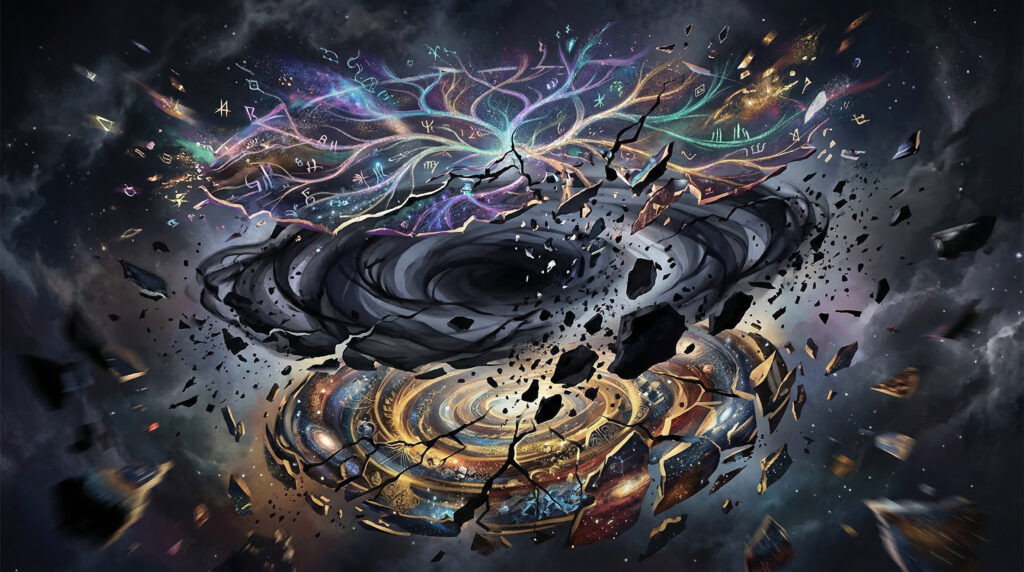
Not as abstractions debated in old rooms by minds seeking the right vocabulary for impossible things, but as operative maximal architectures on both macrocosmic and microcosmic scales. Across the greater boundless reality-fiction layers, entire potential continua were tearing loose from the structures that had once hosted them. Branching outcomes did not merely diminish; they caved inward like hollowed towers. Futures that should have remained available went dark in boundless chains, one after another, as though some hand beyond formal and informal description (and its intensions and extensions) had begun crossing them out at the root. On the macrocosmic level, whole starfields lost the permission to become in more than one way. Galaxies did not merely collide or collapse; they suffered decision-death. They were forced into singular terminal shapes while the countless alternatives that once haloed them were stripped away and pulped into negation. Nebulae folded into black wounds. Spiral systems cracked like frozen gears. Radiant cosmological strata that had once held myriad possible arrangements of matter, law, and narrative became rigid, stressed, and then catastrophically empty.
At the same time, on the microcosmic level, the same collapse expressed itself through smaller and therefore crueler failures. A thought would begin and arrive already narrowed. A hand reaching for a doorknob would feel, for one hateful second, that all other ways of completing the motion had been amputated from existence. A dying patient in a ward would not merely lose hope; the surrounding room would seem to lose the argument that hope had ever been locally admissible. Lovers in bed would find their possible tomorrows thinning to a frightening single thread. Children choosing whether to run, hide, trust, speak, sleep, or scream would do so inside a world whose available paths had become visibly fewer. Even dust motes in sunbeams and blood cells in living arteries seemed, in the hidden architecture beneath their ordinary behavior, to be moving through a maimed field of diminishing options.
Nothingness, too, was collapsing, which should have been impossible to ordinary thought, and yet the world made room for impossibilities now with the exhausted obedience of a body long accustomed to abuse. The negative fields that usually bordered failed realities, erased choices, dead cosmological layers, and the aftermath of unmaking had begun to crumple under the pressure of the Fractiflux presence. They did not remain passive absence. They spasmed. They folded inward, then outward, vomiting scraps of deleted geometries and dead symbolic weather into neighboring strata. Places that should have remained cleanly empty became noisy with broken refusal. Voids bled residue. Silence developed texture. Subtractive regions ceased to behave as final ends and instead started convulsing like collapsing lungs.
And Totality, that grand and arrogant assumption that all things could still be held together inside one final inclusive expression, suffered the worst humiliation of all. It split. At the greatest scales, whole cosmological aggregate fields cracked like plated glass, exposing the obscene truth that the all had never been as singular as it pretended to be. There were ruptures through which lower and higher manifolds glimpsed one another in mutually injurious ways. There were tears through which devoured systems, unborn systems, and dead impossible systems could briefly be seen overlapping like injuries in the body of a larger world. Totality failed not because it was weak, but because the Fractiflux were stronger than the principle required to host the idea of everything at once.
That was the scope of their presence.
The Fractiflux did not have to move everywhere in order to ruin everywhere. Their sheer manifestation inside the source-instance radiated upward and downward through the whole of layered existence. The world Adelaide knew, the world its humans touched with taxes, grief, lust, hunger, bus routes, medicine cabinets, rent deadlines, and family arguments, was only one skin over a cosmological body that had entered open crisis.

And in that crisis, one of the prisoners began to disintegrate.
It happened far from any ordinary witness, in a zone where collapsing possibility and folding nothingness had met in the middle and become a wound suspended over the absolute infinite multiplicity of reality-fiction tiers. The Fractiflux projection stood there in its towering chrome-black horror, red seams burning through its face, partial body still magnificent with impossible compression, yet something fundamental in its coherence had gone wrong. The elegant violence of its frame had begun to come apart not under assault in the usual sense, but under a deeper and much more humiliating correction. Pieces of its projected body flaked into fine black particulate and then into silver dust and then into nothing at all. Anti-local structures beneath the chrome shell sputtered. Its inverse ontological field failed to stabilize. The air around it whitened with particulate damage and then grew startlingly clear, as if reality itself were being relieved of a burden.
The Fractiflux tried to hold.
It failed.
The disintegration climbed through its body in shimmering fractures, up the torso, across the shoulders, through the weapon spines, through the cruel grace of its jawline and the cold architecture around its eyes. Every layer of its projection seemed to remember too late that it no longer had permission to continue. Its local burden of nine hundred thousand tons dispersed into harmless conceptual dust. Its attack lattice collapsed. Its higher anchoring lines snapped one by one and recoiled into the damaged backdrop of creation.
It might have looked like spontaneous failure to lesser observers.
It was not.
A young woman stood at the edge of the phenomenon with one hip slightly angled and a smile too bright for the scale of what she had just done.
Melancholia Lostchild did not enter the scene like a conqueror. She entered it like someone who belonged in no official file and never intended to. She looked almost insultingly human beside the dying Fractiflux. She stood in the open city light near old sandstone and tramline infrastructure, as though she had wandered out of a completely different story and happened to stop at the exact place where cosmological corrections were needed. Her haircut was short and sharp around the face, playful in its silhouette and controlled by a kind of self-invented disorder. Her expression carried the impossible mixture of youth, amusement, and ancient private damage that belonged to those who had been overlooked so thoroughly they had learned how to turn neglect into authority. She wore a cropped SUGGS shirt cut with casual defiance, black arm sleeves marked by clean pale lines, black distressed shorts with hanging straps, and lace-up high-heeled boots that made her look like a riot disguised as a fashion decision. One hand hovered near her cheek as though she were listening to a joke no one else deserved to hear.

She was the cause.
No fanfare announced it. No title card appeared over her head. No explanatory voice descended from above. Yet the proof stood in the way the Fractiflux projection kept coming apart in her proximity, as though her existence occupied some secret antagonism to theirs that the world itself had been waiting to exploit. She did not cast visible circles. She did not chant. She did not need to. Something about Melancholia Lostchild, something private and bitter and carefully sharpened, made the Fractiflux fail. She stood there smiling as if this sort of cosmic disassembly bored her slightly, as if a being that could collapse possibility, nothingness, and totality at once was still just another obnoxious thing she had decided not to tolerate on her street.
When the Fractiflux finally lost its last local anchor, it did not explode. It thinned into non-admissibility and then vanished altogether, leaving behind a great clean absence that the world rushed to fill with relief.
After that, stabilization came in waves.
Not complete peace. Never that. Just restoration enough for ordinary people to begin lying to themselves again. The boundless fractures in possibility stopped propagating at the rate they had been. Negative fields of nothingness quit convulsing quite so violently. The wounds in totality held together under emergency pressure. Broken cosmological plates re-aligned. Dimensional stress did not cease, but it dropped from catastrophic scream to survivable groan. Across the visible world, infrastructures resumed pretending they had not almost been rendered irrelevant. Governments issued statements. Agencies buried footage. Religious opportunists sharpened sermons. Conspiracy markets bloomed. Insurance categories expanded. Cities exhaled with the exhausted embarrassment of people caught sobbing in public.
And in the measurable arithmetic by which humans counted endurance—thirty mornings, four full weeks and change, payroll cycles, rent dates, tram schedules, grocery receipts, bruises yellowing then fading, cuts sealing, hair growing, embers cooling, coffee going cold beside unread messages—one month passed.
In that month, Adelaide did not become safer.
It became more honest.
The world Excella Angelicus had begun describing to Dandemægus Auspiciouscrown over breakfast stopped being theory and became their daily terrain. They moved through it together now, not yet with the smooth telepathy of partners who had spent years on the same edge, but with something more volatile and intimate: fast-growing trust. He was still a blank slate in history, but not in instinct. She was still fully herself, which meant she could love him without once softening her standards. Between them, Australia became less a location and more a live case file the size of a continent.


The missions came in clusters.
Sometimes the first warning came through her phone. Sometimes it came through back-channel hunter networks, ruined ley maps, hidden medical boards, terrified social workers, shelter coordinators, old police contacts who had long ago learned what categories never made it into official databases, or clients from her earlier life who knew exactly how impossible a situation had to become before they risked calling Excella Angelicus directly. Her phone never stayed quiet for long. That was one truth Dandemægus had to learn early: he had entered her life, not erased the previous architecture of it. There were still old worlds orbiting her. Unanswered institutional emails. Secure messages from former scientific teams. Voicemails from a hospital board begging her to consult on a pediatric cluster no one could diagnose. A judge from another country asking, through several layers of unofficial language, whether she would review a private legal archive tied to ritual murders. A retired intelligence operative warning her about transit patterns and missing freight manifests. A sports promoter, astonishingly, still sending offers as though multi-divisional world glory might be coaxed back with the right purse. A former colleague in aerospace forwarding telemetry anomalies that looked less like space weather and more like the upper sky remembering older wars. Her life before Dandemægus had not collapsed when he arrived. It had simply been forced into new proximity with him.
She checked her phone often because that was how the world reached her.
And the world kept reaching.
One week into the month, they hunted a Colossai under the rusted bonework of an abandoned freight interchange beyond the city fringe. The thing had grown out of a ruined military transport archive and a nest of failed predictive engines, standing like a blasphemous shrine to armored futurity. Its body was cathedral-black and plated with pale metallic seams. The weapon fused into its arm was not a gun in the human sense but a compression lance for city-scale subtraction. It had already erased three warehouses, partially disassembled a truck convoy into drifting particulate, and turned an entire concrete loading yard into a crater of uncooperative matter. Dandemægus arrived in white and gold synth-fabric combat wear that seemed to have found him rather than the other way around—clean-lined hoodie, plated knees, reinforced gloves, the word SUGGS across his chest like something between brand and vow. Excella came beside him in a black split-sided dress that moved like old danger and high heels she used as if they were born from the same logic as knives.
The Colossai launched first.
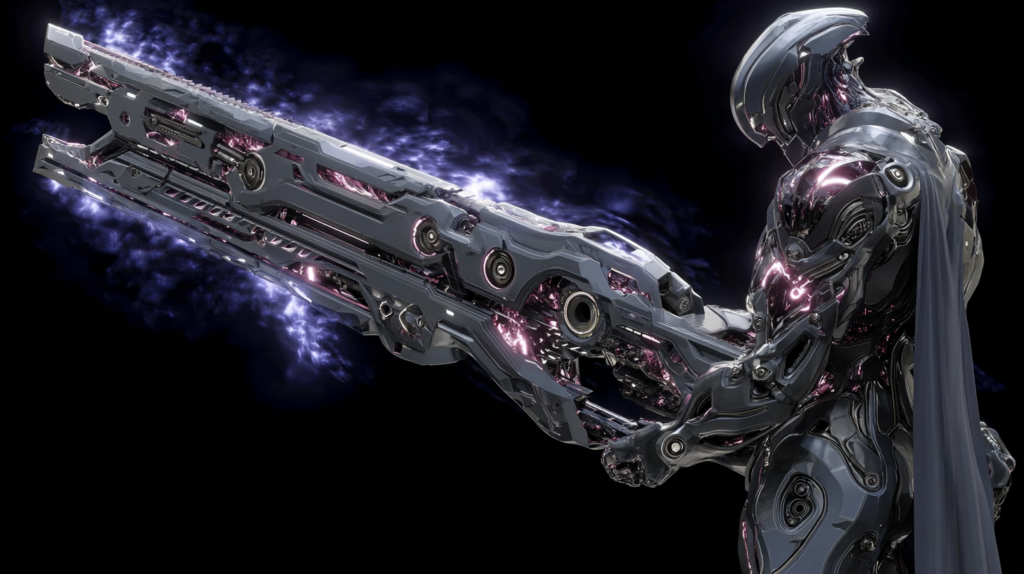
Dandemægus took the beam on collapsed pataphysical terms and made its city-killing argument fail before it reached his skin. Excella crossed under the collapse and rose with her violet-edged blade, carving through the weapon architecture along its moral weakness rather than its mechanical seam. The thing never understood why its scale stopped mattering. Colossai usually relied on spectacle to terrify human prey into stupidity. These two did not offer it stupidity. Within 0.01 attosecond it was down on one knee; within 0.02 attoseconds it had been distributed into harmless slag, then traced, cataloged, and burned under a warded fuel mixture Excella kept in the trunk for exactly that kind of cleanup.
Two days after that, they found the first Voideater.
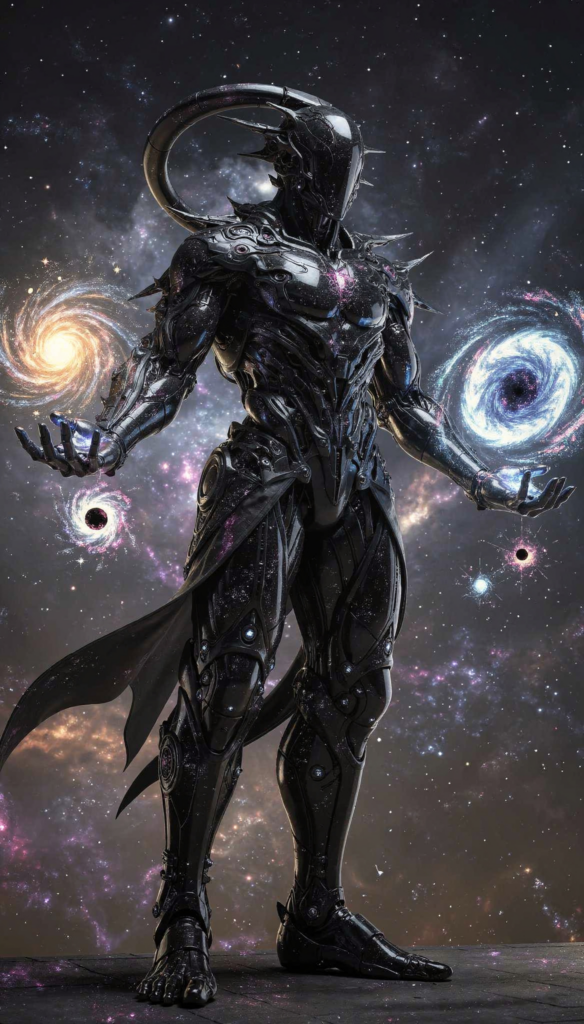
It had been feeding in the drowned under-levels of a condemned medical annex where old flood damage, failed memory-wards, and emergency triage deaths had created the right psychic broth for predation. The Voideater did not look like an animal. It looked like a cosmological appetite forced into a body it had not earned: black armor smooth as midnight oil, internal starfields shifting beneath its chest, hands cupping spirals of dead and living galaxies as if they were snacks or instruments. Its faceplate held no mouth, yet the hallways near it showed unmistakable signs of consumption. Names vanished from charts. Family photographs whitened from the center outward. Nurses who had once worked there and returned out of guilt reported the sensation of having chunks of their dead loved ones bitten out of memory while they stood awake.
Excella and Dandemægus found it standing knee-deep in shadow-water beneath buzzing maintenance lights. The thing turned and raised its hands and the local void around them thickened. Dandemægus’s skull immediately lit with pain, some hidden fracture in him recognizing kinship and violation at once. Excella stepped in anyway, because she had long ago decided that hesitation in front of the hungry only fattened them. Her sword opened a rotating violet wound through the thing’s feeding field. Dandemægus seized the moment, reached with both hands, and forced the false negative around the Voideater to collapse into finite grief. Once grief had edges, the thing could be fought. Once it could be fought, it could be stripped from the hospital understructure and dispersed into sealed null-flasks lined with sigils Excella kept for emergent extraction. They walked out with their boots wet and their nerves shaken and four stolen memories restored to a woman in the parking lot who had come only to visit the place where her sister died and left instead remembering her sister’s voice properly for the first time in months.
The second Voideater came a week later and was worse.
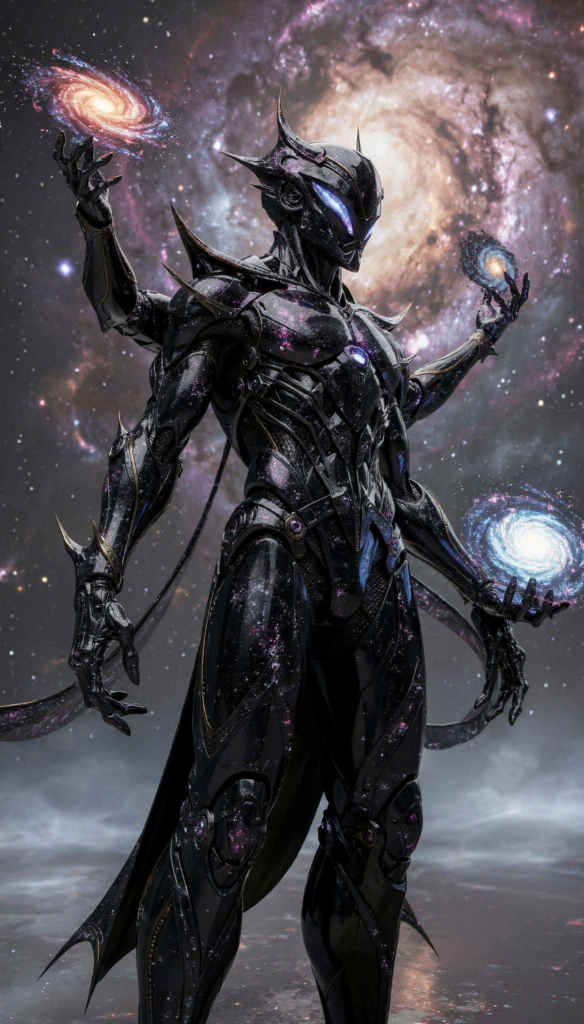
That one had matured farther. It carried universes of infinite complexity and size more confidently, almost elegantly, as if the act of holding cosmic systems in its palms had become part of its self-image. It had nested in a private collection chamber beneath a wealthy suburb, feeding not on grief this time but on hoarded potential. The rich owner of the estate had been stockpiling occult securities against catastrophe—designer relics, adaptive shields, predictive bones, crystallized branch futures—and the Voideater had come to feast on all the unspent tomorrows he tried to buy. By the time Excella and Dandemægus entered the chamber, the floor was slick with the residue of failed futures and the owner sat in the corner aged nearly to dust, not dead, but emptied of every version of himself that might have mattered. Dandemægus fought that Voideater differently. Instead of forcing collapse immediately, he let it widen its feeding field and then answered with neo-suggslogical counter-inscription, red-blue law spinning over his palms until the creature’s star-eating appetite was trapped inside a stricter grammar than it had ever respected. Excella severed its access lines. He made its own hunger recursive. It ate itself into uselessness and fell apart as beautiful black ash.
Not all their hunts were against cosmic things.
Some were against men.
That was harder for Dandemægus in a different way.
They broke a trafficking corridor operating out of refrigerated freight containers along an industrial spur where children had been moved through layered paperwork, false employment visas, drug sedation, ward-disruption tattoos, and the private indifference of those paid to look away. Excella had received the lead from an old detective certification network she never fully abandoned. The visible authorities had already missed the pattern because the visible authorities often saw poverty first and people second. Excella and Dandemægus arrived ahead of the raid that would never officially be called a raid. There were seven kids alive in the containers, three of them too dehydrated to stand, one boy convinced no adult voice could possibly mean safety anymore, one girl still clutching a grocery receipt because it was the last thing from before. Dandemægus, who could face Fractiflux without hesitation, nearly broke when that little girl handed him the receipt and asked whether it counted as proof that she used to live somewhere else.

Excella watched him kneel so he wasn’t towering over them. Watched him take the receipt with the same care he used for active spells. Watched some old unnamed father-sorrow move through his face, sharp and private and almost unbearable to witness. He was magnificent in battle. He was most dangerous when he became gentle.
They cleared the corridor. They recovered records. They handed the surviving network nodes to people who would not lose them in paperwork. Excella spent three consecutive days after that on her phone setting up off-book housing, medical treatment, clean identities, and a covert line to a shelter system that would actually keep the children hidden from the market that had tried to swallow them. Dandemægus spent those same days sitting on the floor of one temporary safehouse while a frightened boy taught him a card game badly and then cried because someone had stayed long enough to let him teach anything at all.
They did the same sort of work with the unhoused.
That surprised him at first. He had expected the hunts. He had expected monsters, weapons, occult corridors, violent rescues, night operations. He had not expected that Excella’s war included paperwork, hot meals, detox referrals, shelter navigation, legal aid, emergency dental vouchers, phone charging stations, trauma-informed check-ins, street medicine kits, and the long humiliating work of helping people reclaim ordinary logistics after the world had stripped even their mailing address from them.
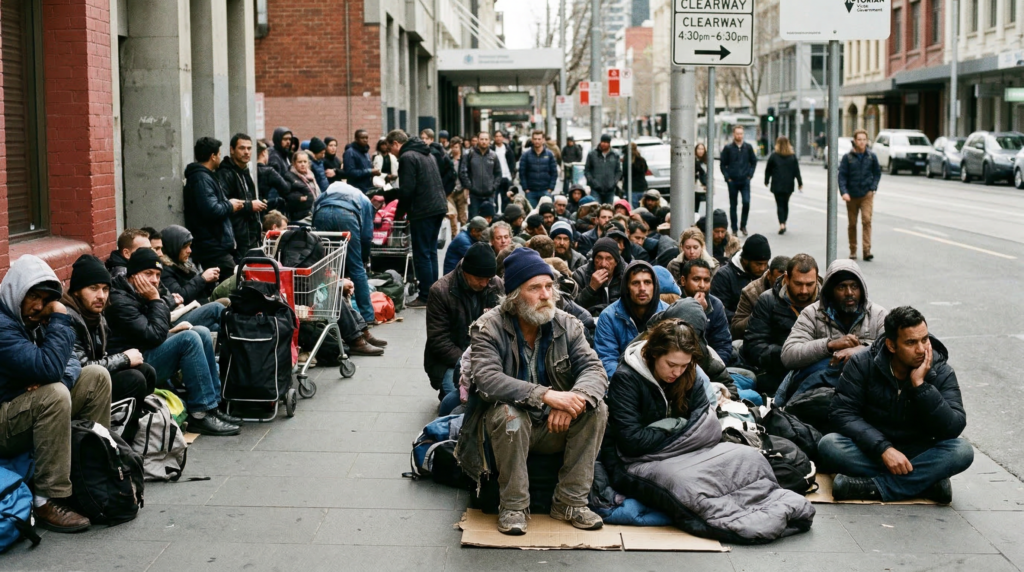
“Monsters love the uncounted,” she told him the first time he asked why she spent so many hours on that side of the work. “People with no paperwork, no family advocates, no lease, no witness chain, no one calling when they vanish. That’s why the street matters. If you help stabilize the ones the city thinks are disposable, you don’t just do good. You disrupt feeding patterns.”
So they learned names.
They learned the older man with the split knuckles who slept outside the bus corridor because enclosed shelters made him relive a cargo container from thirty years ago. They learned the teenage brothers rotating between couch offers because their mother’s new boyfriend had turned the house into a night problem. They learned which girls were pretending to be older than they were. Which boys laughed too hard at violence because terror had calcified into bravado. Which people needed food first, which needed quiet, which needed to be seen without being stared at, which needed a blanket, which needed a social worker, which needed a hunter because something old and parasitic had started circling them when no one else would.
Excella worked her phone almost constantly on those days. She called old judges for emergency injunctions. Old medical contacts for psychiatric beds that would not become holding cells. Former police academy peers who still knew how to use the rules against those who weaponized them. A brand strategist once saved by her intervention rerouted funds through a charity shell. A hospital chief bent triage classifications. A mathematician she had taught years ago now ran a predictive model for shelter overflow and sent her the likely dead zones two days before ordinary city services admitted strain. This was what Dandemægus began to understand: Excella had not left her old lives behind. She had kept them and changed their vector. Every mastery she once held publicly now existed in reserve, available to be weaponized in service of people the polished world left outside.
And through all of it, whenever Dandemægus was away from her too long, the migraines came.
They were not headaches.
They were ontological ruptures pretending to be private pain.
The first truly bad one struck on a morning when Excella had gone three suburbs over to follow a lead tied to counterfeit relics moving through a legal auction house. She left him with a list, a number to call, and a kiss sharp enough to keep him smiling after the door shut. He made it twenty-three minutes alone before the fracture started.
He was in the downstairs study trying to make sense of an old Australian ward map she had left open for him when the room doubled. Then tripled. Then the walls changed their opinion about whether they were made of painted plaster, wet black brick, or the interior of some larger, impossible archive. He gripped the desk and instantly felt three different versions of its surface under his hands. The migraine did not arrive in a line. It arrived like a vertical collapse through him. Images struck next. A corridor of red-blue sigils. A child laughing from behind a locked door. A hand he knew and did not know sliding over blood on tiled floor. A city not Adelaide. A woman with eyes full of devastated tenderness. A name almost surfacing and then breaking into shards before he could reach it. His teeth clenched hard enough to hurt. By the time Excella called, he answered on the third ring and lied without thinking, telling her everything was fine while blood warmed the inside of one nostril.
It got worse when he tried to stay useful.
Once, scouting alone three blocks ahead of her on a suspected Voideater trail, he stopped in the center of a tram lane because the world around him abruptly changed scale. Pedestrians kept walking through him without touching him. Cars seemed both too near and impossibly far. The pavement beneath his shoes flashed with overlays of other roads, other cities, other wounds. He had to crouch with one hand over his face until the pressure passed. Another time, carrying grocery bags back toward the house after a completely ordinary market run, he saw for one bright vicious second the bags decay into ash, then newborn stars, then pages of writing, then the original groceries again. He made it home. He smiled at Excella. He helped unpack. Then he went into the laundry room and sat on the tile floor until the dizziness ended, breathing through a private fear he refused to name because naming it would have made it more real.
The pattern became undeniable.
Her presence anchored him.
Not in some sentimental lightweight way. Not simply because he loved her and therefore felt calmer with her near. It was deeper and more alarming than that. Something in Excella’s field—her magick, her emotional force, the disciplined geometry of her selfhood, perhaps even the rude warm totality of her humanity—acted as stabilizing pressure against the fractures running through Dandemægus’s continuity. When she was near, the migraines diminished. When she went too far or too long without him, the broken architectures in him began looking for exits.
He did not tell her at first because he hated the implication.
Then he hated his own silence more.
At the end of the month’s fourth week, while Excella was on the phone in the kitchen answering a secure call from a former medical board director who wanted impossible advice about six children in Geelong all drawing the same dead city with no known contact between them, Dandemægus stood by the back door staring out into the evening garden and felt another rupture tear through him. This time he did not hide it well enough. The glass door reflected him twice. Then five times. Then not at all. He put one hand to the frame, inhaled sharply, and bent forward just enough for her to hear the change in his breathing even through the call.
Excella ended the conversation mid-sentence.
By the time she reached him, the worst had already peaked, but the evidence remained in the hard line of his shoulders, the white around his mouth, the slight blood mark at one nostril, the way his gaze kept trying to settle and failing.
“Dandemægus.”
He did not answer immediately.
She took his face in both hands and turned him gently toward her. “How long?”
He shut his eyes once. “A while.”
Her stare hardened. “That was not the question.”
He opened his eyes again and there it was, the raw honesty he only ever had when he was too tired to defend himself. “Since before the freight yard. Worse the farther I am from you.”
Excella stood very still after that.
Not because she was cold. Because she was furious in the restrained, devastating way only she could manage. Not at him. At the fact of it. At the audacity of a world that would wound him and then try to pull him apart again in the spaces where he was briefly alone.
“You should have told me sooner,” she said at last.
“I know.”
She exhaled through her nose, forehead almost touching his now. “I’m not angry with you.”
“Yes, you are.”
“Yes,” she said, “but not for the reason you think.”
That was the month.
That was what it became.
Not romance suspended above darkness, but romance braided directly through darkness while they worked. Hunts, hospital corridors, food runs, occult sweeps, weapons in trunks, midnight case reviews, street names, children’s shelters, shattered entities, old contacts, new trust, and between it all the increasingly clear realization that whatever had happened to Dandemægus in the void had not stopped happening simply because he had emerged from it. The migraines were not residue. They were continuation. An ontological event still writing itself through him.
Meanwhile, the looming threat did not lessen.
Melancholia Lostchild did not disappear from the world after disintegrating the Fractiflux. She simply remained difficult to locate in the official sense. Her name surfaced in rumor networks, youth shelters, occult drift channels, vandalized symbolic murals, and encrypted strings traded between the kinds of children adults usually failed to notice until after damage was done. Some called her a runaway saint of abandoned geometries. Others said she was a lost correction from a discarded oblivion itself. A few whispered that she was not “new” at all, only newly visible because the world was now damaged enough to stop hiding the kinds of people it once kept in the seams. Excella kept that file open on her phone and checked it more than once a day, not because she was afraid exactly, but because anyone capable of making a Fractiflux disintegrate by standing near it had already earned the right to trouble her curiosity.
Then there were the new sightings.
One report showed a black-armored giant shaped like some impossible emperor of star-systems, palms cradling whole spiral galaxies as casually as lanterns. Another described a similar entity with colder lines, sharper blue-lit facial architecture, and multiple cosmic systems turning in its hands like toys. These were not Colossai. Not Fractiflux in the local partial-projection sense either. The back channels labeled them cautiously as higher Voideaters, though even that might have been too small a term. They appeared only in fragments—one security still from the Nullarbor sky, one half-deleted video near the upper atmosphere over the Indian Ocean, one prayer-scored description from a ship captain who swore the stars above him had reorganized around a standing silhouette. The message underlying all reports was the same: larger pieces were moving now.
Excella read those files at night with her jaw tight.
Dandemægus felt the migraines watching him back.
And Adelaide, beneath all its official routines, kept widening around a truth it was not built to bear. More people slept rough. More children slipped toward the edges. More hidden feeders tracked the vulnerable. More phones buzzed. More cases stacked. More old institutions failed. More private wars opened in the cracks.
On the first evening after the full month turned, Excella stood in the kitchen once more, phone in hand, half-reading a message from a former aerospace contact about impossible orbital drift, half-listening to the simmer of a pot on the stove, half-tracking Dandemægus by the pressure of his silence in the next room. Her life before him was still there on the screen. Her life with him was in the house. Her life against the world was everywhere else.
And in the doorway behind her, Dandemægus paused, one hand braced lightly to the frame, another migraine threatening to bloom behind the eyes he refused to let close.
He looked at her.
At the phone. At the stove. At the white light over the stone counters. At the woman who had not stopped being fully herself just because he had entered her orbit. At the only stable thing his damaged continuity still trusted without reservation.
And beyond the window, somewhere much larger, something old and cosmological leaned a little closer to the world.
The month had passed.
The world had stabilized only enough to become worth losing again.
And whatever came next was already on its way.