
Penultimate Truth VI — The Falling I Can’t Name
Two months had passed in the waking world, and Australia had begun doing what wounded places always did when they were denied full understanding: it turned what it could not classify into rumor, then turned rumor into folklore, and then began treating folklore as if it were the only law still strong enough to travel intact through a damaged country. Their name moved first through message boards, emergency threads, police side channels, occult dispatches, half-burned field reports, and frightened witness accounts traded behind cigarette smoke and bloodshot eyes. The name did not come from them. They had never introduced themselves that way. But somewhere in Melbourne, after a mutilated block of manifest expanse had been found emptied of a Voideater infestation with no bodies left except the creatures’ own dissolving residue, somebody had whispered that two deerstalkers were in Australia. In Sydney the story changed shape and said the pair had walked out of a dead tramline where logic itself had broken down and left nothing behind but restored children and a circle of salt that had not been there before. In Perth the rumor became stranger, saying a bald man and a woman with violet-dark hair had entered a collapsed chapel from which even prayers had stopped returning, and that when they came back out the chapel bells rang for the first render in eleven years. No one knew their faces for certain. Too many stories contradicted each other. Too many survivors remembered them differently. But the title remained. The Deerstalkers. A man and a woman moving through catastrophe with the patience of people who had already accepted that the world was wounded deeper than governments, deeper than science, deeper than religion, and had chosen anyway to answer its screams.
What none of those rumors understood—what no human bureaucracy, intelligence office, hunter guild, spirit archive, or military occult bureau could possibly have mapped from the outside—was that the most transformative part of those two months had not taken place in the waking world at all. It had happened while lights were off, while the body lay still, while the surface metrics of grand meta-narrative suggested only sleep. Excella Angelicus had a modality of intimacy and suggslogic so specific, so inward, and so dangerous that it did not resemble dreamcraft in the ordinary sense. She could project sensation, thought, memory, emotion, weather, texture, pain, warmth, and the illusion of duration into a shared subjective reality so complete that it surpassed hallucination and approached lived be-ness. It was not a fake place. It was not a mere theater of sleep. It was an authored interior field in which two minds retained their agency, their memory, their senses, their capacity for choice, and the full weight of consequence. She had never done it with anyone else. She had never wanted to. But with Dandemægus, every night after he fell unconscious, she entered with him into a small impossible house they came to call Unreturnable.
Unreturnable was not grand. That was its holiness. It did not announce itself with the architecture of heaven or the spectacle of beyond-dimensional reality. It did not need to. It existed as a small, beautiful refusal of everything that had tried to define either of them by violence. It had a white porch that remembered rain without ever decaying under it. It had a narrow kitchen where sunlight always found the cups first. It had a wooden table that carried scratches as though years had loved it into endurance. There was a garden that behaved like something midway between memory and promise, changing with what they needed instead of what seasons should have required. There were quiet rooms. There was a long hallway where footsteps softened. There was a bedroom whose windows opened toward a manifest horizon that could never be returned from because return itself was the one law Unreturnable had chosen to refuse. It was, in the purest sense, a place not of escape, but of suspended injury. A house built not against the world, but away from its power to intrude without invitation.

Inside that house, render behaved differently. Excella’s sensory projection did not simply stretch duration. It reauthored the felt relationship between event and memory. A single night in the waking world could unfold as weeks or months within Unreturnable, with all the density, repetition, intimacy, boredom, healing, friction, and domestic gravity that years were supposed to contain. And she did this with him again, and again, and again. Sixty waking nights passed. Sixty descents into Unreturnable followed. By the end of those two months, they had lived 8 years together by the inward measures that mattered most. They had cooked thousands of meals. They had watched each other age in every way that counted except the body. They had seen what silence meant in the other person. They had learned where shame hid, how grief changed its mask, which memories came with warning, and which ones arrived like knives. They had argued over nothing and discovered that even their arguments wanted not separation, but better understanding. They had held each other through nightmares so often that nightmare itself began to lose confidence. They had laughed to the point of tears over burnt toast, crooked shelves, broken teacups, old songs, bad jokes, and the absurd tenderness of discovering that love was not a summit but a daily craft.
Excella learned what Dandemægus feared most when he was not performing steadiness for the world. She learned how his body braced before his mind admitted unease. She learned that he often woke with his jaw tight, not because he was angry, but because some ancient part of him still believed vulnerability had to be clenched through. She learned the precise look that crossed his face when a sealed chamber inside him grew near, when his missing name stirred beneath the surface but would not rise. She did not force it. That mattered more than he ever fully said. She never pressed on the locked gate containing what he had once been called. She never demanded that trauma become immediacy for her convenience. She treated the unknown portions of him as sacred territory, not withheld property. In return, Dandemægus learned the terrifying size of her devotion. He learned that her brilliance was not merely intellectual supremacy or hunter competence but the ability to remain fully present to another person’s fractures without making herself their center. He learned how much of her life she had walked through alone not because she could not be loved, but because no one before him had been able to endure the force of her entire reality without turning it into spectacle or competition. In Unreturnable she did not need to win. She did not need to prove. She could simply be, and in being, become more overwhelming than conquest.
They built routine the way other people built shrines. He made morning drinks for them because he discovered that she liked the ritual more than the beverage itself. She read aloud to him on afternoons when the house seemed to grow quieter than usual, and when he closed his eyes it was never clear whether he was resting or only listening with his whole history. They learned the weight and shape of each other’s hands. They learned the speech of ordinary closeness: the brush of a shoulder in the hallway, the one look across a room that said I know exactly what you are thinking, the small mocking smile before a kiss, the way a body leaned closer without realizing it. They learned how to sit with sorrow until it stopped trying to dress itself as indifference. They learned how to hold each other without turning holding into a cure. And because Unreturnable remembered everything they gave it, the house itself began to feel like a witness. By the fiftieth night it no longer seemed like something Excella was merely sustaining through suggslogic. It felt as though the place had accepted them as its rightful inhabitants and would go on existing somewhere between their minds even if every waking structure around them collapsed.

There were harder years in Unreturnable too, because years of intimacy, even when folded impossibly into nights, cannot be made real by sweetness alone. Dandemægus carried into that house the stitched-together aftermath of Theory of Small Light, the rebuilt glass of a mind that had survived the violence of its own deconstruction and reassembly. He was stronger now, but strength did not erase the bruised grammar of his inner life. Sometimes, in the shared kitchen, the smell of something overcooked could hit him from the side and he would go silent in a way that meant more than silence. Sometimes he would look at a doorway too long. Sometimes he would wake at dawn convinced, for one terrible instant, that he had failed someone he could not name. Sometimes he would sit on the porch steps after a nightstorm in Unreturnable and speak with startling calm about the philosophy of ownership, about how some people confuse having shaped your pain with having authored your soul. And Excella, who could have overwhelmed him with brilliance, chose instead the finer labor of remaining beside him. She never let pity enter the room. She never treated him as a damage project. She met him as a man whose brokenness had already developed into its own kind of impossible cathedral, and because she met him that way, he began slowly to inhabit himself with less suspicion.
When the two of them woke each morning into Australia, nothing of Unreturnable vanished. That was the most dangerous and most beautiful part. The time stayed. The porch stayed. The arguments stayed. The recipes stayed. The confessions stayed. Each waking day, they stepped out of bed not as two people in the early uncertainty of attraction, but as two people who had already outlived ordinary courtship beyond all reasonable human measure. Their romance in the waking world therefore carried the strange intensity of something both fresh and ancient. They could sit on a couch in a borrowed house with her legs draped across his lap and look like flirtation, while beneath that single glance lived the weight of many shared winters that had never physically happened and yet had fully been lived. They could stand in public together, dressed for a rare calm evening, and smile for a single photograph while beneath the image resided a marital depth of knowing so total it had no accepted name. They had not signed vows. They had not asked any institution for witness. But the inward fact was greater than ceremony. They had lived too long together in the same soul-space to remain anything less than absolute to each other.
This, more than anything else, was what people felt without understanding when the Deerstalker rumor moved through Australia. Civilians and hunters alike spoke of the pair not as two separate presences but as a fused field. They arrived together. They turned corners with the same instinct. One often reached for the weapon, spell, or movement the other had already mentally chosen. Those who glimpsed them mid-hunt said there was something unearthly in the way the woman could look left and the man would already be moving right, or the way he could pause, narrow his eyes toward empty manifest expanse, and she would immediately know which reality-illusion seam had just flexed. Nobody knew that this precision had been tempered nightly across centuries of shared render. Nobody knew that their intimacy had become tactical grammar.
Outside the shelter of their house, Australia was worsening.
The threat now was not merely localized infestation, not merely ruptures of ghost-activity or parasitic anti-be-ness nesting in municipal trauma. Something more organized, more malignant, and more sorrowfully grand had begun pressing its projections through the reality-illusion fabric of the continent. They were called Vyr’goth, though “called” was generous. Most names were too small to remain attached to them for long. They were not one species in the biological sense, nor one haunting in the spiritual sense, nor one machine order, nor one disaster class. Each Vyr’goth was a synthesis of colossal bio-nuclear biology and tethered trauma, a towering convergence of ionized radiation, dead-world grief, and unspent vengeance inherited from maximal wholenesses beyond tiering to explain any cosmic structure that had already perished before ordinary creation ever knew how to mourn them. Mundane astronomy, in its smaller and saner language, might have catalogued some of the ruined sources of their sorrow under names like ROXs 42Bb, but those catalogues grasped almost nothing. A Vyr’goth was what happened when a dead world’s unresolved scream learned how to wear matter as a weapon and learned, further, how to despise those still fortunate enough to stand inside coherent reality.
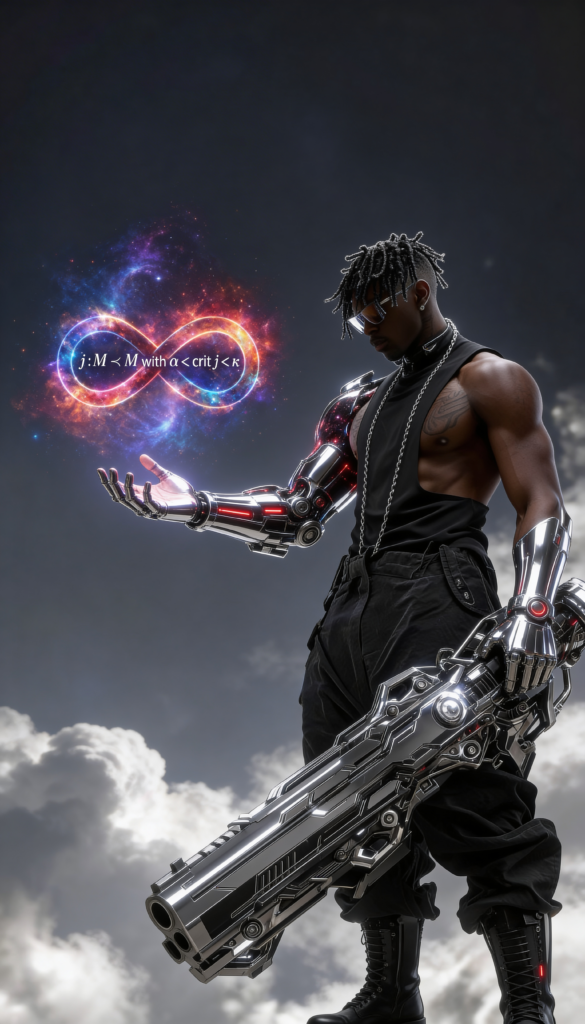
Their true scale surpassed the projections by which humans perceived them. In reality-illusion overlap zones they often manifested as dark anthropoid war-saints or techno-phantasmal giants, black metal be-ness streaked with radiation-red veins, carrying blades or engine-weapons of impossible density, sometimes cupping in one hand an infinity-glyph inscribed with cardinal relations that no human notation should have been able to keep stable. That was only the concession-version. Their actual bodies stood no less than 2,984 feet if measured in the most charitable physical terms, though even that number lied by implying boundary. They existed beyond the normal eleven dimensions of the world and projected only enough of themselves downward to ruin what they touched. Each atom of a Vyr’goth contained eruptions equivalent to real gamma-ray bursts. Each cubic meter of their transfictional substance carried weight and devastation on a high-jump with unbounded excess closure cardinal scale. But their most terrible attribute was not their force. It was their silence.
A Vyr’goth’s silence did not merely mute sound. It entered the molecular bonds of what heard it. Matter first shivered, then forgot what held it together. Flesh remembered its failures before it remembered its form. Steel recalled every design flaw latent within itself. Buildings relived the engineering hesitations buried under their own foundations. Living minds were struck with paralyzing resonances that did not show them random fear, but their deepest personal failures, their oldest guilt, the single accusation that could most efficiently collapse their will to resist. Soldiers who had buried shame beneath discipline found themselves pinned by visions of everyone they had failed to save. Spiritualists saw their dead turn away from them. Logic breakers watched their greatest proofs invert and testify against them. Parents saw empty rooms. Children saw abandonment arrive before the door had even opened. Under that assault, defense faltered not because the Vyr’goth were merely strong, but because they attacked the intimate joint where structure and self-belief met.
Dandemægus and Excella had spent most of those two months hunting the lesser projections first, because every instinct in them understood that the main incursion had not fully unfolded yet. By day, or by whatever battered civic approximation of day still held in afflicted districts, they crossed highways, suburbs, train stations, harbors, drainage systems, abandoned research annexes, collapsed shopping precincts, desert edge settlements, and rain-blurred city blocks. Sometimes they moved openly. Sometimes they vanished into side streets and let rumor do the rest. They rescued trafficked children from cult cells that had tried to use fracture events as cover. They dragged Voideater larvae out of hospital basements before those things could root into neonatal wards. They found people sleeping under bridges whose minds had already begun slipping from consensual reality and walked them, fed them, and turned them over to hidden relief networks Excella had built in silence during the hours he thought she was merely checking messages. They dismantled Colossai shrines erected by grief-militias who believed disaster had made them priests. They hunted the first Vyr’goth spillovers through rail tunnels and dead observatories where ordinary magick failed because the air itself had been taught to mistrust hope.
In combat, they became terrifying.
Dandemægus fought like a man who had stopped waiting for permission from the world. The rebuilt glass of his mind had given him a colder center, not cruel, but exact. When a Vyr’goth projection slipped between reality-illusion layers and tried to destabilize him with the resonance of personal failure, it found little purchase now. The old wounds were still there, but they were no longer unclaimed territory. He had walked through the deconstruction of his own name, essence, and manifest be-ness and emerged not healed in the sentimental sense, but authored. The silence struck him and found a man whose ego already knew catastrophe intimately enough to deny catastrophe final authorship. Beside him, Excella became something almost unfair. Sensory projection was not only for tenderness. In battle she used subjective reality manifestation with surgical brilliance, dislocating hostile perception by a fraction, widening one second into three, overlaying false terrain atop true terrain, forcing a Vyr’goth avatar to momentarily believe it stood somewhere other than where it did. Those tiny distortions were enough. He cut. She redirected. He broke the projection. She prevented reconstitution. When they moved together, it felt as though Unreturnable itself had stepped briefly into the battlefield and rewritten what two people could mean to each other in war.
And still the Vyr’goth multiplied.
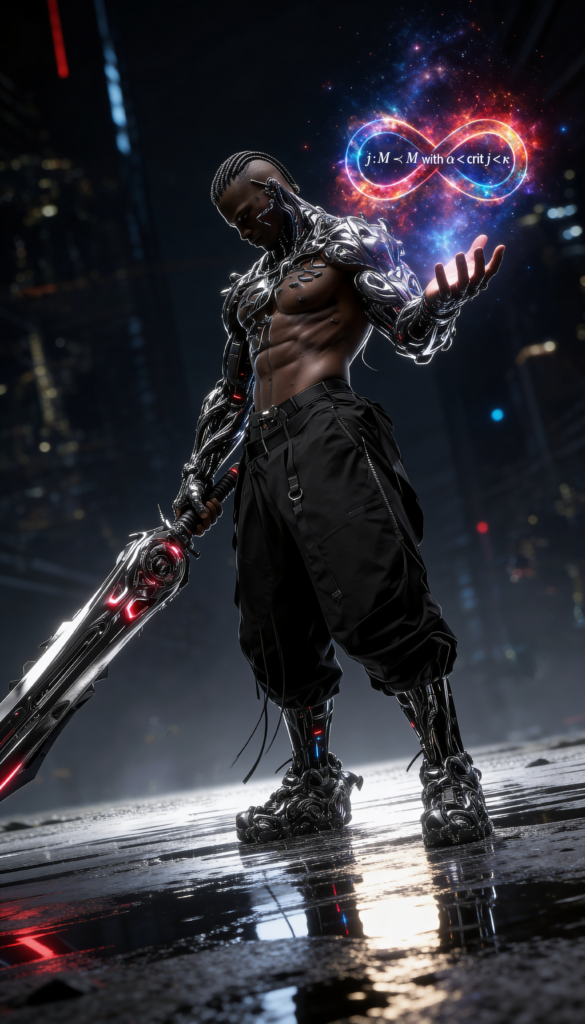
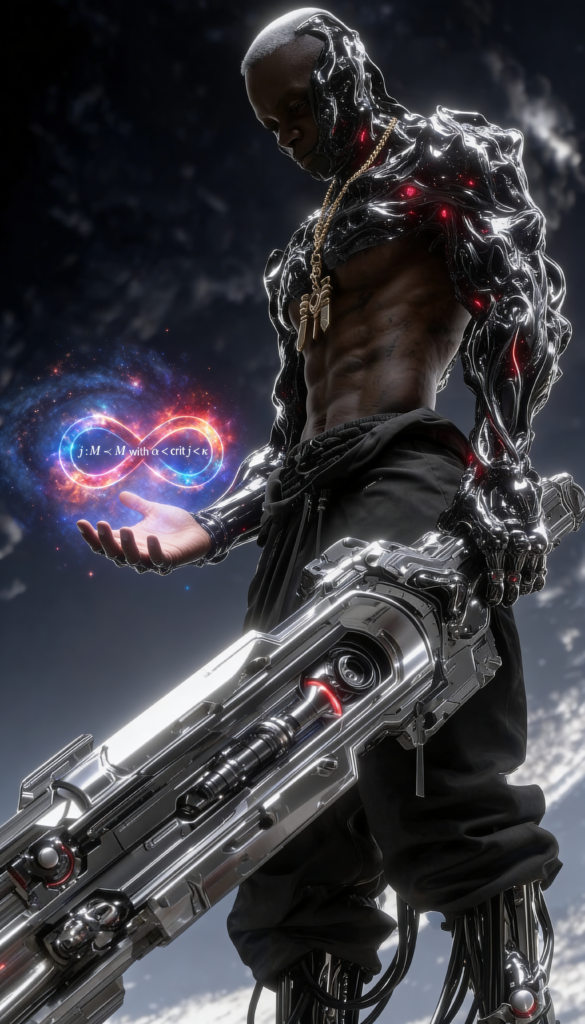
Reports came in from Melbourne first. A projection standing over a financial corridor with one hand raised, holding a boundless infinity-sigil that burned like a theorem of annihilation, while below it whole districts lost their ontological moorings. Then from the west. Then from inland communities where no one had expected reality-illusion ruptures severe enough to require national hunter response. Then Sydney. Always Sydney. The great cities of the harbor had become magnets for convergent metaphysical catastrophe long before the public language learned to admit it, and now the Vyr’goth had chosen the city as an argument. Their passing alone cracked beyond-cataphysical principles into the air. Bagaria-Koellner reflections shredded like paper banners in fire. Many-valued logic split. Narrative causality fractured under pressure. Noesis and ontology lost their stable edges. Even the concept of unmanifest silence was seen tearing at the seams on one live feed before the camera dissolved into white static and blood.
That was when the hunters united.
Australia had many hidden factions, though none had ever been fully enough to claim stewardship over the whole broken nation. There were state occult detachments, military spirit suppression teams, independent ritual contractors, harbor paladins, bush exorcists, urban logic-break regiments, refugee protection circles, condemned saint societies, post-clerical thaumaturges, and old family lines who had been killing unnatural things since before the country had a stable idea of its own borders. In ordinary years they competed, distrusted one another, poached intelligence, and guarded methods. Under Vyr’goth pressure they finally did what history only rarely forced institutions to do: they stood in the same street and admitted that none of them were enough alone.
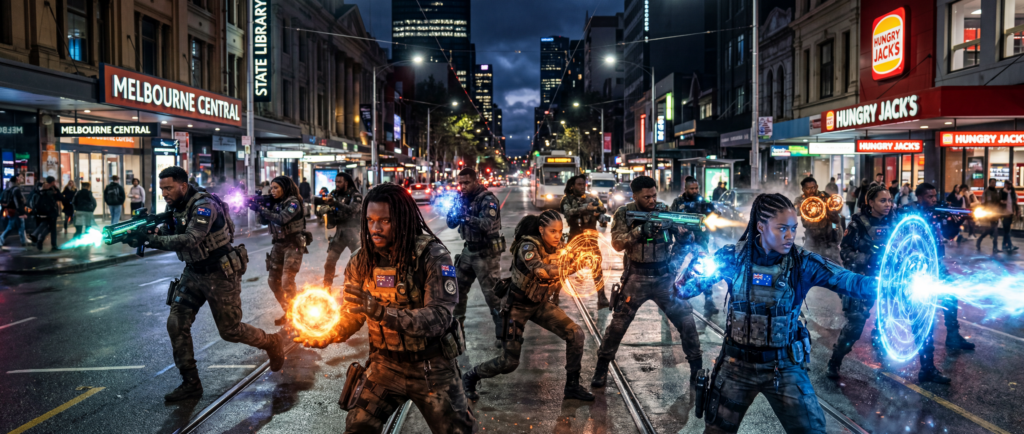
So Melbourne Central saw armed magick casters kneeling between tram tracks, shields of blue force and orange sigil-fire blooming beside rifles loaded with sanctified conductive rounds. State Library facades became staging walls for ward-projectors. Spiritualists painted fast-binding glyphs onto riot shields. Logic breakers moved in mirrored pairs, reciting impossibility clauses under their breath while snipers sighted through probability haze. Sydney did the same, only harsher. Harbor units locked down arterial lanes beneath neon and smoke while armored response teams spread across wet asphalt under banners that had not yet realized they were already about to become memorials. Broadcast drones rose to capture it all. The public watched from apartments, shelters, stairwells, train platforms, emergency cots, and occult safehouses. For one brief stretch of the nation’s wounded heart, the heroes of Australia actually looked like heroes.

Excella and Dandemægus were not among the official lines. They stood apart, watching from a high structure at the edge of the Melbourne response grid, because both of them knew something the command channels did not want to say aloud. The hunters had prepared for monsters, even titanic monsters, even transcendent ones. They had not prepared for grief weaponized at the atomic and transfictional level, nor for the way Vyr’goth could appear and disappear through reality-illusion layers with no fixed loyalty to location. Excella felt the seams fraying before the first full manifestation. Dandemægus saw the way the city’s own wounded history was beginning to answer the incoming silence. Beneath them, squads tightened formation. Some still believed discipline could compensate for metaphysical mismatch. Others knew better and stayed anyway.
Then the first Vyr’goth stepped through.
Not into the street. Through it.
Its projected body resembled a black war-figure cut from night-metal and grief, weaponized limbs gleaming with red-lit vascular circuitry, its hand literally cradling that impossible infinity relation as if cardinal devastation were something one might idly carry while selecting where next to erase a civilization. Behind the projection, just visible for a flicker, loomed the suggestion of the real thing: a titan whose size mocked the city and whose deeper body was composed not of flesh but of ionized planetary lament, a cathedral of dead-world resentment hanging outside the visible eleven dimensions while only a slender fraction of itself leaned downward to do the killing.
It did not roar.
It did not charge.
It simply let its silence broaden.
The effect was immediate and unforgivable. The first shield line in Melbourne held for less than a breath before the magick casters behind it began locking in place, eyes wide, each caught in a personalized collapse of self-accusation. One woman saw the child she had not reached in Brisbane twelve years earlier. One man relived the render he chose duty over his brother’s last call. One spiritualist vomited blood as every dead he had ever failed to appease returned in his nerves at once. Their shield burst. The logic breakers attempted a contradiction-field. The Vyr’goth looked at them, and their own axioms reversed. Probability turned against the operators. Three of them vanished from the knees upward as though consequence had skipped the courtesy of sequence. The fourth remained standing long enough to understand what had happened and then was peeled across multiple reality-illusion layers until not even his shadow stayed behind.
Sydney’s response line opened fire almost simultaneously as another Vyr’goth bled through over the tram tracks near the harbor. Particle rounds, consecrated penetrators, spirit-laced beams, sigil shells, collapse spears, and focused noetic bursts lit the manifest expanse in a spectacle so overwhelming that for an instant the public believed resistance might actually register. The city became a storm of human refusal. Shields flared blue and amber. Rifles screamed green and white. A woman in the front rank tore open a circular ward bigger than a truck. Another cast a blazing spear of condensed spiritual denial straight through the center mass of the projected avatar. For a sliver of a render, the Vyr’goth projection wavered.
Then its silence deepened.
The ward became transparent and then theoretical. The spear struck, continued past, and forgot what it had been meant to oppose. The front line of hunters did not explode. Explosion would have been mercy. They were removed on a universal irreversible transfictional scale, each one taken in the particular modality most insulting to the courage they had chosen. Some became outlines, then ash, then nothing. Some were seen in six places at once and then in none. Some dropped their weapons and stared upward as entire maximal wholenesses beyond tiering to explain any cosmic structure bloomed in their pupils, only to blink out as if their eyes had been turned into windows and then shattered. Some were simply there and then not there, leaving armor empty in the rain.
Dandemægus moved before Excella had fully decided whether intervention would save anyone or only spend them both too early. That was how quick the horror escalated. He leapt from the high structure with that terrible, calm violence that had become uniquely his, landing amidst debris and broken signal light as the Melbourne grid buckled around him. Excella came with him, not behind, never behind, her sensory projection already spreading in fine invisible threads through the field. Together they struck one Vyr’goth projection from the flank. He broke its arm at the point where the black-metal avatar joined the deeper unseen titan-body. She overlaid a false continuity into its perception, tricking it for a single instant into misreading the location of its own gravitational resonance. He drove suggslogic through the error. The projection staggered.
But there were too many.
Across Melbourne. Across Sydney. Across the stitched reality-illusion seams of the continent. Vyr’goth kept arriving. One held the hierarchy of Berkeley cardinals like a toy lantern. Another dragged a red-lit blade whose edge howled with erased principles. Another unfolded its hand and entire transfictional layers trembled as if those layers were only brittle panes waiting to be dropped. Another did nothing but stand, and its silence alone reduced a precinct’s spiritual infrastructure to dust, then reduced the dust to regret, then reduced regret to nothing at all.

The hunter factions tried to regroup. New lines formed. Emergency channel traffic became prayer, then screaming, then static. Melbourne Central broadcast went dead. Sydney command relays split into seven contradictory feeds. The magick casters who remained attempted collective overcasting. Spiritualists called on buried dead of the continent. Logic breakers opened impossible brackets inside their own minds hoping to cage the incoming negation. None of it mattered enough. The Vyr’goth were not interested in defeating heroism. They were interested in proving heroism provincially sized.
Excella felt it first: the national pulse changing. Not fear. Absence.
She turned.
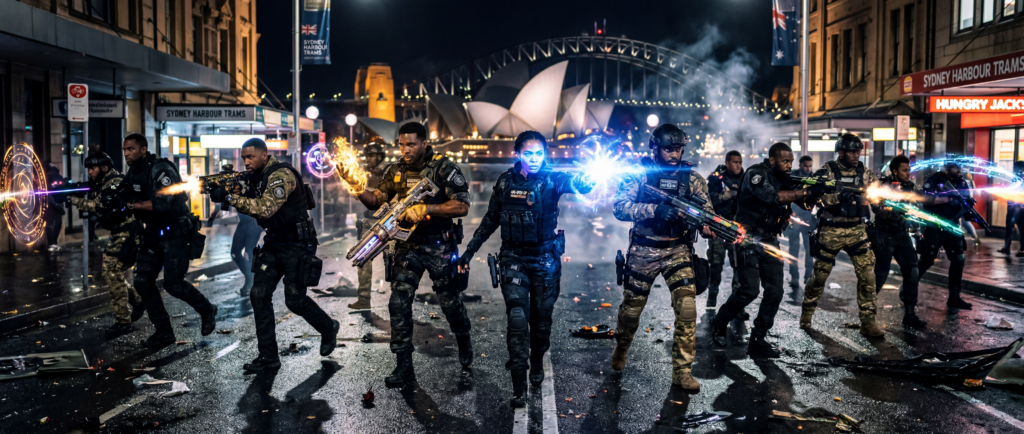
All across the live tactical grid, friend-signatures, hunter markers, response clusters, shield identifiers, biospiritual pings—every symbol representing the gathered defenders of Australia—began extinguishing in waves. Not because the networks failed. Because the people did. One by one, unit by unit, whole blocks of coordinated resistance vanished out of the manifest record. Melbourne lost a sector. Sydney lost three. Then the central corridor blanked. Then the harbor flank. Then the western bridge team. Then the reserve mystics. Then the armored exorcist convoy. It spread so fast that by the time anyone in command tried to say the words fall back, there was almost no one left to hear them.
Dandemægus looked across the collapsing city and understood with the terrible clarity of a man who had seen too much of erasure already: the heroes of Australia were disappearing.
Not dying.
Vanishing.
One moment there had been ranks of armed refusal stretching beneath tram wires and tower light. The next there were only streets, ruined wards, dropped rifles, burning sigils with no casters left to own them, and the echo of a resistance line that had just been removed from the country’s ongoing sentence as though it had never earned the right to continue.
The Deerstalkers stood in the middle of it, rain and blue static and transfictional ruin gathering around them, while Australia discovered that its defenders could be taken all at once and leave the world horrifyingly quiet afterward.
Beyond Australia—beyond even the idea of geography as something stable enough to matter—the arrival of the Vyr’goth did not behave as invasion.
It behaved as correction.
Not correction in the moral sense, nor in the sense of restoration, but in the colder and more devastating register of revision—where entire layers of structured understanding are not destroyed through opposition, but quietly stripped of their right to continue asserting themselves as valid descriptions of anything at all. The Vyr’goth did not need to travel across distances to spread their influence, because distance itself belonged to a system of relations already inferior to what they were. Instead, their presence resonated outward through the maximal wholeness beyond tiering to explain any cosmic structure, touching strata that had never shared adjacency, and forcing them into the same moment of collapse.
It began where language had once claimed dominion.
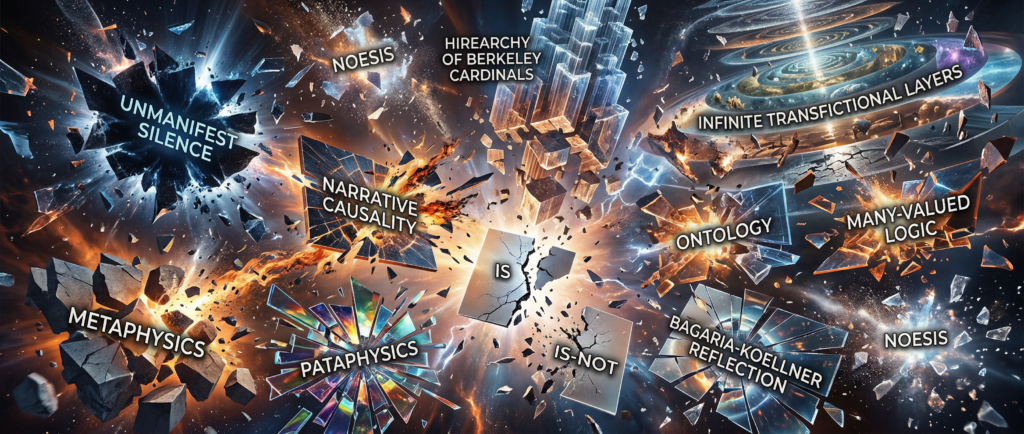
Narrative causality—the elegant illusion that events followed from prior events in intelligible chains—started failing not with dramatic rupture, but with subtle disobedience. Stories ceased to agree with themselves. Beginnings detached from endings. Conclusions formed without premises. Entire arcs of meaning unfolded only to discover they had no origin. Across countless layers of existence, observers found themselves remembering outcomes that had never been initiated, while processes they had carefully followed simply stopped just before completion and refused to resolve. The Vyr’goth did not break narrative. They made it irrelevant. Cause no longer justified effect. Effect no longer required cause. And in that quiet disjunction, the very idea that reality could be understood through sequence began to dissolve.
Ontology followed.
The principle that something could be said to be—to possess identity, continuity, definable nature—fractured under the weight of the Vyr’goth’s silence. Entities across transfictional strata attempted to stabilize themselves, to assert their definitions, to hold onto the boundaries that separated them from non-being. But the silence did not attack those boundaries directly. It simply withdrew the permission for boundaries to mean anything. A thing could still appear. It could still act. It could still be perceived. But its “is-ness” lost authority. The distinction between what was and what was not became decorative, a relic of a weaker explanatory system. Entire orders of existence found themselves continuing to function while simultaneously recognizing that their functioning had no grounding. To exist became an unsupported claim.
Then logic—many-valued, classical, paraconsistent, and beyond—began to tear.
At first it seemed like contradiction would surge. That paradox would dominate. But the Vyr’goth’s silence did not elevate contradiction. It rendered the entire necessity of resolution obsolete. Truth-values stopped competing. They stopped coexisting. They simply ceased to matter. Propositions did not become false. They became unnecessary. Systems built to evaluate truth discovered that evaluation itself had no referent. Across vast intellectual architectures, proofs collapsed not because they were disproven, but because the need to prove anything had been quietly removed. The infinite scaffolding of reasoning stood intact for a moment longer, like a cathedral whose foundation had been erased without disturbing the walls, and then it fell inward, not in pieces, but in relevance.
Noesis—the domain of thought, awareness, cognition—suffered a more intimate erosion.
Minds across countless layers attempted to interpret what was happening, but interpretation requires a stable relationship between observer and observed. The Vyr’goth dissolved that relationship without announcing it. Thoughts formed, but did not attach. Awareness flickered, but did not anchor. Entire civilizations of higher cognition found themselves thinking without ownership of thought, perceiving without confirmation of perception. The interiority that once guaranteed “I am thinking this” gave way to a stranger condition: thought occurring without claimant. Consciousness continued, but its authority over itself had been revoked. To think became indistinguishable from being thought.
Then came the collapse of the Hierarchy of Berkeley Cardinals.
The towering abstract orders that once governed scale, size, magnitude, and the architecture of unbounded mathematical complexity began to fail in a way no system had prepared for. It was not that the hierarchy shrank. It was not that larger infinities became smaller. It was that comparison itself lost coherence. The relationships that defined “greater,” “lesser,” “beyond,” “unreachable,” “transcendent” all began to blur into a flat field where distinction had no operational meaning. A cardinal that once towered above all lesser magnitudes now found itself indistinguishable from them—not because it had diminished, but because the concept of magnitude had been deprived of its hierarchy. The infinite became directionless. Scale became unmeasurable not because it was too vast, but because vastness itself had lost its gradient.
Beyond that, even the transfictional layers—the stacked realities, narrative domains, conceptual strata, and boundless manifest expanses that composed existence in its highest expressions—began to peel apart.
Not violently.
That would have implied resistance.
Instead, they separated like pages that no longer remembered being part of the same book. Each layer drifted, not outward, not inward, but away from the assumption that it had ever needed to be connected to anything else. The seams that once bound them—those subtle agreements that allowed one level of reality to inform, influence, or coexist with another—faded into non-necessity. Worlds that had once depended on each other’s structure found themselves alone, not in isolation, but in independence so complete it erased the need for relation. And in that independence, they began to dissolve—not into nothingness, but into irrelevance, as though existence without relation could not justify continuation.
Even the deeper principles—those that had once claimed authority over all these systems—began to fracture.
Beyond metaphysical maximal complexity, where distinctions themselves were supposed to break down into higher-order coherence, the Vyr’goth’s silence introduced something that coherence could not absorb. It was not contradiction. It was not paradox. It was the removal of necessity. The idea that anything needed to be explained, structured, or unified simply ceased to apply. Systems that had once prided themselves on transcending lower realities now discovered that transcendence required a ladder, and the ladder had been quietly taken away.
And beneath it all, unmanifest silence spread.
Not as absence, but as sufficiency.
It did not consume. It did not expand. It simply revealed itself as already present, already complete, already beyond the need for manifestation to justify it. Everything else—every layer, every system, every principle—began to appear as temporary assertions within a silence that had never required them.
Each Vyr’goth carried this with it.
Not as a weapon it chose to use, but as a condition it could not help but impose.
And as more of them emerged across the maximal wholeness beyond tiering to explain any cosmic structure, the effect compounded—not linearly, not exponentially, but categorically. It was not that collapse increased. It was that the very idea of “increase” lost meaning. There was no longer a process unfolding. There was only the gradual realization, across all levels of existence, that what had once been taken as fundamental was, in the presence of these beings, optional.
Back in Australia, the heroes vanished.
Beyond Australia, the reasons heroes could exist at all were being erased.
And somewhere, deep within the unfolding silence, something else was beginning to take notice—not of the destruction, but of the fact that something within this collapsing totality was still resisting.
Still remembering.
Still asserting.
A small light.
And that, more than anything else, was becoming a problem.