
Prelude Penultimate Truth I — The Render the Sky Broke
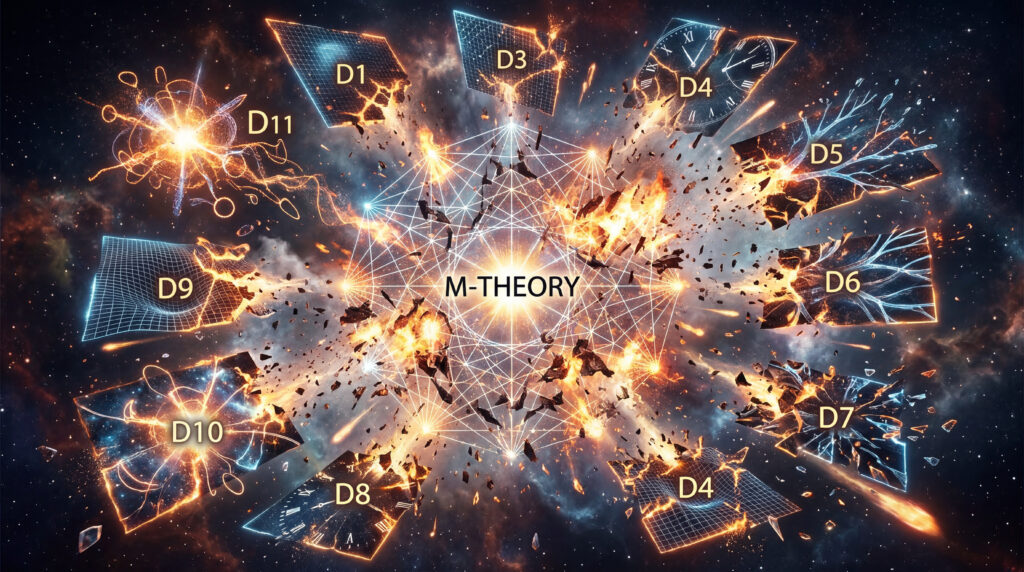
The sky did not split like weather. It split like doctrine failing. Over the wholeness of the world, the upper manifest expanse ruptured across beyond-dimensional realities at once, and what human sciences had once schematized as stacked strata, elegant membranes, hidden branes, and higher geometric permissions began to shear apart in visible catastrophe. The old theoretical scaffold shattered into burning disclosure. Luminous planes marked by lesser designations—D1, D3, D4, D5, D6, D7, D8, D9, D10, D11—peeled away from one another in screaming sheets of fractured fire, while the central lattice that had once quietly held their mutual relation flashed into terrible visibility and burst outward in blazing lines. It was as if the world had been living beneath the skin of a theorem and, all at once, the theorem had lost the right to remain coherent. Across oceans, deserts, mountains, cathedrals, slums, suburbs, laboratories, prisons, and schoolyards, people looked up and saw the hidden architecture of reality-fantasy distinctions tearing open above them. The wound did not remain in the heavens alone. It ran downward through laws, through categories, through named and unnamed orders of be-ness. Elsewhere, older rings broke too: the blue circuit of Possibility cracked and sprayed sparks into oblivion; the black-violet crown of Nothingness split through its own center; the gold wheel of Totality came apart under impacts that had no visible source; a noetic slab spun from its foundation in fire; the hierarchy of thought beneath everything humanity called meaning began to collapse like a great iron city pulled out from under itself. The world was not facing an invasion in the ordinary sense. It was undergoing transfictional collapse, and the collapse was not spreading from impact, contagion, or weapon. It was spreading from the arrival of something whose mere nearness constituted a refusal of continued coherence.

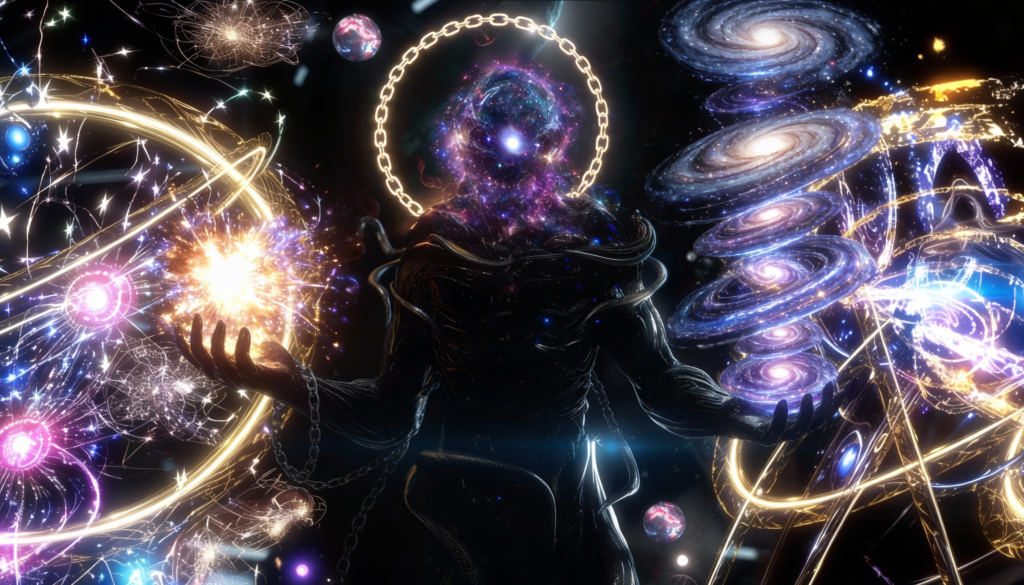
That thing had been imprisoned below even the dignity of annihilation. Not in chains that clanked, nor in walls that could be measured, but in a depth of unmanifest silence so severe that even negation looked generous beside it. There were places beneath reality where even Nothingness had no sovereignty, where possibility had already been judged a childish luxury, where totality was remembered only as a failed claim. In one such lowerless recess, a prisoner had long been held outside narrative allowance. Yet some older wound, somewhere in the background of creation and beneath it, had faltered just enough to loose a clause in that sentence. The Prisoner from the Void did not shatter its prison through strength alone. Its release was uglier than that. It infected containment with less-than-being. It multiplied the prison’s own be-ness by a factor less than zero until the lock ceased to be an absence and became a debt. Once the debt inverted its holding structure, the prisoner slipped through what could no longer sustain itself. Then it rose. It dragged no storm behind it. It dragged silence. Vast black streamers curled from its modality like torn ceremonial cloth from a dead god’s altar. A chain of light circled its head. One hand held a crowded flare of impossible stars and abstract detonations, while the other bore a descending column of spiral star-realms stacked like toys in its palm. Around it, radiant rings, clustered worlds, and atom-like architectures revolved in blasphemous calm. It was at once humanoid and far too large for that word. Its outline suggested a person only so the mind could fail in a familiar way before failing completely. And wherever it moved, the hidden foundations of existence began to subtract themselves. Matter forgot its anchoring. names dimmed in their own mouths. Probability curled up and blackened. The great wheels of Possibility, Nothingness, and Totality that had once turned beyond ordinary sight began to fracture merely because the prisoner’s silence passed near them. It was making for Baltimore.
Eighteen years before Arc 1, Martin Luther King Boulevard still knew how to pass for ordinary on a good day. Neon from corner stores laid tired color over wet pavement. Buses sighed. Streetlights held their ground against evening. The city carried its old mixture of exhaustion and stubborn soul, the peculiar Baltimore refusal that let grief, humor, history, and menace stand on the same block without asking permission from one another. Cars moved in ragged patience through lanes that never seemed designed for the number of people needing them. Music escaped from somewhere down the boulevard and got swallowed by traffic. A storefront television showed a ballgame to an audience that mostly was not watching. Nothing there suggested the manifest expanse was about to disclose its higher wounds to everybody alive. Nothing there suggested the world was one sentence away from tearing into layered ruin.
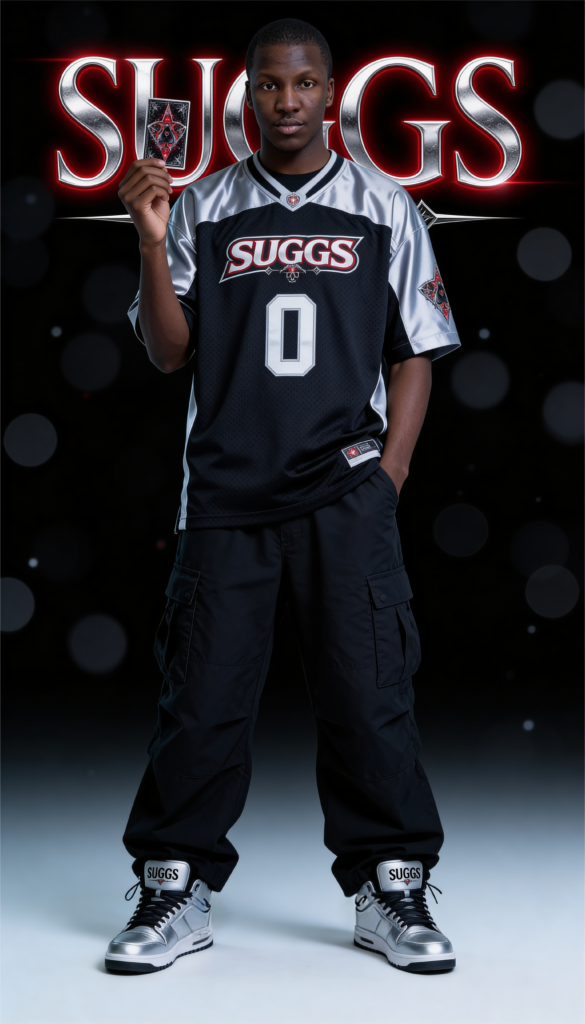

Draven stood under that ordinary sky with a card between his fingers and the posture of somebody already more exact than his age should have allowed. He was young—young enough that the future had not yet hardened into the colder disciplines it would later demand of him—but there was already a restraint in him that made youth look like a disguise rather than a state. His black-and-silver jersey sat loose over his frame, the bold insignia across his chest catching the streetlight with a metallic sheen. The number at the center made him look almost athletic in the casual public sense, but the card in his hand ruined any such simple reading. He did not hold it like a prop. He held it the way some people held a blade they trusted more than prayer. Black cargo pants fell over silver-white high-tops planted with quiet certainty on the pavement. Beside him stood Pearii, bright in a different register, the midnight-blue shimmer of her strapless top catching light as though a living current moved through the fabric. Her black jeans were clean and fitted, practical without flattening her softness, and the blue choker at her throat gave her the look of someone who had dressed with care but never with vanity. There was something open in her face, but not naïve. Her warmth was not ignorance; it was courage wearing a gentler mask. She watched Draven the way one watched a difficult truth one had chosen to trust anyway.
He had been teaching her simple suggslogic, and because it was simple, he had stripped all grandeur out of his voice. “The first mistake,” he said, flipping the card once over his knuckles and catching it flat, “is asking whether something is possible. Possibility is late. Possibility waits for permission. Suggslogic doesn’t.”
Pearii lifted a brow. “That sounds like the kind of thing you say because you enjoy making reality feel unemployed.”
A hint of amusement passed across his mouth and disappeared almost immediately. “Reality should work harder, then.”
“I’m serious.”
“So am I.” He held the card out between them. Its face was black and red, dense with sigilwork that looked decorative until one stared too long and realized the design had hierarchy in it, clauses in it, verdicts asleep in it. “Simple suggslogic starts small. You don’t begin by rewriting the world. You begin by refusing the world one inch at a time. You decide what is true. You insist on it. Then you make everything around you pay the cost of disagreeing.”
Pearii glanced toward a flattened bottle cap near the curb. “So show me one inch.”
Draven’s gaze moved to the cap. He did not gesture dramatically. He did not chant. He did not draw circles in the air like a lesser mystic begging symbols to notice him. He only looked, and in that look Pearii felt the atmosphere around him shift by a degree so subtle it would have escaped anybody else. The bottle cap quivered, stood upright on its edge, spun once without wobbling, and then flattened itself smooth again—this render with the stamped lettering reversed. Pearii stared. It was not the movement that struck her. It was the certainty of it. The cap had not seemed forced. It had seemed corrected.
“You didn’t move it,” she said.
“No.”
“You made it realize it was wrong.”
“Closer.”
Pearii bent, picked it up, and examined it in her hand. “And you expect me to do this casually?”
“I expect you to stop calling it impossible first.” He nodded toward the cap. “Try.”
She set it back on the curb. She inhaled. Her first attempt made nothing happen. Her second made the cap twitch. The third gave it the beginning of rotation before it rattled back flat. Draven watched without impatience. That, more than anything, told Pearii he took her seriously.
“You’re still asking the world,” he said. “Don’t ask. Speak inwardly like the answer is already ashamed for not arriving sooner.”
“That sounds arrogant.”
“It is arrogant.”
“So suggslogic is arrogance?”
“Only if you think truth owes humility to error.”
She laughed softly at that, a sound too warm for the hard edges of the boulevard, and tried again. The bottle cap trembled, rose slightly, then fell. Pearii let out a breath through her nose. “I almost had it.”
“You did have it. Then you doubted yourself and gave the cap a way back down.”
“I’m being sabotaged by litter.”
“You’re being sabotaged by politeness.”
She was about to answer when the whole world lurched.
It began not as sound, but as a pressure that made the boulevard’s ordinary noises feel suddenly fake. The bass from the distant radio flattened into static. Traffic lost depth. Even the breeze seemed to hesitate. Then the sky above Baltimore lit from behind, not with lightning but with systemic disclosure. Pearii looked up first. Her breath caught so sharply it felt like the render itself had snagged inside her throat. Above the city, the hidden scaffold of layered existence had become visible in full catastrophe. The same vast existential frames tearing across the world now hung over Baltimore in burning magnificence and horror. Distant strata split apart in flaming blue grids. Curved sections of higher architecture broke loose and spun. Great geometric planes marked by old human designations ruptured at their edges and shed incandescent debris. The central lattice that linked those unseen layers into one overarching order glowed white-hot and fractured in a hundred intersecting lines. And farther than that, beyond what the ordinary eye should have been able to read, Pearii saw deeper damage: the blue wheel of Possibility cracking under stress; the violet-dark ring of Nothingness caving through itself; the gold architecture of Totality exploding into molten fragments; a noetic block tumbling; the hierarchy of thought itself coming apart like a city-sized scripture dragged behind a moving god.
Baltimore erupted in panic. Car brakes screamed. People ran into the street and then froze because there was nowhere to run when the ruin was above and beneath and within all things at once. Windows burst inward. A billboard on a nearby building showed three different advertisements at once before blackening into a field of nonsense symbols. The pavement under Pearii’s feet momentarily displayed a second road below it, older and blood-dark, then sealed over again. The harbor in the distance reflected not the city but a burning wheel of impossible light. Streetlamps doubled into ghost-images a half inch to the left of themselves. A church spire farther downtown flickered between intact stone and already-fallen rubble. The world was not merely being destroyed in space. It was being contradicted across all the hidden modalities that allowed it to remain itself.
Then the prisoner descended through the wound.
Even if Pearii had not been able to see suggslogic, she would have understood that this was no ordinary monstrous arrival. The Prisoner from the Void came into Baltimore with the grave calm of an unanswerable equation, framed in chain-light and cosmic wreckage, its body a towering darkness threaded with starbursts and circling architectures. In one hand burned a clustered detonation of radiant, expanding structures, like a compressed creation choking on its own birth. In the other spiraled a descending stack of vast stellar wheels, each one the size of a world’s sky, turning in slow obedience to its grasp. Black strands draped from its shoulders and torso like ceremonial void-fabric torn from some lower sanctum. Its face, if face it could be called, centered on a white star-point wrapped in a halo of chained gold. It did not need to strike. It did not need to move quickly. Its mere unmanifest silence walked ahead of it and did the work first.
Where that silence touched, reality began to fail in public. Whole buildings lost conviction in their own geometry and sagged into angles no architect could have drawn. Human bodies seemed to stutter at the edges, as though flesh and the memory of flesh were no longer agreeing. The blue ring of Possibility above the city splintered further; the black crown of Nothingness opened a second crack; Totality’s broken gold rim shed burning plates into the void between strata. More alarming still, Baltimore’s own existence began to slide beneath zero. Draven felt it before he translated it. The prisoner was multiplying be-ness by a factor less than zero. This was not simple erasure. It was not ordinary nullification. It was inversion below absence. A building was no longer being taken away. It was being made to owe its own existence. A human life was not merely being erased; it was being shoved beneath the right ever to have cohered. The city was entering anti-presence. If the process continued, Baltimore would not simply be destroyed. It would become a debt haunting the background of creation, a place that had existed too wrongly to remain remembered.
Pearii looked at Draven, terror in her eyes but not paralysis. “What is that?”
His gaze did not leave the prisoner. When he answered, his voice was steady enough to make fear seem like somebody else’s occupation. “Something from beneath negation.” Then, after one measured breath: “Stay with me.”
He stepped off the curb into the street. The card between his fingers had stopped resembling an object. Pearii could feel his suggslogic concentrating through it in silent layers, each one cleaner than violence and harsher than mercy. Around him, the ordinary render of Baltimore recoiled by instinct. Raindrops hanging from a traffic light cable halted mid-fall. Shards of broken glass curved away from him without touching the ground. The black-red sigils on the card did not simply glow; they clarified, as though every hidden intention in them had just been remembered by the world. Draven did not grandstand. He had not yet become the colder tactician he would later be, but even here there was already that trait in him: the refusal to waste movement, the absence of spectacle where certainty would do. The prisoner’s left hand rose, the clustered radiance within it thickening into a pressure that made the broken sky scream. Baltimore dimmed around the edges. Pearii felt her own breath resist remaining in her lungs.
Draven’s fingers tightened on the card. For an instant he stood perfectly still, and in that stillness Pearii realized the simple lesson from the bottle cap had never been simple at all. Suggslogic did not begin in large acts or small acts. It began in verdict. Everything else was scale. He did not plead with the city. He did not plead with the sky. He did not plead with the prisoner. He made a decision, channeled it through the card, and the air around him locked into agreement. The sigils blazed. The card hummed with a pressure that had no sound but still made Baltimore flinch. Then Draven threw.
The card flew straight and absolute.
It did not wobble. It did not arc. It did not behave like matter. It crossed the ruined boulevard and the burning layers above it as though distance were a superstition. Behind it trailed a black-red incision through the collapsing manifest expanse. When the prisoner’s silence moved to swallow it, the silence failed. When fractured grids and streaming debris moved to intercept it, they parted. The card struck the entity at the center of its chest—not flesh, not armor, but that dense central point where its anti-presence was being articulated into the world—and the entire city saw contradiction bloom. The chain-halo snapped one link at a render. The stellar wheels in its right hand broke into unsustained light. The clustered radiance in its left palm imploded into a negative flare. The black streamers around its body twisted, burned white at the edges, and lost claim to continued movement. Draven’s suggslogic did not overpower the prisoner in the crude sense. It negated its permission. It denied its sentence. It told the Void’s escaped verdict that Baltimore did not owe it recognition, and because the card carried that declaration with impossible precision, the prisoner began to come apart.
The effect was not merciful. Massive sections of its modality peeled away into strips of failed darkness. The star-point in its face guttered, split into thin radiance, and vanished. The circling atom-like architectures and broken stellar ornaments around it lost synchronization and burst into scattered sparks. The towering black body hollowed from the center outward until the city could see through it to the still-shattering strata behind. Then even that outline caved in. It folded into its own refusal and was unwritten in mid-descent. For one impossible render, there remained only Draven’s black-red card hanging in the ruined sky like a final punctuation mark. Then it turned, cut back through the debris, and returned to his hand.
Pearii stared in awe. The prisoner was gone.
But the world did not care that the prisoner was gone.
The blue ring of Possibility was still cracking. The dark crown of Nothingness still bled violet fracture-light through its center. Totality’s gold rim was still breaking apart in burning arcs. The noetic slab that had been ripped from higher placement kept tumbling in fire. The hierarchy of thought beneath the world continued to collapse in enormous metallic cascades. Over Baltimore, D1 through D11 were still tearing from each other in shrieking blue grids. Down on the boulevard, the city still lurched between mutually hostile states. A row of windows across the street reassembled and shattered again. A bus momentarily lost its doors, its shadow, and the concept of forward direction all in the same render. Asphalt bubbled into mirror-black and then hardened into concrete once more. The prisoner had been the engine of the wound, but its damage had already outrun its own author.
Draven knew it instantly. He watched the sky, the broken strata, the burning frames of ruined theory, and for the first render since throwing the card, something more complex than combat moved behind his eyes. Not fear. Calculation colliding with an admission he hated. He could negate the invader. He could deny the thing doing the harm. But the harm itself had propagated across too many layers. The world was still falling apart.
Pearii saw that realization arrive in him, and something in her answered before he spoke. Until then she had been student, witness, the warm bright presence beside the harder line of his will. Now, faced with Baltimore and the whole manifest wholeness above it coming apart even after victory, some quieter truth in her rose to the surface and took its rightful place. She stepped out into the center of the boulevard, into drifting glass, sparks, torn shadows, and the deep blue wash of fractured sky. Draven turned toward her sharply. “Pearii—”
But she was already looking upward, and when she answered, her voice was calm in a way that made him stop. “You dealt with what broke it. Let me deal with what’s still breaking.”
He did not tell her no. Perhaps because the render was too desperate for pride. Perhaps because he heard, in that single sentence, a certainty not borrowed from him. Pearii lifted one bare arm slightly, palm open, not like a commander seizing control but like someone feeling for the pulse of a wounded thing. Her suggslogic moved differently from his. Where Draven’s entered the world like a verdict, Pearii’s entered like a remembering. She did not tell the wound to fear her. She told the wound it had already overstayed its truth. One by one, she reached through the collapsing layers and touched the breaks behind their appearances. She touched the blue ring of Possibility and retconned the crack from its history. She touched the dark-violet wound in Nothingness and denied the fracture the right to have ever cohered. She touched the burning gold ruin of Totality and restored its continuity not by rebuilding it from scraps, but by rewriting the render so the broken state lost narrative legitimacy. The noetic slab slowed, reversed, and rose back toward proper station. The hierarchy of thought stopped collapsing and began to uncollapse, every shattered beam and conceptual girder drawing itself back into intelligible order. Above Baltimore, the blue beyond-dimensional grids of D1 through D11 began stitching shut. Flaming edges cooled. Torn membranes rejoined. The central lattice of relation relit itself node by node, line by line, until the sky once again possessed hidden structure rather than open injury.
Down below, the city followed her. Broken windows inhaled their own shards. Buildings straightened. Streets remembered what they were supposed to be. The harbor released the wrong reflections and resumed the right ones. People who had begun to blur at the edges became wholly themselves again. Lost screams were given back to lungs, and panic that had been severed from chronology reentered the render in the right order. A church spire downtown that had existed half-fallen pulled itself upright, stone rejoining stone. Traffic lights stopped displaying impossible colors. Billboards relearned meaning. The road beneath Pearii’s feet, which had been trying to reveal older, uglier versions of itself, settled into the plain asphalt of Baltimore as if ashamed of the theatrics. She was not merely healing damage. She was retconning collapse. She was revising the world’s wound until the wound had no lawful place to stand.
Draven watched her in silence, and for perhaps the first render in his young life, the thing moving through him was not triumph. It was recognition.
By the time Pearii lowered her hand, the sky had sealed. Not perfectly by human measure, because anyone with the right sight would still have known the world had been touched by something vile. But the manifest expanse held. The rings beyond it held. Thought held. The city held. Baltimore breathed again. Sirens, now merely sirens, wailed through restored streets. Somebody down the block started sobbing in relief. Somebody else laughed so hard the sound collapsed into crying. A police cruiser rolled through the intersection uncertainly, its driver staring upward at a sky that looked normal again and would never truly be normal to him after this render. The world had survived because one young man could negate the intruder, and because one young woman could refuse to let the aftermath remain.
Draven crossed the boulevard toward Pearii slowly, as if speed would cheapen what he had just seen. She looked suddenly smaller now that the work was done—not less significant, only human again, the way great acts sometimes return to softness once they have finished speaking. Her chest rose and fell quickly. A strand of pale hair tipped with pink had fallen against her cheek. The blue shimmer of her top caught the returning streetlight. She met his gaze with a question she did not ask out loud, perhaps because she knew the answer had already begun forming in him.
When he stopped in front of her, his voice came lower than before, stripped of all lesson and all combat. “You healed all of it.”
Pearii gave a small breath that was nearly a laugh. “Somebody had to.”
“No.” He shook his head once. “Not like that. You didn’t patch it. You didn’t force it upright. You rewrote the break until the world no longer had permission to remember itself broken.”
Pearii held his gaze. The city moved around them again, but softly now, as if Baltimore itself was listening. “I didn’t want it to stay hurt.”
Draven looked upward once at the restored sky, then back at her. “You’re a healer.”
The words landed between them with more gravity than either of them had expected. Pearii’s expression changed at once. Not because she was surprised, but because something in her had wanted him to see that long before she had been able to name it for herself. Her answer, when it came, was almost careful. “Do you mean that?”
“Yes.”
She stepped a little closer. “Even though healing isn’t what you teach first.”
“Maybe that’s why it matters more.”
That nearly undid her. He saw it. A warmth rose through her face and eyes that had nothing to do with embarrassment and everything to do with being recognized in the exact place one has secretly hoped to be seen. “Draven,” she said softly, “you negate what tries to take the world from itself. That matters. But after that… somebody has to stay. Somebody has to put it back. Somebody has to make sure the people inside it still have somewhere to stand.”
His gaze did not waver. “And that somebody is you.”
Pearii smiled then, but there was ache in it now, and love not yet hidden deeply enough to call itself anything else. “I think so.”
A render passed in silence. The kind that only becomes possible after catastrophe has been denied. Then Draven, with the same bluntness he used for difficult truths and the same honesty that made his bluntness bearable, said, “You’d do this every render, wouldn’t you?”
Her answer came immediately. “Yes.”
“For the city.”
“Yes.”
“For the world.”
“Yes.”
His eyes narrowed almost imperceptibly, not in suspicion, but in the effort of looking one degree deeper. “For me?”
That was the render everything changed.
Pearii did not look away. Streetlight lived at the edge of her features. Baltimore, healed but still trembling, stretched around them like a witness. When she spoke, there was no flirtation left in it, only sincerity so clean it threatened to break him worse than the prisoner had come close to doing. “For you too. Every render you break, I’ll heal you. Every render the world starts to come apart around you, I’ll heal what I can reach. And when I can’t reach far enough, I’ll reach farther.”
Something in Draven tightened at that, not in rejection but in pain too old for his age. Pearii saw it immediately. His strength had always had a wound folded inside it, even here, even this young. He could deny monstrosities. He could stand under a breaking sky and throw correction into the face of lowerless ruin. But being tended to was another matter. Being promised repair required a vulnerability he had not trained himself to survive.
“You can’t know what you’re promising,” he said, though the sentence lacked the hardness needed to make it a refusal.
Pearii moved closer still until the distance between them had become intimate enough to matter. “Maybe not the full shape of it,” she said. “But I know this much. I know I don’t want you alone inside whatever tries to break you. And I know I don’t want to stand beside you all this while and pretend I don’t love you.”
The last word did not explode. It settled. It belonged there too naturally to shock the render into spectacle. It simply revealed what had already been true in every way that counted.
Draven looked at her for a long while. He did not rush. He never rushed when the truth mattered. Pearii let him take that render. She did not look down. She did not joke to soften it. She gave him the full dignity of her feeling and trusted him not to insult it by mishandling it. At last his hand rose and settled, deliberate and careful, against her waist. Not possessive. Not hesitant either. More like someone touching the edge of a promise to see whether it would remain real.
The city around them had just survived transfictional collapse. The sky had just been retconned back into coherence. Lesser words had no right to survive between them.
She lifted a hand to his chest, over the black-and-silver jersey, over the hard young steadiness of him. “You teach like everything is a verdict,” she said. “Maybe you’re right. So here’s mine. I’m going to heal this world every render it starts to break. And I’m going to heal you every render you start to break. I don’t care how hard you make that. I don’t care how closed you get. I’m promising anyway.”
That promise, more than the kiss that followed, was what remade the render between them. The kiss only gave the promise a mouth.
Pearii leaned up into him and kissed him softly, sincerely, without spectacle and without fear. It was not the kiss of somebody stealing a render from catastrophe because catastrophe made people reckless. It was the kiss of somebody who had seen the worst thing in the sky and answered it by choosing repair. Draven, after the briefest stillness, kissed her back with a restraint so careful it almost hurt. He was learning tenderness even as he enacted it, but there was nothing false in it. His hand stayed at her waist. Her bare foot lifted slightly as she leaned into him, flip-flop flexing against the pavement. The world, which had just been saved by negation and healing in sequence, seemed to hold its breath not because their kiss mattered more than the city, but because it belonged to the same victory. Repair had become personal.

When they parted, only enough to look at one another, Pearii’s eyes shone with the fearless softness of someone who had finally said the truest thing in her. Draven’s expression had changed too. Not into ease. He was not that kind of boy, not even then. But a guarded place in him had opened one measured degree, and for someone like him, that was enormous.
“You really mean it,” he said.
Pearii nodded. “I do.”
“Every render?”
“Every render.”
A small smile touched his mouth then—brief, rare, real. “Then I’ll remember that.”
“Good,” she whispered. “Because I will too.”
Above them, the restored sky held its secrets again. The shattered beyond-dimensional strata had folded back behind ordinary night. The rings of Possibility, Nothingness, and Totality turned unseen but whole. The hierarchy of thought stood repaired beneath the world. Baltimore still wore its fear, its sirens, its shaken breath, but it remained Baltimore. On Martin Luther King Boulevard, two young souls stood in the aftermath of a transfictional disaster and became, without ceremony, something foundational to one another. He had shown her that suggslogic could deny horror. She had shown him that suggslogic could also mend what horror left behind. And because of that render—because the sky broke, because the Prisoner from the Void came, because Draven negated it and Pearii retconned the world back into itself—he would never again see her as merely somebody walking beside him. He would see her as a healer. Not in the small human sense alone, though she was that too. He would see her as the one who, when the world split across all its hidden layers and even he could only stop the hand that struck it, stepped into the ruin and taught existence how to continue.
That was the true beginning of them. Not just the lesson. Not just the card. Not just the kiss. The promise. Her promise to heal the world every render it broke. Her promise to heal him every render he did. And in a city like Baltimore, in a story like theirs, that promise was not romance alone. It was architecture.