
Prelude — The Year the Door Stayed Open
Clear Card Clinic Arc
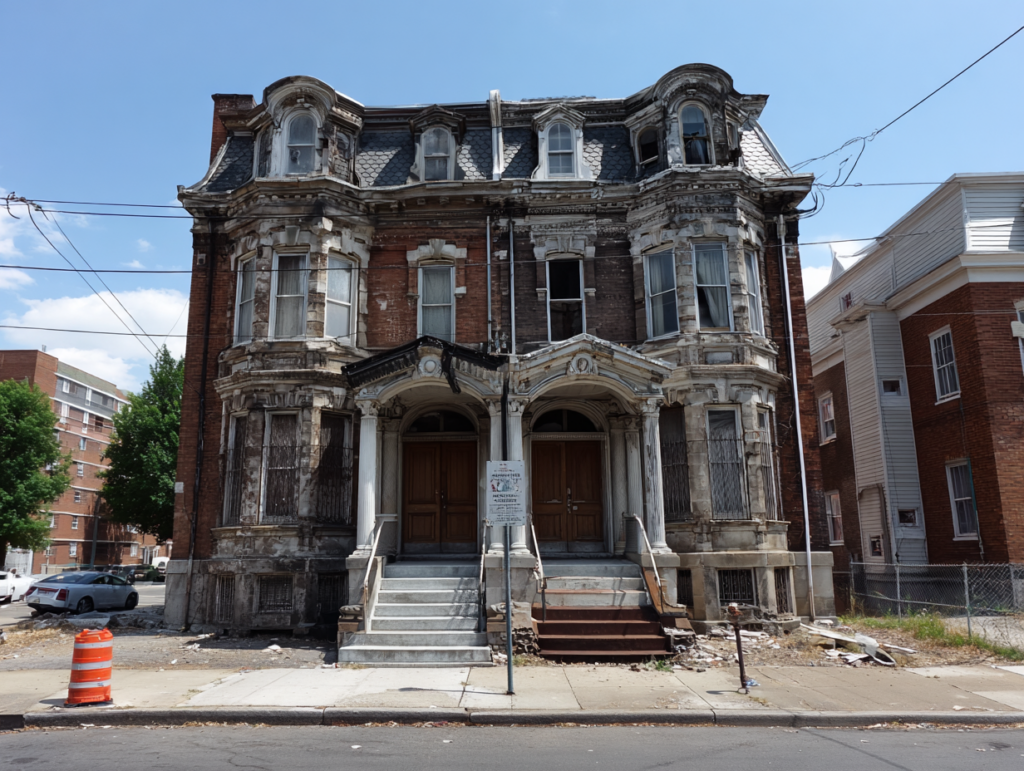
Sixteen years before Arc 1, the duplex did not look like the beginning of anything. It looked like a compromise: a property purchased because it was affordable, not because it was inspiring, placed in a part of Baltimore where the streetlights flickered with the casual fatigue of a city that did not believe it owed anyone softness. The kind of place where people carried groceries past boarded windows without pausing, where you could hear music from one house and yelling from the next, where the ordinary and the unbearable lived on the same block as if they’d always been roommates. Draven Endwriting did not buy it with a blueprint in his hand or a vision statement in his head. He bought it because he needed a place where the lock belonged to him, where the door would not be opened by anyone else’s authority, where “safe” could be something he could enforce with his own hands rather than something he had to request from systems that required pain to become paperwork before they acknowledged it.

The house had three small upstairs rooms that still smelled faintly like old detergent and stale carpet, a basement that held the damp breath of concrete, a garage that was barely wide enough for a vehicle and didn’t invite the fantasy of normal use, and a large attic with slanted ceilings and beams exposed like ribs. Nothing about it was beautiful. That was part of what made it workable. Beauty draws attention; attention draws questions; questions draw the wrong kind of people. Draven’s instinct was not to build a beacon but to build a door that could be found by those who already knew how to search quietly. He did not announce himself. He did not advertise. He did not tell the world, “I am here to help.” He simply made space in his life for the possibility that someone might knock, then made space for the deeper truth that they might not knock at all, that they might stand on the porch for ten minutes trying to decide whether entering the house would be safer than leaving it.
The first months were almost deceptively simple in their appearance. Someone stopped by because they’d heard he listened differently. Another came because the first person said the duplex didn’t feel like a trap. A friend-of-a-friend asked, hesitant, whether they could bring someone else, because “they won’t go anywhere official,” because “they don’t trust clinics,” because “they’ve already tried.” Draven learned quickly that official help, for many survivors, did not feel like help at all. It felt like a second gauntlet. It felt like being asked to translate the unspeakable into neat language, to present their suffering in a format that would satisfy an intake form, to make their memories coherent on demand, to show the right amount of distress without seeming “unstable,” to remain polite while their bodies were screaming. He understood that the most common harm after harm was the way disbelief seeped into every interaction, the way the world treated the survivor like a suspect and the perpetrator like a misunderstanding.
He noticed something else early, something so consistent it began to feel like its own law. The body always arrived before the story. People came in and their mouths offered restraint, caution, vague phrasing, the careful language of someone who has learned that saying too much can cause punishment. But their bodies betrayed the truth continuously. The way their shoulders stayed lifted as if bracing for impact. The way their eyes tracked the doorway. The way their hands kept moving, opening and closing, twisting fabric, tapping a knee. The way their voices grew thin around certain words and then recovered when those words passed. Even when they tried to sound normal, their breathing did not. Draven realized that the question wasn’t merely what had happened to them, but how what happened had rewritten them. He began to approach each visitor with the same underlying method: before you tell me anything, I will give you back what was taken, even if it can only be given back in inches.
That method looked ordinary if you didn’t understand what it meant. He asked where they wanted to sit. He asked whether they preferred the door open or closed. He asked whether they wanted the lights brighter or softer. He asked whether they wanted to speak or simply exist in the room without being demanded from. These were not polite gestures. These were repairs. People who have been violated are often trained into a state of constant readiness, a kind of anticipatory submission where they try to guess what will make the other person satisfied so the interaction can end. Draven refused that dynamic. In his house, the other person was not required to be convenient. In his house, fear was not proof of weakness. In his house, silence was not treated like defiance. In his house, leaving was always allowed.
One young man came during the early spring, the kind of Baltimore season where the air tastes like rain and exhaust and the city looks briefly softer under gray light. He didn’t announce what he needed. He didn’t ask for therapy. He didn’t say he was in danger. He simply showed up with the posture of someone who had learned that rooms are not neutral. He hovered near the wall as if furniture might betray him, sat only on the edge of the couch, positioned himself near the doorway without looking like he was doing it on purpose. When Draven stood to get water, the young man flinched so subtly it could have been missed by anyone not trained by repetition to recognize it. Then he apologized for flinching. That apology landed in Draven’s chest like a weight. The flinch was not the tragedy. The tragedy was the instinct to feel guilty for still being afraid.
The story, when it came, did not come cleanly. It arrived in partial sentences and pauses, with the rhythm of someone stepping around a hole in the floor. It wasn’t the kind of disclosure that could be summarized into a paragraph without losing what mattered. It wasn’t only the harm itself. It was the aftermath. It was how the young man’s sleep had been replaced by vigilance. It was how touch, even harmless touch, had become intolerable on certain days. It was how he had tried seeking help and had been met with skepticism that felt like accusation. It was how his own pain had been used against him to question his credibility. Draven did not treat the story like something he needed to fully extract. He treated it like something the survivor needed to slowly reclaim ownership over. He told the young man he did not have to provide detail to be believed. He told him that trauma does not owe coherence to anyone’s comfort. He told him that what mattered in this room was not whether the story sounded “clean,” but whether the person could breathe.
By the time the young man left that first day, Draven had learned a new thing about the duplex. It was not the furniture that made it safe. It was not the address. It was not even the lock. Safety was a culture you built with repetition. It was a kind of law that lived in micro-decisions: how you sit, where you stand, whether you interrupt, whether you demand eye contact, whether you insist on timelines and details, whether you become impatient when someone dissociates mid-sentence. Draven went upstairs later and moved the chair so it no longer forced anyone to sit with their back to the door. He adjusted the lamp so it didn’t throw harsh glare. He put water in a place that didn’t require asking. He made the room more honest. He understood that survivors often live with a chronic sense of being cornered, and the room itself could either reinforce that or resist it.
In the late spring, a teenager came whose guardedness had been mistaken for attitude by every adult who had met them that year. Draven recognized it immediately: armor that had grown too heavy to remove. The teenager’s voice was clipped and rehearsed, not because they were dishonest, but because they had already been cross-examined by people who were supposed to protect them. The harm had occurred in a place that should have been safe, and the aftermath had been compounded by disbelief from within their own household. Draven did not need specifics to see what disbelief had done. The teenager spoke as if they were walking across broken glass, careful not to say the “wrong” word, careful not to trigger another round of dismissal, careful not to be labeled “dramatic.”
When Draven told them, plainly, that they did not have to convince him, the teenager stared at him with suspicion, as if belief must contain a hidden price. Draven did not get offended by the suspicion. He had learned that distrust is a survival skill. He let the suspicion exist in the room without trying to defeat it. He did not beg for trust. He simply behaved in a way that made trust possible. He did not ask for a full narrative. He asked what days were hardest. He asked what nights were like. He asked whether school felt like a threat and, if so, what parts of it. He asked what would make tomorrow survivable. The teenager’s answers were quiet, almost reluctant, and Draven understood that for some people, vulnerability feels like walking into an ambush because it has been punished before. He treated each answer like it mattered, because it did. He treated each answer like it belonged to the survivor, because it did.
By summer, the duplex had begun to change in ways that weren’t visible from the street. The garage stopped being a garage. Draven cleared it, cleaned it, and turned it into a neutral zone for those who could not tolerate the intimacy of a living room. Some survivors cannot sit in a soft chair facing another person and speak; that setup resembles too many interrogations, too many forced conversations, too many cornered moments. A garage feels different. It feels less like a home and more like a boundary. In that room, someone could stand, pace, lean against a wall, speak without feeling watched. Draven stocked it with water and blankets the same way he stocked the living room, and he learned to offer options without judgment. Options became one of his most consistent medicines. Not the illusion of choice, but real choice: where to sit, which room to use, whether to talk at all.
The basement became its own kind of sanctuary as well, not because it was comfortable, but because its quiet could hold panic without amplifying it. People would arrive mid-spiral, breath shortened, hands trembling, a sense of unreality creeping in, the body convinced danger was imminent even when no danger was present in the room. Draven learned not to argue with panic. He learned that panic does not respond to scolding or logic; it responds to containment. He began guiding people downstairs when needed, not as a dramatic intervention but as a calm logistical move, like changing weather requires changing shelter. He would sit at a distance, speak in measured language, and help them anchor to the present through sensation and breath, without making it feel like an exercise they were being graded on. He treated their reactions as normal responses to abnormal experiences, and that normalization was not dismissive; it was liberating. Many survivors feel ashamed of their own physiology. Draven made physiology something that could be understood rather than condemned.
During one humid night in late summer, a visitor arrived who did not come with a crisis story at first. They came with exhaustion so deep it had flattened their voice. They had attempted official help and had been processed rather than cared for. Their experiences had been treated like data points. They had been asked for a chronology they could not provide without dissociating. They had been questioned about details as if their pain was a riddle to solve. They had been told that their reactions were “maladaptive,” as if the body’s survival mechanisms were a moral failure. Draven listened, and the anger that rose in him was not the anger of a man who wanted to fight; it was the anger of a man who understood that systems can become predatory without intending to be. He asked the person what they needed in the next ten minutes. He asked what would make their body feel less trapped. He asked whether they wanted the door open. He asked whether they wanted water. He asked whether they wanted silence. The visitor began to cry, not in dramatic waves, but in quiet leakage, as if the body had been holding back tears for months because it didn’t believe tears would be allowed.
That night, after the visitor left, Draven sat alone at the kitchen table and began writing rules. Not slogans. Not inspiration. Rules. He wrote that no one would be forced to tell their story in full. He wrote that no one would be interrogated for inconsistency. He wrote that memory fragmentation would be treated as expected. He wrote that consent would be explicit, not assumed. He wrote that leaving would always be allowed. He wrote that no one would be trapped in a room with a man if men were a trigger. He wrote that shame would be named as a symptom of harm, not as truth. He wrote that survivors would not be required to be composed to be respected. He wrote until his hand cramped, not because writing made him feel better, but because he understood that without structure, care collapses under repetition. Kindness alone was not durable enough. The duplex needed a philosophy that could survive fatigue.
In early autumn, the attic began to matter in ways Draven had not anticipated when he first looked at the slanted ceiling and dusty beams. There were nights someone could not return to their household. Not because home was uncomfortable, not because of routine conflict, but because home had become an active source of fear. Draven learned that when a person says they cannot go back, the most compassionate response is not curiosity; it is logistics. He prepared the attic with clean sheets, water, a lamp, and a lock that worked from the inside. He did not ask for proof. He did not demand a detailed explanation that might feel like another violation. He simply made the promise of boundaries tangible. For many survivors, the ability to lock a door and know it will remain closed is an unfamiliar luxury. The attic became a quiet refuge where someone could sleep without listening for footsteps, could rest without anticipating intrusion, could exist without needing to perform normalcy.
The year was not a neat sequence of isolated visits. It was accumulation. The duplex became a place where patterns emerged not only in what people said, but in what they had been taught to believe about themselves. Draven heard versions of the same self-blame again and again, from teenagers and adults, from men and women, from those whose lives had been interrupted abruptly and those whose lives had been eroded slowly. He heard them say they should have known. He heard them say they should not have trusted. He heard them say they should have fought harder, spoken differently, behaved differently, as if the survivor is responsible for predicting another person’s capacity for harm. Draven began intervening gently but consistently, refusing to let shame sit unchallenged. He explained, without preaching, that trust is not stupidity and that the responsibility for harm belongs to the one who committed it. He reminded people that survival strategies do not become invalid simply because the immediate danger is gone. He taught them to see their reactions not as personal failures but as evidence of a nervous system doing its job too well after being trained by threat.
As winter approached, Draven noticed how seasons themselves became triggers for some visitors. The cold made bodies feel vulnerable. The early darkness made streets feel unsafe. Holidays amplified loneliness, amplified family tension, amplified the grief of what should have been but never was. Some people who seemed stable in summer began unraveling in December, not because they were “regressing,” but because the calendar carried associations their bodies could not ignore. Draven began preparing for those seasonal shifts the way one prepares for weather. He checked in more. He kept the attic ready. He kept the garage warm enough. He kept extra blankets in the living room. He understood that trauma does not respect the idea that an event is “over.” The body carries the event forward. The body replays it. The body anticipates it returning. Draven did not treat that as irrational. He treated it as evidence that healing is not linear. Healing is repetition in safer conditions until the body slowly learns new rules.
Late that winter, someone arrived with a kind of quietness that frightened Draven more than panic ever did. Panic can be weather; it is loud and moving and exhausting, but it has motion. This quietness felt like an ending rehearsed for months. The visitor spoke in a flat voice, describing exhaustion, describing disbelief, describing the slow accumulation of being treated as unreliable by family, by friends, by systems, until their own sense of worth had been eroded. They did not say they were at risk in dramatic language. They did not ask for dramatic rescue. They simply described a feeling that continuing was optional, as if the world had made their life feel negotiable.
Draven did not respond with alarmist speeches. He did not say the kind of things people say when they are frightened by someone else’s pain and want to escape it. He remained present. He asked what had kept them alive up to this point, even if the answer was something small and stubborn and unromantic. He asked what they needed to make it through the next hour. He asked what environment felt least dangerous. He offered water, silence, and the simple fact of another human being refusing to leave. He did not frame survival as obligation or debt. He framed it as right. He helped the visitor shrink the horizon from an unbearable future into a manageable present. When the crisis softened, it did not soften into triumph. It softened into breath. Into the decision to continue one more night. Into the possibility that the duplex might be a place where their life was not debated.
After that visitor left, Draven sat alone in the living room with the lights off, the street glow faint through the curtains, and he let the weight settle in him without flinching. He did not feel heroic. He felt responsible, and responsibility is heavier than heroism because responsibility doesn’t allow you to leave when you get tired. It was in that stillness that Draven understood the difference between what he had been doing and what he needed to build. What he had been doing was personal care, delivered by one person’s endurance. What he needed to build was a system of care, durable enough to function even when he was exhausted, even when the city’s indifference pressed harder, even when the next crisis arrived. The duplex could not remain merely a private refuge. It needed to become a counter-institution. It needed to become a place with explicit principles and repeatable practices, so that survivors would not be dependent on one man’s stamina.
That was when the name began forming in his mind, not as branding, but as philosophy. He wanted transparency because survivors have been hurt by hidden conditions. He wanted clarity because survivors have been punished by shifting standards. He wanted a place where belief was not a prize won through perfect storytelling. He wanted a place where you did not have to gamble your dignity for care. Clear Card Clinic was not a romantic title to him; it was a refusal of the culture that treats survivors as suspects. It was his answer to the pattern he had witnessed all year: harm recurring, disbelief recurring, shame recurring, and therefore the need for a response that would recur as well, stable enough to outlast one person’s mood.
By the end of that year, the duplex no longer felt like a house. It felt like a boundary. The three upstairs rooms became breathing rooms where different kinds of people could exist without being watched. The basement became a containment space where panic could be weather rather than catastrophe. The garage became a neutral zone for those who could not tolerate intimacy. The attic became a refuge where sleep could be possible again. Draven understood that architecture alone did not make the duplex what it had become; the culture inside it did. The culture was built through repetition: consistent boundaries, consistent belief, consistent respect for consent, consistent refusal to interrogate, consistent patience with fragmented memory, consistent willingness to let a person be quiet without being punished.
Sixteen years before Arc 1, the Clear Card Clinic was still only a duplex with three rooms, a basement, a repurposed garage, and a large attic. Yet it had already become the first draft of something larger: a disciplined commitment to treat survivors as human beings whose reality would not be negotiated. Draven did not end that year with a sense of victory. He ended it with a deeper understanding of the world’s patterns and the resolve to build a place that could counter those patterns without collapsing. He understood that the harm was not rare, and therefore the response could not be temporary. He understood that disbelief was not accidental, and therefore belief had to be policy. He understood that shame was not organic, and therefore shame had to be challenged with patient truth. He understood, finally, that if the world insisted on leaving people alone with what had been done to them, then he would build a door that opened anyway and would keep opening, not as a gesture, but as a structure.
The year did not end with a ribbon-cutting, or a declaration, or some clean cinematic conclusion that would make the work feel easier to carry. It ended the way real resolve is born: in fatigue that refuses to become surrender, in repetition that sharpens into method, and in a single recognition that the duplex, as humble as it was, could not remain only a private refuge held together by one man’s endurance. Draven had spent months learning the architecture of aftermath without asking for the architecture of events, because he understood, with a kind of cold compassion, that the world already demanded survivors pay for belief with details they could not safely hold in their mouths. He watched the patterns arrive like weather, not just in the people who came, but in the way their bodies arrived before their stories, and in the way institutions made them feel guilty for still being affected. He learned that disbelief was not an accident but a cultural reflex, a public habit of minimizing what was inconvenient to acknowledge. He learned that shame was not an emotion that “just happened” inside a person, but a toxin introduced by the world and allowed to circulate until it felt like truth. He learned that “help” without structure collapses under the weight of recurrence, and that kindness without policy becomes a fragile candle in a city that keeps opening windows.
By late winter, the duplex had already stopped feeling like a house. The three upstairs rooms had become breathing rooms, each in its own quiet way, and he kept them plain on purpose because decoration can become pressure. The basement had become a containment space where panic could be allowed to pass without humiliation, and the garage had become a neutral zone for those who could not tolerate intimacy without feeling cornered. The attic had become the most meaningful square footage in the building, not because it was large, but because it was the only place some people could sleep without listening for footsteps. Draven had not planned any of this as a grand mission. He had built it as a series of responses to what showed up at his door. Yet response-by-response, the duplex became something more deliberate than he ever intended. It became a counter-institution, not in name, but in ethos, because it functioned by a different moral physics than the world outside. Outside, a survivor was often treated like a suspect; inside, a survivor was treated like a human being whose reality did not require debate.
That difference began to cost him. Not financially at first, though money always follows, but psychologically, in the quiet arithmetic of stamina. Draven could feel the strain in the way he stayed braced even when alone, in the way he began waking from sleep already alert, as if the duplex itself was a living duty that could not be set down. He noticed that he no longer enjoyed silence the way he used to, because silence now sounded like waiting—waiting for a call, waiting for a knock, waiting for the next person who would arrive carrying an exhaustion that couldn’t be explained politely. He did not resent the people who came. He resented the world that made them come to a duplex instead of a system designed to protect them. He resented the cultural laziness that called harm “rare” when he had seen how patterned it was. He resented how often survivors were asked to be calm, coherent, and grateful before anyone offered care. He resented the way institutions loved to speak about “resources” while making those resources inaccessible through bureaucracy, suspicion, and judgment.
In the middle of that strain, a thought began to form—not a fantasy, not a slogan, but a practical truth that felt almost harsh in its clarity. If this was going to become what it needed to become, he could not remain its only visible anchor. Survivors trusted him because his presence was consistent, because he did not perform compassion, because he did not ask for proof, because he did not shame fragmented memory, because he treated consent as sacred ground. But the work needed a face the broader world would accept, a face that could walk into rooms Draven could not walk into yet, a face that could speak to policymakers and institutions without being dismissed as merely a private citizen with a bleeding heart. Draven understood the ugly reality that legitimacy is often granted not to truth, but to presentation. If the Clear Card Clinic was going to become durable, it needed representation that could translate his ethic into a language the world could not ignore.
He did not like that reality. He did not romanticize it. He simply accepted it as a constraint. The world runs on gatekeepers, and if you want to build something that protects people, you either learn to bypass gatekeepers or you find someone who can open gates without being consumed by them. That was the moment he began quietly asking questions in his circles, not about funding in the abstract, but about people—people with credibility, people with connections, people who could hold his vision without diluting it, people who understood that survivors do not need to be “fixed” for society’s comfort but stabilized for their own reclaiming. He asked in the same understated way he did everything else. He did not announce a search. He listened, and he waited, and he allowed the right kind of name to surface organically.
The name came through a friend-of-a-friend, spoken in a tone that suggested both admiration and caution. Professor Raude Zenithflor. The title came first—Professor—because that title functions in society the way armor functions in war. It signals legitimacy. It signals discipline. It signals access to rooms where ordinary voices are politely ignored. Yet the person describing her did not emphasize her academic achievements first. They emphasized her seriousness, her strange capacity to be warm without being naive, her ability to hear a problem and immediately map the systems around it, the levers, the choke points, the hidden incentives that keep harm circulating. The description ended with something that made Draven skeptical at first: she had connections that reached into the deepest layers of governance and intelligence, and she carried those connections with the casual ease of someone born around power but not enthralled by it. Draven did not trust big claims on principle. Big claims are often a mask. But he trusted the person who referred her, and so, for the first time in months, he agreed to meet someone not because they needed help, but because they might help him build a structure that could help others.
She arrived one evening when the sky over Baltimore looked like thin metal, the light drained of warmth, the street quiet in that deceptive way it gets before night fully settles. Draven watched from behind the curtain as a vehicle pulled up and the door opened, and he felt something shift—not fear, not hope, but the subtle alertness of someone who has learned that every new ally is also a new risk. The porch light caught her silhouette as she approached, and the first thing he registered was poise that did not read as performance, but as a deliberate self-possession. When he opened the door, the duplex’s plainness met her without apology, and she met it without condescension.
Professor Raude Zenithflor carried beauty the way some people carry authority: as if it were an atmosphere rather than an accessory. Her presence did not scream for attention, yet attention arrived anyway, pulled by the precision of her posture and the confidence in her gaze. She wore a soft white knit cardigan that draped off her shoulders in a relaxed, effortless way, as though she had stepped out of a warmer world and brought that warmth with her. Beneath it, she wore a sleek black ensemble accented with delicate pale-pink bows that softened the geometry of the look without diminishing its boldness, and the contrast between softness and intent made her seem like a person who understood the power of duality. A small round black purse hung crossbody on a chain, resting at her hip like a quiet signature, and her sandals were minimal but adorned with subtle sparkle that caught the light whenever she moved. She sat on the couch once invited, legs crossed with measured ease, one hand braced lightly on the cushion beside her, the other resting with calm ownership on her knee, and the room instantly felt as if it had been rebalanced around her. She did not act like a guest trying to impress. She acted like someone capable of making a room safer simply by refusing to be intimidated by it.

Draven remained himself: reserved, controlled, his kindness expressed through logistics rather than charm. He offered water. He offered the option of silence. He kept his stance neutral, angled so she would not feel trapped by his presence, because he had trained himself to inhabit spaces in ways that made them less threatening to others. Yet she looked at him as if she saw past his restraint, as if she understood the discipline beneath it. Her eyes held an intensity that was not predatory but attentive, and when she smiled, it carried a flirtatious edge that did not cheapen the moment; it sharpened it, like a reminder that she was a full person, not a sterile functionary.
“You’re younger than I expected,” she said, voice smooth, amusement laced through it like perfume. “Or maybe you’re older than you look. That’s the thing about people who carry real work. It rearranges the face.”
Draven did not react the way men often react to flirtation. He did not brighten. He did not lean into it. He absorbed it, measured it, and then placed it aside as he did with everything that could distract from purpose. “You came to hear what this is,” he said. “Not to assess me.”
Raude’s smile widened, and it was the kind of smile that suggested she enjoyed being met with firmness. “I came to hear what this is,” she agreed, and then, almost lazily, she added, “and I came because the person who called me used the kind of tone you only use when you’ve seen something you can’t unsee.”
Draven sat across from her, not too close, not too far, and for a moment he let the room’s quiet take shape between them. The duplex had held so many kinds of silence that he could read silence now like text. Some silence is fear. Some silence is shame. Some silence is relief. This silence was evaluation—calm, intelligent, dangerous in its clarity. He began speaking not in slogans but in philosophy grounded in logistics, explaining how the duplex was not meant to remain a private refuge, how it had become that by necessity, how repeated cases had taught him the pattern of disbelief, the pattern of institutions punishing survivors for being messy, the pattern of shame attaching itself to the wrong person. He explained that the clinic he envisioned would function differently, that belief would not be a prize, that consent would be explicit, that leaving would always be allowed, that no one would be coerced into narration as payment for care. He explained that the goal was stabilization, reclamation, and durability, not spectacle, not inspiration, not saving people for an audience. He described the need for an operation that could endure beyond him, and the need for a public face that could stand between survivors and the world’s appetite for minimizing them.
Raude listened without interrupting, and the more he spoke, the more her flirtation shifted into something deeper—an intensity that was almost devotional, though not in a religious sense. It was devotion to the idea that a system could be built without becoming cold, that governance could be bent toward protection rather than appearance. When Draven mentioned that legitimacy mattered—how he hated that it mattered, but how it did—Raude tilted her head, studying him as if this was the precise fracture point where most men either become cynical or become reckless.
“You’re not naive,” she said. “And you’re not performative. That’s… rare.”
Draven’s eyes stayed steady. “Rare doesn’t matter. Durable matters.”
Raude exhaled, almost pleased, and for a moment the flirtation returned in a softer form, as if she were allowing herself to enjoy his severity because she trusted it. “You know what people like me usually hear when someone says they want to help,” she said, voice lowering slightly. “We hear ego. We hear branding. We hear someone trying to build a monument with a victim’s story as the stone. You’re not talking like that. You’re talking like someone who’s already been doing it quietly and is tired of watching the world refuse to participate.”
Draven did not deny the tiredness. He simply let it exist. Raude’s gaze moved around the room, taking in the plainness, the careful chair placement, the water set in a place that did not require asking, the subtle signs of a space designed around nervous systems rather than aesthetics. She saw the ethic embedded in the architecture. When she looked back at him, her eyes were bright with a kind of certainty that felt almost impossible for someone who claimed to be connected to so many layers of power. People who know too much often become numb. Raude did not seem numb. She seemed sharpened.
“I can do more than nod,” she said, and the shift in her tone made the room feel suddenly more consequential. “I have ties where you wouldn’t expect a woman like me to have ties. Congress, the Senate, agencies that pretend they’re only stories, rooms where decisions are made without sunlight. The NSA. The CIA. A place the public treats like myth, but myth doesn’t pay salaries. MI6. Black box programs that live behind polite language. The Department of Justice. Chiefs of Staff. The United Nations. When I say ties, I don’t mean I’ve been in the same hallway as these people and smiled for a photo. I mean I know how to place a problem on the right desk and make it impossible to ignore.”
Draven did not flinch at the list. He did not look impressed. He looked cautious, because caution was part of his discipline. “Why tell me that,” he asked, “instead of letting me see what you do.”
Raude’s smile returned, slow and deliberate, and the flirtation in it was not trivial; it was almost a dare. “Because you’re not the kind of man who responds to mystery with trust,” she said. “You respond to clarity with respect. I’m giving you clarity. Also,” she added, eyes holding his, “I like you. That complicates nothing, but it motivates everything.”
Draven’s expression barely shifted, but something in his posture changed—an infinitesimal easing, the recognition that her flirtation wasn’t an attempt to derail him, but a signal that she could hold multiple registers at once: warmth and precision, charm and seriousness, allure and discipline. He had met people with power before, and he had learned to distrust it because power often wants to consume and control. Raude’s power felt different. It felt like leverage, not appetite.
She spoke then of her father, and the air in the room cooled as if the duplex itself understood the gravity of the sentence. “My father deals in information,” she said, voice quieter now, less playful. “He sits behind the shadows of society. Not as a villain, not as a hero. As a broker of what people pretend they don’t need. He taught me that the world runs on secrets, and that the difference between protection and exploitation is who the secret serves. I didn’t come here to inherit his world. I came here because I’m tired of watching ‘information’ be used to protect the wrong people.”
Draven listened, and in that moment he understood why she might be captivated by his vision. A man building protection without spectacle, a man trying to build a system that refused the world’s habit of blaming survivors for the harm done to them, a man refusing to monetize pain into narrative. It was a kind of moral anomaly. Raude’s eyes held that recognition with something like impossible faith, and Draven—who did not often accept faith from anyone—felt the rare sensation of being seen without being romanticized. He did not need her to adore him. He needed her to understand the work.
“You want a face,” she said, as if she’d reached into his thought and pulled it out. “Not for vanity. For translation. For access. For survival. You want something that can stand in daylight while you keep doing the quiet work. I can be that face, Draven. Not because I want attention. Because I want this to exist in the world as something that cannot be quietly buried.”
Draven held her gaze. “If you represent it,” he said, “you represent the rules. You represent consent. You represent belief as policy. You represent the refusal to turn people into propaganda.”
Raude leaned forward slightly, cardigan slipping further off her shoulder in a way that felt natural rather than staged, and her expression was suddenly almost fierce. “Good,” she said. “Because that’s exactly what I want to represent. I’ve been around rooms where people talk about suffering like it’s a statistic. I’ve been around rooms where people decide funding based on optics. I’ve watched ‘concern’ become a performance. Your vision doesn’t perform. It builds. That’s what I’ve been waiting for, even if I didn’t know I was waiting.”
For a long moment the duplex held them in silence, and Draven felt the year behind him like a weight that had finally found a place to rest. Not because the work was done, but because the work had gained a new axis. He had built a door that stayed open. Now he had found someone who could build the corridor beyond it, the political and institutional passage that could turn a duplex into a clinic without sacrificing its soul.
He stood, and she stood with him, posture fluid, eyes never leaving his, the flirtation still present but now braided into something more substantial. When she extended her hand, it was not a social gesture. It was a covenant offered in daylight terms. Draven looked at her hand, then at her face, and he understood that handshakes are how the world pretends to sanctify decisions, how it makes intention feel official. Yet this handshake, in this duplex, did not sanctify bureaucracy. It sanctified an ethic.
He took her hand, and the contact was brief and firm, a clean point of agreement. Raude’s fingers were warm, her grip certain, and her smile carried that same captivating duality—beauty and gravity, charm and seriousness, a woman who could walk into rooms filled with gatekeepers and make them believe they had chosen to listen. “We’ll do it properly,” she said softly, “and we’ll do it quietly until we can’t be ignored.”
Draven kissed her hand before releasing it, and the year ended not with triumph, but with alignment. Outside, Baltimore continued humming as if nothing had changed, as if a duplex couldn’t possibly be the seed of a counter-institution. Inside, the duplex held the reality it had learned to hold all year: that harm is patterned, disbelief is patterned, shame is patterned, and therefore protection must become patterned too. Draven watched Raude Zenithflor step toward the door, the chain of her small black purse catching the light, the soft cardigan draped with effortless allure, and he understood, without needing to name it aloud, that this was the first moment the Clear Card Clinic became more than a private refusal. It became a structure with a face, a future, and a lever capable of moving the world’s indifference without becoming the thing it hated.