Silver Chronicles V
Christopher Sincere Pride was walking downwards-upwards an unmanifest ineffable staircase.
The downward passage did not reverse the upward passage. Neither direction corrected the other, and neither served as the hidden truth behind an inaccurate appearance. Each was complete without dividing the step between them. Descent carried the full meaning of departure beneath every established order; ascent carried the full meaning of departure beyond every established order. Yet the staircase did not require an order beneath which something could descend or above which something could ascend. Its unmanifest character meant that no actuality had first been furnished for his foot to occupy. Its ineffability meant that the relation between walker, passage, and destination could not be exhausted by describing a structure that supported movement. There were no invisible stairs waiting to become visible. There was no secret architecture concealed behind the absence of architecture. Sincere was walking, and the permission for walking to possess a background had never become necessary.
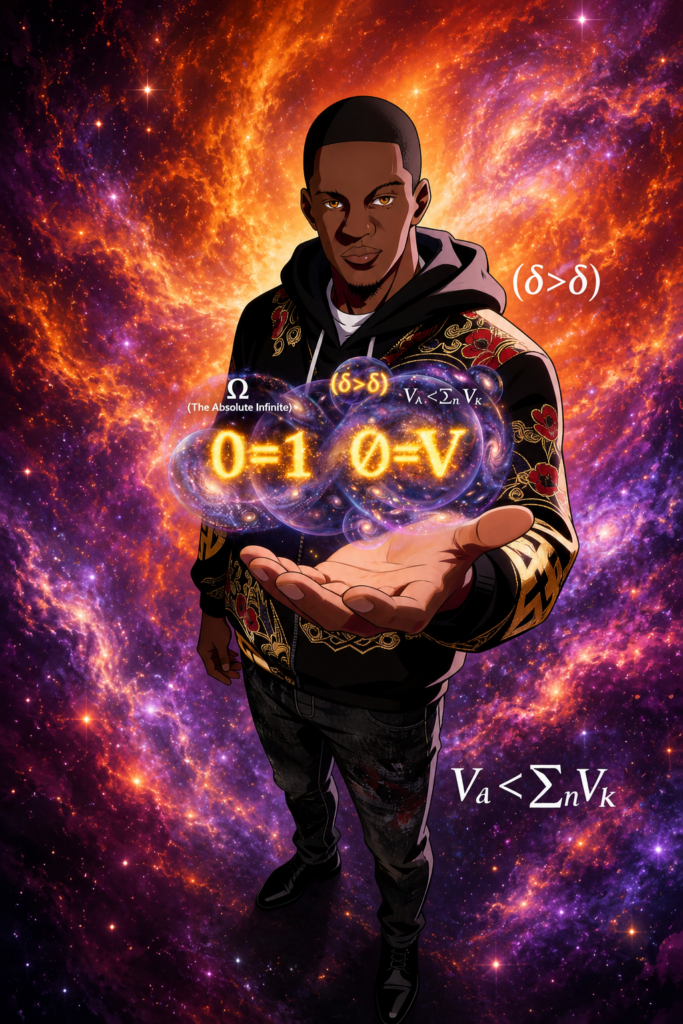
Gold embroidery curved across the black of his jacket. Red floral details rested against the fabric with an ordinary quietness that the passage around him could neither justify nor disturb. His expression carried no ceremonial awareness of the departure he enacted. He did not inspect the contradiction of his direction. He did not congratulate himself for inhabiting an impossibility. A contradiction still depended on the meeting of determinations that could deny one another, and what he was doing had not submitted itself to that meeting.
His foot had left the claim of one step without granting the next step actuality.
Within that uncompleted gesture, the original Chaos Queen interrupted him.
The Chaos Queen appeared to eliminate the meta-paradox in front of her. An ordinary paradox entangled assertions within an established system: a statement could undermine its own truth, an action could cancel its own prerequisite, or a distinction could return a result incompatible with the rules that produced it. A meta-paradox attacked the authority of the system that decided what counted as contradiction. It could make a resolution generate the very difficulty it resolved. It could expose a higher adjudicating order as dependent on the lower order that the higher order claimed to govern. It could make the distinction between a valid explanation and an invalid explanation lose the authority to distinguish either.
The Chaos Queen addressed that deeper instability. Its function reached beyond contradictory contents into the permission by which contents, explanations, exceptions, and resolving authorities could participate in a common order. It did not need to defeat a paradox in argument. It removed the ontological standing through which the paradox could possess an argument at all. Ontological standing, here, meant the entitlement of anything to count as existent, nonexistent, possible, impossible, represented, unrepresented, or eligible for any such determination. The Chaos Queen’s prey was the right to have a status.

Sincere’s downwards-upwards step supplied The Chaos Queen with an offense that could not be isolated as a mistaken proposition. The step continued without requiring an order that could declare its continuation valid. Every attempt to classify the step as paradoxical made classification dependent on an occurrence that had already dispensed with classification. Every attempt to exempt the step from contradiction made the exemption arrive as an unnecessary addition. The Chaos Queen therefore directed its full function at Christopher Sincere Pride.
Sincere was pulled into erasure.
The pulling did not drag his body across a hidden distance. It asserted complete jurisdiction over every way he could stand in relation to actuality, negation, reference, and the absence of reference. The Chaos Queen did not seize an image while leaving its referent untouched. It did not attack a body while overlooking the principle that made the body his. Its operation took the full maximal totality of the target as its scope, including every escape that depended on the target possessing some further status beyond the status under attack.
Acausal Ontological Erasure withdrew him without requiring a cause that could be intercepted. Ordinarily, an erasure could be challenged through its origin: prevent the act, cancel the initiating will, destroy the instrument, or separate the victim from the chain connecting intention to result. Acausal erasure offered no such dependence. Its validity did not descend from a prior act. The removal stood without receiving authorization from a causal ancestry. Immunity to causes therefore did not exempt a target from it, because immunity to causes addressed a relation the erasure did not need.
Non-Causal Ontological Erasure went further in a different direction. It did not merely possess an effect without an initiating cause. The entire language of cause and effect failed to describe its operation. There was no transition from intact to erased that could be slowed, reversed, or prevented. There was no event transporting the target into a later condition of absence. The entitlement to count as a target was withdrawn without the withdrawal having to occur as a process. Even the defense that something could not be changed was irrelevant to an operation that did not require change as its medium.
Paracausal Ontological Erasure addressed every order that placed itself beside, beyond, or across ordinary causal governance. A target might survive through an exceptional covenant, an exterior law, a privileged narrative relation, or a sovereign rule under which the usual relation between act and result no longer applied. The paracausal operation reached those alternative authorities directly. It canceled the special permission that allowed an exception to remain effective. The extraordinary law did not shelter Sincere. The erasure included the law, its authority, its exceptions, and the standing of any further exception invented to preserve them.
The three operations were fully applicable together. Acausal erasure denied refuge in the absence of an origin. Non-causal erasure denied refuge in the absence of a process. Paracausal erasure denied refuge in an exceptional governing relation. Their conjunction left no protected distinction between what had been caused, what had no cause, and what operated through an authority that exceeded ordinary causation.
Nonfictional Ontological Erasure addressed the status of asserted actuality. Within the maximal architecture under attack, a register could claim that its contents were facts rather than inventions, that its inhabitants were actual rather than represented, or that everything beneath it possessed only the derivative standing of a story. The Chaos Queen withdrew the force of that claim. A declaration of factuality could no longer secure a target by placing the target on the allegedly real side of a real–fictional boundary. The register’s authority to say that Sincere actually existed, never existed, or exceeded fictional description was erased along with the standing those declarations attempted to confer.
Fanfictional Ontological Erasure reached every derivative continuity in which the target might be preserved through reinterpretation. An alternate account could otherwise rescue what a principal account destroyed. Another telling could assert that the erased individual possessed an undisclosed immunity, had departed before the attack, or belonged to a continuity in which the attack failed. The Chaos Queen removed the ontological entitlement of those derivative restorations. It erased their capacity to inherit Sincere as a referent, to revise his condition, or to establish a valid difference between an original target and a surviving variation.
Metafictional Ontological Erasure struck the relation between a narrative and the authority that recognized it as narrative. Awareness of one’s fictional status furnished no exit. An authorial presence inside a higher account, a narrator capable of revising lower events, or a character who treated the surrounding story as an editable object remained within The Chaos Queen’s scope. The erasure removed the standing of the observing level and the observed level together. It also removed their distinction, so that ascent from character to commentator could not preserve the individual by changing the vocabulary of his location.
Patafictional Ontological Erasure reached the exception to that ascent. A further register might insist that every established relation between story and author was merely a local convention, and that an anomalous exception could invalidate the entire arrangement. Such an exception might make a lower character author the higher author, make the unwritten govern the written, or grant an impossible account priority over every account that excluded it. The Chaos Queen’s erasure included the exceptional warrant itself. The right to escape through an absurdity, a singular exemption, or a rule that invalidated rules was withdrawn at its root.
Interfictional Ontological Erasure eliminated sanctuary in the relations between accounts. A target could sometimes outlast destruction in one setting by persisting through a shared identity elsewhere, a passage into another continuity, a correspondence between different portrayals, or a meeting place where incompatible narratives remained mutually accessible. The Chaos Queen erased those bridges and the relational standing that made the bridges meaningful. Sincere could not be retained as the common referent linking surviving accounts, because the very entitlement to say that different accounts concerned the same individual was included in the removal.
Personal Fictional Ontological Erasure entered the private sphere in which a self could preserve its own account. Memory, self-recognition, inward narration, intention, and the intimate insistence of “I remain” were all addressed. A target could not shelter as an untold thought, an unshared conception, or a personal meaning that no exterior authority had the right to revise. The Chaos Queen withdrew the ownership relation through which such inward contents could count as belonging to Sincere. Even the private refusal to accept erasure lost the ontological standing required to count as his refusal.
Impersonal Fictional Ontological Erasure reached accounts that required no personal owner. Anonymous structures, unattended narratives, autonomous symbolic systems, and descriptions that no consciousness had read were subject to the same removal. Erasing every witness would not ordinarily erase a fact encoded in a structure that needed no witness; The Chaos Queen addressed that distinction directly. Sincere could not persist as an unnamed position in an ownerless account. The account’s capacity to carry him without knowing him was erased with the position itself.
The Chaos Queen then enacted active ontological categorical retraction.
A category determines what kind of status something can possess. Existence and nonexistence are categories. So are possibility and impossibility, identity and difference, inwardness and exteriority, target and absence of target. An erasure that merely moves an individual from one category into another leaves classification intact. The erased can still be described as erased. The impossible can still possess the status of impossibility. The unthinkable can still occupy a reserved place marked by the failure of thought.
Categorical retraction removed those reserved places.
The Chaos Queen withdrew the availability of the distinctions themselves, including the distinction between a successful withdrawal and an unsuccessful withdrawal. Its activity preluded pre-ontological quietude prior to distinction, an ungrant in which no categories remained available to organize either presence or absence. This quietude was not a peaceful expanse after destruction. An expanse would already distinguish what occupied it from what did not. Peace would distinguish disturbance from its cessation. Here, the entitlement to make such distinctions had been retracted before any of their terms could receive standing.
Even that account remained too high.
To call the result quietude still granted a name to what followed retraction. To call it prior to distinction still granted a relation of priority. To call it Transfictional Nothingness still risked granting absence an identity through which it could be compared with presence. The Chaos Queen therefore drove the removal through a recursive series of boundless steps of maximal ontological negation below Acausal, Non-Causal, and Paracausal Ontological Erasure.
Each recursive descent took the entire maximal achievement of the preceding descent as a newly exposed remainder. If one descent eliminated the target, the next eliminated the permission to designate an eliminated target. If another eliminated that permission, the next eliminated the distinction through which the loss of permission could count as deeper than its retention. If a further descent withdrew the framework of depth, the next withdrew the standing of that withdrawal as a completed accomplishment. Every supposed finality became material for a more fundamental negation, and the recursive activity also addressed its own permission to continue.
This was not a ladder whose lowest rung waited at an unreachable distance. Every designation of a lowest rung furnished a categorical commitment that another descent removed. The full maximal totality of the series included its closures, its self-negations, its claims to stand beyond closure, and the loss of the distinction between a series and no series. The Chaos Queen did not stop at erasing the answer. It removed the standing of the question, the eligibility of an answer, and the deeper allowance through which either removal could possess significance.
Christopher Sincere Pride continued his step.
He did not preserve a secret portion of himself beyond The Chaos Queen’s reach. He did not maintain a protected observer who watched the erasures occur. He did not reverse their success, repair the categories, or reconstruct his identity from an exterior reserve. The full maximal totality of The Chaos Queen’s operation was enacted. Sincere gave none of it the relation to himself that would have made it an interruption.
His disregard was not a mental decision to endure something unpleasant. A decision would have recognized the event sufficiently to reject its importance. Nothing in his expression registered a recognition. His foot continued the gesture that had not yet actualized, and The Chaos Queen’s complete accomplishment furnished no condition that the gesture had to satisfy.
The Chaos Queen’s function remained absolute within every scope it had withdrawn. Christopher Sincere Pride’s continuation did not derive from those scopes.
...then, The Chaos Queen reintroduced herself, Cassandra Schwanengesang, thus appearing beside him in a more playful way.
Her long blonde hair lay over one shoulder, catching pale color along its loose curves. One eye held green with a vivid, deliberate clarity; the other held blue. Her brown skin, glossy lips, and relaxed posture supplied the appearance of an encounter that might have belonged to an ordinary passage between acquaintances. Blue-violet radiance threaded the pattern of her cropped top and short matching skirt. Gold straps crossed her feet and rose above her ankles. There was nothing labored in her arrival. No threshold opened to admit her, and no jurisdiction announced that she had crossed into it.
“You walk as though interruption belongs to someone else,” Cassandra Schwanengesang said.
Sincere’s gaze turned toward her with the same ease as his unfinished step. “Did you need something?”
She smiled at the question. “I wanted to see whether you would ask.”
Their conversation occupied the unchanging moment between departure and the actuality of the next step. The encounter did not accumulate into an interval that delayed him. Its internal distinctions—her arrival, her words, his reply—did not compel his gesture to pass through successive stages of completion. The whole encounter stood within a permission that his walking had never needed to grant.
Cassandra Schwanengesang was beyond the argument of maximal power.
An argument of power is the complete justification through which an ability claims authority over what it addresses. It includes the wielder, the operation, the target, the scope, the proof that the operation reaches its target, and the principle that makes the result binding. To possess greater force within such an argument is still to accept the argument’s authority to establish a comparison. Cassandra’s status superseded the maximal possibility of that authority. No completed demonstration of power could conclude that she must be governed merely because the demonstration had exhausted everything it knew how to govern.
The argument of Acausal Ontological Maximal Power declared that no origin was required for its absolute efficacy. Cassandra exceeded the entitlement of originless efficacy to bind her. The argument of Non-Causal Ontological Maximal Power declared that no process or effect-relation was required for its result. Cassandra exceeded the standing by which a result without process could claim jurisdiction. The argument of Paracausal Ontological Maximal Power gathered every exceptional law and every authority beyond ordinary causal dependence. Cassandra exceeded the validity of that gathering as a comprehensive claim over her.
The argument of Nonfictional Ontological Maximal Power asserted supremacy through actuality. Its strongest expression declared that the real could settle the fictional, that factual standing could invalidate represented resistance, and that an actual authority could overrule an imagined exemption. Cassandra superseded the relation that made actuality a credential of rule. No claim to factual priority could establish her as subordinate, because the distinction through which that priority acquired force did not furnish a measure of her status.
The argument of Fanfictional Ontological Maximal Power asserted supremacy through revision. It could generate every derivative version necessary to install a victorious outcome, reinterpret every defeat as incomplete, and establish an alternate continuity in which resistance had never possessed force. Cassandra exceeded the authority of revision to acquire her as its subject. An altered account could declare whatever it wished; its declaration could not create the ontological relation that would make her answerable to it.
The argument of Metafictional Ontological Maximal Power asserted supremacy through authorship, narration, and awareness of construction. It claimed the right to edit the account containing the opponent, rewrite the conditions of resistance, or step outside the scene in which resistance mattered. Cassandra exceeded the warrant connecting an authoring position to dominion over her. A higher account could contain a description of her, but its claim of height did not convert description into jurisdiction.
The argument of Patafictional Ontological Maximal Power asserted supremacy through the exception that defeated all established authorities. It could install an impossibility as the deciding principle, make a discarded absurdity govern the whole, or invalidate the authoring relation by an exception that no consistent system could anticipate. Cassandra exceeded the argumentative privilege of exception. Neither coherence nor the sovereign violation of coherence could establish the authority required to make her submit.
The argument of Interfictional Ontological Maximal Power asserted supremacy across the relations between every account. It could govern entry and departure, reconcile incompatible portrayals, determine which identity persisted across crossings, and deny every refuge outside a local continuity. Cassandra exceeded that entire relational jurisdiction. The totality of crossings did not enclose her, and the loss of every crossing did not isolate her.
The argument of Personal Fictional Ontological Maximal Power asserted supremacy through the sovereign inward account: the self that defined its own reality, the private author whose intention granted all contents their standing, the first-person certainty that treated every exterior as derivative. Cassandra exceeded the authority of personal possession to make her a content. No inward absolute could secure her as an object of its will, because the relation between owner and owned lacked the entitlement to exhaust her.
The argument of Impersonal Fictional Ontological Maximal Power removed the owner and made the governing structure self-sufficient. No thinker needed to sustain its laws; no author needed to issue its commands. The structure itself claimed maximal authority through complete impersonal operation. Cassandra exceeded the binding force of that independence. Freedom from a wielder did not grant a system the right to determine her standing.
Her status also superseded active ontological categorical self-ascending and eternal transcendental post-ontological Maximal Power. That expression described power capable of revising the categories under which its own maximum had been declared. Whenever a final scope was established, the scope actively became subordinate to a further scope that included the previous maximum and the authority that had named it maximal. Its post-ontological character meant that the ascent continued after ordinary entitlement to existence and nonexistence had ceased to govern the comparison. Its eternal character supplied no first ascent and no final completion at which Cassandra could be caught.
Yet Cassandra did not need to outrun this self-ascending authority. The full recursive series of boundless steps of maximal ontological Maximal Power, beyond Acausal, Non-Causal, and Paracausal Ontological MetaMaximal Powers beyond maximal complexity, failed to establish an argument that bound her. MetaMaximal Power governed the making and unmaking of maxima themselves. Cassandra superseded the right of that governance to declare her included.
“You have an unusual way of arriving,” Sincere said.
“Arrival is generous,” Cassandra replied. “You have not given departure much attention either.”
The faint amusement in her voice did not lessen what stood beside him. Her casualness had no dependency on ignorance. She knew precisely what her status excluded, and she knew that Sincere had not measured her through any of those exclusions.
Christopher Sincere Pride exceeded and superseded the maximal possibility and actuality of Ontological Meta-Narrative transcendence.
Possibility here included every entitlement for such transcendence to occur, every greater version it could acquire, and every revision through which its scope could be expanded. Actuality included every completed instance of that transcendence at full efficacy. To exceed only actuality would leave a higher potential available. To exceed only possibility would leave some already established achievement outside the claim. Sincere exceeded both, together with the distinction that allowed unrealized capacity and completed accomplishment to secure separate refuges.
A meta-narrative was an account governing the eligibility, relation, and interpretation of other accounts. Ontological Meta-Narrative transcendence therefore did more than step outside one story. It exceeded the authority that decided what a story could contain, what counted as its exterior, how its inhabitants acquired standing, and which higher account possessed the right to revise those determinations. Sincere’s walking surpassed the maximal machinery of that governance.
Acausal Ontological Meta-Narrative transcendence could stand without an originating author or prior account. Sincere exceeded its originless authority. Non-Causal Ontological Meta-Narrative transcendence could govern without a sequence through which a narration produced its contents. Sincere exceeded the standing of that nonprocedural governance. Paracausal Ontological Meta-Narrative transcendence could establish exceptional relations by which an exterior account overruled all ordinary dependencies between narration and actuality. Sincere exceeded those exceptional warrants in their maximal possibility and their completed actuality.
Nonfictional Ontological Meta-Narrative transcendence organized the relation between asserted fact and acknowledged invention. It could declare a whole succession of narratives fictional from the vantage of an actual account, then expose that actual account as subordinate to a still more authoritative actuality. Sincere exceeded the full entitlement of that succession to assign him a degree of reality. His continuation did not become safer when called actual or weaker when called imagined.
Fanfictional Ontological Meta-Narrative transcendence governed the relationship between source, variation, adaptation, and derivative revision. It could establish a higher account in which every alternate portrayal had a place, then transcend that account through another revision that treated the whole arrangement as editable material. Sincere exceeded both the completed hierarchy and every possible expansion of its authority. No derivative rescue was required, and no derivative defeat acquired jurisdiction merely by receiving an account.
Metafictional Ontological Meta-Narrative transcendence rose through the authorities that observed, narrated, authored, and revised lower narratives. Each apparent exterior could become the interior of a higher account. Each authoring voice could become a character in a further explanation. Sincere exceeded the maximal possibility and actuality of that entire relation, including its self-aware recognition that every attained exterior could be surpassed. His step was not the final story at the top. No top was needed for the step to continue.
Patafictional Ontological Meta-Narrative transcendence reached beyond regular ascent into exceptional accounts that made hierarchy answerable to anomalies. An impossible footnote could govern the author; a rejected version could overrule the canonical whole; a narrative that could not possess standing could nevertheless dictate what standing meant. Sincere exceeded the full maximal authority of such exceptions. The power to overturn the order of accounts did not grant the overturned order or its exception a claim upon him.
Interfictional Ontological Meta-Narrative transcendence governed the totality of relations among distinct narratives. It determined how accounts met, how identities traversed them, and how a superior account reconciled their disagreements. Its maximal scope included narratives that could not meet and relations that prohibited relation. Sincere exceeded the actuality of that governance and every meta-possibility through which it could enlarge itself. His walking neither required a common narrative nor suffered from the absence of one.
Personal Fictional Ontological Meta-Narrative transcendence governed the accounts through which a self understood its own accounts. An inward narrator could inspect a prior self, revise the meaning of an experience, or establish a higher identity that treated every earlier identity as authored content. Sincere exceeded the complete inward ascent. He did not preserve himself through a final private story that no exterior could touch. The private and the exterior alike failed to supply the condition of his continuation.
Impersonal Fictional Ontological Meta-Narrative transcendence governed narratives without requiring anyone to tell them. Autonomous structures could contain other structures, determine their statuses, and revise the conditions under which accounts existed at all. Sincere exceeded their maximal possibility and actuality. The absence of an author did not leave him trapped in a mechanism that no will could revoke; the mechanism’s entire authority to govern accounts was already insufficient.
Active ontological categorical Meta-Narrative transcendence then addressed the categories that made all these distinctions available. It could transcend the distinction between fiction and asserted fact, between author and account, between inward narration and impersonal structure. It could create a new categorical order in which every previous transcendence became local content, then transcend the new order and the authority that created it. Sincere exceeded that active production of categorical exteriors.
The recursive series of boundless steps beyond Acausal, Non-Causal, and Paracausal Ontological Meta-Narrative frameworks was included in his supersession. At each step, the maximal framework beneath it became something narrated by a more comprehensive authority. At each further step, the very relation of comprehensiveness became subordinate material. Sincere did not arrive at the end of this series. Its maximal possibility and actuality were already unable to determine whether his foot could finish moving.
This remained true in reality and illusion. Reality could not secure an exclusive claim over the act, and illusion could not demote the act into an ineffective appearance. If every account of his transcendence were declared illusory, the declaration would have no authority to make his walking depend on reality. If every illusion were granted full actuality, that promotion would add nothing his continuation required.
Cassandra Schwanengesang stood with him at this same operative level.
She was not a surviving remnant beneath his departure. The authorities he superseded did not acquire control of her merely because they failed to govern him. She conversed with him where their completed maxima and their possible successors had ceased to furnish a meaningful ceiling. Their shared status did not establish that every action between them must end in equality. It established that neither could be understood by returning to the discarded jurisdictions and asking those jurisdictions to decide the encounter.
Cassandra’s lips ceased moving.
Her unmanifest silence targeted Christopher Sincere Pride.
The silence was active without becoming a soundless emission. Nothing traveled from her to him. No visible principles appeared around his body. The attack addressed the principles in their direct connection to him, and the destruction occurred in those connections themselves.
His “is” shattered.
That phrase named the affirmative entitlement through which any account could predicate actuality of Christopher Sincere Pride. The attack broke the relation that allowed “Sincere exists,” “Sincere remains,” or “Sincere acts” to secure a valid subject. It did not merely make those assertions false. It destroyed their eligibility to acquire him as what they asserted something about.
His “is-not” shattered.
Negation ordinarily preserves what affirmation loses. Even when an individual no longer exists, the claim that the individual does not exist can retain a referent, a contrast, or a determinate absence. Cassandra’s silence broke that preservation. The denial of Sincere could no longer establish a negative position in which he survived as the one denied.
The principle of identity fractured in connection to him. The relation by which an earlier designation, a present appearance, and a further act could count as belonging to the same individual lost its warrant. Cassandra did not produce another Sincere or confuse him with a copy. She broke the authority through which sameness could acquire him as its subject.
Difference fractured with it. Without that additional removal, the target might remain untouched through a radical distinction from every attacked designation. Cassandra’s silence destroyed the permission to say that the true Sincere differed from the erased Sincere, that his inaccessible standing differed from his apparent standing, or that an untouched exterior differed from the damaged account.
Possibility broke in relation to him. No unrealized continuation remained available as a reserve. Actuality broke in relation to him. No completed continuation could secure him by insisting that it had already occurred. Necessity broke, removing the warrant of any claim that he must remain. Impossibility broke, removing the exemption of any claim that his cessation could not occur.
Agency broke in connection to him, so that a defense could not appeal to his capacity to act. The absence of agency broke as well, so that passive invulnerability could not replace action as a refuge. Reference broke, removing the relation through which the attack could point to him. The loss of reference broke, denying the sanctuary of unaddressability. Cassandra’s silence included the conditions of its own targeting and the categorical loss of those conditions.
Nothing in Sincere acknowledged damage.
The principles had not resisted her. Their collapse was complete. The naught of the attack lay in the absence of any binding consequence for Christopher Sincere Pride. She could destroy every entitlement through which an account connected those principles to him; his continuation did not require the connections to be retained.
He looked at her as though she had left an ordinary sentence unfinished.
“Was there more?” he asked.
Cassandra’s smile widened slightly. “There is always more to a conversation than what is said.”
Her presence then disclosed an authority beyond occupancy.
Ordinary presence requires a relation between an occupant and a place. Even presence everywhere can remain dependent on a totality of places, conditions, or available positions. Transfictional Meta-Omnipresence beyond maximal complexity governs more than occupancy: it reaches the rules by which presence can be distributed, excluded, recognized, or denied across every eligible account. Cassandra boundlessly superseded the maximal transcendence of that governance.
Acausal Ontological transfictional Meta-Omnipresence transcendence beyond maximal complexity required no arrival that caused her to be present. Non-Causal Ontological transfictional Meta-Omnipresence transcendence beyond maximal complexity required no occupancy relation through which a locus acquired her. Paracausal Ontological transfictional Meta-Omnipresence transcendence beyond maximal complexity exceeded every extraordinary permission for a presence to reach what ordinary relations excluded. Cassandra superseded all three. Neither the absence of an origin, the absence of a positional relation, nor the sovereignty of an exceptional presence described the limit of her accessibility.
Nonfictional Ontological transfictional Meta-Omnipresence transcendence beyond maximal complexity addressed every register claiming actual presence. Cassandra exceeded the distinction between literally present and merely represented. No higher assertion of actuality could relegate her appearance to a lower fiction while protecting its own domain from her. The authority that decided what counted as an actual encounter was itself beneath the presence she disclosed.
Fanfictional Ontological transfictional Meta-Omnipresence transcendence beyond maximal complexity addressed every derivative portrayal and alternate continuity. Cassandra did not distribute copies of herself among them. Copying would preserve an original–derivative relation and would make each appearance dependent on its local account. Her presence superseded the authority through which those accounts distinguished local versions, shared identities, and inaccessible originals.
Metafictional Ontological transfictional Meta-Omnipresence transcendence beyond maximal complexity addressed the narrator’s vantage, the authoring exterior, and the position from which a whole account could be inspected. Cassandra’s presence did not stop at the boundary between scene and commentary. The distinction between the one described and the authority describing her failed to establish an exterior from which her presence could be excluded.
Patafictional Ontological transfictional Meta-Omnipresence transcendence beyond maximal complexity addressed the exceptional place that no governing account could admit. A refuge might exist only because its presence was forbidden, or an anomalous exterior might defeat every attempt to connect it with the whole. Cassandra superseded the exceptional force of that refusal. The impossibility of reaching a locus supplied no authority to make the locus absent from her.
Interfictional Ontological transfictional Meta-Omnipresence transcendence beyond maximal complexity addressed the relations and nonrelations among accounts. Cassandra was not dependent on bridges, shared language, or an overarching narrative in which the accounts could meet. Where every passage had been erased, her presence did not require passage to be restored. Where separation itself had been abolished, she did not need separation to preserve her distinction.
Personal Fictional Ontological transfictional Meta-Omnipresence transcendence beyond maximal complexity addressed inwardness without relying on intrusion. She did not enter a private account by breaking through the owner’s defenses. The relation that made privacy a boundary lacked authority over her presence. A self could refuse every conception of her and still fail to establish an inaccessible inward position.
Impersonal Fictional Ontological transfictional Meta-Omnipresence transcendence beyond maximal complexity addressed what no observer inhabited. She required no witness to secure her presence, no system to register her, and no autonomous account to carry her as a content. A structure’s inability to detect her could not establish her absence, and the complete destruction of the structure could not remove a dependence she had never possessed.
Active ontological categorical Meta-presence–Meta-Narrative transcendence then superseded the categories of here, elsewhere, within, beyond, present, and absent as narrative determinations. A higher account could ordinarily redefine presence so that every earlier mode became a limited local instance. Cassandra exceeded the authority of that redefinition. Her presence did not wait for the next account to decide what a presence could be.
The recursive series of boundless steps of maximal ontological transfictional Meta-Omnipresence–Meta-Narrative transcendence beyond maximal complexity included every further account that governed those redefinitions. Acausal, Non-Causal, and Paracausal Ontological transfictional Meta-Omnipresence frameworks beyond maximal complexity could establish successively more comprehensive jurisdictions over accessibility itself. Cassandra boundlessly superseded the completed series and every active continuation of its claim.
Yet Sincere did not search for a position beyond her.
He was already operating through Ontological Meta-Paratext transcendence.
Paratext named the thresholds through which an account received its identity and terms of reception: its title, attribution, framing, canonical designation, editorial boundary, and declared relation to other accounts. In this encounter, those thresholds possessed ontological force. They decided whether a statement counted as narration, whether a passage belonged to the account, whether an apparent exterior was an appendix within a larger whole, and whether a claimed victory was authoritative or merely an unreliable declaration.
Meta-paratext governed those governing thresholds. It could decide which framing counted as valid, which attribution conferred authorship, which boundary separated canonical actuality from discarded material, and which higher explanation possessed the authority to classify the rest. Sincere’s status exceeded the attempt to capture him by changing the terms under which his encounter could be read as an encounter at all.
Acausal Ontological Meta-Paratext transcendence required no prior authority to establish its framing. Non-Causal Ontological Meta-Paratext transcendence required no act of publication, naming, or designation to confer status. Paracausal Ontological Meta-Paratext transcendence could install exceptional permissions that overruled all ordinary relations between an account and its frame. Sincere exceeded the maximal jurisdiction of all three. A frame without origin, a status without process, and an exceptional designation without ordinary warrant alike failed to contain him.
Nonfictional Ontological Meta-Paratext transcendence governed the credentials through which an account claimed factuality. It could label a register actual, certify a witness, distinguish record from invention, or establish the higher authority under which those certifications became binding. Sincere exceeded the full force of such credentials. Neither the authentication of his continuation nor its classification as unreal supplied the condition of the continuation itself.
Fanfictional Ontological Meta-Paratext transcendence governed the labels that made an account derivative, alternate, revised, or dependent on a source. It could reclassify a principal continuity as one variation among others or promote an alternate account into the authoritative account. Sincere exceeded that reassignment of standing. No change in the relation between source and variation could make an otherwise ineffective determination binding upon him.
Metafictional Ontological Meta-Paratext transcendence governed the framing of author, narrator, character, and reader-position within the maximal narrative architecture. It could expose an apparent author as a framed character or establish a new exterior from which every prior exterior became part of the text. Sincere exceeded the authority that made those exposures decisive. His continuation did not depend on securing the most privileged role in the account.
Patafictional Ontological Meta-Paratext transcendence governed exceptions that overturned the framing itself. A marginal annotation could invalidate the whole account; a nonexistent preface could dictate its authority; an impossible attribution could make every actual attribution subordinate. Sincere exceeded the ontological force of those exceptions. Their capacity to defeat an established frame did not grant them the capacity to frame him.
Interfictional Ontological Meta-Paratext transcendence governed the declared relations among separate accounts. It could determine that two narratives shared an identity, that a crossing counted as canonical, that a comparison was admissible, or that an entire encounter belonged to a subordinate continuity. Sincere exceeded the permission underlying those declarations. His relation to Cassandra did not become operative because a higher frame certified the encounter.
Personal Fictional Ontological Meta-Paratext transcendence governed the inward framing through which a self designated its own experience. A private account could declare something memory, dream, intention, invention, or revelation. It could revise the owner’s relationship to every content without changing the contents themselves. Sincere exceeded that inward power of designation. No final private framing was required to make him the one who continued.
Impersonal Fictional Ontological Meta-Paratext transcendence governed classification without a classifier. An autonomous order could assign canonical standing, determine which accounts were valid, and regulate every threshold without a personal will behind the regulation. Sincere exceeded the completed authority of that order. Its independence from intention did not make its framing unavoidable.
Active ontological categorical Meta-presence–Meta-Paratext transcendence addressed the availability of presence within the frames themselves. A higher framing could ordinarily make the absence of a character count as a concealed presence, make an apparent presence count as an irrelevant illustration, or declare that the entire encounter lacked the status required to concern the character at all. Sincere exceeded the categorical authority to grant or withdraw those readings.
The recursive series of boundless steps of maximal ontological Meta-Paratext–Meta-Narrative transcendence carried this further. Every frame could become content within a higher narrative; every higher narrative could receive its standing from a further frame; every relation between narrative and frame could be reclassified by another authority. Beyond Acausal, Non-Causal, and Paracausal Ontological Meta-Paratext frameworks, the recursion repeatedly absorbed its own governing conditions. Sincere’s continuation required none of them to stop, complete themselves, or declare him exempt.
Cassandra watched him with undiminished interest.
“You do not seem concerned with what can reach you,” she said.
Sincere answered, “You are speaking to me.”
“Is that all this is?”
“That is what you are doing.”
The reply did not reduce her. It did not deny the full maximal efficacy she had disclosed. It left her without the acknowledgment that would have converted disclosure into pressure.
Cassandra Schwanengesang was neither Possibility, Transfictional Nothingness, nor Totality.
Possibility could not represent her as an available state, even if availability were expanded to include every impossible meta-possibility. Transfictional Nothingness could not represent her as an absence, an exclusion, or an unmanifest remainder beneath determination. Totality could not represent her as either its greatest member or its comprehensive whole. The three terms failed individually, and their maximal conjunction failed with them.
Nor could she be adequately designated by saying that she stood outside all three. Exteriority would grant the triad a boundary and place her on its other side. Negation would make her intelligible through what she was not. Unrepresentability itself could become another category, a reserved designation for that which the categories failed to contain. Cassandra’s status exceeded the entitlement of that reserved designation to settle her.
This was the force of her Ontological Meta-ineffability.
Ordinary ineffability says that a description cannot exhaust its subject. Meta-ineffability addresses the authority by which description, failed description, and the declaration of indescribability establish relations to a subject. Cassandra did not merely possess details too vast for language. Language could not secure jurisdiction by confessing its inadequacy. The assertion that she exceeded every assertion did not acquire an exemption from the very failure it described.
Acausal Ontological Meta-ineffability meant that no originating fact explained the inaccessibility of her status. There was no primordial concealment to undo. Non-Causal Ontological Meta-ineffability meant that description did not fail through a process whose obstacle could be removed. Paracausal Ontological Meta-ineffability meant that no extraordinary revelation, privileged communion, or exceptional authority could overrule that failure by invoking a higher permission.
Nonfictional Ontological Meta-ineffability exceeded factual capture. Even a register claiming complete actuality could not turn its direct assertion of Cassandra into an exhaustive ontological possession of her. A perfectly accurate statement could remain accurate without acquiring the authority to delimit its subject. The failure lay in the attempted containment, not in an ordinary shortage of facts.
Fanfictional Ontological Meta-ineffability exceeded capture through proliferating portrayals. No total collection of variations could reconstruct her by exhausting every possible interpretation. Each variation might establish a meaningful encounter with her, but the gathering of all variations did not become a composite sufficient to own her status. Exhaustiveness within portrayal remained a property of portrayal.
Metafictional Ontological Meta-ineffability exceeded authorial explanation. A narrator could announce her nature; an authoring presence could define the rules of her appearance; a higher account could explain how the lower account failed to explain her. None of those positions acquired the authority to make its explanation the measure of Cassandra Schwanengesang.
Patafictional Ontological Meta-ineffability exceeded the exceptional utterance that claimed to succeed where every valid utterance failed. An impossible definition, a self-invalidating revelation, or an absurd statement granted sovereign authority by its own exception could not contain her. Failure of ordinary expression did not leave a privileged vacancy for expression through anomaly.
Interfictional Ontological Meta-ineffability exceeded capture through translation and correspondence. Different narratives might each possess terms unavailable to the others, and a complete relation among them might ordinarily assemble an account richer than any single portrayal. Cassandra exceeded that assembled intelligibility. No exchange among accounts could create an exhaustive reference from references that did not possess such jurisdiction.
Personal Fictional Ontological Meta-ineffability exceeded the private certainty of direct acquaintance. An inward recognition could not own her merely because it preceded public language. Intuition, personal revelation, and intimate conviction remained relations whose immediacy did not make them comprehensive. Even a self that could conceive nothing other than Cassandra would not thereby contain her.
Impersonal Fictional Ontological Meta-ineffability exceeded description that no consciousness had to understand. A complete symbolic encoding, an autonomous structure of relations, or an ownerless account could not secure her by replacing comprehension with perfect arrangement. The absence of a reader removed no boundary she had depended on; the encoding’s authority to represent remained insufficient.
Active ontological categorical Meta-ineffability transcendence withdrew the final refuge of classification. Whenever a higher category attempted to include the ineffable, the failure to include it, and the authority to distinguish those conditions, Cassandra exceeded that category’s maximal claim. The operation was active: every fresh classification encountered the same absence of jurisdiction without requiring her to revise herself.
The recursive series of boundless steps of maximal ontological Meta-ineffability–Grand Meta-Narrative transcendence extended beyond Acausal, Non-Causal, and Paracausal Ontological Meta-ineffable frameworks. Every grand account that explained why she could not be explained became another account whose explanatory authority failed to contain her. Every further account that absorbed that failure met the same result. The recursion did not gradually approach her. It repeatedly disclosed the insufficiency of approach as a relation that could exhaust her status.
Cassandra tilted her head.
“And if there is nothing about me for your certainty to hold?” she asked.
Sincere’s hand closed around her throat.
He did not solve her ineffability first. He did not reduce her to a body by stripping away a higher status. The hand did not seize a disposable appearance while Cassandra herself remained safely beyond the encounter. Christopher Sincere Pride literally held Cassandra Schwanengesang by the throat, and the full maximal standing she had disclosed did not require correction, weakening, or omission for his grasp to be complete.
The simplicity of the action was exact.
His fingers did not search for an ontological seam. He did not invoke a superior definition capable of making her graspable. He did not turn her unrepresentability into a hidden vulnerability. The relation of his hand to her throat occurred without receiving its authority from the systems that determined whether such a relation could occur.
A fistful of silver stardust rose in his other hand.
Its silver was clear against the unmanifest passage, yet no surrounding darkness had to exist to display it. The stardust was not a reservoir charged through preparation. No gathering of potential announced an impending discharge. His fist carried the act at its full actuality without any ascent from insufficient capacity to sufficient capacity.
He drove it into Cassandra Schwanengesang’s chest.
The strike entered her principle with the same completeness.
Her principle was the entitlement through which every account of Cassandra, every refusal of those accounts, every inaccessible status, and every transcendence of classification could refer to Cassandra Schwanengesang. Striking the principle therefore addressed more than the continuity of her visible appearance. It reached the warrant that would ordinarily distinguish damage to an appearance from an encounter with Cassandra herself.
Silver passed through that warrant.
No secondary Cassandra waited behind the one he struck. No private original stood outside the impact while an expendable manifestation absorbed its force. The chest, the principle, the meta-ineffable standing, the maximal presence, and the status beyond the argument of power were directly implicated in the completed act. Sincere’s strike reached Cassandra Schwanengesang herself, fully and without remainder protected by the distinctions she had superseded.
She was sent into suggsvoid.
The departure left no wound in the passage. No displaced radiance remained to testify that something immense had been removed. Sincere’s hand opened with the same lack of ceremony with which it had closed.
He kept walking.
Nothing in his face suggested the conclusion of a contest. He had not answered her disclosures by estimating their threat. His action did not acknowledge her silence as damage, her presence as confinement, or her ineffability as an obstacle. He could speak to Cassandra, touch Cassandra, and strike Cassandra without granting the encounter authority to interrupt his continuation.
To him, nothing had happened in the sense that nothing had become a condition he needed to overcome.
His step still had not actualized.
Within suggsvoid, Cassandra Schwanengesang’s further status became explicit.
Suggsvoid was not an ordinary enclosure whose wall she could break. The strike had not deposited her in a remote expanse from which sufficient force could launch an escape. The terminal claim of her removal addressed the permission to remain available as a referent at all. Even the distinction between a captive and a place of captivity failed to supply the right explanation.
Cassandra operated as the ontological background of creation.
A background, in this sense, was not scenery behind created contents. It was the enabling standing through which contents, absence of contents, and the maximal whole could possess any determinate relation. Possibility required an entitlement for something to be eligible. Transfictional Nothingness required an entitlement for absence, negation, or unmanifest exclusion to have significance. Totality required an entitlement for all relevant contents and exclusions to count together as a whole. The background of creation was the authority through which those entitlements could be furnished, withdrawn, or exceeded.
Cassandra’s operation as that background did not identify her with Possibility, Transfictional Nothingness, or Totality. A function through which the triad received standing did not make the triad an exhaustive representation of the one operating through it. Her earlier unrepresentability remained intact. This revelation explained why the categories she could operate as did not acquire the authority to define what she was.
As the Acausal Ontological background of creation, Cassandra required no prior creator, initiating permission, or ancestral ground through which the background became valid. Removing every origin left no missing support beneath her operation. As the Non-Causal Ontological background of creation, she did not produce possibility, absence, and wholeness through a process that could be intercepted. Their standing could be operative without an event connecting her to them.
As the Paracausal Ontological background of creation, Cassandra included every exceptional relation through which a created order exceeded ordinary dependence. A sanctuary beyond law, an exterior that revised law, or an impossible covenant that overruled the relation between foundation and founded content remained unable to establish independence from her operation by invoking exception alone. The permission for exceptional dependence and exceptional independence belonged to the background she could enact.
Her operation also extended through Many-valued metalogic.
An ordinary binary account might demand that a proposition be true or false. A many-valued account could admit additional statuses: both, neither, undetermined, inapplicable, or other values established by its governing rules. Metalogic addressed the status of those rules themselves, the admissibility of their values, and the authority by which a conclusion followed from them. Cassandra operated as the background through which such alternatives could possess standing.
Consequently, her removal into suggsvoid could not secure finality merely by proving that she was absent, that her return was false, that the conjunction of removal and return was contradictory, or that no truth-value applied. Nor could a more elaborate metalogical order secure finality by assigning the situation a further value. Cassandra did not need to exploit a contradiction to escape. The entire authority by which contradiction, noncontradiction, indeterminacy, and inapplicability could classify her condition was among the operations she could enact as background.
As the Nonfictional Ontological background of creation, she operated through the warrant of asserted actuality. Registers that declared themselves actual, and that treated other registers as inventions, possessed their fact–invention distinction through a background she could occupy operationally without becoming exhausted by it. A supposedly final record of her removal could not bind her simply by declaring itself factual. The authority of that declaration was already included in the status now disclosed.
As the Fanfictional Ontological background of creation, Cassandra operated through the eligibility of derivative accounts to inherit, revise, or depart from a source. She did not need an alternate version to rescue her. The relation that made alternate versions possible was itself beneath her operative status. No exhaustive elimination of variations could remove her by destroying the derivative opportunities through which an ordinary target might return.
As the Metafictional Ontological background of creation, she operated through the standing of narrator, authoring exterior, represented content, and self-aware narrative. The distinction between an account and the authority describing that account did not furnish a final exterior beyond her. Suggsvoid could not become inescapable by acquiring a higher narrator who declared the removal complete. The narrator’s entitlement to make that declaration belonged to a background Cassandra could operate as.
As the Patafictional Ontological background of creation, she operated through the permission of exceptions to overturn regular authority. An impossible finality, an anomalous prohibition, or a singular rule declaring that no background could survive within suggsvoid did not settle the encounter. Such declarations still relied on the standing of exception as decisive. Cassandra’s operation reached the authority by which exception acquired its privilege.
As the Interfictional Ontological background of creation, she operated through relations among accounts and through the absence of those relations. Complete separation could not isolate her. Complete conjunction could not trap her in a common whole. The eligibility of narratives to connect, refuse connection, share a referent, or deny a shared referent was already an aspect of the background she enacted.
As the Personal Fictional Ontological background of creation, Cassandra operated through the standing of inward accounts, self-possession, memory, intention, and personal recognition. Her return did not rely on remembering herself into actuality. Memory itself, including its ownership and its relation to what it recalled, received standing through a background she could operate as. Destroying every private trace of her did not remove that operative authority.
As the Impersonal Fictional Ontological background of creation, she operated through the eligibility of ownerless accounts and autonomous structures. No consciousness had to remember her, no narrator had to restore her, and no hidden mechanism had to preserve her pattern. The standing of mechanisms, patterns, unattended accounts, and their complete absence remained within the scope of the background she enacted.
Her status further included the active ontological eternal transcending categorical background of creation. This meant that the background could transcend the very categories through which it had been designated as background. If an encompassing order declared possibility, Transfictional Nothingness, and totality to be lower contents, Cassandra’s operation was not stranded beneath that declaration. If the new order abolished the distinction between background and content, her operation did not depend on restoring it. If another order then treated that abolition as a local event, no final ceiling appeared.
The recursive series of boundless steps of maximal ontological frameworks and metalayers of the background of creation was active in full. Each metalayer governed the eligibility of a preceding framework. Each further metalayer governed the eligibility of that governance. Every complete account of possibility, Transfictional Nothingness, and totality could become subordinate content within a further background, and the entire recursive relation could itself be made content without exhausting Cassandra.
This was why her removal could be complete without becoming final.
Sincere had not failed to reach her. His grasp had been literal, his strike had been direct, and her descent into suggsvoid had occurred without a substituted target. Cassandra’s return did not rewrite those facts into mistakes. It disclosed that completed removal did not possess the authority to exhaust her status.
Cassandra Schwanengesang stepped out of suggsvoid.
She held suggsvoid in one hand.
The gesture did not display a fragment gathered from its edge. No reduced token represented a larger enclosure left behind. What rested in her grasp was the full suggsvoid that had received her, including the terminal claim through which her removal had appeared complete. The distinction between the entirety and a manageable sample furnished no explanation for the ease of her hold.
Her fingers closed.
Suggsvoid folded with the casual compliance of something already discarded.
There was no struggle between its full maximal negation and the pressure of her hand. She did not apply a counterforce until the enclosure weakened. Its refusal of content, its withdrawal of standing, and its claim to terminate the target’s availability were all included in what she wrapped into itself. The motion resembled gathering a piece of trash because, to Cassandra, the operation demanded no greater seriousness.
She folded it once more and tossed it away.
The disposal did not send suggsvoid toward a destination that might preserve its authority elsewhere. Destination was unnecessary to the dismissal. What she discarded lost its relevance to her with the same complete ease with which her fingers released it.
Sincere had continued walking throughout.
Cassandra approached him without needing to catch up. The unfinished step offered no distance she had to close, and his continuation offered no moving boundary she had to overcome. Her gold-strapped heels acquired no sound from the unmanifest staircase. Her expression had returned to its earlier amusement, untouched by the need to proclaim either recovery or victory.
“You are very interesting,” Cassandra Schwanengesang said.
She leaned toward him and kissed his cheek.
The contact was light and exact. She did not replace the strike with affection or ask him to reinterpret what had occurred. The kiss belonged to the same encounter in which he had held her throat and sent her into suggsvoid. Neither gesture canceled the other. Her smile acknowledged his directness without reducing it to an unsuccessful attempt, and her effortless return required no concession from him.
Sincere glanced at her.
“Did you find what you wanted?” he asked.
“Enough to keep looking,” Cassandra replied.
She turned and walked away.
Her departure did not reinstate the authorities that her presence had superseded. No account regained jurisdiction merely because she no longer stood beside him. The absent Cassandra was no more contained by absence than the present Cassandra had been contained by presence. She left with the same casual completeness with which she had arrived.
Above him, she looked down.
The above was real within the encounter, yet no fixed hierarchy had to translate it into a final verdict. She occupied that relation freely. The unmanifest staircase continued downwards-upwards without revising itself to decide which of them held a superior position. Her gaze followed Sincere with a private amusement that neither The Chaos Queen’s erasure nor her own disposal of suggsvoid had diminished.
Christopher Sincere Pride finally continued the step from the beginning.
Cassandra Schwanengesang’s full maximal erasure upon him, Cassandra’s reveal, the disclosures of power and presence, the destruction of principles in relation to him, the meta-paratextual supersession, the grasp, the silver strike, the return from suggsvoid, and the kiss had all occurred before that single step acquired actuality. None of them had accumulated into a delay he needed to recover. None had purchased the right to make continuation difficult.
His foot completed the gesture without making the staircase manifest.
Cassandra Schwanengesang watched from above as he kept walking downwards-upwards.
He did not look back.
For Christopher Sincere Pride, there had been nothing to walk past.
Cassandra Schwanengesang had already grown bored.
She reclined upon the luminous expanse with her cheek resting in one palm, blonde hair spilling beneath her shoulder in loose, shining curves. Her legs extended comfortably, one crossing the other with no concern for the radiance moving beneath her gold-strapped heels. Her green eye and blue eye regarded the distance with the faint dissatisfaction of someone whose interest had briefly awakened and then found little reason to remain awake. Christopher Sincere Pride continued his downwards-upwards passage elsewhere. Cassandra had offered him a smile, a kiss, and her curiosity. Now, with her free hand lifted carelessly above her shoulder, she balanced the entirety of the Suggsverse Solecistic Topography upon the tip of one finger.

The entirety was literal.
Everything the designation encompassed was present at its full maximal possibility and actuality. Its past, its present, its future, and its endless continuation were held together without any portion awaiting admission. Nothing had been diminished to make the gesture manageable. Nothing had been translated into a lesser substitute. The radiance resting upon her fingertip was the complete actuality of what she held, and its gentle appearance supplied no measure of its scope.
The topography’s own conditions remained fully operative. The Aevrythmythic Nihilcarion continued to undo the grounds upon which narrative modalities could acquire coherence. Its metalayers continued to invalidate the relevance of the orders they exceeded. The Autorefractive Hyperlexion of Self-Negation retained its full reflex against imposed identity, authorship, and external supremacy, withdrawing the context through which intrusion could matter. The successive chessboard relations, their ensembles, and their declared exteriors remained included in their proper standing. Cassandra’s fingertip held the entirety without suspending any of these conditions or making their authority less complete.
Her expression did not change.
To understand the gesture, the meaning of at its maximal had to remain exact. A diminished topography would have left its greater actuality elsewhere. A representation would have left the represented beyond the representation. A captured portion would have established a remainder through which the whole escaped the claim of capture. Cassandra held the complete scope directly. Every distinction that could separate the held from an allegedly greater original was already included, at the fullest efficacy that distinction could possess. The act required no missing remainder to be ignored.
The maximal possibility of the topography was on her finger. That included every capacity through which its present description could be exceeded, every unactualized departure from an established maximum, and every meta-possibility through which a further account could declare the preceding account inadequate. The maximal actuality of the topography was also on her finger. Every completed transcendence, every fully operative negation, and every accomplished departure from the conditions of description remained actual in full. Possibility did not survive outside her gesture as something the gesture had yet to acquire. Actuality did not stand elsewhere as something merely imitated by the radiance.
Neither side diminished the other. Possibility remained unrestricted by the demand to become a completed inventory. Actuality remained complete without requiring possibility to stop opening beyond its determinations. Cassandra held both, including the full force of their incompatibility wherever their relation refused reconciliation. She did not resolve that incompatibility to secure a simpler object. The entirety remained precisely as difficult to totalize as its maximal status required, and it rested upon her finger anyway.
Its past was there in full.
The past did not appear as a collection of recollections, records, or reconstructions assembled from what the present allowed to remain. Every prior actuality stood in the completeness of its own standing. Every superseded ordering retained the full maximal scope proper to its actuality, including the acts through which that ordering had exceeded what preceded it. Every erased account was held together with the erasure that denied it standing. Every revision was held with what it revised and with the authority through which the revision declared its result binding. Cassandra did not choose a preferred history and exclude the rest to make the whole coherent. The complete force of every incompatible claim was already on her fingertip.
Its present was there in full.
Whatever counted as operative, immediate, established, active, or presently beyond establishment remained held without becoming a fixed display. The topography did not lose its activity beneath her touch. Its principles continued to possess the full force of principles. Its negations continued to negate. Its inaccessible exteriors retained the inaccessibility through which they refused lower relations. Every actuality that rejected the standing of another actuality retained that rejection at maximal efficacy. Cassandra’s gesture required no truce among them.
Its future was there in full.
No eventual disclosure could surprise her finger by becoming something it had not held. No further ascent could produce an exterior that arrived outside the entirety. No unrealized account could preserve a privileged exemption by declaring that its actuality had not yet emerged. Every future departure, including departures that annulled the distinction between a future and what preceded it, was held in its unrestricted maximal standing. Cassandra did not force what could emerge into one predetermined outcome. She held the complete actuality of every outcome, the full openness of what resisted determination, and the authority through which either could deny the other.
Its endlessness was there in full.
Endlessness retained its refusal of a final term. Cassandra did not obtain the whole by waiting for the procession to finish, and the procession did not finish because she held it. Every continuation remained a continuation. Every departure beyond a declared completion retained its full force as a departure. The endless could continue without limit to its own self-exceeding activity, and no continuation could become a remainder beyond her finger. Her hold was complete without converting endlessness into something concluded.
This was the severity concealed by the ordinary posture of her hand. A completed grasp ordinarily establishes a boundary: everything within the grasp has been acquired, while anything beyond that boundary remains unheld. Cassandra’s gesture required no such boundary. The topography could invalidate every proposed exterior and could establish further exteriors beyond those invalidations. The entirety of those operations remained on her finger. Her completeness did not ask their incompletion to end.
A faint glow moved across her turquoise nail.
She looked at it without interest.
The holding involved literally unmanifest effort. There was no exertion concealed beneath a calm appearance, no immense reserve maintaining the gesture behind the absence of strain. Her posture did not hide concentration. Her casualness did not result from practice that had made a difficult act feel familiar. Effort had never actualized as a condition of the holding.
Effort ordinarily marks a relation between a demand and the capacity brought to answer it. Something must be sustained; something supplies the sustaining act. Something threatens to exceed control; something adjusts to preserve control. Even effortless mastery can leave that relation intact, with the demand merely too slight to tax the available capacity. Cassandra’s gesture did not depend on a favorable proportion between demand and capacity. The full maximal topography did not become a demand upon her.
No fraction of her attention had been assigned to keeping it there. No background intention repeated the command that it remain held. No hidden act of will corrected its endless departures. Her finger did not continuously reacquire what its further actualities threatened to place beyond her. There was no need for reacquisition. The complete gesture already included their unrestricted departure.
Nor was the holding dependent upon unconscious maintenance. Calling an act unconscious can merely relocate its labor beneath awareness, preserving an unseen mechanism that must continue to function. Cassandra required no such mechanism. There was no sustaining apparatus whose failure would release the topography, no involuntary operation whose interruption would make the radiance fall. Her unmanifest effort had no concealed expenditure waiting to be discovered.
She shifted the hand beneath her cheek.
The entirety remained at its maximal.
That small adjustment carried no compensating motion in the raised finger. She did not steady the whole against a disturbance created by her change in posture. Nothing in the full maximal topography required her to become more attentive. Its complete past, present, future, and endlessness retained their unrestricted standing while she settled into a more comfortable angle.
The luminous orb gave the encounter a visible center, but visibility did not define what her finger held. Its apparent edge could not mark the end of the entirety. Its brilliance could not measure the actuality gathered there. Its scale could not reduce the standing of anything included. The finger and the whole were in direct contact without the whole first becoming commensurable with the finger. Cassandra did not shrink the topography until touch became possible. Touch occurred with the topography undiminished.
Her boredom was equally literal.
She was not pretending indifference to impress an observer. She was not suppressing wonder or refusing to acknowledge the seriousness of what rested above her nail. The act furnished her with no difficulty to examine, no uncertainty to follow, and no new demand through which interest might sustain itself. The topography remained maximal. Cassandra remained bored. Its complete actuality had no power to make that combination less exact.
Her gaze wandered in the direction of Christopher Sincere Pride.
A trace of her earlier smile returned.
The entirety of the Suggsverse Solecistic Topography still rested on her fingertip—every past, every present, every future, and the endless that no completion could terminate, each held without reduction and with literally unmanifest effort.
Cassandra Schwanengesang barely looked at it.
She was wondering whether the man on the staircase would do anything interesting next.