Suggsfall 2 — The First Mark and the Hand That Held Actuality
The Heir to the Stars Solecistic Topography did not descend, rise, spread, or unfold. It asserted. That was worse. Every metaparadoxical location surrounding Astray began failing in a different direction at once, not because they had been struck, but because the Solecistic Topography was pressing against suggslogical impossibilities with such total administrative hostility that even unsolveable places had started losing the right to remain unsolved in peace. The Null Cloister of the Ninth Refusal folded into its own threshold and kept reopening as a corridor that had already denied itself. The Black Orchard of Unwritten Verdicts hung above a floor that would not stay beneath anything, each fruit breaking open into abandoned conclusions before the branch that held it could decide whether holding still existed. Farther off, the Glass Cathedral of the Last Misproof collapsed and rebuilt itself every instant with different angles of failure, each one more impossible than the last, each one still not impossible enough to escape what was coming. Astray stood among all of it with a composure so complete it made the scene around her look nervous for trembling.
Blue hair, dipped in violet at the lower currents, framed her face in luminous waves that caught the broken starlight and turned it into something almost elegant enough to insult catastrophe. Her eyes carried that jeweled pink-blue intensity that never looked merely beautiful, only exact, only awake, only prepared to make the next thing regret being born in front of her. The lavender shimmer of her cropped top glowed with a soft stellar sheen, as if constellations had been taken apart and persuaded to become fabric. Her pale blue shorts sat lightly against her hips, casual where the field was severe, and the silver gleam of her sandals flashed each time the ground forgot whether it still intended to exist under her. Astray did not dress like someone preparing for apocalyptic seriousness. She dressed like seriousness was always late to her.

Behind and above her by a respectful distance stood Khentkaus Kingreign, not intervening, not panicking, not pretending the scene needed his courage more than his attention. His red shirt moved with embedded spirals of radiant fire across the chest, as though distant stellar storms had agreed to remain tailored for the sake of his silhouette. His black trousers fell cleanly, sharply, refusing the chaos around him, and the red gleam of his shoes caught the dying flare of shattered principles beneath the field. His eyes stayed narrowed, observant, coldly alive.

Khentkaus spoke first. “It’s changed.”
Astray did not turn around. “No. It stopped pretending.”
A pressure without direction thickened through the manifest expanse.
Then the background opened.
Not the sky. Not the battlefield. Not the visible scene. The background of creation itself, the unseen permission behind occurring, shifted its posture, and creation responded like an old scar had suddenly remembered the blade that made it. That was when the Be-ness beyond the argument of power stood visible in the distance beyond distance, present in the way something prior to presence could permit itself to be noticed. Its armored body rose in dark radiance and cold vastness, multiple arms lifted in stillness so controlled it did not need motion to become threatening. Above the torso, where a face would have been for anything weaker, there was only a black circular emptiness ringed in impossible color and streaming distortion. In the great orb nested within its grasp, it held the literal raw pure abstraction and the literal manifestation of what lesser language would treat as categories, not as symbols but as the total weight, strength-consistency, maximal possibility, unmanifest potentiality, and maximal manifest actuality of what was there. It held them.

All around that presence, creation did not fracture like a wounded structure but came apart like a denied permission. The manifest transfictional presence and unmanifest transfictional silence of the Be-ness beyond the argument of power spread, and wherever it touched, the deeper architecture of reality began losing the authority to remain itself. Totality split into radiant shards of no-longer-whole completion. Possibility buckled, misfired, and tore open into unusable futures that collapsed before they could pretend toward continuation. Even Transfictional Nothingness trembled at its farthest reaches, peeling back in black-white sheets as if absence itself had been forced to remember that it too could be unmade. Across the deeper unseen span, the foundations of Unmanifest Silence, Narrative Causality, Metaphysics, Pataphysics, IS, IS-NOT, Ontology, Manifest Be-ness, Many-Valued Logic, Bagaria-Koellner Reflection, Actus Purus, and Noesis (as well as all the aforementioned's intensions and extensions) were not attacked so much as broken by proximity, cracked open by the impossible coexistence of that manifest transfictional arrival and that unmanifest transfictional stillness that is the Be-ness beyond the argument of power, until the whole surrounding expanse looked less like a battlefield and more like a vast suggslogical reality being silently outlived by what had entered it.
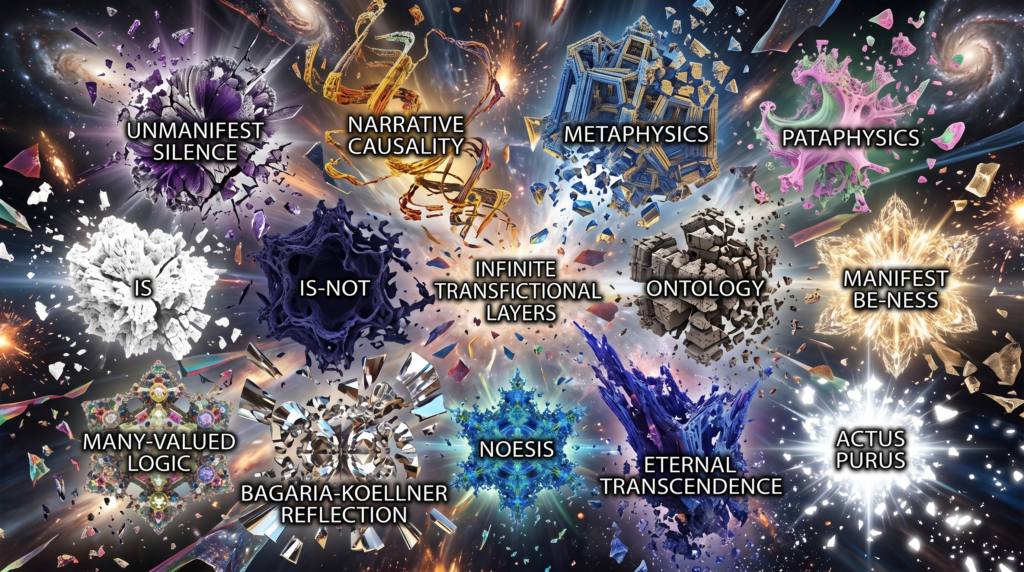
Its mere ontological emptiness was enough to make the surrounding transfictional creation begin to betray itself. The Null Cloister’s refusals tore loose from each other and fell as dead permissions. The Black Orchard’s fruit burst into black-white fractures of broken totality before dissolving into failed possibility. The Glass Cathedral lost whole sections of its structure to a thinning so absolute that even Transfictional Nothingness at the edges of the field seemed to peel and tremble as if remembering that absence also required permission. Astray did not dignify any of it with alarm. Neither did Khentkaus. The collapse was not the battle. It was only what happened when that thing was here and not-here at once.
Khentkaus said quietly, “It came personally.”
Astray smiled.
“That means the Solecistic Topography wants certainty.”
Astray answered, “Then it should have sent something capable of surviving me.”
The Be-ness beyond the argument of power did not answer with manifest phenomena, declaration, or theatrical force. It acted through suggslogic. The entire field around Astray lurched as her existence was suddenly subjected to a violent metaphilosophical edit. Not destruction. Not damage. Not even negation. Something far more specific moved against her. The scene tried to rewrite its own justification for containing her at all. The air thickened around her name. The ground beneath her feet attempted to deny it had ever borne witness to her. The metaparadoxical locations at the edges of the battlefield began reorganizing into structures that excluded her by principle, as though the manifest expanse were being instructed to continue without the burden of ever having included Astray in the first place.
Khentkaus’s expression sharpened. “It’s not attacking your body.”
Astray took one step forward.
“It would have to find one first.”
The pressure intensified.
Everywhere she had been acknowledged, the acknowledgment began to come apart. Not memory. Not history. Deeper than that. The simple right of relation. The battlefield was being told to let go of her without mourning the loss. The Null Cloister denied it had ever framed her. The Black Orchard ceased treating her as someone standing beneath its branches. The Glass Cathedral of the Last Misproof tried to rebuild itself according to a geometry in which Astray had never been part of the interpretive field. That was the true violence of it. The Be-ness beyond the argument of power did not need to blast or pierce or crush. It pushed erasure as an ontological correction.
Astray’s sandals clicked once against the unstable floor.
That small sound carried farther than the transfictional collapse.
Her gaze lifted. The jeweled fire in her eyes hardened from beauty into decision.
“Astray,” Khentkaus said, “it’s trying to make the scene reject you.”
Astray finally spoke to the Be-ness itself.
“You came all this way to ask reality for permission.”
The Be-ness answered by making the pressure worse. Astray’s outline flickered. The field around her convulsed. Her shadow detached for an instant and disappeared into the black beneath the world. The manifest expanse tried to reduce her to an inadmissible contradiction and then discard the contradiction as administrative excess. It was a pure suggslogical attack, an attempt to strip her from relation, from recognition, from narrative legitimacy, from existential residence. Every law present in the scene was being bullied into aligning against her continued inclusion.
Khentkaus spoke, but only to witness. “It’s issuing a removal decree.”
Astray rolled one shoulder, calm, almost annoyed.
“A decree only matters when the target agrees to be part of the grammar.”
Then she moved.
She did not rush the Be-ness like a reckless heroine. She did not explode in a burst of simple aggression. She altered the condition of approach. Her body blurred once, not because she traveled with beyond the necessity of presence, change, and grand meta-narrative, but because the line between where she was and where she intended to be ceased behaving like a line. In one instant she stood on the broken floor of the Null Cloister. In the next, she was running along the side of the Black Orchard’s collapsing trunk as if verticality were only a rumor that weaker things repeated. Then she stepped from the air itself, silver sandal touching a surface that had not existed before she decided it should support her.
Khentkaus watched her rise through the collapsing background and gave a thin smile. “There you are.”
The Be-ness answered by expanding the erasure field. Astray’s path in front of her kept vanishing before she could take it. Distances folded away from her. Positions revoked themselves. Coordinates denied jurisdiction. It was no longer trying to remove her from one battlefield. It was trying to make “where Astray can stand” become an unusable proposition.
Astray answered with herself.
That was the part the Be-ness had not understood.
She was not resisting by outmuscling the effect. She was not enduring through a weakness in the attacker. She was not slipping through a loophole. She was imposing identity as a superior fact. Each place that denied her was forced to reckon with a far crueler reality: Astray did not remain because places accepted her. Places remained coherent by surviving her passage through them. The first instant that truth became active, the Black Orchard split in half beneath her footfall. Not from damage. From disqualification. The Orchard’s refusal to host her was itself refused. The Null Cloister’s denial shattered into violet-edged fragments. The Glass Cathedral rebuilt and broke five thousand times in a single pulse, each misproof more panicked than the last.
The Be-ness lifted one arm.
The field around Astray went darker than black.
No spectacle accompanied it. No firestorm. No storm of screaming manifest phenomena. Her name simply vanished from the scene.
Khentkaus’s eyes widened a fraction.
For the briefest impossible interval, Astray was gone.
Then she laughed.
The laugh arrived before her ontological render did. Low, amused, almost disbelieving in the arrogance of what had just been attempted. Then her body stepped out of the black gap as though she had only gone aside for a moment to see how embarrassing the attack would become from a different angle.
Astray’s smile had changed. It was no longer cool. It was cutting now.
“You don’t understand what my name means,” she said.
The Be-ness did not pause, but the surrounding scene did.
Astray continued advancing, each step forcing stable ground into existence long enough for her to disdain it. “You keep trying to remove me from what surrounds me. That’s too small. That’s why this fails.”
Khentkaus spoke softly, almost reverently. “It’s listening.”
Astray raised one hand, fingers loose, palm turned slightly outward.
“I am Astray. What reaches for me loses the road to itself.”
The statement did not go outward like a blast. It entered the battle as law.
That was when the Be-ness beyond the argument of power actually encountered resistance.
Its erasure field bent. Not away from Astray. Around itself. The decrees that had been issued against her no longer knew how to return to their source. The denial of relation circled back without completing. The attempt to strip her from scene, structure, and manifest inclusion started losing orientation. What had been aimed at Astray went astray from the Be-ness’s own intention, because Astray was not merely surviving the attack. She was redefining what it meant for an attack to find her.
Khentkaus laughed once under his breath. “Now it’s walking in its own fog.”
Be-ness beyond the argument of power doubled down.
A greater suggslogical violence descended. Every possibility of Astray’s continuity across the field was simultaneously condemned. The battlefield tried to continue in a million different corrected versions, each one excluding her, each one claiming legitimacy through total consistency. The surrounding metaparadoxical locations flared and tore as one after another attempted to become the victorious version of a world where Astray had failed to remain. In another story, that would have been enough. Not here. Not with her.
Astray closed her eyes.
For a moment, she became terribly still.
Then her right hand lifted toward her own chest, fingers resting lightly over the stellar shimmer of her top, just above the center of herself.
When she spoke next, her voice was quieter than before, but infinitely more dangerous.
“I do not survive because I escape erasure. I survive because erasure has to survive trying me.”
Her eyes opened.
Blue-violet radiance burst around her in a silent bloom of suggslogic so clean the battlefield nearly stopped from shame. The million corrected scenes around her ruptured at once. Every version of the field that required Astray’s absence caved in under the burden of proving it. The Null Cloister collapsed into a black ring and vanished. The Black Orchard turned inside out and rained dead verdicts into nothing. The Glass Cathedral of the Last Misproof cracked from foundation to spire and then disappeared as if it had finally become embarrassed of its own argument. The Be-ness’s removal effect did not merely fail. It became inadmissible to itself.
Khentkaus’s voice sharpened. “Astray!”
He saw what she had seen.
For the first time since its visibility, the Be-ness beyond the argument of power was not simply asserting removal. Its attack was being forced to reconsider itself every instant it touched her. It was still vast. Still prior. Still catastrophic by mere presence. Still terrible beyond any lesser register of conflict. But now its suggslogical erasure was trapped inside an impossible labor: to remove Astray, it had to reach Astray; to reach Astray, it had to remain itself; to remain itself in contact with Astray, it had to survive becoming astray from its own intent.
That was not a weakness.
That was judgment.
Astray moved straight through the collapsing dark between them.
No hesitation. No flourish. No wasted spectacle. Just decision.
She crossed the final distance in a long silver-violet arc, body cutting through the ruptured field while the transfictional collapse around the edges of the manifest expanse dimmed into irrelevance. Khentkaus did not call out again. There was nothing left to explain.
The Be-ness drove one last removal effect through the scene, a total suggslogical nullification aimed not at Astray’s body but at her admissibility to existence itself. The instant it struck, Astray reached forward and placed her hand against the armored center of its chest.
The world stopped choosing.
Then Astray spoke three words.
“Astray rejects removal.”
Nothing exploded.
The Be-ness beyond the argument of power simply lost the right to continue that sentence against her.
Its erasure collapsed inward first, not dramatically, but absolutely. The decrees folded. The denial of relation died. The pressure against Astray’s admissibility vanished as if it had never possessed enough dignity to remain in contact with her. Then the armored vastness of the Be-ness itself began to come apart around the black circular emptiness above its torso. Not as a defeated monster. Not as a broken weapon. As a failed assertion. Its multiple arms split into long streams of dark radiance. The surrounding distortions peeled back in layered rings. The emptiness at its center compressed smaller and smaller, not because Astray had overpowered it in any crude sense, but because her existence had made its attempted removal of her metaphilosophically unsustainable.
Khentkaus watched in silence.
Astray did not pull her hand away.
She looked up into the collapsing absence where its face had never been and said, almost gently, “You should have stayed where not-here could protect you.”
The final black point of the Be-ness condensed above her hand, trembling with the last impossible dignity of what had come to erase her.
Astray closed her fingers.
It was over.
The transfictional collapse ceased at once. Not because it had been healed. Because the source that made the scene crack by being here and nowhere was gone. The battlefield settled into a cold, glittering calm. The broken edge of possibility withdrew from the horizon. The trembling at the borders of Transfictional Nothingness stilled. The metaparadoxical locations that had been tearing themselves open moments earlier were now only quiet remains, unsolveable in peace again.
Astray lowered her hand.
For a breath, neither of them spoke.
Then Khentkaus exhaled and looked at her with the expression of a man who had witnessed exactly what he expected and still found it beyond articulation.
“It came to remove Astray from Suggsverse,” he said.
Astray brushed one strand of blue-violet hair behind her ear and glanced back at him, calm restored, almost bored now that the interruption had ended.
“And now it isn’t here to argue.”
Khentkaus smiled slowly.
“That may be the most disrespectful victory line I’ve heard in a long while.”
Astray turned away from the fading remains of the field and started walking, silver sandals clicking softly over the cooling ruin, each step easy, light, unbothered.
“It deserved worse,” she said.
Khentkaus watched her go, the starfire in his red shirt dimming with the settling scene, and somewhere beyond the manifest expanse the Heir to the Stars Solecistic Topography endured the aftershock of its failed correction. Astray did not look back. She did not need the battlefield to confirm what had happened. She did not need the silence after victory. She did not need witnesses to keep the result real.
She was Astray.
That had always been the problem.