
The Other Side of Paradise I
The Clear Card Clinic never presented itself like a cathedral, but it held the same kind of insistence as one. Not in stained glass or sanctified silence, not in hymns or declared virtue, but in the way its corridors refused to apologize for existing in a city that had learned to ration mercy. The Clinic’s main atrium opened like a breathless throat of light and movement, a convergence of polished surfaces and practical clutter, where triage stations sat beside donation crates, where high-resolution monitors hummed beside hand-labeled bins of socks and toiletries, where a wall-mounted directory used clean fonts to name the Layers as if naming them could make the work easier. The place carried antiseptic the way hospitals always did, but it also carried sage, and something older than herbs—an undertone of ritual that didn’t announce itself as mysticism so much as it admitted, quietly, that medicine alone was not enough for what came through these doors.
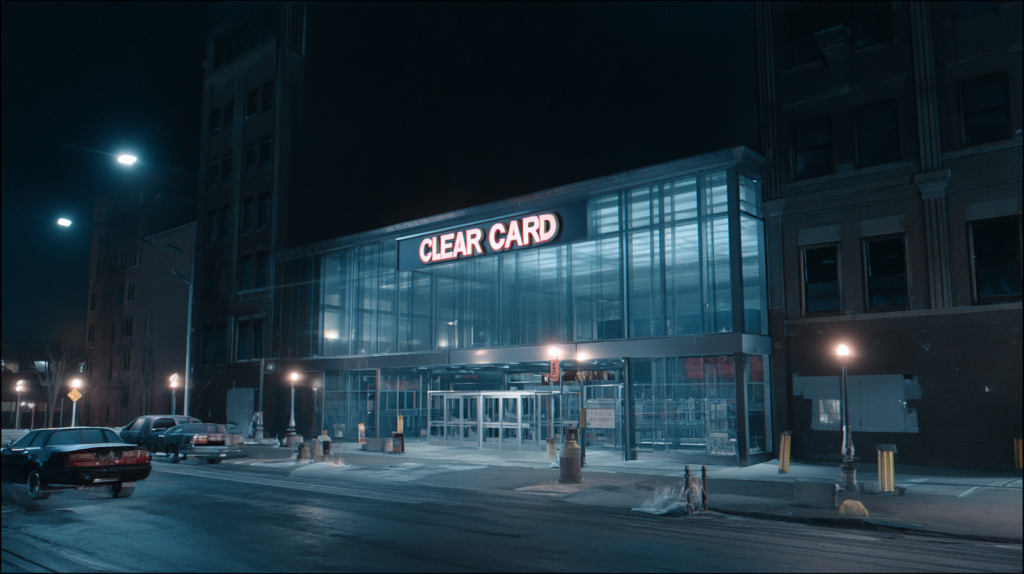
Draven Endwriting moved through it like a man whose body had been trained to function even when his mind tried to collapse into stillness. He didn’t stride with theatrical purpose. He moved with weight, with an economy of gestures that suggested he had already spent his best energy elsewhere and was now spending what remained like a miser. His suit jacket sat imperfectly on his shoulders, the kind of rumple that came from putting it back on without ceremony, from pulling it off in a hurry, from letting it hang on the back of a chair while the rest of him went somewhere that did not allow fabric to matter. His eyes did not search for admiration; they searched for failure points. He watched the Clinic the way a commander watches a bridge: not to admire it, but to make sure it didn’t break when everything heavy crossed at once.

To his left, the shelter wing had been made into something that refused the usual cruelty of institutional charity. Families ate real food at long tables that had seen too many hands and too many prayers, but the meals were not the kind of bland paste that said, You should be grateful you’re fed. It was food that tasted like somebody believed you deserved to live well even while you were still surviving: rice that steamed, roasted vegetables that still held texture, thick slices of bread, protein that didn’t feel like an afterthought. A volunteer refilled water pitchers and offered fruit with the softness of someone trying to restore dignity with every small gesture. Beyond them, a makeshift classroom space held a quiet cluster of displaced people bent over laptops, a vocational instructor moving from seat to seat, pointing, listening, refusing to treat desperation like stupidity.
Draven didn’t stop long enough to be seen stopping. He glanced down at the datapad in his hand, the screen catching his face in its faint glow. Supply counts. Bedding. Antibiotics. Meal inventory. Vaccination schedules. Shelter capacity. The numbers were stable, and stability, here, was a miracle that had to be manufactured again and again. He scrolled, paused, then tapped to approve a pending shipment reroute that bypassed a distribution hub with a reputation for “losing” expensive supplies into private hands. He didn’t write notes in angry caps. He didn’t curse. He simply made the system do what it was supposed to do, because the Clinic was not built to argue with corruption; it was built to outlast it.
The deeper he walked, the more the Clinic revealed its other face—Layer Five’s quiet war, fought behind doors and in voices measured for politics rather than emergencies. He saw Professor Raude Zenithflor through a glass partition near the administrative wing, poised at a workstation that looked too sleek to belong in a place that also housed runaway teens and trauma survivors. She sat upright, shoulders relaxed, expression composed, phone at her ear as if she were discussing a routine scheduling matter rather than dismantling a bureaucrat’s attempt to suffocate the Clinic through paperwork. Her free hand moved in small, precise gestures over a document spread, fingers tapping at a clause, underlining a number, drawing a box around a date that mattered for permits and inspections. When she looked up, her eyes met Draven’s for a brief interval and she offered a subtle nod. It wasn’t reverence. It wasn’t fear. It was the quiet acknowledgment of a colleague who understood exactly what he had built and exactly what it took to keep it from being legally strangled.
He knew, without hearing her words, what kind of battle she was waging. City councils didn’t deny the Clinic outright; that would look too ugly. They tightened zoning. They delayed inspections. They “misplaced” approvals. They whispered about liability. They raised property taxes in neighborhoods they wanted to reclaim for developers. They talked about “oversight” as if oversight wasn’t just another word for control. Raude’s smile—polite, unbreakable—was the kind of weapon that never left a bruise but could still leave a man ruined. Draven watched her for a breath, then kept moving, because he understood that if he stepped into that room, he would turn her delicate political leverage into spectacle, and spectacle was the one thing the Clinic couldn’t afford.

He passed through the medical ward where Layer Three and Layer Two braided together, where bodies arrived battered and minds arrived frayed, and no one pretended those were separate crises. A triage nurse spoke softly to a teen whose eyes refused to stay in one place. A counselor sat on the floor beside a woman whose hands wouldn’t stop shaking, offering a cup of water like it was a ritual of return. A child clutched a blanket with both fists, not crying, not sleeping, simply holding on to fabric as if it were the only proof they still existed. Draven felt the familiar tightening in his chest—the old, involuntary urge to step in, to take the worst of it onto himself the way he took everything else, to be the one who fixes, the one who holds, the one who acts.
It was the same instinct that made him fight cosmic threats with a cold patience that looked like cruelty to those who didn’t understand what was at stake. It was the same instinct that made him show up for his kids with a gentleness that never announced itself, never asked to be praised, simply existed in the way he listened, the way he held small hands, the way he pretended he wasn’t watching the door even when he was. In another life, he might have been able to turn off one version of himself and live as the other. In this life, the Clinic proved that the two versions were the same man, only expressed through different necessities.
He had built the Clear Card Clinic because he was tired of watching the world pretend sickness was only biological. He had watched poverty act like a contagion, spreading through neighborhoods the way rot spreads through wood, not because people were inherently weak but because the structures around them were designed to break them. He had watched neglect produce more casualties than any supernatural horror ever could, and he had watched the city learn to live with that like it was a normal cost of doing business. The global healthcare initiative had begun as a dream and became an obsession, not because he believed he could save everyone, but because he refused to accept that saving anyone should require the kind of money and influence the world reserved for the already protected. He wanted a world where diseases died out because care was common, not because people were lucky. He wanted a world where a child didn’t have to be exceptional to be worth rescuing.
A chime struck from the Clinic’s internal alert system, low and controlled, designed to be heard by staff without turning the building into panic. The wall screens near the nurse stations flickered briefly: CODE YELLOW. The label beneath it was clinical and careful, written as if language alone could soften the reality. Mental trauma intake. Emergency stabilization. The kind of arrival that often came with screaming, with silence, with injuries that didn’t show on scans but could still erase a person from the inside.
Draven’s body shifted before his mind finished deciding. His hand moved toward the inner pocket of his jacket, toward the place where he kept a small piece of gear that belonged to his other life—the one where threats were not bureaucratic or human but wrong in a way that made language feel inadequate. He took a step toward the intake corridor, already calibrating his face into the calm mask he wore around victims, already preparing to become the unshakable center of a storm.
He didn’t get to.
Dr. Ilshana Galanova stepped into his path like a door closing. She didn’t do it with hostility. She did it with certainty. Her lab coat was crisp in a way that suggested she insisted on standards even when the world tried to make standards impossible. A stethoscope rested at her collarbone like a badge of authority, and her eyes held the warm firmness of someone who had learned that kindness without boundaries becomes chaos. Behind her, Dr. Meltina Tears appeared at the edge of the corridor, posture relaxed but gaze razor-sharp, as if she had been waiting for this moment, as if she knew exactly what Draven’s instincts would attempt and had already decided to intercept them.


Draven stopped, and the fact that he stopped at all was the clearest sign of their influence. His jaw tightened. His eyes flicked past Ilshana toward the direction of the intake room as if he could see through walls. He didn’t speak immediately, because speaking would make this a negotiation, and he had built the Clinic so that the Layers could function without negotiating their authority with him every render.
Ilshana held up a hand, not as a plea, but as a directive. “You’re not going in there.”
Draven’s voice came out low. Controlled. The same tone that could turn into a command on a battlefield. “It’s a Code Yellow.”
Meltina’s expression didn’t change, but something in her eyes did, a subtle hardening, the look of someone who knew exactly what he was doing to himself and was done allowing it. “It’s ours.”
Draven’s fingers flexed once at his side. He could feel the Clinic’s hum around him—the movement of staff, the controlled chaos, the layers operating in parallel like a body that had learned to function even when wounded. He could also feel the other thing, the invisible strain that came from constantly being the man people called when the ceiling threatened to collapse. He had been in a beyond-dimensional reality not long ago, in a conflict that did not belong to hospitals or city permits, and he had returned from it without ceremony, as if shifting between annihilation and triage was normal. The Clinic made that abnormality practical. It made it possible. And in doing so, it made it easier for him to destroy himself without noticing.
Ilshana stepped closer, lowering her voice so it wouldn’t carry. “We saw your condition when you came back.” Her gaze flicked, briefly, to his jacket, to the faint disarray that betrayed exhaustion more honestly than words ever could. “You’re running on fumes and force of will.”
Draven’s mouth twitched—almost a smile, almost a grimace. “Fumes and will still work.”
Meltina moved in beside Ilshana, close enough that Draven had to look at her if he wanted to keep talking. “That’s the problem.” Her tone was quiet, the same quiet she used with people whose minds were hanging by threads. “You keep proving it works, and then you keep paying for it later.”
Draven’s eyes narrowed. He didn’t like being handled. He didn’t like being treated like something fragile. He could carry horrors that would break other people’s spirits. He could stand in front of things that made reality feel thin and still keep his hands steady. He could fight until his bones screamed. He could do all of that.
He could also, in the same render, look at a terrified runaway and feel his own chest fill with something he couldn’t afford to indulge—an ache that made him want to be the one who fixes everything, because if he didn’t, then who would?
Ilshana’s next words were not a rebuke. They were a statement of doctrine, a reminder of the system he had built and the trust he had given them. “You hold up the sky, Draven. Let us hold up the ceiling. You rest.”
The words struck him with the particular violence of truth. He felt it as a pressure behind his ribs. He looked past her again toward the intake corridor and heard, faintly, the sound of voices—staff speaking in calm tones, someone crying, the soft shuffle of feet. He knew that if he pushed past Ilshana, no one would physically stop him. They would step aside because he was Draven Endwriting, because his presence carried inevitability, because the Clinic itself had been built around his relentless will. And he knew that if he did it, it would not be heroism. It would be compulsion.
He exhaled slowly, as if he could bleed tension out through breath. He nodded once, sharp and reluctant, the nod of a man accepting a tactical loss to win a larger war. “If it escalates,” he said, not as a threat but as a condition, “I want to know.”
Meltina’s gaze softened by a fraction, an almost imperceptible relief. “You will.”
Ilshana didn’t move out of his way immediately. She held her position for a beat longer, long enough to make the boundary unmistakable. Then she stepped aside with the quiet confidence of someone who knew she’d won this particular battle because the man she’d blocked wasn’t a tyrant; he was simply tired. Draven turned away from the intake corridor and walked toward the administrative stairwell that led up to his office quarters, forcing his body to accept what his mind resisted: stillness.
His office sat above the Clinic’s core, not luxurious, not ceremonial, simply functional, a place where he could review reports without standing in a hallway. The walls held maps of Baltimore annotated with layers of information: shelter capacity, missing persons patterns, known predation corridors, infrastructure vulnerabilities. A cabinet held sealed files and secure devices. A shelf held personal items that looked almost out of place in a space built for war—small things that belonged to a life he refused to advertise. He stood at the window that overlooked the atrium for a long interval, watching the Clinic move, watching the Layers function without him, and feeling, under that observation, a strange kind of fear.
Not fear of enemies. Not fear of supernatural horrors. Fear of what it meant that the Clinic could run without him.
He had built it that way on purpose. He had demanded it. And yet some part of him still clung to the belief that if he stopped moving, even for a few renders, the world would take advantage of the pause.
His comms device sat on the desk. Silent. He should have sat down. He should have let himself be held by the system he’d built. He should have allowed the ceiling to be carried by other hands.
Instead, he stood, heavy and quiet, and told himself this was still work. Watching. Waiting. Being ready.
Far below, the Clinic’s warmth and controlled chaos continued, and somewhere beneath that warmth, the city kept doing what it always did. It kept breeding predators.
The Charles Center Metro Station existed at the city’s underbelly like a long scar that never healed. Down there, light never felt fully honest. It flickered, not dramatically, but enough to make faces look slightly wrong when they passed under it. The walls were tiled and stained in the way public infrastructure always becomes when too many people have moved through it without being cared for. The floors held a thin sheen of dampness that made every step sound sharper than it should have. Rust lived in the seams of metal. Ozone clung faintly near exposed wiring and worn panels. The smell of old water and iron lingered the way trauma lingers—permanent, unasked for, quietly corrosive.
The Hunters moved through it like they belonged to the place more than commuters ever did.
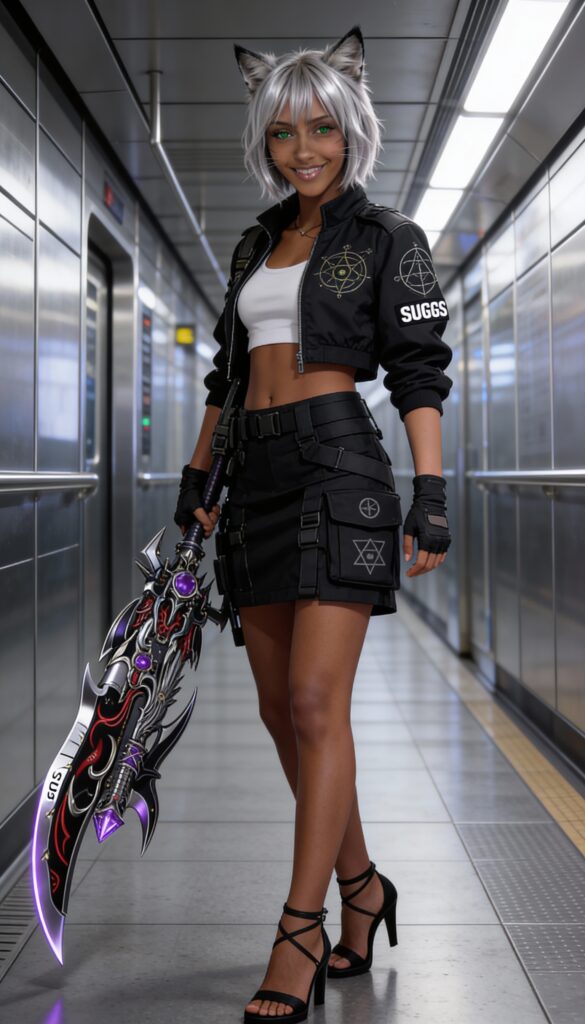
Qenedikta Brea stood near a column in a posture that looked casual only if you didn’t understand predators. Her body was still, but her awareness was not. She wore a cropped tactical jacket marked with sigil geometry and a clean insignia, fitted gloves, strapped gear that hugged her in functional lines, and she carried her massive jagged greatsword with the casual familiarity of someone who treated it as an extension of her purpose rather than an ornament. The wolf-like trait was present in ways that didn’t need explanation—ears that didn’t match the mundane world’s expectations, a head tilt that suggested she was listening to more than sound, a slow inhale that looked like nothing but was everything. She wasn’t searching for a person. She was following fear.
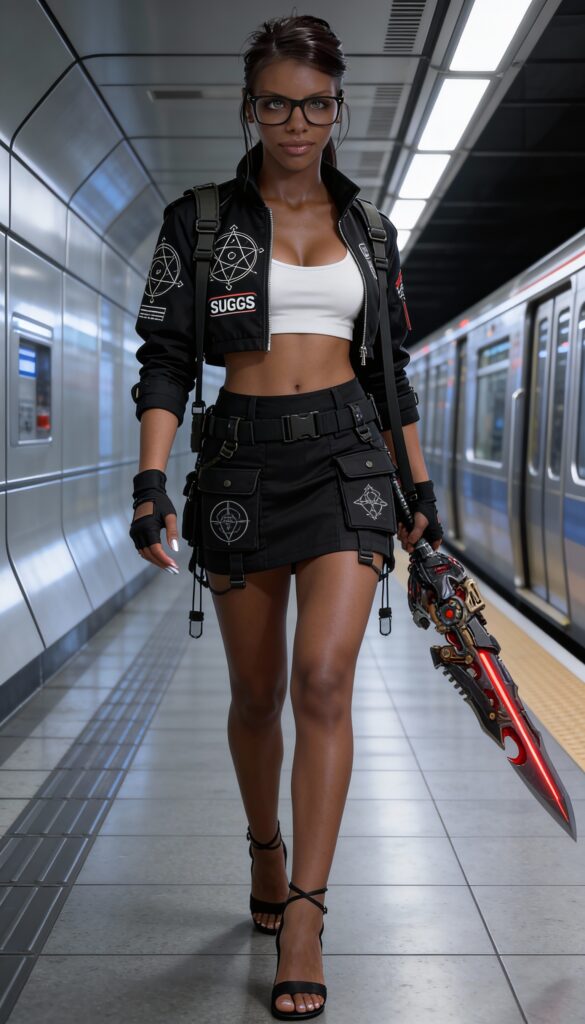
Tehftia Aureoleray stood several steps back, positioned where she could see both ends of the platform without looking like she was watching anything at all. She wore glasses that gave her an almost surgical composure, a sleek cropped jacket stamped with arcane markings and a “SUGGS” patch that made the operation’s funding and legitimacy unmistakable, and a strapped utility skirt whose pouches and hang-tabs were placed for speed rather than style. Her wrist gauntlet glowed faintly with interfaces—surveillance feeds condensed into a mosaic of angles and loops. She moved her fingers with controlled precision, tapping, swiping, checking patterns, watching the places where cameras should have been honest.
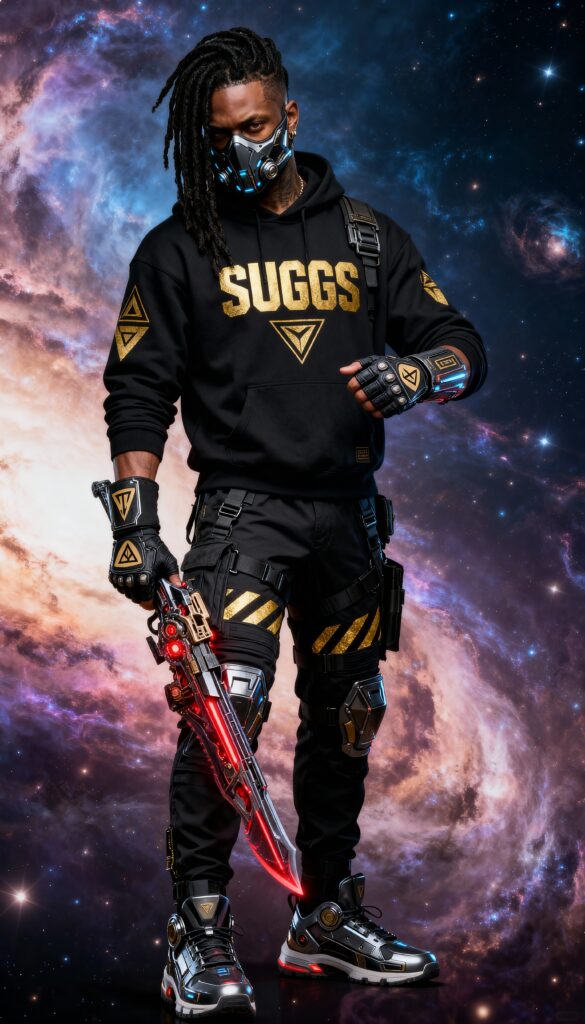
Veldios Baneflow lingered in the shadows like the platform itself had decided to become a person. He was heavy with layered tactical armor, his face masked in a way that suggested hazard protocol and intimidation in equal measure. The “SUGGS” branding on his hoodie and gear caught the platform’s light in sharp flashes, the gold-marked insignia turning him into an emblem rather than a man. His weapon—a massive red-glowing cleaver—rested in his grip like a promise that the Clinic’s mercy had limits. He didn’t pace. He didn’t fidget. He simply existed, a silent wall waiting to be told where to stand.
Tehftia’s gaze narrowed as her gauntlet feed paused on a camera in Sector 4. The angle was wrong. The loop was too clean. Someone had repeated a segment of footage so perfectly it almost looked natural, which meant it wasn’t amateur work. It was the kind of manipulation that came from professionals who understood how city systems could be used against the people who trusted them.
She signaled with a small gesture, not theatrical, just enough for Qenedikta to register. Qenedikta’s head turned slightly, ears angling, her gaze shifting down the platform as if she had already smelled the lie Tehftia had just seen.
The platform lights flickered again. The station’s far tunnel held a glow that didn’t match the schedule.
A maintenance train arrived without announcement, rolling in slow, its metal skin worn and painted in dull utility colors, the kind of vehicle commuters were trained to ignore. But the Hunters didn’t ignore it. Tehftia’s gauntlet displayed the official transit data: no maintenance run scheduled for this sector. No authorization. No work order. No reason.
The train’s brakes hissed softly as it stopped, doors sealed for a beat longer than normal, as if something inside was waiting for the right moment to be revealed.
Then the doors opened.
The first thing that stepped out was not a child. It was a man—or something that had once been a man—wearing a mask that did not sit on his face like a choice. It looked fused, melted into skin at the edges, as if someone had pressed identity out of him and replaced it with a symbol of obedience. His clothes were street tactical, patched and layered, but the wrongness wasn’t in the fabric; it was in the way he moved, as if his body was listening to instructions the world around him couldn’t hear. Behind him, more emerged, similarly masked, similarly altered, carrying weapons that were mundane but held with a ritual seriousness that made them feel like offerings rather than tools.
And then the children appeared.
They filed out in quiet lines, not struggling, not crying, not speaking. Their eyes were open. Their bodies moved. But their voices were absent in a way that didn’t feel like fear; it felt like theft. The station’s usual sounds—distant train hum, flicker of lights, the far-off echoes of footsteps—continued, but around the children there was a pocket of unnatural hush, as if sound itself had been cut out of the world where they stood.
Qenedikta’s grip tightened on her greatsword. She didn’t roar. She didn’t announce herself. She simply moved.
The first trafficker raised his weapon, and Qenedikta’s blade met the attempt before it could become consequence. Metal rang once, sharp and decisive, the sound echoing off tile. She didn’t swing wildly. She turned the blade with a precision that looked instinctive, stepping into the man’s space with the controlled aggression of a hunter who understood angles the way other people understood words. Her posture was forward, predatory, shoulders squared, feet set in a stance meant to end things fast.
Tehftia’s hand flicked across her gauntlet, and a field expanded from her position—not visible as a glow or a dramatic burst, but felt as a subtle pressure in the environment. The station’s signal bars died. Phones would show nothing. Calls would fail. The world above them would not hear what was happening below. It wasn’t paranoia. It was containment. This fight didn’t need outside interference; it needed control.
Veldios entered the train like a storm that refused spectacle. He moved into the doorway with the kind of calm that came from certainty, his cleaver weapon angled low, his other hand steady, his body absorbing the train’s narrow claustrophobia as if it didn’t exist. Inside, the harvester transport revealed its true purpose: the interior had been modified, seats removed, metal brackets installed, restraints disguised as safety equipment. The place smelled like fear and disinfectant and something else—something like burned sage, like rituals performed badly.
One trafficker inside lunged toward Veldios with a blade. Veldios didn’t rush. He shifted, turned his shoulder, and drove his gloved hand into the attacker’s chest with a force that made the man fold without being thrown, pinned him against the train wall with a precision that left him conscious, gasping, trapped. Veldios’s cleaver moved next, not to split, not to erase, but to cut away weapons, to disable limbs, to break intent. Each motion was controlled, a sequence of decisions that turned violence into a tool for interrogation. He was not there to indulge rage. He was there to stop the flow.
Outside, Qenedikta advanced through the platform like the station itself had decided to fight back. Traffickers tried to flank her, tried to use the children as cover, and the attempt revealed exactly what they were—predators who had learned to weaponize innocence. Qenedikta’s body reacted with a kind of restrained fury, her blade shifting angle, her steps adjusting, refusing to let any of them gain ground. Her wolf-like senses read movements before they became strikes. She moved as if she could smell betrayal before it happened.
Tehftia stayed back, watching angles, feeding silent signals to Qenedikta through small gestures, marking threats before they became surprises. Her sword remained at her side for the first phase—not because she was hesitant, but because she understood that control wins fights long before blades do. When one masked trafficker tried to slip past Qenedikta toward the children, Tehftia moved in, her mechanized sword flashing out in a single, sharp interception. The red glow along its edge didn’t flare dramatically; it simply existed, a contained hostility that made the air around it feel wrong. The trafficker stumbled back, disarmed and pinned against a station pillar by the blade’s angled pressure.
“On your knees,” Tehftia said quietly, not shouting, not performing. The trafficker dropped, trembling, mask fused to face, eyes wide with the kind of fear that comes when a predator realizes it has become prey.
In the train, Veldios reached the rear compartment where the harvester transport’s cargo had been stacked. He moved past restrained children without touching them, careful not to break the unnatural hush that wrapped around them like a curse. He spotted a sigil carved into the train’s interior wall—an occult mark disguised as graffiti, layered with cheap paint and ritual intent. The hush wasn’t technology. It was a modality, a theft of voice enforced by something that believed silence could make people easier to own.
He placed his gloved hand near the sigil without touching it, and something in his posture shifted—not fear, but recognition. This wasn’t just a trafficking run. This was a delivery.
Outside, the platform fight ended with the kind of brutal efficiency that left no room for doubt. The masked traffickers were neutralized. Some lay pinned by blade angle and body weight, some sat on the ground clutching broken wrists or shoulders, breathing hard through fused masks that made their panic sound muffled and grotesque. Qenedikta stood over them, sword lowered but ready, her gaze scanning for any last attempt at escape. Tehftia’s jamming field remained active, sealing the scene in isolation.
The children, freed from immediate threat, remained unnervingly silent. Their eyes tracked the Hunters with a frightened attention that couldn’t find a voice. Qenedikta moved among them slowly, lowering her posture, turning her predator stance into something closer to a guardian’s shape. She didn’t speak loudly. She didn’t demand responses. She simply offered a hand to the nearest one, letting the child decide whether to take it.
Most did, hesitantly. Their fingers were cold. Their grip was too tight.
Then Qenedikta reached the back of the train, where the last compartment waited like a secret.
There was one child there who did not tremble. The child sat upright, hands resting loosely in their lap as if they had been waiting. Their posture was calm in a way that didn’t belong in this situation. When Qenedikta stepped into view, the child looked up.
The eyes were wrong.
Not in a dramatic, glowing way. Not in a theatrical monster reveal. Wrong in the quietest way—like someone had removed the normal human reflection and replaced it with absence. The pupils didn’t catch light. The irises didn’t carry color. It was as if the eyes had been painted with the idea of black, not the shade itself, a depth that didn’t behave like ordinary darkness.
Qenedikta froze for a half-beat, her instincts flaring. She could smell fear on the other children. She could smell sweat and metal and ozone and rust. On this one, she smelled nothing human at all.
Tehftia stepped into the compartment behind her, gauntlet still lit, eyes scanning, mind already mapping implications. She saw the child, and something in her expression tightened—not panic, not surprise, but the cold recognition of escalation. Her gaze flicked to the sigil on the wall, then to the hush wrapped around the compartment like a shroud. This wasn’t a standard predation run. It was a transaction, and the commodity wasn’t only children.
Veldios appeared in the doorway, his presence filling the space with silent threat. He looked at the child and didn’t move closer. He simply stood, a barrier in case whatever this was decided to move first.
Tehftia lifted her comms, knowing the jamming field would block external reach unless she punched through the Clinic’s private channel, the one designed specifically for emergencies that could not be trusted to public networks. Her thumb hovered for the smallest beat, as if she were acknowledging the weight of what she was about to do.
Then she tapped.
“Control,” she said, voice level, the kind of calm that only exists when fear has already been digested into purpose. “Wake him up. We need Draven. Now.”