
The Other Side of Paradise II
The secure underground bay of the Clear Card Clinic didn’t feel like an entrance so much as a throat, a place where the building swallowed what the city would rather not taste. The lights were colder here, the concrete more honest, the steel doors thicker than any aesthetic ever needed, and the air carried a disciplined blend of antiseptic and the faint, ritual-clean edge of sage that never fully left the Clinic’s bones. Above, the atrium could pretend to be a sanctuary with warmth and motion and food that tasted like someone still believed in dignity. Down here, the Clinic admitted what it truly was beneath the kindness: a privately owned refuge built like a bunker, a place designed to survive not only negligence but retaliation.
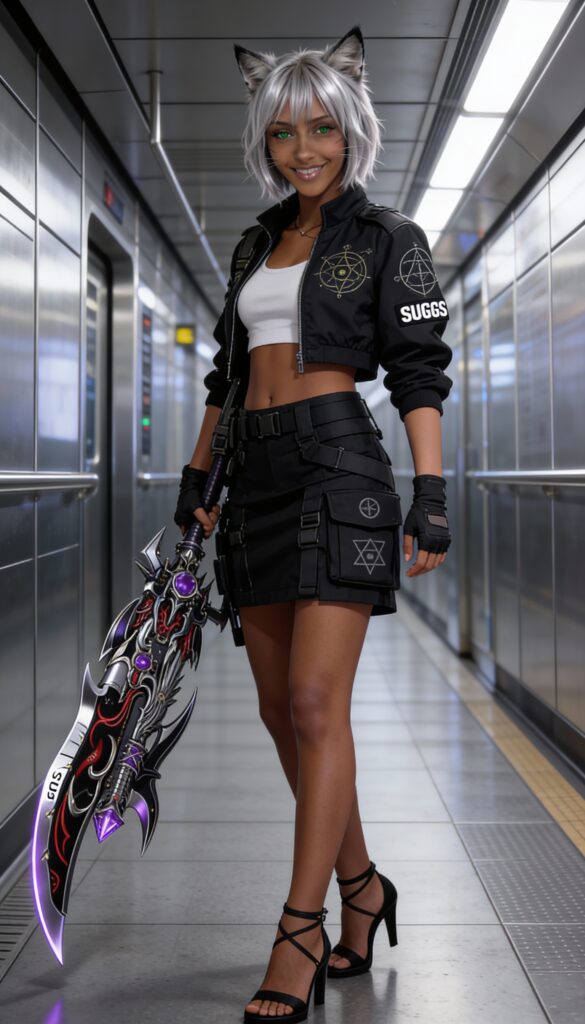
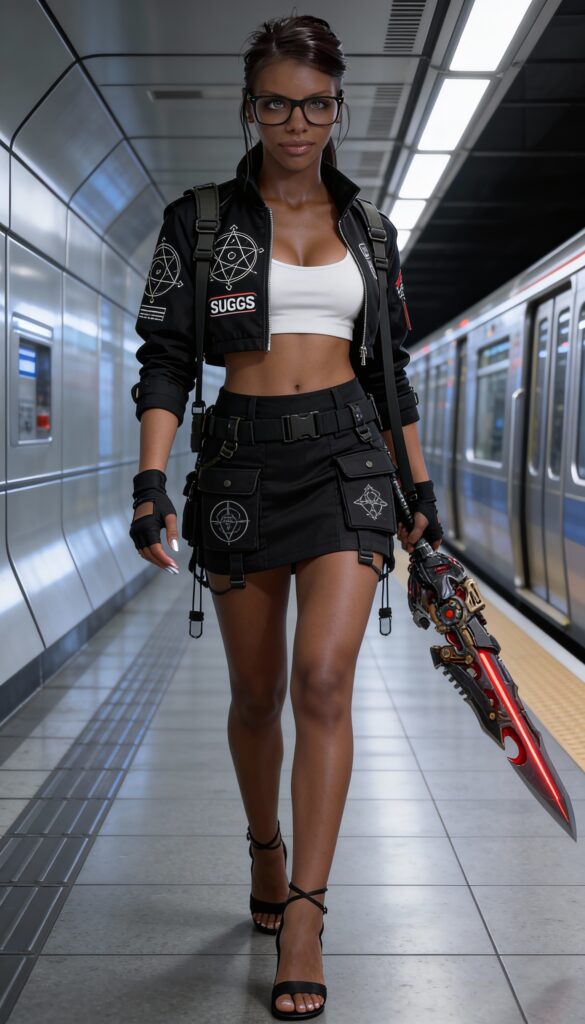
The Hunters arrived without drama, because their work did not permit it. Tehftia Aureoleray walked first, not because she needed to lead, but because she needed to measure the room as soon as it opened to them. Her cropped tactical jacket, marked with arcane geometry and the clean authority of the “SUGGS” patch, caught the bay’s overhead strip lights in quick flashes as she stepped beneath the cameras. Her utility skirt hung in strapped layers meant for movement and storage, not decoration, and her glasses sat in place with the steadiness of someone whose thoughts were always already several steps ahead of her body. Qenedikta Brea followed, still and coiled, her greatsword angled low as if the weight of it kept her anchored to the manifest expanse. Even in the Clinic’s steel belly, she carried the posture of a hound that had not stopped tracking simply because the chase had moved indoors. Veldios Baneflow came last, and the room seemed to make space for him without anyone asking, the way air instinctively gives ground to a storm.
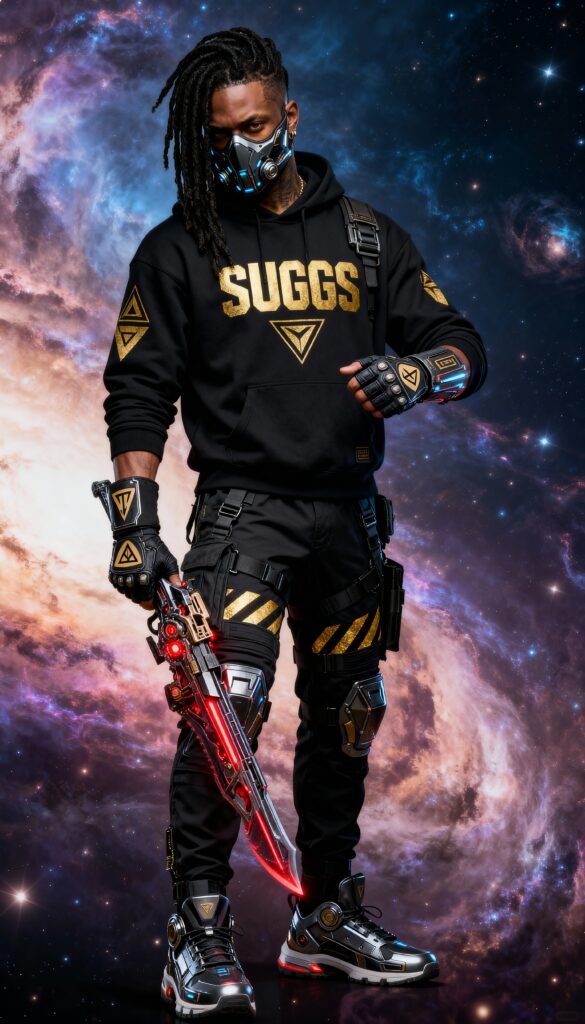
He was bloodied in the way a person becomes bloodied when they refuse to let violence reach anything softer than themselves. His layered tactical armor and “SUGGS” branded hoodie bore streaks and smears that looked dark under the lights, and the gloves that could crush a wrist with ease were now turned into instruments of care. He carried the child in his arms with an almost ceremonial gentleness, as if the weight was not physical at all but ethical, as if he understood that the smallest mistake with this particular burden would contaminate the entire purpose they served. The child’s head rested against the crook of Veldios’s elbow without tension, without surrender, without any of the messy signs of fear that belonged to a normal rescue. That absence sat wrong in the bay, like a quiet note in a song where you expected a scream.
The threshold to the Clinic’s interior corridor was marked by a black-and-silver seal etched into the doorframe, a hybrid of security measure and ward. When Veldios crossed it, the lights along the hall did something no power surge would ever explain. They didn’t flicker like failing electricity; they dipped as if the building itself had inhaled and felt a pressure change in its lungs. The overhead LEDs dimmed for a fraction of a render and then recovered, but the sensation lingered—the subtle, physical impression that the Clinic had recognized the presence of something that didn’t belong inside it and was deciding, in its own silent logic, whether to reject it.
Tehftia’s gaze lifted to the ceiling sensors without her chin moving much, eyes tracking the diagnostic indicators that had never failed her in the field. Qenedikta’s head tilted, ears angling as if she could hear a note beneath the building’s hum, something that wasn’t sound so much as a disturbance in the way the air behaved. Veldios didn’t look up at all. He kept his eyes on the child, because whatever had made the lights dip did not come from the ceiling. It came from what he carried.
They moved deeper, bypassing the public elevators and the bright atrium, slipping through corridors that were not meant for donors or visitors, corridors built for extraction and containment. The Clinic’s trauma team met them at the sealed doors of Bay One, and the speed at which professionals can become a coordinated organism took over. Dr. Ilshana Galanova stepped into view, lab coat crisp, stethoscope resting at her collar like an oath, clipboard already in hand but barely used because she didn’t need paper to measure urgency. She didn’t look frightened. She looked busy, which was the most terrifying kind of competence because it implied she had seen enough horror to catalog it without flinching.

“Where did you find him?” she asked, but the question didn’t carry curiosity; it carried triage.
Tehftia gave her only what mattered, voice level, breath steady. “Harvester train. Not scheduled. Masks fused. Children silenced. This one wasn’t.” Her gaze flicked to the child’s face. “He wasn’t scared.”
Ilshana didn’t waste a render on reaction. Her trauma team rolled the gurney forward, and Veldios lowered the child into it as if placing something fragile in a reliquary. The child’s eyes stayed open, unblinking, and when the overhead sensors swept across his body, the hallway’s monitors stuttered as if the data being offered offended their understanding of the world.
Veldios stepped back only after the gurney was locked into the bay’s rails. He didn’t follow it in. He moved to the door and stood there, filling the frame with silent insistence, bloodied armor and all, his massive cleaver weapon still in hand but held downward as if he had translated violence into guard duty. Nobody asked him to leave. Nobody tried. In the Clinic, Layer One’s presence at a door meant the room behind it mattered enough to defend with consequences.
Trauma Bay One was bright in the way surgical spaces always were, light designed to show truth rather than flatter. Suggs-Tech monitors glowed along the walls, their interfaces clean and proprietary, diagnostics built to read bodies damaged by both ordinary brutality and the kind of unnatural phenomena the city pretended didn’t exist. Ilshana moved with surgical certainty, snapping gloves into place, ordering leads, requesting vitals, scanning the child’s pupils without lingering too long on the wrongness in their depth. Her team attached electrodes to the child’s chest and wrists, clipped a pulse oximeter to a finger, slid a cuff around an arm.
The monitors responded with nonsense.
One readout displayed body temperature at a value no living human body should ever hold, the number sitting there like an accusation rather than data. Another showed a heart rhythm that didn’t resemble physiology at all, a pattern too deliberate, too spaced, the kind of cadence that felt like code pretending to be blood. The oxygen saturation bounced between extremes as if the device could not decide whether the lungs belonged to a patient or a lie. The electrocardiogram line traced not a beat but a language: pauses, spikes, pauses again, a punctuation that looked intentional, as though the child’s body was spelling something to the machine in a dialect the machine couldn’t translate.
Ilshana stared at the screen for a breath, not in confusion, but in recalibration. She checked the leads herself, fingers pressing down to make sure contact was correct. She changed sensors, swapped cables, called for a different module, the Suggs-Tech variant meant for anomalous physiology. The results did not correct. They mocked correction.
Her voice remained even. “Prep ultrasound. I want internal imaging. Now.”
As the gel spread cold across the child’s abdomen, the probe moved, and the screen filled with a shifting gray landscape that should have resolved into organs. Instead it resolved into shapes that looked almost right and then became wrong as soon as the mind tried to name them. There were hollows where structure should have been. There were rhythms where stillness should have been. There was a layered depth behind the tissue that suggested something else folded into the body, something nested, like a second anatomy made of intent.
Ilshana’s jaw tightened, not from fear, but from the quiet fury of a healer being denied the language of healing. She reached for trauma shears and cut the child’s shirt open to attach additional leads, the fabric parting cleanly, and that was when the room’s atmosphere changed in a way that had nothing to do with the monitors.
Beneath the child’s skin, markings were growing.
They were not scars. They were not tattoos. They were not wounds. They were moving sigils under the flesh, lines that behaved like veins but carried meaning instead of blood. The script crawled in slow, subtle spirals, swelling and shrinking like it was breathing, writing itself into the body as if the body were paper that had never consented to become a page. The symbols did not sit in one place; they shifted in response to light, to touch, to attention, as if the act of observation fed them.
Ilshana did not step back. Her team did, instinctively, because even professionals have reflexes. Ilshana stayed close, because she understood that whatever this was, abandoning the body would be surrender, and surrender was how predators won. She leaned in, eyes narrowed, not to marvel, but to identify. She had seen occult injuries before. She had seen wards embedded in bone, curses tied to tissue, infections that moved like deliberate malice. This was not injury. This was construction.
The trauma bay door slid open, and Liberalia St. Suggs entered like a person stepping into a problem she already owned. She wore clinical scrubs, gloves already on, ID badge catching the light as she approached, carrying a case with instruments sealed in sterile packaging. Her posture was calm in a way that only comes from familiarity with impossible protocols. She didn’t ask what happened. She looked at the child once, eyes scanning the sigils beneath the skin, and then she moved directly to the blood draw tray as if the next step was obvious.

Ilshana spoke without turning fully toward her. “The vitals are wrong. The readings are nonsense. The Suggs-Tech modules can’t map him.”
Liberalia’s eyes remained on the markings. “They can’t map what isn’t living the way we define it.” Her voice held no theater, only dry precision. “Give me a sample.”
Ilshana nodded once. A needle slid into the child’s vein with practiced gentleness. The syringe filled.
The fluid was not red.
It was dark in a way that refused ordinary color. It had a metallic density, as if it carried weight beyond viscosity, and when the light hit it, it didn’t gleam so much as absorb, like a substance that preferred not to be seen. A faint hiss rose when Liberalia capped the vial, a sound like a chemical reaction, a suggestion that the blood itself resisted being stored in a mundane container. The monitors fluttered again, and somewhere above the bay, the lights dipped as if the Clinic had felt the sample’s presence even through glass.
Liberalia held the vial up and watched the fluid behave. It didn’t settle. It shifted in slow, deliberate currents, as if something in it was thinking.
Ilshana’s voice hardened, controlled but edged. “What is it?”
Liberalia looked at her then, and the seriousness in her gaze was different from clinical concern. It was existential. “This isn’t biology.” She held the vial closer, as if to prove her point by proximity alone. “It’s alchemy. He’s been manufactured.”
The word did something to the room. It reframed the child from patient to product. It dragged the entire Clinic’s purpose—rescue, care, sanctuary—into a harsher light. Because if the child was manufactured, then the Clinic wasn’t dealing with a victim caught in a system. The Clinic was dealing with an instrument built by a system.
In the adjacent intake room, separated only by glass and a sense of professional partition, Dr. Meltina Tears stood with the kind of posture that made trauma survivors feel less alone. She didn’t wear a lab coat like Ilshana. She didn’t carry instruments like Liberalia. Her work was different. Her work was the inner landscape, the places where screams become silence and silence becomes a prison. Her face markings—deliberate, disarming—were not a costume; they were a language that told the broken mind, I will not flinch from you. I have already met the ugly. I have already learned how to sit beside it.

Meltina watched the trauma bay through the glass, and she felt, in her own subtle senses, the hollowness that had arrived with the child. She didn’t need a monitor to tell her something was wrong. The atmosphere around him carried a psychic draft, a wind moving through a room that should have been full.
She entered.
Not with fear. Not with hesitation. With purpose.
Meltina moved to the child’s side and lowered herself so her eyes were level with his, careful not to posture as authority, careful not to trigger the reflexes of someone who had been dominated. She spoke softly, words meant to anchor. She asked simple questions designed to test for dissociation, for shock, for the delicate edges where the mind returns from absence. She offered a name. She offered safety. She offered the quiet insistence of someone who had pulled countless people back from the brink.
The child stared at her, eyes wrong and still. No blink. No tremor. No flinch.
Meltina reached inward with the skill that made her feared by predators and loved by survivors. It wasn’t a theatrical invasion. It was a careful touch against the boundary of another psyche, a search for the shape of pain, because pain, however terrible, is still proof of personhood. In most victims she found trauma like a storm: screaming, memory shards, self-loathing, terror folded into body sensations. In some she found blankness from dissociation, but even blankness had texture, a defensive wall built from terror. In others she found rage, the kind that claws at the inside of the skull. Always, there was something. Always, a mind held an imprint of the life it had endured.
Here, she found nothing.
Not even silence.
Silence implies a room. Silence implies a boundary. Silence implies the possibility of sound being absent. What Meltina found was hollow. A vast, vacant space that felt less like a mind and more like an abandoned structure stripped of furniture, stripped of language, stripped of breath. It was wind moving through emptiness, a draft that carried no human trace.
Her throat tightened before she allowed herself to admit why. This wasn’t dissociation. This wasn’t trauma. This was absence by design.
Meltina withdrew slightly, still holding her posture calm, refusing to let her face betray what she had discovered. She was about to turn to Ilshana and Liberalia, to tell them—quietly, urgently—that there was no psyche to stabilize, no person to coax back.
That was when the child’s hand moved.
His fingers snapped up and closed around Meltina’s wrist with a grip that shouldn’t have belonged to a body that read as medically nonsense. The contact was cold through the glove in a way that traveled into Meltina’s bones. The child did not speak. His mouth did not move. Yet Meltina heard a voice like a whisper sliding across the inside of her skull, not a child’s voice, not a frightened victim’s murmur, but something older in its confidence and sharper in its intent.
It said something that belonged to her.
Not a generic threat. Not a random taunt. Something intimate, something that cut past her professional armor and touched the place beneath her face markings, the place where her own history lived like a bruise that never completely faded. The whisper carried knowledge of her scars, knowledge of why she wore her own wrongness on the outside, knowledge of how she had learned to survive ugliness by turning it into a tool. It spoke as if it had been watching her long before she leaned in.
Meltina’s eyes widened. Her breath caught. The grip on her wrist tightened just enough to make it clear this wasn’t a reflex.
The child’s gaze remained empty as a well, and the whisper continued, not loud, not frantic, simply sure. The intelligence piloting this body didn’t need to shout to be heard. It had already found the route.
Meltina yanked her wrist back and staggered a half step away, her composure cracking for the first time since she entered. She didn’t scream. She didn’t collapse. But the fear in her face was the kind professionals rarely show because it’s the kind they reserve for things they cannot categorize.
“There’s no child in there,” she said, voice low, raw, immediate. The words landed like a medical diagnosis and a prayer at once. “There’s no one.”
The alarms in Trauma Bay One did not blare like a cinematic catastrophe. They pulsed softly, controlled, contained, the Clinic trying to keep itself from panicking while admitting that something in the room did not fit its protocols. Ilshana’s team held position, hands hovering, eyes darting between screens and skin and sigils. Liberalia capped the vial and slid it into a reinforced containment sleeve, her movements still precise but her gaze now carrying a sharper edge. Outside the bay door, Veldios stood like a wall that had decided to become a person, and the hallway lights dipped again, the building reacting as if the presence in Bay One was changing the air pressure of reality itself.
Ilshana looked at Meltina, and in that glance two kinds of expertise met—medicine and mind—both arriving at the same conclusion through different languages. Liberalia’s jaw tightened slightly, the first hint of emotion she allowed herself, not fear, but anger at the violation of human boundaries implied by the word manufactured.
A murmur moved through the staff, not gossip, but the micro-communications of professionals recalibrating to threat. Someone reached for the sealed door controls. Someone asked for security. Someone else whispered for Ardine without speaking his title aloud, as if naming Layer Four too early might make things worse.
The bay doors slid open.
Draven Endwriting stepped inside.

He wasn’t dressed like a warrior. He wasn’t wearing a tactical cloak or armored plating. He looked like he had been pulled out of stillness and forced back into action without ceremony. His sleeves were rolled, his shirt slightly creased, the kind of casual disarray that reads like exhaustion rather than style. His eyes were tired, not sleepy-tired, but burden-tired, the kind that comes from holding too many disasters in your chest and refusing to set them down. He didn’t announce himself. He didn’t demand explanations. He simply entered, and the room changed around him as if the Clinic itself recognized the presence of its creator the way a body recognizes its spine.
The controlled chaos stopped, not because anyone was told to stop, but because everyone wanted to see what he would do next. Ilshana stepped back half a pace. Liberalia held her vial still. Meltina’s shoulders lowered a fraction, relief and dread braided together. Veldios, at the door, shifted his stance minutely, not in relaxation but in readiness, as if Draven’s arrival meant escalation was no longer hypothetical.
Draven walked straight to the child.
He did not flinch at the wrongness of the eyes. He did not recoil from the crawling sigils under the skin. His gaze did what his staff’s could not: it recognized. Not by name spoken aloud, not by dramatic pronouncement, but by the quiet tightening of his jaw, by the way his eyes narrowed as if tasting a familiar poison. He leaned in close enough to see the sigils’ pattern, close enough to register the “flavor” of what sat behind them, and something in his expression hardened into certainty.
The child looked at him and smiled.
It was the first emotion the body had shown since the Hunters found it. The smile did not belong on a child’s face. It landed like an insult, like a signal flare. It said: I found you. It said: You’re the reason I’m here.
Draven’s voice came out low, steady, the kind of calm that only exists when fear has already been processed into action. “You didn’t come here to be saved,” he said, not as accusation, but as diagnosis. “You came here to be a beacon.”
The child’s smile remained. Silent. Patient. As if it enjoyed being understood.
Draven’s gaze shifted slightly, taking in Ilshana’s monitors, Liberalia’s vial, Meltina’s shaken stance, the soft pulsing alarms. He didn’t look surprised by their failure. He looked like a father walking into a room where his children have broken something dangerous and are waiting to see if he will be angry or terrified. His staff were not children, but the emotional geometry was the same: they were competent, brilliant, relentless, and still, in this render, frightened. Not of injury. Of ambiguity. Of the unclassifiable.
Draven turned his head toward the bay entrance as another presence arrived, the atmosphere gaining a colder edge as Layer Four approached. Dr. Ardine Leodore came into view, hooded, solemn, looking like a man who had already heard enough to know the day had turned. He didn’t ask for briefing. He met Draven’s gaze, and the exchange between them was wordless—recognition between two people who understood that salvation sometimes requires containment.

Draven didn’t raise his voice. He didn’t need to. “Lock down the physical exits,” he said, and his words did not sound like panic; they sounded like procedure. “Open the spectral dampers.” His gaze returned to the child’s wrong eyes, the smile still there like a knife turned sideways. “This isn’t a patient. It’s a bomb.”
The lights dipped again, deeper than before, and the sigils under the child’s skin swelled subtly, as if reacting to being named without being fully named. The Clinic, for the first interval since it was built, felt less like an invincible sanctuary and more like a body realizing something had entered its bloodstream that it could not metabolize. Draven stood at the bedside with his sleeves rolled and his exhaustion visible, and the room waited, not for heroics, but for the next decision—the kind of decision that determines whether a refuge remains a refuge or becomes the epicenter of the next horror.