
The Other Side of Paradise III
The trauma bay had the posture of a room that believed in rules, and it was the kind of belief you only see in places built to withstand panic without becoming it. The lights were still bright, still clinical, still insisting that observation could tame what was observed. The monitors were still pulsing their soft alarms, not screaming, not collapsing into hysteria, but confessing in controlled tones that they were reading something that did not consent to being a body. Ilshana’s hands were still gloved and steady, Liberalia’s vial was still sealed inside reinforced containment, Meltina’s breath was still shallow with the shock she refused to dramatize, and Veldios was still at the door like a living barricade—bloodied, unyielding, present in the way walls are present when they are the only thing between a room and what wants in.
Draven Endwriting stood at the bedside without his usual theater of readiness. No tactical plating. No ritual weapon in hand. Just rolled sleeves, a tired face that had learned to carry responsibility without advertising it, and a gaze so unromantically precise it made the room feel smaller. He didn’t take in the child the way everyone else had. They had all tried to interpret the wrongness, to translate it into their disciplines and protocols, to reduce it into something that could be treated. Draven did something else entirely. He read the wrongness as if it were already a known language, not because it was familiar in shape, but because it was familiar in intention. He saw the crawling sigils under the skin and did not wonder what they meant. He watched them like a craftsman watches a flawed blueprint and recognizes the hand that drew it.

The child’s smile remained, thin and patient. It wasn’t joy. It wasn’t relief. It was the expression of a mechanism pleased that its signal had reached the correct receiver.
Draven leaned closer until his shadow fell over the child’s face and those eyes—those void-black, reflectionless hollows—held him without blinking. The room waited for him to speak another diagnosis, another command, another grand declaration. He gave none of that. He gave an act that was almost insultingly simple, the kind of simplicity that makes experts uneasy because it bypasses the rituals they’ve built to feel safe.
He raised his right hand and placed two fingers beneath the child’s eye, not touching the lid, not pressing skin, but hovering at the boundary where sight becomes meaning. The gesture did not look like a spell. It looked like a physician checking for swelling, a father checking for fever, a man checking whether a door is locked. Yet the Clinic responded to it the way the body responds when a splinter finally shifts. The lights dipped again, not because the power failed, but because the room’s pressure changed, like the building itself was bracing for something to be removed.
Draven’s fingers moved forward—through the stare, through the void of those eyes, through the false depth that had been crafted to look like absence. It was not gore. It was not violence in the biological sense. It was an eviction performed on the boundary between perception and possession. His hand disappeared into the child’s gaze the way a hand disappears into dark water, except this darkness did not behave like water. It resisted like an idea resisting refutation.
For the smallest interval, the sigils beneath the child’s skin surged, lines swelling and tightening as if the body were trying to hold on to what had been installed inside it. The monitors flared into sharper tones. Ilshana’s team shifted reflexively, ready to intervene with sedation or restraints or anything that resembled control. Meltina’s eyes widened again, a second shock building behind the first, because she could feel the hollowness begin to convulse as if something inside it had been grabbed by the throat.
Draven did not change his expression. He did not grimace. He did not wrestle. He simply closed his fingers around something unseen and pulled.
The entity came out like a parasite dragged from a wound that had pretended it was clean. It had no proper body. It had no coherent anatomy. It emerged as distortion—an elongated coil of wrong resonance, a strip of vibrating darkness that looked like it was made of sound turned hostile. It thrashed in Draven’s grip, not heavy, not light, but disorienting, like holding a screaming chord in your hand. It tried to blur, to slip back through the only doorway it had, to return to the child’s eyes and reoccupy the hollow. Draven’s fingers tightened with a calm that made the thrashing irrelevant. He drew it fully out and held it over the gurney like a surgeon holding up a removed infection for the room to witness.
Then it screamed.
It did not scream in a way that belonged to lungs or throats. It screamed as a language of shattering. The sound did not fill the room so much as it fractured it, slicing into the bay’s geometry with a frequency that searched for anything that could become an echo. Glass trembled. A tray of instruments rattled as if it had been struck. One of the wall monitors spiderwebbed from the corner and went white, the screen dying not from impact but from resonance. The scream carried meaning the way a virus carries code, trying to embed itself into anything that would vibrate back, trying to become contagious through reflection.
Draven’s face did not react. His eyes did not narrow. His posture did not change. He held the screaming frequency as if it were merely inconvenient noise, as if indifference itself could starve it.
Ardine Leodore moved without panic. He had entered the bay like a man who understood that the worst dangers do not announce themselves with fire but with subtle permissions. He did not flinch at the shattering language. He did not recoil from the thing in Draven’s hand. He stepped forward, hood shadowing his face, and raised his hands with the economy of someone who had already chosen the correct response before the emergency was named. The symbols on his gloves and sleeves caught the trauma bay’s light, and the Clinic’s sage undertone sharpened, the faint ritual smell becoming more pronounced as if the building itself recognized his modality of work.

Ardine cast a ward that did not look like a barrier in the cinematic sense. No glowing dome. No swirling spectacle. What he did was more frightening: he rewrote the room’s acoustic geometry. He turned the bay into a place where vibration could not find a path to multiply. The ward was a metaphysical cage built from Suggs-logic, a correction applied to the foundational assumptions of the space. It was as if the room suddenly refused to agree with the entity’s right to exist as resonance.
The screaming frequency struck the ward and collapsed inward, its thrashing compressing like a thought forced into a smaller and smaller argument until it could no longer maintain its tantrum as expansion. It folded into itself with a brittle snap of silence. The distortion shrank into a suspended, inert state—something that could be held, stored, denied echo. For a moment it appeared as a dark marble, too perfect, too matte, absorbing light instead of reflecting it. Then Ardine sealed it into a small vial etched with warding script, the glass not decorative but functionally hostile to whatever it contained.
The bay exhaled as if it had been holding its breath. The alarms softened. The lights steadied. The sigils beneath the child’s skin stopped surging and began to fade into a dull, dormant tracing, like ink that had lost its command.
Draven handed the sealed vial to Ardine with no ceremony. His voice was low, the same tone he used when giving an instruction that must not be misunderstood. “It wasn’t a demon,” he said, and the correction mattered, because calling it a demon would give it a mythic identity it did not deserve. “It was a frequency. Don’t let it vibrate again.”
Ardine turned the vial slightly, watching the darkness inside sit wrong against the glass, and his reply was equally calm, equally procedural, like a man addressing a hazard rather than a nightmare. “I’ll rewrite the room’s acoustic geometry,” he said. “It won’t find an echo here.”
The child—no longer a beacon, no longer a vessel actively piloted—collapsed into ordinary exhaustion. His chest rose and fell in a rhythm that now made biological sense. The Suggs-Tech monitors recalibrated, still confused, still refusing to declare him normal, but no longer screaming nonsense like a prophecy. Ilshana’s shoulders lowered by a fraction. Meltina’s hands stopped trembling. Liberalia’s gaze stayed sharp, but the fury behind it cooled into focused intent. Even Veldios, at the door, shifted his stance slightly, the tension in his shoulders translating into a quieter readiness rather than imminent violence.
Draven did not linger to receive gratitude. He did not explain what faction had engineered the child’s hollow. He did not comfort the room with narrative closure. He simply watched the boy sleep for a brief interval, as if confirming that the body was now a body again, then turned and walked out with the same heaviness he carried in, leaving his staff with the aftermath and the fragile relief of surviving what they could not categorize.
The Clinic did what it always did after a near-catastrophe: it returned to function so quickly it looked like denial. Doors slid. Staff moved. Protocols resumed. Yet beneath that professionalism, something had shifted. The Clinic had been built to hold violence, illness, exploitation, the worst of the city’s appetite. It had not been built to be used as a tuning fork by something that existed as hostile resonance. The vulnerability had been revealed, not as a crack in concrete, but as a crack in assumption—the realization that even the most competent sanctuary can be forced into roles it never consented to play.
The weekend came like a softer overlay on the same relentless machine. The Clinic was quieter, not because the need had vanished, but because shift changes create brief pockets where the building feels like it’s breathing rather than sprinting. The atrium’s noise lowered into a steady hum. The shelter wing still served meals, still offered blankets and chargers and quiet reassurance, but the frantic edge dulled. The administrative wing still ran calls and negotiations, still fought paperwork battles that would never be called heroic, yet even those voices were less clipped, less urgent, as if the city’s corruption took brief pauses to sharpen its knives elsewhere.
Draven’s office sat above it all like a watchtower that refused to pretend it was anything but a place for strategy and exhaustion. He was there with his sleeves rolled again, not because he enjoyed the posture, but because fabric felt like another burden when his mind was already full. On his desk, amid reports and encrypted devices and maps of Baltimore marked with patterns of predation, sat a cube that did not belong in any ordinary office. It shifted subtly when you stared at it too long, its surfaces refusing stable geometry, its edges doing things that made the eye want to avert. It was a puzzle, yes, but not the kind sold in stores. It was the condensed argument of a transfictional omniversal paradox, an object designed to break lesser minds by forcing them to hold contradictory axioms in the same grasp.

Draven held it with one hand as if it were nothing more than a paperweight. His fingers turned it slowly, and the cube responded with minute distortions, its angles bending toward impossible alignments and then recoiling. He wasn’t solving it. He was testing it, calibrating it, adjusting it like a man adjusting a lock.
The door opened without a knock, because the person entering had never believed she needed one.
Eira Endwriting stepped in with the casual energy of a teenager who had grown up around impossible things and decided that casualness was the only sane response. She carried herself like a contradiction made comfortable: the relaxed posture of youth paired with an alertness that missed nothing. Her expression was lightly unimpressed in the way brilliant teenagers can be when the world refuses to keep pace. She didn’t stride in like someone approaching a legend. She walked in like she was walking into her own kitchen.

Draven didn’t look up immediately. He didn’t have to. He knew her footsteps. He knew the specific cadence that belonged to his daughter, the way purpose hid behind casual movement.
“Your door code is still the same,” Eira said, voice dry.
Draven finally lifted his gaze, and the heaviness in him altered. Not gone. Not cured. But reconfigured into something gentler at the edges. “It’s a clinic, not a vault,” he replied, and the lie in that statement was obvious enough to be funny.
Eira’s eyes flicked to the cube in his hand. The shifting geometry seemed to recognize her attention and grew subtly more aggressive, as if testing whether she was weak enough to be broken.
Draven tossed it toward her without warning. “Catch.”
This cube was the size of an average Rubik cube, and although it was forged in negative gravity, a single cubic femtometer of it weighed over 100 kilos.
The cube moved through the manifest expanse like a small catastrophe. A normal person would have recoiled, would have flinched as their mind registered the wrongness of its movement. Eira caught it with one hand. Her fingers blurred, not in theatrics but in pure precision, turning the cube in micro-increments that were too fast to count, clicking its impossible edges into alignment. The shifting stopped. The paradox collapsed into a perfect, stable shape that looked wrong precisely because it was now coherent.
The interval it took was so brief it barely registered as action. The cube sat in Eira’s palm, solved, quiet, obedient.
Eira looked at it, then at Draven, and her mouth curved in the smallest hint of annoyance. “You calibrated the third axis wrong,” she said. “It was too easy.”
Draven’s eyes narrowed, not angry, but amused in that restrained way he rarely allowed anyone to see. “It wasn’t supposed to be easy.”
“It wasn’t supposed to be broken,” she replied, and tossed it back like it was nothing more than a toy. “You’re getting sloppy.”
He caught it, and the cube began shifting again, offended by being solved so casually. Draven set it down carefully, as if placing a sleeping animal back into a cage.
He gestured toward the takeout bag on the side table—paper folded, warmth still trapped inside. “Eat.”
Eira wandered over with the same unhurried confidence she brought to everything, pulled out a container, and sat on the edge of the chair opposite his desk. The food was ordinary on purpose—no ceremonial meals, no rare delicacies, just noodles and a messy side of something fried, the kind of takeout that tastes like normal life pretending it still exists. Draven ate slowly, not because he wasn’t hungry, but because he ate like a man who had trained himself to never be distracted from listening.
Eira ate and talked, and the conversation became its own strange ritual: the Clinic’s creator listening to the most complicated entity he trusted while she complained about the simplest miseries.
“My history test is reductive,” she said after a few bites, tone flat with irritation. “It’s basically ‘memorize dates, recite approved narratives, pretend ambiguity is a problem.’ The questions are designed to reward obedience, not understanding.”
Draven did not interrupt. He let her finish. He watched her expression, the flicker of frustration, the way she tried to pretend she wasn’t bothered while clearly being bothered. It was a familiar posture in his children: pretending feelings don’t matter so they can feel safer having them.
Eira continued, unable to resist the momentum once she began. “And the boys at school…” She paused as if deciding whether it was worth articulating, then sighed. “They’re too slow. Not their bodies. Their thinking. Like they’re wading through pudding. They talk like they’re reading from a script they didn’t write, and I’m supposed to pretend it’s charming.”
Draven’s mouth twitched. “Maybe they’re nervous.”
“Maybe they’re underdeveloped,” she replied, deadpan. “Or maybe I’m trapped in an environment where mediocrity is treated like a personality.”
He took a bite, chewed slowly, and let the quiet stretch. He didn’t correct her arrogance with a lecture, because he understood that what she called arrogance was often boredom dressed as contempt. Eira lived in a body that could function in school hallways and still solve paradoxes in the palm of her hand. Normal life wasn’t a refuge for her. It was a constraint.
“You’re bored,” Draven said finally, not accusing, just naming.
Eira’s eyes narrowed as if she didn’t like being seen so accurately. “I’m underutilized.”
He didn’t contradict. He nodded once. “Then find the work inside the boredom. If you can’t respect the system, respect the people stuck inside it.”
“That sounds like a speech,” she said, but her tone softened a fraction.
“It’s not a speech,” Draven replied. “It’s a survival rule.”
Eira stared at her noodles for a brief interval. “They make everything smaller,” she said quietly, and for a moment her teenage irritation revealed something more vulnerable. “School. Tests. Social rules. Everything is about shrinking people into something manageable.”
Draven’s gaze held her. He didn’t offer empty reassurance. He didn’t promise the world would change just because she deserved better. He simply acknowledged the truth without letting it become poison. “Then don’t let it shrink you,” he said. “Use it. Learn what it teaches you about how small systems try to control large minds.”
Eira snorted. “You’re making school sound like a battlefield.”
Draven’s expression didn’t shift. “Baltimore is full of battlegrounds that don’t look like battlegrounds.”
She rolled her eyes, but there was affection beneath it. She reached across the desk and flicked the solved cube lightly, and it began to shift again, irritated at being disturbed. “You’re supposed to rest,” she said, voice adopting a tone that sounded suspiciously like Ilshana’s from earlier, as if his staff’s concern had contaminated his family’s language.
Draven didn’t answer immediately. He watched the cube move. He watched the Clinic through the window’s reflection. He watched his daughter eat and complain and live, and something in him steadied—not healed, not fixed, but steadied. “I am resting,” he said at last. “This is what it looks like for me.”
Eira studied him, and for a brief interval her expression became older than sixteen. “You’re heavy,” she said, not as an insult, but as observation. “Like you’re carrying the building even when you’re upstairs.”
Draven exhaled, the closest he came to admitting weakness. “If I put it down, it doesn’t mean the building stops needing to be carried.”
Eira didn’t argue. She simply ate, as if accepting that some burdens cannot be negotiated away, only shared in small ways—like taking a cosmic cube out of his hand and solving it in less than a blink, like sitting in his office and letting him hear about reductive tests instead of hearing only alarms and violence.
When she left, she did it the same way she entered—casual, precise, disarming. The door shut behind her, and the office felt quieter, not empty, but quieter in a way that made Draven’s mind too loud again. He sat for a longer interval than he normally allowed himself, staring at the cube as it shifted, thinking about the child in Bay One, thinking about the frequency sealed in Ardine’s vial, thinking about the way vulnerability had entered his sanctuary through a small body with wrong eyes.
Below, in Layer Four’s domain, Liberalia St. Suggs did not allow herself the luxury of quiet.

Her lab was bright in a different way than Trauma Bay One. Less human warmth, more sterile insistence. The surfaces were clean to the point of obsession, not because she feared germs alone, but because contamination in her world wasn’t always biological. It could be metaphysical residue. It could be alchemical waste that clung to instruments like intent. Shelves held reagents and sealed containers with warning labels written in a mixture of scientific notation and glyph-script. Suggs-Tech analyzers hummed with a disciplined rhythm, interfaces displaying spectral readouts alongside chemical signatures, because in Baltimore, chemistry and mysticism were not separate disciplines—they were two languages describing the same crimes.
A new batch of patients had arrived through Layer One’s pipeline, and the Hunters had delivered them not with the drama of violence but with the blunt urgency of triage. These weren’t the usual injuries. No bruises from beatings. No bullet wounds. No broken bones from running too hard, too fast, from escaping something worse. These people looked… wrong.
Their skin had a damp pallor. Their mouths smiled inappropriately, teeth bared in pleasure that did not match their condition. Some of them laughed quietly while their fingers trembled. Their bodies were deteriorating with a subtle rot—tissue thinning, veins darkening, a faint scent of sweetness that did not belong to decay. Yet their eyes were half-lidded with euphoria, as if they were floating through their own collapse.
Ilshana’s team stabilized them enough to keep them breathing. Meltina’s team tried to keep them from panicking when the euphoria broke and the reality of pain returned. But it was Liberalia who was called because the pattern smelled like a formula, and formulas offend her more than cruelty does.
She wore gloves and drew samples with careful efficiency. Blood. Saliva. Skin scrapings. Residue from under fingernails where the drug had been handled. A small bag of glittering powder recovered from a victim’s pocket. The powder looked almost beautiful under the lab lights—golden, fine, catching brightness like dust caught in a sunbeam. But beauty in Baltimore was often bait.
Liberalia placed the powder in a sealed tray and slid it into the analyzer.
The first readout came back and her mouth tightened.
It wasn’t heroin. It wasn’t fentanyl. It wasn’t a cocktail of street narcotics cut with household poisons. It was something else entirely—alchemical runoff, waste product from a synthesis that had attempted to create a higher substance and failed. The signature carried traces of a holy modality, but not holiness in any moral sense—holiness as an energetic classification, the residue of “grace” attempted in a lab without reverence. Someone had tried to synthesize angelic energy, to bottle what desperate people call salvation, and the toxic precipitate—the useless, dangerous remainder—was being sold to the poor.
Liberalia stared at the results and felt something sharp rise behind her ribs. Not fear. Not even disgust. Offense. Scientific offense. Moral offense. The kind of offense that comes when someone commits bad chemistry and calls it a miracle.
She ran the sample through a second system, one that tracked spectral signatures, and the display confirmed what the chemical readout implied: the powder was not merely toxic. It carried a spiritual scar, a kind of energetic imprint left behind by something that had been forced into a vessel and shredded in the process. It was grace stripped of dignity, grace treated as raw material, grace reduced into waste, then sold as bliss.
Liberalia’s voice was quiet when she spoke to the lab recorder. “Seraphim,” she named it, not because she enjoyed poetic drug names, but because naming matters when you’re going to dismantle a supply chain. The name was a mockery of what the substance pretended to be. “Street distribution. Euphoria onset within minutes. Tissue degradation within hours. Energetic resonance suggests failed grace synthesis. Cross-reference with local… miracle centers.”
The database returned a cluster of matches that were too consistent to be coincidence. Reports from the slums. Rumors from shelters. Whispered testimonies of people being “healed” at a faith center that operated out of an abandoned cathedral. Claims of holy fire, of sudden relief, of pain leaving bodies in a blaze of light. And beneath those claims, an uptick in disappearances, a rise in addicts smiling while they rotted, a pattern that pointed less toward salvation and more toward harvesting.
Liberalia removed her gloves slowly and stared at her hands as if imagining the city’s veins spread beneath them. “Someone’s turning desperation into a manufacturing process,” she murmured, and her tone made it clear she did not mean metaphorically.
When she requested field access, nobody questioned her. In the Clear Card Clinic, Liberalia did not ask permission the way ordinary staff would. She operated with the authority of someone whose work kept Layer Four from becoming a reckless myth. She took Veldios Baneflow not because she needed a guardian in the childish sense, but because the city’s predators respect mass and consequence, and Veldios embodied both.
They left through a secure exit that didn’t announce itself to the street. The city outside was Baltimore as it always was—beautiful in patches, brutal in seams, neighborhoods stitched together by neglect and stubborn survival. The “Miracle Center” sat in an abandoned cathedral that had once been a genuine place of worship before money dried up and people stopped believing the building mattered. Now it mattered again, but not because of faith. It mattered because it had become a machine.
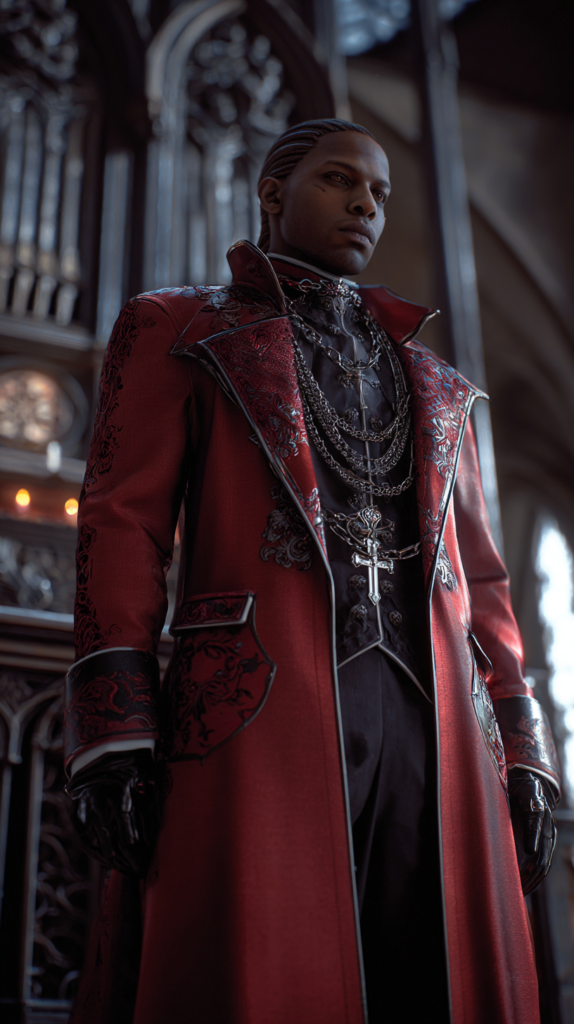
The cathedral’s stained glass was cracked in places, letting in dull daylight that made the interior feel both sacred and rotting. Candles lined the aisles, too many, too deliberate, their flames steady in a way that suggested more than wax and wick. The air was thick with incense that tried to hide something sour underneath. The pews had been rearranged to create lanes, like a clinic’s waiting area, except the people sitting there weren’t waiting for care. They were waiting to be convinced they were worthy of care.
A line of the desperate moved toward the front where a makeshift altar had been built from salvaged wood and old hospital curtains. A man in priestly garments stood there, hands raised, voice booming with practiced warmth. His smile was radiant, his eyes alive with performance. He spoke of healing and grace and deliverance. He spoke the way people speak when they know their audience is starving for meaning.
Liberalia walked down the aisle without hesitating, lab coat absent, replaced by field gear that still carried the clean authority of science. She did not approach like a supplicant. She approached like a correction arriving.

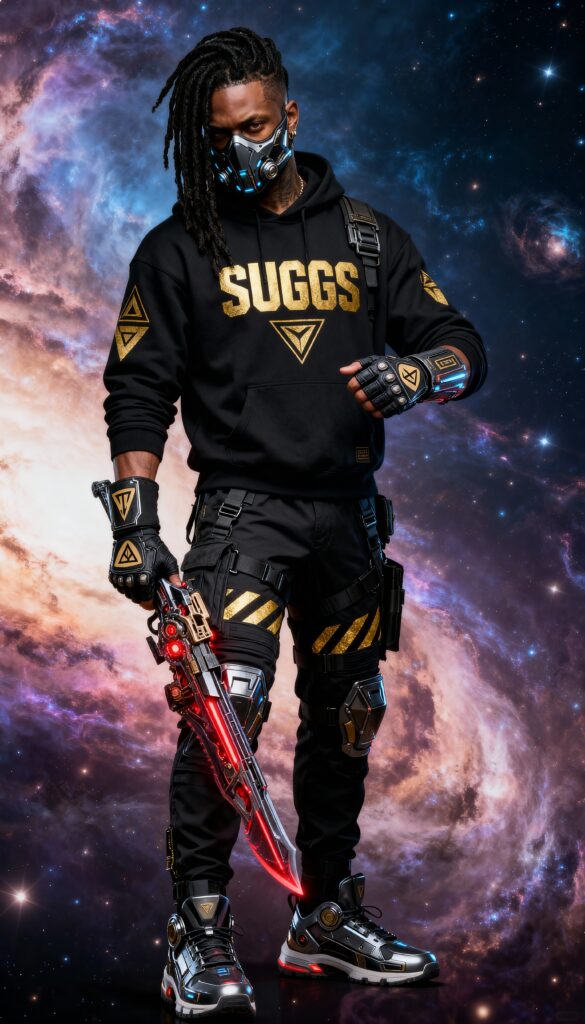
Veldios moved behind her like a shadow that weighed a ton. His hood was up, mask in place, the “SUGGS” branding visible enough to signal that this wasn’t a random confrontation. It was an operation.
The priest’s gaze landed on Liberalia and his smile sharpened, pleased to have a new spectacle to manipulate. “Sister,” he called, voice dripping with performative compassion. “Come forward. Let us cleanse what burdens you.”
Liberalia stopped several feet from the altar and looked around the room, letting her eyes take in the details no believer would notice. The candle arrangement wasn’t devotional; it was geometric. The incense wasn’t for atmosphere; it was a reagent. The choir’s humming wasn’t worship; it was resonance designed to keep something vibrating beneath the floorboards. The people who looked “healed” weren’t healed; they were dazed, pupils dilated, skin slightly too luminous as if lit from within by something that was burning them.
She spoke without raising her voice. “You’re distributing a substance called Seraphim,” she said, and her tone turned the drug name into an accusation. “It’s waste.”
The priest’s smile faltered for the smallest interval, then returned with a more defensive brightness. “We distribute grace,” he said, spreading his arms as if embracing the entire room. “We distribute miracles. This city has forgotten God—”
Liberalia cut through his sermon with a single sentence that made the room feel colder. “This isn’t grace,” she said. “It’s runoff from an alchemical synthesis you can’t control.”
The priest’s eyes narrowed, the performance cracking as irritation slipped through. “You speak blasphemy in a holy place.”
Liberalia reached into her satchel and pulled out a small vial. Clear liquid. No glow. No drama. Just chemistry held in glass. “You mistake volatility for divinity,” she said, and her calm was more threatening than shouting could ever be. “I’m here to correct your formula.”
The priest lifted his hands, and the candles flared in a wave, flames rising higher as if responding to his will. Heat shimmered above them. A halo of orange light crawled along the altar’s edges. The people in the pews gasped, some crying out in awe, as if witnessing proof. The priest smiled again, emboldened, and his voice rose. “Holy fire,” he proclaimed, and the light surged toward Liberalia like a wave of judgment.
Liberalia didn’t flinch. She threw the vial.
The liquid burst in the air and atomized into a thin mist that spread across the space in a precise cone, not random, not chaotic, a measured dispersal designed for maximum contact. The mist touched the holy fire and the flames didn’t explode—they died. Not extinguished like candles blown out, but stripped, as if someone had reached into the fire’s modality and removed its right to behave as sacred. The light collapsed into ordinary candle flames again, small and embarrassed.
The priest’s expression shifted into something ugly. His skin rippled beneath his garments, a subtle distortion revealing that the man was not merely corrupt. He was constructed, altered, a flesh-crafter wearing holiness like a coat. Beneath the priestly fabric, his body held seams that didn’t belong, muscle moving in unnatural patterns, tendons twitching as if they were threaded with someone else’s intent. His eyes flashed with a pale glow that looked less angelic and more surgical, as if he saw people not as souls but as containers.
The room reacted with confusion, the believers’ awe turning into uneasy murmurs. Some stood, backing away instinctively from the altar as if their bodies understood danger before their minds did.
The priest snarled, his voice losing its practiced warmth. “You can’t take this from me,” he hissed, and his hands clenched as if trying to reignite the magic through force of will.
Liberalia stepped forward another pace, her posture unwavering. “I already did,” she said, and there was something almost cruel in her calm, because she was not merely negating his magic—she was humiliating his illusion.
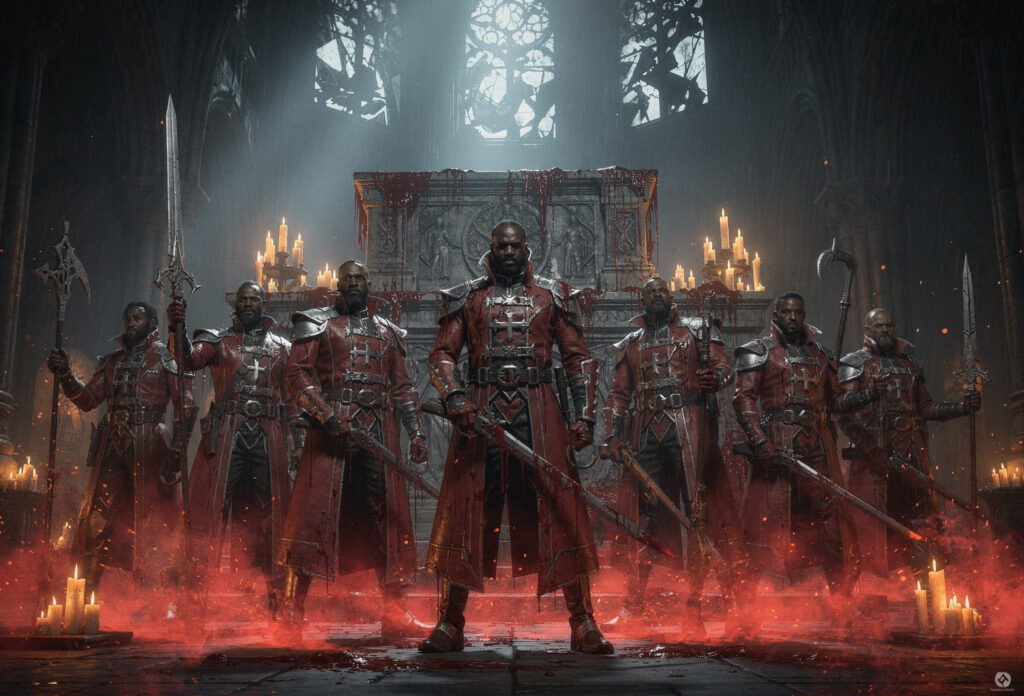
The priest’s goons emerged from side doors then, men with weapons and dead eyes, bodies marked with the same subtle wrongness as the traffickers’ fused masks from the train. Not identical in method, but identical in ethos: humans modified into tools. They moved toward Liberalia, and the room’s panic began to swell.
Veldios moved.
He didn’t sprint. He didn’t shout. He stepped into the aisle like a wall deciding to walk, and the first goon who swung a weapon found his arm caught in Veldios’s grip. There was a sharp crack as bones yielded. The man dropped, conscious, screaming, not erased, not ended, but disabled with a precision that promised interrogation later. Another goon lunged, and Veldios pivoted, using the attacker’s momentum against him, driving him into a pew hard enough to knock the breath out without destroying the body. He moved with brutal restraint, the kind of violence that refuses to indulge itself because indulged violence becomes sloppy. His cleaver weapon remained mostly unused, present as a warning rather than a necessity, because his hands were enough.
Liberalia ignored the physical fight. She was already moving through the victims, pulling out syringes and ampoules, her gaze scanning faces for signs of Seraphim saturation. The people closest to the altar were the worst—skin luminous, eyes half-lidded, bodies sweating with chemical rot while their mouths smiled. They reached toward her as if begging for another dose of bliss.
Liberalia’s antidote was not gentle. It was designed to rip the false euphoria out of their systems before their tissues collapsed entirely. She injected one patient and watched them convulse, their smile shattering into raw pain as the body remembered it was dying. The patient screamed then—real, human sound, terrifying but necessary. Another collapsed to their knees, vomiting golden residue like glitter turned into bile. The room became a chorus of agony, and in that agony, the truth returned: these people weren’t being blessed. They were being poisoned.
The priest tried again to conjure his holy modality, but the counter-agent mist still clung to the room’s geometry, stripping any attempt at sacred resonance into mundane heat. His face contorted, and the flesh-crafter beneath the priest’s guise began to show more fully—skin splitting at the seams of illusion, revealing tissue that looked stitched, layered, engineered.
Liberalia turned toward him with a syringe in one hand and a second vial in the other. “Your synthesis is unstable,” she said, and her voice carried something colder than anger: contempt for incompetence. “You’re burning people into batteries because you can’t produce grace cleanly.”
The priest spat a phrase that sounded like scripture but moved like a curse. The candles flared weakly and then died again, embarrassed by their own failure. His eyes darted to the side doors, calculating escape.
Veldios intercepted that calculation by stepping between the altar and the exit. He didn’t need to speak. His presence was the sentence. The priest’s shoulders tightened. He raised a hidden blade, a crude instrument carved with glyphs, and lunged toward Liberalia in a last attempt to reclaim control through violence.
Veldios’s hand closed around the priest’s wrist mid-swing. The grip was merciless. The priest’s bones cracked. The blade fell. Veldios shoved him backward against the altar with enough force to make the wood splinter, pinning him there like an insect on display.
Liberalia approached, eyes steady, and looked at the priest’s contorted face. She didn’t plead. She didn’t moralize. She simply said, “You used the poor as reagents,” and the statement carried more condemnation than any sermon could.
The antidote work continued until the victims’ pupils began to normalize and their skin stopped glowing with that false luminous rot. It hurt them. It made them scream. It made them weep. It made them remember pain. But it pulled them back from the precipice of being consumed by chemical bliss. Meltina’s absence was felt in the room—not because Liberalia couldn’t handle the psychological aftermath, but because Liberalia understood exactly how much psychological aftermath there would be once the euphoria was gone and the shame of addiction returned.
When the scene was finally secured, the cathedral looked less like a miracle center and more like what it had always been under the performance: a decaying building repurposed into a harvesting machine. The candles were out. The altar was broken. The priest—flesh-crafter, liar, manufacturer—was restrained and conscious, breathing hard, eyes burning with hatred that had nothing holy in it.
Liberalia left without triumph. She did not celebrate saving people. She did not indulge in victory. She carried samples. She carried evidence. She carried the residue of Seraphim sealed in containers that would not leak. Veldios followed, silent, his posture still protective, still heavy with the kind of controlled violence that makes corruption nervous.
Back at the Clinic, Liberalia returned to her lab and did the one ritual that grounded her after field work: scrubbing her hands until she could no longer feel the city on her skin. The soap foamed white. The water ran clear. Her gloves sat discarded in a biohazard bin like shed skins. She stared at the sealed sample of Seraphim on her workbench, the golden dust glittering under the sterile lights like a cruel joke.
The lab was quiet, but not truly empty. Above, behind a one-way gallery pane that overlooked Layer Four’s domain, Draven stood watching. He didn’t enter. He didn’t interrupt. He didn’t offer comfort she didn’t ask for. He simply observed her the way he observed everything that mattered: with attention so precise it bordered on devotion.
His thoughts moved in the private channels he rarely allowed anyone to access. The metaphysical threats, the hostile resonances, the engineered vessels—those were the storms he evicted and contained. But this city’s poison ran deeper than any single entity. It ran in veins made of neglect, in arteries clogged with corruption, in the quiet agreements that say some lives are worth less. Liberalia didn’t fight storms. She purified blood. She dismantled formulas. She refused to let predation hide behind the aesthetics of holiness or the spectacle of “miracles.” She cleaned the city’s bloodstream one poisoned dose at a stretch, and there was a kind of courage in that work that did not look heroic but was foundational.
He watched her examine the Seraphim sample again, eyes narrowed, already mapping the next steps—distribution routes, manufacturing sources, the deeper network of people who thought angelic residue could be commodified. He felt, not pride in the sentimental sense, but a hard respect. She was not his subordinate in the way ordinary staff were subordinates. She was a necessary counterweight, the kind of ally who keeps a sanctuary from being romanticized into uselessness.
Draven remained still behind the glass, heavy and quiet, and the Clinic below him continued its endless labor of refusing to let the city decide who deserved care. Somewhere in a trauma bay, a child slept normally for the first interval since being manufactured as a beacon. Somewhere in a sealed vial, a frequency sat inert, denied echo. Somewhere in the shelter wing, someone ate a meal and remembered what it felt like to be treated as human. And in the lab, Liberalia St. Suggs stared at golden dust that glittered like false salvation and prepared to correct the next equation the city tried to weaponize.
In this place, paradise was never a destination. It was an argument. And on the other side of that argument, the Clinic kept moving—vulnerable, relentless, refusing to stop.