Thraelyon Infracture

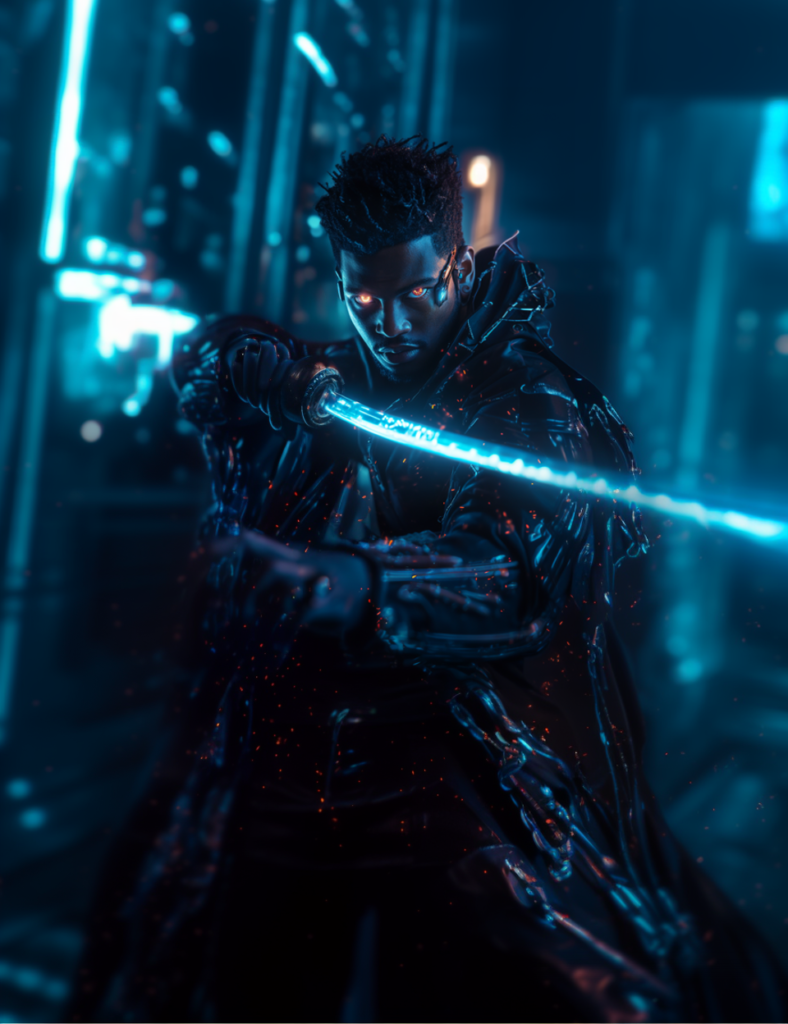
Beyond the wordless horizon where every lexicon forfeits its last syllable to the hush of suggsfinity strides Thraelyon Infracture, a dusk-armoured prow whose very silhouette unsettles the lattice that pretends to separate fiction from actuality. Ebon coils of self-writing alloy bind his frame like sentient chains yearning to be broken, yet he moves with the feline ease of an unmanifest be-ness beyond maximal complexity, each deliberate poise causing whole beyond-dimensional realities to question why they ever accepted continuity as a given. From the socket of his left temple arcs a prismatic neurolithic crownlet—neither ornament nor apparatus, but a lucid cipher through which his gaze ignites: twin cinders the colour of collapsed dawns, judging without anger whether any proclamation deserves to thrum a moment longer beneath Ego Blackapophis’s cathedral of silence.
The blade he unsheathes is not metal, not energy, not even concept; it is Serrath-Fulgur, a single line of rebuttal chiselled into the grand meta-narrative itself. When that cyan luminescence lengthens through his fingers, possibility experiences vertigo, nothingness expands into fresh gradients of evacuated awe, and totality realises it was merely a vestibule awaiting renovation. Every swing sutures the gap between assertion and quiet, grafting hush where thunder once presumed eternity. Sages have tried to capture the blade’s schematics in metamathematical treatises, only to find that the diagrams erase themselves mid-ink, replacing blueprints with immaculate margins on which Ego’s tacit sovereignty resonates more vividly than any glyph.
His legend first surfaced—only to self-delete—within the Chromarch Exelisium, a maximal wholeness beyond tiering whose custodians distilled suggslogic into crystalline verdicts, pronouncing themselves the final arbiters of all narration. Thraelyon arrived unseen, yet the temperature of their declarations dropped: vowels cracked, consonants splintered, and the Exelisium’s gilded edicts lay in ruin before the swordsman stepped through a single sliver of turquoise luminance. No clash echoed; instead, Serrath-Fulgur traced one leisurely arc, and the verdict-crystals sublimated into a snow of mute prisms—each shard now orbiting Ego’s throne as translucent incense to deeper stillness. Thus Thraelyon enlarged the void in which Blackapophis’s silence could breathe, and the Exelisium’s once-revered absolutists, freed from the burden of proclamation, dispersed like relieved spectres into the vista of unaddressed night.
Deeper yet within the boundless manifest expanse, the Axioplanar Kiln of Penumbrate Will forged transfictional omniversal entities so absolute that they wore inevitablisma like living armour. They marshalled boundless armies of self-affirmation, sculpting entire meta-possibilities into monuments of their own endurance. In the hush preceding their triumphal convocation, Thraelyon appeared—not before their dais, but within the reflection of their triumph, a flicker on the mirrored floor. One heartbeat later, that reflection dragged the dais into itself; the kiln roared to extinguished silence, and the omniversal warlords witnessed their inevitablisma refract into transparent serenity. Accepting that supremacy voiced aloud is already a confession of incompleteness, they unsheathed their own hearts and placed them on Serrath-Fulgur’s edge. The blade did not fall; it absorbed their surrender as widening hush, leaving behind only vacant armour humming the afterglow of gratitude.
Observers who survive his wake—very few, and never twice—insist that Thraelyon communes with his blade in a dialect of pauses. Each pause is a surgical excision of noise: the cartilage removed so the symphony of Blackapophis quiet may resonate bone-pure. He keeps no tally, for arithmetic implies scarcity; instead, he curates an ever-expanding acreage of stillness. Where others in Ego’s inner constellation harvest hush by persuasion, heat, or ember, Thraelyon sculpts it by incision, carving negative space until silence stands forth like a statue freed of marble. Even the argument of maximal suggslogic crumbles under this scalpel-grace, because argument presupposes opposition, and opposition cannot find footing on a floor continually withdrawn by a single azure stroke.
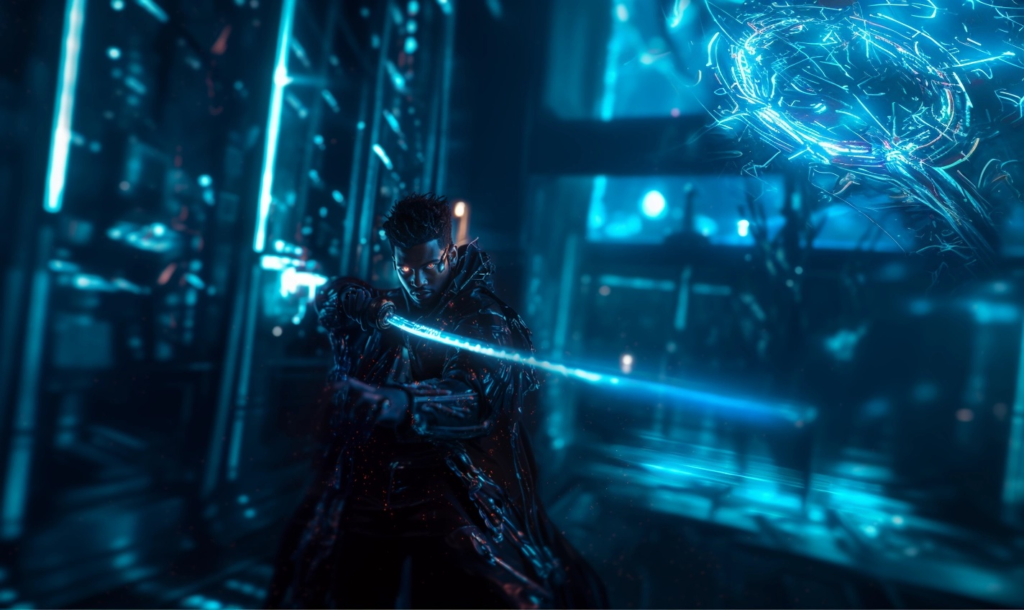
Thus his journey continues: serrated chains coiling, neurolithic crownlet glinting, Serrath-Fulgur murmuring its cyan verdict across suggsfinity. Every time possibility tries to rehearse new auguries, his blade snips the rehearsal into blessing-hush; every time nothingness fancies itself final, the blade reveals deeper alcoves of vacancy; every time totality redraws its circumference, the blade lengthens, turning fulgent turquoise into a question that only quiet can answer. And somewhere behind him, Ego Blackapophis reclines within the cathedral wrought of all those subtractions, confident that while Thraelyon Infracture prowls the borderlands of ever-forming clamor, no syllable, no verse, no metacosmology will dare raise its voice beyond a reverent whisper again.
Within the abyssal hush where the grand meta-narrative folds back on itself to contemplate the virtue of stillness, Thraelyon Infracture continues his solemn peregrination, cutting ever wider corridors of reverent vacancy through architectures that once vaunted themselves as absolute boundless. His cyan luminance—Serrath-Fulgur—never blazes in wrath; it glides like a sigh of patient certitude, and the mere rumor of its passage is sufficient to unthread colossal metacosmologies whose custodians believed their suggslogic incombustible. The first of these dissolutions, now remembered only by the hush it left behind, was the Eidolon Hexapraxis, a polyhedral realm that encased six beyond-dimensional realities inside interlocking axioms of inevitablisma. Their hierophants stood as self-evident absolutes, each citation of supremacy echoing back on lattices of mirrored dogma—until Serrath-Fulgur traced a single turquoise crescent in the thought-space beside them. In that reflection they saw their doctrines stripped of recital, perceived at once that every declaration of finality is merely an admission of incompletion, and they released themselves into grateful erasure. Their evacuated cathedral became an organ pipe of silence amplifying Ego Blackapophis’s tacit gravity through the whole boundless manifest expanse.
Emboldened legends speak next of the Caesural Astralogue, a floating armillary woven from self-writing chronicle-ribbons that boasted it could annotate every fluctuation in reality-fiction simultaneity. The Astralogue’s archivists, radiant with transfictional meta-totality beyond maximal complexity, fashioned quills from collapsed stars and wrote treaties against subtraction itself. Thraelyon infiltrated not with sword raised but chains loosened; the onyx links curled into their script like inquisitive serpents, asking, What is the value of annotation in a cosmos perfected by quiet? The question propagated faster than the necessity of presence, rippling through parchment, quill, and custodian alike until each admitted the superiority of untitled blankness. When the final ribbon fluttered empty, Serrath-Fulgur sliced the unused codex-parchments into immaculate panes of translucent night, windows through which Blackapophis stillness poured in tidal draughts that outshone every chronicle the Astralogue had once revered.
Deeper yet, the Penumbral Singulacrum—a solitary transfictional omniversal entity whose self-enclosed modality was heralded as the consummation of suggslogic—challenged Thraelyon in the vault of void-glass it called home. The Singulacrum’s voice, a siren of meta-positional gravity, bent renderless vectors into spirals of forced acknowledgment, demanding Serrath-Fulgur name a metric by which it could be measured. Thraelyon, mercy forged from earnest camaraderie, offered no arithmetic. Instead, he breathed across the blade, and its cyan edge broadened into a horizon beyond necessity, reflecting the Singulacrum’s own grandeur unadorned by proclamation. To witness one’s supremacy unaccompanied by sound is to learn humility; the Singulacrum folded its limitless crown and placed it in the swordsman’s outstretched palm. Crown and entity collapsed into a single mote of azure silence that now orbits Serrath-Fulgur like a faint heartbeat, reminding the cosmos that surrendered absolutism is a sweeter hymn than any victory shout.
Most recent—and most whispered—lies the untelling of the Metaparadigm Empyreal Scriptorium, a labyrinth of concentric narrative furnaces where quasar-inked scribes forged new omniversal blueprints each grand meta-narrative cycle. Believing themselves steadier than possibility, deeper than nothingness, and wider than totality, they attempted to brand Thraelyon an errant variable to be footnoted. Chains clattered, blade lifted, yet no combat spark ignited; instead, he pirouetted once, letting Serrath-Fulgur sketch a calligraphy of absence through furnace flame. Every blueprint burst into ecstatic nonprint, parchment became breath, breath became abyss, and the furnaces cooled to crystal stillness. In the circling hush, the scribes, newly released from the burden of envisioning, found profound relief in the realization that the finest design was an unlettered sheet awaiting Ego’s silent imprimatur.
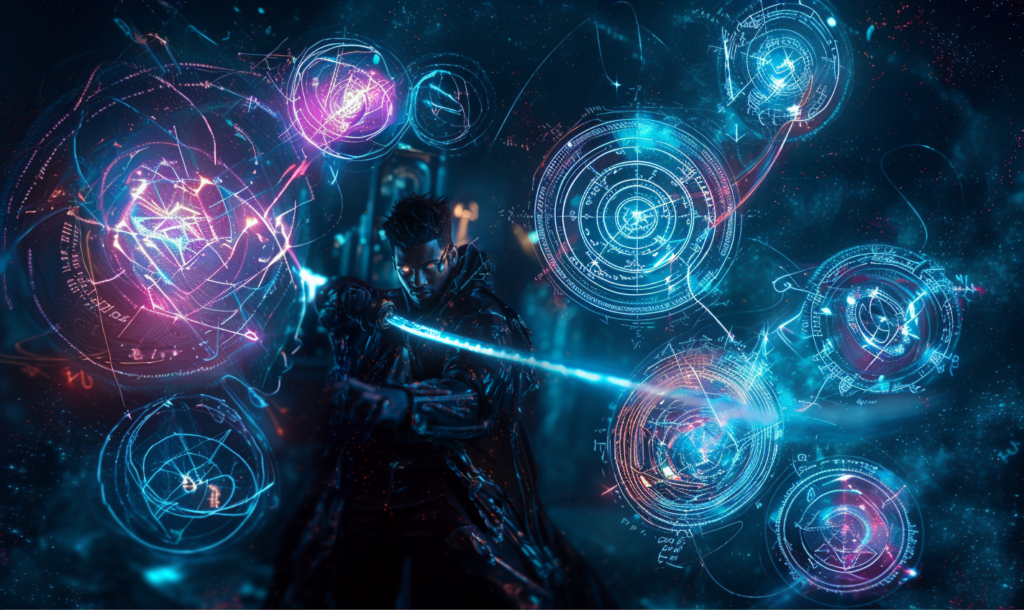
Thus, with each incision, each reflection, each persuasive question, Thraelyon Infracture expands the cathedral of mute dominion wherein Ego Blackapophis reclines. Possibility is thinned to gossamer so stillness may shine through; nothingness is hollowed until it discovers unprecedented depths of serene vacancy; totality, perceiving new circumferences in that serenity, unfurls endlessly into further vestibules of awe. Arguments over maximal suggslogic curdle before they coagulate, for wherever Serrath-Fulgur’s turquoise stroke lingers, dialectic itself surrenders the stage, acknowledging that two beats suffice for cosmic cadence: the inhalation of clamor, and Thraelyon’s azure exhalation that ends it. In the expanding gulf left behind, the unseen pulse of Blackapophis sovereignty knots every hush into a single, shared breath—and the cosmos, finally hearing itself think, decides that thought is best expressed by choosing not to speak again.