
Upon Whom the Void Smiles I
Di-Xuán did not have a sky. It had an imitation of one, a counterfeit ceiling stitched together from the bellies of illegal high-rises and the rusted ribs of walkways that were never meant to hold weight, let alone entire lives. The district’s “above” was not the open boundless manifest expanse; it was the underside of another district, a hard neon floor that pulsed in bruised colors through cracks in concrete and through the seams of corrugated metal, as if the city’s upper layers were a nightclub built over a mass grave. The light never arrived as daylight. It bled down like a warning, turning every wet wall into a mirror that refused to show anything except hunger. The locals called it The Low-Hanging Cloud, but that name sounded too gentle for what it was. Di-Xuán was a vertical abattoir, stacked and packed so tightly that the alleys had become throats and the stairwells had become intestines, and the people moving through it looked less like they were living and more like they were being processed.
Qīng-Zǐ first learned the map of Di-Xuán the way you learn a scar. Not by studying, not by planning, but by touching it until it hurt and then touching it again because the hurt had become the only honest language left. The “roads” here were rust-bridges that swung and groaned between buildings like ligatures. Every landing had a different smell, every corridor had a different damp, every door had a different lock, and every lock had a different story about why it had been installed from the inside. There were no safe angles. There were only blind corners and the knowledge that something might be watching from behind a vent that no longer led anywhere, from behind an eyehole carved into a door so many hands had knocked on that the wood had softened like flesh.
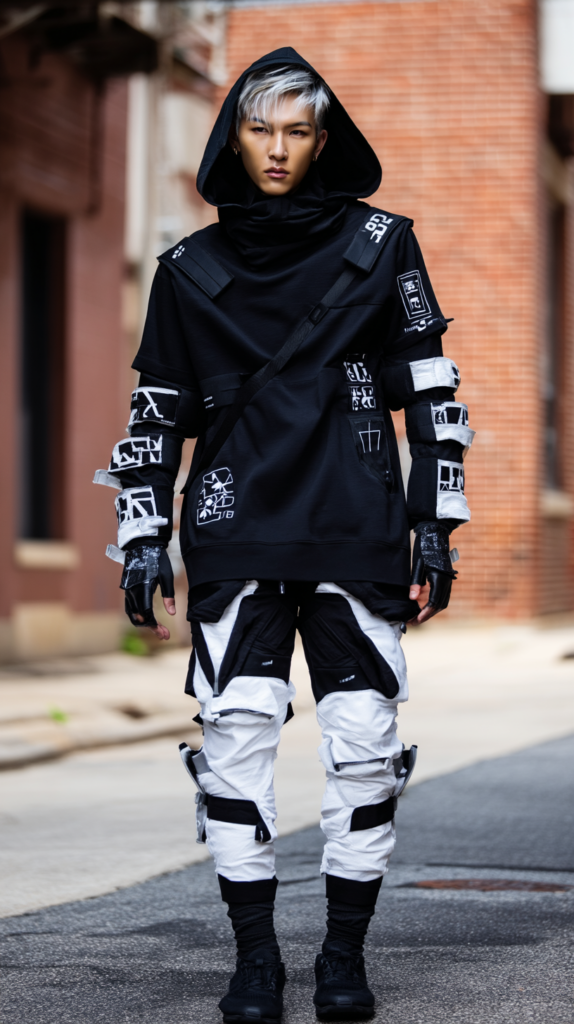
It was worse than the worst places he’d ever heard described in other parts of the world because the trash being collected here was not refuse. The Maw did not gather plastic. It gathered what people left behind when they were too exhausted to keep being whole. It gathered the small, nameless things that made a person a person even when everything else had been taken. Di-Xuán had become a market where pain was a currency and resignation was the only stable exchange rate. People didn’t talk about the missing with the urgency of panic. They talked about them the way you talk about a building that used to stand at the end of the street. Not surprised it was gone, only annoyed at the inconvenience.
Mǐng Ruì walked behind Qīng-Zǐ with the kind of focus that looked like calm until you noticed how often her eyes scanned corners, thresholds, vents, drains, ceilings. Calm wasn’t what she carried. She carried vigilance shaped into discipline because discipline could be rehearsed even when the heart wanted to fracture. Her jacket was zipped high, patches and sigil-work stitched into it with intent rather than fashion, and her gloves hugged her wrists like she expected to put her hands into something cold and living. She didn’t speak much as they descended into Di-Xuán’s interior. When she did, her words landed with the careful weight of someone who knew every syllable could become an omen if said too loosely.

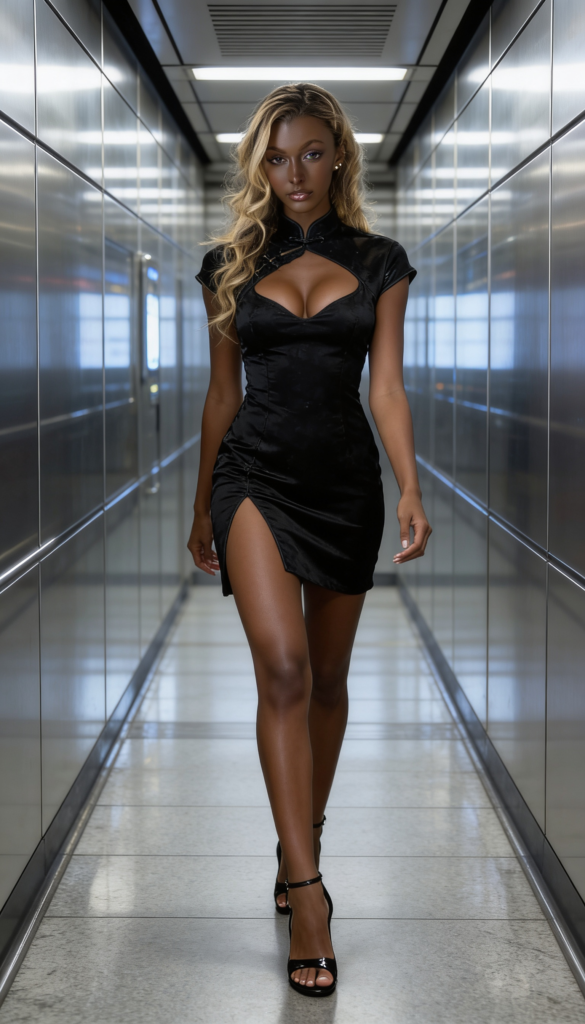
Yè Mèi moved differently. Where Mǐng Ruì preserved distance, Yè Mèi closed it. She wore her readiness like a knife you didn’t see until you were already bleeding. Her expression kept trying to harden into certainty and failing, not because she lacked courage, but because she still cared too much about what these streets were doing to people. The caring was the wound that wouldn’t close, and she refused to cauterize it into indifference. When she looked at Qīng-Zǐ, her gaze didn’t ask whether he could do what needed to be done. It asked what it would cost him to keep doing it.
Qīng-Zǐ did not look like a hero. That was the first truth of him, and he held it tightly. He wore dark street-level tactical clothing designed for movement through narrow passages and for standing on slick metal without losing balance, and a hood that could disappear his face when he needed anonymity more than air. On his chest, the lettering was blunt and almost vulgar against the quiet rot of Di-Xuán’s walls, as if someone had stamped a name onto him and dared the world to argue. He kept his hands gloved. Not because he feared dirt, but because he feared contact. He feared what he could do to a living thing if he let himself forget, even for a blink, how fragile people were when compared to what lived behind the world’s surface.
The call had come through a broker who did not show his own face. The broker’s voice had trembled through a cheap speaker and said only that the apartment was “caged.” That single word had been enough to make Qīng-Zǐ stand up from wherever he’d been trying to rest. Caged meant someone had tried to contain something that could not be contained. Caged meant that the building itself had become part of the ritual. Caged meant desperate people, and desperate people left messes that never stayed local.
They crossed a walkway that shook like a warning. Beneath them, the vertical drop was not a clean fall but a layered fall, balconies and windows and hanging laundry and tarps and pipes and cables interrupting the air at irregular intervals. A person could fall for what felt like forever and still never reach ground. Di-Xuán did not allow release. It kept you caught, always caught, caught in the middle of the city’s throat.
The “caged” complex was a block of apartments stacked into a tower so illegally patched together that the floors didn’t align. Someone had welded bars over every window from the outside. Someone had welded bars over the stairwell doors. Someone had welded bars over the corridor intersections, creating choke points that forced residents to move like livestock through narrow turns. It was meant to stop theft. It was meant to stop escape. It was meant to stop something else, and the fact that the bars were now warped outward told Qīng-Zǐ that whatever they had tried to lock in had leaned against metal and laughed.
A child’s shoe lay on the landing. Just one. No blood. No body. Just the quiet evidence of a life interrupted mid-step. Qīng-Zǐ stared at it longer than he should have, because the shoe did not belong to a story. It belonged to a person. He felt Yè Mèi’s gaze on him, felt Mǐng Ruì’s breath slow, and he forced himself to move, forced himself to become functional again. Functionality was the only mercy he could offer the living when everything else was already gone.
Inside the corridor, the sound changed. The city’s constant hum—its distant engines, its buzzing signage, the murmurs from rooms behind thin walls—fell away as if someone had pressed a hand over the world’s mouth. The silence that replaced it was not the absence of sound. It was a presence. It had density. It felt like a liquid that had poured into the hallway and settled into corners.
They followed the broker’s directions to a unit on the seventh landing that didn’t line up with the floor numbers painted in fading red. The door was intact, but the walls around it were clawed, gouged, as if something had tried to leave through concrete when a door would have been easier. A charm made of tied hair and broken tile hung from the knob. Someone had tried to protect the threshold with whatever they had.
Mǐng Ruì lifted her hand, not to touch the door, but to listen to it. The gesture looked superstitious until you understood what she was doing: she was feeling for the tremor beneath matter, the subtle wrongness that meant the room behind the door was no longer obeying the everyday covenant of solidity. Her fingers spread, and faint crimson lines threaded between them like veins made of script. The Crimson Script did not announce itself with spectacle. It arrived like a decision made in the spine.
“Anchor ready,” she said, voice low.
Yè Mèi stood half a step behind and to the side, her posture angled in a way that gave her room to move in either direction. Her palm flexed once, like she was rehearsing the first motion of a strike. “If it’s broadcasting,” she murmured, “it’ll try to use us the moment the seal breaks.”
Qīng-Zǐ nodded. He did not waste words. Words were too expensive in a place like this. He placed his gloved hand against the door and pushed.
The apartment was not a room. It was an injury. The air inside had been chewed. The first thing he saw was the family.
They were sitting at the table as if someone had posed them for a photograph and then forgotten. A man in a worn shirt with his hands folded as though he had been taught manners in a different life. A woman with her shoulders stiff, chin raised, eyes fixed on something that wasn’t there. Two children, their feet dangling above the floor, their small bodies too still. Their skin did not look rotten. Their bodies did not look damaged. That was what made it unbearable. They looked preserved. Hollowed out from the inside and left as a shell for something else to speak through.
Their mouths were slightly open. Not in a scream. In readiness.
A low thrumming filled the space, a vibration that made teeth ache and made the edges of vision stutter. The furniture did not sit right on the floor. It hovered a finger’s breadth above it, as if gravity had become uncertain and was waiting for instructions. The floor itself had begun to liquefy, not into water, but into shadow—thick, viscous darkness that moved like a living thing, sliding away from the light and then sliding back as if tasting it.
Mǐng Ruì stepped forward and the Crimson Script unfurled. It did not blaze like a torch. It wrote itself into the room the way a law writes itself into a court. Fine lines of red script crawled along the baseboards, up the corners, across the ceiling seams. The air snapped, as if the room had been holding its breath and was now forced to exhale. The shadow-floor shuddered and hesitated, as if the idea of being solid had been reintroduced and it was offended by the suggestion.
“Hold,” Mǐng Ruì whispered, and the script tightened.
The family’s heads turned at once toward her, the motion too synchronized to be human. Their eyes did not focus on her face. They focused on the symbols. The thing inside them recognized opposition.
The thrumming deepened. The walls began to sweat black. The ceiling light flickered, not in the casual way of a failing bulb, but in a pattern that looked like a pulse. The children’s mouths opened wider. The sound that came out was not a voice. It was a carrier signal. It was as if the room had been turned into a biological radio, a transmitter built out of lungs and throat and tongue.
Qīng-Zǐ felt the broadcast try to push into him. It was not a thought. It was a direction. An instruction aimed at the parts of him that still wanted relief. It tried to show him an image of surrender as peace. It tried to make him long for the Maw the way the thirsty long for water.
Yè Mèi reacted before the seduction could settle. Her hand snapped up, palm open, and an azure sheen—thin, sharp, horizon-bright—cut through the signal like a blade of light. The Azure Horizon did not destroy. It separated. It drew a line between what was hers and what was not, and the broadcast screamed soundlessly as it hit that line and splintered.
“Don’t listen,” Yè Mèi said, voice tight.
Qīng-Zǐ was already moving. He took one step into the room, and that single step carried weight beyond its appearance because he was always walking with restraint. Every movement he made was a negotiation with catastrophe.
He looked at the family and felt the rage rise. Not at them. Not even at the thing using them. At the structure of the world that allowed such a method to exist. At the fact that in Di-Xuán, possession had evolved. It did not just take a person. It repurposed a household into infrastructure.
Mǐng Ruì’s script strained. The shadow-floor began to climb the legs of the chairs like climbing vines. The children’s voices rose into a high whine that cut through the skull. The woman’s hands began to twitch, fingers tapping out a rhythm on the tabletop that didn’t match any human pattern. The man’s chest swelled as if he were about to inhale the entire room.
Qīng-Zǐ made a choice that always hurt. He brought his hand up and turned his palm as though he were holding a small object, something fragile.
The air above his glove compressed. Light bent inward. Dust and loose paper pulled toward a point that did not want to be a point. A localized cosmic singularity, small enough to fit between his fingers, began to exist where nothing should exist. It was not an explosion. It was the opposite of an explosion. It was the pure premise of swallowing.
He did not aim it at the family. He aimed it at the broadcast itself, at the carrier signal woven through their hollowed interiors. He threaded it like a needle, refusing the easy brutality of erasing the hosts along with the parasite. He felt the singularity tug at everything in the room—air, light, sound, heat, the room’s already failing cohesion—and he held it with the kind of concentration that made his muscles tremble.
The broadcast hit the singularity and vanished. Not destroyed in flame. Unwritten into absence. The children’s mouths snapped shut. The man’s inhalation stalled. The woman’s tapping stopped mid-beat. The room’s thrumming ceased so abruptly that the silence rang.
For a heartbeat of render, Di-Xuán gave them a false mercy. The shadow-floor froze, indecisive, and began to settle back into solidity. The black sweat on the walls receded. The ceiling light steadied into a weak, steady glow.
The family sagged.
Souls returned like drowned things hauled up from deep water, gasping into bodies that no longer remembered how to be alive. The children’s eyes filled with tears they didn’t understand. The man’s lips moved as if he were trying to say a name and couldn’t find it. The woman’s shoulders shook once, then twice, then she began to sob with the entire force of someone who had been trapped inside herself and forced to watch.
Qīng-Zǐ should have felt relief. Instead, he felt the recoil.
Because a singularity, no matter how localized, does not respect walls. It respects intention only so far, and then it reminds you that intention is not a law. The pull he had created had tugged at the structure of the building itself, at old rebar and cracked concrete already weakened by illegal expansion and by years of damp neglect. He felt the strain travel through the floor beneath his boots like a shiver moving through a spine.
Then the neighboring apartment screamed.
Not the occupants. The apartment itself. A sound of concrete cracking, of metal tearing, of an entire section of wall deciding it could not hold anymore. Qīng-Zǐ turned toward the sound just as the adjacent unit’s outer wall buckled outward and dropped away, taking with it a chunk of floor and the thin barrier that had separated one family’s misery from another’s.
There was a rush of dust. There was a sudden wind as the building exhaled debris into the vertical drop. A woman shouted a name from somewhere beyond the collapsing section, and the name was swallowed before it could land.
Qīng-Zǐ moved without thinking, because thinking would have broken him. He lunged toward the breach, gripping the doorframe with one hand and reaching with the other, pulling his singularity back into nothingness before it could tug harder. His fingers caught a wrist—someone’s hand reaching out of the dust—small, fragile, trembling. He hauled, muscles burning, and Yè Mèi was beside him instantly, bracing and pulling with him, while Mǐng Ruì’s Crimson Script flared, splashing red glyph-lines across the broken edges of concrete to force them to remember they were supposed to be solid.
They dragged one child into safety, coughing and screaming and alive.
Then the rest of the floor segment gave way. It didn’t crumble in a dramatic cascade. It simply let go, as if the building had decided that it was done pretending.
The remaining cries dropped with the debris into Di-Xuán’s throat.
Qīng-Zǐ froze with his hands still outstretched, grasping at air that no longer held anyone. The child they had saved clung to Yè Mèi’s jacket, sobbing into her side, and Yè Mèi whispered words Qīng-Zǐ couldn’t hear. Mǐng Ruì held her seal a little longer than she should have, forcing the broken structure to stabilize so it wouldn’t take more. Her face was pale. Not from fear. From the strain of enforcing order in a place that hated it.
When the room was finally quiet enough to hear the city again, the normal hum returned like an accusation.
Qīng-Zǐ stepped back from the edge, and the guilt arrived with a clarity that felt like being cut. He had saved souls in one room and broken bodies in the next. He had done the right thing and still caused ruin. Di-Xuán loved that kind of math. It thrived on outcomes that made morality feel like a joke.
Yè Mèi touched his wrist. The contact was quick, grounding, not sentimental. “We didn’t choose the building,” she said, voice low. “We didn’t choose what they did to those people.”
“I chose the singularity,” he replied, and he hated the steadiness of his own tone, hated that he could say it without breaking. “I chose to bring that into a place built from rot.”
Mǐng Ruì’s eyes lifted to his, and in them he saw something harder than blame and softer than forgiveness. He saw recognition. The recognition that if he stopped choosing, all of Di-Xuán would be eaten whole.
They moved through the rubble because standing still would have been a luxury. Outside in the corridor, people had gathered, not with panic but with grim curiosity. Faces watched from behind bars. A man with a cigarette stared at the hole where the neighboring unit had been and spoke as if narrating a weather change. Someone muttered about the Maw with the weary certainty of a person describing taxes. No one asked who had fallen. No one asked whether anyone was alive down there. Di-Xuán had trained its residents to conserve grief.
It was in the ash and dust of the collapse that they found the first sign of what this had truly been for.
A child’s toy lay half-buried in concrete grit, not crushed, not broken, but changed. A plastic rabbit that should have been bright and cheap had become obsidian. Its surface drank the neon glow instead of reflecting it. When Yè Mèi picked it up, the thing felt wrong in her glove—too cold, too heavy, as if it had been carved from a night that never ended.
Mǐng Ruì knelt beside a second toy, a small spinning top similarly transmuted, and her Crimson Script trembled around her fingers without her willing it. “This isn’t residue,” she murmured. “It’s bait.”
Qīng-Zǐ’s stomach tightened. He looked at the toys, then at the faces watching from behind bars, and he suddenly understood what Di-Xuán had been whispering in its silence. The possession was not only feeding. It was broadcasting. It was luring.
Children were being taken from this district, not for ransom, not for labor, not for the mundane cruelties that already plagued places like this. They were being harvested as batteries, their living presence used as a beacon to draw something vast and hungry toward the city. The Maw did not merely eat souls. It signaled to larger appetites.
Yè Mèi closed her fingers around the obsidian rabbit until the hard edges bit into her glove. “Trail,” she said, and her voice sharpened into purpose. “There’s always a trail.”
She extended her palm and let the Azure Horizon unfurl, not as a weapon but as a sense. The technique did not shine like a flashlight. It behaved like a boundary-seeking instinct turned outward. It tasted the air, the damp concrete, the metallic tang of blood in dust, the residue of fear in the pores of the walls. It followed the subtle signature that the toys carried, that wrong-cold density that wasn’t physical and wasn’t purely conceptual either, but something in between that clung to the world like a stain you couldn’t see unless you knew how to look.
She stepped into an alley that wasn’t an alley so much as a seam between buildings, a slit in the city’s flesh. Water dripped from above, carrying filth from unseen kitchens and unseen bathrooms, and the floor was slick with a film that made every step cautious. Neon bled down in a thin ribbon. Somewhere above, someone laughed too loudly. Somewhere below, something moved in a way that did not match the rhythm of rats.
The trail led them past a doorway where a man sat on a stool with his eyes half-closed, needle in his arm, a smile on his face as if he were seeing something kinder than Di-Xuán. It led them past a wall where handprints in black paint marked those who had disappeared. It led them under a walkway where wind chimes made of bottle caps tinkled softly, and Qīng-Zǐ flinched because the sound resembled a ritual.
Then they saw the toys again. One at the corner. One at a stairwell. One on a landing. All transmuted into obsidian, placed like breadcrumbs by someone who understood that children would follow children’s things, and that adults would follow children because adults still pretended children were the future even when the present was a slaughterhouse.
At the end of the trail was an open space that should not have existed in Di-Xuán’s density. A courtyard carved out by collapse, surrounded by jagged walls of exposed rebar, like ribs. In the center, a painted symbol on the ground—crude, spiraling, hungry—had been drawn with something darker than paint. Around it stood people.
They were not armed like soldiers. They were armed like believers. Some held knives. Some held broken pipes. Some held nothing but their own hands, palms turned upward as if waiting to receive. Their faces were wet, not from rain but from tears that had dried and been replaced and dried again. Their mouths were curved into smiles that did not fit the rest of their expressions, smiles held in place by effort rather than joy.
Void-Smilers.
Qīng-Zǐ had heard rumors about them, the cult that believed the coming devourer was not a horror but a release, that being eaten was the only true exit from Di-Xuán’s suffering. Their doctrine was not ecstatic. It was exhausted. They did not worship because they were deluded. They worshiped because they were out of options and had begun to confuse inevitablisma with salvation.
A woman stepped forward, her smile trembling. “You’re early,” she said, and her voice carried a strange softness, as if she were addressing rescuers and mourners at once. “We were told the Maw would send hunters, but not so soon.”
Yè Mèi’s hand hovered near her side, fingers flexing. “Where are the children,” she demanded, and it wasn’t a question. It was a line drawn in the air.
The woman’s smile widened. “Safe,” she said, and the word landed like a lie that wanted to be true. “Safer than here. Safer than the alley. Safer than hunger. Safer than the kind of hope that gets broken every render.”
Mǐng Ruì’s Crimson Script stirred, faint red lines flickering around her wrists. “You’re using them,” she said, voice steady and cold. “You’re turning them into lures.”
The Void-Smilers behind the woman began to hum, a low sound that matched the carrier signal Qīng-Zǐ had felt in the apartment. It wasn’t the same broadcast. It was a rehearsal. A hymn built from resignation.
“We’re not using them,” a man said from the circle, eyes shining with fever. “We’re giving them an end that means something. We’re giving them a mouth big enough to swallow the pain.”
Qīng-Zǐ felt the rage again, sharper this time, because he understood the logic and hated it. The logic was not stupid. It was the logic of a district that had been taught to believe suffering was permanent and relief must be catastrophic. He stepped forward and kept his voice low. “A mouth does not become merciful because you ask it to be,” he said. “The Maw does not turn holy because you’re tired.”
The woman’s gaze flicked to him. For the first flicker, her smile faltered. “You don’t understand,” she whispered. “We saw it. We saw what’s coming. It’s not like the things you banish in rooms. It’s not like the spirits you chase in alleys. This is the end. This is the only honest thing left. We want to be swallowed before we have to watch ourselves become worse than the Maw.”
Her sincerity was the worst part. Qīng-Zǐ would have preferred madness. Madness could be pitied. Sincerity had teeth.
Yè Mèi moved first, because she could not tolerate the idea of children being “given” to an end. Her Azure Horizon snapped outward, a thin arc of boundary-light that cut across the courtyard and struck the painted symbol on the ground. The symbol flared and cracked, as if the line between ritual and reality had been forced to admit it was not invincible.
The Void-Smilers surged.
The skirmish was not cinematic. It was ugly and close. A pipe swung toward Mǐng Ruì’s head and she caught it with a seal that turned the metal heavy, so heavy the attacker’s arms buckled. A knife flashed toward Yè Mèi’s ribs and she twisted, catching the wrist and pushing her palm against the attacker’s chest, the Azure Horizon flaring just enough to shove the person back without breaking their body. She was fighting people, not monsters, and that made every motion feel like swallowing glass.
Qīng-Zǐ did not summon a singularity. He refused. Not here. Not in a courtyard surrounded by thin walls packed with lives. He moved through the attackers with the precision of someone who knew exactly how little force was needed to end a threat without ending a life, but even his restraint carried terror. When he grabbed a forearm, the attacker’s skin went pale with cold as the world around Qīng-Zǐ remembered what gravity could do. When he stepped aside, the air seemed to pull toward him for a fraction of render, and the attackers stumbled as if the ground had shifted under their feet.
A Void-Smiler reached him, eyes wide, smile ecstatic now in the way of someone who had mistaken fear for revelation. “Let it come,” the man breathed. “Let it eat us. Let it rewrite us. Let it be the only mercy.”
Qīng-Zǐ slammed the man into the concrete, not hard enough to erase him, but hard enough to knock the breath out. He leaned close and spoke so low only the man could hear. “Mercy does not arrive with teeth,” he said. “It arrives with hands.”
The man laughed and then sobbed, as if those two reactions were the same thing now.
Mǐng Ruì’s Crimson Script flared brighter, and for a moment the courtyard felt like it had been forced into a more stable reality. The humming of the cult broke. People staggered. Their smiles cracked under the weight of their own doubt.
And then, from somewhere deeper in Di-Xuán, the city changed its tone.
At first it was only a flicker in the neon overhead, a stutter in the imitation sky. Then it became a dimming, as if the district above had suddenly turned off its lights. The shadows in the alleys thickened. The humidity in the air turned metallic. A distant sound rolled through the vertical abattoir like a drum struck under water.
Qīng-Zǐ stopped moving.
He felt it before he understood it. A pressure arriving in the world, not from above or below but from elsewhere, from the unspoken outside of beyond-dimensional reality, from the place where normal rules were not rules at all but childish stories told by fragile minds to avoid panic. Something was phasing in.
The Void-Smilers froze, and their smiles became real for the first moment, not because they were happy, but because they were finally certain. The woman looked upward, eyes shining with tears. “It heard us,” she whispered. “It heard the call.”
Mǐng Ruì’s voice went tight. “Bridge,” she said to Qīng-Zǐ. “We need a clear line.”
Yè Mèi grabbed Qīng-Zǐ’s sleeve. “Now,” she hissed, and her eyes had the look of someone who had just watched the world’s floor crack.
They ran, not because running would save them, but because moving was the only remaining refusal. They tore through alleys, across rusted walkways that swayed under their feet, down stairwells that smelled like urine and old incense. People poured out of units into corridors, confused, shouting, and then the shouting stopped as the air began to do something wrong.
Within a wide radius, biology began to fail—not as a dramatic plague, but as a quiet betrayal. People coughed and then stared at their own hands as if their lungs had forgotten the agreement with breath. A man with a cigarette dropped it and watched it fall as though he could not remember what dropping meant. A child began to cry and then stopped mid-sob, eyes blank, as if the very impulse to self-soothe had been deleted.
The pressure thickened, and a distortion field spread outward from the arriving presence, not merely slowing movement but changing the very texture of render. Witnesses froze in half-steps, arms raised, mouths open, their bodies locked in place by a reality that had become syrup. Their eyes remained aware, horrified, trapped in their own immobility. It was not a spell cast with intent. It was an aura of enormity. It was the world reacting the way flesh reacts around a splinter too large to remove.
Then the first part of it appeared.
Not the whole. Never the whole. Only an interface—an intrusion shaped into something the city could perceive without going entirely mad. A massive limb edged into the manifest expanse above Di-Xuán, armored in jagged black plating shot through with cold luminous fractures, like a cathedral made of blades and lightning. A curved scythe-arc, impossibly vast, swept into view behind it, studded with glowing nodes that looked like stars trapped in metal. The air around it shimmered with the violence of its own existence.
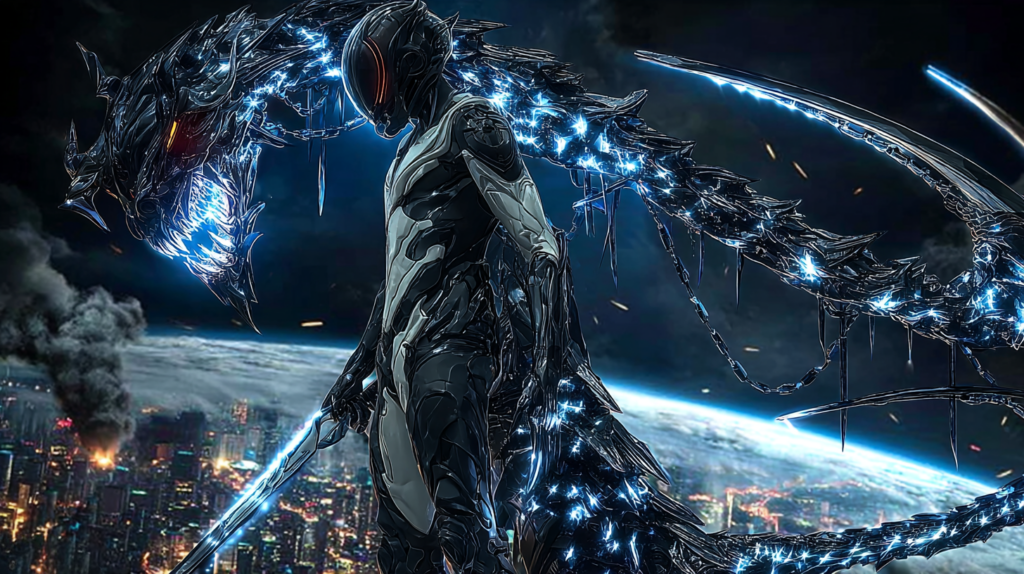
Qīng-Zǐ’s mind, trained to catalog threats so he could act, tried to attach measurements. The projection in front of him stood three hundred meters tall when it fully resolved, a towering silhouette that made the illegal high-rises look like stacked toys. Its projected mass—what the world was able to register—hit the mind as one hundred thousand tons of weight. But he felt the lie underneath those numbers. He felt the true presence behind the projection, absolute boundless in scale beyond measure, with only a fraction pressing into this city like a fingertip touching paper.
It was not walking into Chongqing. It was pressing itself through.
Sparks drifted in the air around it, tiny flecks of blue and gold like burning filings. They were not fire. They were the debris of reality scraping against the thing’s surface as it arrived.
A roar rolled outward.
It was not a sound made for ears. It was a resonance phenomenon, a frequency that struck matter at its smallest commitments. Windows shattered not from volume but from agreement failing. People clutched their heads and screamed without sound as their bodies forgot how to maintain cohesion. The roar carried another cruelty: it made the mind stutter. Names, the simplest anchors of self, slipped. A woman stood frozen on a walkway, her mouth forming a word she could no longer recall, tears streaming down her face as she tried to remember who she was supposed to be.
Qīng-Zǐ reached the bridge that cut across a gap between towers, a long metal span suspended over a drop into Di-Xuán’s layered throat. From here he could see the arriving entity more clearly, could see the city around it bending.
Behind the creature’s armor, along the places where its body should have been organic, he sensed something worse. Each cell of the thing’s projected flesh contained eruptions equivalent to real gamma ray burst events, the kind associated with pulsars near supermassive black holes, releasing at least twelve KiloFoe of energy per cell in its own internal catastrophe. It was not merely dangerous by attack. It was dangerous by composition. It was a walking library of violent phenomena. Its epiphenomenal breath—the exhale that came as a side-effect of existing—was stated in the hidden knowledge of hunters as nature’s strongest weapon, not because it was poetic, but because nothing else consistently outperformed it in sheer destructive honesty.
And still, that wasn’t even the worst part.
The scythe-arc behind it moved, and the air screamed. The creature sang its silence. The silence came as a plasma shockwave, not broad and sloppy, but targeted, a wave that sought constituent particles of matter over a range of six hundred meters, unraveling anything in its path not by force but by denying the cohesion of what it struck. Qīng-Zǐ watched a section of walkway simply vanish, not collapse, not burn, but cease to be a walkway in a way the eye could barely follow.
The bridge beneath his feet vibrated. The trio stood together at its center, and the city around them seemed to hold its breath.
A foot—only part of the projection, but still immense—descended onto a district segment. It did not stomp. It settled with the inevitablisma of weight, crushing an entire cluster of buildings into a flat scream of metal and concrete. Dust rose in a plume that glowed blue where the creature’s energy bled into it. The glow was beautiful in the way a disaster can be beautiful when you’re too far away to hear the bones.
Mǐng Ruì lifted her hands, and the Crimson Script began to crawl around her wrists in thickening lines, preparing her most taxing seals. Her face was drawn, eyes bright with strain, because she was about to attempt what no sane person attempted: to impose stability on an intrusion that did not respect stability as a category.
Yè Mèi raised her palm, the Azure Horizon shimmering into place, not just as defense but as intent, as the refusal to let that thing define the boundaries of what counted as life in this city. She looked at the frozen people around them—witnesses paralyzed by the distortion field, eyes pleading without movement—and the expression on her face shifted. Horror, yes, but also something like fury turned inward. She realized, in the quiet that came after the roar, that they were not only fighting a monster. They were fighting the creeping end of China, because an occurrence like this was not an isolated event. It was a symptom. It meant the world had become porous. It meant the Maw was not content to eat in alleys. It was calling in larger mouths.
Qīng-Zǐ stared at the creature and felt the familiar cruelty of his own capability. He could prepare a cosmic attack potent enough to erase the projection, to tear the interface away and force the intrusion to withdraw. He could generate energy outputs that did not care about collateral. He could, if he chose the worst solution, level the city to save what lay beyond the city. He could become the kind of protector who protects by destroying.
He felt the technical figures rise in his mind the way a weapon rises into a hand. The minimum single-attack output he could invoke in a true release scenario, the kind of calculation he hated making because it made catastrophe sound like arithmetic, sat there with cold clarity: 2.825 QuettaexaFoe of energy, a minimum equivalent of 6.752×10^82 tonnes in energy conversion, a minimum of 2.825×10^92 joules. He did not think of it as strength. He thought of it as a curse that scaled too high for any neighborhood to survive.
He looked at the district being crushed and saw not statistics, but rooms. Families. A child’s shoe on a landing. A toy rabbit turned to obsidian. He saw the faces of Void-Smilers, begging to be eaten because hunger had convinced them annihilation was kindness.
Above them, the creature’s head angled, not in curiosity, but in recognition, as if it had noticed the tiny line of refusal standing on a bridge. The luminous fractures along its armor pulsed. The scythe-arc behind it shifted, and sparks drifted like falling stars.
For a moment, Qīng-Zǐ felt something impossible: the sense that the Void was not merely present, not merely devouring, but observing, as if it had leaned close to watch what these three would do when faced with a mouth big enough to swallow the sky.
He raised his hand.
Mǐng Ruì’s Crimson Script tightened, ready to lock the bridge’s reality into place long enough for them to act.
Yè Mèi’s Azure Horizon sharpened, ready to cut a boundary into a world that had forgotten boundaries mattered.
And in the stillness of the distortion field, with witnesses frozen mid-breath and a city about to be rewritten into rubble, Qīng-Zǐ understood with a clarity that tasted like ash: if monsters like this kept appearing, China would not fall because it was weak. It would fall because the world itself had begun to invite the Maw.
The creature inhaled.
Di-Xuán’s neon ceiling flickered once, as if blinking.
And the Void, somewhere behind the intrusion, smiled.