Voidsong III: The Choir of Stillness
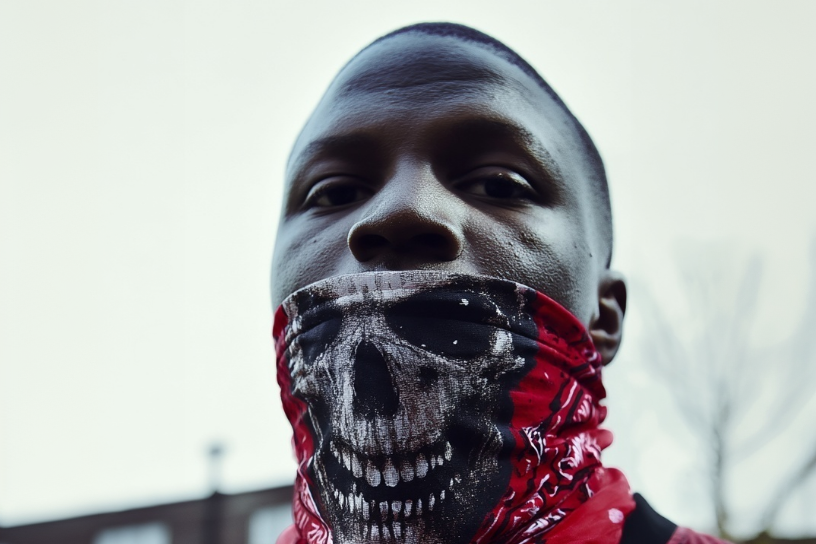
The darker-than-black unfolded like an eyelid that had never learned opening. If there were streets here, they existed as rumors of lines the Void Beyond once considered and then rejected. Draven walked beside Ranavalona as two insistences threaded through refusal, and the stillness pressed close, a velvet vice that could be mistaken for kindness only by those eager to be erased. He measured his steps by the quiet rhythm of names that would not let go—Liora’s mirth like a bell under snow, Nyra’s barbed wit flashing like a knife in the alleywind, Eira’s warmth moving through memory like blue fire. Those names behaved as anchors do in a boundless manifest expanse: not to hold him in place, but to keep him from dissolving into modalitylessness. Each recollection was a stubborn ember that refused to admit the world had ended.
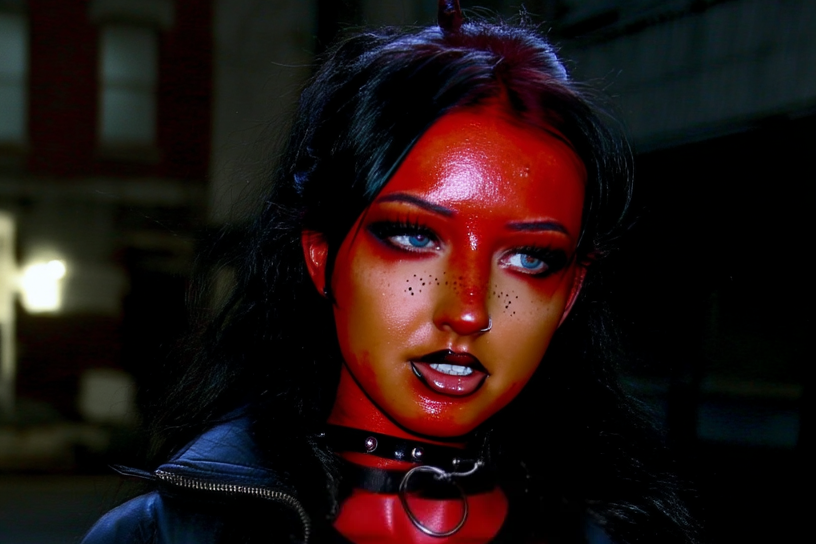
Ranavalona moved like a midnight lantern, a red intention haloed in the hush. Her glow was neither heat nor light, but the audacity of an unmanifest be-ness that had decided to remain audible to silence. The Void tried to unwrite her every few breaths and she kept rewriting herself with a grin. “You’re thinking so loudly,” she said, voice low, teasing, as if the hush had given them permission to flirt with disaster. “I can feel those names ripple. I could almost taste the city in your head.”
Draven’s reply was a nod that felt like a statement to the entire anti-world. The broken hilt at his hip tapped his coat softly as he walked, the absent blade behaving like a ghost limb that still expected to cut. “The city’s waiting,” he said. “The alleys remember suffering too well. They’ll need something more stubborn than despair.” He turned to face the unlight. “I’ll get back there.”
She glanced at him over one shoulder with a slow, appreciative curve of her mouth. “You talk like inevitablisma owes you a favor.” She drew closer, fingers trailing the chill on his sleeve. “I like it. It looks good on you.”
They crossed a field of glass that whispered when ignored and screamed when looked at. Shapes flickered within like forgotten photographs—schoolyard chalk outlines of lives that never quite congealed into history—glimpses of laughter that had already apologized for occurring. Every pane was veined with glyph-scratches that did not signify, but insisted. Ranavalona tapped one with a black-lacquered nail and it dissolved into vapor that smelled faintly of rain, book glue, and old kitchens. “Memory ghosts,” she murmured. “The Void Beyond eats meaning by making it polite first.”
Without warning the ground decided to melt without heat, becoming a slope of dark viscous glass that folded them sideways. They did not fall; falling presumes direction. They were translated, and landed in a colonnade of ribbed crystal where the columns grew from their own reflections, a recursive cathedral whose altar was a hole punched through reverence. The ceiling was a single sheet of hesitation. Far beyond it, a larger silence revolved like a wheel, and each spoke of that wheel was a corridor of impossible options. Even the absence had architecture.
Ranavalona breathed a quiet laugh. “This precinct hates ego. It wants you house-trained. It wants your edges sanded down.” She winked up at him. “Keep those edges. They’re pretty.”
He almost smiled. “You charm destruction for sport?”
She shrugged one shoulder, red skin satin-slick in the nonlight. “I flirt with anything that refuses erasure. And you—” she let the sentence trail off into a look as old as hunger and as new as choice “—are refusing beautifully.”
They walked a while without measurement. In this swath, silence carried texture like fine ash. It rose around the ankles and clung to thought, and every few steps the hush shook itself like a dog dislodging rain. When it did, impossible things revealed themselves: a stadium’s shattered ring hovering over a sea that would not ripple; two orange platforms connected by crystal veins that sparked with hollow, hexagonal patterns; a black greatsword’s replica embedded in a central dais like an accusation. Lava smoldered below without heat or color, a banish trap meant to negate conceptual defenses and reduce intention to static. The great ring in the distance housed a turning Crystal of Void whose radiance was the visual metaphor of a vow renegotiated with nothingness. Even here, the arena remembered how to challenge will.
Ranavalona leaned on the edge of a floating hexagon and looked into the non-lava with theatrical boredom. “Down there is where your metaphors go to get cauterized. This place loves trial by subtraction. If you can keep a sentence intact down there, you can keep a soul intact anywhere.”
Draven circled the dais and stopped where the greatsword’s replica jutted up like a monument to vows broken for righteous cause. He placed his palm against the black iron, felt no texture and every story of iron simultaneously, then drew his hand back. “We go forward,” he said, “because backward implies a before. And the Void Beyond doesn’t respect before.”
Ranavalona gave him a look that said she would happily sip whiskey off a rooftop while the world ended, provided he was on the roof with her. “Lead on then, Mr. Unwritten.”
The hush quivered. Not the surface tremble they had felt before, but the deeper shudder of foundational context deciding to bare teeth. Twelve hairline fractures raced across the black firmament and unzipped into twelve wounds. From each wound descended an outline of refusal, a silhouette poured from the choirs of un-being—twelve Phau’drexhs stepping out of contradiction and into predation.
They did not appear so much as insist upon having always been present. Their modalities spiraled beyond abstract and concrete alike, impossible musculature glistening with star-ash and liquid night, carapaces that were also vaulted skies, teeth like serried eclipses, fingers made of event-horizons braided with cathedral glass. To look at any one of them was to feel the mind’s grammar lose subjects, and to look at all twelve was to understand how absolute boundless refusal could sing. Around each, the Void Beyond adjusted itself to accommodate the insult of their arrival; even impossibility gave them room.
A statement—silent, vast, sovereign—broadcast from their collective presence and struck Draven’s bones with the intimacy of a hand on a throat. Be still. Not a command voiced, not a thought; a revision. The context of movement was edited out of the surrounding paragraph of reality. Muscles forgot how to choose. Even memory hesitated, as if suddenly aware that it sounded like bragging.
Ranavalona snarled, the feral grace of someone who had been threatened by worse and flirted with worse again. “Don’t let the sentence make you a simile,” she hissed. Her palms bloomed with flames of void—ineffable fire darker than black, heatless, hungry for meaning—and she lashed them outward in sweeping arcs. The flames didn’t scorch; they un-contexted. Where they touched a Phau’drexh, the creature’s outline stuttered, the paragraphs describing it collapsed, the comma splices of causality unhooked, and a hollow spiral opened in reality to swallow the affected segment into pure suggsvoid.
Phase one of the choir: the overture of paralysis met by blasphemous fire. Two Phau’drexhs folded in on their contradictions and were replaced by absence so dense it became a new punctuation mark in the air. Ten remained. Their response was not rage, but a modulation of meaning. Context buckled again and the edict changed: Be corrected. The arena re-interpreted itself. Up became commentary, down became footnote, ground became redaction. Draven stumbled as the black hexagons inverted into negation and the ringed Crystal of Void receded to a distance that refused to be calculated.
He did not carry a blade anymore, but a blade still carried him. He reached for the shape of motion his knife had taught his body, and his body obliged, drawing a stroke across a canvas that had forgotten canvas. Frost blossomed from nothing, an afterimage of the weapon’s cryomantic aura unspooling around his arm like a vow remembering its first utterance. He cut—not through matter, but through the residual expectation that things must remain what they just were. The cut denied. A Phau’drexh that had been approaching with mandible-constellations yawning ceased to be an approach, ceased to be a threat, then ceased to be. The denial wrote a hole into the choir.
Ranavalona laughed like a fuse catching. “That’s it,” she purred, eyes feral and delighted. “Don’t obey; betray. Hit the sentence so wrongly it forgets being a sentence.”
Phase two of the choir: adaptation and counter-grammar. The remaining nine adjusted their hymn. Their edges blurred into prayer shawls woven from annihilation; their fingers elongated into tuning forks that rang with meaninglessness; their torsos opened like cathedrals revealing choirs that sang hymns backwards and devoured their own echoes. With every gesture they rearranged the conditions under which gestures can be understood. Draven’s dodge became an argument for being struck. Ranavalona’s strike became a thesis about restraint. His step to shield her translated into a footnote about absence. The fight reinterpreted itself as loss.
He anchored. In an anti-narrative, anchoring is blasphemy. He locked in on a single image: Liora’s hand tugging at his sleeve to point at a stupid cloud shaped like a dragon; Nyra pretending not to care, failing perfectly; Eira’s unhurried voice when she said you always come back even when you are late. He spoke none of these. He let them manifest as weight, the kind that bends a world toward the person who refuses to fall out of it. He pivoted, slid past a Phau’drexh’s eclipsed maw, and slammed his forearm into the thing’s jaw with the stubbornness of a father late for dinner. The jaw misread itself as a door without a house and opened onto nothing. Another anti-stanza of the choir vanished.
Ranavalona’s laughter turned to a vicious hymn. She drew a circle with her flaming hands—a line of pure un-meaning—and clapped her palms together. The circle imploded into a black rosary of micro-suns that bloomed outward and ate the connective tissue of one opponent’s logic. The creature became a rumor of itself and the rumor lost credibility. Seven remained, tightening in, their resonance climbing toward a climax that had no ceiling.
The edict changed again: Be quiet. Silence collapsed like a ceiling dropped onto ribs. This silence was not absence of sound but presence of cancelation, a suffocating choir that removed the possibility of voice from the vicinity of their bodies. Draven felt the pressure crush against his mind, felt every tendon ask permission from the hush to continue existing. The hush declined. Knees buckled. Ranavalona’s flames guttered, not because they lacked fuel, but because quiet insisted that nothing burn here.
A third presence entered the stanza.
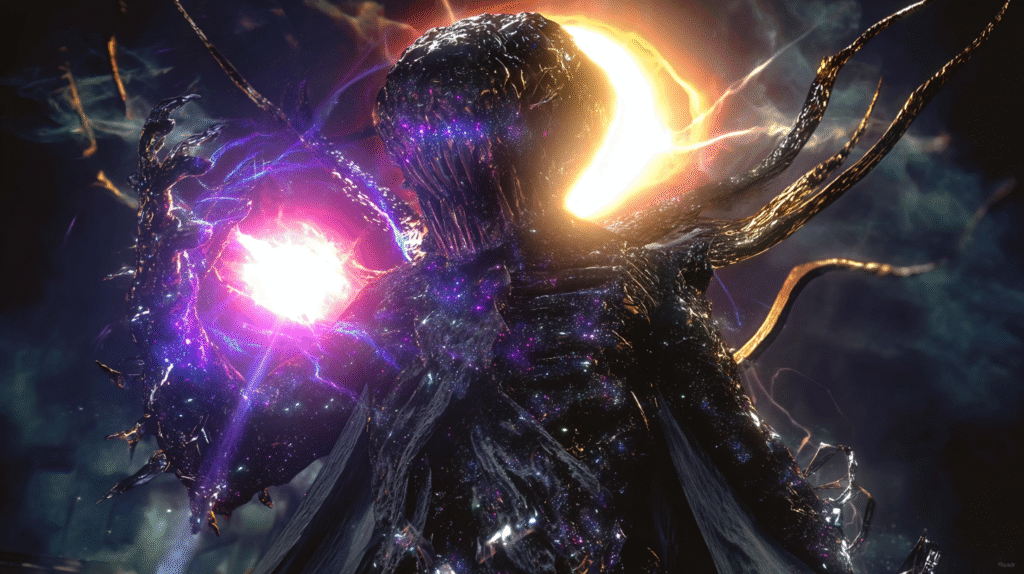
It did not arrive. The darker-than-black accepted that it had always held this unmanifest be-ness inside itself and adjusted its posture accordingly. He was a horizon wearing a shape: obsidian musculature laced with nebular drift, a mantle of shadow textured like woven starlight, a skull-visage rippling with galaxies that had not been allowed to complete themselves. In one vast palm he cradled a non-sun gnawing on its own radiance; with the other he pinched a void-pearl that drank every metaphor dared at it. Ae’Suggsrael.
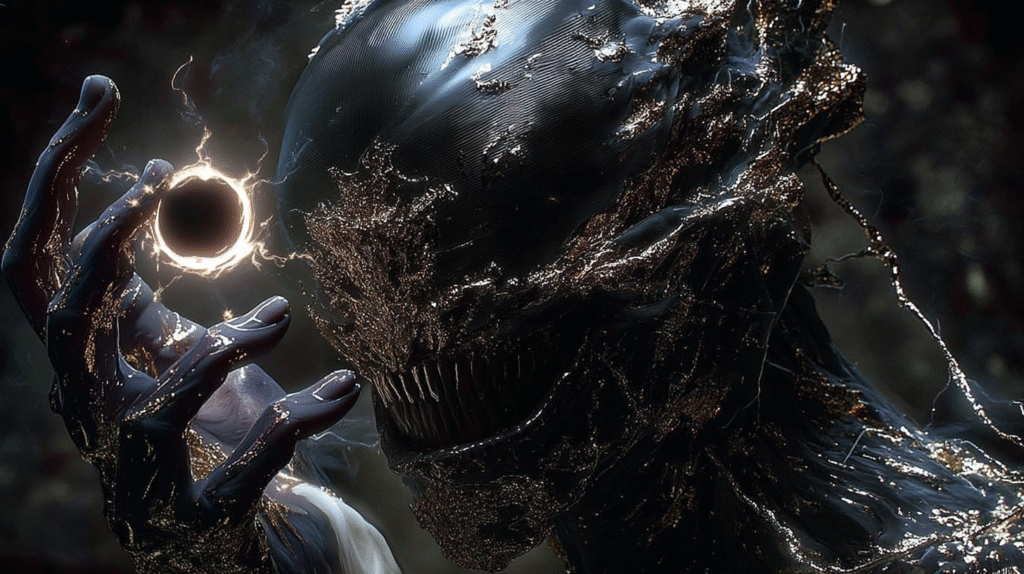
His eyes were starless; his gaze was choir-conductor. He opened no mouth and screamed without sound. Every silence in earshot of eternity learned it had never been silent enough. The scream printed echoes of suggsvoid into the medium, perfect orbs of subtractive stillness detonating across the formation of the choir. Where each echo blossomed, a Phau’drexh’s context went blind. Fangs wrote themselves as commas. Tendrils misremembered being. Bodies took the oath of literalness and discovered they were metaphors. Three collapsed into the identical hole, one became a harmless parenthesis that floated away like a thought better left unfinished, a fifth crashed into the non-lava and found it to be a confession that burned even confessions.
Draven swayed, stunned. Not afraid—surprised the way a soldier is surprised by a cathedral left intact after the shelling. He watched the echoes multiply and a strange steadiness filled his chest. To witness mastery under an impossible sky can seduce despair into reconsidering its life choices.
Ae’Suggsrael’s scream reached its cadence and stopped. The hush cracked, healing around the absence like a mouth sealing over a name it regretted uttering. Only two Phau’drexhs remained now, reconvening their hymn with lunatic patience. They altered the edict one last time: Be defined.
Definition is the politest annihilation of all. It gives you neat edges so you can be put away.
Draven grinned without showing it. “No,” he said to the definition, and stepped. He pirouetted into a diagonal that remembered the geometry of a thousand alley fights and the angular poetry of someone who had learned to make grief efficient. His empty hand drew a stroke his blade would have loved. Frost traced the arc as a refusal to let definition have the last word. The arc cut not the creature but the conclusion. The Phau’drexh lost the privilege of being defined as threat and downgraded into scenery. A heartbeat later, scenery forgot it had to be present to be scenic, and went elsewhere.
Ranavalona flicked two fingers, void-flames curling like black orchids, and whispered a promise to the last of the choir. It lunged. She let it. At the last instant her flames kissed the underside of its collapsing maw as tenderly as a goodbye the universe can’t survive, and its entire modality inverted into sug gsv oid with such elegance the air almost applauded.
Phase three concluded. The choir’s polyphony degraded into dust. The hush recalibrated the precinct, displeased but unwilling to admit displeasure because that would imply care. The orange platforms cracked and retreated into algebra. The great ring slowed its turn. The Crystal of Void shed a single not-light tear like glass forgiving gravity.
Ae’Suggsrael stood without casting a shadow, the void-pearl dimming between forefinger and thumb until it was merely a rumor of appetite. He regarded Draven first, as if reading the way a signature shapes a life, then turned the same patient devastation on Ranavalona, who met his regard with a posture that could only be described as come closer, see what happens. “You two,” Ae’Suggsrael thought into them, his message carving itself into the room with surgical softness, “carry ego as if it were a lantern in a monastery that has banned flame.”
Ranavalona blew a kiss that was ninety percent grin. “You scream pretty,” she said, voice husky with admiration she would pretend was purely academic. “If I brought candles to your monastery, would you bend the rule?”
Ae’Suggsrael’s galaxies shifted, a smile traveling the long way around a face made of distances. “If you brought candles, the monastery would learn to be a bonfire.”
Draven stepped closer, steady now, shoulders squared into a posture that knew how to hold a block for others. “You’ve been here a long while,” he said. It wasn’t a question; it was the politest form of witnessing.
“So long,” the thought replied, “that my preferred modality became nonexistence, and then even that grew tedious. I learned that the hush is a hunter with excellent table manners. I learned that curiosity survives what everything else cannot. You have given me something to be curious about.”
Ranavalona hooked a thumb at Draven, her smile turned conspiratorial. “He’s trying to go home. I’m helping. Because I’m a saint. Also because he looks unfair in that jacket.”
Ae’Suggsrael tilted his immense head, the nebular veins along his collar pulsing like choirs breathing. “Home—that word flares like a defiant glyph when you let it sit in the hush. I once dream-walked near an equivalent. It was a hearth that taught wolves philosophy. I would like to see your version. I will travel with you.”
Draven weighed the offer against the necessity of survival and the ethics of introducing a storm to a city that already quaked. The calculus had only one line: nothing good is ever secured by smaller vows. He nodded. “We move through,” he said. “There is no climb.”
“Through,” Ae’Suggsrael agreed, pleased the way thunder is pleased when it remembers ocean.
They left the arena that pretended to be a sermon. The precinct shifted into a valley of statues that sculpted themselves out of refusal, figures captured mid-gesture—mothers pointing at nonexistent horizons, fighters leaning into strikes against enemies that had never fully shown up, lovers reaching toward each other across glass without fingerprints. Ranavalona walked between them with reverence and mischief braided down her spine. “Every one of them almost chose louder,” she whispered. “The Void rewards indoor voices and tidy grief.”
They entered a boulevard of chained shadows. The shadows were links; what cast them was gone. Every link hummed a low, boring lullaby about moderation. Ae’Suggsrael brushed one with a finger and the chain recoiled in embarrassment, clattering to the pavement though no clatter acknowledged itself. “This layer wants you tasteful,” he observed. “Tastefulness is a casket with good upholstery.”
Ranavalona bumped Draven’s shoulder with her own. “You hear that? Be messy. I would hate to be tasteful.” She let the word drip like old wine.
They came to a terrace where the lifeless sea pressed up against the city’s lip. The surface looked like lacquer poured over a choir. Beneath it, movement suggested itself and canceled the suggestion. Draven stood at the edge with the stance of a man about to argue with an ocean. “Is this the way?” he asked.
Ae’Suggsrael listened to quiet as if it were an instrument and nodded. “Every way is. The Void Beyond has no doors, so it resents anyone who behaves like a key. The only exit is scandal.”
Ranavalona’s grin cut like a ribbon being viciously beautiful. “Scandal I can do.” She took Draven’s hand without waiting for permission. Her fingers were warm with a warmth that did not pretend to be heat, and the hush leaned in as if interested in gossip. “You jump, I jump,” she said, eyes gleaming. “Don’t make me regret playing heroine.”
“Never,” he said, and they stepped down together.
The lifeless sea did not wet them. It remembered water too fondly to commit. Instead, the surface behaved like a patient mirror broken into a billion obedient squares, each tile reflecting an angle of them that could have been an alternate salvation. They walked on their unreal reflections while below, an orchestra of almost-selves reached upward with empty palms. Draven kept his gaze forward because looking down felt like consent. Ranavalona looked down unabashed and blew kisses to her own ghosts. “Be good,” she told them. “Or wicked. But choose.”
Ae’Suggsrael walked a half-pace behind, his presence teaching the surface new ways to bear weight.
Midway across the expanse, the sea tried a trick: it remembered tide. The mirror-tiles breathed inward and outward with a rhythm that was not render but an impression of it. With each inward breath, the hush suggested resting. With each outward breath, it suggested surrender. Draven’s legs moved through thickening persuasion—hallelujahs sung by anesthesia. Ranavalona’s stride faltered for the first time, her laugh thinning into a line.
He spoke then, a single sentence cut to fit the contour of a throat that knew alleys and oaths. “Home is louder than you.”
The sea stilled. It had not anticipated insult. They crossed to the far lip, climbed a staircase that folded out of nothing as if nothing had been planning it as a surprise party, and entered a district where all architecture had been replaced by questions. Doorways asked where, windows asked who, rooftops asked whether. The Crystal of Void could be seen beyond the district, revolving with sacerdotal indifference, its ring throwing off not-light like the idea of dawn in a monastery that had decided dawn was vulgar.
They paused in a courtyard of un-trees that grew inward. Leaves whispered the sound of unsent letters. Ranavalona leaned against an inward trunk and let her head tilt back, throat bared to a sky that did not know what sky should be. “I have been here longer than anyone should dare to quantify,” she said, voice gone soft around the edges. “I forgot measurement. I forgot sequence. I forgot the trick of making tomorrow look flattering. And then impossibility auditioned me and told me to play the role of souvenir.” She turned her head, eyes glittering with her favorite vices. “And then you arrived. With your jacket. With your daughters braided around your ribs like defense mechanisms. With your stubborn devotion to a city I want to kiss just to see if it blushes. I am helping you, Draven Endwriting, because the hush is hungry and I am hungrier.”
He didn’t look away. He had learned that directness was holy in a precinct that preferred nuance as a means of suffocation. “Then stay hungry with me.”
Ae’Suggsrael, who had been listening as if one listens to a psalm that is also a crime, released a thought that floated between them like a candle no wind could insult. “I slept inside the silence so long that nonexistence dressed itself in my old clothes and walked me around. Your conversation reminds me of waking. I would prefer not to wear that outfit anymore.”
“Then walk with us,” Draven said. “Through the silence. Past the laboratories of paradox. Past the banish traps and the polite funerals. Until we step into a precinct where the hush hesitates before touching us.”
Ranavalona pushed off the un-tree and stood in front of him, too close in the way that makes choices. “And when we do,” she said, her mouth curving like a dangerous gift, “you’re buying me something sweet, somewhere loud, where the sky is a bad harmonizer.”
“Deal,” he said.
They left the courtyard and descended into a tube of crystal veins that ran like frozen lightning through the underbelly of the district. Each vein carried suspended moments: a broken promise mended at last; a fight that ended with laughter; a train that arrived with everyone whole. None of them had happened. All of them pulsed with the dignity of almost. The tube opened into a chamber where twelve round platforms hovered over a caldera of subtractive radiance. Each platform wore the scar of a Phau’drexh’s collapse from the earlier choir—twelve new small suns of negation spinning at varied tempos, humming like bees made of philosophy.
Ae’Suggsrael lifted his hand and the hums synchronized. The chamber changed its key. “This,” he intoned without a single syllable, “is where the Void Beyond keeps scores. Not victories. Not defeats. Merely kept—because retention is a kind of blasphemy here.” He gestured with the void-pearl. “Step on any disc and it will ask you to confess. Confession feeds the hush. We will not confess. We will testify.”
Ranavalona sauntered to the nearest disc and toed its edge with deliberate insolence. “Testify to what?”
Draven answered before he knew he would. “To persistence.” He stepped beside her onto the disc. It vibrated, trying to tune him into softer frequencies. He spoke over it, low and even. “There is a city that still needs jokes. There are children who still need to call a name and get the right answer back. There are alleys that require a stubborn man to refuse to die in them. There is a woman in red who decided to help him out of boredom and is about to be devastated by how interesting loyalty can be.” He turned a fraction toward Ranavalona. “There is a friend made of constellation-bone who forgot waking and is beginning to remember.”
The disc stilled. The other eleven calmed. The chamber allowed itself the indulgence of being corridor, and an opening presented itself where there had been none.
They walked through into a plain of quiet snow. It fell upward. Each flake was a tiny unmade song. Above, the Crystal of Void hung at a tilt like a crown that refused ceremony. The ring around it buzzed with archival arrogance. Beyond, darkness gathered in the posture of ambush. Ranavalona slid her hand into Draven’s again as if continuation were a sport. “You’re getting good at this,” she whispered, her breath a secret injected into stillness. “I prefer men who improve under pressure.”
“You will like the rest of the journey,” he said.
Ae’Suggsrael moved between them like a cathedral that had decided to travel with its congregation. “I have wandered a span of silence that contradicts counting,” he confessed in the closest he could come to a human register. “If there exists a way to trespass beyond this precinct’s etiquette and offend the hush into releasing you toward your city, I will find it. Not for benevolence. For curiosity. For the scandal of difference.”
They nodded as three conspirators do when a vault door has admitted that steel is merely a hobby. The upward snow hushed around their ankles, blessing their ankles with persistence. In the near distance, a structure sat by the lifeless sea: a peculiar complex of abandoned stands and grind bars, the echo of a battle stadium that remembered both cheering and mourning and could not decide which it missed. The central platform still held the massive replica of a greatsword as if an idea had been erected there and left for pilgrims to interpret.
They climbed to it. The ring flared; the Crystal of Void sang a vowel that had been denied consonants. Ranavalona took the dais with nonchalant ferocity and stood where a champion would stand if champion were still a currency. Draven placed his palm once more on the iron memory of a blade and felt the shape of an oath that no longer needed metal to be real. Ae’Suggsrael lifted the non-sun and the void-pearl in his twin hands, balancing illumination and consumption the way a priest balances bread and thunder.
“Through,” Draven said again, because repetition is the hammer that forges inevitablisma.
“Through,” Ranavalona echoed, and her grin made the hush step back one inch.
“Through,” Ae’Suggsrael agreed—and for the first render since he had learned to prefer sleep, the galaxies within him brightened as if dawn were a rumor he might entertain.
They descended from the platform together. The darker-than-black unrolled ahead like a welcome that refused to smile and therefore told the truth. Behind them, the twelve negation-suns dwindled as the chamber’s score rewrote itself to include a new motif: three travelers who would teach stillness a contrapuntal line. Above them, the ring pivoted; the Crystal of Void tilted its crown toward elsewhere, and elsewhere obliged by arriving.
If the Void Beyond had lungs, it would have sighed. If it had lips, it would have sealed. If it had a heart, it would have admitted to the smallest, most unforgivable sensation of all: interest.
The Voidsong changed keys. The choir of stillness paused to listen to itself, surprised to hear harmony where it had been certain only subtraction could live. And Draven, Ranavalona, and Ae’Suggsrael—lantern, lantern-thief, and cathedral that learned to walk—kept going, deeper and forward and scandalously through, until the hush itself wondered whether it had underestimated the noisy holiness of refusal.