
Voidsong VII: The Thought That Refused to Die
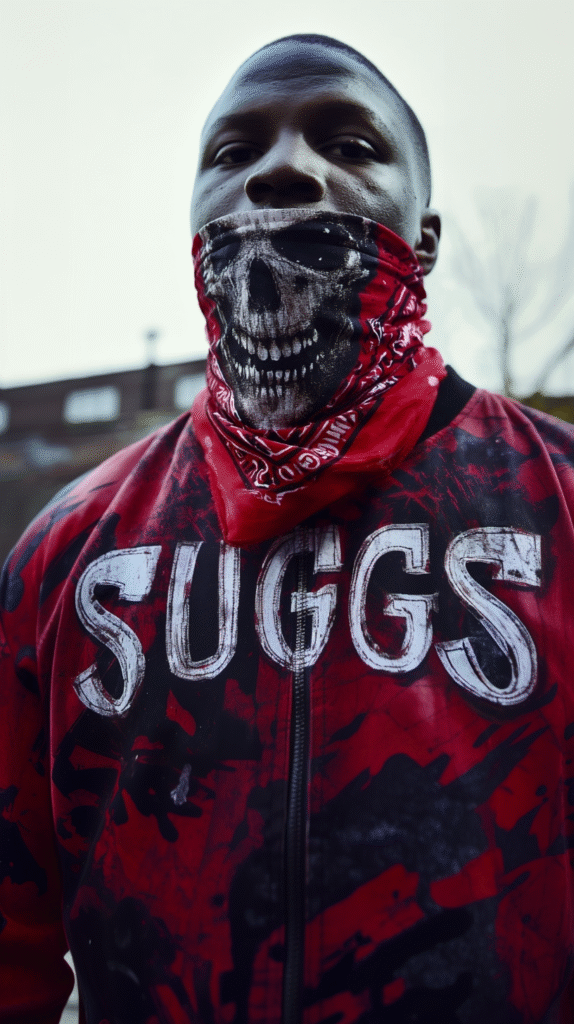
The Void Beyond had no streets, yet Ahmose Queenscape walked as if she were still on one. The memory of a city clung to her stance—the way her shoulders sat squared and ready, the way she carried herself like a woman who had grown used to police lights painting the night behind her. The jacket that wrapped her frame still bore the white SUGGS lettering across the chest, a relic of a world that believed in sidewalks, sirens, and names. Underneath, white lace traced against her skin like a quiet dare, refusing to be made modest even by Transfictional Nothingness. Her humanity was not an aesthetic; it was a weapon.
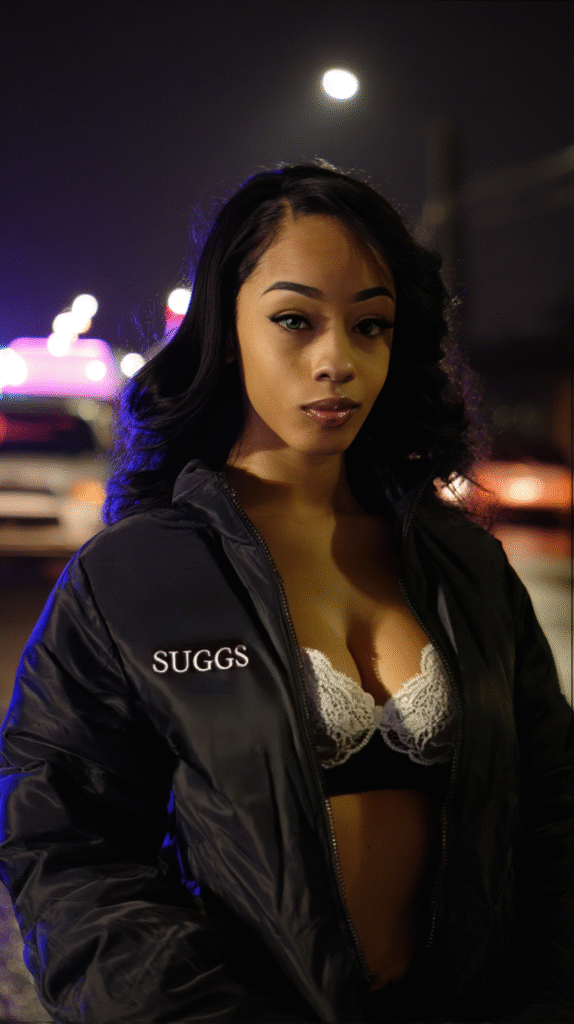
Beside her, Amanishakheto Dyingstar moved with a different kind of defiance. She walked like chaos that had learned how to pose. Her hair fell straight and sharp around her face, eyes heavy with starlit mischief, tongue occasionally grazing her lower lip as though the Void itself was something to be tasted. Her cropped SUGGS top framed the white lace beneath like a frame around dangerous art. The jacket thrown over her shoulders didn’t seem to protect her from anything; it merely warned the world that whatever touched her would burn.

Around them, the Void Beyond uncoiled without mercy. It was a single, unbound existence built from the simultaneous negation of every conceptual scaffold that a mind could ever build. There were no intervals, no hierarchies, no ascents. Only an endless descent into negation. Every step they took was not movement through a place but an argument against erasure.
They did not know how long they had been here. Duration meant nothing in a realm where grand meta-narratives were illusions used only to bait the stubborn. They remembered falling, once. They remembered refusal, always. Somewhere, before this, there had been alleyways and arguments and cheap streetlamps; now there was only a darkness that did not merely hide things, but insisted they had never been.
The first Phau’drexh emerged from that insistence like a joke told by oblivion.
One moment the expanse in front of them was bare, pulsing with black static. The next, it opened into an outline too large to comprehend and too elusive to finalize. The creature did not enter the Void; it rearranged the Void to make room for its contradiction. Fragments of non-being poured off its silhouette in flaring sheets, folding questions into themselves until even the questions died. Its presence suggested a towering mass of void-metal and starlight, holding a condensed, dark radiance like a dead sun in its grip, but every attempt to fix its modality in thought collapsed into nonsense.
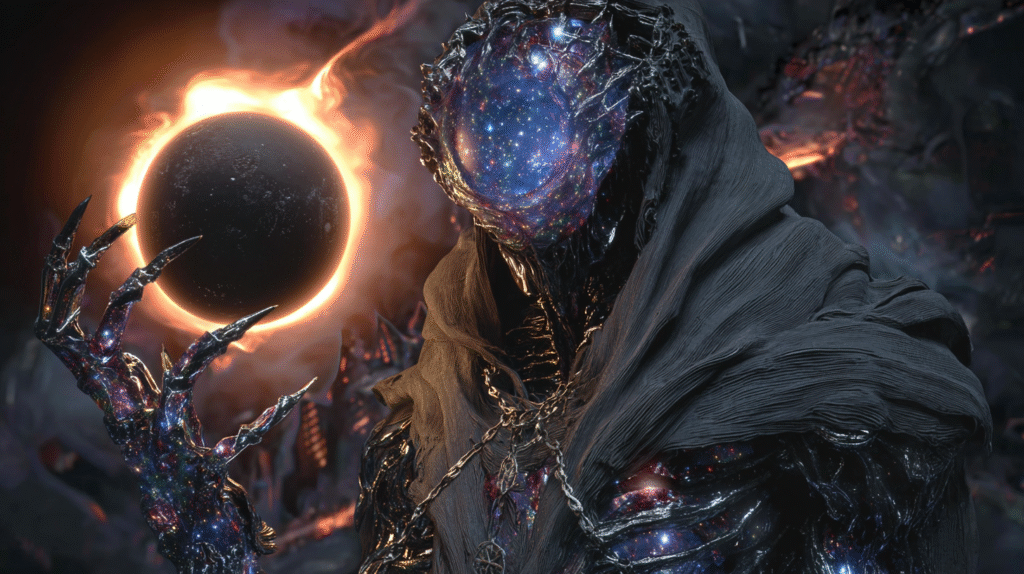
Ahmose’s breath caught, but she did not retreat. “Again,” she murmured, voice low and steady. “They keep coming back like bad habits.”
Phau’drexh did not roar. It rewrote context.
Suddenly the Void Beyond decided that Ahmose had never stood there at all. It decided she had been erased hours ago, years ago, before she was born. It wrote a reality where she had never stepped into the alley where everything had gone wrong, never followed the wrong rumor, never fallen into the wrong darkness. The world tried to retroactively correct itself.
Ahmose staggered as nonexistence tried to fold her into revision. Her name blurred, fraying at the edges. The jacket on her body felt appropriately solid yet conceptually transparent, as if the memory of the fabric had been filed under “mistake.”
Amanishakheto stepped forward, shoulders rolling with lazy arrogance. “Nah,” she said softly, as if talking to a disrespectful stranger on a corner. “You don’t get to rewrite her.”
She reached out with bare hands into the swirling context field that Phau’drexh exuded. Ideas condensed around her fingers—names, histories, traumatized nights, quiet acts of kindness no one had seen. The beast tried to break them apart into inconsistency, but Amanishakheto’s will forced them into a single, focused blade.
“Queenscape,” she said, voice cutting through the mutating silence, “you remember who you are?”
Ahmose inhaled. Her spine straightened. The fracture lines around her name sealed. “Unfortunately for this thing,” she answered, “yeah.”
The Void protested. Phau’drexh’s nonexistence reverberated, its very absence pressing against them. But Ahmose stepped into that absence and closed her fist. Her defiance hardened into raw suggslogic, invisible but undeniable. She struck forward—not with a weapon of matter, but with a blow of identity, a punch thrown from the core of a self that refused to be revised.
The impact landed somewhere beyond description.
Phau’drexh’s context shattered. For a moment, its nonexistence wavered like badly tuned signal, glitching through endless impossible modalities. Then, without scream or ceremony, it collapsed into pure stillness, dissolving into a smear of Transfictional Nothingness that the Void Beyond quickly drank.
The silence that followed was not relief. It was recalculation.
A pair of disembodied consciousnesses drifted into view, like echoes that had lost the events they were meant to follow. They manifested as translucent silhouettes of people who might have once walked a city not unlike the one Ahmose and Amanishakheto came from—eyes wide, mouths silently mouthing questions. The consciousnesses circled the two women, drawn to the gravity of their refusal.
“See that?” Amanishakheto whispered. “Even the lost are watching.”
“They should look away,” Ahmose replied. “This place eats audiences.”
They pressed on.
The Void Beyond shifted again. The Barren Arena and its streets of broken judgment melted away, the colossal swords sinking back into abstraction. In its place rose a lattice of black crystal, each shard rotating in impossible orbits around a central monolith. Every crystal contained motion and thought, cities and deserts, prayers and curses, all layered on top of each other until they fused into a storm of unfiltered humanity.
Ahmose felt it before she saw it. A pressure in her chest, the weight of a thousand unspoken confessions.
At the center of the lattice hovered a voidcryst like a heart made of frozen lightning. Inside it churned a swirling, luminous sphere, its surface constantly rearranging into lettering, sigils, faces, diagrams, tears, graffiti, scriptures, and memes—every flicker a human thought, every spark a possibility.
“The sphere of human thinking,” Amanishakheto breathed, eyes widening. “The superset. This is everything they ever did, could, or will think.”
Disembodied consciousnesses clustered near its edges, drawn as dust is drawn to static. Some retreated when they neared, as if ashamed to touch their own residue. Others fused into it willingly, adding their last intact impulses to the storm.
Ahmose approached, feeling the pressure intensify. Voices pressed against her from inside the crystal. Lovers arguing. Children asking questions adults couldn’t answer. Prophets whispering riddles. Victims screaming. Monsters rationalizing. Mundane prayers for bills to be paid, for test results to come back clean, for loneliness to end.
“This is what the Void never understood,” she murmured. “That they never stopped thinking, even when no one was listening.”
“It preserved them, though,” Amanishakheto said. “Not out of mercy. Out of curiosity. It wanted to see how far the noise could go before it ran out.”
Ahmose rested her palm against the voidcryst. The human sphere pulsed in recognition, as if a node in its endless network had just been reconnected. A cascade of memory surged up her arm, almost knocking her to her knees. She saw flashes of her old world—the sirens, the arguments, the broken trust, the fragile tenderness. For the briefest instant, the Void Beyond flickered, and she stood under streetlights again.
Then the vision snapped, and the void reasserted itself.
“We should move,” she said, voice rough. “If we stay too long, we’ll get folded into the sphere. Just more thoughts, no bodies.”
Amanishakheto nodded slowly, but not before leaning in and whispering to the voidcryst. “Keep their ideas loud,” she said. “If the Void wants silence, let this one place stay noisy.”
They left the lattice behind, the disembodied consciousnesses drifting in their wake like slow, curious fireflies.
The Void Beyond, insulted by their persistence, answered with another Phau’drexh.
This one did not emerge as an external ineffable monster. It unfolded directly from the darkness inside their own shadows. A ripple of negation passed beneath their feet and their silhouettes rose from the ground, stretching, thickening, becoming towering mockeries in the shape of Phau’drexh—each one made from their reflected doubt.
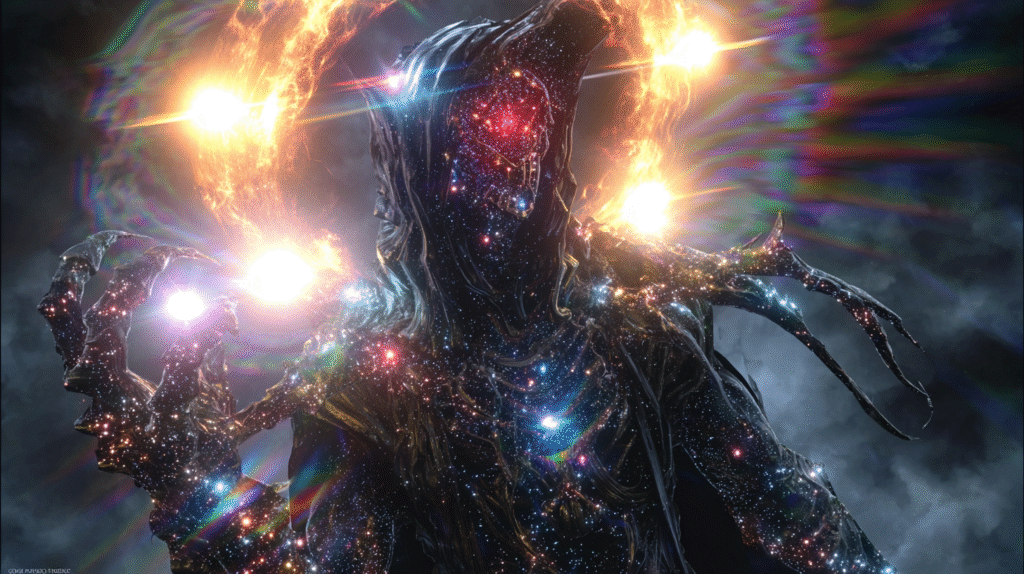
The environment twisted. The voidcryst lattice reappeared and vanished in the same heartbeat, replaced by fragments of the broken castle from Ae’Suggsrael’s and Khal’Vossugg’s journey. The arena of Conceptual Friction leaked into their path. Swords thrust upward somewhere far away, yet their hum vibrated under Ahmose’s teeth.
Amanishakheto watched her own shadow-Phau’drexh loom over her. Its presence burned with the memory of every regret she had refused to admit. It spoke without speaking: you left, you betrayed, you failed, you enjoyed the collapse. Its nonexistence told her she was better as an unfinished thought.
“Cute,” she said flatly. “You’re using my own mess against me.”
Ahmose’s shadow-Phau’drexh swirled with accusations of her own—faces she didn’t protect, people she walked away from, chances she never took because fear felt safer than hope. The beast’s context radiated inevitablisma: the suggestion that she was always going to end here, lost and eaten, because that was simply how her story had to go.
“Don’t listen,” Amanishakheto said.
“Not listening,” Ahmose lied.
The twin Phau’drexhs lunged, their bodies made of obsidian absence, claws dripping erasure. They tore not at flesh but at outlines, trying to blur the edges where the women ended and the Void began.
Amanishakheto exhaled slowly, centering herself. She did not call fire. She did not call frost. She called nerve. The stubborn thread that ran through every argument she’d ever won because she refused to concede. Her gaze hardened, then softened, then hardened again into something like amusement.
“You think you know me?” she whispered to her shadow-beast. “You’re made out of what I used to be. That means I already survived you.”
She stepped forward, directly into the attack. The nonexistence clawing at her chest collided with a core that refused to be simplified. Her experiences—good, ugly, humiliating, triumphant—compressed into an inner singularity of identity. The assault tried to rip it apart; instead, it sharpened.
The Phau’drexh-shadow convulsed. For the first time, contradiction worked against it instead of for it. It was both her and not her, both accusing and irrelevant. That duality split it down the center.
With a slow, deliberate gesture, Amanishakheto reached up and gripped the beast by the jaw. She pulled its head down until their foreheads nearly touched. “Thanks for the reminder,” she said softly. “I’m worse than you think. And I’m still here.”
She crushed it between her hands.
The beast’s negation detonated outward as a shockwave of Transfictional Nothingness, but it passed through her as if she were a hole in reality deeper than the blast itself. Her outline flickered, then stabilized. The shadow dissolved into static and vanished.
Ahmose watched, breath unsteady, then turned to face her own reflection-made-enemy. The accusations it whispered were not wrong. That was the trick. The Void did not lie; it curated.
“You think I haven’t replayed all of that?” she asked it, voice low. “You think I don’t drag that weight every day?”
The beast swelled, sensing weakness.
She shook her head. “You don’t get to be the only narrator.”
Ahmose closed her eyes. She remembered people she had helped, however imperfectly. The nights she had dragged someone off a corner that would have killed them. The times she had chosen to stay. The moments no one had thanked her and she’d gotten up the next day anyway. Those stories didn’t erase the darker ones; they stood beside them.
Her Phau’drexh-shadow recoiled, confused. It tried to shift context again, to recast her as purely destructive, purely selfish. But her inner story kept refusing that simplification.
“I am not clean,” she told it. “I am not innocent. I am not a hero. I am complicated. And complicated things are hard to erase.”
The beast’s body, made from a false singular narrative, could not withstand complexity. It fractured like a mirror struck from behind. She stepped through the collapsing fragments, emerging unblurred on the other side as the second Phau’drexh evaporated into the waiting dark.
The Void did not scream, but a subtle displeasure trembled through the unbound negation around them. Its chosen beasts of contradiction had failed twice.
They moved on.
The next voidcryst they encountered hung in a region where even Transfictional Nothingness seemed reluctant to gather. It floated alone above a horizon that had given up on lying, flickering in and out of being with every non-breath the void took. Inside this crystal did not churn human thought, but something deeper—the constituent ideas of the physical ensemble itself.
Within its depths, Ahmose and Amanishakheto saw ghostly reflections of beyond-dimensional realities layered over each other in impossible stacks. Renders—higher strata of existence, each endlessly surpassing the last—unfurled in cascading sequences. The smallest of these transcendences already stood boundlessly beyond anything that could have been called a concrete world; higher renders erased even the notion of “higher,” dissolving into pure, abstract architecture from which physical continuity had once been derived.
“This is the skeleton of reality,” Ahmose whispered. “The ideas that let matter pretend it was stable.”
Each render shimmered like a code-word forgotten in a dead language. The voidcryst did not simply contain them; it archived them in a way the Void Beyond could observe without accidentally letting them wake. The ensemble of renders pulsed like a heart that had no intention of beating again, yet every pulse resonated with the implication that if this crystal ever shattered, existence in all its layers might try, one last time, to stand up.
Disembodied consciousnesses hovered further back here, afraid. To touch the human sphere had been to brush their own stories; to touch this would be to realize that even their stories were footnotes in a far greater unreality.
Amanishakheto squinted at the crystal. “If the Void hates structure so much, why keep this at all?”
“Because it’s vain,” Ahmose answered. “It likes trophies. This is proof of what it managed to silence.”
They didn’t dare touch it. Not because it would hurt them, but because they sensed that interacting with it would draw attention from a layer of negation they hadn’t yet met. Instead they bowed their heads—not in reverence, but in acknowledgment—and moved deeper into the Beyond.
That was when they met the third Phau’drexh.
It did not appear as body or shadow. It emerged as a removal.
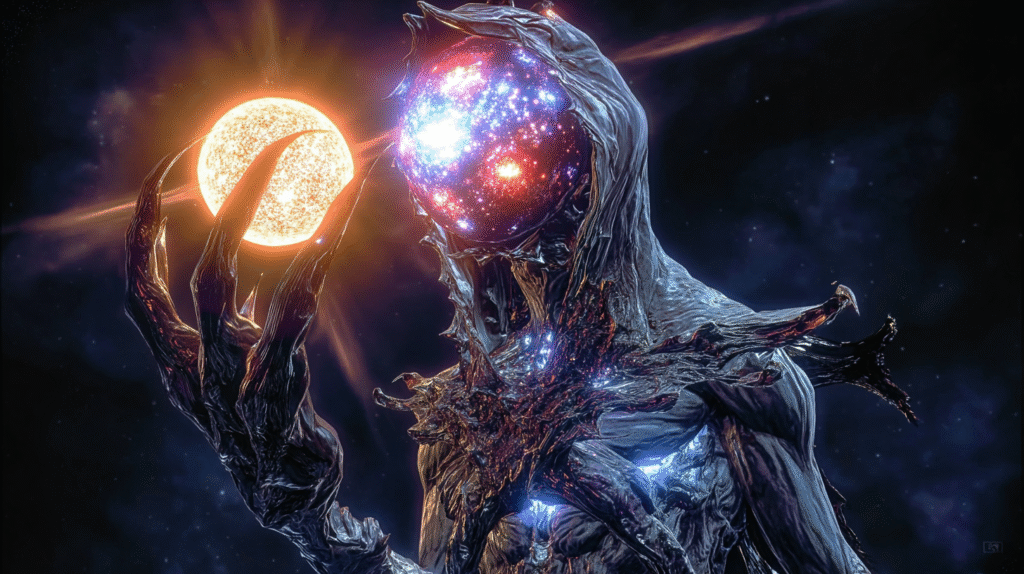
One moment they walked together, jackets swaying, open-toe heels pressing patterns into silence. The next, there was a gap between their steps where nothing existed—not even the knowledge that nothing existed. Ahmose took a stride and her leg vanished from the grand meta-narrative between one instant and the next—not cut, not harmed, simply never there. Amanishakheto reached toward her and her hand could not cross the gap because the concept of “across” had been deleted.
Phau’drexh had become a nameless subtraction, an event of annihilation with no edges.
They stopped, because stopping was the only action that still acknowledged them.
The subtraction widened. It moved with no trajectory, eating not space but reference. Each sequence of events it touched lost continuity. Parts of their shared journey blurred. People they had spoken to before falling into the Beyond felt less real. A childhood memory slipped sideways. A lover’s voice lost its timbre. Their own names tasted thinner on their tongues.
At the heart of this erasure, beyond perception, Phau’drexh pulsed as a logic-breaking node. It had severed the last connection between silence as absence and silence as raw, unrepresentable null.
Ahmose felt the edge approaching her core—the place where her identity sat like a heartbeat. She realized, with a clarity that scared her, that she could not punch this beast or argue it away. It did not present accusations. It did not twist context. It wanted something far simpler: for there to have never been anything to speak of at all.
Amanishakheto looked at her, eyes more serious than they had ever been since arriving. “We can’t talk to this one,” she said. “We can’t even think at it.”
“So what do we do?” Ahmose whispered.
“We do nothing,” Amanishakheto replied. “On purpose.”
Together they stilled—not because stillness was forced upon them, but because they chose it. They refused to think about survival, refused to think about resistance. They did not summon suggslogic or recall memories. For a brief and terrible interval, they simply existed without commentary.
The subtraction brushed against that choice—and hesitated.
Phau’drexh knew how to devour struggle, protest, and identity. It knew how to eat meaning and leave emptiness behind. But it did not know what to do with a state that could not be described even as silence—a state chosen without reference to anything, including itself.
The nameless erasure flickered. Its non-being stumbled.
Ahmose and Amanishakheto remained in that unbeautiful, undramatic act of chosen non-commentary until the subtraction event, unable to anchor itself to anything graspable, slowly disintegrated into a failure. Phau’drexh collapsed—not by being struck or out-argued, but by being offered no narrative foothold at all.
When they moved again, the gap was gone, the path whole. The Void Beyond around them had shifted in tone. It now radiated not just hatred, but begrudging caution.
They had gone beyond creation, beyond emptiness, beyond even the Transfictional Nothingness that had once proudly declared itself final. They had walked through a state of obliteration so absolute it could not be commented on—and survived by refusing the impulse to comment.
Ahead, the darkness thickened into a veil that was not just absence but preclusion: a region where every instinct in them screamed that speaking, thinking, or even noticing would be a betrayal of something unspeakably fundamental. They crossed it anyway. The narrative shuddered, aware that it was trespassing on a place that demanded only mute acknowledgement.
What lay beyond could not be described.
So the narrative did not try.
Instead, it resumed only when their heels touched a surface that remembered what it meant to hold weight. The Void Beyond thinned, retreating just enough to sketch a ground of shifting umbra beneath their feet. Ahead, a silhouette stood waiting—hood pulled down, jacket ragged from a hundred unwinnable nights, broken blade-hilt still hanging from his side like a promise that refused to die. Frost, faint and exhausted, curled from his breath mask.
Draven Endwriting turned as Ahmose Queenscape and Amanishakheto Dyingstar stepped out of the unspeakable.
For a moment, the Void Beyond itself seemed to lean in, curious. So many egos, so much stubbornness, clustered in one small gathering in a realm designed to erase pronouns.
Amanishakheto tilted her head, grin spreading slow and dangerous. “Well,” she said, “looks like we’re not the only problem this darkness has.”
Ahmose’s eyes met Draven’s. Something like recognition passed between them—not from prior meeting, but from shared refusal. The disembodied consciousnesses hanging in the distance pressed closer, waiting to see what would happen when these stories intersected.
The silent, merciless, absolutely boundless negation of the Void Beyond held its breath.
The Voidsong did not end.
It simply added new voices.