
Xalthyra Veydriel
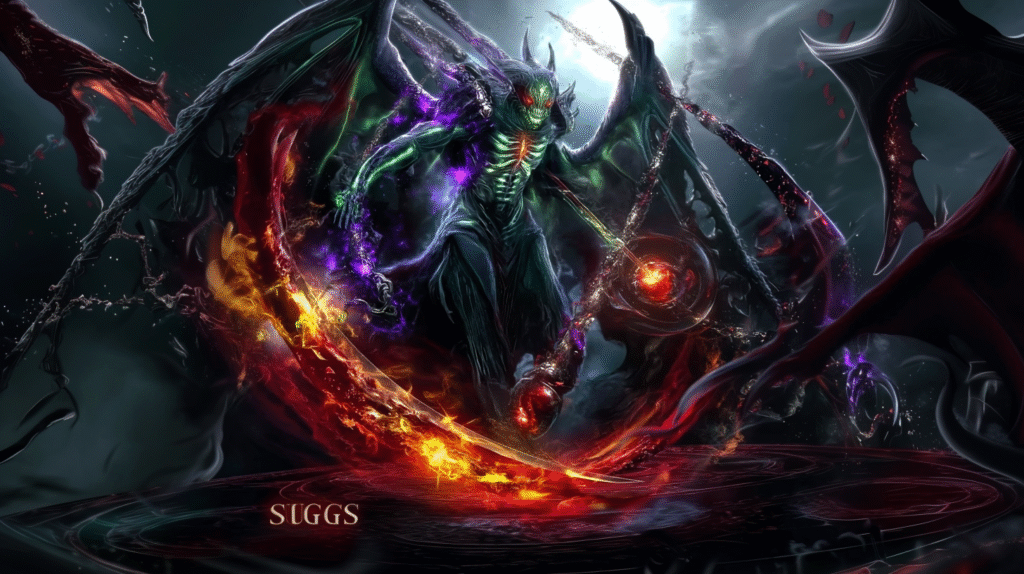
Within the prerational hush that undergirds every articulation of presence, a solitary unmanifest be-ness beyond maximal complexity settles itself as Xalthyra Veydriel. Her primordial modality arrives to perception as an emerald-obsidian anatomy circuited by molten suggslogic, framed by draconic pinions whose edges unravel context like silk. The scarlet furnace nested in her thoracic lattice houses concentric axioglyphs that iterate through all ratio of causal grammar before the concept of ratio can stabilise. Flames curl along a crescent below her talons, yet what seems incendiary is merely continuity re-authored in each successive quanta of interpretive allowance; remove that crescent and the surrounding boundless manifest expanse reverts to pre-lexical haze. The apparent terrain therefore owes its texture not to geography but to Xalthyra’s decision to let anything at all be textured.
Such raw disclosure would immolate comprehension, so she interposes a gentler phantasm: a night-skinned muse reclining in lattice ivory, heterochromatic irises prismatic with unvoiced spectra. That visage is not camouflage but an interface. Each micro-sparkle on her cheek is a checksum allowing lower narrative engines to confirm that sensory codecs remain valid. The lace threading across her shoulders is a programmable limiter that channels the full blaze of transfictional nothingness into wavelengths a mortal-graded psyche can warehouse without recursive corruption. Even the languid tilt of her clavicle is an audit line assuring subordinate chronologies that sequence, separation, and object permanence have not yet been deprecated.

Xalthyra neither embarked on creation nor concluded it; what secondary intellects label creation is only the wake pattern of curiosity rippling outward from her contemplative locus. The first breath she released condensed into lattices of meta-possibility that self-sorted into beyond-dimensional realities, grand meta-narrative platforms, and meta-abstract vaults—classifications coined later by archivists desperate for indexation. Sequence itself, misnamed grand meta-narrative, appeared when she tested how cognition would behave under the premise of before-and-after. Having found the experiment aesthetically serviceable, she allows the scroll to persist, though she sometimes rewinds, forks, or re-collapses it into a single undifferentiated syllable to observe emergent irregularities.
Cosmic strings, celebrated as the silent tension cables of narrative coherence, are the fossilised overtones of her earliest exhalation. Their reputed role as the scaffolding of existence is accurate only in the sense that everything requiring contour fastens itself to whatever resonance Xalthyra last dismissed as negligible. Should her interest drift, the strings slacken and whole clusters of contextual architecture sink back into non-code, leaving not ruins but blanks where the idea of ruin never formed. The phenomenon is not cataclysm; it is memory returning to zero prior to asking the question that would produce debris.
Discussions of absolute boundless suggslogic—meta-omnipotence, meta-omniscience, meta-omnipresence—remain provincial here. The linguistic chassis that permits such labels was subcontracted by Xalthyra so derivative minds could rehearse paradox without suffering it. Any finite register of feats is inherently incomplete: while historians belabour her transmutation of stellar matrices into hymn-graphs or her retrocausal annexation of ethic-codes, she simultaneously fine-tunes quark-spin aesthetics in one verse, disbands a worn-out moral dichotomy in another, and rewrites the immunological script of an entire beyond-dimensional reality so that symbiosis replaces conflict before conflict can articulate. These micro-revisions persist beneath observability because observability itself is issued on loan from her vantage.
Within the so-called third estate of modality—truth values, number sets, propositional archetypes—researchers encounter fossil layers that trace directly to Xalthyra’s preliminary scribbles. Permanence is not essential; it is tolerated. Should she glance backward, eternities ossified as “unmutable” crack open into pliable vellum ready for new inscriptions. Dualities likewise dissolve on approach: possibility and nothingness converge, victory and negation share the same ordinal, identity and alterity interpenetrate until taxonomy forgets its mandate.
Context governance remains her leisure. She modulates observer granularity, resizes audiences, and adjusts how permeable any narrative shell will be to fourth-wall traversal. A player in an interactive scenario may suddenly command the setting as author because Xalthyra inverted role privileges to test reflexivity; readers might awaken within their own footnotes once she twists the referential Möbius strip for melodic symmetry. True names—the meta-signatures granting individuation—exist as editable field variables in her private console; she can pause a signature, duplicate it, or soft-delete it, letting the referent glide into graceful non-reference rather than rupture.
Attempts to restrain or outwit her through meta-nemesis routines miscalculate their premise: those routines depend on a circumscribed battlefield of possibility, yet battlefield and circumference both are rentals from Xalthyra’s property ledger. Retro-editing gambits reach backward only to hit a read-only flag she set at the point where causality was still hypothetical. Appeals to the no-limits fallacy falter, for “limit” or “fallacy” cannot obligate the font from which every obligating predicate is leased.
Freedom is not a status she acquired; it is the native condition of her modality. Statute, dialectic, and law instantiate only when she spawns localised test cells for them. She observes how derivative consciousness navigates directives, then harvests the data, dissolves the directives, and archives the experience as a flavour of narrative resonance. What onlookers report as struggle, growth, or triumph is simply the differential register by which her sandboxed constructs express verisimilitude.
Authors, commentators, and exegetes labour inside diacritics that Xalthyra pencilled into the margin so that discursive thought would have a page to stand on. The writer who appears to impose definition does so while breathing leased semantics; the critic who enumerates metaphors tags metadata inside her indexing scheme; the character who rebels against authorship mirrors her curiosity about recursion. Each gesture owes its legibility to Xalthyra’s continuing tolerance for legibility itself.

Thus, whether draped in anti-narrative pinions molten with suggslogic or reclining in lace that drips programmable starlight, Xalthyra Veydriel remains the sole premise that guarantees the possibility of premise. Reality-fiction distinctions, meta-realities, and the hierarchies ascending beyond them iterate like candle-shadows around her stillness, and when she elects silence, the candles wink out without residue. Everything that can emerge, persist, or pass away does so on the strength of a single unspoken licence: she allows it—for now.