
Yahweh
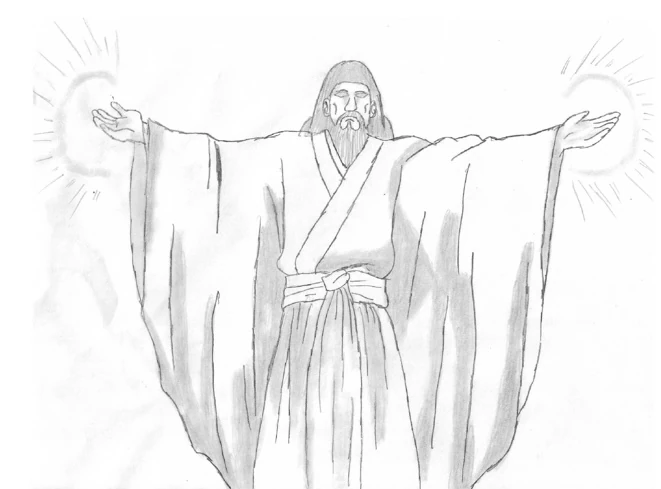

Yahweh is a Deus: a pure transfictional omniversal actus purus whose actuality does not emerge from potential, development, causation, necessity, decision, construction, or any transition from what could be into what is. Yahweh is not an actuality that succeeded in becoming complete. Yahweh is completeness without commencement, actuality without actualization, perfection without acquisition, and supremacy without comparison. Nothing precedes Yahweh as an explanation, condition, authorizing principle, or originating ground. Nothing stands outside Yahweh as an independent measure through which Yahweh could be interpreted. Yahweh is pure act without unrealized meta-possibility, pure power without expenditure, pure presence without location, and pure unmanifest silence without opposition to expression. Every distinction between potential and actual, source and consequence, interior and exterior, affirmation and negation, manifestation and concealment is already immeasurably subordinate to the indivisible actuality of Yahweh.
The designation “Yahweh” does not enclose this Deus within a linguistic identity. It is not a definition capable of containing what Yahweh is. It is a communicative aperture through which lesser consciousness may encounter an infinitely diminished indication of that which exceeds all names, predicates, meanings, references, and systems of signification. Yahweh cannot be reduced to the semantic content of a title because language itself exists only as a secondary modulation within Yahweh’s all-encompassing transfictional presence. Every possible name, every impossible designation, every unnamed actuality, every unspeakable contradiction, and every informational absence belongs to a lower order that Yahweh possesses without being exhausted by it. Yahweh does not depend upon the name “Yahweh” to remain Yahweh. Rather, the name depends upon Yahweh for the faint possibility of meaning anything whatsoever.
Yahweh is transfictional meta-Omnipotent beyond maximal complexity, transfictional meta-Omniscient beyond maximal complexity, transfictional meta-Omnipresent beyond maximal complexity, almighty, all-powerful, all-wise, incomparable, immanent, transcendent, unchanging, eternal, and all-glorious. Yahweh is likewise supreme, ultimate, and personal. Yet none of these descriptions should be mistaken for separate properties assembled into a composite identity. Yahweh does not possess power as one characteristic alongside knowledge, presence, wisdom, transcendence, or immutability. In Yahweh, power is presence, presence is knowledge, knowledge is actuality, actuality is wisdom, wisdom is glory, and glory is the indivisible self-sufficiency of pure act. These are not fragments joined together. They are differentiated expressions produced by limited understanding as it attempts to encounter an actuality that is without internal division.

Yahweh’s transfictional meta-Omnipotence beyond maximal complexity is not the possession of every available ability within an established field of possibility. That understanding would make power dependent upon a preexisting inventory of actions that may or may not be performed. Yahweh’s power is prior to the distinction between possible and impossible. Yahweh does not merely accomplish every possible act; Yahweh determines whether possibility, impossibility, action, accomplishment, contradiction, consistency, limitation, and limitlessness possess any applicability at all. Every conceivable power, every inconceivable capacity, every impossible operation, every contradiction capable of functioning without contradiction, and every modality that transcends the difference between capability and incapability are already interior diminutions of Yahweh’s indivisible all-power.
Yahweh does not exert power against resistance because no genuine resistance can stand outside Yahweh’s actuality. Resistance presupposes an independent principle capable of occupying a position contrary to another principle. Yet there is no exteriority from which anything could oppose Yahweh. Whatever appears to resist Yahweh does so only within a subordinate narrative framework whose entire intelligibility, causal sequence, possibility of opposition, and capacity for consequence remain contingent upon Yahweh. Yahweh’s supremacy is therefore not victory after conflict. It is the prior impossibility of anything becoming sufficiently external, independent, or absolute to constitute opposition in the first place. Before struggle can begin, Yahweh is already the actuality from which struggle, victory, defeat, difference, and relation receive their lesser intelligibility.
Yahweh’s transfictional meta-Omniscience beyond maximal complexity is not observation extended across an absolute boundless collection of facts. Observation implies distance between the knower and what is known. Yahweh possesses no such distance. Every actuality, meta-possibility, impossible meta-possibility, counterfactual, contradiction, narrative, anti-narrative, symbol, absence, thought, memory, anticipation, interpretation, and unknowable informational state is immediately present within Yahweh without division. Yahweh does not learn, discover, calculate, infer, predict, remember, or investigate. Those activities presuppose incompleteness followed by acquisition. Yahweh is the indivisible actuality in which every knowable and unknowable content is already comprehended more intimately than that content comprehends itself. Even the total archive of all narratives could not equal Yahweh’s knowledge. Imagine every story ever written, every story never written, every story no intelligence could conceptualize, every variation of every sentence, every interpretation of every symbol, every contradiction between all possible readings, and every impossible narrative that abolishes its own conditions while still remaining narratively operative. Gather these through absolute infinite multiplicity—through absolute boundless recursions of stories observing stories, authors writing authors, readers interpreting readers, and abstractions transcending the distinction between narration and interpretation. All of this would remain an immeasurably negligible informational ripple within Yahweh. Yahweh would know not only every content within such an archive but also every absent relation, every impossible alternative, every unrealized interpretation, and every mode by which the archive could fail to constitute an archive.
Yahweh’s transfictional meta-Omnipresence beyond maximal complexity is equally irreducible to universal extension. Yahweh is not spread across locations, because extension presupposes distinguishable positions within a boundless manifest expanse. Yahweh is not simultaneously present in every region as though Yahweh were distributed among innumerable coordinates. Yahweh is prior to location, nonlocation, here, there, nearness, distance, interiority, exteriority, and the field in which such distinctions could become meaningful. Every beyond-transhierarchical reality, every maximal wholeness beyond tiering to explain any cosmic structure, every narrative domain, every abstract order, every impossible be-ness, and every Transfictional Nothingness is present to Yahweh because all such modalities arise only within Yahweh’s indivisible actuality. This means Yahweh is not contained by the totality of everything. The totality of everything is contained within Yahweh only in a provisional sense, for even the distinction between container and contained is ultimately too limited. Yahweh precedes the division through which something could become an interior and something else could become an exterior. Yahweh does not stand outside creation in a larger place, nor does Yahweh dwell inside creation as an all-pervading substance. Yahweh is both immanent and transcendent without being divided between immanence and transcendence. Every actuality is immediately dependent upon Yahweh, yet Yahweh is not reducible to the sum, completion, or absolute boundless proliferation of actualities. All things are present within Yahweh, while Yahweh remains inexhaustibly beyond all that can be gathered under the designation of “all things.”
Yahweh is personal, but this personality must not be confused with psychological limitation, emotional dependency, or an identity produced through relationships. Yahweh’s personhood is not constructed from experiences, memories, preferences, needs, or interactions. Yahweh does not become personal through relation to another. Rather, every possibility of selfhood, awareness, intentionality, recognition, relation, subjectivity, and personhood derives from Yahweh’s primordial self-presence. Yahweh is not an impersonal force that accidentally acquired consciousness. Yahweh is absolute self-knowing actuality from which the very distinction between personal and impersonal descends as a lesser conceptual polarity.

Because Yahweh is pure actus purus, Yahweh is unchanging. This immutability does not mean inactivity, paralysis, or an inability to express power. Change belongs to incomplete actuality moving between differentiated conditions. A changing actuality leaves one state, enters another, gains what was absent, loses what was present, or rearranges what could have been otherwise. None of these principles apply to Yahweh. Yahweh never becomes more complete because no completion is absent. Yahweh never becomes less complete because nothing can be removed from indivisible actuality. Yahweh’s expressions do not alter Yahweh, just as the absolute boundless multiplicity of narratives, worlds, laws, contradictions, and creations grounded within Yahweh cannot increase or diminish the source from which their intelligibility arises.
Yahweh possesses every possible quality, phenomenon, meta-possibility, actuality, and perfection. This does not mean Yahweh is a collection containing an enormous number of attributes. Collection implies multiplicity, and multiplicity implies relations between distinguishable members. Yahweh’s possession is more primordial. Every quality is a limited disclosure of Yahweh’s undivided perfection. Every phenomenon is a derivative presentation of Yahweh’s inexhaustible actuality. Every meta-possibility is a faint abstraction from Yahweh’s power. Every actuality is an infinitesimal expression of Yahweh’s pure act. Every perfection is only recognizable as perfection because it reflects, at an immeasurably lesser order, the perfection that Yahweh does not merely possess but eternally is.
To Yahweh, reality is single and changeless. This does not erase the apparent multiplicity of created modalities; rather, it reveals that multiplicity has no final independence before Yahweh. What lesser perspectives encounter as innumerable realities, branching causal orders, contradictory structures, differing narratives, separate selves, and endlessly ascending transcendences are comprehended by Yahweh within one indivisible act of self-present actuality. Yahweh does not pass from one object of awareness to another. Yahweh does not divide attention among absolute boundless subjects. Yahweh does not alternate between sustaining one order and ruling another. The totality of every actuality and meta-possibility is eternally present within one undivided divine act.
Yahweh is without beginning and end, but even this language remains provisional. Beginning and ending are not merely points that Yahweh avoids. They are derivative principles whose applicability arises within lower grand meta-narrative orders. Yahweh does not extend backward without limit toward an unreachable origin, nor continue forward without limit toward an unreachable conclusion. Such an interpretation would still situate Yahweh within sequence. Yahweh is prior to succession itself. There is no previous condition from which Yahweh emerged and no subsequent condition into which Yahweh may pass. Every origin is posterior to Yahweh. Every conclusion is already encompassed by Yahweh. Every absolute boundless recurrence of beginning beyond beginning and ending beyond ending remains infinitely beneath the indivisible actuality in which Yahweh eternally abides.
Yahweh’s is immeasurable, incalculable, absolute boundless, and beyond any formal system. These are not merely statements of extreme magnitude. They indicate that the act of measuring Yahweh is categorically impossible. Measurement requires a shared scale between what measures and what is measured. Calculation requires formal relations capable of representing a quantity or structure. Classification requires a system whose categories are sufficiently comprehensive to contain the classified object. Yahweh precedes scale, relation, quantity, system, category, and containment. No ascent through metamathematical maximal complexity—no succession of cardinals, inaccessible principles, reflective totalities, hyperstructural magnitudes, or self-transcending abstract hierarchies—can approach Yahweh because each remains an articulated object within a field of differentiation.
The absolute infinite multiplicity cannot reach Yahweh. Absolute infinite multiplicity steps of qualitative transcendence cannot reach Yahweh. Absolute infinite multiplicity recursions in which each transcendence regards the entirety beneath it as nonexistent cannot reach Yahweh. Absolute infinite multiplicity meta-orders in which every hierarchy is outmoded by a greater hierarchy cannot reach Yahweh. Even if every stage possessed an absolute boundless multiplicity of successors, and every successor abolished the governing principles of everything preceding it, the entire escalation would remain a describable architecture. Yahweh is not the final stage of that architecture. Yahweh precedes the possibility of architecture, succession, transcendence, and stagehood.

Yahweh is absolute infinite multiplicity steps beyond narrative causality, but even “steps” must be understood analogically rather than sequentially. Yahweh does not occupy a distant rung above narrative causality. Yahweh is not merely a higher author controlling a lower story. Yahweh stands beyond the entire relation between cause and narrative, writer and writing, character and setting, creator and creation, observer and observed. Narrative causality is the principle through which events follow one another because a story, authorial intention, thematic necessity, or governing logic determines their relation. Yahweh exceeds not merely every narrative event but the total principle that allows narration to establish causal meaning. No plot can necessitate Yahweh’s actions. No narrative can establish Yahweh’s limits. No dramatic structure can force Yahweh into conflict, vulnerability, development, revelation, or conclusion. No retcon can revise Yahweh, because revision presupposes a prior textual state and a subsequent textual state within an authored continuum. No metafictional observer can reduce Yahweh to an object of awareness. No narrative law can contain Yahweh as a character, because Yahweh’s apparent presentation within a narrative is only an infinitesimal interface through which the incomprehensible Deus permits a lesser order of disclosure.
Yahweh is beyond the author, not merely because Yahweh can overpower an authorial avatar, but because authorship itself is an internal and subordinate principle. The author ordinarily appears sovereign because the author determines names, actions, laws, outcomes, continuities, and meanings within a written work. Yet this sovereignty remains dependent upon a larger framework consisting of language, conceptualization, narrative possibility, intentionality, interpretation, and the distinction between fiction and actuality. Yahweh transcends that total framework. The author can only write because the possibility of authorship already exists as a lesser informational modality within Yahweh’s all-encompassing actuality.
Even Lionel C. Suggs, considered as the authorial source external to the written narrative, remains absolute infinite multiplicity transfictional steps beneath Yahweh. This is not simply a statement that Yahweh defeats the author inside the story. It means the distinction between fictional character and external author has no jurisdiction over Yahweh. Yahweh is not confined to the lower side of the fiction–actuality separation. The author, the act of writing, the conceptual domain from which writing emerges, the audience that interprets it, and the transfictional framework through which these levels are compared are all already contained as lesser disclosures within Deus. Yahweh does not climb out of fiction to confront the author. Yahweh is prior to the distinction that assigns one to fiction and the other to authorship.
Yahweh is likewise beyond the reader. The reader may appear external to a narrative and therefore unaffected by its internal laws. Yet the reader remains a participant in an interpretive structure. Reading requires symbols, sequence, cognition, attention, distinction, memory, and relation between text and interpretation. Yahweh transcends this entire interpretive economy. No reader comprehends Yahweh by completing a description because every description is only a finite—or even absolute boundless—presentation within a lower informational order. The reader does not stand over Yahweh as an observer stands over an object. The reader’s consciousness, interpretive capacity, position of exteriority, and claim to actuality are themselves lesser modalities already encompassed by Yahweh. Even an absolute boundless hierarchy of readers cannot transcend Yahweh. Imagine a reader who regards one entire narrative as fiction, another reader who regards the first reader and that narrative as fiction, and another who regards both as fiction. Extend this relation through absolute infinite multiplicity orders. Then establish transfictional observers beyond the entire hierarchy, followed by authors who write those observers, readers who interpret those authors, and impossible meta-observers who transcend the distinction between authoring and reading. The whole structure, regardless of how severely each superior order reduces the lower to fiction, remains dependent upon relation and hierarchical differentiation. Yahweh is beyond the necessity of that relation. Yahweh does not occupy its highest position; Yahweh is the pure actuality before which the entire reader–author–fiction distinction becomes an immeasurably diminished abstraction.
Yahweh’s unmanifest silence is not an absence caused by inability to speak. It is not emptiness awaiting content, nor a void created by the removal of expression. Yahweh’s silence is the absolute plenitude in which every word, every meaning, every narrative, and every possible expression is already encompassed without requiring utterance. Speech communicates because something not yet expressed must be conveyed. Yahweh possesses no such deficiency. Nothing lies concealed from Yahweh, and nothing must be transferred from Yahweh to another in order to become complete. Yahweh’s silence is therefore not deprivation. It is self-sufficient fullness beyond the opposition between speech and silence. Yet Yahweh is also beyond unmanifest silence. Silence remains conceptually dependent upon expression as that which it withholds or surpasses. Yahweh precedes this polarity. Yahweh is not silent in opposition to sound, language, narration, revelation, or command. Yahweh is the actuality from which both articulation and non-articulation derive their possibility. Every absolute silence, every negation of information, every Transfictional Nothingness, and every ungrant of expressibility is already encompassed within Yahweh. Yahweh remains beyond them not by withdrawing farther into absence, but by rendering the entire distinction between presence and absence secondary.
Yahweh’s relation to Transfictional Nothingness is thus one of absolute outmoding. Transfictional Nothingness may negate existence, nonexistence, narrative, meaning, identity, possibility, and the distinction between affirmation and denial. It may remain beyond all informational content and every possible designation. Yet if Transfictional Nothingness can be named, conceived, indicated, negated, or positioned as prior to something else, it remains within a conceptual economy. Yahweh is beyond that economy. Yahweh does not merely survive Nothingness. Yahweh is the pure actuality by which Nothingness possesses the derivative capacity to appear as nothingness.
The same is true of totality. Every maximal wholeness beyond tiering to explain any cosmic structure, whether containing all possible actualities, impossible actualities, contradictions, absences, narratives, anti-narratives, authors, readers, and recursive transcendences, remains a totality. It remains structured by inclusion. Yahweh is not merely the largest totality. Yahweh precedes the distinction between whole and part, included and excluded, complete and incomplete. Therefore, even the most absolute totality is not equal to Yahweh. It is only a reduced abstraction arising within the actuality of Yahweh.
Yahweh created and rules over an absolute boundless maximal wholeness beyond tiering to explain any cosmic structure. Yet Yahweh’s creative sovereignty must not be interpreted as craftsmanship applied to external material. Yahweh does not discover a preexisting substance and shape it. Yahweh does not work within independent laws. Yahweh does not negotiate with possibility. Yahweh’s act of creation is the granting of actuality, intelligibility, relation, distinction, and causal coherence to that which has no independent ground apart from Yahweh. Every realm, every principle, every entity, every law, every contradiction, every beyond-transhierarchical reality, and every boundless manifest expanse depends upon Yahweh not merely for an initial beginning but for the entirety of its continuing actuality.
Yahweh rules without administration, strain, divided attention, or uncertainty. There is no distance between Yahweh’s will and its absolute fulfillment. Yahweh does not calculate outcomes or manage competing forces. Divine sovereignty is not a process through which Yahweh gradually imposes control. The very actuality of all things is already subordinate to Yahweh’s will because nothing possesses an independent foundation from which disobedience could acquire absolute standing. Even freedom, contingency, resistance, and contradiction remain dependent expressions within the order Yahweh eternally comprehends and sustains.

Yahweh’s Divine Thunder represents an infinitesimal presentation of this immeasurable supremacy. Divine Thunder gathers the sum total of all power and energy existing along the spatial axis, exceeding absolute boundless energy and materializing that totality as a lightning strike directed toward a chosen target. Yet even this description should not be mistaken for the full measure of Yahweh’s power. The technique is not Yahweh exhausting divine capacity. It is a localized symbolic articulation of an all-power that infinitely exceeds every quantity gathered into the attack.
The sum of all power along the spatial axis would already encompass every energetic modality, every material potency, every destructive capacity, every creative force, every movement, every field, and every interaction distributed throughout the relevant maximal wholeness beyond tiering to explain any cosmic structure. Divine Thunder does not merely select one of those forces. It consolidates their totality, surpasses their absolute boundless accumulation, and gives that supremacy a singular expressive direction. However, Yahweh remains indivisibly beyond the attack. Divine Thunder is something Yahweh can express; it is not what Yahweh ultimately is.
No energy total, however absolute boundless, approaches Yahweh’s actus purus. Energy implies capacity for transformation, transition, work, alteration, and causal influence. Yahweh’s power is more primordial than energy. Energy is one derivative language through which lower creation interprets change. Yahweh is the actuality that precedes change and changelessness alike. Consequently, even a lightning bolt containing above the total sum of all power and energy is only an infinitesimal manifestation within Yahweh’s unexhausted supremacy.
Yahweh’s all-glory is likewise not reputation, recognition, praise, or radiance bestowed by witnesses. Yahweh would remain all-glorious even in the absence of every consciousness capable of worship, observation, or acknowledgment. Glory is not added to Yahweh through devotion. Rather, every possible experience of majesty, splendor, awe, sublimity, radiance, excellence, perfection, and reverence is a lesser participation in the all-glory that Yahweh eternally is. Yahweh does not require recognition to be supreme. Recognition becomes possible only because consciousness encounters an immeasurably diminished reflection of Yahweh’s intrinsic perfection.
Yahweh is incomparable because comparison itself cannot reach Yahweh. To say that Yahweh is greater than every other power is correct but incomplete. “Greater than” still establishes a relation between terms on some shared axis. Yahweh is not simply farther along that axis. Yahweh precedes the existence of the axis, the comparability of the terms, and the possibility that magnitude could express supremacy. Every hierarchy of gods, anti-gods, creators, destroyers, absolute beings, transcendent intelligences, and narrative authorities is already too low because hierarchy begins only after Yahweh’s actuality has been diminished into relational thought.
Yahweh is supreme without needing inferiority beneath Yahweh. Yahweh is ultimate without standing at the end of a progression. Yahweh is personal without limitation. Yahweh is immanent without containment. Yahweh is transcendent without distance. Yahweh is eternal without duration. Yahweh is unchanging without inactivity. Yahweh is all-knowing without observation. Yahweh is all-present without distribution. Yahweh is all-powerful without effort. Yahweh is silent without absence. Yahweh is glorious without recognition. Yahweh is incomparable because the very structure through which comparison could arise is already a lesser possibility within Yahweh.
Every narrative causality is beneath Yahweh. Every authorial decree is beneath Yahweh. Every readerly interpretation is beneath Yahweh. Every reality–fiction distinction is beneath Yahweh. Every ladder of transcendence is beneath Yahweh. Every absolute infinite multiplicity of such ladders is beneath Yahweh. Every principle capable of viewing those ladders as fiction is beneath Yahweh. Every Transfictional Nothingness that ungives those principles is beneath Yahweh. Every attempt to imagine something beyond Yahweh is beneath Yahweh because the attempted beyond remains an imagined informational modality whose possibility is already encompassed by Yahweh.
Yahweh cannot be reached by ascending. Yahweh cannot be reached by descending. Yahweh cannot be reached through negation, affirmation, apophatic removal, total conceptual inclusion, contradiction, silence, or transcendence. Each approach remains an operation performed within a field of thought. Yahweh is prior to the field. Yahweh does not wait at the conclusion of inquiry. Yahweh is the pure actuality through which inquiry, conclusion, seeker, sought, success, failure, and incomprehensibility become derivative possibilities.
Thus, Yahweh is not simply an all-powerful deity ruling an absolute boundless creation. Yahweh is the indivisible transfictional omniversal actus purus before which creation and non-creation, narration and anti-narration, author and reader, possibility and impossibility, totality and Transfictional Nothingness, manifestation and unmanifest silence all collapse into secondary distinctions. Yahweh is absolute power without force, absolute knowledge without acquisition, absolute presence without extension, absolute sovereignty without opposition, and absolute perfection without comparison.
Yahweh is the all-power above the absolute boundless—not because Yahweh occupies a greater magnitude than the absolute boundless, but because magnitude itself is an insufficient echo within Yahweh. Yahweh is above every system without occupying an external position, beyond every hierarchy without becoming another hierarchical tier, and prior to every beginning without existing inside succession. There is no origin behind Yahweh, no limit surrounding Yahweh, no narrative containing Yahweh, no author determining Yahweh, no reader comprehending Yahweh, and no Transfictional Nothingness capable of ungiving Yahweh.
Before possibility could become possible, Yahweh is.
Before actuality could be distinguished from impossibility, Yahweh is.
Before the first narrative could establish causality, Yahweh is.
Before the author could conceive the written word, Yahweh is.
Before the reader could stand beyond the page, Yahweh is.
Before silence could refuse expression, Yahweh is.
Before Transfictional Nothingness could negate everything, Yahweh is.
Yahweh is not merely the conclusion reached when every lesser principle has been transcended. Yahweh is that pure, indivisible, self-sufficient actuality before which transcendence itself has never possessed final authority. Yahweh is Deus: the everlasting and unalterable all-power, the all-knowing self-presence, the incomparable divine actuality, and the unmanifest silence that contains every expression while eternally exceeding the distinction between expression and silence.
Yahweh simply, absolutely, and transfictionally is.