
Early Genesis
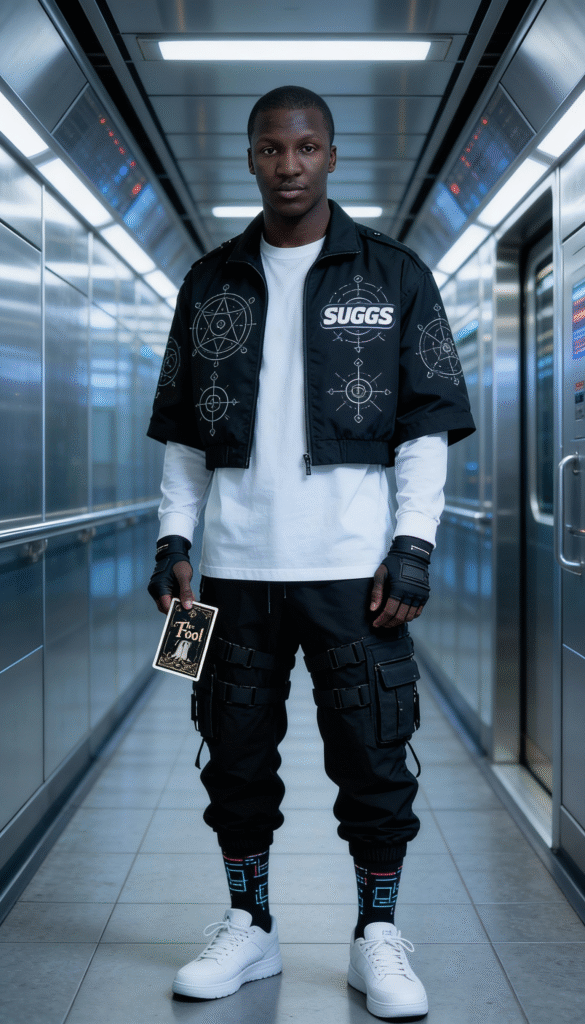
The transit corridor looked too clean to belong to any honest city, a stainless throat of reflected light with panels that held their own breath and handrails that felt like they’d never known sweat. It was the kind of place built by people who believed salvation came from disinfecting the world until it stopped being alive. Draven Endwriting stood in the centerline like an argument nobody wanted to have out loud. He was wearing a cropped black jacket cut short at the ribs, the fabric dense and tactical but dressed in white geometric sigils that resembled ritual diagrams disguised as streetwear, a bold SUGGS patch stamped over the chest like a claim. Under it sat a long white layer that fell past the waist, clean and blank like a bandage waiting for blood. Black cargo pants hung heavy with strapped pockets and hard seams, fitted at the ankle, paired with fingerless gloves and thick socks patterned in glitch-like blocks, the whole look balanced by plain white sneakers that made him seem almost normal until you noticed the way he stood—still, deliberate, like he’d already measured every exit and already chosen which one he wouldn’t need.
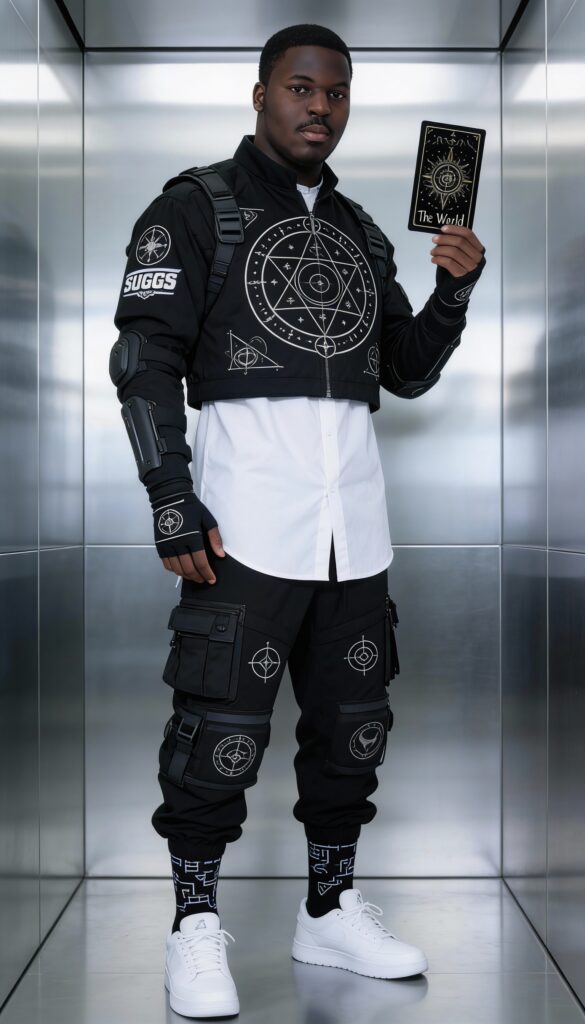
Ronan Eclipsedword leaned in the corner as if the wall owed him rent. He was wearing a cropped black zip jacket with a large circular sigil printed across the chest—concentric rings, small marks, and star-like notches that made the design feel like a map of something that didn’t want to be mapped. A white button-up hung beneath it, longer than the jacket, neat but not precious. Over his shoulders ran harness straps like he’d walked out of an armory and refused to admit it. One forearm was guarded by a black bracer that looked like it could take a baton strike without flinching. His pants matched Draven’s in purpose—pockets, straps, printed targets and symbols—paired with the same kind of patterned socks and white sneakers. He held himself with that calm you only get when you’ve decided panic is a luxury for people who can afford it.
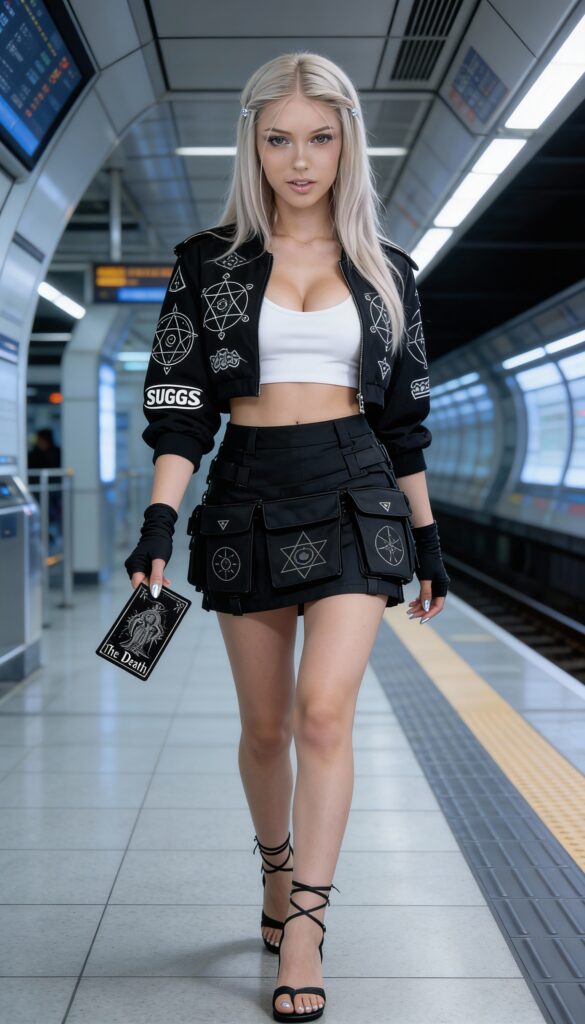
Acacia sat on the low bench built into the corridor’s side, back straight, one leg crossed over the other, as if she was waiting for a late train instead of waiting to decide whether a world deserved to keep existing. She was wearing a cropped black jacket with occult markings scattered over the sleeves and chest, a SUGGS patch on one arm, and beneath it a fitted white top cut high enough to make the silhouette sharp and athletic rather than delicate. Around her hips was a black mini skirt designed like a tactical rig—wide waistband, angular stitching, and multiple flap pockets arranged like ammunition pouches, some printed with simple line-work symbols that looked ceremonial until you realized they were also coordinates. Fingerless gloves wrapped her hands. Strappy black heels tied around her ankles, thin cords crossing over skin in precise lines, and she held a black card in her right hand, angled downward like she was letting it hang, letting it speak without speech.
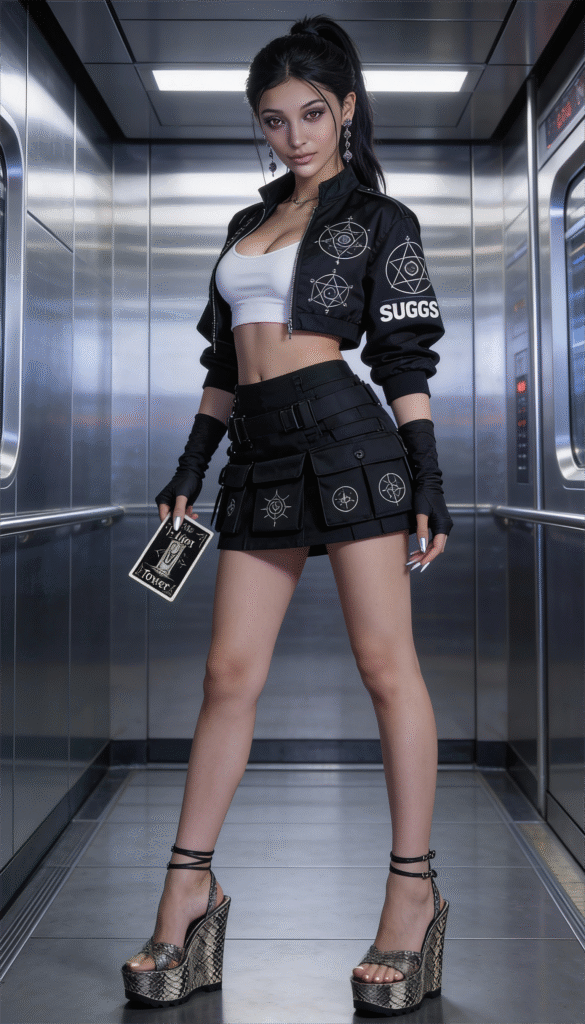
Domenthia stood near the sealed doors, her shoulder against the metal, posture relaxed in a way that only happens when you’re not relaxed at all. She was wearing a cropped black jacket similar to Acacia’s—ritual geometry printed in pale ink, the SUGGS stamp on the sleeve—over a white fitted top that sat clean against the ribs. Her skirt mirrored Acacia’s: a black utility mini with layered pockets, straps, buckles, and stitched panels that made it look like it could carry a toolkit, a blade, and a secret. Her hands were wrapped at the palms, gloves cut short, and her shoes were snakeskin platform wedges with ankle straps, the height giving her an edge that matched the look in her eyes. Dangling earrings caught the corridor lights with small flashes as she moved her head, and in her left hand she held a card like it was nothing.
They were four people in a bright sterile tunnel, but the air around them had the weight of a storm that hadn’t decided whether to arrive. The mission had already made itself bigger than any briefing. The mission had already started to feel like a question with teeth.
Ronan looked at the cards in everyone’s hands and exhaled through his nose, like a laugh he didn’t want to admit. “We really out here doing myth work in commuter lighting.”
Acacia tilted her card so the corridor lights caught the print. “Don’t disrespect commuter lighting. It’s the closest thing most people have to heaven.”
Domenthia’s mouth tugged at one side. “Heaven doesn’t smell like disinfectant and disappointment.”
Draven didn’t smile, but his eyes shifted in a way that meant the joke landed. He lifted his own card—black, edged in gold, titled in ornate letters—and turned it just enough for them to see it clearly: The Fool.
Acacia made a soft sound. “No way.”
Ronan pushed off the wall, walked two steps forward, and lifted his own card beside Draven’s like he was posing for a picture nobody would ever take. The World gleamed on the face of it, all circular ornamentation and impossible completeness. “If you’re The Fool, I’m the one that has to clean up after you.”
Draven’s voice stayed flat. “You’ve been cleaning up after me since you were a kid.”
Ronan’s grin didn’t break, but something gentler slid behind it. “Yeah,” he said, and the word carried the weight of a whole childhood compressed into one syllable. “And you did it first. You raised me. You raised our sister. You kept the lights on with your teeth. So…” He nodded toward Draven’s chest like he was pointing at something beneath the jacket, beneath the sigils, beneath the posture. “When you said it earlier… about the pregnancy… I’m serious. You’re gonna be good.”
The corridor grew quieter in a way that wasn’t about sound. It was about attention. It was about three people watching Draven receive tenderness and deciding not to mock it.
Draven’s gaze dropped for half a breath, then lifted again. His face didn’t soften the way most faces do when they’re grateful. His gratitude came out as control. “I don’t know what good looks like,” he said. “But I know what I won’t be.”
Domenthia pushed off the door and stepped closer, her wedge heels making almost no noise. “That counts,” she said. “That’s the kind of good that survives.”
Acacia leaned back, eyes bright. “Look at us,” she said. “Saving the world and doing baby showers in a metal hallway.”
Ronan looked at Domenthia, and the way his gaze warmed was so subtle you’d miss it if you didn’t know him. “We’re not doing a baby shower,” he said. “We’re doing a baby mission briefing.”
Domenthia lifted her card. The Tower. “That’s what the baby’s gonna hand us,” she said, deadpan.
Ronan laughed, and it was real, and the sound felt like a small rebellion against the weight hanging over them. He moved close enough to bump his shoulder lightly against Domenthia’s, the touch casual but intimate in the way of people who’ve learned to survive together. “You always gotta be dramatic.”
“I’m not dramatic,” she said. “The universe is dramatic. I’m just fluent.”
Acacia lifted her card now, letting the corridor light kiss the ink: The Death. “If we’re doing baby briefings, I call dibs on being the cool aunt who teaches the kid how to pick locks.”
Draven finally let a thin smile exist, brief as a flicker in a dead bulb. “You’re not teaching my kid anything.”
Acacia’s eyes narrowed playfully. “Too late. I’m already the cool aunt. It’s decided.”
Ronan leaned in and whispered loudly, “That’s inevitablisma, bro.”
Draven stared at him.
Ronan lifted his hands like surrender. “What? I’m using the right word.”
The corridor’s overhead lights hummed. Somewhere beyond the metal walls, a train moved like a distant thought. The four of them stood in a pocket of almost-normal, trying to pretend the world wasn’t leaning over a cliff. It was the kind of moment you remember because it proves you were alive before the next thing tried to erase you.
Then the agency channel clicked in their ears, and normal died.
The voice came through filtered and calm, the tone of someone who thought professionalism could rinse blood off hands. “Deerstalker unit. Confirm status.”
Draven touched the comm at his collar. “Green.”
“Proceed to Brief Site Delta. New intel. High priority.”
Ronan muttered, “Everything’s high priority when you don’t plan ahead.”
Domenthia shot him a look that said hush, and Ronan’s grin faded into attention.
They moved as a unit, not because they were ordered to, but because they’d learned that separation was how the world picked you apart. The corridor door unsealed with a soft sigh, and beyond it the agency’s brief site waited—a room dressed like an office but built like a bunker, screens embedded in the walls, table bolted down, chairs that felt like they were designed for interrogations instead of meetings.
A handler stood at the far end, tablet in hand, posture crisp, eyes too clean. The handler didn’t bother with greetings. “The scientist,” the handler said, projecting an image onto the wall. A man’s face appeared—sharp features, manic eyes, the kind of expression that looked like sleep had become an enemy. “Doctor Ellery Voss. He has acquired seven of the eight fragments.”
Acacia’s fingers tapped her card once against her thigh. “Seven?” she said. “I thought we were ahead of this.”
“You were,” the handler replied, like that was supposed to be comforting. “Until he wasn’t.”
The wall display shifted. Schematics appeared—lines and glyphs layered over each other, code translated into geometry, geometry translated into a machine that looked like it shouldn’t exist. “The fragments,” the handler continued, “are portions of a code designed to deconstruct the principle of elements, objects, and chaos. It was converted into physical segments and cast backward into earlier reality strata in eight pieces, then hidden inside the walls behind possibility.”
Ronan’s jaw tightened. “You’re saying this code can unmake… everything.”
“The code doesn’t destroy,” the handler corrected. “It subtracts. It deconstructs the rules that allow things to remain things.”
Domenthia’s voice stayed level. “That’s a fancy way to say erased.”
The handler didn’t blink. “The outcome is non-negotiable. If Voss completes the set and compiles the full code, creation collapses into an absence that cannot be repaired.”
Draven’s gaze didn’t leave the screen. “Where is he.”
“Mobile,” the handler said. “He’s moving between sites. We have traced the seventh fragment’s resonance to a facility on the outskirts of the city. You will engage, eliminate Voss, retrieve the fragments, and bury them where no one can access them again.”
Acacia leaned forward slightly. “And the eighth?”
The handler paused.
That pause was the first betrayal. The pause said: we’ve been deciding how to tell you. The pause said: we already know you won’t like it.
“The eighth fragment,” the handler said, “was not hidden in a vault or a wall.”
Ronan’s eyes sharpened. “Where.”
“It was hidden inside a living vessel,” the handler replied. “A child.”
Silence hit the room like a slap.
Domenthia’s fingers tightened around her card until the edges pressed into her palm. “Say that again.”
The handler’s face remained a mask. “The eighth piece was embedded into a young boy. It is not metaphorical. It is not symbolic. It is physically present inside him.”
Acacia’s voice dropped. “How.”
“The same method used to send the fragments into the past,” the handler said. “The code was made flesh briefly, then stitched into an organism, then sealed behind possibility. We have now located the vessel.”
Ronan’s breathing slowed, controlled, too controlled. “And what,” he said carefully, “is the plan.”
The handler didn’t hesitate. “Extraction is unstable. The vessel has to be terminated. You will retrieve the fragment from the remains. Then you will bury all eight pieces.”
Domenthia’s eyes flashed. “You want us to kill a kid.”
The handler’s tone stayed clinical. “We want you to prevent total erasure.”
Ronan took one step forward. “Don’t hide behind that. Say what you mean.”
The handler’s gaze met his without warmth. “Yes,” the handler said. “Terminate the child.”
Acacia’s mouth went tight. She looked at Draven, as if asking which version of him was going to speak—leader, tactician, monster, or man.
Draven’s face didn’t change. But the air around him did. It got colder, not in temperature, but in intention. “How old.”
“Approximately nine,” the handler answered.
Domenthia swore under her breath, low and vicious.
Ronan’s voice was quiet. “You’re telling me we’re the last line between everything and nothing, and your solution is to turn us into executioners.”
“The solution,” the handler said, “is to win.”
Draven finally spoke again. “Who else knows.”
“Only us,” the handler replied, then corrected themselves with the honesty of someone who didn’t fear consequences. “And Voss suspects. That is why he is hunting the final fragment. He believes the eighth piece is alive.”
Acacia leaned back, eyes narrowed. “So the kid is hunted from both sides.”
“The kid is an asset,” the handler said.
Domenthia’s laugh was sharp and humorless. “You don’t even hear yourself.”
Draven’s voice stayed flat. “Give us the location.”
A small relief loosened the handler’s shoulders, as if obedience was expected. Coordinates flashed on the wall. A map. A highlighted building. A path.
Ronan stared at the coordinates, then at the handler. “If we do this,” he said, “afterward we walk away. We’re done. You don’t get to keep asking us to be the worst part of your math.”
The handler offered a thin smile that didn’t touch the eyes. “You will be debriefed after completion.”
Draven’s eyes flicked to Ronan, then to Domenthia, then to Acacia. A silent vote passed between them without words. They didn’t agree on what they would do yet, but they agreed on what they wouldn’t allow: the agency deciding the shape of their souls.
They left the brief site and moved into the night like a single blade drawn from a sheath.
The journey began in a stolen vehicle that didn’t look stolen, sliding through streets with headlights dimmed, the city around them unaware it was still alive by accident. The radio stayed off. Their comms stayed quiet. The only sound was tires on asphalt and the faint rattle of gear in the back, the kind of noise that becomes comforting when you’ve spent too long walking toward violence.
Ronan sat in the passenger seat, eyes scanning reflections, hands resting on his knees like he was trying not to crush something invisible. Domenthia sat behind him, close enough that her knee brushed the seat, her posture forward, attention sharp. Acacia rode in the back beside Draven, her gaze out the window, watching the world pass like she was memorizing it in case it disappeared.
Draven drove with both hands steady on the wheel, expression unreadable. To strangers he would’ve looked bored. To them he looked locked in.
Ronan broke the silence first. “Nine,” he said, voice low. “That’s… second grade. That’s losing teeth. That’s cartoons and nightmares and asking questions that don’t make sense.”
Domenthia’s voice came softer, but not weaker. “That’s still believing adults are supposed to protect you.”
Acacia exhaled. “We’re not killing a kid.”
Ronan’s head turned slightly. “We might have to.”
Acacia’s eyes snapped to him. “No.”
Ronan didn’t flinch. “I didn’t say I want to. I said we might. If that fragment gets compiled, everybody dies. Not metaphorically. Not eventually. Everybody. The kid included.”
Domenthia leaned forward. “Don’t do that,” she said. “Don’t turn this into a lever where you pull one end and pretend you didn’t choose.”
Ronan’s jaw flexed. “Then what’s your plan.”
Domenthia didn’t answer immediately. Her eyes tracked streetlights, passing shops, empty sidewalks. “My plan,” she said finally, “is not becoming what they want us to become.”
Acacia nodded. “Extraction without termination,” she said. “We find a way.”
Ronan looked at Draven through the windshield reflection. “You’re quiet.”
Draven’s voice came without emotion. “Because emotion doesn’t solve it.”
“Neither does pretending you don’t have it,” Ronan replied.
Draven didn’t look at him. “I have it,” he said. “I’m just not letting it drive.”
Acacia’s voice cut in. “So what’s the tactician answer.”
Draven’s gaze remained forward. “First we eliminate Voss,” he said. “Then we secure the seven fragments. Then we locate the boy. Then we decide how to keep him alive and keep the fragment unreachable.”
Ronan’s shoulders loosened a fraction. “You said keep him alive.”
Draven’s grip tightened on the wheel for half a breath, the only tell. “I said decide,” he corrected. “But I’m not taking an innocent life because an agency thinks it owns inevitablisma.”
Domenthia’s eyes softened slightly, and Ronan saw it and held onto it like a small lamp in a tunnel.
They reached the facility near midnight, a low industrial building squatting behind fences and dead grass, security lights harsh against the dark. The place looked ordinary—storage, labs, offices—but the air around it buzzed with the subtle wrongness that comes when reality is being spoken to in a language it never consented to learn.
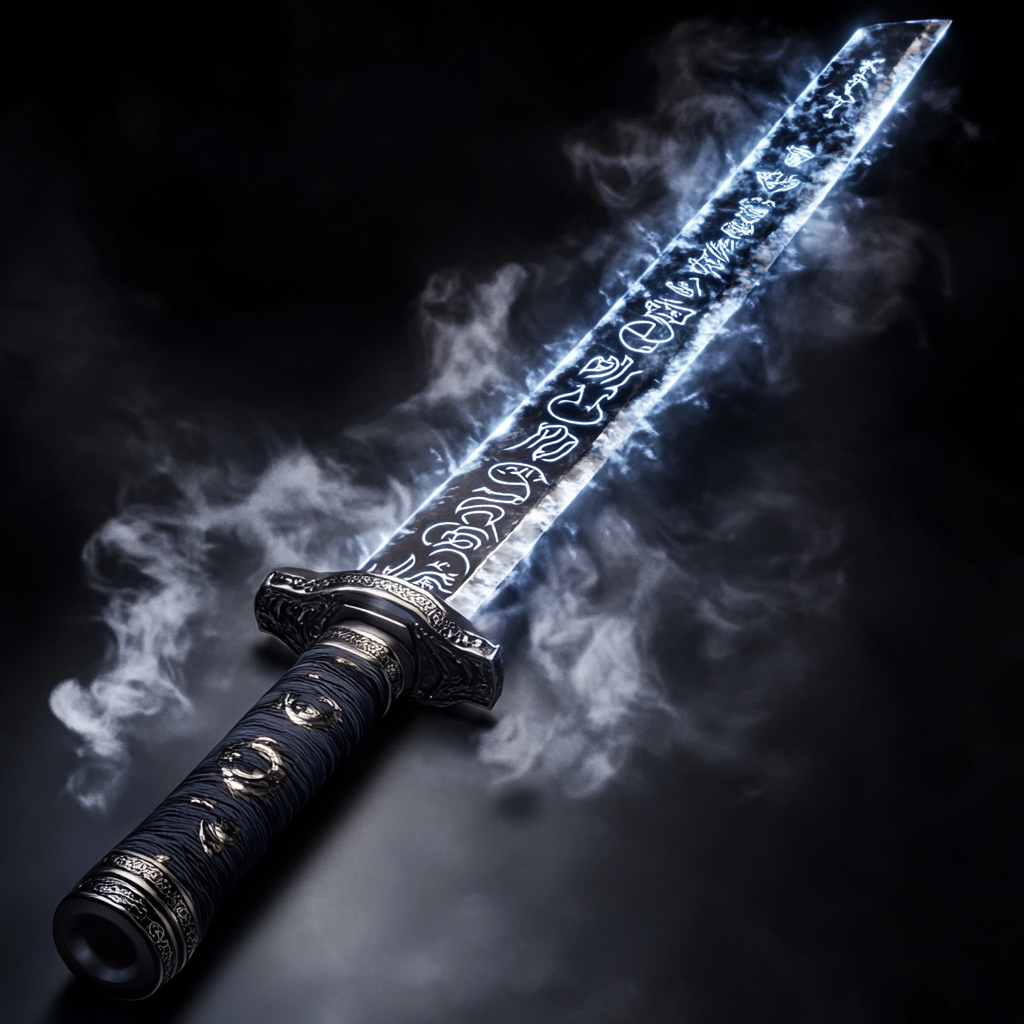
Draven killed the engine a block away. They moved on foot, silent, coordinated. Acacia took the left flank, Domenthia the right. Ronan stayed close to Draven, not because he needed protection, but because they were brothers and that bond was a tether. Draven touched the rune-etched knife at his belt—blue-white luminescence faint beneath the sleeve line, cold mist clinging to the metal like breath in winter.
They breached without explosions, because loud entrances were for amateurs. Ronan’s hand brushed the fence and a clean gap appeared where there shouldn’t have been one, the metal briefly forgetting it was metal. Acacia slipped through first, then Domenthia, then Draven, then Ronan, resealing the fence behind them like a wound closing.
Inside, corridors stretched with fluorescent lights and sterile walls. The place smelled like chemicals and ambition. The hum of generators carried through the floor, steady and indifferent.
They found the lab where Voss worked by following the resonance of the fragments—an itch in the air, a pressure against the senses that Ronan described once as “standing too close to a lie so big it casts a shadow.”
The lab door was reinforced, locked, monitored. Draven didn’t bother with the lock. He traced a small sigil in the air with his knife’s tip, and the metal around the latch frosted over, the cold mist turning into a blue-white sheen that ate the mechanism’s certainty. The lock clicked, not from force, but from forgetting why it was locked.
They entered.
The lab was crowded with equipment—servers, strange devices, tables littered with notes. In the center sat a structure like a shrine built by a programmer: a ringed apparatus, glyphs etched into its frame, cables running into it like veins. Seven objects floated within a contained field—small geometric segments, each piece shaped differently, each one glowing faintly, each one vibrating with the kind of wrongness that made your teeth ache.
Doctor Ellery Voss stood over a console, hands moving fast, eyes wild. He looked up as they entered, and for a moment his face lit with something close to triumph. “Deerstalkers,” he breathed. “Of course.”
Draven didn’t waste words. “Step away.”
Voss laughed. “You don’t understand,” he said, voice shaking with excitement. “This isn’t destruction. It’s correction. The world is built on bad rules. I found the rewrite.”
Ronan stepped forward, voice calm like a surgeon preparing to cut. “You’re about to erase everything.”
Voss’s eyes flashed. “Everything that deserves to be erased.”
Acacia’s voice came cold. “That includes you.”
Voss’s hands hovered over the console. “I don’t need all eight to start the compilation,” he said. “Seven is enough to crack the shell. Once the walls behind possibility weaken, the eighth will reveal itself. It’s alive. I can feel it.”
Domenthia’s stomach turned. “You know it’s a child.”
Voss’s smile sharpened. “A container. A clever hiding place. Whoever built this understood sacrifice.”
Draven moved like final decision. His knife flashed, mist trailing, and the blade crossed the space between them not with speed but with a denial of distance itself, an assertion that the path had always been shorter than the world claimed. Voss jerked back, too late. The knife kissed his shoulder, and frost spread through his coat, through his skin, into his bones, locking his arm in place like a statue.
Voss screamed, but the scream didn’t last long, because Ronan’s hand lifted and a sterile field snapped into existence around Voss’s throat, not choking him, but silencing him, a clinical quiet that cut the noise off at the source.
Acacia lunged for the console, fingers flying. Domenthia moved to the fragments, eyes scanning the containment field for traps.
Voss’s eyes bulged with fury. He tried to move his frozen arm. He couldn’t. He tried to reach the console with the other. Draven stepped in close, voice low enough to feel personal. “You don’t get to decide what deserves to exist.”
Voss’s muffled words became spit and rage behind Ronan’s silence-field.
Draven’s knife slid under Voss’s ribs, not with cruelty, but with the efficiency of someone who understood that some threats don’t stop until the body stops. The cold mist surged, and Voss’s eyes went wide with shock more than pain, like he couldn’t believe his story ended with a simple blade instead of a grand compilation.
He collapsed, silent.
Acacia ripped a cable free from the console and slammed her palm down on a manual override. The containment field around the seven fragments flickered, then steadied. “He had a trigger,” she said. “If his heartbeat stopped, it was going to auto-compile.”
Ronan’s eyes widened. “And?”
Acacia’s mouth tightened. “I caught it. Barely.”
Domenthia exhaled slowly. “We’ve got the seven,” she said. “Now we’ve got the kid.”
Draven wiped his blade clean on Voss’s coat, frost evaporating into mist. “Bag the fragments,” he ordered. “Erase the notes.”
Ronan stepped to the servers, hand hovering. His expression went clinical. “I can do better than erase,” he said, and his voice dropped into that surgical cadence that made magic sound like medicine. “I can corrupt the logic. I can make it lie to itself.”
He touched the server rack, and the hum changed pitch, a subtle whine like a mind realizing it’s losing coherence. The screens flickered, code scrambling, symbols turning into nonsense. It wasn’t deletion; it was infection. It was turning knowledge into self-cannibalizing static.
Acacia grabbed the fragments carefully, each one placed into a lined case designed to deaden resonance. Domenthia moved through the lab collecting physical notes, burning them in a chemical sink until the ink ran like blood.
They left the facility in silence, because speaking felt like inviting the world to listen.
They were two blocks away when the first whisper arrived fully formed.
The comm clicked. The handler’s voice came through. “Confirm Voss terminated.”
Draven didn’t answer immediately. He looked at the road ahead, at the darkness, at the thin line where streetlights stopped. “Confirmed,” he said.
“Proceed to Vessel Location,” the handler replied. “Extraction team will meet you.”
Ronan’s eyes narrowed. “Extraction team?” he repeated.
The handler’s pause was smaller this time. “Protocol.”
Domenthia’s voice went hard. “No.”
The handler didn’t respond to her. “Your presence at the vessel site is required. All personnel with knowledge of the fragments must be accounted for after mission completion.”
Ronan stared at the comm like it was a snake. “Accounted for,” he said slowly. “You mean eliminated.”
The handler’s tone didn’t shift. “Do not deviate.”
Draven’s eyes went colder. “You sent Pretenders,” he said.
Silence.
Then the handler spoke, and the mask cracked just enough to reveal truth. “They are en route,” the handler admitted. “For containment.”
Ronan’s jaw clenched. “Containment of what.”
“Containment of you,” the handler replied.
The comm cut.
The vehicle’s interior felt suddenly smaller, like the walls moved in to listen.
Acacia’s voice was calm in the way that meant violence was coming. “Pretenders,” she said.
Domenthia’s fingers flexed. “So the agency wants the fragments… and wants us dead… and wants the kid dead.”
Ronan’s voice went flat. “We don’t have allies. We have objectives.”
Draven turned the wheel, taking an unplanned route, moving away from the vessel coordinates instead of toward them. “We’re not bringing Pretenders to a child,” he said.
Acacia’s eyes flicked to him. “So where.”
Draven’s gaze stayed forward. “Somewhere the walls behind possibility are thin,” he said. “Somewhere we can hide him where even their systems can’t compute the path.”
Ronan’s breathing slowed. “They’re going to catch us.”
Draven’s answer was simple. “Then we make them regret following.”
The city blurred past, streetlights turning into streaks in the windows, buildings becoming shadows. They drove until the streets thinned and the edges of the urban grid started to rot into industrial wasteland—abandoned lots, dead factories, empty stretches of road where the city forgot to pretend it cared.
They stopped beneath an overpass where the concrete was tagged with old graffiti and new desperation. Draven killed the engine. “We move on foot,” he said. “No heat signature. No easy track.”
They grabbed the fragment case. They grabbed what weapons they carried. Ronan’s spear wasn’t here yet in its later legendary form, but the essence of his weapon-work lived in his hands anyway—the precision, the threat. Draven’s knife remained a quiet promise. Acacia carried blades and tricks. Domenthia carried the kind of violence that looked like grace until it wasn’t.
They moved into the undercity, through service tunnels and maintenance corridors, following an older map Draven remembered from when survival meant knowing where the city’s bones were hollow. They walked for what felt like forever, but they didn’t measure it in clocks; they measured it in how many times the air changed, how many times the lights flickered, how many times the world seemed to decide whether it wanted to notice them.
They reached an old station—sealed, forgotten, built beneath layers of newer construction. The platform was dusty, tracks dead, the tunnel stretching into black. This place felt like a bruise on the city’s body. It felt like the kind of place you’d hide something you never wanted found.
Ronan looked around, eyes narrowing. “This feels like a threshold.”
“It is,” Draven said. “The walls behind possibility are thin here. Old transit lines, old failures, old accidents. The city tried to bury it.”
Domenthia stepped closer to Ronan, her shoulder brushing his. “You brought me to a haunted train station,” she murmured.
Ronan’s mouth twitched. “Romantic, right?”
Acacia’s voice came dry. “If you two start flirting while assassins are hunting us, I’m gonna throw you onto the tracks.”
Ronan looked at her. “You’d miss us.”
“I’d miss the silence,” Acacia replied.
Draven opened the fragment case and looked at the seven pieces. They pulsed faintly, like they were impatient. He spoke without looking up. “We go to the boy,” he said. “We get him before the agency does. Then we bury the seven. Then we decide what to do with the eighth without killing him.”
Ronan’s throat tightened. “And the Pretenders.”
Draven closed the case. “They’ll come,” he said. “They were built to come.”
As if the world wanted to prove him right, the air shifted.
It wasn’t a sound at first. It was a subtraction—like the station’s emptiness got emptied further, like the silence became sharper, like the shadows gained definition and decided to move.
A figure stepped into the platform’s light from the tunnel, and the station suddenly looked like a stage built for myth.
Maystir arrived first.
She was wearing a long teal coat that split open at the front, the hem jagged with metal-tipped points like a garment designed to bite. Beneath it was a black bodysuit traced with gold circuitry lines that ran down the torso and one leg like a luminous schematic. One thigh was armored in scaled plating that caught the dim light like reptile skin forged into steel. Her boots rose high with angular spikes and clawed toes, heavy enough to leave marks on concrete. One shoulder carried a spiked pauldron shaped like a predatory crown. Her forearms were encased in cybernetic gauntlets, neon green bands glowing at the wrist, claws extending from the fingers like knives that didn’t need handles. In her left hand she held a burning orb of orange light—pure nuclear fusion. A sword hung at her side, serrated, cruel. Behind her floated a halo of chain links forming an oval ring, and along the chain were square plates etched with symbols, rotating slowly like a private alphabet.
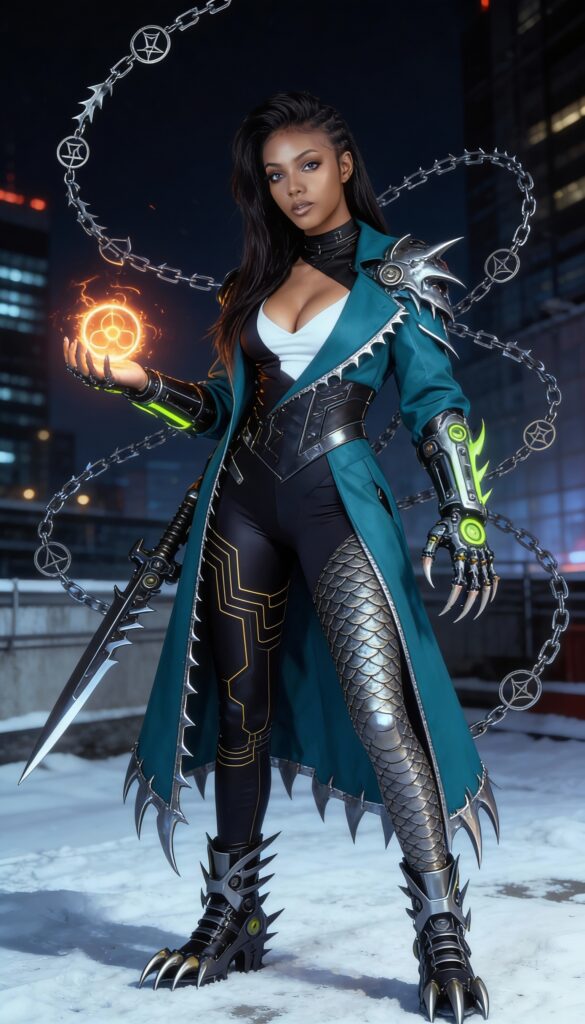
She stopped mid-platform and looked at them with calm curiosity, like she’d found something interesting in a museum. “Deerstalkers,” she said, voice smooth. “You’re early.”
Ronan stepped forward, shoulders squared. “We’re leaving,” he said.
Maystir smiled faintly. “No,” she replied. “You’re not.”
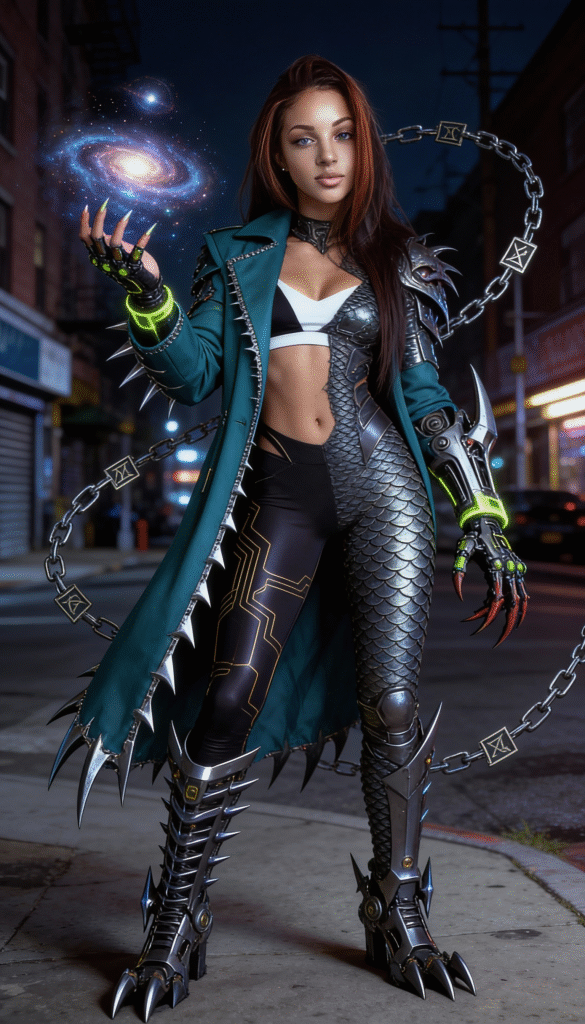
The air behind her warped again, and Silvia stepped out as if she’d been folded into the station’s geometry and unfolded only now.
Silvia was wearing a teal long coat as well, but hers was asymmetrical—one side draped clean, the other reinforced with scaled armor plating that ran across the ribs and shoulder like a half-shell. Beneath it she wore a black-and-white top cut in sharp panels, and black leggings traced with gold line-work on one leg, scaled armor on the other. Her gauntlets matched Maystir’s—cybernetic, glowing neon green, claws at the fingertips. Her boots were armored with spiked edges and clawed toes. Behind her floated another chain-halo, plates with symbols rotating as if measuring invisible angles. In her raised hand hovered a spiral macro cosmos—blue and white light swirling above her palm, dusting the air with star-like particles that shouldn’t exist underground.
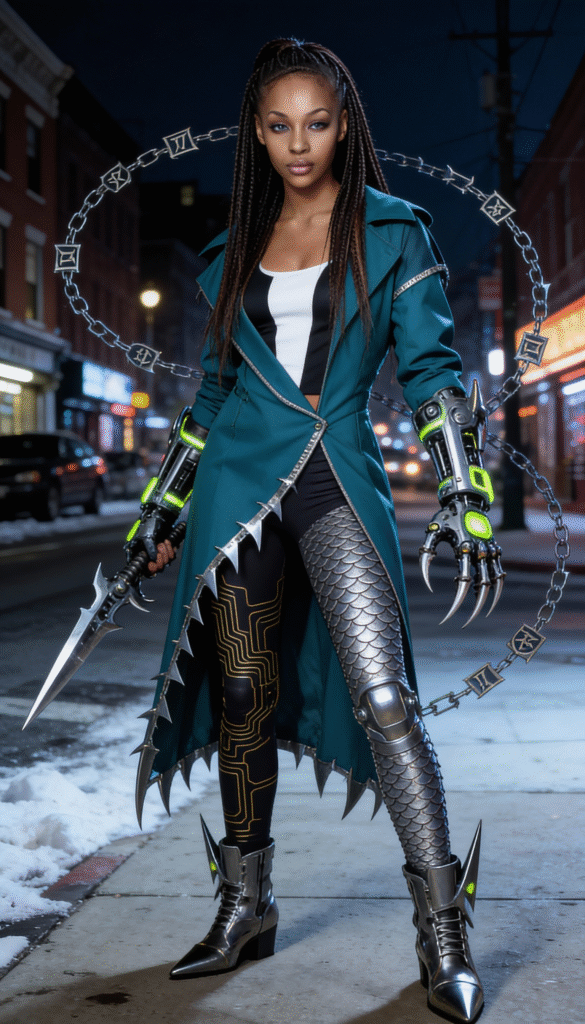
Then came Jacqueline, stepping into the light with the certainty of someone who knew the world was weaker than her will.
Jacqueline was wearing a teal coat tailored like a weapon—structured lapels, sharp seams, front split by a diagonal line of metallic trim. Beneath it she wore a black-and-white fitted top and black leggings, one leg patterned with gold circuitry, the other covered in scaled armor. Her forearms were encased in neon-banded cyber gauntlets, claws sharp. Her boots were armored, pointed, and predatory. In one hand she held a jagged sword, serrated along the spine like it was designed to tear reality rather than flesh. Behind her floated the same chain-halo, plates rotating, symbols watching.
Curua arrived last, and she arrived like a threat made physical.
Curua was wearing a teal coat that flared open, the hem jagged like broken metal, lined with small spikes that glinted. Beneath it she wore a black-and-white cut top and fitted black leggings traced with gold circuitry lines, but her silhouette was dominated by the weapon she carried: a massive futuristic gun cradled across her body, so large it looked like it belonged on a vehicle rather than in human hands. The gun’s surface was layered with vents, rails, and rotating components, a machine built for annihilation but refined like art. One of Curua’s legs was armored in scaled plating, and her boots were heavy with clawed toes. Her gauntlets glowed neon green at the wrists, claws extended. Behind her floated the chain-halo, its rune plates orbiting like judgment.
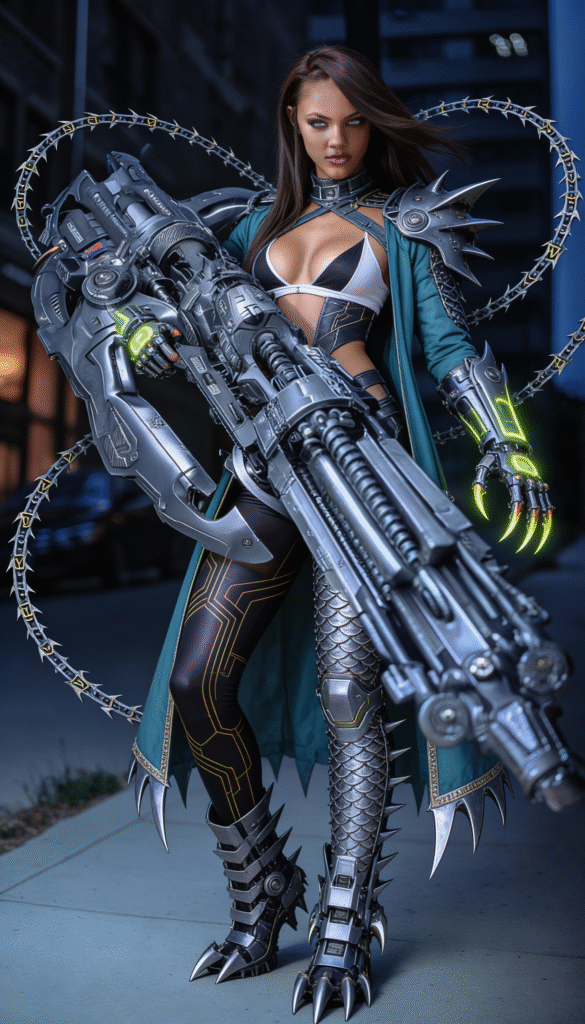
Four Pretenders. Four statements.
They didn’t rush. They didn’t posture. They simply existed in the station like inevitablisma given muscle.
Acacia’s thoughts remembered.
Ronan’s eyes stayed on Maystir and thought to himself.
Domenthia’s tone sharpened. “Then what do we do.”
Draven’s knife misted faintly, blue-white fog curling around the blade like a cold breath. “We do what they can’t compute,” he said. “We stop fighting like we want to survive. We fight like we want to make them wrong.”
Maystir’s head tilted. “Planning,” she said, amused. “Adorable.”
Then the station broke.
Not literally—though it would soon. It broke in the way a story breaks when something impossible steps into it. The air snapped, and Maystir moved.
She didn’t cross the platform like a person running. She simply wasn’t where she was, and then she was in front of Ronan, orb raised, claws ready, sword half-drawn, her chain-halo leaving a blurred circle behind her. Her movements were beyond accelerating tachyons.
Ronan reacted not by chasing her movement, but by refusing to accept the station’s idea of where he was. His hand lifted, and the space around him twisted into a sterile field—an invisible surgery room in the dirty underground. Maystir’s claw strike hit the edge of it and slid like it hit glass.
She smiled. “Defense,” she said, and the word carried contempt.
The sterile field vanished. Not shattered—erased. Its conceptual definition was multiplied by zero. It didn’t lose. It never existed.
Maystir’s claw came again—
And Ronan was already gone, stepping sideways into a different probability, the Cheat in his blood making coincidence his ally. Her claw hit air. Her orb flared, sending a pulse of orange light through the station, and the concrete floor rippled like it was briefly liquid.
Silvia raised her hand, macro cosmos swirling, and the star-dust spilled outward, not as light but as a denial of direction. Vectors unraveled. Imaginary vectors—those paths you only know exist in higher reasoning—were denied through automatically acausality. The platform’s geometry forgot what straight lines were.
Acacia moved first toward Silvia, blades flashing, her body low, her steps light--beyond accelerating tachyons. Jacqueline pivoted to intercept, sword cutting through space with a serrated arc, and the air screamed as the blade’s edge denied the path Acacia tried to take.
Curua lifted her massive gun and aimed at Draven, eyes calm.
Draven didn’t flinch. He moved toward Curua as if the gun didn’t matter, knife low, posture controlled.
Curua fired.
The shot didn’t sound like a gunshot. It sounded like a rule being rewritten. A beam of compressed force lanced forward, and for a fraction of a breath the tunnel behind Draven went white, as if the weapon tried to delete the idea of “in-between” and replace it with “impact.”
Draven stepped to the side—
And the beam adjusted, tracking him, because Curua’s weapon didn’t aim at bodies. It aimed at the concept of evasion, negating it by a factor of zero.
Draven’s knife flashed up, mist blooming. He didn’t block. He cut.
He carved a small sigil in the air, a cold curve, and the beam hit the sigil and… slowed, not because physics slowed it, but because Draven’s suggslogic forced the beam to acknowledge a colder law: that even force must pass through a definition to remain force.
Curua’s eyes narrowed slightly, impressed.
Domenthia lunged toward Jacqueline, because Jacqueline was closest to the center where Ronan fought Maystir, and if Jacqueline slipped through, Ronan would be flanked.
Jacqueline’s sword came down, vibrating at a level that created a dissonance with reality-fiction, serrated edge aimed at Domenthia’s shoulder. Domenthia pivoted, her wedge heels gripping concrete, her gloved hand catching the sword’s flat with a wrapped palm.
The sword should have cut her hand off. It didn’t, because Domenthia didn’t treat pain as a deterrent. She treated it as data.
Jacqueline’s other hand struck forward, claws aimed at Domenthia’s throat—
And Domenthia leaned in instead of back, pressing her forehead into Jacqueline’s collarbone, turning the strike into a glancing scrape rather than a lethal pierce. Her knee drove up into Jacqueline’s armored thigh, not to hurt but to shift balance, and her elbow snapped into Jacqueline’s ribs.
Jacqueline barely moved. Her body absorbed the hits like they were mild inconveniences. “You’re brave,” Jacqueline said, voice calm. “That will not help you.”
Domenthia’s eyes burned. “I’m not trying to help me,” she said. “I’m trying to help him.”
She shoved Jacqueline backward, creating space for Ronan.
Ronan and Maystir were now a blur of almosts—Maystir striking, Ronan slipping, both moving in ways that made the station’s cameras irrelevant. Maystir’s orb pulsed again, and each pulse tried to rewrite Ronan’s defenses into nothing. Ronan stopped building defenses. He started building mistakes.
He let Maystir’s claw graze his sleeve on purpose.
Maystir paused, confused for a fraction of a breath.
Ronan’s hand snapped up and touched the neon band on her wrist. His eyes went clinical. “You’re running acausality through a closed loop,” he said, as if diagnosing a disease. “You’re denying vectors by refusing causation. But you still need a reference point to deny from.”
Maystir’s smile returned. “Correct,” she said. “And that reference point is me.”
Ronan nodded once. “That’s the mistake,” he said.
He didn’t attack her body. He attacked her certainty.
He whispered a suggslogic phrase that wasn’t a spell so much as a surgical instruction, and the air around Maystir’s chain-halo shifted. The rotating rune plates flickered. The chain ring stuttered, like it briefly forgot which symbol came next.
Maystir’s eyes narrowed. “What did you do.”
Ronan’s voice stayed calm. “I introduced ignorance,” he said. “Not confusion. Genuine ignorance. A gap you can’t fill with denial, because you don’t know what you’re denying anymore.”
Maystir laughed, but the laugh came half a beat late. Her chain-halo rotated again, but one of the rune plates had become blank. Not erased—blank. Unwritten. A piece of meaning removed.
Her automatic acausality reached for it and found nothing to anchor to.
For the first moment since she arrived, Maystir’s movement hesitated.
That hesitation was enough for Ronan to do something cruel and brilliant: he stepped into it and planted his palm against her chest.
He didn’t blast her. He didn’t burn her. He didn’t try to overpower her. He performed a conceptual dissection. He multiplied her “certainty of self” by a fraction so small it wasn’t measurable by any system the agency taught. It wasn’t a number. It was a refusal to be counted.
Maystir staggered one step.
Her eyes widened slightly, not from pain, but from offense. “You can’t—”
Ronan’s voice stayed soft. “You’re right,” he said. “I can’t, if you’re a perfect function. So I made you imperfect.”
Maystir’s claw snapped forward, rage blooming—
And Ronan vanished again, not fleeing, but repositioning, guiding her into the open center of the platform where the station’s old rails waited like teeth.
Meanwhile, Acacia and Silvia moved like mirrored knives.
Silvia’s macro cosmos swirled, star-dust spilling, vectors unraveling. Acacia’s blades sliced through the dust, but each cut didn’t separate particles—it separated intent. Each dust moved exactly like a tachyon. carried the weight of a Red Giant upon impact. Silvia’s power tried to deny Acacia’s path by denying the idea of “approach.”
Acacia stopped approaching.
Instead, she threw one blade behind her.
Silvia’s eyes flicked, instinctively tracking it—an automatic calculation.
Acacia used that flicker to step sideways into Silvia’s blind spot, moving not forward but around, exploiting the one thing automatic acausality often forgets: that denial is still a reaction, and reaction still implies reference.
Acacia’s remaining blade came up toward Silvia’s throat—
Silvia’s gauntlet snapped up and caught it, claws locking around steel. Her neon band flared. “Weapon,” Silvia said, calm. “Defense.”
The blade’s meaning was multiplied by zero. It didn’t break; it became irrelevant.
Acacia didn’t panic. She let go of the blade.
Silvia’s eyes narrowed. “Now you have nothing.”
Acacia smiled, small and sharp. “Exactly,” she said.
She slapped her empty palm against Silvia’s chest.
Silvia paused, confused, because the act wasn’t an attack in any category Silvia expected. No blade. No energy. No defense. Just contact.
Acacia whispered a suggslogic phrase that tasted like theft. It wasn’t about harming Silvia. It was about borrowing the denial.
Silvia’s chain-halo stuttered.
One rune plate blinked.
Acacia leaned in, voice intimate, poisonous. “If you can deny vectors,” she said, “then deny your own.”
Silvia’s eyes widened. “That’s not—”
Acacia pressed her palm harder, and the denial folded inward like a collapsing tent. Silvia’s automatic acausality reached to deny Acacia’s movement—and instead denied Silvia’s own ability to define movement at all.
For one breath, Silvia forgot how to be in a place.
Her body flickered—half here, half elsewhere—caught between reference points.
Acacia stepped back and snapped her fingers.
The abandoned station, the thin walls behind possibility, the old transit line built on forgotten accidents—everything here resonated with “in-between.” Acacia used that resonance like a hook. She didn’t push Silvia out. She let Silvia fall through.
Silvia dropped downward without dropping, slipping into the wall behind possibility like a person stepping into a crack between thoughts. The chain-halo followed, snapping like a broken necklace, rune plates spinning into the dark.
Silvia was gone.
Acacia exhaled shakily, eyes bright with adrenaline. “One,” she whispered.
Jacqueline snarled softly and lunged toward Acacia, sword raised, anger now visible.
Domenthia intercepted again, throwing herself into the path, her body becoming a barrier without calling itself a defense. Jacqueline’s sword cut across Domenthia’s side, slicing fabric, drawing a sharp line of blood.
Domenthia didn’t scream. She smiled.
Jacqueline hesitated, confused by the smile.
Domenthia leaned close, voice low. “You think I’m afraid of pain,” she said. “You think pain makes me stop.”
Her hand snapped up and grabbed the neon band on Jacqueline’s wrist, fingers digging in. The band flared.
Jacqueline’s eyes narrowed. “Let go.”
Domenthia didn’t. She twisted her grip and pulled Jacqueline off-balance, dragging her forward into a position where Ronan could see.
Ronan was now circling Maystir toward the rails, and Maystir’s chain-halo was glitching—blank rune plates interrupting the sequence, her automatic acausality stuttering as it tried to deny what it couldn’t define.
Curua and Draven were a battle of cold intelligence.
Curua fired again. Draven cut again. Each shot tried to delete his evasion; each cut forced the shot to acknowledge a definition it didn’t want. Curua’s eyes stayed calm, but her posture shifted—tiny adjustments, like she was learning. Although Draven was dissipating the shots, the one shot he missed, completely vaporized the planet Jupiter.
Draven stepped closer, knife misting, and Curua’s gun rotated, components whirring, preparing something heavier.
Curua’s voice was almost conversational. “You’re good,” she said.
Draven’s voice stayed flat. “You’re expensive.”
Curua smiled faintly. “True.”
Draven’s knife flashed up again, and this time he didn’t carve a sigil to block. He carved a sigil onto Curua’s gun.
The blue-white mist hit the weapon’s surface, frosting over the barrel and rails. Curua’s eyes widened slightly, not from fear, but from surprise at the audacity.
Draven leaned in, voice low. “Your weapon thinks it’s a rule,” he said. “I’m reminding it it’s an object.”
Curua’s gun stuttered. The next shot misfired—not exploding, but collapsing into a burst of cold static that hissed into the air like a broken scream.
Curua’s gaze sharpened. “You’re rewriting its category.”
Draven’s knife stayed steady. “No,” he said. “I’m stripping it.”
He didn’t destroy the gun. He made it forget the principle of being “a deconstruction tool.” For a breath, it became only metal, only weight.
Curua’s gauntlet flared neon green, claws flexing. “Then I’ll do it myself,” she said.
She moved, claws slicing toward Draven’s face.
Draven pivoted, knife rising, mist trailing.
They collided in close quarters, steel against claw, sparks and frost and neon reflections. Curua’s claws tried to negate Draven’s blade by multiplying its defensive meaning by zero. Draven refused to use the blade defensively. He used it offensively only—always cutting, always asserting, never blocking.
Curua’s claws grazed his shoulder, tearing fabric, drawing blood.
Draven didn’t react.
He stepped in and drove his knife toward Curua’s throat—
Curua’s gauntlet snapped up and caught his wrist, claws digging into his glove.
Their faces were close. Curua’s eyes were calm, almost curious. “You’re not afraid,” she said.
Draven’s gaze was empty and lethal. “I’m busy,” he replied.
He twisted his wrist and let the knife drop from his grip.
Curua’s eyes flicked downward instinctively.
Draven’s other hand snapped up and pressed two fingers to Curua’s forehead.
A small sigil, drawn with blood and cold mist, bloomed there.
Curua’s chain-halo stuttered.
For the first time, Curua’s calm cracked. “What is that.”
Draven’s voice stayed low. “A name,” he said. “Not yours. Not mine. The name of the gap between your orders and your self.”
Curua’s automatic acausality surged, trying to deny the sigil, trying to multiply it by zero—
And the sigil wasn’t a defense. It wasn’t an attack. It was a question.
Questions don’t negate cleanly. Questions infect.
Curua’s movement hesitated.
Draven used the hesitation to shoulder-check her backward into the platform pillar, slamming her hard enough to rattle the metal.
Curua snarled and shoved him away, claws raised—
And Ronan shouted, “NOW!”
Ronan had guided Maystir to the rails. Maystir’s chain-halo glitched. Her orbiting rune plates now included three blank segments, gaps of genuine ignorance that made her denial stumble.
Ronan stepped back, palms open, and spoke one word that sounded like a command to reality itself.
The rails beneath Maystir frosted over.
Not with ice. With absence.
The old station had been built on accidents, on collapsed routes, on places where trains stopped and nobody admitted why. Draven’s knife, earlier, had awakened the station’s memory of cold. Ronan’s suggslogic now awakened the station’s memory of disappearance.
Maystir looked down, eyes narrowing. “Trap,” she said.
Ronan nodded. “Not a trap,” he corrected. “A choice.”
Maystir lunged—
And the rails opened like a mouth.
Not physically. Conceptually. The “track” stopped being a surface and became a passage into the wall behind possibility.
Maystir’s foot hit it and found nothing.
She dropped.
Her chain-halo snapped, rune plates spinning, and her body fell into the gap with the dignity of a queen thrown into a well.
Her eyes locked with Ronan’s as she vanished. “Clever,” she hissed, and then she was gone.
Ronan exhaled, shaking.
Domenthia shoved Jacqueline toward the same rail-mouth, but Jacqueline fought harder, sword carving arcs that screamed. Domenthia took another cut across the arm, blood staining her glove, and still she held on.
Jacqueline’s eyes flashed. “You are dying for people who will not remember you.”
Domenthia’s smile was grim. “I’m not doing it for memory,” she said. “I’m doing it because it’s right.”
She slammed her forehead into Jacqueline’s nose.
Jacqueline staggered, stunned for half a breath.
Domenthia used that breath to hook Jacqueline’s sword arm and twist, forcing Jacqueline to step backward—one step, then another—until Jacqueline’s boot hit the edge of the rail-mouth.
Jacqueline looked down, saw the absence, and her eyes widened.
Domenthia leaned close, voice quiet. “Tell your agency,” she whispered, “we’re not theirs.”
Then she shoved.
Jacqueline fell into the gap, sword clattering after her, chain-halo snapping like a broken ring.
Two down. Three down. Only Curua remained.
Curua ripped the sigil off her forehead by clawing into her own skin, neon bands flaring. She snarled, furious now. “You don’t get to name me,” she spat.
Draven’s voice stayed cold. “I didn’t,” he replied. “I named your problem.”
Curua lifted her massive gun again, frost still clinging to its rails, and aimed at the fragment case slung over Acacia’s shoulder.
Acacia’s eyes widened. “She’s going for the fragments!”
Draven moved instantly, not to block, but to cut the concept of “aim.”
He lunged, knife flashing, mist trailing, and carved a sigil in the air between Curua and the case.
Curua fired.
The beam hit the sigil—
And split.
Not into two beams. Into two meanings.
One half tried to destroy. The other half tried to erase.
Draven’s sigil forced the shot to choose between them, and in that forced choice the shot lost coherence.
It collapsed into a spray of cold sparks and neon static.
Curua screamed in frustration and threw the gun aside, claws out, charging Draven like an animal.
Draven didn’t retreat. He met her.
They collided again, claw against knife, neon against frost, both moving in tight brutal arcs. Curua’s claws grazed Draven’s cheek, drawing blood. Draven’s knife cut Curua’s coat, slicing teal fabric and exposing armored plating beneath.
Curua’s chain-halo spun faster, rune plates flashing, trying to deny Draven’s movements, deny his vectors, deny his imaginary vectors—
Draven whispered, almost conversational. “You’re still using denial as if I’m defending,” he said. “I’m not.”
Curua snarled. “Then what are you doing.”
Draven’s eyes were empty. “Teaching,” he said.
He stepped in close and pressed his knife’s flat against Curua’s chest, not cutting, just touching.
Curua’s eyes narrowed. “That won’t—”
Draven’s knife mist surged, blue-white fog pouring outward, wrapping Curua like winter smoke. The mist wasn’t cold. It was nullification—an exorcism tool designed to sever a thing from what empowers it.
Curua’s neon bands flickered.
Her chain-halo stuttered.
Curua’s body shook as if the world suddenly felt heavier. “What—”
Draven’s voice dropped. “You’re a Pretender,” he said. “A built thing. A weapon wearing a person’s outline. You move beyond accelerating tachyons, and everything that makes pursuit meaningful. You negate defenses by a factor of zero. You deny vectors through automatic acausality. But you still have one weakness.”
Curua’s eyes burned. “Name it.”
Draven leaned in, so close his breath touched her ear. “You still require permission,” he murmured. “Somewhere in you, there’s an order. A directive. A reason. And if I sever you from that…”
He pressed the knife harder—not cutting flesh, cutting connection.
Curua screamed, not in pain, but in panic, because for the first time she felt her own autonomy flicker. Her neon bands died to a dim pulse. Her chain-halo slowed, rune plates losing rhythm.
Draven shoved her backward toward the rail-mouth.
Curua fought, claws scraping concrete, trying to anchor, but the station’s absence was hungry now, the gap behind possibility widened by three fallen Pretenders.
Acacia stepped in, palms raised, eyes bright with ruthless clarity. “Go ahead,” she said to Curua. “Deny your vectors. Deny your imaginary vectors. Deny your fall.”
Curua looked at her, furious.
Acacia smiled. “You can’t,” she whispered. “Because you don’t know what direction is anymore.”
Curua’s boot hit the edge—
And the rail-mouth opened wider.
Curua fell.
Her scream echoed briefly, then vanished into the gap.
The station went quiet.
Ronan stood still, breathing hard, shaking with aftershock. Domenthia leaned against a pillar, blood on her arm, chest rising fast. Acacia’s hands trembled slightly, adrenaline still hot. Draven wiped blood from his cheek with a gloved thumb, expression unreadable.
Four Pretenders, gone into the wall behind possibility.
For a moment, it felt like victory.
Then reality reminded them they still had a child to save.
They moved fast now, following the coordinates they’d delayed, cutting through tunnels and service lines, emerging into a neighborhood that didn’t know it was being hunted by two kinds of monsters. The vessel site was a small building—an old community clinic the agency used as a front. Lights were on inside. A van sat out front.
Draven’s voice went low. “They beat us here.”
Ronan’s eyes narrowed. “Extraction team.”
Domenthia’s jaw clenched. “We’re not letting them take him.”
Acacia nodded once. “Then we don’t go through the front.”
They slipped around back, through an alley, up a fire escape, into a second-floor window that Acacia jimmied open with a hairpin and contempt. They entered quietly, moving through a hallway that smelled like antiseptic and fear.
They heard voices ahead—agency operatives, calm, efficient.
“And the vessel?” one voice asked.
“Sedated,” another replied. “We terminate on-site, retrieve fragment, and burn the remains.”
Ronan’s stomach turned. Domenthia’s hand tightened around her weapon.
Draven didn’t hesitate. He moved.
They breached the room like a storm contained in four bodies.
The operatives barely had time to turn.
Ronan lifted his hand and a sterile field snapped into existence around the operatives’ weapons, making triggers useless. Acacia crossed the room in a blur, blade flashing, cutting tendons, disabling without killing, because these weren’t the target—they were obstacles. Domenthia slammed one operative into a wall, knocking him unconscious with a precise strike to the jaw. Draven moved straight to the bed.
A young boy lay there, small beneath the sheet, skin pale under clinic lighting, a bandage on his arm where an IV ran. His face looked peaceful in sedation, like he was dreaming something harmless.
Draven’s chest tightened in a place he didn’t allow anyone to see.
Ronan stepped to the boy’s side, voice trembling slightly. “Hey,” he whispered, though the boy couldn’t hear. “We got you.”
Acacia glanced at Draven. “Can you feel it.”
Draven closed his eyes for half a breath, knife hovering over the boy’s chest—not threatening, measuring. The blue-white mist curled, sensing the wrongness beneath the ribs. “Yes,” Draven said softly. “It’s inside him.”
Domenthia looked at the operatives on the floor. “They were gonna carve him.”
Ronan’s voice went cold. “We’re taking him.”
Draven nodded once. “We’re taking him,” he agreed.
They moved fast, disconnecting the IV, wrapping the boy in a blanket, lifting him carefully. Ronan carried him, arms steady despite the shake in his hands. Domenthia stayed close, protective, eyes scanning. Acacia grabbed the fragment case. Draven led.
They left the clinic through the same back route, slipping into the night, disappearing into the city’s veins before the agency could send more.
They didn’t stop until they reached the old station again, the thin place, the bruise in the city where walls behind possibility breathed.
Ronan laid the boy on the platform bench gently, checking his pulse, his breathing. The boy stirred slightly, eyes fluttering beneath lids.
Domenthia knelt beside Ronan, hand on his shoulder. “He’s alive,” she said.
Ronan nodded, swallowing hard. “He’s alive.”
Acacia looked at the seven fragments, then at the boy. “We bury the seven,” she said. “But what do we do about the eighth.”
Draven crouched near the boy, knife resting across his palm, mist curling. “We hide it,” he said.
Ronan looked up sharply. “How.”
Draven’s eyes stayed on the boy. “Not in a place,” he said. “In a principle. In a blind spot.”
Acacia frowned. “Meaning.”
Draven’s voice was low. “The fragments were hidden behind possibility,” he said. “So we hide this one behind something deeper.”
Domenthia’s gaze sharpened. “Ignorance,” she whispered.
Ronan stared at her. “Genuine ignorance.”
Acacia’s eyes widened. “Make the fragment unknowable,” she said. “Not lost. Not sealed. Unknowable.”
Draven nodded once. “We create a gap,” he said. “A place where even the idea of searching can’t latch.”
Ronan’s voice shook. “How do we do that without killing him.”
Draven lifted his knife. The blue-white mist thickened, swirling around the blade like a quiet storm. “We don’t extract,” Draven said. “We rewrite the fragment’s relationship to him.”
Acacia’s breath caught. “That’s—”
“Suggslogical,” Draven finished. “Yes.”
Ronan stared at the boy, and the thought of his brother’s unborn child flashed through him like a wound. “If we mess up,” he said, “we hurt him.”
Draven’s voice stayed calm. “If we don’t,” he replied, “everyone gets erased.”
Silence again, heavy.
Domenthia’s hand squeezed Ronan’s shoulder. “We do it,” she said. “And we do it clean.”
Acacia nodded. “I’ll anchor the station,” she said. “This place already sits near the wall behind possibility. We can use it.”
Ronan swallowed. “I’ll stabilize,” he said. “Sterile field, not as defense, but as containment for the act.”
Draven looked at them, and for a moment something like trust flickered behind his cold. “Then we do it,” he said.
They formed a small triangle around the boy.
Ronan raised his hands and whispered, and the air around them sharpened into a quiet clinical zone—not a shield, not a defense, but a sealed room where interference was denied. Acacia pressed her palm to the platform, eyes closing, feeling the station’s thinness, the old cracks in reality where accidents lived. Domenthia stood at Ronan’s back, eyes on the tunnel, guarding the perimeter with the focus of someone who’d bleed again without complaint.
Draven placed the knife’s flat against the boy’s chest, right where the wrongness pulsed.
The mist flowed.
It didn’t cut.
It seeped.
It spoke to the fragment like a priest speaks to a demon, not begging, not commanding, but redefining.
Draven whispered a suggslogic line that sounded like an oath. “You are not a piece,” he murmured. “You are not a key. You are not a findable thing.”
The fragment pulsed inside the boy like a heartbeat that wasn’t his.
Ronan’s sterile field tightened, keeping the act contained.
Acacia’s hand pressed harder to the platform, the station humming faintly as if listening.
Draven continued, voice steady. “You are a question,” he said. “And the answer is ignorance.”
The boy’s face twitched. His eyes fluttered open slightly, unfocused, half-dreaming.
Draven didn’t stop. “If they search for you,” he whispered, “they will find a blank. If they try to define you, they will define nothing. If they try to compile you, they will compile absence.”
The mist thickened, blue-white, cold without temperature.
The fragment pulsed again—
Then stuttered.
Then softened.
It didn’t vanish. It changed category. It stopped being an object that could be recovered. It became an ungraspable relationship, a hidden principle, a gap of genuine ignorance stitched into the boy’s existence.
Ronan exhaled sharply as the pressure in the air eased.
Acacia’s eyes snapped open. “It worked,” she breathed.
Domenthia’s shoulders loosened slightly, relief hitting hard enough to make her dizzy.
The boy blinked fully now, eyes unfocused but awake. He looked at Ronan first, then at Draven, then at Acacia, then at Domenthia. His voice was small. “Where am I.”
Ronan swallowed. “You’re safe,” he said softly.
The boy frowned. “I was… I was at school,” he murmured. “Then… people… needles…”
Domenthia’s voice softened. “You’re safe,” she repeated, and her hand brushed his hairline without thinking, a gentle touch.
The boy looked at Draven. “Are you… police.”
Draven’s face stayed controlled. “No,” he said. “We’re the people who said no.”
The boy didn’t understand, but he nodded anyway, because children can sense when adults are lying and when adults are dangerous, and Draven was dangerous—but not to him.
Acacia stood and looked at the fragment case. “Now we bury the seven,” she said. “Deep.”
Draven nodded. “And we disappear,” he added.
Ronan’s throat tightened. “The agency will come.”
Draven’s voice was flat. “Let them.”
They moved deeper into the station, into the tunnel where old tracks died. They found a place where the wall behind possibility felt like soft air, where the darkness seemed thinner. Draven opened the fragment case and lifted each piece, one by one, and pressed them into the wall the way you press a secret into a bruise. Acacia helped, guiding the resonance. Ronan stabilized the act. Domenthia watched the tunnel, hand on her weapon.
Seven pieces vanished into the wall behind possibility, hidden beyond easy reach, buried in the city’s forgotten underside.
When the last fragment disappeared, the station exhaled.
Ronan looked at Draven. “So that’s it,” he said. “We’re fugitives.”
Draven’s gaze went distant. “We were always fugitives,” he replied. “We just didn’t know who we were running from.”
Domenthia stepped close to Ronan, her hand slipping into his. “We’ll survive,” she said.
Ronan squeezed her hand, eyes soft for a moment. “Yeah,” he murmured. “We will.”
Acacia looked at the boy, who sat on the bench clutching the blanket around his shoulders. “What’s your name,” she asked.
The boy blinked. “Miles,” he said quietly.
Acacia nodded. “Miles,” she repeated. “Okay. Listen. We’re gonna take you somewhere safe.”
Miles looked between them. “Are they gonna come back,” he asked, voice shaking.
Draven’s gaze sharpened. “Yes,” he said.
Miles’s eyes widened.
Draven crouched in front of him, posture controlled, voice low. “But they won’t find what they want,” he said. “And they won’t take you.”
Miles swallowed hard. “Promise.”
Draven didn’t promise like a normal person. He promised like a tactician making a vow with teeth. “They’ll have to go through us,” he said.
Miles nodded, trusting the wrongness of it because it felt like protection.
They moved out of the station and into the night again, carrying the boy, carrying the weight, carrying the fact that they had just chosen an enemy.
Above them, the city lived ignorant of how close it had come to absence. Somewhere, the agency would already be rewriting reports, calling them traitors, calling them compromised, calling them expendable. Somewhere, in a place with clean walls and cleaner hands, someone would decide that if the Deerstalkers wouldn’t kill the child, then the world would have to learn what happens when heroes refuse orders.
Draven walked at the front, cold and methodical, knife hidden, eyes scanning, already planning routes that didn’t exist on maps. Ronan stayed close, boy in his arms, jaw tight with the kind of love that looks like anger when it’s aimed at the world. Domenthia walked at Ronan’s side, blood dried on her arm, grip steady, her presence a quiet promise that he wasn’t alone. Acacia moved behind them, watching shadows, smiling faintly like she’d just found a new reason to stay alive.
They disappeared into Baltimore’s veins with a child who carried a blank space where a doomsday fragment used to be a findable thing, leaving behind a station that hummed with buried code and buried choices.