
Dandelion – Massacre (V): Chapter White
The morning began the way Seren liked her world best—small enough to hold in one breath, quiet enough that the city couldn’t lean in and take notes. The kitchen felt lived-in, not staged; not a safehouse’s sterile geometry, not a hotel’s disposable comfort, but a room that carried the slow scars of real use. The wood on the table had its own history, the shelves held bowls that had been washed a thousand times, and the window gave out a pale, ordinary light as if Baltimore had decided to pretend it was just another place on a map. Draven leaned in without announcement, a shadow choosing to become warmth for exactly one moment, and kissed her like a seal being pressed into wax—simple, final, and quietly possessive in a way that didn’t ask permission because it didn’t feel like a question. Seren kept one hand around a mug, her other resting near the edge of the plate, and she let the kiss happen with the calm of someone who could end worlds yet still wanted breakfast to taste like breakfast.

“You’re up early,” Draven said when he pulled back, voice low, the kind of low that wasn’t softness but restraint. His eyes swept the room the way they always did—never fully in the moment, always measuring what the moment could become. Even here, even with her, the habit didn’t turn off. It only narrowed.
“Am I?” Seren asked, and the corner of her mouth lifted like she was humoring him. “Or did you just decide to be dramatic about daylight?”
He nodded toward the table where the deck of cards sat near her mug—worn edges, a quiet suggestion that symbols mattered even when nobody was watching. “You’re the one who keeps a language on the table. I’m just making conversation.”
Seren glanced at the cards without touching them. “Languages don’t keep you safe,” she said. “They just tell you what’s coming in a prettier way.”
Draven’s hand brushed her shoulder as he moved behind her, an intentional contact that said he was here, that she was not alone in the room even if her work demanded she be alone everywhere else. “What’s coming?” he asked, as if he didn’t already know the answer was always the same: something that shouldn’t exist, insisting on existing anyway.
Seren took a bite, chewed slowly, and let the normalness sit on her tongue like a temporary truce. “A week,” she said. “One of those weeks where the world dares me to notice it.”
Draven’s gaze sharpened. “And will you?”
Seren’s eyes flicked toward him, and for a second the air between them held that paradox that made her dangerous in a way no file could capture. She wasn’t fearless. She wasn’t numb. She was simply unwilling to be owned by the universe’s expectations. “Only long enough to correct it,” she said. “Then I go back to not existing.”
Draven didn’t argue. He didn’t try to soften it with romantic language. He simply accepted the truth as if it were an equation. “Don’t let the week write you,” he said.
Seren’s smile was brief. “It won’t,” she promised, and it was the kind of promise that didn’t ask faith because it carried proof in its posture.
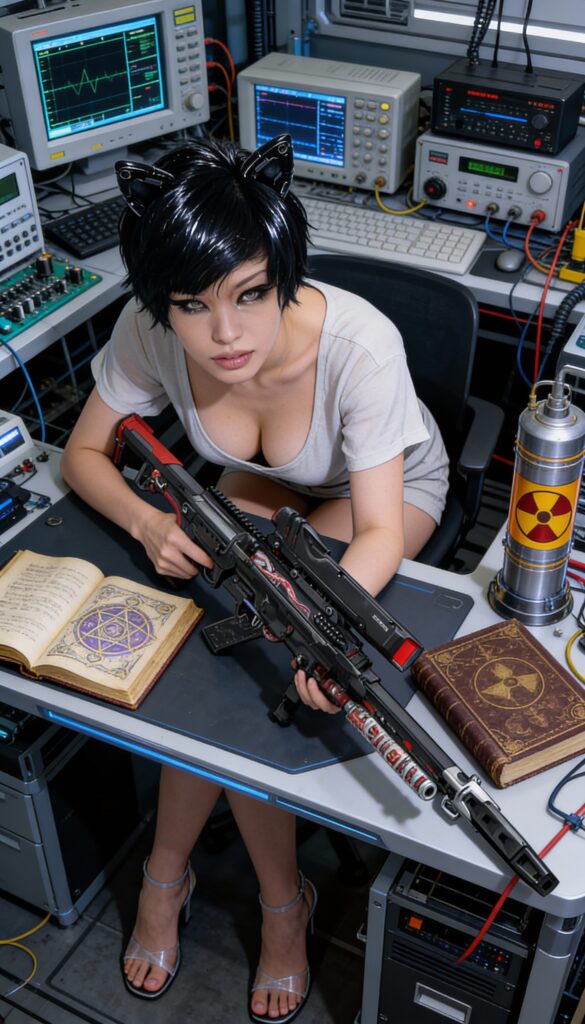
Later, when the city had fully awakened and started pretending it wasn’t haunted, Seren sat in a room that looked less like a bedroom and more like a private laboratory built for someone who treated physics as a polite suggestion. Screens hummed with quiet graphs and green lines. Equipment rested in rows like obedient instruments waiting for a conductor who never needed to raise her voice. On the desk, an open book showed geometry that wasn’t meant to be seen by eyes that wanted comfort. Another book sat nearby with an emblem pressed into its cover like a warning. A metal canister, holding pure nuclear fusion, marked with a symbol for hazard and consequence waited beside a coil of cable, as if the room itself was admitting that the things Seren worked with were not strictly meant for human hands. Seren moved through it all with steady precision, cat-ear headpiece perched like a joke only she could afford, the rifle laid across her lap as she adjusted it with the care of a surgeon closing a wound no one was allowed to know existed.
Her phone buzzed. Unknown number. No contact name, no history, just a blank digital mask the way her employers preferred.
The message wasn’t in English. It wasn’t in any language that modern institutions would admit existed. The characters looked like they had been carved into bone by people who had never agreed the world was stable. Seren read it without blinking, because she had learned the difference between nonsense and dead meaning a long time ago.
She translated it in her head the way she translated everything else: into a problem that required a solution.
WHITE WEEK INITIATED, the message meant. CLEAN THE PAGE. NO WITNESSES. NO BLEED.
A second message followed, colder.
SOLAR EVENT. UNMAKE THE UNMAKING.
Seren’s eyes narrowed just slightly. The confidence of the payment came next—not a promise, not a negotiation. A deposit hit her account with the blunt certainty of someone who believed money could be used like a key. It wasn’t flattery. It wasn’t trust. It was a warning disguised as professionalism: this mattered enough that the consequences had already been prepaid.
Seren exhaled through her nose, set the phone down, and returned to the rifle as if nothing had happened. She tightened a component, checked a connection, ran a finger along the edge of a custom module hidden beneath the weapon’s sleek shell. A logic-paradox virus lived inside that module, not as code alone but as a philosophical contradiction made executable. It didn’t “hack” systems the way normal people imagined. It introduced an argument a system couldn’t survive without rewriting itself into silence.
“You don’t get to end the sky,” Seren murmured, not to the phone, not to the employer, but to the thing that was coming—whatever it was. Her voice held no panic. Only refusal.
She didn’t run straight into the impossible. Chapter White wasn’t that kind of week. Chapter White was a week where she moved between catastrophe and humanity without ever letting either touch the center of her. So she left the lab, stepped into a brightly lit store full of color and artificial fragrance, and became a woman browsing shelves like she belonged in the ordinary world. The mirror-lined aisles made a thousand Seren reflections, and none of them were the real her. She wore a crisp white blouse tied at the waist, denim shorts cut with casual confidence, and heels that clicked softly on clean floors—every detail curated to say harmless. She reached for a palette as if the most important decision in her life was whether a shade leaned warm or cool.

A sales associate smiled at her. “Looking for anything specific?”
Seren looked up, eyes calm, and smiled back with a softness that could have convinced a saint. “Something that doesn’t smear,” she said. “I’m… busy.”
The associate laughed politely, as if “busy” meant meetings and errands instead of erasures. “Long day?”
Seren’s gaze flicked down the aisle, then back, perfectly placed. “Long week,” she corrected. “But it’ll be clean when I’m done.”
The associate didn’t understand, couldn’t understand, and that was the point. Seren paid, thanked her, and walked out with a small bag swinging from her fingers like the world’s most normal secret. Outside, Baltimore’s noise wrapped around her, and for a moment she let herself feel the strange comfort of a place that thought it was real.
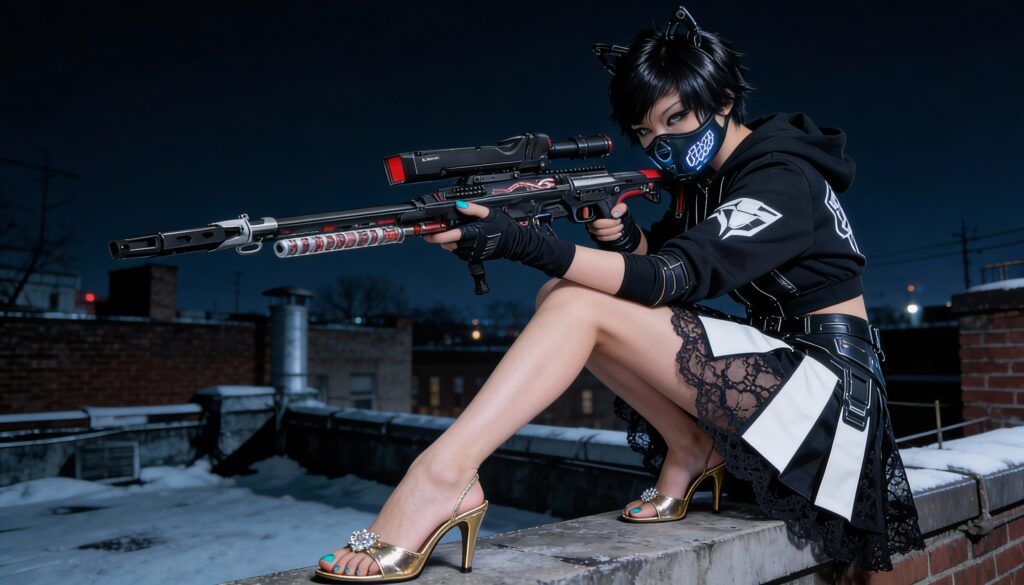
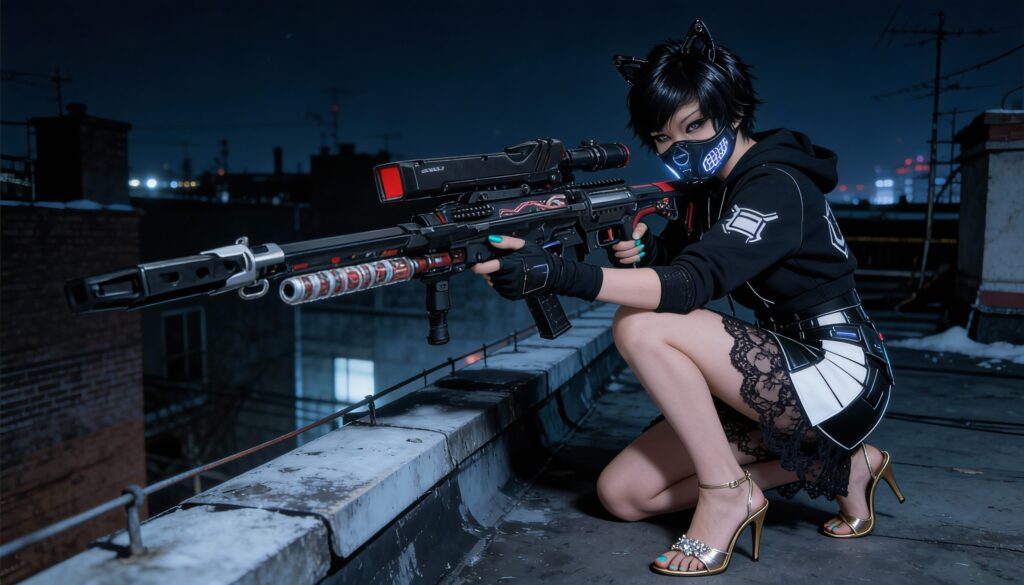
Night made her honest again. The city’s rooftops were her cathedral, not because they were holy, but because they were high enough that the world’s lies sounded smaller. Seren crouched on a ledge with the rifle braced, mask on, cat-ear silhouette cutting a strange profile against the skyline. Snow dusted concrete and ductwork. The wind tugged at her clothing like it wanted to ask questions. Her heels—gold, sharp, absurd—made her look like a contradiction: glamour perched on the edge of violence. That was her favorite kind of camouflage. People remembered what they wanted to remember, and they always wanted to remember the wrong thing.
Her phone buzzed again. Unknown number.
A string of coordinates, then a phrase in that dead language that translated into a single blunt instruction: AIM AT THE THOUGHT, NOT THE OBJECT.
Seren didn’t look up at the sky with wonder. She looked up at it like a target list.
Above the atmosphere, beyond the city’s thin ceiling of cloud and pollution, something was assembling. Not a meteor, not a satellite in any normal sense. It was an event—an engineered inevitability. A machine-pattern designed to brush the sun the wrong way, to introduce a tiny corruption into the heart of the system that fed everything living. Most people would have called it impossible because their minds needed the universe to be stable. Seren had long since learned stability was just a story the world told itself so it could sleep.

She adjusted her scope. The rifle’s readouts weren’t just distance and wind. They were meaning. They were probability folded into sight. She calculated the curvature of the earth out of habit, yes, but she also calculated the curvature of fate-like inevitablisma, the way certain outcomes tried to become “guaranteed.” Her skill was refusing guarantees. She didn’t fire at metal. She fired at the claim the event made—that it would happen.
She squeezed the trigger.
The round didn’t travel through air. It didn’t climb, arc, or obey. Space between Seren and the target simply failed to matter. The bullet appeared where it needed to be, not because it teleported like a trick, but because Seren’s entire existence was a veto against distance. The event in orbit shuddered—not in a visible way, not in a way anyone could record, but in the way a thought shudders when it realizes it’s wrong. The machine-pattern tried to compensate. It tried to rewrite itself. The paradox virus embedded in the round whispered a logic the event couldn’t endure: if you require certainty to function, you are already broken.
The event collapsed into a non-event. It didn’t explode. It didn’t streak across the sky. It simply ceased to be the thing it was going to become. Somewhere, an astronomer would later look at a gap in data and blame equipment. Somewhere, a priest would feel a sudden relief and call it a blessing. Somewhere, a billionaire would frown at a report and decide to fire a subordinate.
Seren lowered the rifle and exhaled. No fireworks. No applause. Just the quiet satisfaction of a solar system that kept existing without knowing it had almost been revised into oblivion.
That should have been enough for one night. Chapter White didn’t care about human expectations, though, and her phone buzzed again before her breath fully settled. Another target. Another impossibility. Another instruction in the dead tongue that treated reality like a contract Seren had already voided.
The next night put her near water, where the city’s concrete met a cold stretch of shoreline that looked too empty to be true. Seren walked the wet sand like she owned the horizon. She wore tactical black—cropped armor, strapped shorts, lace wrapping her forearms like elegant damage—and she carried a curved blade that looked less like a weapon and more like a question with an edge. The mask’s glow made her face unreadable, a digital snarl beneath her eyes. The target wasn’t human. It wasn’t even exactly “there” in the way humans preferred. It was an avatar of creation’s maintenance—a thing that corrected errors by deleting whatever it decided was an error. Tonight it had decided Baltimore was an error.

Seren felt it before she saw it. A pressure against the mind. A hush in the senses. A quiet insistence that everything should stop resisting and let the correction happen.
“You’re in the wrong city,” Seren said into the darkness, voice calm.
The thing moved like a revision. Like a sentence being rewritten mid-read. Its presence didn’t announce itself with sound or heat or spectacle; it announced itself with the sensation that the world was being edited. The waterline trembled. The horizon sharpened, then blurred. Somewhere in the distance, a gull’s cry vanished mid-note, as if the sound had never been permitted.
Seren didn’t charge. She didn’t posture. She stepped.
Her movement was the cruelest kind of speed—not sprinting, not blur, but the ability to exist in the gap between cause and consequence. She carved a line in the air with the blade, and the line became a binding symbol written into the world’s permission structure. The avatar recoiled, not from pain, but from offense. Seren had marked it. Seren had acknowledged it. Seren had made it subject to rules, and it hated rules it didn’t author.
The avatar struck, a pressure-wave that would have erased a city block’s worth of matter into clean nothing. Seren’s body became intangible in the same instant, not dodging but refusing participation. The wave passed through her as if she were a rumor. She stepped again, inside the avatar’s reach, and drove the blade forward—not into flesh, not into armor, but into the central premise that allowed the avatar to operate. She punctured its authority.
The avatar’s presence stuttered. It tried to reassert itself. Seren’s eyes narrowed, and her voice stayed quiet. “Not tonight.”
She twisted the blade. The symbol she’d written flared without light, a meaning-flame. The avatar unraveled into silence, not destroyed with violence, but removed like a false line in an old document. The shoreline returned to normal. The gull’s cry resumed as if it had never stopped. The city continued to pretend it was safe.
Seren cleaned the blade with a cloth, walked back to the street, and vanished into the alleyways like she had never been there.
On another night—because Chapter White was greedy—she went to an arcade and stood in front of a claw machine filled with plush toys, neon lights washing her skin in colors that didn’t belong to the dark work she did. She wore denim shorts and a soft top that made her look like a woman on a date, like someone chasing a childish prize. A group of teenagers laughed nearby, too loud, too alive. Seren watched the claw descend, miss, and rise again, and for a moment her expression softened.

A little girl tugged her mother’s sleeve and pointed. “Mom, she’s pretty.”
The mother glanced at Seren, smiled politely, then looked away because humans were trained not to stare too long at things that felt sharp. Seren’s lips curved faintly. She dropped a coin in, tried again, and this time the claw caught a plush bear with dumb luck that wasn’t dumb at all—Seren nudging probability the way she nudged bullets through impossible distances. She handed the bear to the little girl without a word.
The girl’s eyes widened. “Thank you!”
Seren nodded, and her voice was gentle when she spoke. “Take care of it,” she said. “Don’t lose it.”
The mother thanked her too, still unaware she had just accepted kindness from someone who could erase Gods quietly from Baltimore shadows. Seren watched them leave, the bear bouncing against the child’s hip, and something in Seren’s chest tightened—not pain, not regret, but longing with no name. The human side of her didn’t want blood or money or legend. It wanted a world where giving a child a toy was the most dangerous thing she had to do.
Her phone vibrated in her pocket, and the week reminded her what it was.
UNKNOWN NUMBER: NEXT CLEANING. MOVING CROWD. FOLLOW THE NEON.
So she did.
A street drenched in signage, crowds flowing like water, reflections shimmering on wet pavement. Seren walked with her back to the camera of the world, bare shoulders exposed, a small purse hanging off her hip, lace-up heels turning her steps into music. She didn’t look like a weapon. She looked like desire. That was how she hunted here. Invisible didn’t always mean hidden; sometimes invisible meant everyone looked at you and still didn’t see you.
The target walked somewhere ahead, wearing a face that belonged to someone else. A diviner who had bound a swarm of lesser infernal watchers to the crowd—eyes without bodies, attention without form. They weren’t meant to stop a normal assassin. They were meant to stop a Seren. They were meant to make her existence “register.”
Seren let them try.
She felt their attention skim her like insects testing skin. She felt the diviner’s warding-pattern ripple through the crowd, counting heartbeats, counting steps, measuring anomalies. Seren adjusted her pace by fractions no human mind could track, sliding through the gaps in surveillance like she had been designed for it. She passed a street vendor, accepted a skewer she didn’t eat, smiled at nothing, and kept walking.

Then she stepped sideways into an alley without breaking stride.
The diviner’s watchers swarmed the place she had been.
Seren was already behind the target.
She didn’t draw a gun. She didn’t swing a blade. She pressed two fingers against the back of the diviner’s neck and wrote a binding rune into skin using touch alone, her occult knowledge condensed into a gesture. The rune didn’t burn. It didn’t glow. It simply asserted a truth the diviner couldn’t fight: you are seen by the wrong thing now.
The diviner’s breath hitched. Seren leaned close, voice barely audible. “You’ve been looking everywhere,” she whispered, “except at the obvious.”
The diviner tried to speak. Seren didn’t give the attempt time to become possibility. She turned her fingers, and the rune collapsed the diviner’s connection to the watchers like a cord being cut. The watchers vanished. The diviner’s face went slack, not dead in a dramatic way, but ended—erased from the job he had been performing on reality. When Seren walked back out into the street, the crowd moved like it had moved before. Neon stayed neon. Nobody screamed. The world never knew it had just been rescued from a future it didn’t deserve.
The rooftop night returned again, because it always did. Seren crouched with a curved blade in her hand, the city behind her, a starfield above that looked too clean to be real. The galaxy hung like a bruise of light across the dark, and Seren’s silhouette—mask, cat-ears, hoodie, lace—looked like a myth someone would invent to explain why monsters disappeared. This time the target wasn’t a person. It wasn’t even a machine. It was a decision. A group of people somewhere had agreed to initiate a chain reaction—an engineered cascade meant to chew the solar system from the inside out, not by exploding the sun, but by convincing it to become something else. A philosophical weapon disguised as science. A divination-backed inevitablisma that said: the future belongs to us.

Seren watched the sky for a long moment, then spoke softly, as if addressing a listener only she could hear. “I don’t belong to you,” she said. “And neither does the sky.”
She lifted the rifle on the next rooftop, the weapon sleek and brutal in her hands, and lined up a shot at something no telescope could properly label. She didn’t aim at a point. She aimed at an agreement. The bullet carried the paradox virus again, and the virus carried something even older: Seren’s insistence that nothing is allowed to be inevitable if it demands innocent lives as payment.
She fired.
Far above, the chain reaction tried to begin—and found the first link missing. Not broken. Not severed. Missing, as if it had never been written into the universe’s script at all. The initiators would later stare at their instruments, at their runes, at their readings, and feel madness creep in because the cause they swore they triggered simply failed to exist. Their divinations would show a blank page. Their calculations would resolve into silence. Some of them would pray. Some would drink. Some would decide it was sabotage by something greater than them.
They wouldn’t be wrong.
The week ended the way it began: quiet, domestic, almost tender in a way Seren never let the world witness. She came back to Draven not with speeches, not with vulnerability dressed up as romance, but with her body simply choosing where it wanted to be when the work finally stopped pressing its teeth against her mind. In the bed, Draven held her the way he held every serious thing—firm, protective, controlled. A man built to survive disaster choosing, for a few hours, to become shelter.
Seren lay against him, eyes closed, skin still carrying the faint aftertaste of adrenaline and night air. The room was dim and ordinary. A model on the nightstand stood like a quiet reminder that even warriors needed hobbies to keep from turning into weapons full-time. Draven’s hand rested on her as if confirming she was real.

“You’re back,” he murmured.
Seren’s lips barely moved. “I said I would be.”
Draven’s breath warmed the back of her neck. “You look tired.”
Seren’s smile was a ghost. “I’m clean,” she corrected. “That’s what the week wanted. A clean page.”
Draven didn’t ask what she had erased. He didn’t ask for details, didn’t ask her to confess the weight she carried. He only tightened his hold a fraction, and in that small motion Seren felt something sharper than desire and more dangerous than intimacy: the idea that she didn’t want to spend her whole life as an absence.
Her phone buzzed, muted on the nightstand.
Unknown number.
The screen lit the room for a second with pale insistence.
Seren didn’t reach for it.
She let it ring itself into silence while Draven held her and Baltimore pretended it was safe, while the solar system kept existing without ever knowing how close it had come to being rewritten into nothing.
And in the quiet after the buzz, Seren realized what she wanted more than anything wasn’t money or legend or the thrill of impossible work. It was a life where the world didn’t need her to be Invisible. It was a life where her hands could be used for more than corrections. It was a life that didn’t demand she be a ghost just to keep everyone else breathing.
Chapter White ends with that realization sitting inside her like a blade she hadn’t decided whether to draw.
Outside, the city kept making noise.
Inside, Seren finally let herself rest—still the world’s greatest assassin, still a walking contradiction, but for a few hours, simply a woman in someone’s arms, choosing to exist.