
Song of the Demon Queen I
The house had already gone quiet in that way that made every sound feel like it belonged to someone else. The hallway light outside the bathroom door was off, the living room was dark, and the only illumination that mattered came from the small rectangle in Eira’s hands, tinting her fingers and the underside of her face with that soft, indifferent glow that social feeds always carried, no matter what they were showing. She sat on the edge of the tub with her knees drawn up, back pressed to the cool mirror-panel, and the tiles beneath her legs held a clean chill that made her feel awake even while the rest of the home leaned into rest. A towel bar held folded cloths that looked too neat to be accidental, and the sink’s chrome caught little highlights that made it look like a cold eye. Eira’s shirt was a black graphic tee with a ribcage print stretched across the front like a joke that never quite landed, and her dark joggers were loose enough to be comfortable but fitted at the ankles so she didn’t trip when she moved. She wasn’t trying to look like anything. She was trying to disappear into a corner where she could think.
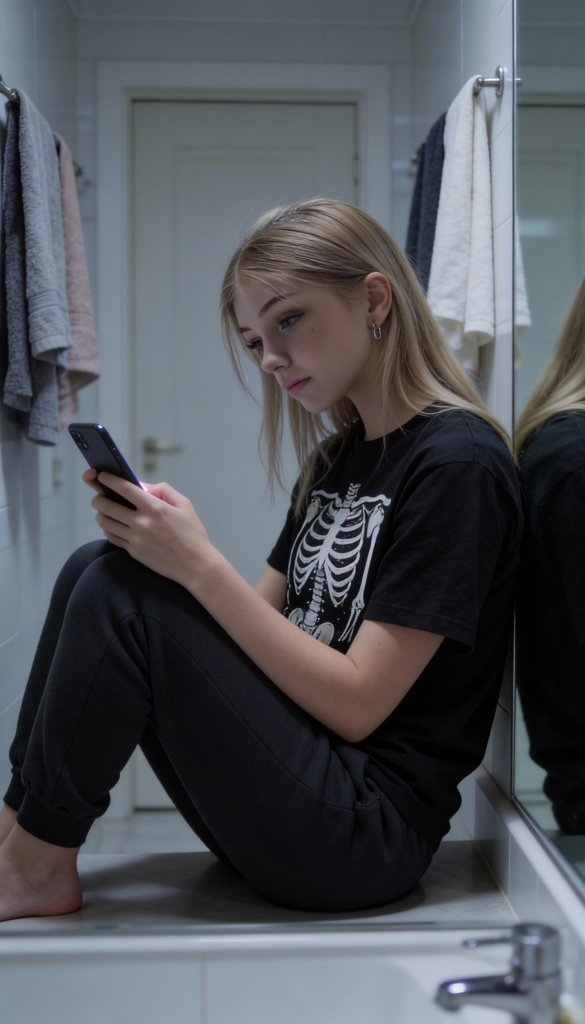
Her phone vibrated again, not a ring but a subtle insistence, and the group chat lit up with the kind of energy that always arrived when people pretended they weren’t tired. Adonis was first, because Adonis always got there first; it was never loud, but it was immediate, like she’d been waiting for a reason to speak.
Eira stared at the message bubble and smiled without meaning to.
Adonis: “You awake, or are you doing that thing where you’re awake but you’re pretending you’re not?”
Eira: “That’s not a thing. That’s a lifestyle.”
Adonis: “Same. I can feel my brain chewing on nothing.”
Eira: “That’s because you refuse to rest like a normal person.”
Adonis: “Normal people are a rumor.”
A second bubble appeared almost instantly, and Eira could practically hear Adonis’s tone inside it—dry, blunt, honest in a way that made adults uncomfortable and friends feel safer.
Adonis: “Did you see the video going around? The one with the alley behind the laundromat?”
Eira’s thumb paused over the screen. She hadn’t opened the clip, not because she didn’t want to, but because she’d learned that some things were invitations. Some images weren’t information; they were hooks. She tilted her phone slightly, letting the reflection in the mirror catch the edge of the screen, and for a fraction of a breath the reflection didn’t align with the device in her hand. The mirror lagged behind her movement as if it needed to remember what she looked like before it agreed to show it. It corrected itself so fast she could have dismissed it as her eyes, but Eira didn’t dismiss things like that. She didn’t get to.
Eira: “I saw it trending. I didn’t click it.”
Adonis: “Good.”
Eira: “That makes me want to click it more.”
Adonis: “That’s how it gets you.”
There it was again—Adonis’s way of speaking like the world was a set of traps and she’d been studying the mechanisms long enough to recognize the spring before it snapped. Eira shifted her weight, the tile biting into her skin through the fabric, and she typed back with the practiced speed of someone whose mind never slowed down even when she wanted it to.
Eira: “What is it?”
Adonis: “It’s the same block. The same complaints. ‘Something in the alley.’ ‘Roaches.’ ‘It moved.’ ‘My cousin—’ and then people stop typing like they forgot the rest of the sentence.”
Eira: “Maybe they got embarrassed.”
Adonis: “Maybe the sentence got taken.”
Eira read that twice. The bathroom felt suddenly smaller, not claustrophobic, just… precise, like the walls had decided to listen. Her phone vibrated again, and this time it wasn’t Adonis.
Nyra: “U up??”
Eira’s chest softened in that immediate older-sibling way, the part of her that could be sharp and unkind to the world becoming gentle without effort for the two people she’d sworn she would never let drown in the same storms she’d already walked through.
Eira: “Yeah. You okay?”
Nyra: “I saw something outside my window earlier. Like a shadow but it was wrong. Mom said it was a tree.”
Eira didn’t ask which mom. She didn’t need to. The word “mom” carried different meanings depending on which home held the night’s quiet. Eira’s jaw tightened, then eased, then tightened again as she typed.
Eira: “Did it move like a shadow, or did it move like it was pretending to be one?”
Nyra: “Pretending.”
Eira: “Curtains closed?”
Nyra: “Yes.”
Eira: “Door locked?”
Nyra: “Yes.”
Eira: “Okay. That’s good. If it comes back, don’t stare at it. Don’t argue with it. Don’t dare it. You hear me?”
Nyra: “I know. I know. I didn’t. I just felt it.”
Eira: “Text me if you feel it again. I’m not sleeping.”
Nyra: “You never do.”
Eira’s smile returned, faint and brief. She switched to Liora’s chat, already anticipating the response.
Eira: “You awake?”
Liora: “Eira.”
Eira: “That’s not an answer.”
Liora: “I was. Now I’m annoyed.”
Eira: “Perfect. Stay annoyed. Annoyed people are alert.”
Liora: “Nyra told you about the window.”
Eira stopped typing. The mirror in front of her held her profile, her gaze lowered to the phone, her expression calm. The reflection did not show the micro-tension in her shoulders. It didn’t show the way her brain was already mapping the layout of Nyra’s room, the line of sight from the window, the streetlamp angles, the shadows that should exist, the shadows that shouldn’t. Eira’s mind was a calculus that never asked permission.
Eira: “Yeah. You both are good?”
Liora: “We’re fine. You’re the one who acts like the world is a loaded gun.”
Eira: “Because it is.”
A new message flashed, sliding into her notifications like something bright and reckless.
Draven: “Send me your best meme. I’m confiscating laughter from the universe.”
Eira exhaled through her nose, the closest she came to a laugh when she was thinking hard. Her father’s texts were always like that—dry humor sharpened into something that could cut through fear without naming it. He never wrote “I’m worried.” He wrote jokes like he was daring the world to confess it couldn’t take everything from them.
Eira: “You’re stealing laughter again? That’s a felony.”
Draven: “It’s only a felony if the law can describe it.”
Eira: “That is exactly what a criminal says.”
Draven: “Then I learned from the best.”
She scrolled, found a short clip—a cartoon character staring into a cosmic void with the caption “When you realize the assignment was due yesterday” —and sent it. Immediately, Draven reacted with the kind of emoji that looked like a man trying to pretend he wasn’t smiling. Eira stared at the thread for a moment longer than she needed to. She didn’t say what she wanted to say. She didn’t type the obvious questions. She didn’t ask him if he’d felt anything shift in the neighborhood. She didn’t ask him if the Clinic had any new cases that made his shoulders heavier than usual. She didn’t ask him if he was safe. That wasn’t how Draven lived in public, and Eira had learned to respect the armor he wore for everyone else.
The group chat buzzed again. Tremaine finally arrived, and when he did, the tone changed.
Tremaine: “You’re all awake. So I’m awake.”
Nene: “That’s not how responsibility works, Tremaine.”
Tremaine: “It is when you’re all determined to be stupid together.”
Adonis: “We weren’t being stupid. We were being vigilant.”
Tremaine: “Vigilant is a word people use when they want to dress panic in nicer clothes.”
Eira read that and felt the edge of irritation rise in her chest, not because he was wrong, but because he was always close enough to the truth to make it difficult to ignore. She typed carefully.
Eira: “Nobody’s panicking.”
Tremaine: “You’re in a bathroom with the lights off and you’re using a mirror as a second screen.”
Eira blinked. Her fingers froze on the phone.
Eira: “How would you know that.”
Tremaine: “Because you always put yourself in corners when you’re thinking. You like walls. You like angles. You like control.”
Nene: “He’s not wrong.”
Eira: “I hate all of you.”
Adonis: “No you don’t.”
Nene: “Also, why are we acting like the mirror thing is weird? Mirrors are literally portals. People just pretend they’re not.”
Tremaine: “Don’t encourage her.”
Nene: “I didn’t. I encouraged the truth.”
Adonis: “I’m sending the clip.”
Eira’s thumb hovered as the video arrived in the chat. A blurry recording, angled wrong, caught by a phone held with shaking hands. A narrow alley, brick walls, trash bags, a broken fence. A low chittering sound that didn’t feel like ordinary insects; it felt like something imitating them. Then, near the far end of the alley, the camera shifted and the image tore—like the pixels couldn’t agree on what they were supposed to show. A ripple passed through the manifest expanse, subtle as heat-haze but colder, like the air itself had become a sheet of glass being flexed. Something moved inside the ripple. Not fast. Not dramatic. Just present.
The clip ended before it could explain itself, and the comments beneath it were a war between mockery and fear, people calling it fake, people swearing it was real, people laughing too hard to convince themselves they weren’t bothered. Eira watched it once, then again, then a third render, each viewing more careful than the last. She didn’t feel fear in the obvious way. She felt recognition. She felt the sensation of a seam in the world being pulled.
Adonis: “See what I mean. They stop typing.”
Tremaine: “That’s because this clip is bait. It’s sloppy bait.”
Nene: “Bait is still bait even when it’s sloppy. The hook doesn’t care if the fisherman is elegant.”
Eira’s eyes stayed on the freeze-frame she’d captured, her thumb holding the screen down. In the ripple, there was a distortion that wasn’t only visual. It was ontological. It was the sensation of something insisting the alley belonged to it. Eira swallowed slowly.
Eira: “We’ll look at it. Not now. Later.”
Tremaine: “Define later.”
Eira: “When the house wakes up.”
Nene: “You mean when the world pretends it’s safe again.”
Adonis: “Eira. You’re at your mom’s.”
Eira glanced toward the bathroom door. The home was silent. Her mother’s presence in the house wasn’t loud, but it was absolute—like the quiet itself belonged to her. Eira typed back, softer.
Eira: “Yeah. I’m here.”
Tremaine: “Okay. Then don’t be reckless. Don’t go looking for problems from inside a house that’s trying to hold you.”
Eira didn’t answer immediately. The mirror held her stillness, held the curve of her shoulder against the glass, held the ribcage print on her shirt like a reminder that bodies were temporary. She turned the phone in her hands, watching the reflection keep up this time, and decided not to test it again.
Eira: “I’m not going anywhere.”
Nene: “That’s a lie.”
Eira: “That’s a promise I’m making for a few more renders.”
Adonis: “Send one more meme to your dad. Then go sit on your bed like a person.”
Eira: “You’re bossy.”
Adonis: “You’re alive. Don’t ruin it.”
Eira read that and felt something like gratitude twist beneath the surface. She didn’t type it. She saved it. She sent her father one more image—a screenshot of a cat glaring at a calculator with the caption “Advanced math is just numbers arguing”—and then she finally stood, joints stiff from the tile, and slipped out of the bathroom with the careful silence of someone who didn’t want to wake the house’s dreams.
When the home brightened again, it did it in stages. Not a single switch flipped, but an accumulation of signals: the faint sound of the kitchen, the television waking into a low murmur, the scent of something warming on a stove, the soft rhythm of footsteps that belonged to a woman who moved like she knew where every object was without looking. Eira found her mother in the living room on the white sectional sofa, relaxed in a posture that looked casual until you noticed how deliberate it was—shoulders back, gaze forward, one arm draped with ease that still kept her ready to sit up if something demanded it. The television was showing a reel of clips and headlines, people talking over one another, influencers laughing too loudly, a scrolling banner about missing teens, a short segment about a neighborhood petition to “clean up the alley behind the corner store,” and then a sudden switch to a viral dance as if the world could erase its own seriousness by changing channels.
Eira sat beside her, leaning back into the cushion. In this light she looked younger, not because she was naïve, but because she had a softness that only existed around her mother—like the nervous system finally believed the room would hold it. She wore a simple light-blue tee and dark track pants with side stripes, and her sandals were thrown on without ceremony, the kind of choice that said she wasn’t trying to be impressive. Her mother glanced sideways, the expression composed but warm, and reached over to tuck a strand of hair behind Eira’s ear without thinking. Eira didn’t flinch. She let it happen.

“You were up,” her mother said, not as a question.
Eira’s eyes stayed on the television, where a reporter’s lips moved too quickly as she spoke about “another unsettling incident,” her voice polished, her concern contained. “I wasn’t sleeping,” Eira admitted.
Her mother’s gaze returned to the screen. “You don’t have to be on guard in here.”
Eira didn’t answer right away. The television showed a shaky clip of a street corner, sirens blurred into bokeh, someone recording from behind a window. The caption said something about a disturbance, something about a suspect, something about fear. Eira watched the people in the clip react like prey that didn’t know what hunted it.
“I’m not on guard,” Eira said finally. “I’m just… listening.”
Her mother hummed, like she understood that word meant more than sound. “Listening to what.”
Eira turned her head slightly. Her mother’s eyes were clear. There was no panic in them. There was something stronger than panic: an unwillingness to pretend. “Things that don’t want to be heard,” Eira said.
The television shifted again, and suddenly it was a panel of commentators laughing about a celebrity scandal. The emotional whiplash made Eira’s mouth tighten. Her mother noticed.
“They do that on purpose,” her mother said. “They mix tragedy and jokes until people forget they’re allowed to be angry.”
Eira’s gaze sharpened. “You notice that too.”
Her mother gave a small smile that wasn’t quite amused. “I notice a lot. I’ve had to.”
Eira leaned back into the sofa, feeling the cushion support her spine. “There’s a clip going around,” she said, and tried to keep her voice casual. “An alley. People are calling it fake.”
Her mother didn’t look at her, but her body shifted subtly, the way an animal shifts when it hears a particular kind of sound. “And you think it isn’t.”
Eira shrugged, a gesture that failed to hide the seriousness beneath it. “I think it’s… complicated.”
Her mother finally turned, studying Eira with that careful patience mothers used when they wanted to be gentle but couldn’t afford to be ignorant. “Complicated like your father’s work.”
Eira’s throat tightened at the mention of him. “He doesn’t call it work,” she said.
Her mother’s gaze softened. “Because if he calls it work, he has to admit it’s consuming him.”
Eira stared at the television again. The panelists’ laughter sounded like static. “He’s fine,” Eira said, and knew it was a lie the second it left her mouth.
Her mother didn’t argue. She reached for the remote and lowered the volume instead, turning the room into something less invaded by strangers’ voices. “Eira,” she said, and the way she said it made the name feel like a hand on the shoulder. “You are allowed to be sixteen.”
Eira felt irritation rise—not at her mother, but at the universe for daring to offer permission it never honored. “I am sixteen,” she said. “That’s the problem.”
Her mother’s eyebrows lifted slightly, inviting her to explain.
Eira picked at the seam of her track pants, the small nervous movement betraying the part of her that wasn’t always composed. “People treat sixteen like it’s… small,” she said. “Like it’s supposed to be safe. But it’s not safe. Not for everyone. Not in this city. Not for girls. Not for kids who disappear and don’t come back the same. Not for people who get taken and nobody notices until it’s too late.”
Her mother’s jaw tightened, but she didn’t interrupt. She let Eira speak, which was its own kind of protection.
“I don’t want to be like him,” Eira said, then corrected herself before the sentence could grow sharp. “I do. But I don’t. I don’t want to become something cold. I don’t want to walk through the world like everything is a threat. But I can’t unsee things.”
Her mother’s hand settled on Eira’s knee, warm and steady. “You won’t become cold,” she said. “You’re too angry. Anger is heat. It keeps you human.”
Eira’s mouth twitched. She wanted to argue about the word “human,” about what it meant in a world where some things wore faces they didn’t deserve, but she didn’t. She let her mother’s hand stay there and felt the grounding of it.
“You have school,” her mother said after a pause, voice returning to the practical. “And you have that ridiculous schedule of yours.”
Eira sighed, performing boredom to hide relief that the conversation wasn’t going to turn into a lecture. “Four classes,” she said. “All of them want me to pretend the world is exciting.”
Her mother’s lips curved, faintly proud. “Your GPA is absurd.”
Eira rolled her eyes. “It’s not a personality trait.”
“I didn’t say it was.” Her mother squeezed her knee once, gentle. “But it means you’ve been working hard. Even when you’re pretending you haven’t.”
Eira stood, stretching her arms over her head like she could shake off the heaviness that had settled in her bones across too many renders. “I’m going,” she said.
Her mother watched her with a look that held love and worry braided together so tightly you couldn’t separate them. “Text me,” she said.
Eira nodded. “Always.”
At school, the day unfolded like a ritual that didn’t care whether she believed in it. The hallways were full of noise, lockers slamming, laughter bouncing off painted cinderblock, teachers calling names with the practiced fatigue of people who’d been doing this too long. Eira moved through it with ease, not because she was careless, but because she had learned how to wear normal like a cloak. Her phone stayed in her hand more than it should have, screen dimmed, thumb flicking, not to escape reality but to keep it at a manageable distance. She sat in advanced physics first, posture relaxed, eyes half-lidded, listening to a teacher explain a principle she’d already mapped in her mind into a dozen variations. The teacher wrote on the board as if the chalk could make truth more stable. Eira watched the chalk dust fall like snow and felt her boredom stretch into something almost painful.
Her phone buzzed. A meme from her father: a picture of a scientist staring at a whiteboard covered in scribbles, captioned “When the numbers start arguing back.” Eira’s lips twitched. She tapped out a response.
Eira: “Stop breaking laws while I’m trying to be educated.”
Draven: “Education is a rumor. Stay sharp.”
Eira: “That’s not helpful.”
Draven: “It’s honest.”
Eira looked up from her phone just in time to catch her teacher’s gaze. She didn’t flinch. She didn’t look guilty. She simply looked… absent, like her mind was elsewhere, which was true.
Chemistry came next, then calculus, then statistics, each class more advanced than what most students would ever touch, and each one still not enough to keep Eira’s brain from chewing on the world outside the classroom. She answered questions without raising her hand. She wrote notes that looked like art. She corrected an equation in her head and didn’t bother to say it out loud because it would only start a war with the instructor’s pride. She wasn’t trying to be disrespectful. She was trying not to scream.
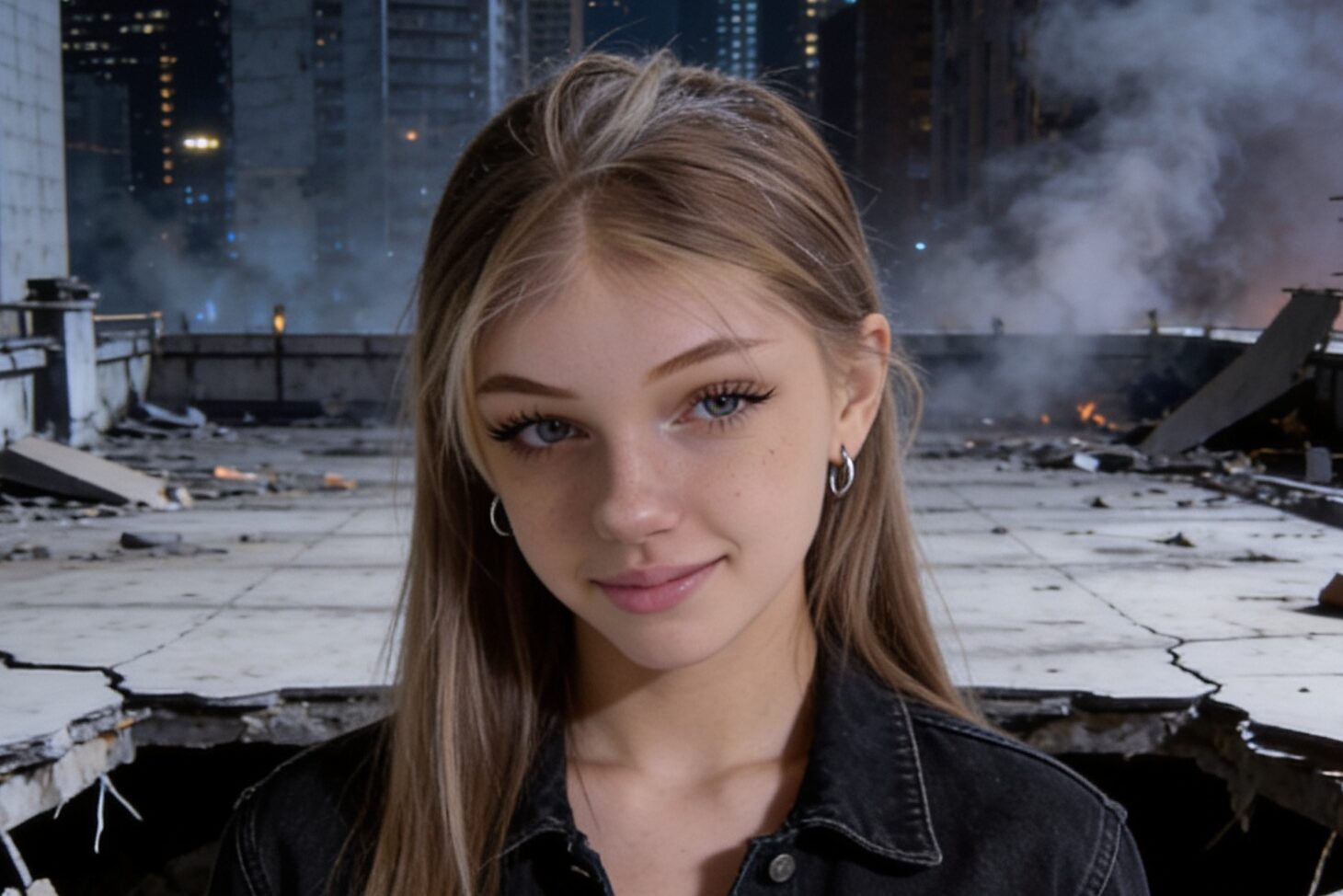
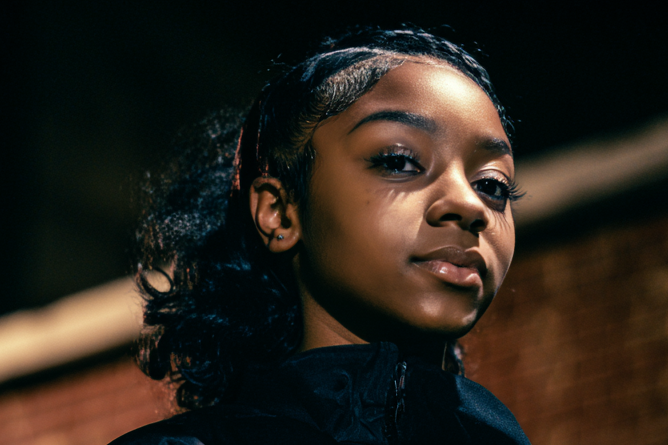
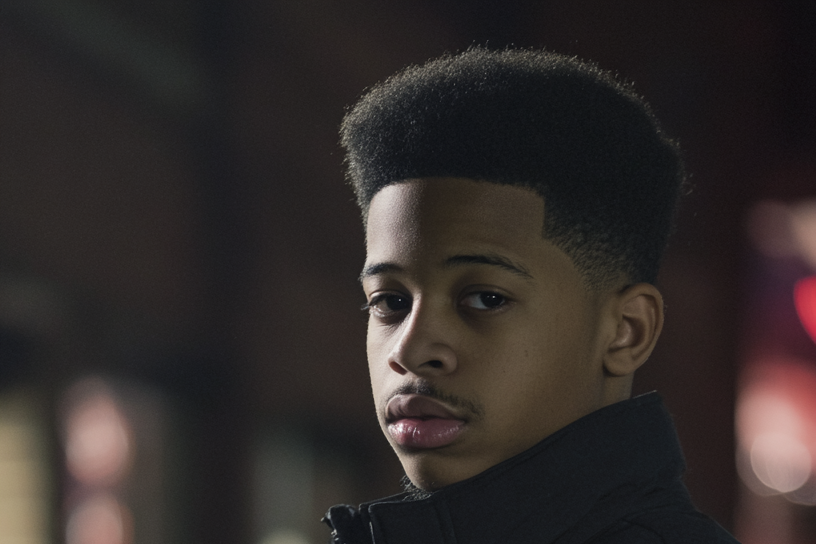
Between classes, she found her friends the way gravity found objects. It didn’t matter how crowded the halls were; the group always formed its own center. Tremaine leaned near a pillar with his black jacket zipped high, posture still, gaze scanning, like he was always measuring the room’s mood for fractures. Adonis stood with a cropped zip-up windbreaker pulled snug, the “4” patch stark against the fabric, her expression calm but watchful, eyes sharp in a way that made people think twice before approaching her with nonsense. Nene was a contrast—soft sweater with embroidery across the chest, long scarf draped in a bold strip of color that made her look like she belonged in a different world than the fluorescent hallway, her stance easy, one hand half-lifted as if she was always about to gesture a secret into existence.

“You look like you didn’t sleep,” Nene said, voice light but eyes knowing.
Eira tilted her phone. “I did the thing where I rested my body while my brain committed crimes.”
Tremaine’s mouth tightened. “That’s not a joke.”
“It is,” Eira said. “It’s just not funny.”
Adonis’s gaze slid over Eira’s face. “You watched it.”
Eira didn’t ask what “it” meant. She didn’t need to. She gave a small nod.
“Okay,” Adonis said, as if that settled something. “We don’t talk about it here.”
Nene’s lips curved. “We can talk about it anywhere if we use the right language.”
Tremaine glanced at her. “Don’t.”
Nene shrugged, unbothered. “I didn’t say I would. I said we could.”
Eira shifted her weight, feeling the tile-cold sensation of last render still in her knees as if her body remembered. She looked at her friends and felt the strange comfort of knowing she wasn’t alone in her awareness. “How’s everyone,” she asked, and the question meant more than grades.
Adonis’s eyes narrowed, then softened. “I’m fine.”
Nene’s smile stayed too bright. “I’m perfect.”
Tremaine’s gaze held steady. “We’re here.”
Eira nodded once, accepting that as truth for this render. Then her phone buzzed again—Nyra.
Nyra: “I’m good. No window shadow. Liora said stop worrying.”
Eira typed back with quick fingers.
Eira: “I’m not worrying. I’m being annoying. It’s my love language.”
Nyra: “lol.”
Eira sent the same message to Liora, adding a stupid sticker that made the conversation feel normal. Then she slipped her phone into her pocket and let herself exist in the hallway for a breath, surrounded by voices that didn’t know what hid behind the walls of the world.
Break period arrived like a sanctioned pause, a structured moment where students pretended the day belonged to them. The courtyard and corridors filled with clusters—friends, couples, rivals, the social architecture of teenage life built out of glances and whispers and alliances that could shift in a single render. Eira leaned near the side wall with her friends, posture relaxed, gaze distant, phone in her hand again because it was easier than letting her eyes drift to things she might notice.
That was when she heard Brianna.
It wasn’t the first time. It wouldn’t be the last. Brianna’s voice carried, not because she was loud by accident, but because she had learned that sound was a weapon. She stood with a small pack of girls near the vending machines, black cropped jacket zipped halfway, the fabric puffed slightly in the sleeves, jeans fitted and worn, a set of keys clipped at her waist like she wanted to sound dangerous when she moved. Her stance was planted, chin lifted, the kind of posture that dared the world to challenge her. She wasn’t smiling. She rarely did. Her expression was a permanent warning.
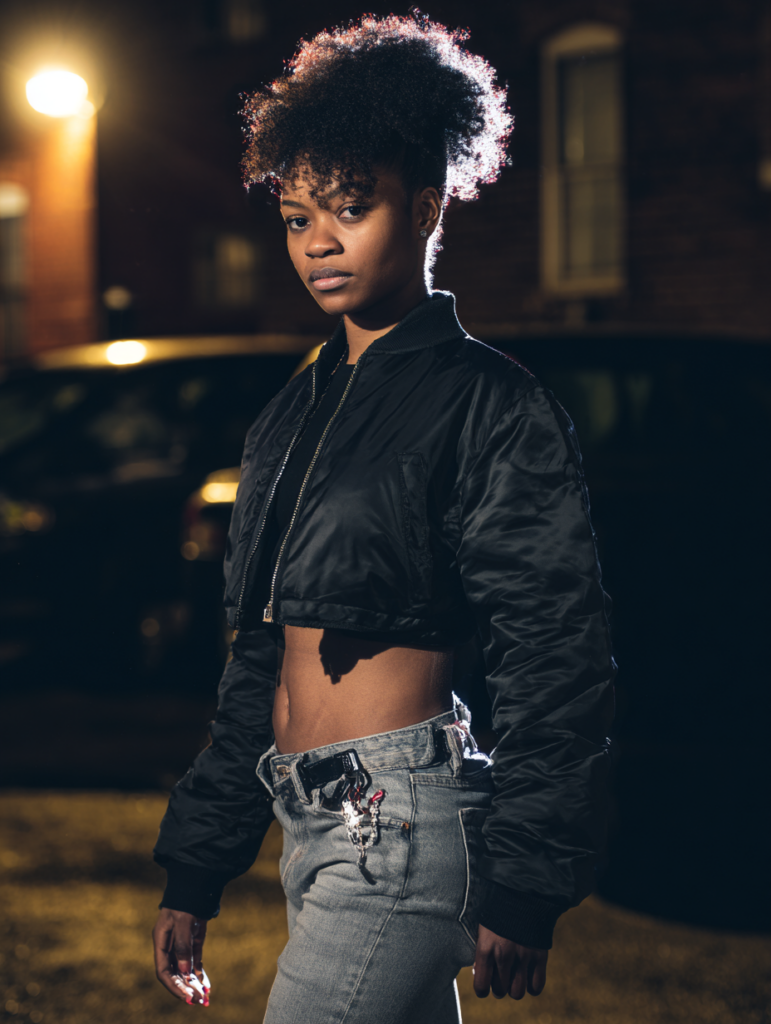
“There she go,” Brianna said, eyes cutting toward Eira like a blade thrown with precision. “Acting like she too good to even look at people.”
One of the girls with her snickered. “She always on her phone.”
Brianna’s lips curled. “Like she got somewhere important to be. Like she not just a little girl playing smart.”
Eira didn’t look up. She didn’t need to. She felt the words like a breeze that carried grit, annoying but not dangerous. She’d learned long ago that envy liked to dress itself as disdain.
Tremaine’s body shifted, subtle. Adonis’s gaze sharpened. Nene’s smile faded into something colder.
Eira lifted her eyes then, slowly, letting Brianna see she’d been heard without giving her the satisfaction of a reaction. She didn’t glare. She didn’t smirk. She simply looked—calm, disinterested, present.
Brianna’s voice rose, irritated by the lack of impact. “And my man keep talking about her like she some kind of prize.”
Eira blinked once. The name “my man” landed like a childish claim. She felt nothing about it except mild confusion. She didn’t know Brianna’s boyfriend. She didn’t care to. People in the hallway were always looking at something; she had never taken it personally.
Adonis took one step forward, not aggressive, just… claiming proximity. “You want attention,” Adonis said, tone flat. “There are better ways.”
Brianna’s eyes snapped to her. “Who you talking to?”
“The person talking too loud,” Adonis replied.
Nene let out a small sigh, like she was bored by the ritual. Tremaine’s gaze stayed on Brianna, steady and quiet, not hostile, but unyielding.
Brianna’s mouth tightened. “Y’all her bodyguards now?”
Eira finally spoke, voice calm, and in that calm there was something sharper than any insult. “I don’t know your boyfriend,” she said. “I don’t want your boyfriend. You don’t have to compete with me. You can compete with his eyes.”
The words were simple. They weren’t cruel. They were true.
Brianna flinched like she’d been struck, not physically, but ontologically—like the world had collapsed a small lie she’d been using to justify her anger. Her face hardened immediately, rage rushing in to cover embarrassment.
“You think you funny,” Brianna snapped. “You think you—”
Tremaine spoke then, voice low, not theatrical. “Walk away.”
Brianna’s eyes cut to him, and for a second something like calculation appeared. Tremaine wasn’t loud. He wasn’t flashy. But there was a gravity to him, a refusal to be moved, and even delinquents recognized that kind of presence.
Brianna scoffed instead, performing dominance for her friends. “Whatever,” she muttered, and turned away with a sharp movement that made her keys jingle like a threat.
Eira watched her go and felt the hallway settle back into its usual noise. She didn’t feel victorious. She felt tired. She glanced at her friends.
“I didn’t even do anything,” she said.
Adonis’s mouth twitched. “You did the worst thing.”
“What.”
“You told the truth.”
Nene smiled again, small and bright. “Truth is an aggressive modality in a world that runs on performance.”
Tremaine exhaled, gaze still scanning the crowd as if he expected something else to rupture. “Don’t underestimate her,” he said.
Eira didn’t argue. She didn’t think Brianna was a cosmic threat. But she did understand what Tremaine meant: harm didn’t always arrive wearing claws. Sometimes it arrived wearing jealousy and a willingness to make someone else bleed just to feel less small.
The rest of school drifted by in that hazy way it always did when Eira’s mind refused to fully enter the building. She sent Nyra a check-in. She sent Liora a sticker that made her roll her eyes. She sent her father a meme about statistics being “numbers gossiping.” She answered three questions without raising her hand. She corrected a teacher silently. She watched a fluorescent light flicker and felt the flicker misalign for half a breath—as if the bulb had blinked out of existence and returned slightly wrong. She stared at it until it stabilized, then wrote nothing down, because writing it down would make it real in a way she didn’t want.
By the time she walked out of the school, the sky had dimmed into that deep urban blue that made streetlights look like halos and alleys look like mouths. The city’s manifest expanse felt heavier in this render, as if the structures themselves were tired. Eira met her friends where they always met when they didn’t want anyone else to notice—a place just far enough from normal foot traffic to feel private, but not so isolated that it became foolish.
They moved together toward the block from the video, not rushing, not dramatizing, walking with the practiced ease of teenagers who knew how to look like they were just hanging out. Eira wore a cropped denim jacket over a dark top, the sleeves textured and thick, and her skinny jeans were worn at the knees in a way that made them feel lived-in rather than fashionable. Her sandals were simple, strapped, and quiet against the pavement. She kept her hands in her pockets, and inside one pocket her fingers rested on the shape of the dagger’s sheath, a secret weight against her palm. Ixchel wasn’t loud. It didn’t hum like a fantasy weapon. It existed like a decision.
They reached the alley behind the laundromat and the corner store, and the first thing Eira noticed was how ordinary it tried to look. Trash bags. A dented dumpster. Brick walls damp with old grime. A chain-link fence with a bent section that suggested someone had forced their way through. The ground was littered with fragments—bottle caps, paper scraps, something glittering that might have been broken glass or might have been something else pretending.
The second thing she noticed was the absence of the usual sounds. The block still lived around them—cars passing, distant voices, music bleeding from someone’s window—but the alley itself felt muted, like it existed behind a pane of thick glass. Eira stopped just before the entrance, posture casual, eyes narrowing.
“You feel it,” Nene murmured, voice soft.
Eira didn’t answer. She didn’t want to validate the sensation out loud. She wanted to measure it.
Tremaine stepped slightly ahead, not leading, but shielding by instinct. His hands stayed visible, empty, posture calm. Adonis’s gaze moved along the brick walls, taking in details. She looked like she was simply watching shadows, but Eira knew she was reading patterns, searching for the kind of inconsistency that meant something was wearing the alley like a costume.
They stepped in.
The chittering began almost immediately, faint at first, like a distant hiss of static. It wasn’t a single sound. It was layered—tiny clicking stacked over other tiny clicking, a chorus of small mouths rehearsing an appetite. Eira’s skin tightened along her arms. Her mind reached for definitions: roaches, infestation, pests. The definitions felt too small. The alley didn’t feel like it had insects. It felt like it had a hunger dressed as insects.
A movement flickered near the dumpster. A cluster of glossy bodies crawled over one another, too many legs, too much coordination. Then they paused, as if listening, as if the swarm itself had sensed it was being observed.
Eira’s fingers closed around Ixchel’s handle inside her pocket, not drawing yet. Her heartbeat stayed steady. She didn’t let fear drive. She let it inform.
A second ripple passed through the alley, subtle as breath, and the brick wall to her left looked briefly… wrong. The mortar lines shifted, then corrected. The graffiti tag near the fence blurred, then sharpened. Eira’s stomach tightened, not from nausea but from recognition. This wasn’t just an infestation. This was a fracture—possibility splitting, reality stuttering, illusion testing its edges.
Nene lifted her hand slightly, palm open, as if she was greeting something invisible. The glow that formed above her skin wasn’t flashy; it was structured, precise, a lattice of symbols and circles that looked like geometry dreaming itself into language. It hovered near her hand like an argument made of light.

Tremaine’s gaze flicked toward her hand, then away, keeping watch down the alley. He didn’t narrate what she was doing. He didn’t ask. He simply adjusted his stance, as if aligning himself with a field only he could feel.
Adonis reached into her jacket pocket and pulled out something small—an object that looked mundane until you noticed the way she held it, careful, respectful, like it was a key. She didn’t raise it. She didn’t perform. She just… prepared.
The roaches moved again.
They didn’t rush. They didn’t scatter. They advanced as a single organism wearing many bodies, a crawling tide that didn’t care about the alley’s debris because it didn’t need to. The ground beneath them seemed to accommodate their movement, like the manifest expanse was cooperating. Eira took a step back, forcing herself to breathe evenly.
A shape appeared behind the swarm, deeper in the alley where the shadows thickened. It was not a person. It was not an animal. It was a suggestion—an absence shaped like a body, a void where the world refused to fully render detail. For a heartbeat, Eira’s eyes tried to fill it in with something familiar. Then she understood that was the trap.
She closed her eyes for a fraction of a breath and opened them again, letting her gaze soften, refusing to force the world into a shape it wanted to use against her.
Ixchel slid into her hand.
The dagger was small compared to the threat, which was precisely why it mattered. It wasn’t meant to overpower. It was meant to collapse. Eira drew it with a smooth movement that didn’t look dramatic, only necessary. The blade caught the alley’s dim light and returned it coldly. She didn’t announce herself. She didn’t shout. She simply stepped forward and let the weapon become an extension of her will.

The first roach reached her foot, then another, and another, their legs tapping against the pavement like a hundred tiny needles. Eira lowered the dagger and traced a short line in the air—nothing extravagant, just a clean motion. The line didn’t cut flesh. It cut permission.
The swarm hesitated. Not because it feared pain, but because the alley itself hesitated, as if it had forgotten whether this thing was allowed to exist here. Eira felt the shift and pressed into it, her mind focusing on a single thought: collapse the lie. Collapse the modality that lets hunger pretend it’s natural. Collapse the story that says small things can become a god in an alley simply because people stopped looking.
The roaches recoiled, not flying back, but losing cohesion, their movement stuttering as if the swarm’s unity had been snipped. Some fell still. Some crawled in confused circles. The chittering changed pitch, becoming irritated, angry, like something was speaking through them now.
Nene’s light lattice tightened, the symbols shifting as if rearranging themselves into a new sentence. The glow pulsed once, and the alley’s shadows shivered. The roaches nearest her hand froze, their bodies flickering between positions as if the world couldn’t decide where they belonged.
Adonis stepped forward, small object still in her hand, and murmured something under her breath that sounded like a phrase you’d say when you didn’t want the walls to understand. The air around her—no, the manifest expanse around her—felt subtly denser, like a boundary had been drawn without being drawn.
Tremaine moved with quiet speed, placing himself between the girls and the deeper shadow, his hands lifting slightly, palms out, not aggressive, but protective. Eira could feel something building behind him—an invisible pressure that promised restoration, defense, and the refusal to let the alley take what it wanted.
The void-shape behind the swarm shifted, and for the first time, Eira felt something like attention land on her. It wasn’t the swarm’s attention. It was something else, something higher, something that didn’t belong to the alley at all.
She glanced, instinctively, toward the far end of the block—past the alley mouth, past the streetlights, past the edge of what any normal person would consider relevant.
And she sensed it.
Not a monster. Not a demon. Not a human. A presence that felt like an editorial hand hovering above the page of the world. A Zenithmu, distant, not intervening, simply observing with the cold patience of something that didn’t need to hurry because it had authority over outcomes. Eira didn’t see a silhouette clearly. She felt the implication of a watcher whose gaze could revise the rules if it chose to.
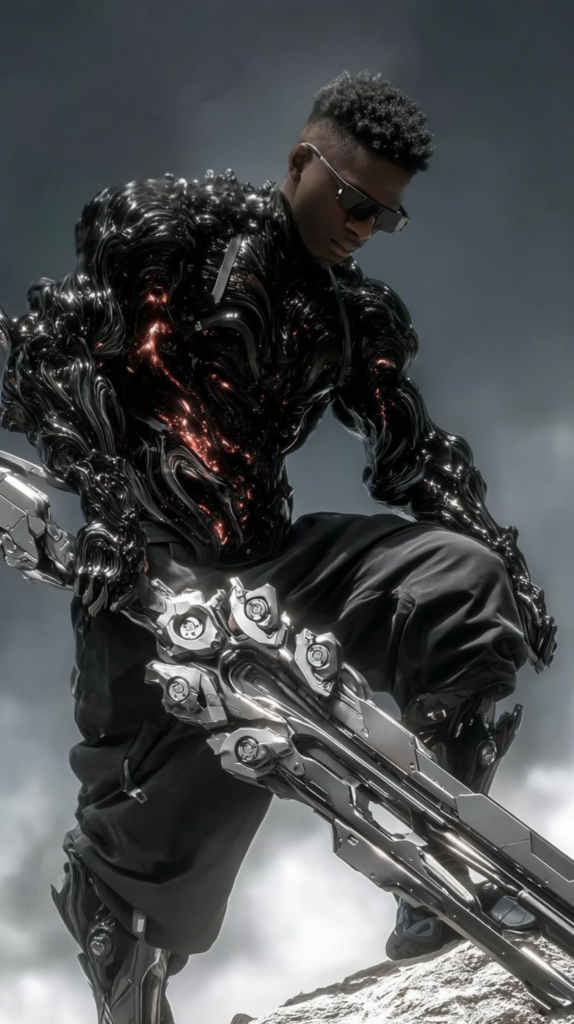
Her stomach tightened—not with fear, but with anger so clean it felt almost holy. The alley wanted to become a feeding ground. The swarm wanted to become a story. The Author wanted to witness it.
Eira refused.
The void-shape surged forward through the swarm, and suddenly the roaches weren’t merely insects. They became teeth. They became mouths. They became an ontological mechanism designed to erase residents from the block without leaving blood, without leaving evidence, without leaving memory. Eira saw flashes—people stepping into the alley to take out trash and never stepping back out, neighbors hearing screams and deciding not to look, the city absorbing disappearance as if it was normal.
Eira moved.
She stepped into the swarm with a precision that didn’t look like a teenager fighting. It looked like someone performing a correction. Ixchel cut downward, then across, then upward—not slashing at bodies, but slicing through the connective tissue of the infestation’s narrative. With each motion, she felt layers of falsehood crumble. The roaches didn’t burst. They didn’t spray gore. They simply lost their legitimacy. They became smaller, weaker, confused, their unity unraveling into ordinary panic.
The void-shape behind them screamed—not with a mouth, but with a distortion of the alley itself, brick vibrating, trash bags rustling as if caught in a storm that wasn’t there. The scream tried to push into Eira’s mind, tried to tell her she was too young, too small, too human, too late.
Eira’s jaw clenched. She didn’t answer the scream. She didn’t argue. She let Ixchel answer.
She drove the dagger’s point into the ground—not stabbing the pavement, but pinning a principle into place. Her free hand lifted, palm open, fingers slightly curled, as if holding an invisible thread. She felt the fracture in possibility, the ripple that had made the brick blur, and she pulled on it—not to tear it wider, but to collapse it shut.
The alley shuddered.
For a heartbeat, everything went silent. The swarm froze. The void-shape stalled. Nene’s lattice dimmed, then flared again, stabilizing. Tremaine’s invisible pressure surged, surrounding them in a field that felt clean, sterile, safe. Adonis’s whispered phrase solidified into a barrier that made the alley feel like it had boundaries again.
Then, like a lie losing its audience, the infestation began to retreat. The roaches didn’t run like insects. They withdrew like a thought being erased, like a sentence being deleted. The chittering faded into the brick, into the cracks, into the spaces where the world had been thin enough to let them through.
Eira stood with Ixchel still in her hand, breathing steady. Her gaze stayed on the spot where the void-shape had been, watching for the slightest sign of return. She felt sweat at the back of her neck, not from exertion, but from the intensity of focus. She felt the cold certainty of the Zenithmu’s attention still lingering in the distance, like a camera lens refusing to blink.
Nene lowered her hand slowly, the light lattice shrinking into nothing like a firefly folding its wings. “That wasn’t normal,” she murmured, voice almost reverent.
Tremaine’s shoulders rose and fell once, controlled. “None of this is normal.”
Adonis’s gaze stayed on Eira. “You saw something,” she said.
Eira didn’t deny it. She didn’t name it out loud. She only nodded, small and tight, and in that nod was a promise that she would not forget.
They walked out of the alley together, not triumphant, not celebrating, moving with the quiet urgency of people who understood that a problem solved in one render could return in another with sharper teeth. The block around them looked the same to anyone who didn’t know how to see—streetlights, parked cars, windows glowing, people living their lives as if the alley wasn’t a mouth that had tried to eat.
Eira glanced once more toward the far distance, toward the place where the presence had hovered. She didn’t see a figure standing under a streetlamp. She didn’t see a silhouette perched on a rooftop. She felt something worse: the sensation that they had been witnessed by an authority that didn’t need to touch them yet.
And as she slid Ixchel back into its sheath and tucked it away, Eira understood something with chilling clarity. The roaches were not the beginning. They were not even the warning. They were a small cruelty wearing a bigger system’s permission.
Somewhere beyond the alley, beyond the block, beyond the city’s tired manifest expanse, something was watching her life the way a reader watches a story and decides what deserves to continue.
Eira’s grip tightened briefly around the sheath inside her pocket. Her face stayed calm. Her voice stayed quiet when she finally spoke.
“Next render,” she said, not to the street, not to the sky, but to the invisible listener that had hovered beyond sight, “you don’t get to write me.”
No one answered. Not the alley. Not the swarm. Not the distant Author.
But the world, for a fraction of a breath, rippled as if it had heard her anyway.