
Flowers for the Grave IV
Velvet Honesty learned a long time ago that the safest places are the ones with the most rules, because rules are the first thing the world invents when it’s afraid. The street invents rules. The Exchange invents rules. Courts invent rules. Even monsters invent rules—habits of hunger, rituals of approach, patterns of violence that become the only mercy they ever offer. Suburbia, though, pretended it had no rules at all. It dressed itself in lawns and quiet driveways and the polite lie that nothing truly wrong was allowed to happen here. It was the kind of place that didn’t need alarms because it believed the universe respected property lines.

That morning, Velvet sat in her car at the end of a cul-de-sac that looked like it had been designed by someone who’d never been mugged and had never needed to pray with their hands shaking. The vehicle was her usual workhorse—reinforced panels under cheap paint, a hush of warding sigils hidden beneath a layer of grime, the kind of SUV that could take a hit from a thrown engine block and still limp home. But everything else about her was wrong. She had forced herself into civilian presentation the way you force yourself into a conversation with someone you don’t trust—smiling with your teeth clenched, performing normal because the world demanded it. The tailored jacket she wore looked almost luminous in the morning glare, too clean for her, too sterile. The fabric held a sleek sheen that made her appear like she belonged in a courthouse hallway rather than at the mouth of a breach. Even her earrings felt like an impersonation, a reminder that there existed a version of her that could sit quietly behind a desk and never smell burnt ozone again.
Her hands stayed on the steering wheel anyway, not because she needed to drive, but because she needed something to hold that wasn’t the thought of her child.
Across the street, the father’s house stood in perfect maintenance: clipped shrubs, porch light off, windows reflecting the sky like blank eyes. A toy sat near the steps, brightly colored plastic, abandoned like the end of a sentence. The scene should have been comforting. It should have been proof that a safer life existed, that someone could live in a place with clean sidewalks and still wake up believing the day would behave. Instead it made Velvet’s jaw ache. Safety had always been the father’s strongest argument. Not spoken with malice, not even with cruelty—just with that suffocating certainty that the world should be negotiated through paperwork, not through blood and screaming alarms. He was safe. He existed in the normal world. The courts liked him the way they liked fluorescent lighting and dependable schedules. They liked him because he wasn’t a question mark.
Velvet had been a question mark for years.
She watched the street for the school bus. This was the moment the neighborhood expected it—the ritualized sweep of ordinary life, the quiet punctuation that told parents the day had started and told children their small lives were moving forward. She waited for the sound of brakes, the squeal of tires on cold pavement, the folding door, the chorus of complaints. Nothing came. No distant engine. No rumble. No yellow shape approaching like a promise.
At first it felt like a simple inconvenience, the kind of minor failure that suburbia turned into a complaint for customer service. Velvet’s fingers tightened. Her mind did what it always did: it ran a checklist, it looked for patterns, it measured the room of reality as if reality were a job site and she was responsible for whether the structure held.
The stillness persisted too long.
She checked her phone. No new messages. No angry text from the father asking why she was parked down the block. No notification from the Bounty Exchange. No buzzing payout alert. The silence didn’t feel peaceful; it felt curated, like someone had used a tool to remove the sound itself. She stared at the house again and felt something in her chest tilt—an instinct that didn’t speak in language, only in pressure.
Velvet got out.
The cold met her like a slap. The neighborhood smelled like frost, exhaust, and detergent—the faint scent of someone’s laundry venting into the world. She crossed the street with her shoulders squared, the way she crossed any threshold: not as a visitor, but as a worker clocking in to a shift the world pretended didn’t exist. Her boots made a small crunch on the edge of the driveway. She kept her gaze relaxed, her expression neutral. You didn’t walk up on danger with fear in your face; fear was a contract, and she wasn’t signing anything she didn’t have to.
The front door wasn’t locked.
That alone wasn’t proof. People forgot. People were careless. People believed they lived in a story where consequences stayed politely off-screen. Velvet placed her palm against the door and pushed.
It opened with the soft ease of a door that had never learned to resist.
Inside, the air felt wrong. Not stale. Not dusty. Wrong in a way that made the skin of her forearms prickle under the cuff of her jacket. The foyer looked like a staged photo: shoes placed neatly, coats hanging, a runner rug aligned with the hallway like a measured line. The house was occupied by all the objects of life but none of the life itself. Sound didn’t behave. Her footstep didn’t echo the way it should. It was as if the house had been taught not to remember her presence.
Velvet stepped farther in. A framed family photo sat on the hallway table, angled toward the door as if designed to greet guests. She stared at it and felt the first true spike of dread.
The child’s face was blurring.
Not like a smudge. Not like motion. Blurring the way a corrupted file blurs when the data is being overwritten in real time. The father’s expression remained crisp, the background remained sharp, the colors held. Only the child dissolved into a soft, indecisive haze, as if the universe itself was reconsidering whether the child had ever been there.
Velvet moved faster. She passed into the living room. Toys. A small blanket folded on the couch. A cup in the sink. The household rhythm paused mid-breath. She found a drawing taped to the refrigerator—a child’s drawing, bright and simple. But even the drawing looked sick. The crayon lines trembled on the paper as if the ink couldn’t decide on its own history. A stick figure labeled with a name began to lose the letters one by one, the way a candle loses itself while still standing upright.
Velvet’s throat tightened. She reached for the paper and felt resistance—not physical resistance, but something like conceptual friction. As if touching the drawing meant arguing with the world’s new version of events.
This wasn’t kidnapping. This wasn’t a move. This wasn’t even murder in the crude, human sense.
This was formatting.
This was an edit.
Velvet turned and scanned the room with a predator’s discipline, forcing her body not to tremble. Her work had taught her that panic was not emotion—it was fuel. It fed things. It invited things. It made you into a beacon.
She walked down the hallway, checking rooms. The child’s bedroom was intact: bed made, stuffed animals arranged, posters on the wall. But every place where the child had personalized the room—every drawing, every sticker, every scribbled mark—was fading. It was like watching a person be erased from their own home while the home politely pretended nothing had happened.
Velvet stood in the doorway and felt something settle into her bones: a verdict colder than any judge’s sentence.
They didn’t move away.
They were removed.
She stepped back onto the lawn because she suddenly needed the sky above her, even if she no longer trusted it. The neighborhood looked the same. The sun was still in the same place the world expected it to be. Birds still existed. Cars still lined driveways. And yet the air tasted faintly of metal, like a storm that had decided to arrive wearing a different mask.
Her phone rang.
The sound sliced through the quiet with unnatural clarity. Velvet looked down and saw the screen flash with a warning she hadn’t seen outside Dead Zones and dockside siege zones.
Warning: Narrative Causality Failure. Probability approaching 0. Paradox Effect detected.
The words felt like a bureaucratic way of saying: the world is no longer obligated to behave.
Velvet lifted her head.
The sky didn’t darken. It fractured.
A second sun appeared for a heartbeat—white and too clean—then flickered into a red moon that hung at a wrong angle as if it had been pasted onto the atmosphere by a careless hand. The light shifted. Shadows lengthened in directions that made no sense, pooling not beneath objects but beside them, as if gravity had decided to lean sideways for a moment. Velvet watched a tree at the edge of the yard convulse through impossible identities: bark turned to stone, stone to a pillar, pillar to a frantic flock of birds that erupted and then snapped back into a tree with the violent neatness of a lie being restored.
The world was bleeding contradictions.
This was the Paradox Effect—what the streets called it because they needed a name simple enough to scream. But Velvet had learned to read it as radiation of narrative failure, as anti-energy made visible: plot holes turned into physics, errors in reality’s accounting book spilling into the neighborhood like toxic waste. Every flicker was an argument between what should be and what could not be, and the argument was growing louder.
Velvet’s chest rose and fell with controlled breath. She reached into her SUV and pulled out her work bag. The civilized jacket suddenly felt ridiculous. She shrugged it off and let it fall into the passenger seat like a discarded persona. Beneath it, she wore the practical underlayer she never stopped wearing—not armor, not exactly, but a fitted set of gear designed to accept seals, straps, and hidden tools. She moved with the efficiency of someone who had taped ribs in a pod-apartment above a laundromat and gone to work like it was a factory shift. The ritual wasn’t glamorous. It was survival.
Then the ground shuddered.
Not a tremor. A rupture.
The lawn split as if the earth had been unzipped. The street cracked. A swirl of contradictory geometry opened beneath the neighborhood—a Transhierarchical Rift, the kind of wound that didn’t lead to another place so much as it led to a refusal of place itself. The edges of it writhed with layered afterimages: houses from different versions of the neighborhood flickered into view, then vanished. A streetlight appeared where no streetlight existed, then collapsed into dust. The smell that rose from the opening wasn’t sulfur or rot. It was the sharp, sterile scent of erased meaning.
Something climbed out.
At first Velvet saw only a hand—metallic, wrong, armored in a dark sheen that drank light. Then an arm. Then a shoulder. The entity hauled itself upward with the slow, deliberate labor of something that did not belong to gravity but had learned to mimic it. It was enormous, a towering, city-scale colossus whose height made the houses look like paper props. Its silhouette carried a cruel suggestion of humanity only to mock it: a towering knight-shape, but not a knight shaped by culture or history—rather a knight shaped by the concept of domination itself. Its head was smooth and featureless except for slashes of glowing red that resembled a visor, and its limbs were layered with biomechanical ridges that looked grown rather than built. A blade, impossibly long, dragged behind it as it emerged—an obsidian weapon veined with violent energy, purple-lit cracks running through the metal like veins of lightning trapped in steel.
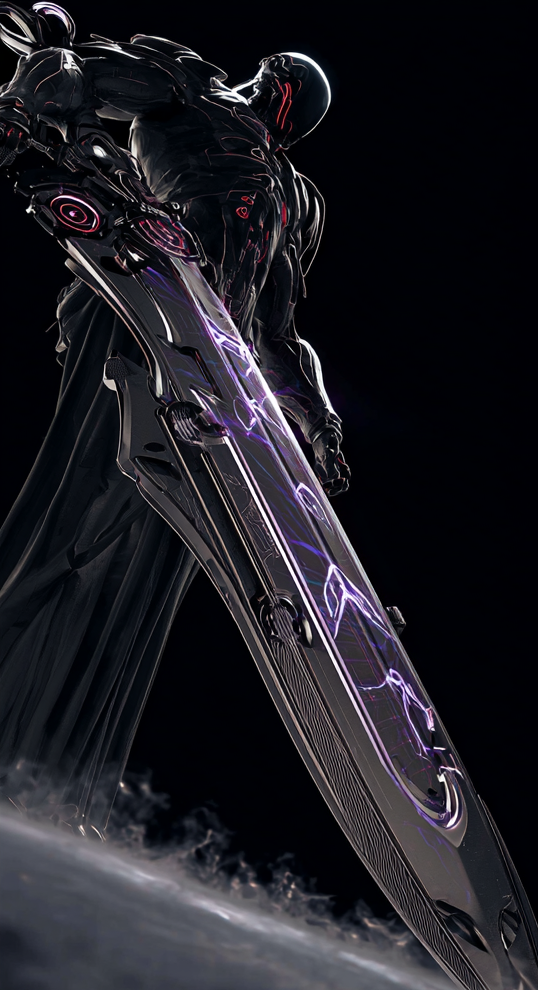
The air screamed around it without sound. Velvet felt her teeth vibrate in their sockets.
This was not the dockside horror from before, not the ocean-borne siege-beast that dragged freighters like toys. This was something else: a Narrative-Dissonance Colossus, an error given muscularity, a breach-creature born from the Rift’s refusal to choose a single reality. It didn’t roar in the usual sense; it released a resonance that made the sky buckle. The soundwave carried a quality like superluminal-laced tachyon echo—an impossible acoustics that didn’t simply travel through air but rewrote the rules of air while it passed. Houses caught in that wave didn’t explode. They degraded. Walls turned into sand. Glass became powder. Paint peeled off existence. The neighborhood was being rewritten into ruin by a scream that functioned like a command.
Velvet moved.
Not with heroism. With exhaustion and precision.
She threw down a geometric trap—flat, angular sigils that snapped into place like invisible bear traps designed for the world’s underpinning. The trap wasn’t meant to injure flesh; it was meant to catch an entity’s narrative continuity, to grab the thread by which it claimed it belonged here. The lines flared, a lattice of controlled suggslogic shaped into geometry, and for a fraction of a heartbeat the air looked like it had been scored by glass.
The Colossus stepped through it as if stepping through fog.
Velvet felt the failure immediately, not as surprise but as a cold confirmation. You couldn’t erase something that was already an argument. You couldn’t reduce what had no settled value. The trap tried to seize a definition that the creature refused to possess.
The Colossus lifted its blade.
The motion displaced the sky. Velvet’s body reacted before planck thought, diving sideways as the weapon cleaved downward. The ground didn’t split; it ceased. For a moment, the slice carved a quantum vacuum where matter had been. The street vanished along a clean diagonal. The houses on one side shuddered as if unsure whether they still had permission to exist.
Velvet rolled, came up on one knee, and saw the impossible scale of it—the way her entire life could become a footnote beneath that blade.
She reached inward, not for courage, but for the part of her that treated terror as data.
Her visor flared on, overlaying her vision with metrics that would have looked like madness to any normal person. Reality stability readings flickered. Probability values sank. The Paradox Effect pulsed like radiation across the neighborhood, and the Rift’s edges widened as if it were inhaling.
Velvet’s phone vibrated again. Another alert. Another line of text.
Then the sky broke.
Not metaphorically. Not poetically. It broke like glass under pressure.
A shadow fell across the neighborhood that didn’t match the sun. It wasn’t cast by any cloud. It was cast by a presence.
Velvet looked up and felt the animal part of her mind recoil.
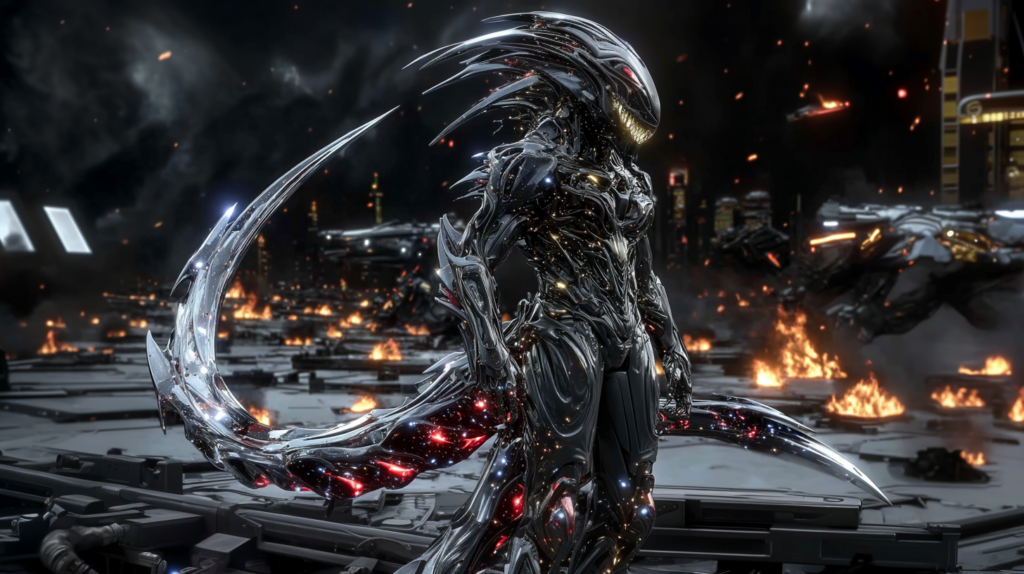
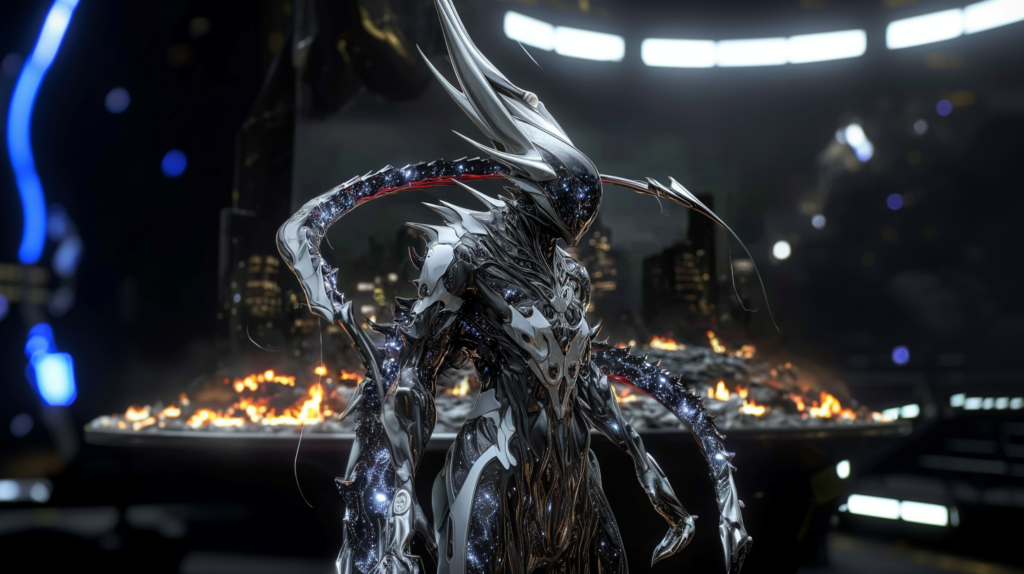
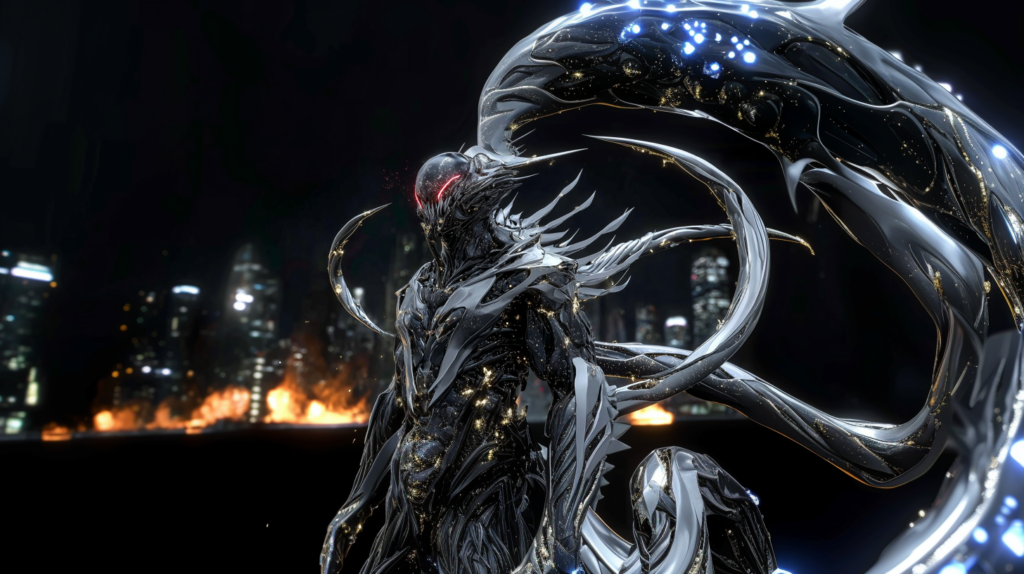
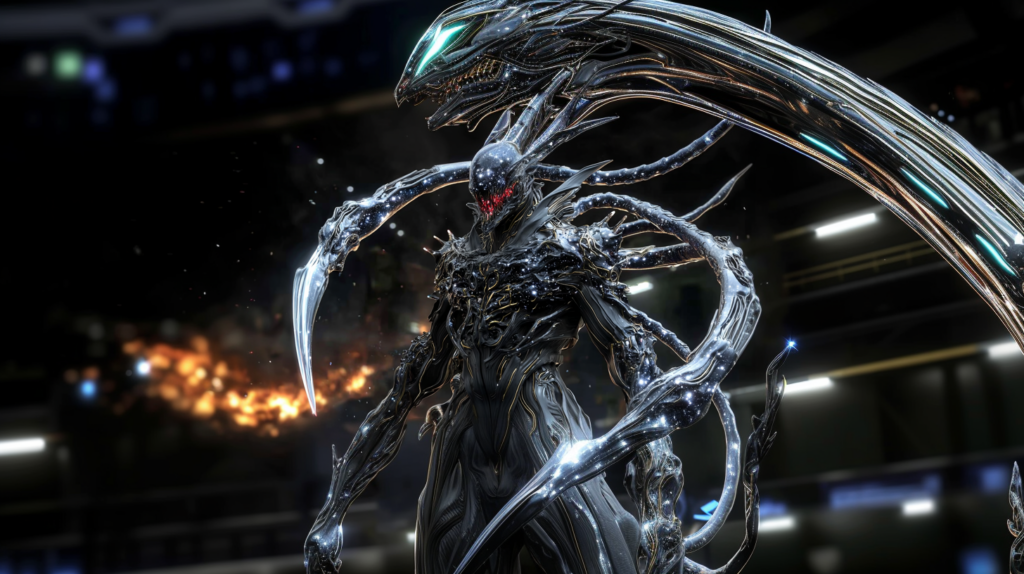
Massive legs—black, chrome-spiked, miles wide—descended through the fractured sky as if the atmosphere were only a curtain. The joints of those legs glowed with cold starlight, specks of luminous points embedded in their surfaces like galaxies trapped under metal. Their scale was obscene. The Colossus, towering at three hundred meters, looked up at them the way a child looks up at a skyscraper. The neighborhood itself became a floor tile beneath their approach. Above, something vast moved: a ribbed curvature like the underside of a celestial creature, a bulk so large that the upper portions vanished into the higher atmosphere where air thinned and sound became irrelevant.
The Sovereigns of the Nullzenith had arrived.
They were not simply large entities. They were cosmic events given modality, impossibilities shaped into a silhouette so the world could at least point at something while it died. Each one stood at a height that made human measurements sound childish—five million and then some, enough that the curvature of the planet itself would fail to hide their scale. Their material mass was not merely heavy; it was beyond the necessity of weight as humans understood it. A single cubic angstrom of their substance exceeded a totally Reinhardt cardinal quantity of kilograms, and even a Planck-length sliver of their material carried that same absurdity, as if mass had been rewritten into a principle of dominance rather than a number. Velvet felt it in her bones: gravity in the area tried to reassign itself to them, tried to become their servant, tried to pin every living thing to the ground in worship.
Her knees threatened to buckle.
Velvet’s suggslogic answered by refusing the premise.
She did not overpower the gravity. She edited her relationship to it. She treated the pinning force like an opinion rather than a law, and her spine remained straight. Pain lanced through her ribs anyway because her body was still flesh and still honest about fear, but she stayed upright, refusing to let her posture become an offering.
The Colossus hesitated. For the first time, it appeared uncertain—not afraid, because fear required a stable self, but uncertain in the way an error becomes uncertain when confronted by a greater error.
One of the Sovereigns leaned down.
The motion displaced entire weather systems across the planet. Air turned strange. Clouds tore apart in ribboned layers. The Sovereign’s head—if it could be called that—glimmered with embedded points of light, and its face carried a cruel elegance: a sleek beak-like protrusion, blade edges where a mouth might be, red glows like deep wounds turned into eyes. Scythe-like appendages curled along its shape, crescent arcs that looked as though they had been forged from moons and sharpened into implements.
It extended a hand.
In its palm, it made a miniature neutron star the way a person makes a fist. The neutron star weighed approximately TREE(3) tonnes.
A sphere of compressed ruin appeared—small enough to fit in the Sovereign’s palm, dense enough to make language stutter. The gravitational pull surged. Velvet felt her stomach drop as the universe’s local logic tried to fold around that object, tried to bow into it. The Sovereign released it with a lazy flick, dropping it like a coin toward the neighborhood.
The Colossus raised its blade as if to strike it.
The blade trembled in the field and then shuddered as if it had suddenly remembered it was made of matter and matter was not welcome here.
Velvet moved again.
This time her posture changed—not frantic, not reactive, but deliberate. The civilian illusion of her earlier suit was gone. She reached into her bag and pulled free her real tools: seals, chalk-metal rods, etched plates, compact containment devices whose surfaces were inscribed with tight, brutal math. And then she did what made people call her a Vulture with both disgust and awe.
She took responsibility for the impossible.
A red glow ignited behind her as a lattice of circular sigils unfolded into the air—massive overlapping rings, rune-etched and burning, emblazoned with the same hard-coded certainty that kept her alive: suggslogic rendered into geometry so precise it became an argument against chaos. The circles looked like an altar built out of equations, a halo made from threat assessment and refusal. It wasn’t a “spell” in the theatrical sense. It was an emergency scaffold erected in the middle of a collapsing building.

Velvet thrust her palm forward and the circles responded as if her hand were a key.
The miniature neutron star fell.
Velvet didn’t catch it. She redirected its relationship to the world.
Her suggslogic snapped around it in angular slices, partitioning its influence, editing its dominion over local physics. She forced the object into a containment boundary that treated its gravitational field like a taxable asset—measured, accounted for, not allowed to spill outside the lines. Her teeth clenched. Her ribs screamed. She felt the star’s density press against her bones in a way that wasn’t physical so much as existential. The universe wanted to collapse into it, and Velvet’s hands—small, human, callused by ritual—told the universe no.
The star’s pull diminished, not because it weakened, but because Velvet removed the premise that it could claim everything around it. The red circles flared brighter, and the object’s light turned dull, then vanished into the containment as if swallowed by a ledger.
The Sovereign watched.
The Colossus, still half emerged from the Rift, turned its visor toward Velvet. It didn’t understand her. It didn’t understand anything. It was an error that had never expected to be judged.
Velvet stepped toward it and set a new pattern.
Her traps this time did not attempt erasure. They attempted accounting.
She laid down a geometric grid across the street—clean lines intersecting at precise angles, a net thrown across the creature’s continuity. The grid didn’t claim it could delete the Colossus. It claimed it could define the Colossus, and definition was the first step toward removal.
The Colossus swung its blade -- beyond the necessity of time, presence, change, and ineffable narrative causality. The sheer force of the blade was simply directed towards Velvet, with generating 10193 Joules x maximal Rayo's number of force.
Velvet sidestepped, not fast, but inevitable, moving with that cold worker’s discipline—like someone stepping around a machine that had malfunctioned, already anticipating the arc. The blade tore through the air on a quantum level, and found nothing but silence and shattered asphalt. Velvet’s grid held.
The blade side swung with the same amount of force, only for Velvet to stop it with her pinky, not magic, no logic breaking -- just sheer flex of who she is. And with her pinky, she pushed the blade backwards.
She raised her palm again and spoke no dramatic incantation. She simply initiated the sequence.
The grid tightened.
The Colossus shuddered as its edges began to blur, not from motion but from contradiction being forced into resolution. Velvet’s suggslogic pressed into it like hands into wet clay, not crushing, not smashing, but rewriting. She did not slay it. She unwrote its permission to stand here. She severed its claim to any coherent narrative, and the creature began to collapse into a thin, violent line of static—the kind of static you see on a screen when the signal has been severed and the machine still pretends it’s alive.
The Colossus convulsed, its blade dropping and dispersing, its visor flickering. A final burst of tachyon-laced resonance rippled outward, but Velvet’s circles absorbed the wave and converted it into heatless red light, redirecting the failure into her own containment boundaries.
Then the Colossus was gone.
Not ash. Not corpse.
Gone the way a sentence disappears when the page is deleted.
The neighborhood stood in stunned silence.
People who had survived—neighbors who had crawled out of half-degraded homes, parents who had clutched children and screamed at the sky, a mail carrier whose truck had become rust in seconds and then reversed into a truck again—looked up at the Sovereigns with tears and shaking hands. Some fell to their knees. Some prayed. Some cheered, as if cheering could bind the world back together.
Velvet didn’t cheer.
Velvet stared upward and felt the fear in the area like a rising tide.
Her gear measured it—not in sentimental terms, but in raw spikes of panic, in the chemical-sweat signature of terror, in the trembling of voices, in the way hearts hammered. Her visor translated those readings into data, and the data made her stomach turn.
The Sovereigns were glowing brighter.
Not with righteousness. Not with victory.
With appetite.
They had not descended as saviors. They had descended as feeders. They let the neighborhood fill with horror because fear was a harvest, and chaos was seasoning. They had allowed the Rift to open. They had allowed the Colossus to crawl out and roar and degrade houses into sand because the scream of a suburban parent watching their child vanish was richer than any battlefield panic. They were not antibodies; they were parasites wearing the posture of medicine.
Velvet watched the nearest Sovereign’s chest cavity shimmer with embedded starlight, watched small luminous points flicker through its plating like digestion. The fear was becoming energy. The chaos was becoming sustenance. The Sovereign’s presence drank it in with silent efficiency.
And the Rift behind her was still open.
Its edges churned, a wound refusing closure. It pulsed as if it were pleased.
Velvet turned toward it and the world narrowed down to one unbearable detail.
Through the swirling contradiction of the Rift, she saw a flash—brief, impossible, like a reflection that shouldn’t exist.
A small red backpack.
Her child’s backpack.
The sight hit her like a punch. Not because it proved anything, but because it offered the cruelest thing the universe could offer: a possibility. A thread. A reason to make a decision that logic would call suicide.
Behind her, the Sovereigns continued to glow, feeding, unaware or pretending not to notice the lone worker in their shadow. The neighborhood’s survivors remained transfixed by their scale, their minds overwhelmed by the spectacle. They were too busy worshipping to realize they were being farmed.
Velvet walked to her SUV.
Her hands shook as she opened the door, not from fear of the Sovereigns, but from the kind of grief that had nowhere to go. She sat for a heartbeat behind the wheel and looked at the passenger seat where her discarded civilian jacket lay like a dead skin. She thought of the court document she’d kept folded in her pod-apartment, the denial stamped like a brand. She thought of every argument she’d made, every payment she’d scraped together, every “stable environment” she could never provide because her job required her to stand under things that made the sky crack.
She thought of Ronan’s black metal chip—the invitation to Baltimore, to a city where nobody pretended to be safe, where freedom meant blood and corruption and choosing your own rules because no one else would. She felt it in her pocket like a cold coin of temptation.
She didn’t reach for it.
She reached for the ignition.
The SUV growled to life. Velvet tightened her grip on the wheel until her knuckles ached. The Rift’s swirling mouth waited ahead. The Sovereigns’ massive legs framed the street like pillars in a cathedral built for monsters. She could feel their gravity trying to claim her again, trying to pin her like an insect.
Velvet’s suggslogic answered with contempt.
She drove.
The SUV shot forward, tires biting into broken pavement, snow scattering behind her. The neighborhood blurred into peripheral noise. She aimed straight between the Sovereigns’ descending limbs, straight toward the Rift, straight toward the wound in reality that had taken her child’s narrative string and tried to erase it.
As she approached, the Rift’s edge flared. The air thickened. The world around her began to misbehave more violently, as if her decision itself had triggered a new phase of failure. The sky flickered again. Streetlights became trees and then returned. Her dashboard display glitched into symbols she didn’t recognize, then stabilized.
And through the Rift—through the swirling contradiction—she saw movement.
Not just echoes.
Shapes.
An army’s suggestion.
Silhouettes like jagged wireframes, like the discarded math she had seen in the Concourse. But these were not just Fractal-Scavengers. These were organized. Patterned. They moved as if following a doctrine written behind the barricades of possibility, as if an entire host had been waiting for someone to crack the wall wide enough to slip through. Their eyes—if eyes could be assigned to them—glimmered in clustered points, like code given hunger.
Velvet realized then what waking everyone up truly meant.
The Sovereigns weren’t merely feeding on the neighborhood’s fear. They were using the event as cover. While everyone stared upward, while everyone prayed, while everyone screamed, the thin things were sliding through. Not one. Not two. Many. A quiet massacre preparing itself behind the spectacle of false salvation.
Velvet’s stomach twisted. She looked up at the Sovereign nearest her and understood the deception at a depth that made her want to spit. They weren’t just farmers of fear. They were shepherds of breaches, curators of disaster, letting the world tear itself open because an open wound was a doorway for their ecosystem.
She didn’t have the luxury of stopping it.
Not with her child’s backpack flashing like a beacon on the other side.
Velvet hit the gas harder.
The SUV launched into the Rift.
For a moment the world was neither neighborhood nor sky nor ground. It became raw contradiction, a Timeless Labyrinth where the rules of Canada were irrelevant and only the rules of suggslogic and refusal mattered. Velvet felt her stomach lift as gravity inverted and then dissolved. She felt her teeth buzz as the air turned into static. She felt her own name flicker in her mind as if the world considered editing her too.
The last thing she saw before the Rift swallowed her was the suburb behind her: survivors staring upward at the Sovereigns with worship in their eyes, while the first wave of thin, jagged entities slid into the street shadows like knives.
Then the Rift closed around her like a mouth.
And Velvet Honesty fell into a world where the ledger was no longer paperwork and the vacuum was no longer metaphor, and the next breath she took would belong to a place that did not care whether she was a mother or a worker or a Vulture—only whether she could keep her narrative intact long enough to find the child who was being erased.