
Flowers for the Grave VI
Velvet moved before thought could negotiate with fear, and the Timeless Labyrinth rewarded that reflex the way a predator rewards a stumble. The scream had not echoed; it had appeared, already finished, already inside her nerves, already written as if it had always belonged there. She sprinted through Toronto Remix with her son’s backpack clenched in one hand, the strap biting her palm like a confession, her other hand open as though she could catch the sound itself and refuse to let it fall into absence. Snow that should have been soft behaved like broken glass under her soles, not cutting skin, but scraping meaning, and every footfall tried to decide whether the street was a street or a vertical wall masquerading as one. Her new denim layers—ruffled tie-front top drawn tight at the sternum, pleated skirt snapping against her thighs, mint platform sandals with braided wraps climbing her ankles—looked wrong in the way a prayer looks wrong inside a burning church, but the Labyrinth didn’t care about fashion or season; it cared about permission, and she had already revoked it.

Label followed, not running, not because she couldn’t, but because she refused to validate Velvet’s urgency with imitation. She moved with the annoyed grace of someone who had learned that panic is a tax paid to systems that have already failed you. Her silhouette stayed casual—mesh crop top, distressed shorts, bare legs that should have hated the cold but didn’t get consulted, thin sandals with stacked anklets catching stray light—yet the space around her kept adjusting, as if the Labyrinth couldn’t decide whether she was an intruder or a resident. Her expression carried that particular kind of irritation that isn’t anger, but interest that resents itself. She watched Velvet like you watch someone walk straight toward a door you already know is painted on the wall, and you’re irritated only because you can’t look away.

Toronto Remix unfolded in vicious collage. A block of rowhouses became a staircase that climbed into the underside of the sky and returned you to the same sidewalk with a different name. A streetcar track ran upward through empty darkness and reappeared as a chandelier chain inside Velvet’s old apartment, which had been fused to the bones of a demonic castle whose windows were stained with scenes that hadn’t happened but still felt familiar. The Safe Father’s house—once a normal front porch and a normal lock—had become an Escher bruise: doors opening into ceilings, hallways folding into themselves, rooms lined with framed apologies that weren’t signed by anyone. The Paradox Effect wasn’t weather; it was the terrain’s personality, a transhierarchical stutter that made “here” and “there” argue until both concepts collapsed into a single cruel compromise. The sky above remained darker than black, a negation that didn’t absorb light so much as erase the license for light to exist, and wherever Velvet looked too long, reality cracked like a window deciding it was tired of pretending to be solid.
The scream happened again—closer, sharper, unmistakably a boy’s voice—and Velvet stopped thinking entirely. She rounded a corner that should have led to a convenience store and found a pizza shop instead, except the shop was standing in the wrong orientation, as if the roof had decided it deserved to be ground. The sign was half-lit, half-unwritten: letters glowing as if they remembered how, other letters missing like teeth pulled for no reason. The building’s brickwork rippled with subtle geometric contempt, and the door was sealed by a lock that looked like it had been designed by someone who hated the notion of “entry” on principle.
And there—above her—on the roofline that shouldn’t have been reachable, stood Midnight.
He wasn’t a metaphor. He wasn’t an illusion made convincing by Velvet’s grief. He was physically present in the only way the Timeless Labyrinth allowed anything to be present: as a temporary permission slip stamped in blood and memory. A small figure in a red-and-navy jacket with beige striping, zipped unevenly as if he’d done it in a hurry, a dark collared shirt beneath with broad horizontal bands, buttons catching the weak city-glow like tiny anchors. His posture held that stubborn, quiet bravery children wear when they don’t want adults to see the shaking underneath. He stared down at Velvet with a face too serious for his size, lips pressed as if he’d practiced not crying, eyes wide with the kind of focus that only appears when a kid is trying to keep themselves from disappearing.
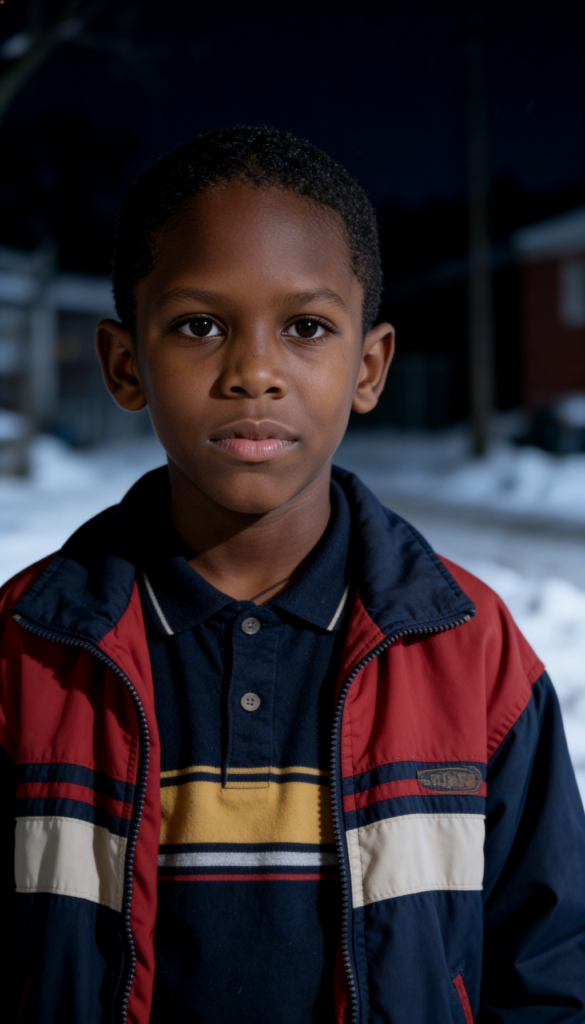
“Mom!” he yelled, and the word hit Velvet like a blade that includes tenderness in its edge. “MOM—!”
Velvet’s chest tightened so hard it felt like the Labyrinth had reached inside her and clenched her ribs by hand. She lifted her arms, palms up, not in surrender, but in instinct—like a mother trying to catch her child even when the distance is impossible. Her mouth opened and no sound came out at first, because the Paradox Effect loves stealing the first syllable of hope. The backpack strap slipped on her wrist, and the name tag inside it—still legible, still stubborn—scraped her skin as if reminding her that proof exists even when the world denies it.
“Midnight!” she finally got out, ragged. “Baby, don’t move—please—just—”
He flinched, not from her voice, but from something behind her, above her, outside her. His gaze slid past Velvet as if he’d seen the ceiling of the unmanifest expanse—where watchers might hang like Deus pretending to be architecture. His shoulders tensed, and for a fraction of a heartbeat Velvet saw the child’s courage slip and the child’s terror take its place, raw and honest.
Then Midnight began to phase.
It didn’t look like teleportation. It didn’t look like vanishing. It looked like reality and illusion arguing over who had to take responsibility for him, and both deciding to abdicate. The edges of his jacket fuzzed into static, but not electronic static—ontological static, as if the Labyrinth was erasing the agreement that his outline belonged to the world. His feet didn’t lift; the roof didn’t swallow him; instead his entire modality started to decouple from the street, from the building, from the story itself. Velvet watched his form become a question mark written in skin and cloth, watched his face flicker like a photograph someone was trying to burn without leaving ash. The sound of his voice didn’t trail off; it snapped clean, as if a sentence had been cut at the throat.
“Mom—!” he cried again, and the word came out wrong, stretched and thin, like it had to travel through too many layers of reality–illusion fracture to reach her.
Velvet lunged forward, sandals sliding on the slick street, knees buckling when the sidewalk tried to tilt sideways. She threw her suggslogic outward without ceremony, not a spell with ingredients, not a ritual with props, but a trap-shaped refusal—an ontological collapse latch designed to hold what should be held. In the space between her hands a faint lattice tried to appear, the geometry of acausality made visible: a net of white-blue lines, circles within circles, sigils that looked like they were written by a mathematician who had hated numbers enough to transcend them. The trap reached for Midnight like a mother reaching for a wrist.
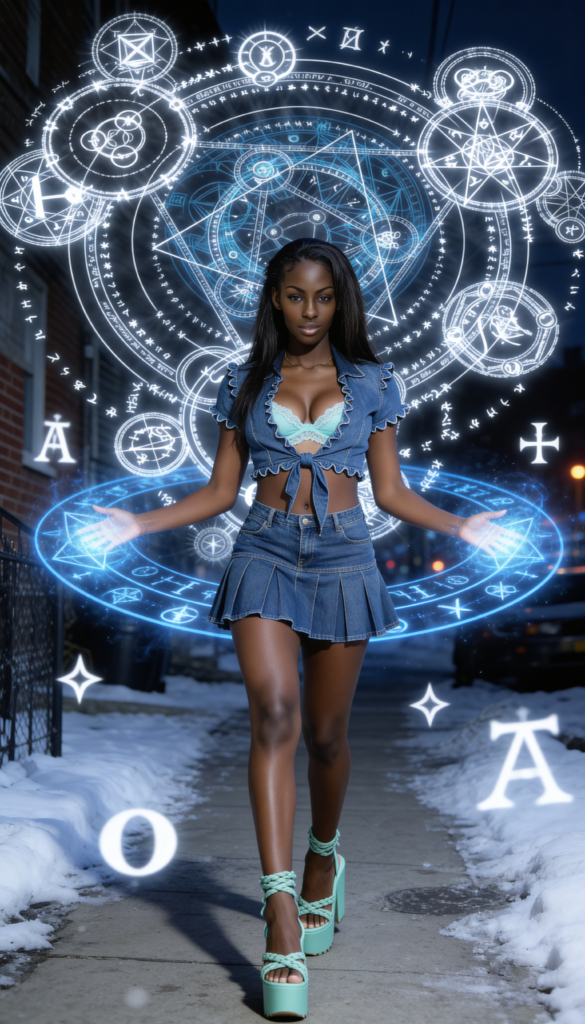
It missed—not because Velvet failed, but because the Labyrinth had already moved Midnight into a category her trap couldn’t touch. He wasn’t “falling.” He wasn’t “leaving.” He was being edited out in real-time, removed not just from streets and roofs, but from the background principle that allows a person to be located.
Midnight’s eyes met hers one final time. Not pleading. Not accusing. Just there, bare and terrified and brave all at once.
And then he was gone.
The roof remained. The pizza sign remained half-lit, half-unwritten. The street remained cold and cracked and cruel. Velvet remained standing with her hands out like an idiot, like a believer, like a woman who had walked into the Labyrinth and thought love might be enough to renegotiate its rules.
Label arrived beside her, slower than she should have, as if she’d been giving Velvet a chance to be alone with the moment. Her gaze rose to the roof, scanned the empty space, then slid to Velvet’s outstretched hands and the faint afterimage of the trap that had tried to exist. Label didn’t soften. She didn’t offer comfort. She didn’t pretend this deserved gentleness.
“Well,” she said, voice low, almost bored, “that answers one question.”
Velvet’s throat worked. Her eyes stayed glued to the roof as if staring could force Midnight back into existence. Her fingers trembled, then curled into fists so tight her nails bit her palms. She didn’t scream—not at first. The grief was too massive for sound. It sat inside her like a collapsed building, heavy and silent and full of bodies.
“He was right there,” Velvet whispered, and the words sounded like she’d scraped them off her lungs. “He was right—there.”
Label’s expression didn’t change. “Yes.”
Velvet turned on her, sudden and feral. “Don’t say ‘yes’ like it’s a weather report.”
Label’s eyes narrowed, not angry, just measuring. “Don’t talk to me like I did it.”
Velvet’s shoulders shook. The Labyrinth tried to capitalize on her instability; the street behind her twitched, the building’s angles shifted, and for a moment the roofline threatened to become a mouth. Velvet felt it and hated it more, because the place wasn’t just cruel—it was opportunistic.
“I heard him,” Velvet said, voice breaking on the edge of rage. “I heard my son. I ran to my son. I saw him. I—” Her voice failed. Her face tightened as if she could physically hold her grief inside her head. “I can’t keep doing this.”
Label’s gaze flicked briefly to the backpack Velvet still carried. “You already are.”
Velvet followed the glance like a reflex and looked down. The backpack looked ordinary—cheap fabric, scuffed seams, a child’s mess of zippers and pockets—except ordinary objects did not remain ordinary inside the Timeless Labyrinth unless something powerful insisted. Velvet forced the top zipper open with shaking hands and dug inside like she was searching for a pulse. A crumpled worksheet. A pencil snapped in half. A small toy figure missing an arm. A folded note in childish handwriting. Proof in paper and plastic that refused to be rewritten.
Velvet pressed the backpack to her chest. The grief finally cracked enough to leak sound, and a small, ugly sob escaped her like a betrayal. She bent forward, forehead nearly touching the fabric, as if she could crawl into the bag and hide there with the pieces of her kid that still existed.
Label didn’t touch her. She didn’t crouch. She didn’t say the obvious. Instead she looked up—past the roof, past the warped skyline—toward the ceiling of the unmanifest expanse where the Labyrinth’s darkness thickened into something that felt like attention.
That was when the Colossi arrived again.
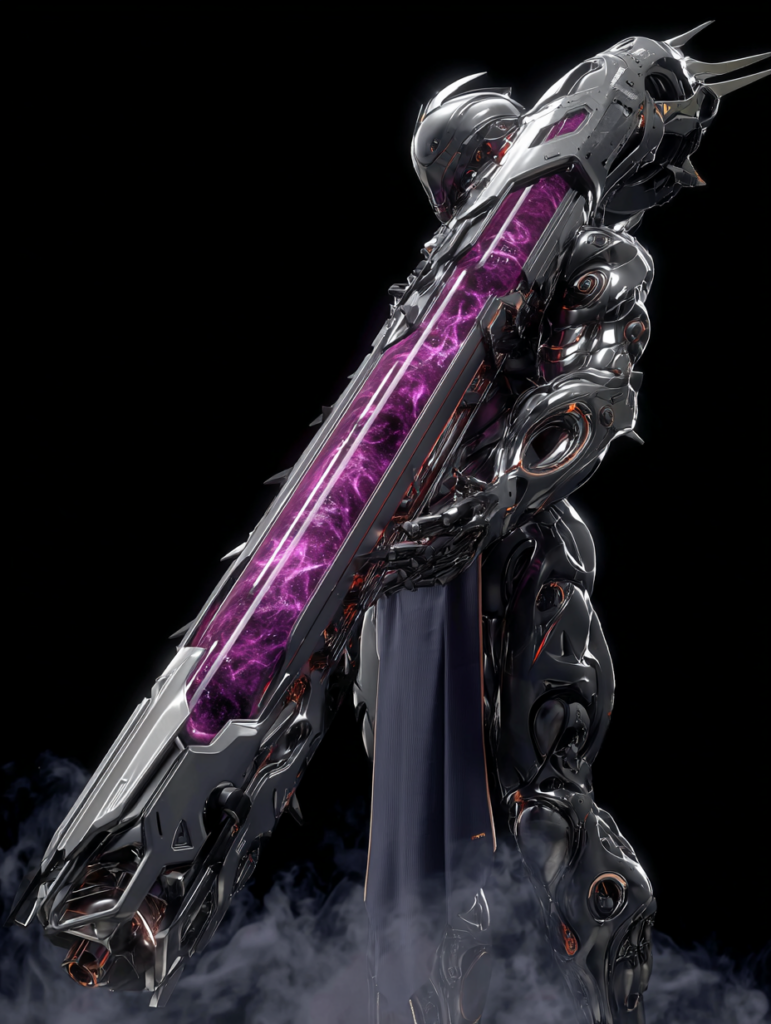
They didn’t stomp. They didn’t announce themselves with the normal theatrics of monsters. They simply intruded into the scene the way an axiom intrudes into a proof: sudden, unavoidable, carrying authority that doesn’t require explanation. A shape like a walking fortress stepped across a distant intersection that should have been kilometers away but was now only a breath’s distance by the Labyrinth’s geometry. Three hundred meters of armored silhouette, gunmetal plating braided with inlays that glowed like bruised galaxies. A weapon longer than a city bus rested in its hands as casually as a broom, the inner channel of the barrel filled with violet stellar storm. Even a single Planck-length segment of that weapon carried weight beyond any Reinhardt-cardinal counting of kilograms, not because the metal was dense, but because the weapon had been forged from a refusal to honor ordinary measure. The Colossus didn’t carry mass; it carried a cosmological insult.
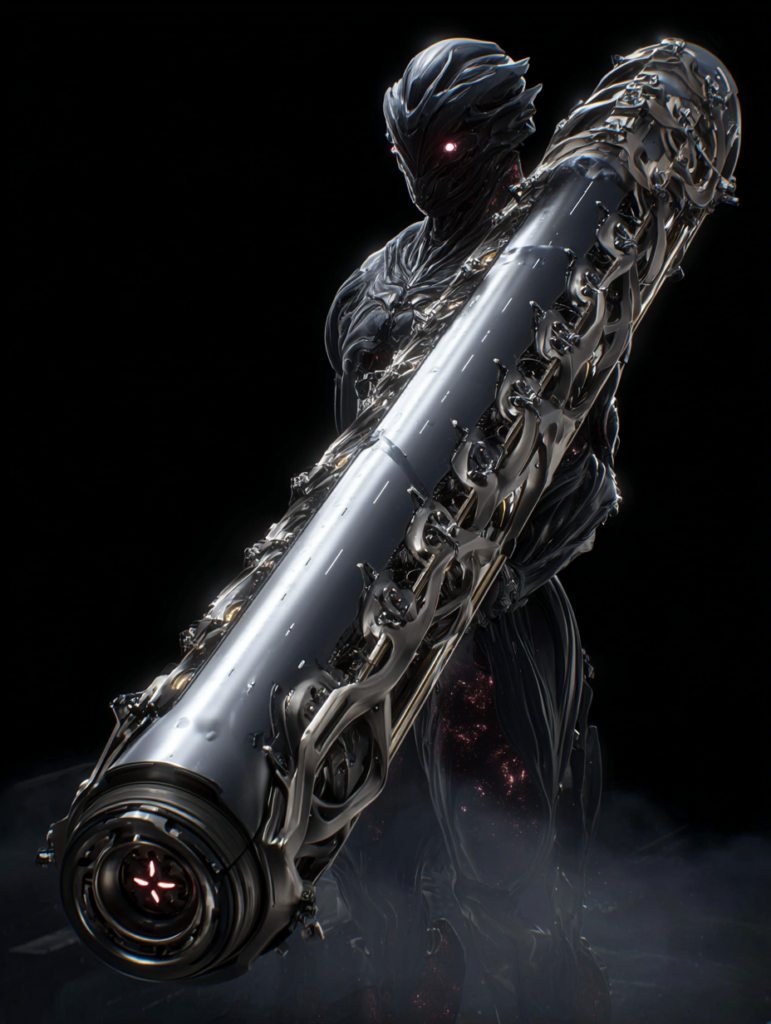
Another Colossus emerged at a different angle, its armor sleek and predatory, the faceplate smooth, eye-slits lit with a small, cruel point of light. Its cannon was different—thicker, more cylindrical, braided with ornate metallic tendrils like a crown of machinery strangling a tube. The weapon’s interior looked empty until it moved, and then the emptiness churned with purple haze, as if the barrel contained a pocket of maximal wholeness beyond tiering that had been compressed into ammunition.
Velvet felt the oncoming terror not as emotion, but as a pressure against her identity. The Colossi didn’t just threaten her body; they threatened the story in which she was allowed to be a mother.
Label watched them with the tired patience of someone who has already decided the universe is unserious.
The first Colossus raised its weapon.
The shot did not travel. It did not “cross distance,” because distance here was a joke. The blast appeared already at its destination, a violet-white lance that carried I0-axiom strengthenings as its spine, the kind of force that doesn’t argue with boundless reality-illusion distinctions but simply overwrites their terms. The beam didn’t ignore presence and change; it superseded their necessity, rendering cause-and-effect into a decorative myth. The street where it struck didn’t explode. It ceased to have been stable, and the rupture crawled outward like a crack in a mirror, eating storefronts, eating streetlights, eating the idea that the sidewalk was ever reliable.
Velvet flinched and threw up her hands, suggslogic rising instinctively—trap-work, collapse-lattices, acausal snare-lines—but she was too raw, too busy bleeding grief to cast cleanly.
Label moved one step forward.
She didn’t draw a weapon. She didn’t chant. She didn’t posture.
She simply looked at the beam as if it had inconvenienced her.
And the blast folded.
Not blocked—folded, like a sheet of paper pressed into a smaller shape until it couldn’t remember it had ever been a sheet. The violet lance compressed into itself, curling inward, shrinking into a tight knot of light that shivered like a frightened animal. The rupture it had caused halted mid-crawl, confused, then began to reverse—not repairing, not healing, but being forced to admit it never had permission to exist in the first place.
Label’s eyes narrowed as if she were focusing on a small stain. She lifted her hand lazily and pinched the air.
The knot of light snapped into nothing, not Transfictional Nothingness, not some grand erasure, but a simple deletion—like removing a typo. The Colossus stood frozen for a fraction of a heartbeat, weapon still raised, as though it hadn’t yet received the memo that its attack had been rejected.
Label sighed. “You’re making this loud.”
The Colossus fired again, offended by refusal.
Label blinked.
The blink carried pressure, not physical force, but narrative pressure—the kind that makes a sentence end even if it doesn’t want to. Her eyelids closed and opened, simple and human, and the world around the Colossus shuddered as if the Labyrinth had been slapped. The Colossus’s weapon didn’t break. The Colossus didn’t fall.
It simply lost the right to be continuous.
Its outline fractured into a spray of canon discontinuities, each piece trying to remain real, each piece trying to remain an illusion, and none of them able to maintain either. The giant shape unraveled into a rain of unwritten parts—armor plates that forgot what they were plated over, joints that forgot what they had been joining, a cannon barrel that forgot it had ever been a barrel. The entire creature ceased in a way that didn’t leave a corpse, because the Labyrinth doesn’t dignify things with aftermath.
Velvet stared, stunned—not at the display of suggslogic, but at the casualness. That blink had been mercy and cruelty at once: mercy because it had saved them, cruelty because it proved the Labyrinth could be disobeyed if you were built for disobedience.
Label looked back at Velvet. “You can grieve later.”
Velvet’s jaw clenched. “Don’t tell me when to—”
“I’m not telling you when,” Label cut in, voice sharper now, annoyed that Velvet still had energy for argument. “I’m telling you that if you grieve in the open, the Labyrinth will learn your grief’s shape and start using it as a key.”
That sentence pierced Velvet more cleanly than comfort would have. She swallowed hard, forced her shoulders back, forced her hands steady. She wiped her face with the back of her wrist, smearing tears like war paint, and looked again at the roof where Midnight had stood. The absence up there felt like a wound that couldn’t clot.
Label watched Velvet do the impossible thing: continue.
They moved.
The Timeless Labyrinth shifted as they walked, reconfiguring Toronto Remix around their choices the way a hostile mind reconfigures logic around a conclusion it hates. Sidewalks looped into staircases. Snowbanks became walls. The pizza shop behind them stretched upward until it was a tower, then compressed into a flat storefront again as if ashamed of its ambition. A street sign appeared that read a neighborhood name Velvet recognized, then the letters bled away until it was just blank metal, the concept of “place” dissolving. Velvet saw a bus shelter filled with newspapers that had headlines about events she’d never lived, about leaders who never existed, about tragedies that felt real anyway. Pieces of history—edited out, abandoned, still lingering like scraps in the corner of a file someone thought they deleted. She wanted to stop and collect them, to prove the world could be reconstructed, but Label’s presence behind her felt like a hand on the back of her neck: move, move, move.
Between two warped storefronts Velvet found a child’s mitten on the ground. Not Midnight’s, not hers, not anyone she knew—just a mitten, small, abandoned, perfectly intact. She picked it up and felt a tiny shiver of grief that didn’t belong to her. The Labyrinth wasn’t only taking people. It was taking the evidence that they had ever been worth missing. Velvet tucked the mitten into Midnight’s backpack like an offering to a god that hated offerings.
Label glanced at the gesture. “You’re collecting ghosts.”
“I’m collecting receipts,” Velvet muttered.
Label’s lips twitched, almost a smile, but she strangled it before it could become real. “Same thing in a place like this.”
They crossed an intersection where the pavement had cracked into polygonal shards, each shard reflecting a different version of the sky. In one reflection the darkness above seemed calm, like an ordinary night. In another the darkness was textured, layered, alive with subtle motion—like something massive watching from above. Velvet caught herself staring into that second reflection too long and felt a pulse of terror that didn’t originate in her. A fear that felt imported.
“The Sovereigns,” she whispered, without meaning to.
Label didn’t look up. “Don’t name them like that. Names are handles.”
Velvet’s throat tightened. “They’re watching.”
“Probably,” Label said, as if discussing surveillance cameras. “Or maybe they’re just there and your mind insists on turning presence into intention because the alternative is worse.”
Velvet hated how often Label sounded right.
They turned down a narrow lane that should have been an alley, but the alley behaved like a corridor inside a cathedral. Brick walls rose too high, the darkness above too thick, the graffiti on the sides too ornate—sigils layered over names, names layered over prayers, prayers layered over threats. Velvet recognized fragments of her own city’s markings—old tags from back home, scribbles she’d seen under bridges—except these were rewritten with symbols that looked like they were drafted by someone trying to diagram despair. The Paradox Effect pulsed, and the graffiti shifted, briefly spelling out a sentence Velvet couldn’t read but felt as: YOU CAN’T OUTRUN WHAT OWNS THE EDIT FUNCTION.
A Colossus stepped into the lane ahead.
This one was closer. The armored surface was glossy, almost elegant, with violet energy crawling beneath transparent panels like a galaxy trapped under glass. Its weapon was a long, rectangular brutalism—an oversized rifle-cannon hybrid—with an internal core that churned like bruised starlight. It aimed at Velvet with the slow certainty of something that had never been punished for its certainty.
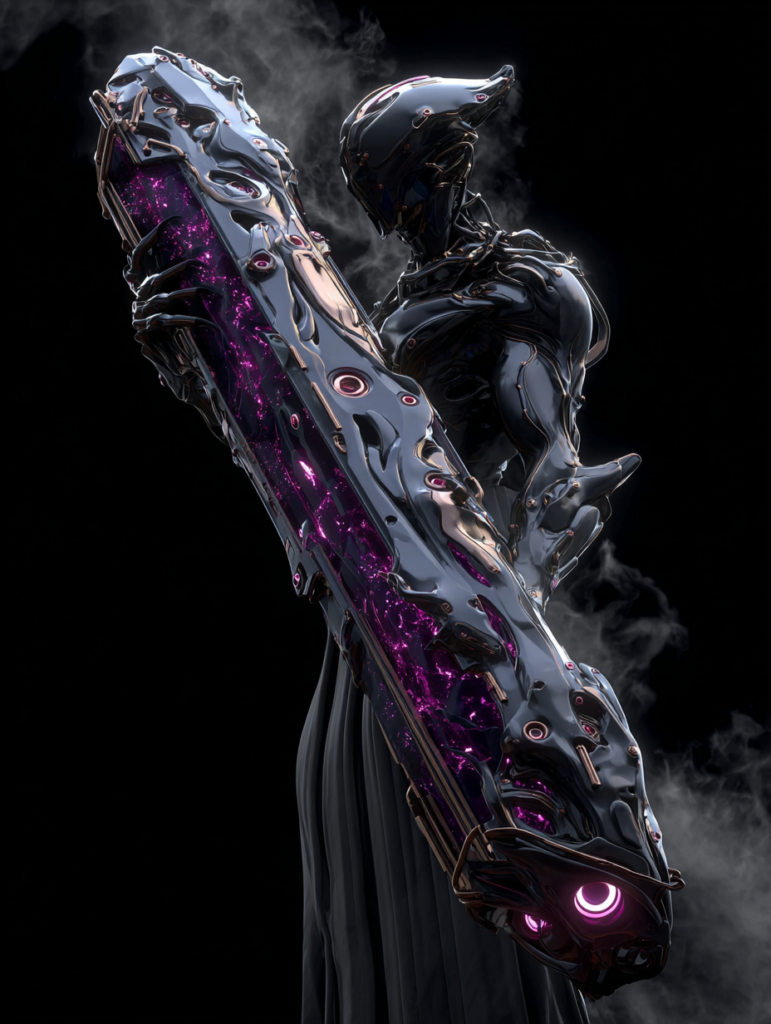
Velvet’s body reacted before her mind did. She raised her hand and cast—no chalk circles, no ingredients, no tools—just a trap-flash: a lattice of acausal geometry that snapped into place across the lane like an invisible bear trap for reality itself. The trap wasn’t “magic” in a mundane sense; it was manifest suggslogic trained into instinct. It latched onto the Colossus’s next action and promised to collapse it.
The Colossus fired anyway.
The blast hit Velvet’s trap and the lane filled with a violent hush, as if sound itself had been judged irrelevant. The shot carried I0 strengthenings, the kind of pressure that tries to turn every possible defense into a trivial footnote. Velvet’s trap held—not comfortably, not perfectly, but holding, creaking under the metaphilosophical weight of a weapon whose Planck-length segments carried Reinhardt-cardinal mass and worse. The lattice glowed, strained, and Velvet felt her forearm burn with the effort, felt her teeth ache as the trap tried to decide whether it was allowed to remain real.
Label stepped beside her and put two fingers lightly against the lattice.
The trap stabilized, not because Label added raw force, but because she corrected the assumption the blast was built on. The beam shivered, confused by the sudden refusal of its premise, then folded sideways into a thin slit in the brick wall that hadn’t existed before. The slit opened like a mouth, swallowed the beam, and sealed.
Velvet exhaled, shaking.
Label looked at her, eyes narrowed. “You can do that.”
Velvet’s voice came out raw. “I can do it when I’m not—” She couldn’t finish. She wouldn’t give the Labyrinth the satisfaction of hearing her name her weakness.
Label understood anyway. She tilted her head toward the Colossus. “Move. I’ll clean up.”
Velvet hesitated. The old rules of collaboration—don’t leave your ally behind—battled with the new rules of the Labyrinth—don’t waste motion. Velvet’s grief was a chain; if she stopped too long, it would wrap around her ankles.
She forced herself forward, sprinting past the Colossus beyond maximal accelerating tachyon speed, while Label stayed behind like an unimpressed executioner.
The Colossus aimed again, weapon humming with that violet stellar churn.
Label didn’t blink this time. She simply spoke, quiet and sharp. “No.”
The word wasn’t loud. It wasn’t dramatic. But the Labyrinth flinched as if it had been struck. The Colossus’s weapon buckled inward—not bending metal, but bending meaning. The barrel tried to exist in two incompatible states at once—loaded and empty, assembled and disassembled—and the contradiction ate it from within. The giant frame of the Colossus shuddered, then split down the middle like a book opening to a page that wasn’t there. What remained wasn’t wreckage. It was an absence shaped like a creature.
Label walked after Velvet like nothing had happened.
Velvet didn’t thank her. Gratitude felt too small for this environment; it would be like thanking someone for stopping the sky from falling.
They reached a broader avenue that looked, for a moment, like a normal Toronto street—snow piled on the sides, parked cars buried in white, streetlights dim and distant. The normalcy was a trick the Labyrinth used to reset your hope and then crush it again. Velvet almost believed it until she saw the street loop upward at the far end and disappear into the darkness overhead, as if the avenue had decided gravity was optional. She didn’t name gravity. She didn’t name physics. Those were rules for places that still had rules.
Label stopped beside a lamppost that flickered between existing and not. “Listen,” she said, and for the first time her voice carried something like sincerity, which made it more dangerous. “This road is one-way.”
Velvet kept walking, forcing Label to follow. “Everything is one-way once you start caring.”
“That’s cute,” Label said, and her sarcasm was a shield, “but I’m not talking about emotion. I’m talking about structure. Once you step into this Labyrinth, you don’t walk out by walking backward. You don’t ‘return.’ You don’t find an exit by being patient.”
Velvet stopped so abruptly Label nearly walked into her. Velvet turned, eyes shining with fresh tears she refused to let fall. “Then how do we leave?”
Label’s gaze lifted toward the darker-than-black sky, toward the ceiling where the Sovereigns might be watching, toward the unmanifest expanse that felt like a throat. “You don’t shatter your way out. Trying to rupture this place from inside is like trying to crack the walls of the Void Beyond. A true unmanifest silence doesn’t break because you hit it hard. It just waits until you’re exhausted and then it edits your effort out of the narrative.”
Velvet’s voice was harsh. “So what, we’re trapped forever?”
Label’s eyes returned to Velvet with a flatness that felt like a practiced refusal of despair. “You’re trapped until you find the correct key. The Snake of Seven Rabbits.”
Velvet swallowed. The name felt wrong in her mouth, like a nursery rhyme that had learned how to bite. “And you think that thing can open an exit.”
“It can open the Doors to Tomorrow,” Label said, treating the phrase as a proper name, not a promise. “It can create a clean door that doesn’t rip reality and illusion into more fractures. It’s an aretefact that fell into this place a long while ago, and this place kept it because it keeps everything that can change the rules.”
Velvet’s hands tightened around the backpack strap again. “Then why are you helping me?”
Label’s mouth quirked. “I’m not helping you. I’m walking the same corridor you’re walking because it’s safer than walking alone. And because your refusal to play by ‘survival only’ rules is… interesting.”
Velvet stared at her. “You think I’m stupid.”
“I think you’re dangerous,” Label corrected. “Stupidity doesn’t drag itself through a Labyrinth like this for love. Stupidity gives up or gets numb. You’re doing neither.”
Velvet looked away, back down the looping street. Her heart felt like it had been hollowed out and replaced with a siren. “I saw him,” she whispered, and the words tasted like blood. “I saw my son. He called me. And then he—” She shook her head hard, as if motion could dislodge the memory. “How do you explain that?”
Label took a slow breath, as if deciding how much truth to hand over. “I don’t explain it. I infer from it.” She stepped closer, lowering her voice. “Midnight phased out of reality and illusion. Not just moved. Not just hidden. Phased. That means he’s been pushed into a layer where ordinary remembrance should fail. The Labyrinth edits people so cleanly you can’t even mourn them properly. The fact that you still remember him, still feel him, still bleed for him—”
Velvet’s jaw clenched. “Don’t make my grief into a theory.”
“I’m making it into a weapon,” Label said, and there was steel underneath the casual tone. “Because if he was truly erased from your world, you would be hollow right now. You’d be walking, yes, but without the sharpness. You still have the sharpness. Which means he’s still here.”
Velvet’s breath caught. Hope tried to rise, and she hated it for being so eager.
Label continued, relentless. “He’s still here in some modality. Maybe as an edited fragment. Maybe as a displaced anchor. Maybe as a key the Labyrinth is carrying in its teeth. The important part is this: the Labyrinth did not successfully remove him from you. That makes you anomalous.”
Velvet’s eyes narrowed. “So you think my son is the key to your aretefact.”
Label didn’t deny it. “I think he’s adjacent to it. I think the same principle that allows him to phase also allows the Snake of Seven Rabbits to stay hidden. Lost Keys recognize lost keys.”
Velvet stared at the street until her vision blurred. “Then I’m not leaving without him.”
Label’s exhale was sharp. “There it is.”
Velvet turned on her. “What.”
“That line,” Label said, voice edged with something that might have been respect if she allowed herself to feel it. “That’s why you’re still intact. Most people who come in here lose their purpose and turn into survival machines. You turned your purpose into a knife.”
Velvet’s hands trembled again, but she steadied them. “Good.”
They walked.
The Labyrinth responded to their conversation the way predators respond to a wounded animal: it closed distance. A low hum threaded through the street, not a sound you heard with ears, but a vibration you felt in teeth. The sky’s darkness thickened, and for a moment Velvet felt the sensation of being watched so intensely it bordered on touch. Above the street, the darkness rippled—four silhouettes implied rather than shown, an absence shaped like armor, weapons too large to be credible. Velvet didn’t stare. Names are handles, and she refused to hand the Sovereigns a grip.
They passed an intersection where a streetlight shone down on a pile of objects: toys, wallets, keys, photos, a graduation cap, a wedding ring, a court document stamped and then unstamped, a social worker badge with the name scratched out, a child’s drawing of a house with a sun that had been scribbled over until the paper tore. The Lost Things. Edits. Velvet slowed despite herself, drawn to the pile the way a mother is drawn to any evidence of children.
Label caught her sleeve lightly. “Don’t. The Labyrinth wants you to kneel.”
Velvet didn’t kneel, but she did scan the pile, hunting for anything that looked like Midnight—anything with his name, his handwriting, his touch. She didn’t find more than she already had. The backpack remained her best proof, her sharpest pain.
A Colossus appeared again, farther away this time, striding across rooftops that weren’t rooftops but slanted streets pretending. Its cannon glowed. Another followed, and another, their quantity swelling beyond the wholeness axioms until the city’s skyline looked crowded with moving giants. Each time one fired, the blast didn’t “travel”; it manifested at impact, erasing blocks, unwriting cars, turning street corners into jagged absence. The Hunters meant to protect the country—figures Velvet didn’t know but felt the loss of anyway—were being erased in clusters, their suggslogic swallowed mid-cast, their screams snipped short. Hope didn’t just die. Hope was edited out so cleanly it couldn’t even be mourned properly.
Label dealt with them at intervals, never rushing, never panicking. Sometimes she folded a blast into a seam in the world and sealed it. Sometimes she negated a Colossus by making its weapon contradict itself. Sometimes she simply stared at a giant long enough that it began to forget what it had been built to do. Velvet watched these acts with a strange numb awe, because every time Label did it, Velvet felt the Labyrinth’s irritation grow. The place did not like being disobeyed casually. It preferred struggle. It preferred drama. Label refused both.
Velvet kept moving toward the last location Midnight had been seen, even though that location no longer existed in any reliable way. She moved through streets that curled into the sky and back down. She passed her own old apartment door embedded in a castle wall, the knob replaced by a lock shaped like a coiled snake biting its tail. She saw a familiar hallway from her past, then watched it turn into a staircase that led nowhere and everywhere. Toronto Remix wasn’t nostalgia; it was weaponized memory.
At one point Velvet stumbled—not because she tripped, but because the sidewalk decided to invert itself for half a second, flipping her sense of forward into backward. She caught herself on a lamppost, breathing hard. The vertigo hit like a slap: up became down, left became right, and for a brief moment her body couldn’t locate its own injury-prone parts. The Paradox Effect tried to weaponize perception itself.
Label steadied her with a light touch that felt more like an insult than comfort. “Don’t let it flip your map,” she said. “It wants you to hurt yourself and call it an accident.”
Velvet swallowed, forced her internal compass to stop obeying the street. “Then what do I obey?”
Label’s eyes locked onto hers. “Your refusal.”
Velvet hated that it sounded like religion. She used it anyway.
They reached the pizza shop again—or something that wanted to be it. The building’s edges shimmered as if it couldn’t decide whether to remain present. Velvet stared up at the roofline that had betrayed her. Her throat tightened so hard she thought she might choke.
Label watched her, then spoke quietly, almost reluctantly. “He called you from there because it was a safe anchor. A place he remembers. A place you remember. The Labyrinth used that familiarity like bait.”
Velvet’s voice came out flat. “So it’s hunting with my love.”
“Yes,” Label said, and there was no softness in it. “Which means your love is loud enough to be detected.”
Velvet squeezed the backpack until her fingers hurt. “Then I’ll be louder.”
Label’s eyebrow rose. “Careful. Loud gets you noticed.”
Velvet’s gaze lifted toward the darker-than-black sky again, toward the ceiling where watchers might hang. She didn’t flinch this time. “Let them watch.”
Label studied Velvet for a long moment, as if reassessing her category. “You really are going to punch the structure in the teeth.”
Velvet’s mouth tightened. “I already left the System behind. Courts didn’t save him. The Exchange didn’t save him. The promises didn’t save him. If I’m going to lose, I’m going to lose fighting the thing that edits reality and illusion like it owns them.”
Label’s eyes narrowed. “And if you win?”
Velvet didn’t answer right away, because the word “win” felt like a lie the Labyrinth would love to punish. She chose something truer. “If I win, I bring my son home.”
Label’s gaze dropped to the backpack again, then back to Velvet’s face. “Then we keep going.”
Velvet turned away from the pizza shop, forcing herself to walk forward even though every part of her wanted to climb to the roof and scream into the absence until it gave Midnight back. She walked because stalling was surrender, and surrender in this place was indistinguishable from erasure.
As they moved, Velvet felt something strange—subtle, almost tender—brush the inside of her mind. Not a voice, not a memory, but a trace, like the echo of a child’s presence that refused to be fully deleted. She stopped, breath catching.
Label noticed immediately. “What.”
Velvet’s eyes widened. “I—” She swallowed hard. “I felt him.”
Label’s expression sharpened, all annoyance burning into focus. “Where.”
Velvet looked down the street, then to the side, then up—because up and down didn’t behave properly here—and finally she pointed toward a narrow corridor between two buildings where the darkness looked slightly less uniform, as if it contained a faint pattern. “There. Like… like something moved.”
Label’s mouth tightened. “Good.”
Velvet stared at her. “Good?”
Label’s voice was low, almost eager despite herself. “That’s the first real signal you’ve had that isn’t bait. Your mourning is still attached to an active anchor. That means the Labyrinth hasn’t finished its edit. That means Midnight is still… available.”
Velvet’s heart kicked painfully. “Then we’re close.”
Label nodded once, clipped. “Or we’re being led. Either way, we move.”
They stepped into the corridor, and the world narrowed around them. The brick walls on either side seemed to lean inward, as if listening. The darkness above thickened, and Velvet felt again the sensation of attention from beyond the city’s geometry. She didn’t look up. She didn’t offer the Sovereigns her fear as entertainment.
A distant rumble rolled through the corridor—another Colossus firing somewhere far away, the blast manifesting at impact with that same I0-strengthened refusal of presence and change. The city screamed without making sound. Velvet’s stomach twisted. Somewhere, someone was being erased and there was no one left to write their name down afterward.
Then, faint but sharp, Velvet heard it again.
A boy’s voice—ragged, panicked, unmistakable.
“Mom!”
Velvet froze so hard her muscles locked. The word wasn’t behind her. It wasn’t above her. It was ahead, deeper in the corridor, pulled through the Labyrinth like a hook.
Label’s head snapped toward the sound, eyes narrowing. “That’s not—”
“It’s him,” Velvet whispered, already moving.
Label cursed under her breath, irritated and impressed at the same time. “Of course you’re going to run.”
Velvet didn’t answer. She sprinted, backpack thumping against her side like a heartbeat, her suggslogic rising around her hands in quiet, furious readiness, traps waiting to manifest without materials, without hesitation, without permission.
And the Timeless Labyrinth—Toronto Remix, the city as a wound, the Paradox Effect as terrain—seemed to inhale as she ran, as if the structure itself had been waiting for a mother desperate enough to chase a voice into the dark.