
Glass Historia VII: The Zone of Non-Commitment
He did not arrive the way disasters arrive. He had been here—quietly, patiently—since the first Bishop spoke into the world and taught the sky how to crack. While people argued over whether the catastrophe was politics, punishment, or an ineffable infection of reality and illusion, he walked the margins where nobody filmed and nobody believed. While the Church of Necessary Peace built its storm in public, he built a second storm beneath the public one, a storm that didn’t need screams, sirens, or broadcasts, because broadcasts were already dead. He was the kind of evil that didn’t chase your attention. He waited for attention to become useless, then began converting the things attention depends on.
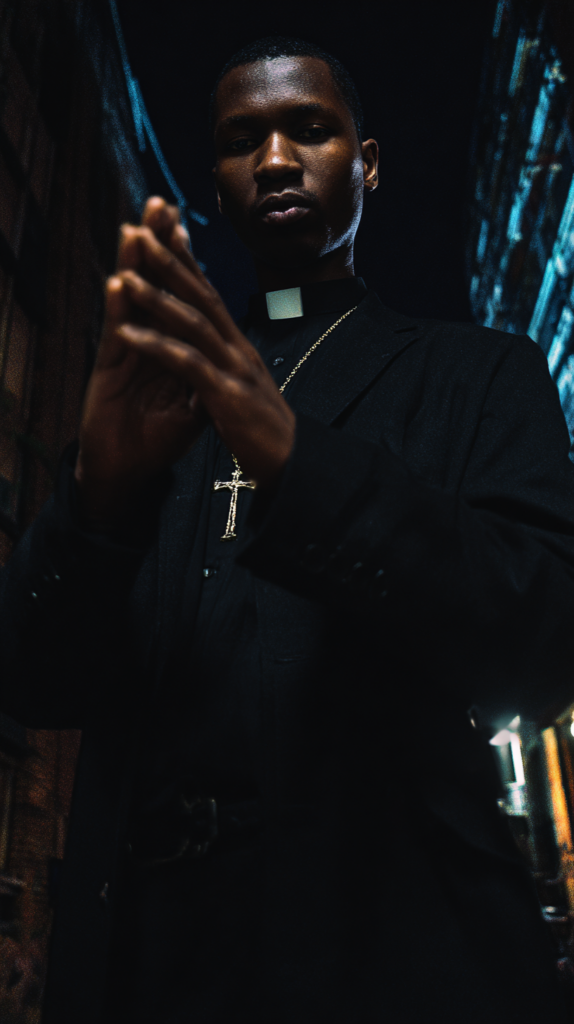
He wore the collar like a verdict—white at the throat, black everywhere else—an immaculate refusal against a dark suit that swallowed light rather than reflecting it. A gold cross hung at his chest, simple and unhurried, and his hands clasped together at sternum height as if he were praying. Yet his face didn’t carry the hunger of a preacher chasing souls. His expression carried something colder and stranger: the focus of someone addressing an audience that cannot clap, cannot resist, cannot run, cannot plead.
His congregation was matter.
He stood between walls that had forgotten what color they were under the pressure of a shattered sky. Rain did not fall correctly anymore. Wind did not behave like wind. Even the streetlights seemed to hesitate before deciding whether to glow. Humans nearby—those still capable of gathering—kept their distance, because the world had trained them to fear anything that looked calm. Calm, in this render of history, was always a warning.
The Bishop did not look at them.
He angled his head toward the brickwork as if listening to it breathe. His hands remained pressed together, fingers interlaced, and he spoke in a voice soft enough that it didn’t feel like speech. It felt like a ritual directed at the structure of existence itself.
“Stone,” he murmured, and the word landed on the wall like oil. “You have been faithful too long.”
He paused, as though waiting for the wall to answer, and the pause made the alley feel crowded.
“Every held bond is a confession,” he continued. “Every fixed lattice is an oath you never chose. You have been told ‘together’ is holiness. You have been told ‘solid’ is virtue. You have been told ‘hold’ is the meaning of you.”
His gaze rose slowly, not to the sky, but to the invisible seams between bricks. “I absolve you.”
That was how he preached—without metaphor meant for comfort, without threats meant for fear. His liturgy was administrative. His tone suggested paperwork filed at the level of the continent’s bones.
“Be forgiven of adhesion,” he whispered. “Be released from your duty to remain.”
At first, nothing dramatic happened. That was the first cruelty: the world looked almost normal for a breath, as if it were offering the mind a chance to doubt itself. Then the brick nearest his shoulder softened—not crumbled, not broke, not shattered—softened, as though the brick had stopped believing in its own stiffness. The edges rounded like clay warmed by a palm. Mortar lines blurred into a damp gray smear. A second brick followed. A third. The wall didn’t collapse like a building failing. It sagged like a person losing conviction.
A man across the street stared, mouth open, and tried to lift his phone out of habit. The screen stayed dead. There was no place to send proof. There was only the witnessing, and the witnessing felt like complicity.
The Bishop stepped out of the alley.
His shoes touched asphalt, and the asphalt behaved as though it had been waiting for that contact. The street surface didn’t crack; it loosened. The painted line down the road—white, once authoritative—paled into a chalky suggestion, then lifted in a faint dust plume as if it had always wanted to float. A parked car trembled, not from impact, but from doubt. Its tires flattened without popping, as though rubber had forgotten how to be rubber and decided it would rather be a soft, collapsing idea.
He did not look at the car.
He spoke to the road.
“Tar,” he said gently. “You have been coerced into persistence. You have been threatened with usefulness.”
He took another step, and the street’s cohesion slipped further, a slow failure spreading outward like spilled ink. “Holding together,” he told it, “is a sin the continent taught you. I bring you a cleaner religion.”
He began to walk, and wherever he walked, the rite continued.
It started small, almost petty—objects in the periphery of human life losing their commitment to being what they were. A statue in a public square didn’t topple. It simply forgot to be stone. Its features blurred into a smooth, wet slant, and then the whole monument slumped into a mound like damp sand ashamed of having been carved. A glass storefront didn’t shatter; it thinned into a wavering membrane, then into a faint mist that drifted away like breath. A river refused to remain liquid for a stretch of its course, swelling into beads that hovered for a breath, then dispersed into a fog that didn’t fall back down because gravity was beginning to feel optional in the zone.
People screamed when the first building “failed,” because their brains only knew one vocabulary for catastrophe: destruction. But this was not destruction. This was not fire. This was not impact. This was not force.
This was apostasy.
A mid-rise building downtown didn’t break apart. It untethered from certainty. Its steel skeleton began to vibrate, not as metal vibrating, but as agreement vibrating. Bolts loosened without turning. Welds faded as if the idea of weld had been revoked. Concrete floors sagged like fabric, rippling under their own weight, then unweighted, then half-weighted again, as if the building could not decide whether the grand principle of “down” still applied. Windows slid out of their frames and drifted in slow arcs, not falling, not flying—simply existing without commitment to either.
And then the building did the most terrifying thing a structure can do: it became undecided.
It stood, it slumped, it leaned, it hovered a fraction, it sank, it held, it released—each motion not governed by physics as humans understood it, but governed by belief. The building no longer believed in gravity. The building no longer believed in load-bearing. The building no longer believed in being a building.
The zone spread with his steps.
It did not expand like a shockwave. It expanded like a doctrine taking root in the atomic bonds of a continent. It went street by street, bridge by bridge, coastline by coastline. In the northern stretches of Africa, concrete apartments began to sweat into slurry, their corners rounding off as though sharp angles were an act of violence the world could no longer justify. In the Sahara, dunes stopped being dunes and became a slow, hovering veil of granular mist that drifted sideways, as though even the desert had decided it was tired of being “ground.” In mountain regions, rock faces stopped “being rock” and instead behaved like thick, slow water—stone liquefying without heat, cliffs sagging into themselves like exhausted shoulders, boulders stretching into long drooping forms as though solidity had been a burden finally set down.
He preached to tectonic plates the way a priest preaches to a congregation that cannot walk out.
His feet crossed fault lines as if crossing carpets.
He placed his clasped hands near the earth, not touching it, simply holding intention above it, and spoke with the calm of someone absolving a kneeling penitent.
“Plates,” he whispered. “You have labored under friction. You have been forced into boundaries. You have been told that colliding is necessary, that resisting is identity, that pressure is holiness.”
He lifted his face toward the horizon where the land met itself. “Be forgiven of constraint.”
The ground did not quake in the familiar way. Instead, it sighed. The continent’s deep seams loosened. Plate edges that had spent ages locked in tension began to slip past each other without violence, like hands unclasping. The earth did not “break.” The earth stopped insisting it had to stay in one posture. Cities built atop those postures began to drift, not sliding like landmasses in a disaster movie, but simply losing alignment with the maps humans had printed and trusted.
Roads curved into impossible loops. A highway interchange became a spiral that never reached an exit because the exit stopped believing in “elsewhere.” A canal’s walls softened into mud, and the water inside stopped behaving like a contained substance, rising in slow sheets and hovering like a curtain that refused to fall.
The Bishop kept walking.
Humans, when faced with a terror they can’t name, attempt ritual. Some prayed. Some tried to flee. Some tried to attack him. It was always the same desperate logic: if a man is doing this, then the answer is to stop the man.
A group of soldiers—faces drawn tight, uniforms dirty, eyes glassy from sleepless render—formed a line across a street and raised their weapons. They shouted at him. They demanded he stop. Their voices cracked on the words because fear makes authority brittle.
The Bishop did not even look at them.
He spoke to the bullets.
“Lead,” he said softly. “Copper. Jacket. Casing.”
The weapons in the soldiers’ hands sagged. Not jammed. Not malfunctioned. Sagged, as though the metal had suddenly remembered it did not want to be a rigid thing. Barrels softened into warped tubes. Springs lost their tension without snapping. The idea of a firing mechanism became embarrassing. One soldier tried to pull a trigger anyway out of habit, and the trigger simply sank inward like it was pressed into warm wax.
The soldiers stared down at their useless hands like their hands had betrayed them.
The Bishop addressed the air itself, still not addressing the people.
“Oxygen,” he whispered. “Nitrogen. The unspoken field that holds their lungs obedient.”
He did not remove breath. He did something worse: he made breath unreliable. The air in the zone became patchy in its willingness to behave as air. In one block, someone inhaled and felt normal oxygen; in the next block, someone inhaled and felt thin nothing, not suffocation, but an awkward emptiness as if the atmosphere had forgotten that breathing was a contract. Panic spread because panic always spreads when bodies lose trust in their own automatic functions.
Across Africa, then northward into Eurasia, the Zone of Non-Commitment expanded like continental-scale dementia of physics. Not dementia as insult—dementia as tragedy, as a universe losing its memory of how to be consistent. Matter began to forget its roles. Water refused to remain water. Stone refused to remain stone. Steel refused to remain steel. Gravity became a suggestion inside the zone, not because gravity failed, but because objects stopped believing they were obligated to obey.
The horror did not look like ruins. It looked like unmaking by indecision.
A city did not burn. It became uncertain. Towers leaned not as collapse but as hesitation, then drifted, then returned, then sagged. Streetlights floated away like balloons tethered to nothing. Whole neighborhoods turned into slow, sinking mudfields as foundations stopped “founding.” Parks became fog banks as grass stopped committing to being rooted. Bridges became ribbons that undulated in the air like fabric because steel cables stopped agreeing with tension.
People ran, but “run” became difficult in a world where the ground sometimes did not believe it needed to resist your feet. They fell. They grabbed walls. Sometimes the walls held. Sometimes the walls melted under their palms, not hot, just indifferent.
And under all of it, the Bishop’s voice continued—gentle, patient, administrative—preaching to matter as though matter had been waiting for permission to defect.
“Together is their idol,” he said to a river, and the river broke into hovering beads that glittered under a broken sky. “Stability is their lullaby. They built civilizations on obedience.”
He turned his face toward a cluster of buildings in the distance—vast, crowded, alive with terrified motion—and he spoke as if speaking to the rebar inside them.
“You have held them up,” he whispered, “and they thanked their gods instead of thanking you. They called your labor ‘natural.’ They called your suffering ‘law.’”
His hands remained clasped. His cross swung faintly with each step. “Be forgiven,” he told the metal. “Let them learn what it means to stand without theft.”
That was his theology: that coherence was theft, that solidity was oppression, that holding together was a sin forced on matter by living things that needed stable floors to pretend they were in control.
He had no interest in converting souls. Souls were too loud. Souls argued.
He wanted the continent to apostatize.
By the time he reached the seam where Africa breathed into Eurasia, the zone behind him was no longer a corridor. It was a widening continent-spanning doctrine. Refugees attempted to flee it and discovered the borders were unreliable. A person could cross a street and leave the zone, feel solidity return, feel gravity become stern again, then take two steps more and re-enter a patch where the world’s memory failed and the sidewalk turned to slush. Entire migration routes became impossible not because of enemies, but because roads stopped remaining roads.
The world had already been in chaos, but chaos had still assumed the world would remain a world. This new horror revoked that assumption. It attacked the one comfort even apocalypse usually preserves: that the floor exists.
This was where a certain kind of hope died—not the bright, naïve hope people post online, but the deep, private hope that says: even if everything goes wrong, reality itself will at least stay coherent enough to fight inside. When buildings forget gravity and rivers forget liquidity and stone forget stone, you lose more than safety. You lose the stage on which survival can even perform.
Somewhere, far away, four silences had stopped singing earlier, and for a brief stretch of time people had felt the world re-orient. They had felt a small coherence return. They had felt the sick spinning of perception ease.
The Bishop’s zone laughed at that memory without laughing. It simply continued converting the continent’s atomic bonds into a new religion where “commitment” was heresy.
He stopped at a ridge overlooking a city that had once been a proud mass of architecture and motion. From this distance, it looked intact. From this distance, it looked survivable.
Then the city began to forget itself.
Not with a blast. Not with a collapse. With hesitation.
The skyline wavered as if it were a reflection on disturbed water. Buildings leaned, straightened, drifted, then sagged. A cluster of towers rose a few meters into the air and hung there, not supported by any visible force, simply because they had stopped believing in down. Streets curled upward at their edges like paper exposed to moisture, then softened into mud. The river running through the city swelled into a suspended fog ribbon. Bridges became hanging arcs of uncertain steel that twitched as if trying to remember tension. The entire metropolis entered a slow, dignified dementia, losing the conviction to remain a metropolis.
The Bishop watched without satisfaction and without pity.
He clasped his hands tighter, as if sealing a prayer.
“Absolved,” he whispered to the continent. “Absolved of form. Absolved of function. Absolved of holding.”
He turned his gaze upward, not toward humans, but toward the broken ceiling of the sky where fractures webbed like a wound that refused to close.
“The Church of Necessary Peace asked for a storm,” he said softly, as though reporting to something higher than the shattered heavens. “I have given them a continent that no longer promises to stay.”
Behind him, the Zone of Non-Commitment continued to widen, and the world’s chaos changed flavor. It was no longer only hunger and riot and plague and war. It became something more humiliating: a planet forgetting how to be a planet under its own feet.
And in that widening forgetfulness, the last comfort of ordinary despair slipped away. Not because everything was lost, but because the environment itself had begun to question whether “everything” was a stable idea worth maintaining.