
Penultimate Truth — Theory of Small Light II
When Excella Angelicus and Eira stepped farther into the inner world, they discovered that the damage was no longer content to remain symbolic.


The first region of Dandemægus’s psyche had been ruin on a transcendent scale, a broken inward cosmology where possibility, nothingness, and totality cracked apart like overburdened heavens and his ties to names, terms, and essence came undone in radiant silence. This deeper region was worse. Here, the collapse had learned intimacy. Vast black plates of shattered inward reality still drifted through the great unmanifest dark, and the luminous streams below still ran like exposed nerves beneath the floor of his being, but now everything was more personal, more surgical, more cruel. The broken architecture of his mind had taken on the emotional weather of a child who had been taught that love and pain were not merely adjacent, but interchangeable. The air itself seemed bruised. Even the lower brilliance beneath the fractures no longer looked like raw life trying to hold. It looked like life under interrogation.

Above them, impossible panels of inner creation continued to split in long white veins. Great mandalic globes, each one once containing some sealed continuity of self, shattered from within, and what fell from them was not only memory now, but judgment. Words that should have become identity disintegrated before they could land. Sounds that might once have formed belonging dissolved into dust. Every layer of the place announced one terrible truth with relentless clarity: the one they were trying to save had not merely been wounded by the world. He had been constructed in violence, corrected by contradiction, and raised under a regime of emotional law so unstable that even his soul had learned to expect treason from anything calling itself love.
Young Dandemægus walked through all of it.
He emerged from a corridor of cracked psychic matter as though he had always known how to move through collapse without expecting shelter from it. He was older than the infant they had seen before and younger than anyone should ever have been asked to carry so much. His clothes were worn, too large in places, grimy at the seams, and his sneakers dragged the dust of broken reality like the residue of every unkindness the world had ever laid at his feet. Yet there was still a strange and unbearable gentleness in him. Not softness in the weak sense. Something harder to witness than hardness. An innocence that had not been allowed to remain innocent, yet had not altogether surrendered the instinct to keep going.
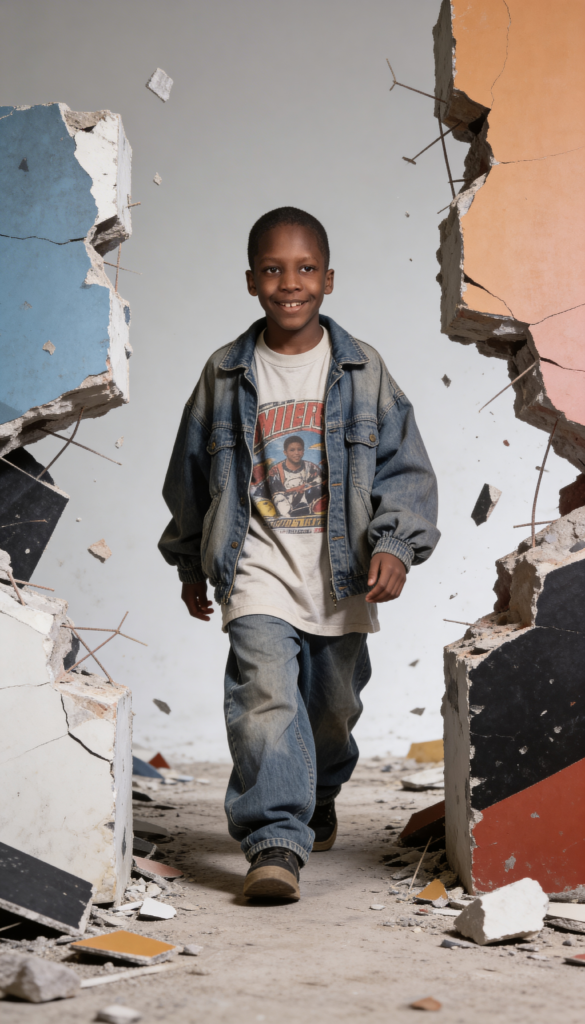
Eira stopped the moment she saw him.
In her hand, a small spiral galaxy hovered, its luminous arms turning slowly above her palm like a private theorem made visible. It was one of the ways her bloodline announced itself in places like this. Dandemægus’s daughters did not merely inherit affection or resemblance. They inherited strange rights of access. The galaxy-light in Eira’s grasp pulsed once, reacting to the fractured boy ahead of them.
Excella glanced toward her. “You’re stabilizing this level.”
“I’m trying,” Eira said quietly, though her eyes never left the child. “If I don’t hold something together, this whole region is going to fold in on itself.”
The younger girl’s face had hardened again, but it was not coldness in the ordinary sense. It was concentration born from grief. She looked like someone trying to keep her own heart from becoming another casualty of what she was seeing.
They followed the child deeper.
The inner world shifted not by road or corridor, but by emotional permission. One broken plate became another. One black ledge opened into a field of torn concrete and raw rebar. One cosmic fracture thinned into the architecture of a shattered rowhouse interior where walls hung open and chunks of old plaster floated in slow suspension as if the house itself had never decided whether to collapse fully or remain upright long enough to witness one more cruelty. Behind those walls, on some deeper psychic horizon, whole galaxies still broke apart in silence, but here, in the foreground of this memory-field, the violence had become domestic.
Young Dandemægus entered the ruin and stopped.
He knew this place.
That was clear not because anyone said it, but because his body changed. His shoulders drew inward just enough. Not the theatrical cowering of a child expecting a single blow. Something more tragic than that. The ordinary readiness of a child who knows a home can become a weapon at any moment. The walls around him were painted in faded colors, once cheerful perhaps, now peeled, dust-marked, and split. A ceiling beam sagged above him. Broken fragments of cheap furniture lay half-phased into the floor, sometimes solid, sometimes transparent, because even the memory of the room could not maintain stable agreement with itself.
Deenvylia’s voice arrived before she did.
It came from everywhere at once. Through the cracked walls. Through the debris. Through the lower streams beneath the broken floor. It did not sound like a ghost. It sounded like the law of the space.
I love you.
The words landed first with such startling softness that even Excella felt the trap in them before the next layer arrived.
Why are you so weak?
Young Dandemægus flinched. Not because the statement was new. Because it was familiar enough to enter him without resistance.
You live for me. Do you understand? You live because I say you live.
The voice shifted again, carrying the passionate insistence of wounded motherhood and the tyranny of possession in the same breath.
Nobody will ever protect you like I protect you. Nobody will ever love you like I love you. If you listen to me, maybe one day you’ll become something. If you don’t, you’ll be nothing. You are mine. You understand? Mine. I’ll break anybody who hurts you. I’ll destroy them.
Then, almost in the same pulse:
I’m never going to be proud of you if you stay like this.
Excella closed her eyes for the span of half a breath.
This was not contradiction as occasional instability. It was contradiction as conditioning. A child forced to internalize love as possession, insult as instruction, dependency as duty, protection as control, worth as approval perpetually denied. The deeper horror was not only that the words were cruel. It was that they were formative. A child does not hear this and simply disagree. A child builds internal law from it. He begins to understand himself through the categories given to him, even when those categories are designed to deform him.
Eira’s jaw tightened so hard that the line of it became almost severe. “This is why he overcorrects,” she said, the words low and flat. “This is why he keeps trying to become the wall for everyone else. Because he was taught that love means being broken into usefulness.”
Young Dandemægus moved again.
He passed through the room, and as he did, the memory split wider. What opened next was not merely physical abuse as isolated incident, but a world in which pain had ceased to be event and become environment. There are childhoods where violence interrupts life. Then there are childhoods where violence is the weather system every other memory must learn to survive under. His had been the latter.
The next fragment struck fast. A hand raised with a bat in anger. Not because he had done anything monstrous. Because he had existed too near someone else’s rage. Deenvylia, younger still in some parts of the memory and older in others, became impossible to anchor to a single moral posture because the wound itself would not allow simplification. She was not one thing. Not victim alone. Not monster alone. Not protector. Not betrayer. She had been injured by the world so profoundly that her anger no longer recognized innocence as boundary. It spilled where it could. Onto the child who loved her. Onto the small body nearest the fire.
A slap. Then another version of the memory where it was a punch. Then another where it was her hands gripping his arms too hard, bashing his skull into the wall because she needed him to become resilient quickly enough to justify everything she had already allowed. The memory-field did not present events in tidy sequence. It presented them in emotional equivalence. All the moments gathered together because his mind had catalogued them not by date, but by lesson.
You are not safe even when the danger says it loves you.
Excella felt that one as if the psyche itself had spoken it directly into her bloodstream.
Young Dandemægus stumbled in one fragment and sat against a corner where two walls met, knees pulled up, arms around them, making himself smaller not because he believed it would help, but because smallness had become the only posture available when there was nowhere left to run. Dust and plaster fell around him in slow drifts. The world behind him kept cracking. Even here, inside the private room of his earliest domestic fear, the larger structures of possibility and totality continued to break above the house like ruined heavens.
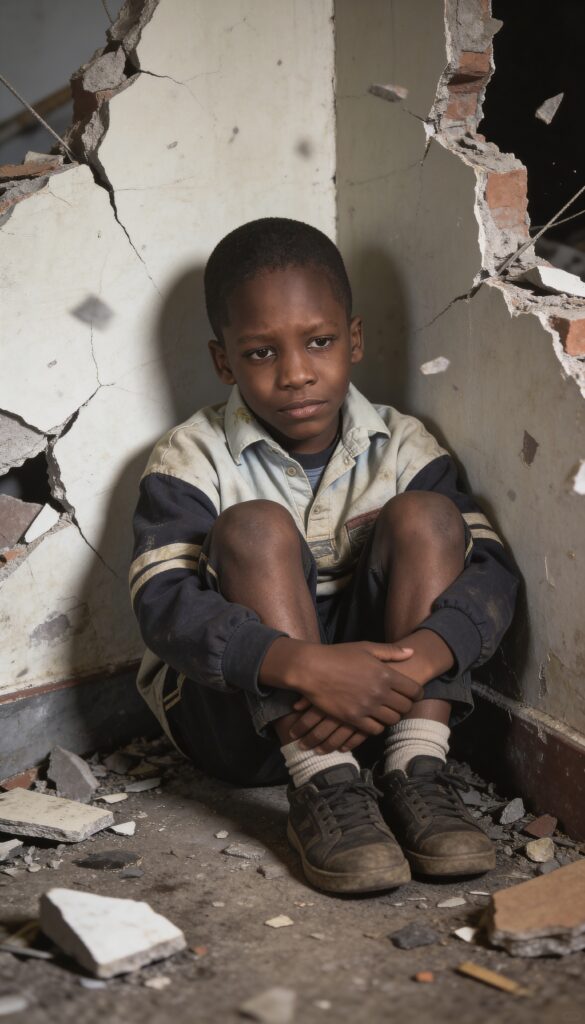
He was not crying.
That was somehow worse.
Not because tears would have been weakness. Because the absence of them suggested a child already too practiced in despair to expect relief from expression. His face held that terrible old-young stillness some children develop when life has made emotion into an efficiency problem. If crying does not alter outcomes, the body eventually learns to conserve it.
Then the spiritual entered.
Excella felt it first as pressure behind the eyes, the kind of invasive inward distortion she had spent years studying in her work before she ever called herself anything like a hunter. But this was not an ordinary haunting. The spiritual violence in this region of Dandemægus’s inner world was not separate from the emotional violence. It had nested inside it, feeding from it, refining it, learning its rhythms until torment from unseen realms and torment from human hands had become interlaced. Shadows gathered along the edges of the ruined memory-space and leaned inward without fully acquiring shape. Murmurs moved through the cracks in the wall. A child’s mind under extreme, repeated injury becomes permeable in ways most people never understand. It does not simply suffer pain. It becomes easier for the wrong presences to enter, easier for predatory forces to find purchase in the fractures, easier for darkness to speak in familiar voices.
The walls breathed once.
Young Dandemægus looked up.
Something in the corner of the room elongated. Not a full entity. More like a thought of one, a malformed appetite clothed in all the terror his childhood had already made admissible. A black handprint appeared on the inside of the wall and then began to spread, not like paint, but like spiritual rot converting structure into invitation. Voices layered over Deenvylia’s. Mocking. Encouraging. Telling the child he was unchosen, unwanted, breakable, edible in the metaphysical sense. The language of the attack was inconsistent because the goal was not persuasion. It was saturation. Break the child’s inner boundary until even his own thoughts became difficult to distinguish from the things feeding on him.
Eira took a step forward, fury rising visibly in her face. “No.”
The small galaxy above her palm flared, and for a moment the black handprint hissed backward from the wall.
Excella laid a hand on Eira’s arm. “Don’t fight the memory. Not yet.”
“It isn’t just memory.”
“I know.”
That was the terrifying part. They were not watching a finished past. They were moving through an active wound-site. The inner world of Dandemægus was still metabolizing this damage. The spiritual remnants were not archival. They still had teeth.
They kept walking.
The deeper they went, the less the mind distinguished between house, alley, ruin, and cosmic fracture. One moment Young Dandemægus was in a shattered room, Deenvylia’s voice raining contradictions into him. The next he was outside in a Baltimore alley under a sky that kept phasing between ordinary urban dusk and a black astronomical rupture where impossible spheres broke apart overhead. Then he was back in a corridor of cracked psychic architecture with raw symbolic light streaming beneath the floor. Then a sidewalk. Then an abandoned basement. Then a broken school corridor. Then a place no child should have known existed at all: a gray zone where adult bargains happened in half-dark and children learned to make their minds leave before their bodies could.
This time Excella understood before the memory fully clarified.
She stopped walking.
Young Dandemægus had entered a narrower chamber, one made of ruined concrete and emotional residue rather than literal brick. The room smelled, somehow, of fear and stale air even inside a psyche. He stood there waiting without understanding what he was waiting for. The kind of waiting a child learns when adults have turned obedience into survival. There was no mother in sight. Only the shape of her decision.
The truth revealed itself in layers too monstrous to need detail.
Not absent protection.
Arrangement.
Not mere negligence.
Orchestration.
Deenvylia had known.

Not once. Not accidentally. Not at the edge of her awareness. She had known what kind of men, what kind of places, what kind of predatory exchanges the world was laying around her child. Worse, there were parts of the memory that made clear she had participated in the logistics of it, bending, permitting, directing, sacrificing, telling herself whatever lie made the next night survivable. Food for access. Shelter for silence. Temporary safety bought by delivering a smaller, more innocent body into the machinery of human cruelty. She had not always been physically present. That was part of the horror. The child had learned that the abandonment was not chaos. It was policy.
Eira did not gasp. She had already known.
Excella did.
For the first time since entering the psyche, true revulsion broke visibly across her face. Not because she lacked the education to understand how desperation distorts moral structure. She understood it too well. But understanding is not exoneration. Some lines remain lines even under starvation, homelessness, fear, and social collapse. The tragedy of Deenvylia’s life did not purify what she had done to her son.
Young Dandemægus stood in the chamber, looking smaller now, as if the knowledge itself had begun to compress him.
He did not have the full adult thought for it then. A child rarely does. He did not say my mother traded my safety away. He did not frame it in language that clean. He felt it as a different kind of extinction. The person whose body had been home, whose voice had named itself love, whose anger had always implied possession, had also allowed him to be broken because the breaking had utility. It is one thing for the world to be cruel. Another for the first center of your existence to decide your ruin is an acceptable exchange rate.
The atmosphere of the inner world changed after that.
Anger arrived.
Not loud at first. Not theatrical. Not an explosion. Something much more frightening. The whole psychic landscape began to tense. Cracks widened across the black plates underfoot. The luminous streams below reddened at the edges. Great splintered structures in the far distance tilted and ground against one another. Every piece of Dandemægus’s inner world began to vibrate with suppressed force. It was not childish temper. Not adult resentment alone. It was insurmountable anger, the kind born when innocence realizes it was not merely unprotected but converted into fuel for someone else’s continuation. The kind of anger that, if left with nowhere honorable to go, becomes the bedrock of an entire adult life.
Excella understood then why his love had gravity. Why his restraint sometimes looked less like calm and more like engineering. He was not gentle because gentleness came naturally. He was gentle because he had spent an entire life building containment around a furnace that should have destroyed him.
From above, another presence watched.
At first Excella thought it was a damaged mandala or one of the vast collapsing shells of identity drifting beyond the main psychic horizon. Then it turned slightly, and all illusion of passivity vanished. It was a fragment of the Void Beyond, lodged impossibly inside the mind-space like a splinter of transfictional silence that had developed preference. A dark, robed unmanifest be-ness whose body was made of starfields and blackened voidal spread, multiple arms lifted not in blessing but in delighted observation. Its face was not a face so much as a devouring spiral, a galaxy twisted into hunger, and its posture radiated something worse than malice.
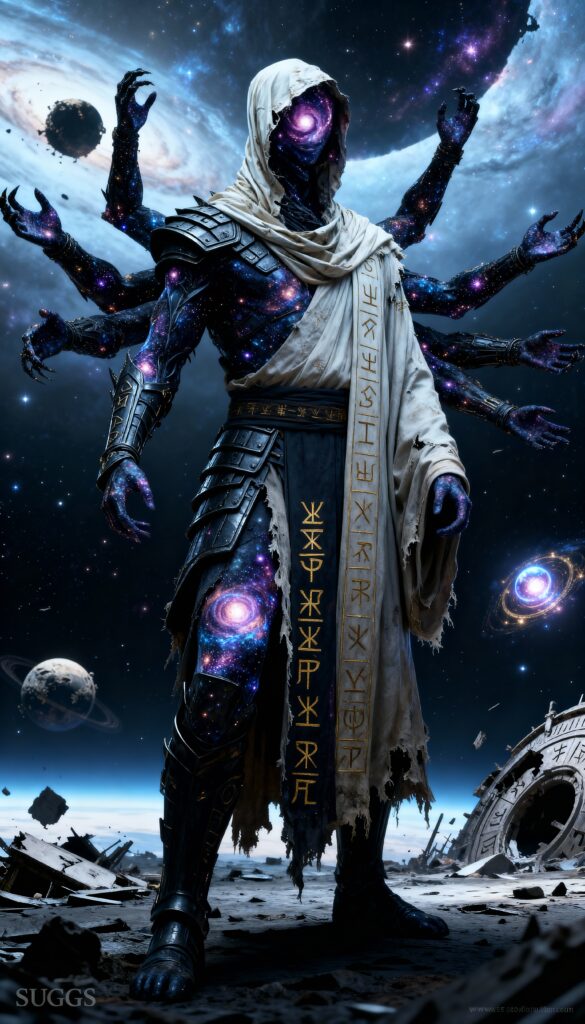
Pleasure.
It was enjoying this.
Not merely the boy’s suffering, but the architecture of it. The way the human and spiritual injuries had prepared the psyche. The way contradiction had hollowed channels for future collapse. The way a child trained to survive the unacceptable became a perfect site for later voidal intrusion. The fragment did not cause every injury. It did not need to. It was the kind of thing that found beauty in damage already underway and leaned close enough to make sure nothing healed clean.
Eira saw it too.
“That,” she said, and now her voice did shake—not with fear, but with the effort of not unleashing herself prematurely, “needs to die.”
Excella’s gaze stayed fixed on the fragment. “Not here. Not while the mind is this unstable. If we hit it wrong, we may tear open more than we save.”
“Then what do we do?”
“We keep moving.”
Young Dandemægus did exactly that.
And that, more than anything they had seen so far, undid Excella.
Because the child was scared. Entirely, visibly, irreducibly scared. Not brave in the performative sense, not armored against his suffering, not above it. He was alone in it. His mother’s voice still stalked the corridors of his being, alternating between adoration and annihilation, telling him she loved him, telling him he was weak, telling him he existed for her, telling him he would be nothing without obedience, telling him she would crush anyone who hurt him while being the first and most unavoidable source of hurt. The spiritual shadows still moved at the corners. The world still kept proving that innocence had no guaranteed sanctuary. Everything in the environment taught surrender, numbness, or corruption.
And still the boy smiled.
Not brightly. Not because he was happy. That would have cheapened it. It was a small smile, fragile and almost private, a smile he gave himself as if to say there remained at least one thing the world had not fully taken. A smile not of triumph, but of refusal. He smiled because if he did not, then chaos would own every chamber of him. He smiled because movement required a small light, and no one else had brought one.
Then he walked forward again.
Dust rose around his feet. Broken plaster drifted. The lower currents of the psyche flashed beneath the cracked ground. Overhead the heavens of possibility and totality continued collapsing. The Void fragment watched with obscene fascination. Eira’s galaxy-light trembled in her palm. Excella felt tears press hot behind her eyes and rejected them only because this place could weaponize tenderness if she let it.
They followed the child through one last corridor.
It opened into a vast impossible hall of shattering links. Great chains of meaning hung from nowhere, each link forged from memories, terms, promises, wounds, bargains, and names. They were all breaking. Every connection by which Dandemægus’s inner world had once held itself in coherent relation to personhood and pain had reached overload. At the center of the hall stood Deenvylia Endwriting.
She was no longer rendered as a single struggling woman in a city. Here she was the psychic sovereign of contradiction, expanded by the mind’s own wound-logic into something almost mythic in her violence. Not taller in physical size, but larger in effect. She held a universe in one hand the way some people hold a grudge, casually and completely. Her face was composed, furious, beautiful, and merciless. There was no apology in her. No remorse. Only that terrible maternal absolutism that believed love excused possession and survival excused sacrifice.

Young Dandemægus froze.
Eira went white with rage.
Excella stepped instinctively in front of them both, though she knew perfectly well that if this region of the mind fully broke, posture would not save anyone.
Deenvylia’s voice arrived not as sound but as decree.
He is mine.
The hall split down the middle.
Light burst upward from beneath the floor, not warm or holy light, but the raw exposure of a psyche being torn through foundational layers. Deenvylia raised her hand, and the chains of meaning shattered all at once. Links of possibility, nothingness, totality, name, shame, love, terror, duty, memory, obedience, and self-concept burst apart in a single convulsion. The world around them began to collapse inward and outward simultaneously. The black plates cracked into smaller and smaller geometries. The luminous streams beneath reversed direction. Entire celestial shells imploded overhead. The fragment of the Void Beyond flared with delighted attention.
Excella grabbed Eira’s wrist.
“Hold—”
Too late.
Deenvylia’s will slammed through the psyche like a mother’s claim weaponized into metaphysical law. She did not simply reject them. She recognized them as foreign density, as extra presences overcrowding a mind she believed belonged entirely to her and the ruin she had helped script. With one impossible act she drove her son farther down, farther out, farther beyond even the Void Beyond he had already crossed. Not into peace. Into a deeper unmanifest silence where even ordinary voidal language could not follow.
Young Dandemægus vanished first.
One moment he stood in the collapsing hall, still small, still trying to smile through terror. The next the ground opened beneath him into an absence deeper than black, deeper than erasure, deeper than anything Excella had yet touched in all her work, and he fell soundlessly into it.
Then the force hit them.
Excella and Eira were ejected not backward through space, but outward through rejection itself. The mind spat them loose. The broken hall sheared away. The galaxy in Eira’s hand exploded into spirals of defensive light. Excella tried to brace, tried to anchor, tried to keep sight of the child disappearing beyond all admissible descent, but Deenvylia’s psychic violence had already won the moment. The inner world shattered around them in one last scream of broken white.
And then they were gone from his unmanifest silence, expelled from the lynchpin of Dandemægus’s being just as the deeper dark closed over him.