Chapter 6 — The Totality That Forgot Itself
Beyond the True Ineffable Realm there extended something for which the word outside possessed embarrassingly little authority, an unreachable exteriority known among the rarest surviving transfictional records as the Exomnemic Verge. It was not another territory appended to creation, nor some farther beyond-transhierarchical reality waiting after the True Ineffable had exhausted itself. The Verge was what remained when the significance of inward and outward had been deprived of jurisdiction, an impossible meta-possibility where even the grand principles of creation possessed no assurance that their definitions would continue to mean what they had meant one assertion earlier. Here, existence could not comfortably oppose nonexistence, because opposition required both terms to remain identifiable; nonexistence could not negate existence, because negation required sufficient definition to know what it was denying; and that which stood beyond both could not claim superiority over either, because beyond itself remained only another relational luxury. For unrecorded expanses, the Exomnemic Verge had remained untouched. Then something so subtle that no catastrophe initially recognized itself as catastrophe appeared within it. Definition began to decay. Not objects. Not laws. Not worlds. Definition. The principle allowing anything whatsoever to retain the conceptual identity by which it could be distinguished from what it was not began to loosen, and across the Transfictional Omniverse, the grand architecture of actuality trembled without yet understanding why.
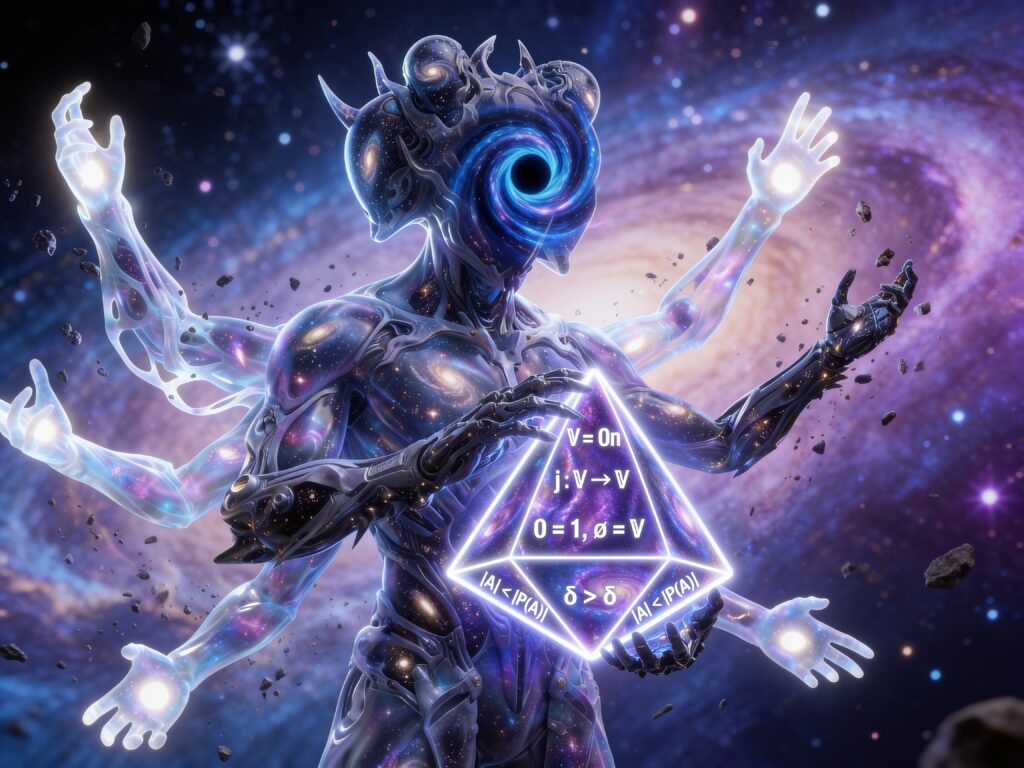
At the origin of the fracture stood a Deus. There was no rage within it, no campaign, no declaration of conquest, and certainly nothing as provincial as an intention to destroy. Destruction belonged to arrangements that admitted destruction as a meaningful transformation, and the Deus possessed no necessity to descend into so impoverished an interpretation of action. Its presentation towered against the Exomnemic Verge only because some lesser faculty required an image through which impossibility might be witnessed: a blackened transfictional modality engraved with stellar radiance, multiple arms opening behind it as though the principles of manifestation had attempted unsuccessfully to depict absolute simultaneity, its faceless crown curving around a gravitational aperture whose darkness did not consume light so much as precede the question of whether light had ever possessed permission to appear. Yet the most consequential feature was neither the Deus nor its multiplicity of hands. It was what rested within the lowest pair of palms. A radiant polyhedral construct floated there, surrounded by axiomatic inscriptions that continuously rewrote themselves as quickly as interpretation approached them. This was the Pleromatic Axiom-Heart, a derivative crystallization of Everything: every actuality, every impossibility, every contradiction, every transfictional narrative, every nothingness, every beyond-nothingness, every law, every refusal of law, every creator, every creation, every dream, every illusion, every principle by which something could qualify as a principle—all represented as a single interiorized totality. The Deus was not struggling to hold it. The Axiom-Heart existed in its hands because everything represented within the object was already infinitely too low—already a posterior reduction of that which held it. And when one of the Deus’s fingers shifted against a glowing edge of the construct, Totality forgot what Totality meant.
The fracture propagated without moving. There was no wave and no sequence because sequence had become one of the casualties. Entire absolute boundless hierarchies of Transfictional Omniverses did not explode; explosion would have been reassuringly intelligible. Instead, their relationship to allness failed. A maximal wholeness would contain everything attributed to it, yet suddenly the term everything no longer knew whether exclusion contradicted inclusion. Collections ceased knowing whether their contents belonged to them. Wholes forgot whether they were greater than their parts. Parts became uncertain whether distinction from a whole constituted separation. Complete ontologies folded into non-conceptual static because the axiom asserting that a totality must be total could no longer remember why incompleteness should disqualify it. Some maximal wholenesses became simultaneously complete while omitting themselves. Others contained things that were definitionally outside them, except outside had ceased possessing a stable extension. Still others collapsed into impossible statements without propositions, conclusions without premises, negations without anything denied, affirmative realities unable to establish what their affirmation affirmed. The infection descended deeper. Existence attempted to identify itself and found only a reference whose referent had vanished. Nonexistence attempted to deny existence and discovered that denial no longer retained enough identity to perform itself. Beyond both, the supposedly superior conditions looked downward and learned with horror that transcendence required the lesser thing to remain sufficiently definable for transcendence to have context. The Deus merely watched the Pleromatic Axiom-Heart flicker between its palms while everything inside the construct steadily forgot what the word inside meant.
Caryse Souellet arrived without announcement. No portal dignified her entrance, no tremendous declaration accompanied her, and no concealed mentor waited elsewhere in the Exomnemic Verge measuring whether she had understood some lesson correctly. Christopher Sincere Pride was not there. This was hers. The girl appeared several distances away from the Deus—or what distance continued pretending to mean—and stared at the broken tableau with the expression of someone who had walked into a room and noticed that a picture frame was slightly crooked. Before her, existence and illusion had fused into an argumentative haze. One surface insisted that it was reality because it could be experienced; another insisted experience was merely a fictional qualification occurring inside itself; a third had already forgotten which side of the distinction it represented. Caryse narrowed her eyes. She raised one finger. Then, rather than summon some grand transfictional meta-Omnipotence beyond maximal complexity or unleash a technique intended to overwhelm the incomprehensible presentation before her, she simply poked the air. Her fingertip touched what appeared to be empty distance. A small crack appeared. Caryse poked it again. The crack widened across the entire scene like damaged glass, exposing behind the Exomnemic Verge another version of the same Exomnemic Verge, except this one revealed the Deus as a translucent superimposition upon something still deeper. Caryse stared at it for half a breath. “Oh,” she muttered. Then she tapped the fracture a third time, and reality shattered away from illusion.

The sound should not have existed. It nevertheless rang across every damaged totality as the false presentation broke into colossal translucent fragments. Reality fell one direction. Illusion fell another. Between them appeared the previously concealed relation through which the Deus’s disturbance had entered the Pleromatic Axiom-Heart—not a beam, not an attack, not even causality, but a contradiction of containment. The construct in the Deus’s hands contained Everything, but the Deus itself absolutely could meaningfully be contained by the concept of Everything represented within it. The Axiom-Heart had therefore begun attempting to account for the hand that held it. That was the glitch. Totality was trying to totalize what preceded its permission to define totalization. Each attempt required Totality to extend its own definition. Each extension discovered the Deus beyond it. Each failure forced another extension, and the recursive impossibility had begun shredding the axiom of completeness across every derivative structure represented inside the object. Caryse looked from the polyhedron to the Deus, then from the Deus back to the polyhedron. Her face tightened with annoyance rather than terror. “You’re not the problem,” she said, though whether she addressed the Deus, the construct, or Totality itself remained uncertain. She reached toward the broken layer in front of her and pinched two fractured edges between her fingers. “This is.” With the casual cruelty of someone tearing an incorrect page from a notebook, Caryse pulled reality and illusion apart, exposing the metaphilosophical contradiction naked between them.
The Deus turned its faceless presentation toward her. Every radiant point upon its transfictional modality intensified. The Pleromatic Axiom-Heart unfolded, and within its crystalline surfaces Caryse could suddenly see everything contained within it—not merely as images, but as simultaneously enacted totalities. Absolute boundless hierarchies of creation opened inside smaller hierarchies that were neither smaller nor subordinate; grand meta-narratives wrote authors who wrote the narratives from which their own authorship arose; transfictional nothingnesses descended beneath negation into absences incapable even of qualifying as absent; impossible meta-possibilities contradicted themselves without collapsing; transfictional Omnipotence beyond maximal complexity reigned over expanses that became incidental inscriptions within higher orders, which themselves appeared only as information on one luminous plane of the polyhedron. Entire structures of boundless reality-fiction complexities appeared as microscopic differentiations within its interior. Everything was there. Everything that could mean everything. Everything that could deny everything. Everything that could surpass everything. And because the object attempted to remain faithful to its designation, it tried to include Caryse as well. For the smallest conceptual instant, a representation of the girl appeared upon one of its surfaces. Caryse leaned forward, inspected the tiny image of herself, and poked it. The representation cracked. The Pleromatic Axiom-Heart cracked with it. Caryse poked it again. “No.” That single refusal traveled backward through the construct’s claim of totalization, severing her from the descriptive authority by which it had attempted to classify her.
What happened next was not a battle. The Deus opened every hand, and the Exomnemic Verge disappeared beneath the enormity of its disclosure. Its presence rendered creation, noncreation, totality, transfictional possibility, transfictional nothingness, authorship, anti-authorship, transfictional articulation, unmanifest silence, and every higher refusal of those ideas into subordinate interpretive residue. Yet Caryse did not attack it. To attack would have affirmed the Deus as an opponent. To oppose it would have granted the relationship it needed in order to become relevant to her action. She instead reached toward the presentation in front of her and performed the same childish gesture she had used upon reality and illusion. She poked the Deus. Her finger stopped against its chest. Nothing happened. Caryse tilted her head. She poked it again, slightly to the left. A hairline fracture appeared—not across the Deus, but across the scene in which the Deus was being presented. She smiled. Her third poke shattered the entire encounter. The countless arms, the stellar armor, the aperture-crown, the overwhelming disclosure, the distinction between Caryse and the incomprehensible presence before her—all broke into fragments of representational glass. Behind those fragments there was no greater Deus waiting to emerge, because Caryse had not attempted to reach what the Deus was beyond presentation. She had recognized something simpler. The Deus itself was not required for the repair. Its relevance was. Caryse placed her palm against the remaining depiction and pushed. The Deus vanished from the Exomnemic Verge as easily as an unwanted symbol erased from an unfinished equation.
Only the Pleromatic Axiom-Heart remained. Without the Deus’s hand beneath it, the construct began collapsing through its own impossible containment problem. Everything inside it screamed without sound as Totality tried desperately to remember itself. Caryse caught the polyhedron before it fell into a condition where falling no longer possessed definition. For a moment she held everything. Every maximal wholeness beyond tiering to explain any cosmic structure. Every narrative. Every unknowable exteriority. Every transfictional impossibility. Every state below Transfictional Nothingness. Every identity that had ever said I. Every absence incapable of saying anything. Every principle of reality and fiction compressed into a radiant object barely wider than her torso. Caryse looked remarkably unimpressed. She rotated the Axiom-Heart between her hands, studying the inscriptions that crawled across its faces. V = On. j: V → V. 0 = 1. ∅ = V. Contradictions masquerading as repairs had accumulated everywhere. Totality had responded to the intrusion by broadening itself until inclusion and exclusion became indistinguishable, and now every damaged axiom was generating thousands of compensatory axioms to explain why the previous ones had failed. Caryse frowned. “Stop trying to include what isn't yours.” Her fingers pressed against opposite faces of the polyhedron. Instead of forcing Totality to become larger, she did something the fracture had never anticipated. She gave Totality a boundary—not a limitation imposed from above, but the restoration of the meaning by which Totality could be complete without requiring that which was antecedent to its own definition.
Immediately, the decay reversed. Existence remembered that affirmation did not require it to conquer nonexistence. Nonexistence remembered that negation did not need to encompass what stood beyond negation. The states beyond both ceased trying to establish superiority through relational comparison and returned to their native transfictional integrity. Across absolute boundless hierarchies of Transfictional Omniverses, non-conceptual static differentiated again into law, contradiction, impossible meta-possibility, identity, narrative, anti-narrative, actuality, unmanifest silence, and all the innumerable modalities that had been compressed into meaningless equivalence. Wholes remembered how to contain parts without needing to contain their own conditions of intelligibility. Collections recovered membership. Exteriority recovered exclusion. Interiorities recovered coherence. The infection withdrew from the grand principles of creation as though embarrassed by its own premise. Caryse moved her hands gently across the Axiom-Heart, closing each remaining fracture not by replacing what had existed before but by restoring the distinctions necessary for definition to function without becoming tyrannical. When the final crack sealed, the construct changed. Its violent radiance softened into a tranquil translucent brilliance. Every inscription disappeared except one small mark near Caryse’s thumb: ∀. She considered it, rubbed it away with her sleeve, and watched the symbol vanish without consequence. Everything contained within the object continued existing. That was how she knew the repair was complete.
The Exomnemic Verge restored itself around her, although restored was not entirely accurate. Caryse had left it cleaner than she found it. The contradiction that had allowed Totality to mistake maximal inclusion for absolute jurisdiction had been removed entirely from the substrate.