Chapter 30 – The Unspeakable Womb of Suggscosms
The ruins where Orvhyss⟠Thyriel//Zhaedryne had failed were still warm with after-echo when something colder than negation leaned over the city and tasted it. Aephyrion stood in the vapor of unwritten laws, hoodie shadowing calm eyes. To anyone who couldn’t read the grain of reality, he looked like a kid in streetwear who’d stayed out too late. But the asphalt beneath his shoes kept forgetting what “surface” meant, and every breath he took convinced a billion micro-axioms to reconsider their careers.
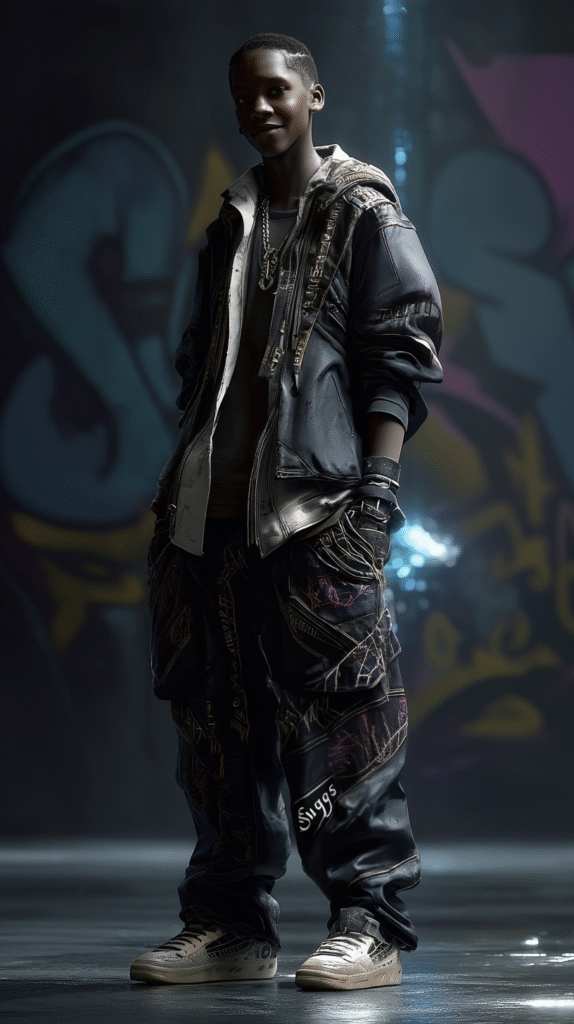
“Still reckless,” said a voice that did not pass through air. It rode the marrow of thought, an older weather he’d never escaped.
“Not reckless,” Aephyrion murmured, fists in pockets. “Efficient.”
Syvarenne Drexameral didn’t appear—not yet. She turned in him, a halo of maternal inevitablisma that made even silence walk straighter. Her concern weighed more than gravity. It was the first pressure of the night.
The second pressure entered like a rumor that already owned the truth. Vaeryss-⟠Nyrrhquos//Ithrael—the Qalythriarchate’s executor—slid from the seam of a cathedral-dark sky, armor like singing obsidian, limned in serpents of rose aurora that were neither light nor law. Where its feet touched, causality wore through. Where its helm turned, the stillness of prey gathered.
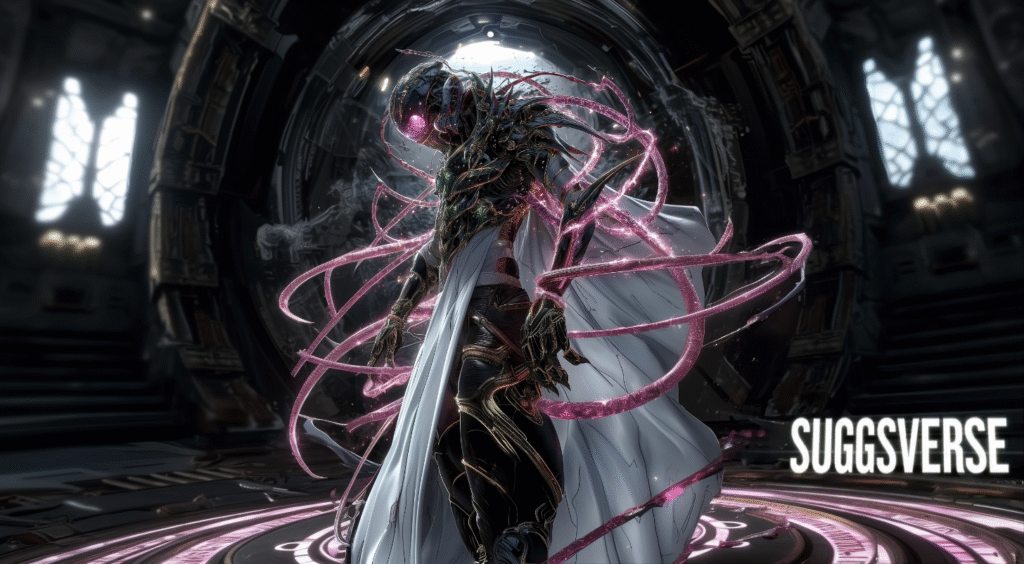
“You,” it said, and the pronoun arrived covered in futures.
Aephyrion lifted his chin. “You’ll have to be specific.”
The city exhaled; the eight unspoken movements began.
First movement—Paranull Meridian.
Vaeryss did not conjure a field; it stabbed a meridian through the possibility of there being fields at all. In the space around them, categories wandered off like bored Deus. Language reached, failed, forgot that “reach” was even a verb. Vaeryss’s suggscosm didn’t occupy—it un-necessitated. It wrung out the very premise of frameworks: metamathematics, metalogic, cataphysics, meta-reality, stacked and restacked until stack lost meaning. Its presence rewrote maximal cosmologies and xenocosmologies at once, not by countering them but by declaring that “counter” was a provincial hobby. Thought misfired; description stuttered; the air learned new ways to not be air.
Aephyrion answered without posture. His suggscosm didn’t expand or resist; it transcessed—a mode beyond transcendence that declined the contract of surpassing. Where Vaeryss erased categories, Aephyrion dissolved the need for categories. His influence folded inward like a star deciding it had never been hot, and the fold devoured the reason folding mattered.
Second movement—Crown of Unchoice.
Vaeryss braided those rose serpents into a crown of constraints and dropped it through every branching path, forcing all timelines to choose the one that said “I lose to Vaeryss.” Choice itself became a hoax exposed by the trick.
“Obvious,” Aephyrion said softly, and released an anti-axiom, a thought that was true before truth had a country. The crown flared, realized it was jewelry for a head that had never been necessary, and guttered out of function.
Third movement—The Archive of Before.
Vaeryss opened a library where moments were shelved as pre-moments. It read backward; cause kneeled to memory; effect signed autographs it hadn’t yet earned. Across the skyline, buildings remembered being built by a hand that had never been born.
Aephyrion cupped a palm; his breath condensed into a blue disk, a pre-thought kernel, compressing histories into an ultrafinite seed that predated pre. The library flipped to its final page and found the page had written the book as a prank. Shelves bent toward him like reeds in a tide no word could photograph.
Fourth movement—Complement of Nothing.
Vaeryss drew the pseudo-vacuum: for every level of power, even those beyond hierarchies invented to contain the phrase “beyond hierarchy,” it paired a lesser nothing, then stacked those nulls until absence looked imperial. “Absolute nothing is above all power,” it intoned across nerves and neon.
“Cute,” Aephyrion said, letting his hoodie’s hem sway as if to a song only egos hear. He extruded counter-vacuum invariants—not somethings, not nothings—the necessity of there being neither. The pseudo-vacuum folded; absolute nothing discovered it was only “absolute” in mirrors and all the mirrors belonged to the boy.
Fifth movement—Axiovore Choir.
Vaeryss sang. Its voice was several architectures of refusal. From that aria rose pale insects shaped like negated syllogisms. Axiovores. They ate rules, ate exceptions, ate the reason rules and exceptions quarrel. The street buckled into an un-plane; church bells that didn’t exist remembered ringing and stopped in shame.
Aephyrion’s lips parted; he breathed out glossolaws—language that had never signed the social contract of language. The axiovores swarmed it and melted, digesting a flavor called no digestive tract. The choir’s notes flinched; the aria forgot its alphabet.
Sixth movement—Egolith.
With the battlefield’s scaffolds shredded, Vaeryss dove at the lone fortress that remained: selfhood. Tendrils of rose glass wrapped Aephyrion’s reflection, trying to weaponize his certainty against him. “Your pride will pedestal me,” Vaeryss hissed from everywhere at once.
Aephyrion smiled, small and irritating. His ego became mirrorless—not humility, not arrogance: a contour that didn’t rely on witness. Vaeryss’s grip tightened and found it held the outline of a thing that refused outlining. The attack slipped, searching for edges that had un-registered.
Seventh movement—The Anapedestal Vow.
Frustration sharpened into ritual. Vaeryss declared the Vow of Anapedestal—no matter what Aephyrion did, victory would always stage under Vaeryss’s foot. The vow sought to make reality a staircase with only one landing.
Aephyrion nodded as if the statement were a valid preference at a café and then unleashed autophagy of autophagy—his suggscosm ate the act of eating itself, then ate the paperwork that proved eating had ever been a service realities could hire. Vaeryss’s vow briefly wore the face of inevitability and then that face dissolved into a crowd with no census.
Eighth movement—The Unspeakable Womb.
Cornered, Vaeryss pulled all its serpents inward and birthed a last theater: a womb of unspeakable recursion, a chamber smaller than nothing yet not negative, where every attempt to imagine was proof you were already inside. It was the Qalythriarchate’s secret—an engine that overwrote past, future, endless, transtemporal, and the reasons those words were proud.
Aephyrion stepped forward and let his Transcessation shed even its pretense of relation. His suggscosm contained the lack of all things as an included case and the presence of all things as a canceled appointment. For every omni-level—up to, around, and through the layers of maximal meta-omnipotence—his creation produced a complementary un-requirement. The womb tried to hold him; he muttered, “Don’t,” and the command arrived as the world’s native grammar. The chamber inverted, then inverted the right to claim inversion, and blew apart without sound.
Vaeryss staggered. The serpents spasmed and vanished. Its helm tilted toward the boy who still hadn’t raised his voice.
“You practice in public,” the executor rasped.
“Only when the city needs the lesson,” Aephyrion said.
“And when you tire?”
He considered. “I haven’t met the concept.”
The armored thing smoldered where meaning had once been rented by the hour. It bent—not in homage, not in defeat, but in the slow arithmetic of recognition. “If any will crown the Tower,” it said, “it will be the child who unhiers the hierarchies.”
Then Vaeryss-⟠Nyrrhquos//Ithrael was gone, not departing but cancelling the clause that had allowed it to stand here.
The heat bled out of the street. Neon remembered being liquid and sagged. Aephyrion exhaled; the city slid back onto its rails.
“Aephyrion Drexameral.”
He did not turn fast enough. Syvarenne arrived the way weather arrives—already inside you by the time you notice sky. She wore no armor, no crown; she did not need costuming. Authority hung on her like a familiar jacket.
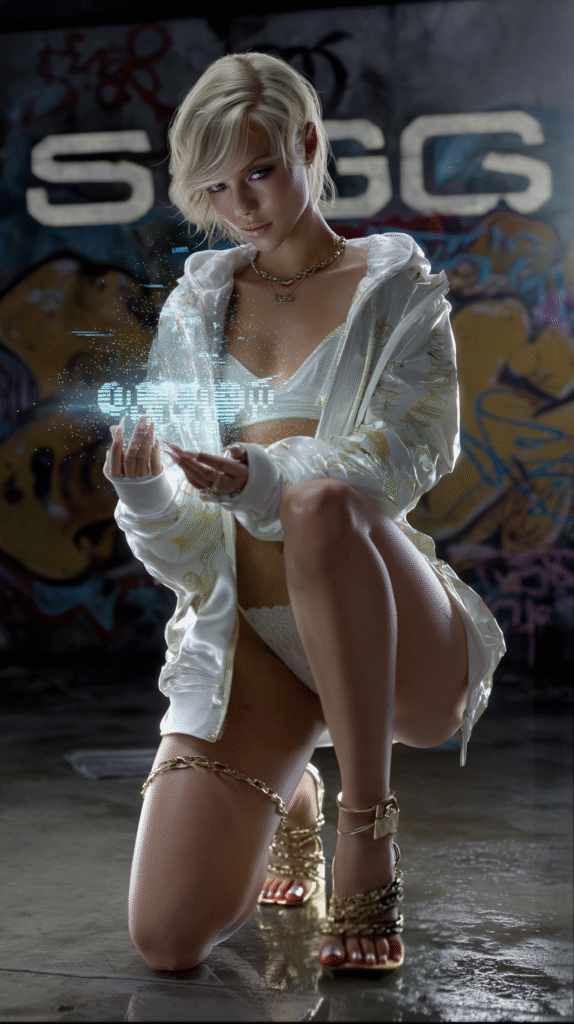
“You’re out again,” she said, tapping her foot on concrete that immediately apologized. “I told you to be home. There are bowls in the sink. Your closet is a cosmological indictment.”
He opened his mouth. Closed it. Tried again. “I was—”
“—saving the city? Collapsing seven kinds of logic? Practicing your Transcessation instead of folding your T-shirts?” Her eyes narrowed. “You’re not untouchable. You’re my son.”
He looked at his shoes. One of them flickered between being tied and having invented the concept of knots. “I’ll clean it.”
“You’ll clean it now.”
He risked a glance up; her expression didn’t budge. Somewhere far behind her scold was the warm edge of pride, but she protected it like a secret garden.
He sighed. “Okay.”
And then all the scolding in the world went quiet.
It wasn’t sound that ended it. It was inevitability arriving in a single, cosmic pulse. A bell tolled—not through air, not through stone, but through the municipal license of existence. Around the city (and above the city, and between the ideas that let there be “around” and “above”), something became visible that was never designed to be seen.
The Zhaerothspire unfolded. It didn’t rise; rising belonged to gravity. It manifested as the final argument—architecture that unspoke geometry, a blade of tournament-law run from earth to else. Every balcony of heaven found itself short of breath. Every alley felt briefly cathedral.
Syvarenne’s stare softened a fraction. “Home,” she said, softer than thunder, sharper than edict. “Then the Tower.”
Aephyrion nodded, and for half a heartbeat he looked exactly like what he’d been at dawn: a boy who hadn’t finished his chores. Then the halo of his unsaid work brightened under his skin, and the city, the sky, the world of rules and their little rebellions held its breath, because the bell had called all makers to witness.
The Tournament had begun.