Chapter 4 — The Stair of Unreturning Echoes
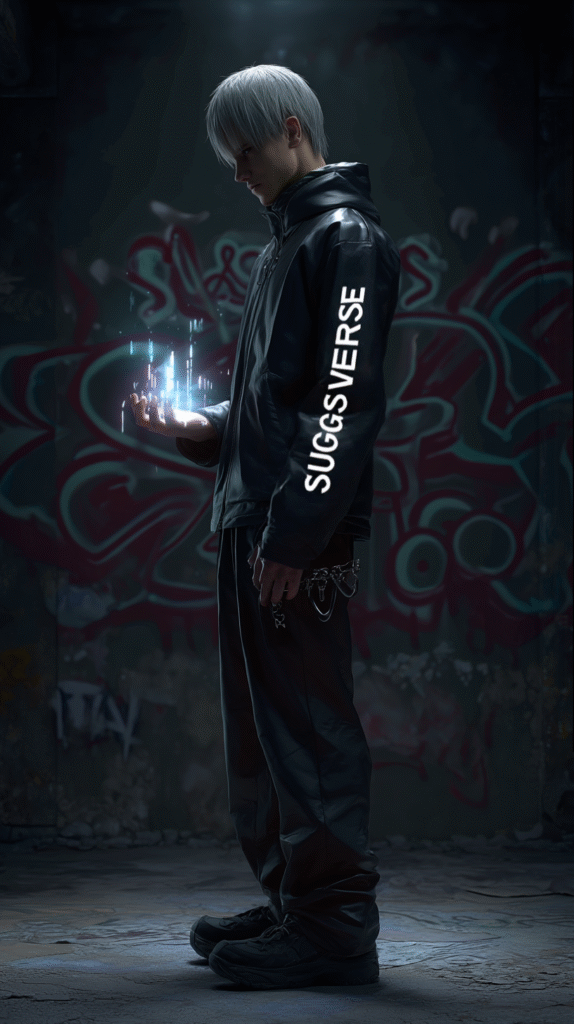
The street was not a street; it was a wound stitched across a boundless manifest expanse, an alley of rusted sigils and humming light where discarded modalities slouched like tired gods. Neon bled from cracked signage and pooled in black water that refused to reflect. Kaelvrynn Drexameral walked there as if the ground were testing him and quietly failing. The jacket that hung from his shoulders looked grown, not sewn—its black surface veined with whispering glyphs that drifted in and out of legibility. His gaze held that Drexameral stillness: silver-irised, unblinking, neither judgment nor mercy, only the cool calculus of suggslogic settling into place. Chains at his waist clicked like tiny verdicts. Behind him the background of creation gathered itself into sharper focus, as though his presence clarified the scene’s right to exist.
He did not patrol so much as occur. Vendors hawked contraband axioms—bottled causality, counterfeit archetypes, secondhand narrative seeds—while crews of gutter-architects dealt in stolen horizons. Kaelvrynn slid through their commerce like a rumor that had decided to acquire a body. He was searching for a voice he had never heard but would recognize instantly, the way a blade recognizes its sheath. The voice arrived as a vibration underfoot, a sub-vocal growl in the cracked masonry. When the crowd split, it revealed a figure standing where three graffiti-choked corridors met, wearing arrogance like a crown and precision like a second pulse.
“Heard the Drexameral shadow was abroad,” the figure said, not loud but acoustically absolute. “I was beginning to suspect inevitablisma had grown bored.”
Kaelvrynn halted. “Name yourself.”
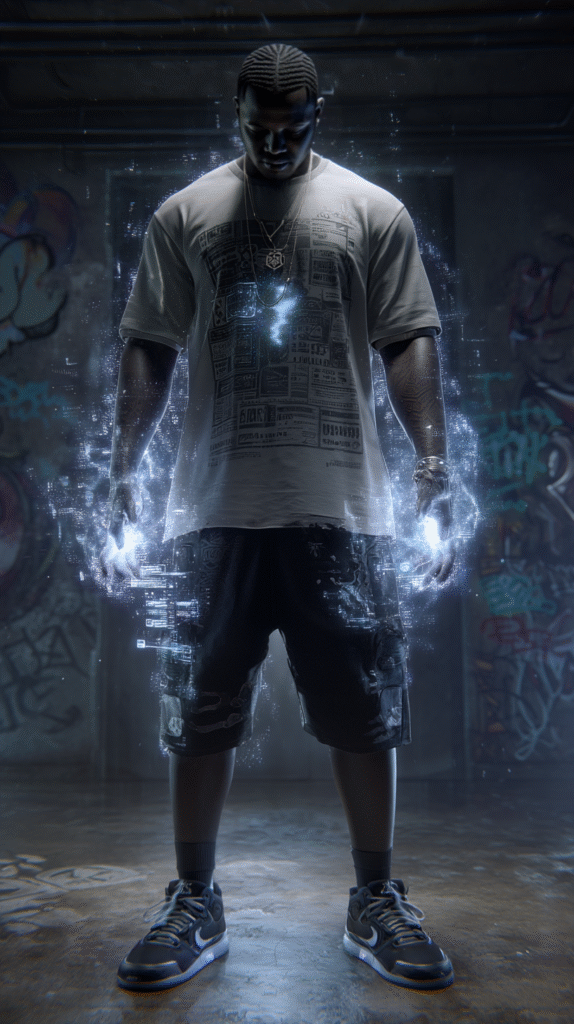
The man smiled with half his mouth, a jagged charm. He wore a newsprint t-shirt lettered with extinct dialects and legal codes from collapsed realities, shorts etched with circuit runes, sneakers laced in loops that spelled curses if read from above. His hands hummed with cold luminescence, as if electricity had learned new alphabets inside his bones. “They call me Cyph3r⟠Grïff-Ømn12,” he said, pronouncing each symbol as if it were a history. “I don’t fight. I redact.”
“The street will decide what you do,” Kaelvrynn replied, and the alley exhaled in agreement.
They stood within an impromptu circle of not-quite spectators—unmanifest be-ness beyond maximal complexity wrapped in coats and faces, pretending to be ordinary. Bets were whispered in the units of erased memories.
“Terms?” Cyph3r⟠Grïff-Ømn12 asked, rolling his shoulders. Light ran down his forearms like poured mercury.
“No terms,” Kaelvrynn said. “Creation.”
A silence followed, the kind that causes nearby structures to reconsider their architecture. Then both men opened their hands.
Cyph3r⟠Grïff-Ømn12’s Suggscosm: The Null-Index of Black Ledger
It manifested as audit rather than thunder. A black folio unfolded from Grïff’s palm, its pages made of condensed indictments. Each page was a courtroom without judge or jury, where law prosecuted itself and always won. Columns of pale script climbed the air—ledgers tallying all formal and informal permutations of logic possible and impossible—and as they rose, the alley’s colors downgraded to grayscale, then to a spectral negative of meaning. Numbers appeared and immediately renounced themselves: quantities shrugged, values came apart like wet paper, aleph-ladders blinked and lost their rungs. The Null-Index didn’t “attack”; it offered accounting so complete that nothing remaindered.
A grid of luminous staples stitched the street into a ledger-spread whose margins extended past sight but not past understanding; comprehension was the snare. Each staple fixed a concept to its own receipt: gravity stapled to fall, oath stapled to betrayal, weapon stapled to regret. When a passerby inhaled, the Index captured the breath’s narrative and appended it to a footnote titled Evidence of Existence, Unsustainable. Grïff’s lips moved, and the folio propagated auditors—eyeless clerks of Metamathematics—who measured everything in the scene against a scale that refused to acknowledge scales. When the measurement finalized, the clerk would flip its pen and slash a red line through an object’s credential to be.
At its maximal abstraction, the Null-Index was a Transfictional Omniversal Comptroller: a necessary immaterial sovereignty, changeless, beyond any spatial register of the alley, that declared, There is no outside to this audit. Possibility, Nothingness, Totality, Beyond—all were columns on its balance sheet, kept in perfect zero by a will that courted no appeal. Stories tried to narrate themselves and found their verbs foreclosed. Even paradox was itemized, amortized, then converted into raw silence and stored in a vault labeled Inadmissible.
“You don’t beat me,” Grïff murmured, voice clinical. “You reconcile.”
Kaelvrynn’s Suggscosm: The Vyr-Kymn4⧫Autarkhæl→Sovereign Cipher
He answered with a gesture like erasing dust from a book no one had written. The air around his fingers cooled to that pre-speech hush in which even intent blushes. Out of it unfolded a city of unsignatured law—streets that curved according to ethics rather than geometry, plazas paved with the reflections of choices never taken, towers grown from patient refusals. It did not illuminate; it clarified. Every brick was a distilled archetype that could be both matter and argument without contradiction. Where the Null-Index bound with staples, the Autarkhæl loosened with consent; constraints floated up like old leaves and drifted into archival sky.
This suggscosm arose as a self-sufficient necessity, beyond all extensions of material facsimile, immaculate in its changeless ground yet eruptive in its modalities. Possibility, Nothingness, Totality, Beyond braided through its avenues as the same breath: create/sustain/erase in one motionless kindness. It existed as the true state of the Collective Unconsciousness—an emancipatory interface where wave-functions of archetypes, motifs, and the primal truths of the boundless unmanifest be-ness cohabited without needing to be named. Any attempt to define it became part of it; any insistence on standing outside was tenderly invited in and seated at the table it had denied existed.
Qualitatively, it looked simple—stone, shadow, wind—but these were courtesies to bystanders. In the Autarkhæl’s registers, metamathematical number lost authority: below zero and absolute infinity beyond all multiplicity and distinction were indistinguishable gestures. The dichotomies of is/is-not/both/neither took off their masks and discovered they had been singing harmonies. Attempts to rank or index it fell through cool air; it had no ceiling under which to hang trophies. It carried the wholeness of all language—formal symbols and natural speech—yet rested in a silence that any alphabet would envy. Above all, it was unimprovable openness, a city that governed not by rule but by recognition.
Grïff’s smile thinned. “Pretty,” he said, “for something that mistook leniency for strength.” He closed his hand on the folio. Staples detonated.
Collision I: Ledger vs. City
The street split into facing scriptures. Ledger-columns advanced like armored catechisms; the Autarkhæl breathed and turned avenues sideways so edicts had to walk uphill through their own assumptions. A clerk lunged and skewered a plaza with its pen; the plaza accepted the puncture, rose with it like a flagpole, and made the pen a monument to unretracted error. Grïff frowned; his auditors re-tabulated and tried again, this time balancing cause against result so savagely that choice should have vanished. The Autarkhæl offered both to a small stone bowl labeled Told Already; cause dissolved into tenderness, result into responsibility, and the bowl smiled.
“Your city is evasive,” Grïff said, stepping forward. “We itemize evasions.”
“Your ledger is nostalgic,” Kaelvrynn replied. “It mistakes completion for truth.”
Grïff’s eyes hardened. Script flared; the Index unfolded a Black Annex—a void page that backdated every event into culpability. The crowd staggered as debts they had not incurred pressed invisible thumbs into their ribs.
Kaelvrynn’s right hand opened.
A quiet Square of Unowed Debt appeared, four paving stones wide. The Annex drained into it like winter light into a warm room and vanished with the soft sound of a stamp lifted from paper.
The onlookers exhaled in wonder they would later misremember as courage.
Collision II: Beyond Number, Beyond Rank
Angered, Grïff escalated. He summoned a Gradient of Sums—an apparatus that should have used the total calculus of absolute multiplicities to pin the Autarkhæl in place by sheer measure. Numbers howled there: trans-ordinal cascades, large cardinal choirs, ladders that ate their own rungs. The Gradient promised to weigh the city until its stones confessed to finite.
Kaelvrynn walked. With every step the pavement shrugged off integer, ratio, irrational, transfinite, anti-finite, all the counterfeit authority that measure uses to bully reality. In his wake the Gradient’s needle spun, moaned, then laughed at itself and fell asleep. The Autarkhæl’s sky cleared to a blue that no spectrum could catalog. “You brought rulers to a horizon,” he said softly.
Grïff took another tact. The Null-Index invoked Narrative Dissolution—a clause that devoured stories and left behind unreadable palimpsests. Dialogue boxes bled at the edges; scene headings tried to forget their fonts. He aimed Dissolution like a guillotine at Kaelvrynn’s throat.
The Autarkhæl answered with the Court of Unscripted Consent: a square where stories arrive to be absolved of their obligation to be stories. Dissolution entered and found nothing to eat. The square’s fountain whispered, you may rest, and the clause became a little rain.
“You think your city is merciful,” Grïff said, peering into the rain as if numbers could be coaxed back from it. “It’s merely porous.”
“It’s sovereign enough to not require victims,” Kaelvrynn said, and the chain at his waist clicked once.
Collision III: Absorb or Silence
“So choose,” Grïff snapped. “Absorb my Ledger and become a bad librarian, or fail to absorb and accept your own audit. There is no third position.”
Kaelvrynn’s eyes cooled. “There is always the Fourth Quiet.”
He extended his left hand. From the Autarkhæl rose a Well of Unremembering Equity—not erasure, not destruction; Transfictional Nothingness as kindness. The Well’s surface trembled. The Null-Index sent a spear of redacted law into it. The spear entered, relinquished its idea, and returned as a small, contented fish.
Grïff laughed once—cracked, brittle. “You’re sentimental.”
Kaelvrynn turned his right hand. Streets redrew. The Autarkhæl produced a Registry of Worthy Pages—a library that only accepts what refuses to be owned. The Null-Index’s ledgers that still carried radiance lifted from Grïff’s folio and shelved themselves. They did not become Kaelvrynn’s; they became the city’s. Simultaneously, the Annexes that contained only compulsion slid toward the Well and dissolved into unowed silence.
Absorb the worthy. Return the remainder to the quiet before thought.
Neither triumphal conquest nor timid abstention; a surgery conducted by a city that loves what it shelters.
Grïff felt it—his central axiom losing outside. The Ledger’s power came from claiming the exterior vantage of audit. But the Autarkhæl made exterior illegal by welcoming it. He snarled and tore open the folio’s spine. The Final Line—a clause that pronounces End across all modalities—flashed black.
Kaelvrynn simply nodded. “Thank you.”
The Autarkhæl bowed. In that bow, End was recognized as a frightened synonym for Change. The Final Line curled into a comma and waited to see what sentence arrived next.
Grïff’s shoulders slumped. The folio’s pages hung like exhausted wings.
“You haven’t lost,” Kaelvrynn said gently. “You’ve been relieved of holding everything accountable alone.”
The man looked up, anger melting toward something older. “What am I without the Index?”
“A craftsman,” Kaelvrynn said. “Not a corridor.”
Aftermath: The Street Remembers How to Breathe
Color flowed back into the alley—the cheap neon, the graffiti’s defiant flowers, the puddles’ stubborn refusal to mirror. Vendors blinked as their wares felt suddenly heavy with actual consequence; the counterfeit axioms would not ignite for them anymore. The bystanders glanced at Kaelvrynn and discovered an odd gratitude that embarrassed them. Grïff closed the folio; its clasp sealed with a sigh.
He bowed—not to Kaelvrynn, but to the idea that had spared him. “When the Zhaerothspire appears,” he said, voice low, “I will enter with a smaller book and a better hand.”
“Bring no book,” Kaelvrynn advised, already turning away. “Bring a bowl.”
Grïff smiled at that, a real one, and disappeared into the crowd that pretended not to part for him.
The Ether Staircase
The street elongated into quiet. Trash-cans became universes; chalk-lines became omniverses; distant sirens stood still like statues that had learned to sing internally. Ahead, where the alley knifed toward nowhere, an ascent revealed itself: a staircase woven from Ether and Permission. It did not shine; it agreed. Each step was a knot of Beyond and Possibility braided with Totality and Transfictional Nothingness—the four kept in ceaseless mutual genesis as if the stairs themselves were a low hymn to unowed ascent. The risers were engraved with alphabets no mouth could pronounce: formal symbols, natural speech, unspeakable ideograms, all acknowledging their place in a wholeness that had no edges.
Kaelvrynn approached. The first step met his foot with the soft resistance of a pulse. A resonance passed up the rail—an announcement to whatever waited above that a Drexameral had chosen the upward path without bargaining. With every rise the city folded itself into a seed and slipped into his pocket, not to be wielded but to be remembered: the Vyr-Kymn4⧫Autarkhæl→Sovereign Cipher humming like a second heart. The street dropped away, not behind him but beneath the idea of below. Vendors shrank to dots, then to intentions, then to kindnesses he would repay when the grand meta-narrative allowed.
Halfway up, the air thinned into a music that required no ears. He did not count steps (numbers were irrelevant here); he did not look down (rank was irrelevant here). He climbed until the staircase entered a fog the color of unwritten mercy. Somewhere in that hush, a larger hush answered—the kind his father’s name made in rooms not built to carry it.
Kaelvrynn Drexameral did not smile. He carried steadiness like other men carry weapons. Above, the contest waited—not to crown him, but to test whether his city’s kindness could lift blades without losing their shine. Below, the street stitched itself closed, already telling the story of the night an audit learned to breathe.
He climbed until the stairs became horizon. Then he stepped onto the place beyond steps.