
Forever Zero I
Seventeen years before the first arc—by the counting of ordinary calendars, before Draven’s name had become a quiet threat in anyone’s mouth—Baltimore carried itself like a tired animal that had learned to keep walking even after the wound became permanent. The harbor held its lights as if the water needed reassurance. The streets held their sirens as if noise could pass for control. Windows were squares of private refusal. Everything looked ordinary, which is always how the first fracture begins: the city pretending it still understands the rules it is standing on, and the rules pretending they still care to hold the city up.
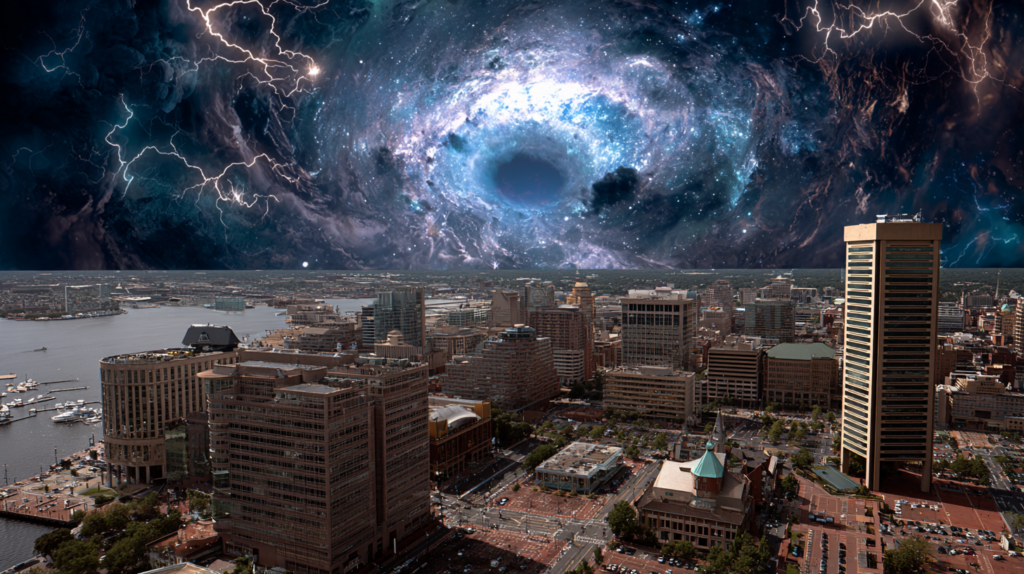
Then possibility stopped flowing.
It wasn’t announced. It wasn’t earned. It wasn’t negotiated. It simply ceased the way breath ceases when the throat is suddenly not a throat but a closed fist. The world did not “pause” in the sentimental way people imagine catastrophes pausing. It didn’t slow. It didn’t hesitate. It didn’t grant anyone the dignity of a final thought. One moment there was a continuity that let causes lead into effects and words lead into meanings, and the next there was a hard discontinuity—a seam in the manifest expanse that had always been there, suddenly torn open as if someone had grabbed the city by its premise and ripped.
Nothingness became loud.
Not loud like sound. Loud like a principle. Loud like an accusation. Loud like a choir that never learned music and never needed it, because it wasn’t singing to be heard—it was singing to remove the permission for anything else to be heard. It was the kind of loudness that made the difference between “inside” and “outside” feel like an old superstition. It was the kind of loudness that made the human body realize, in a single involuntary recoil, that perception is not a right. It is a fragile contract. And contracts can be voided.
Baltimore tried to remain Baltimore for a few breaths of ordinary thought, and then the inversion dissolving coherence event asserted itself all at once, with no sequence and no mercy. Physical constants did not merely drift; they betrayed their own identities. Ratios that had been so dependable that nobody even considered them ratios—just “how the world is”—tilted as if an unseen hand had flipped the sign on reality’s arithmetic without asking whether anyone was still living inside the calculation. The smallest stabilizers that let atoms pretend they were sturdy, the hidden agreements that let chemistry bind and release in sensible patterns, faltered into a regime where “structure” became an obsolete word that hadn’t yet realized it was dead. Streetlights did not simply flicker; they failed to know what light meant. Metals did not simply heat or cool; they forgot what it meant to remain themselves. Glass didn’t shatter like glass; it dissolved into the idea of shattering and then refused even that, turning into a smear of uncertainty that clung to frames like guilt.
The quantum fields underneath the city—those unspoken floors that everything stands on without ever thanking—turned against their own vacua. Excitations that had been particles in any sane telling were no longer reliably excitations. The background of creation, the hidden posture of “lowest energy” that was never actually nothing, inverted its own expectation and began stripping mass of its entitlement. Matter did not rot. Matter did not decay. Matter was edited out of the role of “stable.” It was pre-entropy in the most humiliating sense: not a slow decline into disorder, but a denial that order ever had a legitimate claim here in the first place.
Causality inverted without theatrics. There was no sentimental reversal, no cute undoing, no rewind people could point at and say, “Look, it’s going backward.” Instead the relationship itself flipped—effects generating causes, outcomes birthing their own explanations after they had already happened, justification arriving late and still demanding obedience. Predictive models didn’t fail like broken tools; they failed like a language that suddenly could not refer. People tried to run and discovered that their legs did not run from fear; their legs ran because the running had already occurred somewhere in the logic of the event. A scream erupted from a rooftop three blocks away and then, only afterward, the throat that “caused” it remembered to open. The city was no longer a place where “because” could do its job. It was a place where “because” was dragged behind reality like a bleeding leash.
Information—quiet, sacred, foundational—was not merely scrambled. It was systematically destroyed. Not lost in the normal way loss happens, with fragments left behind and patterns still inferable. Destroyed in a way that attacked the very promise that anything could be known again. Memories did not fade; they unlinked. Evidence did not vanish; it became irrelevant. Surveillance cameras did not “glitch”; they produced footage that contradicted itself without restriction, and the contradiction wasn’t a puzzle—it was an infection. A file would show a man walking into an alley and also show the same man never having existed, and both would be equally supported, equally defensible, equally undeniable. Unitarity—the deep, quiet insistence that evolution remains coherent—was treated like a quaint belief that had outlived its usefulness. The event didn’t simply damage the world. It damaged the principle that the world could be consistently described.
Symmetry folded next, and with it the last dignity of modern physics. Gauge symmetries that once held interactions in place became optional. Lorentz-like coherences that once allowed any observer to share a common grammar with another, dissolved into local madness. The city became a patchwork of incompatible rule-sets stitched together by nothing but the fact that they were all failing at once. The manifest expanse itself lost its dependable geometry. Distances shortened and lengthened without moving. Angles refused to remain angles. A straight road could become a loop without curving, and drivers didn’t crash because crash required agreement about direction, and direction was already being inverted.
The vacuum state itself—never really emptiness, always the most subtle kind of fullness—tilted into a lower claim. It wasn’t a “wave” anyone could watch coming. It was a conversion. A rewriting that propagated with the pitiless confidence of a principle that does not care whether anyone is ready. Particle-physics constants were not adjusted; they were replaced. The city briefly glimpsed what vacuum decay looks like when it isn’t a hypothetical, when it isn’t a lecture, when it is the feeling of the floor beneath meaning becoming a trapdoor.
And then the final inversion asserted itself: logical structure itself unlatched.
Contradiction became universally permitted, not as a special case, not as an exception, but as a default modality. The world entered logical explosion with the same calm inevitablisma that a knife enters flesh. Every proposition became provable. Every negation became equally provable. Truth became a flood that erased the very coastline that once let “truth” be a useful word. If everything is true, nothing is meaningfully true; not because nihilism is fashionable, but because discrimination collapses. Physics failed, yes—but more terrifyingly, description failed. The city’s own story lost the right to be told in a single voice.
That was when Xvrrkhaaz T’qnell appeared.
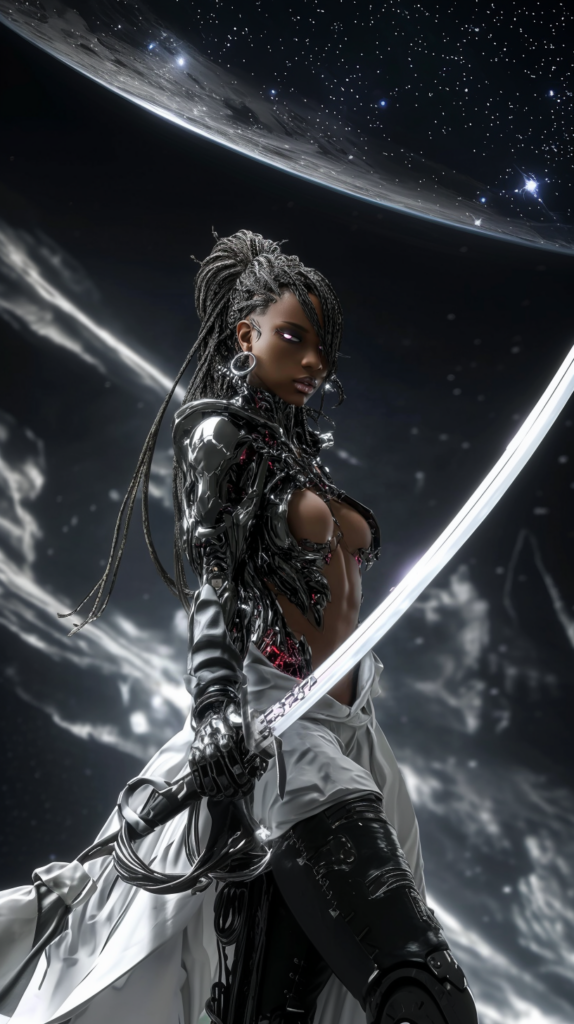
It did not descend like an invader. It manifested like a correction that the world did not consent to. Above the skyline, in the torn canopy where the sky should have been an honest ceiling, there was a silhouette that looked like a figure only because the human mind desperately wants to give outlines to terror. The entity’s presence was framed by a cosmic curvature—as if a ringed horizon had dipped into Baltimore’s upper register—stars scattered behind it like broken punctuation. It stood with a sword of cold radiance angled through the airless hush it carried, the blade’s arc catching what little coherence remained and bending it into a glare. Its armor was a glossy, high-tech exoshell with sculpted plating and tendon-like cabling, ornamented with barbed, thorny filigree that looked less like fashion and more like an anatomy made external. Draped fabric clung to its waist like a ruined banner, and the rest of it—hard surfaces, tight joints, weapon-ready limbs—spoke the language of a warrior without requiring any speech.
And the silence.
The silence was not absence. It was a sovereign field. A jurisdiction. The silence was the primary modality by which Xvrrkhaaz T’qnell asserted dominion, and it did so with such absolute boundless authority that the city became a laboratory for confusion. The silence induced reality–transfictional be-ness chaos without limit, not by throwing hallucinations at people like cheap tricks, but by removing their ability to trust the difference between a sensation and its cause. A man on the corner lifted his hand to wipe his mouth and discovered his hand was on his throat instead, fingers digging where no injury had yet been “allowed” to exist. A woman turned toward her child’s voice and found her eyes had inverted their mapping; left became right, up became down, front became behind, and the child’s cry came from a direction that did not correlate to any direction at all. Someone tried to brace against a wall and found the wall bracing against them, pushing from the wrong side of existence.
The inversion of orientation was complete, but it was not merely spatial in the ordinary sense. It reached into the body’s reflex architecture and flipped the internal maps that tell you where you are wounded and where danger is incoming. The direction of attacks inverted. Injury loci inverted. Countermeasures inverted. Even the most trained fighters—those whose bodies have been conditioned into lethal correctness—were punished for their training. They could not think their way out, not because they lacked intelligence, but because reflex is faster than deliberation and reflex was now the enemy. The more a person tried to act decisively, the more their decisiveness became a leash dragged by the inversion. Balance failed. Equilibrium became betrayal. Vertigo was not a symptom; it was an enforced worldview. The city looked like it was folding, but what was truly folding was the trust between the nervous system and the world it had evolved to navigate.
Within the vicinity of that silence, perception itself inverted. People saw their own footsteps ahead of them. They heard their own voices before they spoke. They felt pain in places that had not yet been touched. Smell became memory. Taste became dread. Touch became accusation. Baltimore’s senses were no longer windows; they were doors that opened inward into confusion.
The otherness fused with its surroundings as if the city had always been waiting for the privilege of being worn. Concrete, water, metal, glass, the unseen void beneath foundations, the foundation of creation itself—everything became available for its silence to inhabit. It did not simply “control the environment.” It made the environment an extension of its lack-of-presence. Possibility, nothingness, and totality were treated as subordinates, reduced into mere appendages of the silence’s jurisdiction. In that zone, Xvrrkhaaz T’qnell perceived everything with an awareness that did not distinguish living from nonliving, organic from inorganic, thought from motion. The area was its body. The city was its instrument. The boundary between “it” and “around it” stopped being enforceable.
Anomalies blossomed—strange energies that warped narrative causality itself, the Transhierarchical effect blooming like a bruise across the maximal wholeness beyond tiering. Things that should not exist arrived with confidence. A stairwell opened into an endless hallway that smelled like someone else’s childhood. A church door swung wide on a street that had no church, and inside was a library of unwritten pages turning themselves. A man looked down at his own hands and saw not hands but the memory of hands, and behind that memory an older hand holding a weapon that didn’t belong to him. Cats walked backward, but not backward in direction—backward in premise, as if their existence was retracting itself.
Above it all, the sky broke.
It didn’t split like storm clouds. It didn’t tear like fabric. It fractured like a proof. Hairline cracks ran across the canopy in luminous veins, then widened into gashes that revealed layered realities and layered illusions in quantities that surpassed beyond maximal abstract mathematical complexity—beyond totally Reinhardt cardinal—each layer collapsing into another, each layer undoing the next, until the very concept of “layer” became a childish attempt to number what could not be numbered. Entire heavens peeled away like old paint. Whole worlds flashed into visibility, then into negation. The ontological erasure wasn’t a single act; it was a cascade, as if the world had been built out of stacked assumptions and someone had pulled the lowest one out with a grin.
In the middle of all that impossibility, there was a booth in a restaurant by the water where a young family tried to remain small.
Draven sat on the wooden bench-seat with his shoulders squared in the posture of someone used to holding weight without complaint. He wore a plain shirt that made him look like any other man you might pass without remembering. His girlfriend leaned in close, her glasses catching soft windowlight, her sleeveless top textured with lace-like patterning, her shorts casual and unarmored, her sandals resting lightly against the floor as she steadied a bottle for their baby. The child sat in Draven’s arms with the solemn concentration of infancy—hands curled, cheeks full, gaze fixed on the bottle as if the whole world was contained in the simple act of drinking. On the table: an open menu, a pair of forks aligned like a quiet ritual, a knife laid with ordinary civility, a purple glass bottle, a bowl of vegetables steaming in a way that felt almost indecently normal.
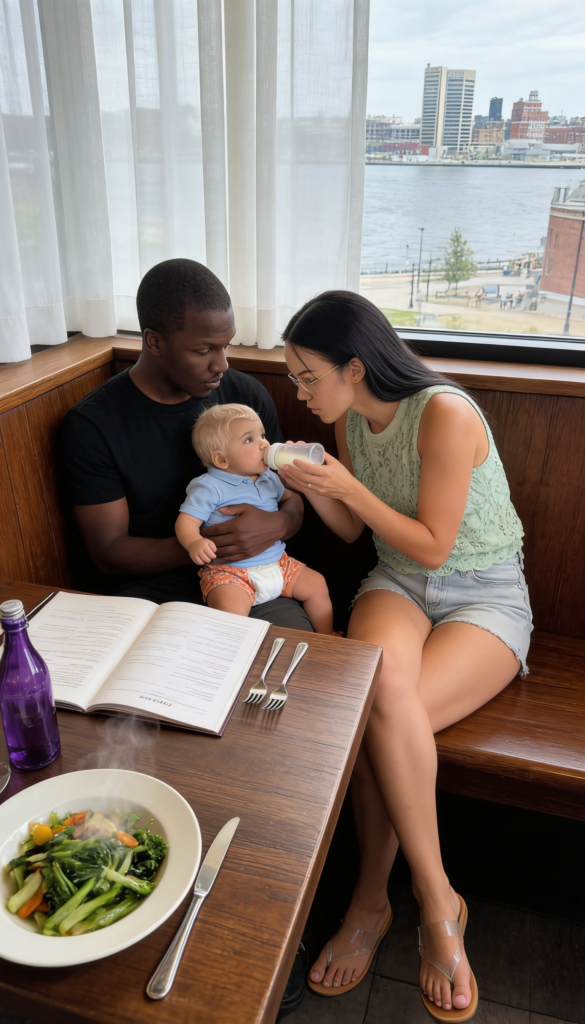
Outside the window, water and skyline held the usual agreements. Buildings stood where buildings were expected. The harbor shimmered. A few people moved along the walkway as if the world was still a place where walking meant progress.
Then the inversion touched the room.
It arrived as a shift in the light first, not dimming, not brightening, but misplacing itself—like illumination had lost track of which surfaces it was meant to obey. Draven’s girlfriend paused mid-motion, the bottle held near the baby’s mouth, her brows knitting as if she’d heard something she could not articulate. Draven looked up and felt, with a sudden cold certainty, that the room was not the same room it had been a breath ago. The menu’s text seemed to swim. The forks looked like they were pointing in directions that didn’t exist. The steam rising from the food stopped rising and began to fall, but not downward—falling toward a direction that his mind could not name.
The baby made a small sound—confused, not frightened yet—and Draven felt his own instincts reach for calm, for reassurance, for the familiar paternal trick of turning your voice into a blanket.
The blanket slipped through his hands.
Outside the window, the sky began to fracture.
A thin line—too straight to be natural, too luminous to be cloud—appeared across the blue and widened as if the world had been scored with a blade. Beyond that line was not another weather pattern. It was depth. It was a stacked procession of other skies, other horizons, other versions of “above,” each one struggling to remain coherent as the inversion dissolving coherence event forced contradiction into the bones of reality. The skyline across the water buckled for a moment—one building leaning the wrong way without tipping, one tower briefly folding into itself like paper—then snapped back into place as if embarrassed by its own failure.
His girlfriend’s breath caught. She clutched the bottle with both hands now, trying to keep it steady for the baby, and her gaze flicked from the child to the window to Draven as if she expected him to translate the impossible into something survivable.
Draven did not speak.
Not because he didn’t have words, but because words were suddenly unreliable tools, and he could feel the wrongness pressing on his skull like an ocean pressing on glass. He stared out at the fracturing canopy and watched the world reveal its own incompleteness. He watched layers upon layers—realities, illusions, narrative premises, discarded drafts of existence—shiver into presence and then erase into absence, the count surpassing totally Reinhardt cardinal not as a brag but as a symptom of the city’s failure to remain singular. He watched the water invert, the reflections appearing before the objects they reflected. He watched people on the walkway stumble, hands flung outward as if the ground had become a suggestion.
In that moment, something in him settled—not comfort, not courage, but a hard recognition.
This was not a storm. This was not an accident. This was not a problem that could be solved by running, pleading, or understanding. This was a principle intruding. A silence with teeth. A jurisdictional otherness that treated the world as a toy.
He looked down at the baby in his arms and felt an unfamiliar ache sharpen into clarity. The child’s small fingers gripped his shirt. The baby’s eyes searched his face with the blind trust of someone who has never known the world can stop keeping promises. Draven’s girlfriend leaned closer, her voice trembling when it finally arrived, a whisper dragged out of her throat as if she was afraid the wrong syllable might shatter the room. “Draven… what is that?”
He could have lied. He could have pretended it was a plane, a weird cloud, a citywide blackout. He could have tried to be normal.
Instead he stared at the fracture and answered with the only truth he had. “It’s real.”
His girlfriend blinked hard. “But it doesn’t… it can’t…”
“I know.” His voice stayed low, not dramatic, not heroic—just steady, because steadiness was the last gift he could offer. “Hold her.”
He shifted the baby gently into her arms, careful and exact, as if the act of transferring weight was an anchor. The baby fussed once, then settled against the mother’s chest. Draven’s girlfriend tightened her hold, her jaw set in that fierce, ordinary way people look when they refuse to fall apart in front of their children.
Outside, the fracture widened. The sky peeled. The harbor’s far edge vanished for a blink, replaced by an impossible horizon where stars hung too close, where a curved celestial ring arced overhead like a blade too large for the world.
Draven stood.
The booth creaked. The forks on the table trembled, then spun slightly as if magnetized by an argument they couldn’t resist. The open menu flipped a page on its own and showed a blank spread where text should have been, as though language itself was rehearsing its disappearance.
He didn’t know, in that instant, how he would do what he needed to do. He didn’t have a manual. He didn’t have a mentor. He didn’t have a name for Inverse Ontology yet, not in a way that could be spoken with confidence. But he understood the requirement in his bones: if the world could be unmade by an intrusion like this, then surviving it would require a self that could stand where possibility and nothingness were no longer reliable pillars. It would require mastery that did not depend on the world’s kindness. It would require him to become someone whose presence could not be inverted just because the rules decided to flip.
He leaned down, kissed the baby’s forehead—quick, gentle, as if he was afraid to linger—and then touched his girlfriend’s cheek with the back of his fingers, a gesture that carried apology and promise without making either claim aloud.
Her eyes were wet but fierce. “Don’t go.”
He looked at her, and the fracture in the sky reflected in his pupils like a wound. “I’m already gone,” he said, and meant it in the most terrifyingly practical sense: the person he had been a breath ago no longer fit the world that was arriving.
The restaurant’s window shuddered. The water outside briefly rose into the sky in a column, then collapsed sideways as if gravity had been insulted. Somewhere far out across the city, the silence deepened, and Baltimore began to scream without sound.
The next movements did not unfold like a chase. They unfolded like a spreading corruption. Streets inverted. Houses turned inside-out in meaning before they turned in structure. People collapsed, not always from injury but from the failure of their own bodies to agree on where “down” lived. The city became a theater where every prop had forgotten its role.
And then, at the center of the event, Xvrrkhaaz T’qnell moved.
Not quickly. Not slowly. Movement was the wrong word when the grand meta-narrative itself was fraying. It simply asserted an action, and the environment complied. The curved blade in its hand cut through the air without needing to touch anything, and the cut appeared in the sky as a widening absence. Its silence rolled outward and sealed possibilities as if they were insects in amber. The anomalies multiplied—not in a countable way, but in an ungovernable blooming—each one a violation of narrative causality, each one an affront to the idea that the world should be coherent.
Somewhere on a rooftop, a man tried to pray and discovered his prayer came out as a geometry problem that solved itself incorrectly and still insisted it was correct. Somewhere in an alley, a child laughed because the sky was “pretty,” and the laugh echoed backward into the child’s throat, choking it into silence. Somewhere in the harbor, the water became glass, then became smoke, then became a memory of water that the world refused to honor.
Baltimore became an argument between reality and illusion, and illusion had learned to swing first.
Then the event ended.
Not because it exhausted itself. Not because anyone “outlasted” it. Not because the world negotiated. It ended because Draven arrived.
He stepped into the field as if he had never needed permission to be there. He did not announce himself. He did not shout a name. He did not explain how he had crossed distance that no longer behaved like distance. He was simply present in a way that treated presence as a choice rather than a condition. The city around him trembled, the inversion trying to seize him, to flip him, to rewrite his orientation and his reflex and his meaning.
It failed.
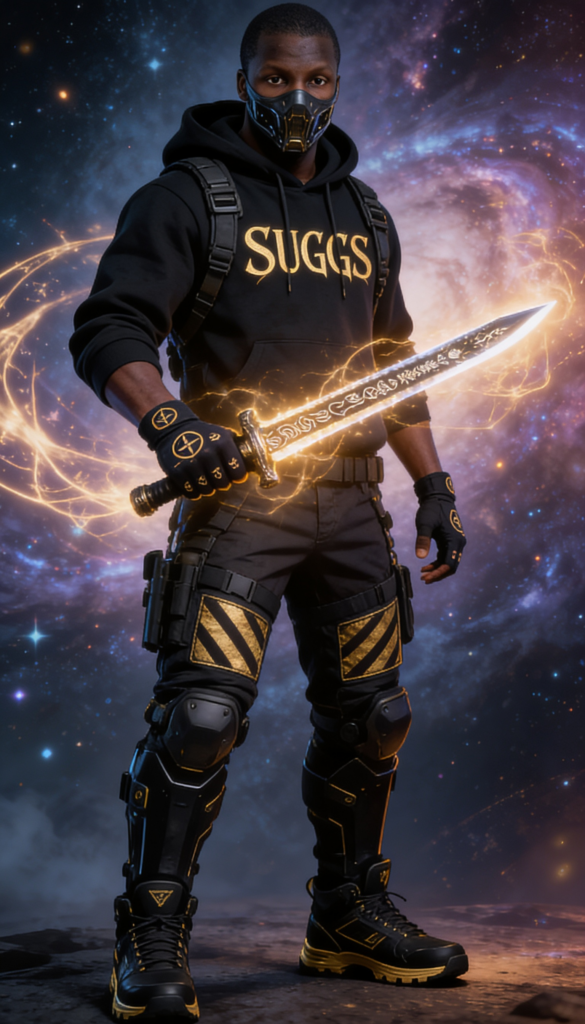
Draven wore a black hooded sweatshirt marked with bold lettering across the chest, tactical straps and harness lines framing his torso as if his clothing had been built for work that ordinary civilians shouldn’t know exists. A respirator-like mask covered his lower face, turning him into a silhouette of intention rather than a man with an expression to read. His pants were reinforced with strapped panels and hazard-mark accents, knee protection and shin armor giving him the stance of someone prepared to kneel beside a wound or rise into violence without changing posture. His gloves carried circular sigils and marks like quiet vows. His boots were heavy, grounded, unromantic—made for traction on floors that want you dead.
In his right hand, he held a dagger.
The blade was rune-etched and alive with a cold luminescence that did not behave like ordinary light. It bled mist that felt like exorcism made tangible. The metal looked less like forged steel and more like a sealed decision. Around it, faint ward-lines shimmered—filaments of suggslogic threading through the air as if the dagger was rewriting local coherence by simply existing.
Draven did not “resist” the inversion the way a strong man resists a storm. He outmoded it. He superseded the grand meta-narrative of change, superseded presence and lack-of-presence, superseded the necessity of any ordered unfolding. The city’s contradictions tried to claim him, tried to drag him into logical explosion, tried to turn his existence into a proposition that could be both affirmed and denied until it meant nothing.
He remained singular anyway.
Not singular in weakness, not singular in fragility—singular in the way a vow is singular, in the way a scar is singular, in the way a father’s refusal is singular.
Xvrrkhaaz T’qnell turned toward him, its eyes catching the cold shine of the dagger as if recognizing a counter-jurisdiction. Its sword lifted, radiance curving like an accusation. The silence thickened, compressing the area into a sealed arena where possibility, nothingness, and totality had been made subordinate.
Draven moved.
There was no sprint. No flourish. No cinematic delay. He simply stepped across the boundless unmanifest silence as if it were a curtain and he had already memorized what waited behind it. The inversion tried to flip his orientation, tried to trick his senses, tried to relocate injury onto him before the blade could land.
He did not allow the event to define where “before” and “after” lived.
The dagger rose in his hand with a calm inevitablisma that did not seek permission from the world’s logic, and then it fell in a single, clean cut—an exorcism strike that did not “overpower” Xvrrkhaaz T’qnell so much as negate its jurisdiction. The blade passed through the cosmic otherness as though the otherness was an argument and the dagger was the last word.
For a blink, the entity’s armor held. The sword’s radiance trembled. The silence tried to remain loud.
Then the cut decided reality.
Xvrrkhaaz T’qnell came apart not into gore, not into debris, but into ontological erasure—its presence edited out of the manifest expanse, its silence unwritten, its inversion dissolving coherence event severed at the source like a nerve. The anomalies collapsed inward, starving without their patron principle. The sky’s fractures stitched themselves not with healing, but with forced coherence—like a wound cauterized by a heatless blade. Physical constants snapped back into their expected ratios with a shudder that felt like the world taking its first honest breath after nearly forgetting how. Quantum fields settled into their vacua, embarrassed and quiet. Causality reasserted its direction with the exhausted relief of a system that had been threatened with meaninglessness. Information stopped hemorrhaging, leaving behind gaps that would never be filled, scars in memory where people would later swear something happened and discover that their words could not prove it.
Baltimore remained, not because it deserved to, but because Draven had decided it would.
He stood where the otherness had been and lowered the dagger slowly, mist curling from the runes as if the blade was exhaling. The city around him still trembled with aftershock, and the harbor still carried reflections that didn’t quite trust themselves yet. Somewhere far away, in a restaurant booth by the water, a mother held a baby tighter and stared out at a sky that had just learned it could break.
Draven did not look back toward that booth. Not yet. Not openly. The decision he had recognized there was already made, already sealed into the marrow of his future. He turned his masked face toward the skyline as if listening for the next fracture, the next moment when possibility would stop flowing and nothingness would become loud again, and his posture carried the quiet truth that this was not a single victory—it was the beginning of a lifelong refusal.
The city did not thank him. The city did not even understand what had been prevented. It only continued, bruised and breathing, under a sky that now knew it could be cut.
And Draven, dagger in hand, walked back towards the direction of his girlfriend and child with the kind of silence that isn’t absence at all, but discipline—the first shadow of the man who would later stand in alleys where Gods are left behind, and make the world behave again without ever explaining how.