Interlude I: The Lesson Behind the Light
The first rule Draven Endwriting taught his daughter about the world was not a rule about violence, or money, or even survival. It was smaller than that—so small it could hide in plain sight and still shape everything.
“Most things don’t break,” he’d told her once, when she was little and she’d dropped a bowl and cried like the universe had cracked open. “They just stop agreeing to be whole.”
Eira didn’t fully understand it then. She understood it now.
Because today wasn’t a normal father–daughter day. It was still that—because Draven didn’t do “normal” in public, and he did “precious” in private without admitting it out loud. But beneath the snacks, beneath the jokes, beneath the ritual of letting her pick the music in the car and pretending it didn’t matter, this was a day where he took her somewhere he only took people he trusted with the foundations of what he believed.
Some fathers taught their daughters how to drive. Draven taught his daughter how to unmake the argument that reality used to pretend it was inevitable.
He parked in a place that used to be a hospital annex—steel and concrete turned into an ugly, empty ribcage. It was far enough from neighborhoods to keep the sound of practice from drawing attention. Far enough from cameras that he could be himself without a thousand eyes trying to interpret him. Close enough to the city that he could still feel it—like a pulse under asphalt—reminding him why he kept going.
The wind pushed smoke through the broken floors above them, not as a dramatic flourish, but as a lazy, everyday consequence of a world that was still learning how to survive its own fractures. A crane stood in the distance like a frozen accusation. The sky was blue in a way that didn’t apologize.
Eira hopped out first. She’d insisted on wearing her “training fit,” which, to her credit, was both practical and defiant. She had on a black athletic top with SUGGS across the chest, matching shorts with white panels, and flip-flops that made Draven’s left eye twitch in silence. She moved like she belonged anywhere she decided to stand, like the world should adjust around her because she had already decided it would.
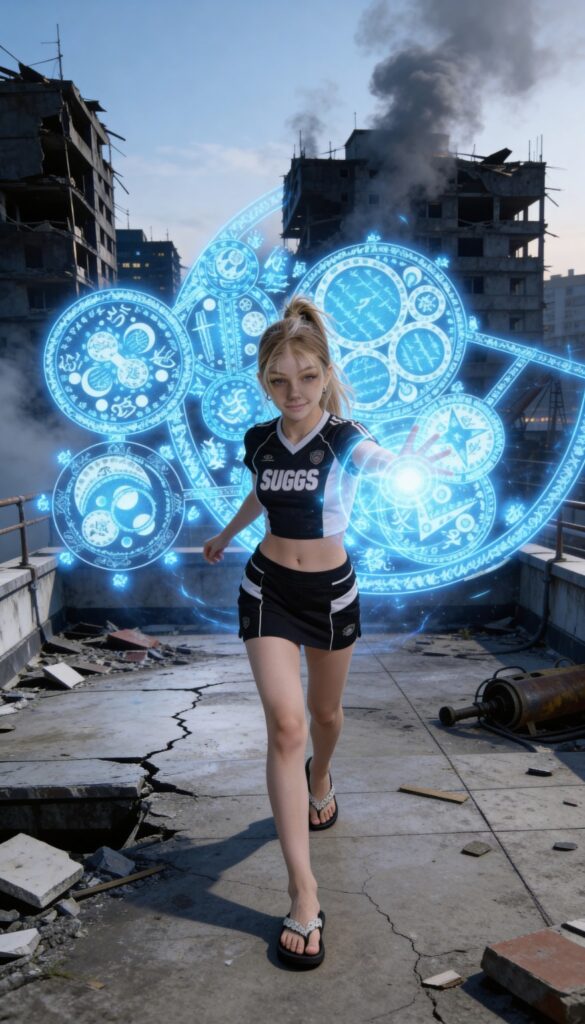
Behind her—already half-manifesting, already humming with intent—an array of luminous circles waited, layered and complex, like a blueprint drawn by someone who didn’t believe in restraint. The designs weren’t just “magic.” Draven hated that word, even in his own head, because it made things sound like tricks. These were agreements. Contracts. Procedures.
Eira held her hand out, palm forward, as if she was about to push the entire day into place.
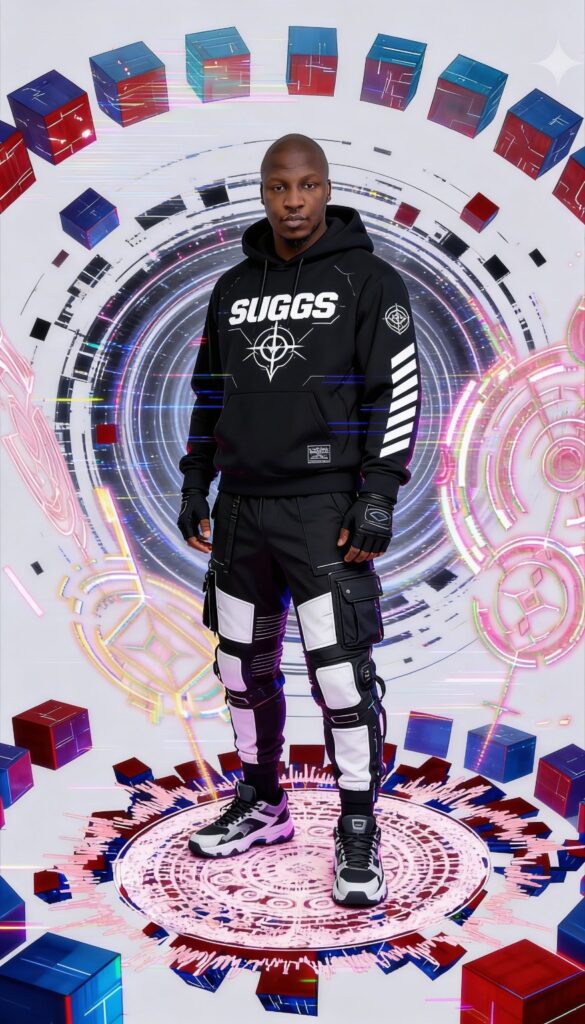
Draven stepped out slower. Not because he was tired, but because he never wasted motion. He wore his black hoodie—SUGGS printed across the chest, a clean emblem beneath it like a warning sign. His pants were tactical streetwear with strapped pockets, reinforced panels, and a utilitarian cut that made him look like he could walk through a riot and still have room in his pockets for gum. His sneakers were heavy, built for traction, built for decisions. Fingerless gloves covered his hands because he liked the feel of materials; he liked knowing what he was touching.
He shut the door. The sound was soft. Final.
Eira turned and grinned, already reading his expression like she’d been trained to do it.
“You’re thinking about my shoes,” she said.
“I’m thinking about you slipping,” he corrected, and his voice was calm enough that it could’ve been mistaken for disinterest—if you didn’t know him. “On concrete that doesn’t forgive.”
Eira wiggled a foot like she was demonstrating invincibility. “If I slip, I’ll just… not slip.”
Draven stared at her. She stared back.
A pause.
Then, like the smallest crack in stone, his mouth twitched—almost a smile, almost an admission.
“That,” he said, “is exactly why you’re here.”
They walked deeper into the building. The old hospital corridors were stripped bare, not abandoned so much as emptied—like someone had taken the idea of a hospital and left the shell. The air was stale, but not dead. Light poured through blown-out windows, turning dust into glittering static.
Eira kept looking around like she was scanning for story beats.
“You used to bring Uncle Ronan here?” she asked.
“Once,” Draven said.
Eira’s eyebrows rose. “Only once?”
“Only once,” he repeated, and there was something about the way he said it that implied the second time would’ve turned into an argument disguised as laughter.
Eira’s grin widened. “So this is like… your secret dojo.”
“It’s a place,” Draven said, and he didn’t give it more romance than that. Then, quieter, because the words mattered: “It’s somewhere I can be exact.”
They reached the open rooftop through a stairwell with missing railings and a smell like old rain. Up top, the city stretched out in the distance—scarred and alive. Two half-ruined buildings stood across from them, their windows blown out, smoke curling from somewhere inside like the structure was still deciding if it wanted to exist today.
Eira stepped onto the rooftop and immediately spread her arms like she was claiming the whole sky.
“Okay,” she said, turning toward him, excitement sharpening her voice. “Teach me the thing.”
Draven didn’t answer right away. He walked to the center of the rooftop where the concrete was cracked in a spiderweb pattern. He crouched, placed two gloved fingers on the ground, and closed his eyes.
Eira watched him like she was watching a wrestler line up a finishing move.
After a moment, Draven opened his eyes again. “This place remembers breakage,” he said. “That helps.”
Eira took a step closer. “Collapsed Cataphysics,” she whispered like a title, like a legend.
Draven stood. He didn’t posture. He didn’t perform. He just became still—like a judge.
“Collapsed Cataphysics is not ‘stronger magic,’” he said. “It’s not a bigger gun. It’s not a louder scream. It’s a decision about the rules that decide what counts as real.”
Eira’s eyes narrowed in focus. “So it’s like—if normal stuff is a video game, Collapsed Cataphysics is deleting the code.”
Draven’s gaze slid to her, sharp. “Close,” he said. “But deleting the code assumes the code is the highest layer.”
He raised his hand, and the air around his palm shimmered—not like heat, not like light, but like the world was being asked a question it didn’t want to answer.
“Collapsed Cataphysics,” he continued, “is when you stop treating reality like the judge and start treating it like the defendant.”
Eira’s lips parted. She loved when he talked like that. It wasn’t poetic for the sake of sounding cool. It was how his mind organized truth: as arguments, as burdens of proof, as liabilities.
He took a slow step forward, then another, and with each step the luminous circles behind Eira brightened—like they were syncing to his presence.
“Cataphysics,” Draven said, “is what happens when you learn to speak beneath physics. Under the rules. Under the assumptions. You’re not bending a law. You’re interrogating why the law gets to exist.”
Eira nodded, absorbing it.
“And collapsed,” he said, “means you don’t just ‘go under.’ You collapse the ladder. You remove the idea that there’s a stable hierarchy to climb.”
Eira smiled like she was proud of herself for keeping up. “So if someone tries to fight me with logic, I collapse logic.”
Draven’s eyes flicked up, and for a second she saw the part of him that was always measuring consequences.
“If you collapse logic,” he said, “you better have something else to stand on.”
Eira’s smile faded into seriousness. “What do you stand on?”
Draven didn’t answer quickly. Not because he didn’t know—because the answer was expensive.
He looked out over the ruined skyline. The world wasn’t ending in one dramatic explosion. It was ending in a million smaller betrayals: systems ignoring people, people ignoring each other, institutions surviving by pretending suffering was normal. Draven was the kind of man who looked at that and didn’t just get angry. He got precise.
“I stand on ego,” he said finally. “And responsibility.”
Eira blinked. “That’s not a power.”
“It is when you don’t lie about it,” he said.
Then he extended his hand toward her.
“Come here,” he said.
Eira walked forward, stopping just close enough to feel the cold presence he always carried—like a quiet storm behind his ribs. Draven took her wrist gently. Not controlling. Not harsh. Just anchoring.
“You want to learn this,” he said, “because you want to protect your people.”
Eira nodded immediately.
“And because you’re curious,” he added.
Eira hesitated, then nodded again, softer.
Draven’s thumb tapped once against her pulse—like he was acknowledging the truth.
“Then we do it the right way,” he said. “No flexing. No showing off. No proving anything.”
Eira rolled her eyes with affection. “Yes, sir.”
Draven released her wrist and stepped back.
“Show me what you’ve already got,” he said.
Eira inhaled. Exhaled.
She lifted her hand again, palm forward, and the luminous circles behind her expanded—layer after layer, ornate and dense with symbols that looked like they belonged to a language the universe used before it learned how to pretend it was simple. Some circles were filled with moon-and-star geometry. Some with sigils. Some with patterns that felt like mathematics turning into prayer.
Blue light wrapped around her arm like a sleeve made of intention.
A sphere of light formed in her palm.
Draven watched without expression, but inside him, something softened—because she was doing it clean. Not messy. Not reckless. She was treating it like a craft.
“Good,” he said. “Now stop.”
Eira blinked. “Stop? But I—”
“Stop,” he repeated, and she did, immediately. The circles dimmed. The light in her hand faded.
Draven nodded once, approving.
“Most people,” he said, “learn to create effects. They chase what looks impressive. Collapsed Cataphysics begins when you learn to interrupt your own ego.”
Eira frowned. “Why?”
“Because the future,” Draven said, and his voice went quieter, “is going to tempt you into becoming a weapon with a conscience.”
Eira stared at him, caught off guard by the weight in that sentence.
He exhaled through his nose. “I don’t want that for you.”
The rooftop went silent in a way that felt intimate.
Eira swallowed. “Dad…”
He held up a hand—not to stop her, but to shape the moment into something teachable.
“Collapsed Cataphysics,” he said, “is also emotional discipline. You don’t do it when you’re trying to win. You do it when you’re trying to be true.”
Eira’s voice came out smaller than usual. “Does being true even matter if the world doesn’t care?”
Draven looked at her—really looked. Not like a tactician. Like a father.
“It matters,” he said. “Because if you don’t care, you become like them.”
Eira’s jaw tightened. “Who is ‘them’?”
Draven’s gaze went distant. “People who can sleep while children disappear.”
Eira’s eyes sharpened instantly, and the air around her seemed to tense with her.
Draven noticed. He always noticed. He let it sit for a second, then he guided it away from becoming a spiral.
“We’re not here to drown in it today,” he said. “We’re here to learn how to move through it without losing ourselves.”
Eira nodded, but she didn’t relax. She couldn’t.
Draven shifted gears—smoothly, like a man who’d learned how to keep a conversation alive without letting it bleed out.
“How are your friends?” he asked, casual enough that it sounded like ordinary father talk—except he wasn’t ordinary, and Eira knew he meant it. He knew names. He knew patterns. He knew which kids laughed too hard because they were afraid.
Eira blinked, surprised by the turn. Then she smiled a little. “Which friends?”
Draven’s eyes narrowed. “Don’t do that.”
Eira laughed. “Okay, okay. Nene’s okay. She’s still… being Nene. Like, dramatic for no reason.”
“That’s a reason,” Draven said immediately.
Eira paused, then nodded. “Yeah. Her mom’s working two jobs again.”
Draven’s mouth flattened. “And she’s pretending it’s fine.”
“Yeah,” Eira admitted.
Draven looked away like he was filing it into a list. He wasn’t going to jump in and “fix” it in front of Eira. He never performed morality. He just practiced it.
“And Jordan?” he asked.
Eira’s eyebrows rose. “You remember Jordan?”
“I remember everyone you mention twice,” Draven said. “And everyone you mention once with a different tone.”
Eira stared at him like he was scary in the way only dads could be.
“Jordan’s… better,” she said. “He’s been eating lunch again instead of pretending he’s not hungry.”
Draven nodded once, satisfied.
“And the one who likes your anime edits,” he added.
Eira’s face brightened. “Kira!”
Draven gave her a look. “That’s the one.”
Eira laughed. “Kira’s good. She said you’re ‘lowkey terrifying’ but like… ‘in a respectful way.’”
Draven’s expression didn’t change.
Eira leaned closer, mischievous. “That’s a compliment.”
“It’s an observation,” Draven said.
Eira grinned wider. “Same thing.”
Draven exhaled, and if someone didn’t know him, they’d have missed the warmth in it.
Then he gestured to the center of the rooftop again.
“Okay,” he said. “Now the actual lesson.”
Eira straightened instantly like she was a student again.
Draven raised one hand and snapped his fingers once—sharp and quiet.
The air behind him rippled.
Not like a portal from a movie. Not like a dramatic tear. It was more subtle than that, which somehow made it more unsettling. A ring of small, floating cubes—red and blue, glossy like polished glass—appeared in an arc behind him, slowly rotating. They looked like pieces of a puzzle that refused to commit to being solved.
Eira’s eyes widened. “That’s so cool.”
Draven’s gaze stayed steady. “It’s not cool,” he said. “It’s dangerous.”
Eira’s excitement dimmed, but her curiosity didn’t.
Draven stepped beneath the floating cubes and looked up at them as if they were paperwork.
“These are anchors,” he said. “Not for power. For coherence.”
Eira frowned. “Why do you need anchors if you’re collapsing rules?”
“Because collapsing without anchoring is just chaos,” Draven said. “And chaos doesn’t care who it hurts.”
Eira swallowed. “So… you anchor yourself.”
Draven nodded. “You anchor your intent. You anchor your target. You anchor what you refuse to destroy.”
Eira’s voice softened. “What do you refuse to destroy?”
Draven looked at her again.
“You,” he said.
Eira’s throat tightened. She looked away fast so she wouldn’t get embarrassed.
Draven pretended not to notice. He always pretended not to notice. It was his way of letting her feel things without making it a big deal.
He moved his hand, and one of the cubes drifted down, hovering between them.
“Collapsed Cataphysics,” he said, “is the art of making the omniverse answer a question it can’t cheat on.”
Eira stared at the cube. “What question?”
Draven’s eyes became sharp again—teacher mode, strategist mode.
“Why do you get to be consistent?” he said. “Why do you get to pretend your rules are neutral? Why do you get to harm people and call it ‘just how it is’?”
Eira felt her chest tighten because she knew he wasn’t only talking about physics.
Draven tapped the cube lightly with one finger.
The cube shimmered, and for a second Eira saw images inside it—faint, like memories in glass. A street corner. A crying child. A police car driving past without stopping. A hospital waiting room. A woman staring at her hands like she didn’t recognize her own life.
Eira’s breathing changed.
Draven watched her carefully.
“You feel that?” he asked.
Eira nodded, voice rough. “Yeah.”
“That’s your anchor,” he said. “Not anger. Not vengeance. Not performance. That.”
He let the cube drift upward again, back into the arc.
“Now,” Draven said, “Collapsed Cataphysics lesson one: you don’t collapse the world. You collapse a claim.”
Eira blinked. “What’s the claim here?”
Draven pointed at the ruined buildings across from them.
“The claim is: ‘This building must hold together,’” he said. “Physics says it. Engineering says it. Habit says it. The world says it.”
Eira’s eyes narrowed. “But it’s already broken.”
“Yes,” Draven said. “Which means it already doubts itself. Easier to teach. Easier to demonstrate.”
He stepped closer to her.
“You’re going to do it,” he said.
Eira’s eyes widened. “Me?”
Draven nodded.
Eira’s excitement flashed again—then fear, then responsibility.
Draven’s voice stayed calm. “You’re not going to destroy it,” he said. “You’re going to make it admit what it already knows.”
Eira swallowed. “How?”
Draven raised his hand and traced an invisible line in the air.
“You don’t push,” he said. “You ask. You interrogate. You present contradictions until the structure collapses under the weight of pretending.”
Eira stared at him. “That’s… kind of like arguing online.”
Draven’s eyes narrowed. “Never compare this to arguing online.”
Eira laughed quickly. “Sorry.”
Draven’s mouth twitched again. Then he angled his head toward her circles.
“Bring your array back,” he said. “But smaller. Controlled.”
Eira inhaled. Exhaled. Lifted her hand.
The luminous circles manifested again—brighter now, more precise. The air around her palm glowed.
Draven walked behind her—not close enough to crowd her, but close enough that she could feel him as an anchor. His presence was a steady pressure at her back, like a hand that wasn’t touching her but was still holding her up.
“Focus on the building,” he said.
Eira aimed her palm toward the half-ruined structure.
“Now,” Draven said, “don’t tell it to fall.”
Eira frowned. “Then what do I—”
“Tell it,” Draven said, “to explain why it’s still standing.”
Eira blinked. “That’s… weird.”
“Do it,” he said.
Eira swallowed and tried.
The light in her palm shifted. The circles behind her rotated, symbols rearranging like thoughts changing shape.
She didn’t blast energy. She didn’t shoot a beam.
She asked.
The building across from them shuddered—not violently, but like someone hearing an uncomfortable truth. A section of its wall rippled, bricks turning soft at the edges as if their commitment to being bricks had been questioned.
Eira’s eyes widened. “Oh—”
“Stay calm,” Draven said instantly.
Eira forced herself to breathe.
The wall’s surface began to lose its certainty. Not melting exactly. Not crumbling. It was more like the wall was forgetting which version of itself it was supposed to be.
Draven’s voice stayed steady. “Now,” he said, “add the contradiction.”
Eira swallowed. “What contradiction?”
Draven’s gaze was on the building like it owed him money.
“Tell it,” he said, “that holding together has caused harm.”
Eira froze. “What?”
Draven’s voice softened just a fraction. “Think,” he said. “People trapped in buildings. People ignored in institutions. People crushed under systems that ‘hold together’ because stability protects the people in charge.”
Eira’s chest tightened. She understood.
She aimed her intent—not as violence, but as accusation.
The wall across from them trembled again.
And then, like a quiet confession, a portion of the building simply let go.
Not exploding. Not collapsing in a Hollywood roar.
It just… stopped insisting.
A chunk of concrete detached and drifted downward as if gravity was a suggestion the building was too tired to honor. Dust rose in slow, lazy spirals.
Eira’s mouth fell open. “I—Dad, I—”
“Stop,” Draven said.
Eira immediately cut the array.
The circles dimmed. The light faded.
The building across from them remained partially undone—like a sentence interrupted mid-word.
Draven stepped beside her and looked at what she’d done.
He nodded once.
“That,” he said, “is Collapsed Cataphysics.”
Eira stared at him, breathing hard—not from exertion, but from the feeling of having touched something too big.
“I didn’t—” she whispered. “I didn’t even… hit it.”
Draven glanced at her. “Exactly.”
Eira’s voice trembled with awe. “So… if someone is evil—”
Draven cut in immediately, firm. “You don’t use this to punish.”
Eira flinched.
Draven’s voice stayed calm but heavy. “You use this to protect,” he said. “To rescue. To interrupt harm. To remove inevitability.”
Eira swallowed. “But what if protecting means stopping someone permanently?”
Draven looked away, and for a moment he looked older than he ever let himself look.
“That’s why we train,” he said. “So you don’t make that decision in a moment where you’re scared.”
Eira stared at the skyline, the broken world.
“Do you think it can change?” she asked quietly. “Like… really change?”
Draven didn’t answer quickly.
He walked to the edge of the rooftop and looked down at the street far below. Tiny cars. Tiny people. A whole city of lives moving like threads.
“I think,” he said slowly, “change is possible.”
Eira waited, knowing there was always more.
Draven’s voice tightened with honesty. “But I don’t think it happens because people suddenly become good,” he said. “I think it happens because enough people get tired of pretending this is normal.”
Eira’s throat tightened again.
Draven glanced at her. “And because some people,” he added, “refuse to let the world keep its excuses.”
Eira looked down at her hands like they were new.
Then, as if to keep herself from crying, she blurted, “Okay but can we talk about the new season of—”
Draven’s head turned slowly.
Eira grinned, grateful for the escape hatch.
“You know,” she said, “the one where the main character keeps saying he’s doing it for everyone but he’s obviously doing it because he’s lonely.”
Draven stared at her.
Then, quietly: “That’s most people.”
Eira laughed. “See! You get it!”
Draven walked back toward her, the severity easing. “I get narrative patterns,” he said.
Eira’s grin turned mischievous. “You get feelings too, you just pretend you don’t.”
Draven gave her a look that would’ve scared most adults.
Eira didn’t flinch.
Draven exhaled, and it was almost a laugh. “What episode are you on?” he asked.
Eira brightened instantly. “I rewatched the whole arc. Again.”
Draven nodded like that was reasonable. “Good,” he said. “The fight choreography is cleaner on the second watch.”
Eira’s eyes widened. “YES. Thank you. Everyone keeps saying it’s ‘slow’ but it’s not slow, it’s tension.”
Draven’s gaze sharpened with approval. “Correct.”
Eira practically bounced. “Okay, and the women’s division—”
Draven held up a hand. “We’re not calling it a ‘division,’” he said. “We’re calling it the best part of the show.”
Eira laughed so hard she had to bend forward. “Dad!”
Draven’s face stayed composed, but there was warmth in his eyes.
Eira straightened, still smiling. “Okay, okay. But seriously. Bianca’s last match? The way she sold the injury? That was art.”
Draven nodded once, fully engaged now. “She knows how to make the audience feel the weight without overacting,” he said. “That’s discipline.”
Eira pointed at him like she caught him. “You analyze wrestling like it’s a war briefing.”
Draven’s eyes narrowed. “Because it is.”
Eira laughed again, then softened. “You’d be such a good manager.”
Draven’s expression turned flat. “No.”
Eira pouted. “Why not?”
Draven’s voice turned dry. “Because I don’t like crowds.”
Eira arched an eyebrow. “You like crowds when you’re saving them.”
Draven didn’t answer. That was too close to truth.
He glanced toward the rooftop entrance. “We’ll eat,” he said, shifting. “Then we train again.”
Eira beamed. “Food first.”
They sat on a broken concrete slab like it was a picnic bench. Draven pulled a bag from his hoodie pocket—because of course he had a bag in his hoodie pocket—and handed her a wrapped sandwich and a small drink.
Eira stared. “You packed snacks?”
Draven shrugged. “You get hungry.”
Eira’s eyes softened. “You’re literally the best.”
Draven’s expression didn’t change, but his voice went quieter. “Eat,” he said, which was his way of accepting affection without letting it become embarrassing.
They ate in companionable silence for a moment, the city humming in the distance.
Eira chewed, then asked through a mouthful, “So like… when I’m older… what do you want for me?”
Draven’s gaze stayed on the skyline. His answer came slow.
“I want you to have choices,” he said.
Eira frowned. “I already have choices.”
Draven looked at her, and the weight in his eyes made her feel older.
“No,” he said. “You have options. Choices are what you get when the world stops punishing you for wanting to live.”
Eira swallowed hard.
Draven’s voice softened. “I want you to be able to love someone without fear,” he said. “To walk outside without calculating danger. To build something without wondering who’s going to tear it down.”
Eira’s eyes stung.
She forced a laugh. “That sounds like a fantasy anime.”
Draven’s mouth twitched. “Most fantasy,” he said, “is just people describing the life they should’ve had.”
Eira looked down, blinking fast. “Do you ever wish you had that?”
Draven stared at her for a long moment.
Then he said the most honest thing he could say without breaking.
“I’m building it,” he said. “For you.”
Eira’s breath caught.
She leaned her shoulder into his arm—subtle, casual, pretending it wasn’t a big deal.
Draven didn’t move away.
He let it happen.
They sat like that for a while—the world still broken, the sky still blue, the rooftop still cracked, but something in the center of it steady.
When Eira finally pulled back, she wiped her eyes like she was annoyed at them.
“Okay,” she said, voice bright on purpose. “Round two. Teach me the next part.”
Draven stood, the father in him folding back into the teacher.
“The next part,” he said, “is the part most people don’t survive.”
Eira’s eyebrows rose. “What—”
Draven lifted a hand, and the arc of cubes behind him reappeared, rotating slowly.
“You learn how to collapse a claim,” he said. “Now you learn how to collapse a future.”
Eira stared at him. “That sounds… scary.”
“It is,” Draven said, simple. “Because the future is where people hide their excuses.”
Eira swallowed, then squared her shoulders.
Draven nodded once, approving the courage.
He stepped closer, and his voice lowered—private, serious.
“You and I,” he said, “are going to talk about what’s coming. About what you’ve seen. About what you’re afraid of.”
Eira’s throat tightened again.
Draven’s gaze stayed steady, like a hand on the back of her neck, guiding her forward.
“And then,” he said, “we’re going to make sure the future doesn’t get to pretend it was inevitable.”
Eira lifted her palm.
The luminous circles returned behind her, brighter than before.
And this time, she didn’t look like a kid playing with light.
She looked like Draven’s daughter—learning how to carry hope without letting it turn into a lie.
The rooftop held its breath.
And the lesson continued.