
Interlude IX: Void’s Epilogue
Draven had walked so long through raw silence that the act of putting one foot in front of the other no longer felt like movement. It felt like contradiction. The Void Beyond had stripped away even the idea that there was somewhere to go, yet his body refused to obey the logic of stillness. He moved through layers of endless negation like a man walking through winter smoke: each veil of Transfictional Nothingness slid across his shoulders, tried to soak into his skin, tried to convince his ego to loosen its grip and dissolve into unmanifest be-ness beyond maximal complexity. Every few steps, he felt reality blink around him, as if the background of creation had already accepted a version of events where he had stopped, sunk, and become another forgotten contour in the darkness. But the awareness inside his chest kept answering with the stubborn pulse of a name.
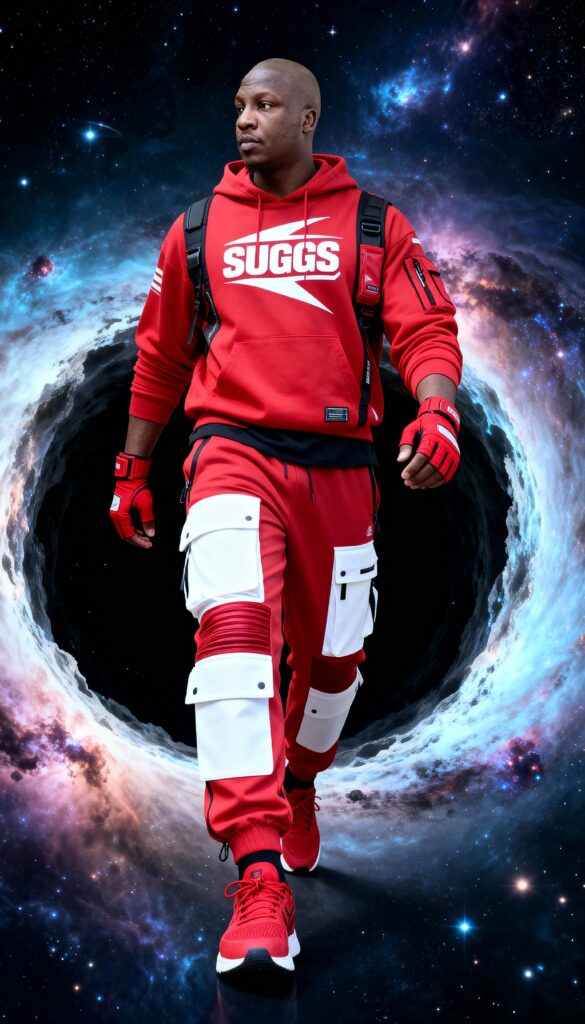
He passed through an ineffable impossibility where the Void Beyond behaved like a philosophy lecture written by a sadist. Concepts floated around him as half-finished sentences etched in frost: causality, identity, value, consequence. Each word appeared, then attacked itself, refuting its own requirements, swallowing its own letters until only unspeakable symbols remained. Draven walked between those dying notions, feeling them gnaw at the edges of his thoughts. When he tried to remember why he needed to keep going, whole stretches of memory fell away into static; when he tried to recall what he had been fighting for back in Baltimore, the city came back to him as a blur of alleyway geometry without people. Only the weight of his daughters’ names, nestled deep in his chest, refused to become vague. Their laughter, their arguments, the particular way their eyes hardened when they were pretending not to cry—those details held. Everything else slipped.
The Void Beyond did not howl. It did not roar. It evaluated. It layered him with fields of negation like a scientist layering reagents on a specimen slide. He crossed a plain of black sand that forgot each footprint the second he lifted his boot, a deliberate declaration that his passage had never occurred. He stepped through a storm of ash that was not ash but canceled possibility, each grain a scenario that would never be realized. He passed under a sky that appeared momentarily as a whirl of constellations before each star blinked out, not in explosion, but as though some unseen editor had crossed the entire idea of starlight from the script. Through all of it, Draven’s awareness remained intact, like a bruise the Void could not massage away.
It bothered him.
Another veil of raw silence slid over him. His thoughts echoed back at him, but slightly delayed, slightly distorted, as if the Void was running them through a filter and returning them in a more acceptable format. “You should be gone by now,” he heard himself say, and then realized it wasn’t his voice at all—it was the realm’s, repeating his internal doubt in a tone of bored certainty. “You don’t belong here. You’re noise in a place that has forgotten what sound means. Why are you still intact?”
He stopped. The unlight around him pooled like spilled ink. For a moment, he let himself feel the question fully. If this was absolute negation, if this was Transfictional Nothingness beyond maximal complexity flattening all narratives into equal insignificance, then why was he still walking? Why hadn’t he been diluted into the chorus of disembodied consciousnesses that fluttered at the edges of perception like static ghosts? Why did his ego—battered, confused, but unmistakably present—still stand upright inside this hostile quiet?
“Yeah,” he murmured into the non-air. “Why me?”
The Void Beyond answered by trying to strip the pronoun away. The concept of “I” blurred at the edges; for a heartbeat, he viewed himself like an unrelated character in a story he had overheard. His history appeared as an external document, written in the third person, drifting just out of reach. He clenched his fists until the knuckles ached, forcing awareness back into first person. The realm pressed harder.
He might have kept wrestling with that question, with the discomfort of surviving where everything else surrendered, if she hadn’t appeared.
Hope did not arrive with trumpets or soft light. She slipped into existence the way a joke slips into a funeral—wrong by principle, irresistible by effect. One moment there was only Draven and the circling architectures of negation. The next, she was reclining against a curve of the Void that had spontaneously decided to look like a universal-bed, as if the backdrop of creation had bent itself into a throne just to emphasize how far she sat from his level of influence.

Her skin held the deep warmth of starlit umber, every curve of her body outlined in quiet, merciless confidence. She wore a bra top of violet shimmer, its silver adornments and cascading beads catching light that didn’t exist here, forcing the Void Beyond to admit, for an instant, that luminescence was still possible. A sheer, flowing skirt of purple wrapped her waist, gliding over long legs that rested on a river of universes as casual as a woman resting on a couch. Pearled chains and intricate jewels traced her hips and midriff like constellations made into jewelry. One hand supported her as she leaned back; the other lifted an impossible miniature cosmos, a small, rotating cluster of orbits and nebulae that floated just above her palm, contained and helpless within her grasp. Her eyes—sharp, amused, and older than despair—met his with an intimacy that felt more invasive than friendly.
“Well,” she said, voice smooth as velvet dragged across glass, “you’re still vertical. I’m impressed.”
Draven’s first reaction was irritation. His second was relief. His third, unfortunately, was the recognition that she was almost dangerously beautiful, in a way that made his defenses want to turn themselves into jokes. He fought down the reflex to say something stupid.
“Hope,” he said instead, the name tasting like old wounds.
She smiled, the expression both fond and predatory. “You sound like you just saw a roach.”
“I’m in the Void Beyond,” he replied. “Didn’t expect to see you crawling around raw negation here.”
She laughed, and the Void flinched. There was no vibration, no echo, yet reality—or what was left of it—wrinkled around the sound as though it had thrown a stone at the concept of stillness. “You say the sweetest things, Draven Endwriting. Still throwing shade in the house of nothing.”
He eyed her warily. “Thought you were done with me. Thought you’d… what’s the word… vindicated me? Set the narrative straight, scrubbed your hands, walked away.”
“I did,” she said brightly. “I told the world you weren’t the problem. I told the structure you’d been trying to stand in wasn’t fit to hold you. I took my little divine spotlight, pointed it at your scars, and made sure everyone had to look. That’s my version of closure.”
“And then you threw me into an alley where reality broke,” he said.
She tilted her head. “You walked into that alley, love. I didn’t have to push. You’ve always been very good at walking toward the edge of things.”
He clenched his jaw. “You hate me.”
“Oh, absolutely,” Hope said cheerfully. “You make my job harder just by existing. But you’re also cute, and I love your dimples.” Her gaze wandered deliberately across his chest, down his arms, taking in the red SUGGS hoodie and the tactical white panels of his pants like she was appraising armor and flesh together. “And right now, unfortunately for both of us, I need you.”
The Void Beyond did not intervene. If anything, it seemed to retreat slightly, as if making space for their conversation, the way a predator might pull back to see whether a new animal introduced into the cage would make things more interesting.
Draven took a step closer to her, more out of stubbornness than trust. “You’ve never needed me before. You’ve only ever needed me to suffer enough to fit your script.”
Her smile dimmed a notch, losing some of its teasing edge. “You’re not wrong,” she said quietly. “Hope, properly weaponized, has always needed martyrs more than anomalies.”
“So what changed?”
She lifted the little cosmos in her hand, letting it spin. Tiny planetary orbits traced patterns of potential. “The world,” she said simply. “Chaos. Absolute boundless future branches. People writing their own meta-possibilities faster than I can catalog them. I built a structure—several, actually—to steer their expectations. In most cases, if they think a narrative is heading toward ruin but there’s still a sliver of me around, they behave predictably. They fight, they break, they cling, they pray. Everything stays… manageable.”
“And now?”
“Now,” she said, eyes hardening, “there are too many overlapping character strings, too many contradictory narratives, too many disobedient hearts. Something woke up that was never supposed to wake. Phau’drexhs walking in the cracks. Avidyraen⧬Voimhyss stirring between possibility and nothingness. You know the rest. It’s not that I want things to be peaceful—that’s never been my brand—but I do prefer the chaos where I can still read the script. Lately, the script keeps editing itself.”
Draven sighed. “Welcome to the club.”
She regarded him thoughtfully. “You think I don’t see what you’ve been doing? You’re an anomaly, Draven. A minor human fragment that refuses to align with the probabilities I laid out for you. Your grand meta-narrative is off-script, but not in any of the ways that lead to collapse I can profit from. You die on page fifty? Tragic, inspiring, good for business. You break completely and become another villain? Also useful. But you keep doing something worse.”
“What’s that?”
“You keep living,” she said. “Badly. Messily. Under too much pressure, with too much guilt, never fully broken and never fully redeemed. You keep loving your daughters like they are the only anchor left in a world I have written to be cruel. You keep helping strangers and failing. You keep surviving catastrophes that should have pinned you to the floor as a cautionary tale.” She flicked her fingers; the little cosmos in her palm stuttered, as if a centillion possible futures skipped. “You keep defying me, and you don’t even know you’re doing it. Do you have any idea how irritating that is?”
Something in her tone—equal parts anger and reluctant admiration—made him hesitate. “You could erase me,” he said. “Put me in that sphere of negation Ahmose and Amanishakheto saw. Make me a story instead of a problem.”
“I could,” she replied. “But that would be conceding that I miscalculated, and if there’s anything I hate more than you, it’s admitting an error in my own Metamathematical scaffolding. Besides…” She leaned forward slightly, eyes catching the unlight and turning it into a glint. “I watched you walk through voids of negation that should have shredded your ego into silent dust. The Void Beyond has no hold on you, and that fascinates me.”
Draven spread his hands. “I feel it trying.”
“Oh, it tries,” she agreed. “It smothers, it cancels, it rewrites context. But your sense of self is built on something the Void doesn’t know how to digest. You are not anchored by triumph or righteousness. You’re anchored by suggslogical responsibility. That kind of ego doesn’t need applause or even hope to keep moving; it just refuses to abandon what it’s decided is its own. That’s the sort of anomaly state I can use.”
His gut tightened. “Use for what?”
“If I spelled it out,” she said, lying back again, one leg stretching along the galaxy beneath her, “you’d walk away just to spite me. For now, I need you to do what you’re already doing—keep defying structures that think they have you categorized. Keep walking in places that insist humans cannot survive. Keep being an unsolvable problem for every construct that tries to define you, including me.”
He frowned. “That still doesn’t tell me why you’re here trying to drag me back to the world.”
She rolled the little cosmos over her fingertips. “Because as long as you’re down here, the anomaly is quarantined. The Void Beyond gets to stare at you like a lab specimen while the surface drowns without its favorite contradiction present. I need you back in the noise, where your refusal can interfere with what’s coming. Down here, you’re just an interesting glitch. Up there, you’re a liability to structures I’m no longer sure I control. And strangely enough, that might be our only chance to keep everything from collapsing into a kind of silence even I can’t work with.”
“You’re asking me to save the world,” he said, incredulous.
“I’m asking you to keep being you,” she corrected. “In very loud places. Under sirens and clouds and human eyes. I’m not here to change what I did to you. I’m not rewriting your suffering, not refunding your losses, not healing your siblings or refunding your childhood. This isn’t mercy. You are not getting a retroactive miracle. I am not that kind of transcendental threat.”
The honesty of it hit harder than any false comfort. He believed her precisely because she didn’t pretend to be kind.
“What about my past?” he asked. “You mentioned something about realignment. About my memory not being… accurate.”
Hope sat up fully now, the miniature cosmos orbiting her wrist. The Void Beyond dimmed around her, unhappy at the concentration of definition. “Your past,” she said, “is not a simple record. It never was. Humans think of their personal character string as a straight line of events, one after another, immutable. But every trauma, every decision, every moment you looked away from something unbearable and then looked back, you were unconsciously weaving different possible histories into one thread. You have been curating your own origin story since childhood, reshaping it each grand meta-moment to make survival possible.”
She gestured, and the darkness in front of them unfolded.
A corridor appeared around him—the one from his fractured-past image. Two walls of incomprehensible data and symbols stretched upward into shadow, etched in pale light like the language of a machine that had read too many myths. Between them, the floor cracked and broken, Draven saw himself crouched, younger, wearing a different SUGGS shirt, surrounded by floating possibilities and fragments of memory. That Draven stared up at a sky of swirling nebulae where each star seemed to be a different version of his own childhood, flickering in and out.
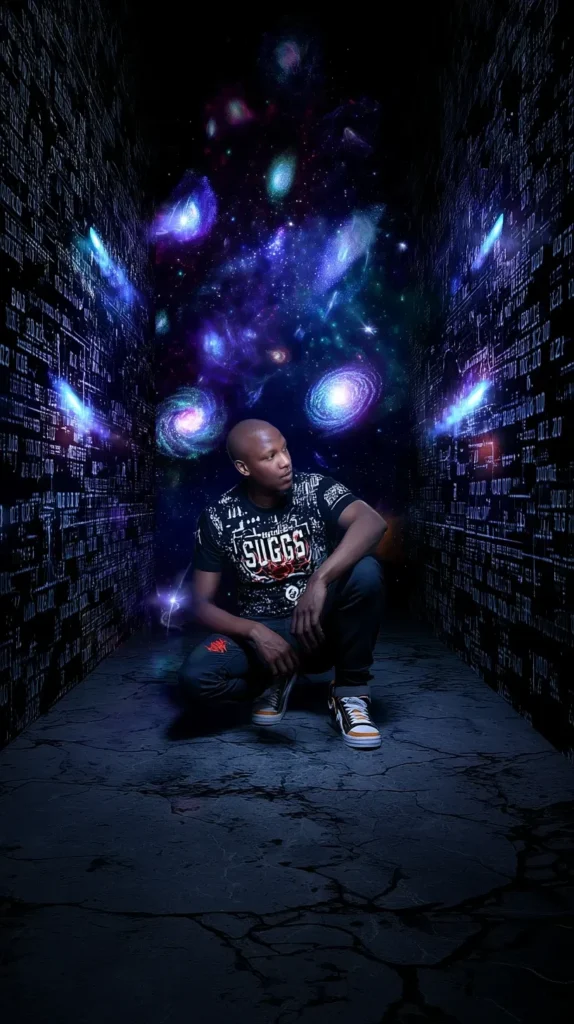
“You’re in the Room of Possibility,” Hope said softly. “This is not outside you. This is inside you, projected outward so you can see it. Every scene you remember has siblings, cousins, abandoned variants. Some are worse than what you live with, some are better, some are merely shifted by a word or a look. Over the years, you unconsciously selected which ones to treat as definitive. Not because they were the truest, but because they were the ones you could bear.”
Draven stepped into the corridor, leaving the immediate pressure of the Void behind like a background hum. He walked past himself, past clusters of visualized memories hanging in the air. He saw his younger self at a kitchen table that kept changing layout—sometimes his mother sat across from him, sometimes she didn’t; sometimes his brother was at his side, sometimes an empty chair; sometimes there was shouting, sometimes just the clink of a spoon in a chipped mug. The variations flickered each time he tried to focus on them, as if embarrassed to be observed.
“You’re saying I don’t actually know what happened?” he asked.
“I’m saying,” Hope replied, her voice echoing from a place both beside and nowhere, “that memory is a negotiation between actuality and survival. In your case, the negotiation played out in maximal complexity. There are versions of your early history you locked away because acknowledging them would have broken the thread you needed to reach your daughters. There are also softer versions you discarded because they would have let you blame yourself less, and you built your entire ethic around absorbing more blame than you deserved.”
He stopped before a suspended image of himself at nearly five, small hands clenched, eyes blazing with rage as adults argued in the blurry periphery. The scene kept trying to resolve, then fragmenting: different adults, different words, different reasons. In some iterations, someone reached out to him. In others, no one did.
“So which one is real?” he whispered.
Hope’s answer came like a hand on his shoulder without touch. “The question is not which is real. The question is: which ones are you willing to carry forward now, knowing they were all once possibilities brushing against you? Your current memory thread is not wrong; it’s simply incomplete. If you want to change the way your past governs you, you must accept that your history is more than the single cut you’ve been replaying.”
He sighed. “And if I don’t?”
“Then you return to the surface as you are,” she said, “and the anomaly keeps walking, stubborn and half-blind. That might still be enough to ruin several carefully constructed inevitablismas. I would prefer, however, that you go back with a slightly wider understanding of your own fractures. The more contradictions you embrace in yourself, the harder it will be for anyone, including the Void Beyond or me, to reduce you to a simple archetype we can plan around.”
Draven closed his eyes. For a long interval, he let the Room of Possibility flicker around him without trying to control it. He saw himself failing, protecting, leaving, staying. He saw his daughters in every variant—the only constant. In none of the possible histories did he fail to love them. That realization anchored him more than any philosophical frame.
“At least they’re real,” he said quietly. “Whatever else is scrambled, whatever I misremember or overown or rewrite… them, I got right.”
“Yes,” Hope said. “Your experiences with them are the closest thing you have to a stable axis. Hold that. Let the rest be allowed to wobble.”
He turned back to her. She had stepped into the corridor now, her cosmic garment and bare feet utterly out of place on the cracked floor, yet somehow making it feel less like a prison. The little xenocosmology in her hand had changed—its orbits now traced shapes reminiscent of his girls’ names, though he couldn’t have drawn the connection if asked.
“Why now?” he asked. “You could have had this talk before you left me hanging over rifts and throwing hands at impossibilities.”
Her expression softened, just for a heartbeat. “Because before, I thought this grand meta-narrative only needed you as an example of how far cruelty could push a man before he shattered. I underestimated your refusal to shatter. It turns out the story needs you as a variable, not a lesson.”
“And you,” he said slowly, “need me as a problem you can’t pre-solve.”
She smiled again, the dangerous warmth returning. “Exactly. You never needed Hope, Draven. You kept walking long after you decided I was a lie. But I, annoyingly, need you now. So consider this my first and last favor: a reminder that you are not just the single version of your pain you’ve been carrying. You are a room full of possibilities that survived collapsing into one man. Take that back into the noise.”
“You’re not coming with me,” he said.
“Absolutely not,” she replied. “I have reputations to maintain. And besides, I’m busy. There are believers to disappoint and cynics to confuse. But we’ll see each other again. You’re far too irritating to stay away from for long.”
The Room of Possibility began to dissolve, its walls of data fading into the textureless dark of the Void Beyond. The younger Draven flickered once, then rejoined him, merging into the present awareness like a shadow stepping back into its owner. The floating memories folded into his chest—not erased, but refiled. Some hurt more; some hurt less. All felt less authoritarian.
Hope stepped backward, reclining once more on her universal throne as the corridor vanished entirely. Only Draven and the raw silence remained, with her resting at its edge like a goddess who had chosen a balcony seat.
“One more thing,” she said. “When you get back to the surface, don’t imagine this means I’m on your side. I’m on the side of narrative tension. You just happen to produce more of it alive than dead.”
“That’s the nicest thing you’ve ever said to me,” he muttered.
She laughed again, and the Void Beyond flinched. “Keep defying me, Draven Endwriting. Ruin my projections. Embarrass my statistics. Make my inevitablismas look foolish. That’s all I’m asking.”
“And if I refuse?”
Her eyes gleamed. “Then you’ll be yourself. Which is exactly what I’m counting on.”
The little cosmos in her hand flared, then collapsed into a point of unspeakable brightness. When the afterimage cleared, she was gone—not departed in the sense of movement, simply no longer referenced by the surrounding unreality. It was as though the Void Beyond had decided she had never been there… and yet, the warmth of her annoyance lingered like perfume.
Draven stood alone again, surrounded on all sides by endless negation and raw silence. But something in the way the darkness pressed against him had changed. It no longer felt like an external absolute trying to crush an isolated ego. It felt like one structure among many, one possible verdict among the countless unsimplified verdicts stored in his chest. The question of why he was still here had lost some of its teeth.
He rolled his shoulders, adjusted the straps of his backpack across his red hoodie, and took a breath he didn’t need. The Void Beyond leaned in, expectant.
“Noise, huh?” he murmured. “You want to keep me in the quiet. She wants me loud. Both of you can wait.”
He stepped forward, not away from the silence but deeper into it. The unbound negation parted grudgingly, reshaping itself around his motion. With each stride, the thought of his daughters burned brighter than the hunger of Transfictional Nothingness. Hope’s words echoed behind him, not as guidance, but as heckling. The Room of Possibility remained somewhere inside him, doors unlocked. The past trembled, flexible.
Draven walked on.
The Void Beyond, absolute in its negation, refused to acknowledge that it had just been refused in turn. But the fabric of raw silence carried a faint, uncharacteristic tremor—like the first hint of distant traffic in a city that had sworn itself dead.