
No Horizon II: The Capital That Forgot It Was Human
Washington, D.C. always pretended it was cleaner than it was, as if marble and policy could bleach the rot out of a city the way bleach scours a hospital floor. Even on nights when the air tasted like exhaust and rainwater running through old metal, even when the streetlights threw their halos onto puddles that looked too dark to be only water, the capital held itself like a lie that learned to speak in full sentences. Ronan Eclipsedword understood lies the way former surgeons understand anatomy: not as morals, but as systems, and he could tell you exactly where to cut one to watch the whole thing collapse.
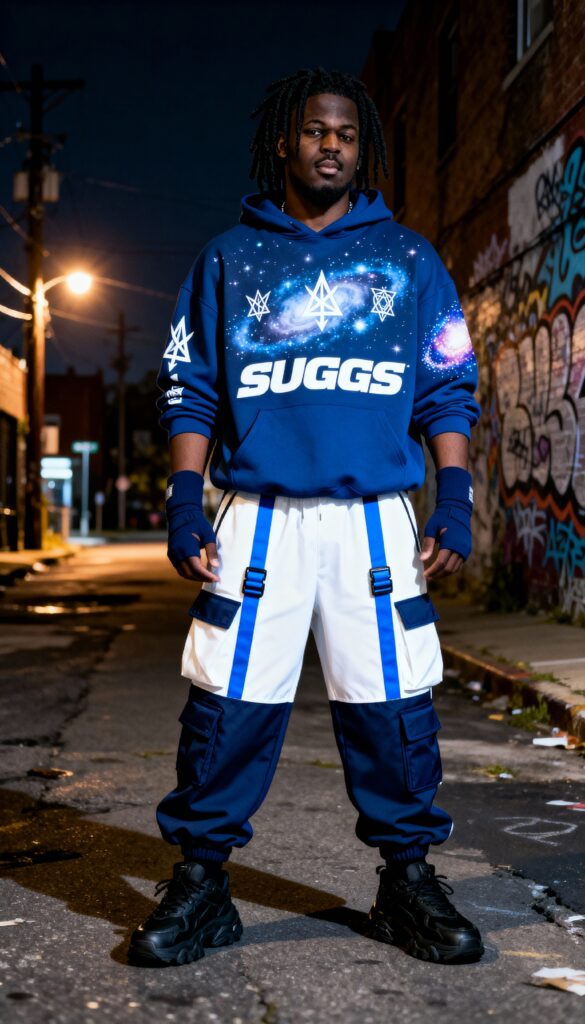
He was still in Baltimore when the first D.C. report hit his secure line, and he listened the way he used to listen to a patient’s pulse—flat expression, steady hands, the faintest narrowing of focus that meant he had already begun deciding what to do. The voice on the line was one of his street captains down south of the line, trying to keep composure while the city behind him sounded like it was being chewed. There were screams in the distance, not close enough to be immediate but close enough to make every word feel borrowed. The captain didn’t bother asking for help in the way people usually did; he spoke like someone delivering a lab result to the only doctor who could read it without flinching, saying that something had arrived that didn’t belong to any neighborhood, any myth, any known taxonomy, any workable superstition. He said the street cameras were failing in patterns that looked like grief. He said the air itself was bending. He said the bodies weren’t falling so much as getting erased from their own matter.
Ronan ended the call without comfort. Compassion was a luxury, and he treated it like a drug—useful, dangerous, expensive, administered only when it wouldn’t kill the patient. He stood at his kitchen table, under his own dim light, and let the silence settle. The dice were already in his palm, two small cubes with nebula patterns that looked like novelty trinkets to anyone who didn’t understand what it meant to sell ignorance at scale. When Ronan rolled those dice, he didn’t gamble. He allocated blindness. He distributed a mercy that felt like vice. He kept entire blocks stable by making sure they couldn’t fully recognize what was hunting them.
The next call came from one of his dealers in Northeast D.C., the kind of kid who still believed money could solve anything if you piled enough of it high enough. The kid said people were buying ignorance in bulk, not even rolling the dice anymore—just pressing them to their foreheads like prayer stones, begging for the relief of not noticing the wrongness creeping into their sightlines. Ronan pictured that, eyes closing briefly, the city full of people choosing not to see the end of themselves. He didn’t judge them. He understood them. A surgeon learns early that people will accept almost any pain if it means they don’t have to accept the truth of it.
He went to find his wife before he went to D.C., not because he needed permission, but because he needed the one person who could look at him without flinching and still call him out when he was being a bastard for sport. Eclipse met him where she always met him when the night was about to become ugly: in the bright, unromantic honesty of a bathroom mirror, where there was nowhere for a person to hide from their own face. She was perched sideways on the edge of the tub, one knee up and the other leg tucked, holding her phone at an angle that made her look like she was taking a casual picture for someone who deserved softness. Her hairstyle was a sleek, straight bob that framed her face with deliberate sharpness, and her expression carried a quiet, unimpressed calm that made Ronan feel exposed in the way wards never could. She wore a fitted athletic tank with wide straps and a clean scoop neckline, paired with snug sport shorts that hugged the hips and thighs with a minimalist, practical cut, the side panels contrasting in tone as if the outfit itself understood balance. She wasn’t dressed for war, but she wasn’t dressed like someone waiting to be protected either. She looked like someone who had decided she would remain herself even if the world’s rules stopped making sense.

Ronan leaned in the doorway and watched her for a moment without speaking. That was his habit—observing before interacting, assessing the room like it was an operating theater. Eclipse lowered the phone and looked at him through the mirror, and her mouth curved into a knowing half-smile that said she’d already read him the way he read everyone else.
“You look like you’re about to do something you’ll pretend you didn’t enjoy,” she said, voice light, like teasing could blunt dread.
“I got a call,” Ronan answered.
“I know.” She slid off the edge of the tub and stood, turning so her shoulder faced him and her gaze stayed level. The way she held herself was composed and intimate at once, the kind of posture that said affection wasn’t weakness. “You always get calls. That’s what you built. People panic, and you monetize the parts of the world they can’t manage.”
Ronan’s jaw tightened. He didn’t like hearing the truth from someone whose opinion mattered. “This isn’t a street problem.”
Eclipse stepped closer, close enough that Ronan could feel her presence change the air, and she reached up to straighten the front of his hoodie like he was a kid who refused to admit he needed anyone. “You’re going to D.C.,” she said, not as a question, but as a diagnosis.
He didn’t deny it. Denial was for people who still believed in innocence.
Eclipse’s eyes narrowed slightly, and then she laughed—soft, honest, almost affectionate in its disbelief. “Of course you are,” she said. “The whole DMV could be on fire, and you’d still act like it’s an inconvenience.” She leaned in and kissed him quickly, the kind of kiss that didn’t beg or plead, only reminded. “Try not to die, Ronan. I’m not in the mood to grieve someone who thinks he’s too clever for grief.”
“I’m not dying,” Ronan said, and it came out like a habit rather than a promise.
Eclipse brushed past him toward the door, and as she passed, she added, “That’s exactly the kind of sentence that gets people killed.” Then, with that same humor that kept her from ever being swallowed by his darkness, she glanced back and smiled again. “Bring the dice. If the world is tearing, somebody needs to keep it blind long enough for you to do whatever you call saving it.”
Ronan left with the dice in his pocket and her laugh still lingering in his chest like a warmth he refused to admit he needed.
By the time he crossed into D.C., the city had already begun to stutter.
Not in the way traffic stutters, or crowds stutter, or politics stutter under pressure, but in the way an image stutters when the file is corrupted. Streetlights blinked out of sequence. Reflections in windows lagged behind the movement in front of them as if the manifest expanse itself was losing synchronization with its own presentation. The air had a density to it that made breathing feel like pushing through invisible fabric. Ronan stepped out of his vehicle into a corridor of brick and shuttered storefronts, and the first thing he noticed wasn’t the screams or the sirens, but the way sound traveled wrong, as though the city was swallowing certain frequencies and amplifying others without logic.
His soldiers were already there, posted at intersections that used to be predictable and were now behaving like nervous animals. They weren’t soldiers in the government sense, and they weren’t his people in the sentimental sense. They were his enforcement arm, his cleanup crew, his dealers of stability, trained to treat the supernatural like a street problem with higher stakes. They wore deep-blue hooded tops with cosmic prints and sharp sigils, the fabric thick and cropped or loose depending on the model, but always practical, always built for movement. Their faces were hidden behind skull-like masks with hollow eye sockets and hard jawlines, the masks giving them the presence of walking warnings rather than men. Their hands were wrapped in fingerless gloves, wrists reinforced, knuckles ready. Their pants were heavy tactical streetwear, strapped and pocketed, with rigid white plates bolted to thighs and hips like makeshift armor. Their boots were bulky and engineered, with luminous accents at the soles and ankle braces wired with small cables that pulsed faintly, as if their gear had to keep reminding itself how to exist in the same reality as the street.
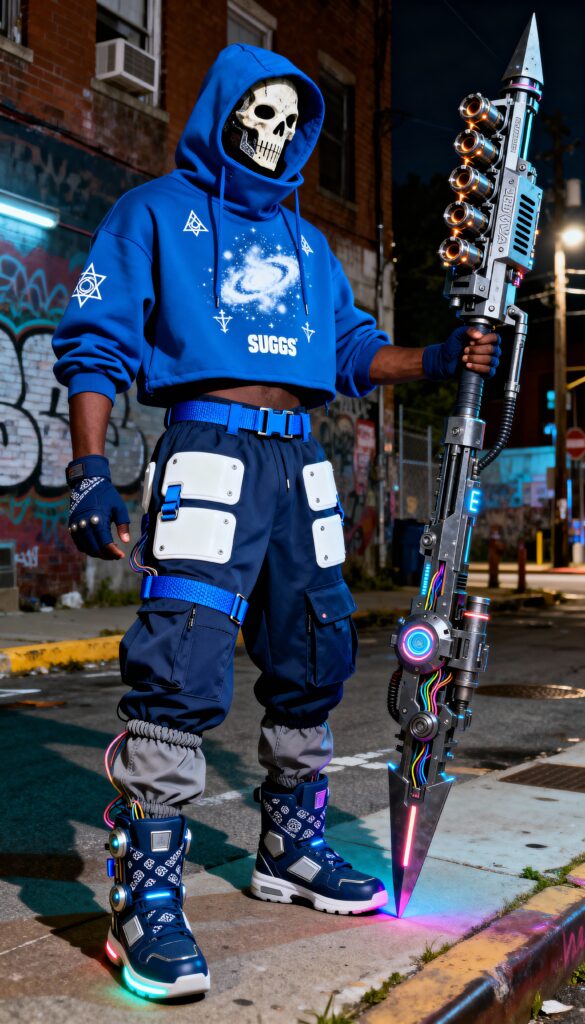
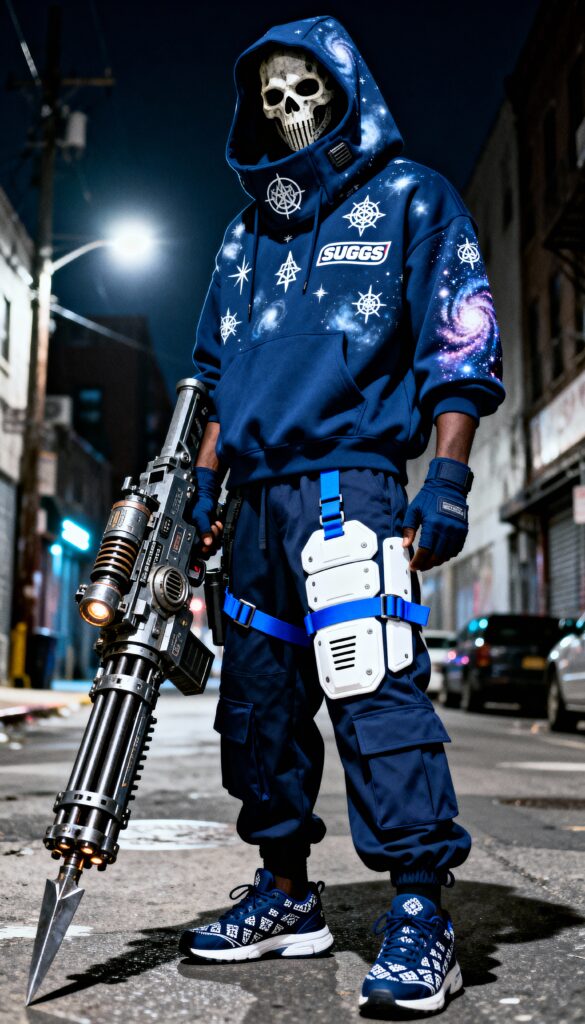
One of them held a weapon that looked like a cross between a siege tool and a ritual instrument: a massive gun-like staff with a long barrel, a cluster of circular chambers glowing with heated light along the top, and a blade-shaped spike at the bottom that could anchor into the ground. Coils, cables, and neon circuitry wrapped the frame like exposed nerves. The soldier held it with one hand, arm extended slightly, the barrel angled downward with casual confidence, the other hand loose at his side as if he was waiting for the city to make the first move. Another soldier carried a rotary-barrel cannon with a heavy cylindrical cluster and a bright lens-like emitter at the front, its mass balanced against his hip. He stood wide-legged in the street, shoulders squared, the weapon held like a promise he didn’t expect to keep.
They were Ronan’s “soldiers,” but they were also his dealers. Every one of them carried at least one set of the nebula dice, because firefights weren’t the only battles. The first job was always to prevent panic from turning into recognition. When people truly recognized what was happening, cities didn’t just riot. They tore.
Ronan walked between his soldiers without ceremony, his hoodie’s cosmic patterns catching the streetlight in brief flashes, his posture relaxed in the way of a man who had already accepted that the night would be ugly and didn’t see the point in pretending otherwise. He spoke quietly, and the soldiers leaned in to hear him, the skull masks turning toward him like a chorus of death.
“What’s the perimeter look like?” Ronan asked.
A soldier answered with a voice filtered through the mask, metallic and flattened. “The entities are manifesting in fragments. They aren’t moving like creatures. They’re moving like… pressure.”
Ronan nodded once. That phrasing was closer to truth than most people would manage.
Another soldier added, “We hit them with rounds, with heat, with electricity. Nothing registers. We can disrupt the air around them, but the fragments don’t take damage.”
Ronan’s eyes flicked toward the far end of the street, where the air shimmered like a mirage that didn’t belong in cold night. “You’re aiming at the wrong category,” he said. “They’re not targets in the way you’re used to. You’re firing into a symptom.”
A faint tremor ran through the pavement, subtle enough that most people would interpret it as a truck passing somewhere nearby. Ronan felt the tremor differently. It wasn’t vibration. It was displacement, as if the ground itself was being asked to move aside for something too large to fit.
Then the first fragment arrived, and the street learned what it meant to be small.
At first it was only a distortion, like heat haze rising off asphalt, except the night air wasn’t warm and the shimmer carried an intensity that made the edges of buildings blur. The distortion thickened, and the manifest matter nearest it began to behave as if it had forgotten how to be solid. A parked car’s metal frame rippled. A street sign bent without wind. Loose trash lifted off the ground and hung suspended, vibrating as if caught in invisible current. People at the far intersection froze, not out of choice, but because the world around them slowed into a heavy, syrupy crawl, their movement reduced to the most minimal increments, their breath caught halfway in the act of being a breath.
Ronan watched the effect with the bored focus of a doctor observing a new pathology. The fragment wasn’t shaped like a monster in any comforting way. It didn’t have a face, because faces are for things that consent to being understood. It looked like a vertical intrusion, a column of wrongness stretching upward far beyond the buildings, the lower portion visible as a rippling wedge of shadow and light that swallowed detail. The shimmer expanded, and the streetlamp nearest it dimmed, not because it broke, but because the concept of illumination was being negotiated.
His soldiers fired anyway, because training teaches reaction even when it’s futile. The siege-staff weapon emitted a blast that cracked the air with a bright pulse, and the rotary cannon followed with a rapid stuttering stream of luminous rounds. The attacks hit the distortion and vanished, swallowed without impact, as if the fragment had no surface to receive harm. The manifest matter around it, however, reacted violently. The pavement buckled. The nearest building’s brickwork shuddered. A mailbox compressed in on itself like it was being squeezed by an invisible fist.
The fragment’s response wasn’t retaliation. It was simply presence. A quantum gravitational field, immense and uncaring, radiated from it, strong enough to distort and negate the manifest matter it touched. Ronan watched a parked car begin to flatten, the metal folding inward in slow, hopeless increments. He watched a human body near the intersection sag as if gravity had suddenly remembered it was allowed to be crueler, bones bending under impossible weight, the person unable to scream because the air in their lungs couldn’t move quickly enough to become sound.
Ronan’s soldiers tried to pull civilians back, but the field didn’t care about heroics. The field didn’t care about intention. People were pinned by the distortion of the grand meta-narrative itself, reduced to witnesses trapped in slowed presentation, their minds screaming while their bodies lagged behind.
Ronan stepped forward, one hand already reaching into his pocket for the dice, because he understood the first battle here wasn’t killing the fragment. It was preventing the city from fully realizing what it was seeing. The moment D.C. became truly aware, the moment the capital comprehended that something beyond the physical universe had begun to press into its streets, the resulting terror would cause more damage than the fragment’s field ever could. Panic would open cracks. Recognition would invite more intrusions.
He rolled the dice onto the pavement.
They bounced once and landed, nebula faces up, glinting under the streetlight like tiny galaxies.
Ignorance spread outward as a soft distortion of perception, subtle, almost kind. The civilians who were still capable of thought began to blink as if they couldn’t focus, their eyes sliding off the fragment, their minds grasping for explanations that made the wrongness feel like exhaustion or drug haze or a dream they could wake from. Their fear dulled, not vanishing, but becoming manageable. The city didn’t calm. It simply failed to fully register the magnitude of what was happening.
Ronan watched that wave ripple through the street and felt the familiar moral nausea that always came with it. He had built a kingdom on this, a top-of-the-food-chain empire that sold the right to not know. He didn’t pretend it was noble. He pretended it was necessary, and necessity was a philosophy that could justify almost anything if you said it with enough certainty.
“Move civilians,” he said to his soldiers, voice even. “Not away from the fragment. Away from recognition. Get them behind cover, get them inside, and keep them from staring.”
One of the skull-masked soldiers hesitated, weapon still raised. “How do we kill it?”
Ronan’s gaze didn’t waver. “You don’t,” he said. “You survive it. You keep it from eating the city’s mind while I figure out what it’s actually attached to.”
The field intensified, and the air became so dense the street sounded like it was underwater. Sirens in the distance warped in pitch. The streetlight’s glow smeared into a halo that looked painted rather than emitted. A second fragment began to manifest two blocks away, visible as another vertical tear of distortion, larger than the first, its visible portion stretching far above rooftops, as if the city had suddenly become the floor of something that had never agreed to be measured.
Ronan moved toward the second fragment because he had the Cheat in his bones, that instinctive navigation of probability and coincidence that put him where he needed to be just before the world admitted it was going to be cruel. He slipped between the pockets of slowed presentation, choosing routes where the gravitational field thinned, stepping through gaps that shouldn’t have existed, feeling the world’s resistance shift like tissue under a scalpel.
On the way, he passed bodies. Not piles. Not gore. Something worse. People half-negated, their outlines softened as if reality couldn’t decide whether to keep them. A man’s hand smeared into the air like a brushstroke. A woman’s legs sank into the pavement as if the street had become a liquid that didn’t reflect light. Ronan didn’t stop. He couldn’t. A surgeon learns early that you can’t save everyone on the table. You choose the operation that saves the most function.
Near the second fragment, a chaotic spirit erupted from a storefront window, drawn by the distortion like a moth to flame. It looked like a twist of shadow and static, limbs too long, joints too many, its mouth a jagged void that poured out a sound like laughter being strangled. It lunged at a civilian who was frozen mid-step, their movement trapped in slowed presentation, their eyes wide but incapable of fully closing.
Ronan lifted his hand, and his magic didn’t manifest as theatrical chanting. It manifested as procedure. A sterile field snapped into place, sigils flickering in the air like translucent surgical lights. The chaotic spirit hit the boundary and recoiled, its body compressing against an invisible plane.
Ronan’s eyes narrowed slightly, clinical. He flicked his fingers, and the spirit’s “infection” turned against it, a bio-thaumaturgical inversion that treated its essence like diseased tissue. Necrosis spread through its shadow-mass in precise lines, not burning the air around it, not harming the civilian, only erasing the spirit’s stability until it collapsed into a smear of inert static. The civilian blinked as if waking from a bad dream, their mind already sliding off the memory because ignorance had softened the edges.
Ronan moved again, faster now, because D.C. was beginning to drown in simultaneous catastrophes. One fragment hovered over a line of parked cars, flattening them in slow, horrifying increments. Another fragment pressed against a building and caused the brickwork to ripple outward like waves. The gravitational fields didn’t merely crush. They negated manifest matter, rewriting solidity into pliability, turning hard things into failing things. Around each fragment, the world’s render-rate slowed, trapping witnesses in a syrupy paralysis that made rescue feel like trying to pull someone out of wet cement while the cement refused to admit it was wet.
His soldiers fought anyway, because courage is often just refusal to accept helplessness. They fired their heavy weapons at the fragments not to injure them, but to disrupt the area, to buy seconds, to create noise that kept civilians running rather than staring. One soldier anchored the staff-weapon into the pavement, the blade tip sparking against concrete, and discharged a pulsing field that pushed back chaotic spirits trying to ride the distortion into the street. Another soldier swung the rotary cannon up and fired at a spirit cluster, shredding them into dissolving static. Their movements were practiced, tactical, almost beautiful in a bleak way, like dancers performing in the shadow of something that didn’t care they existed.
Ronan watched them work and felt, unexpectedly, a flicker of respect. These weren’t heroes in the storybook sense. They were employees in a nightmare economy. They were the kind of people who died quietly and got remembered wrongly, if at all. They had chosen Ronan’s empire because at least his lies had structure.
Then a third fragment manifested, and structure stopped mattering.
This one arrived with less shimmer and more weight, as if the city itself had been forced to make room. The air folded inward. A row of streetlights dimmed simultaneously. The pavement cracked in a line that ran straight toward the fragment like a vein bursting under pressure. The visible portion of the intrusion stretched higher than any building could justify, its edges faintly luminous, as if the fragment carried its own cold radiance into the world. The gravitational field around it swelled, and the nearby block began to distort so severely that the buildings leaned without falling, their geometry bending into impossible angles while still insisting they were upright.
A soldier nearest the fragment tried to retreat, but his body slowed, trapped in the distortion field, his steps reducing into micro-movements that couldn’t complete. The field didn’t freeze him; it simply reduced the world’s willingness to allow him to move at a normal rate. His weapon dipped. His skull mask turned toward Ronan, and though the mask had no expression, the posture carried a silent question: what now?
Ronan acted before thought could become regret. He raised his hand and carved a glyph into the air with two fingers, not as art but as incision. The glyph latched onto the slowed field and created a thin corridor of normal presentation just wide enough for a body to be pulled through. The soldier’s movement jerked suddenly, freed in that narrow lane, and another soldier grabbed him by the vest strap and hauled him backward.
The rescue worked, but it cost.
The field reacted, not with anger, but with adjustment. The fragment’s gravitational presence shifted, seeking equilibrium, and in that shift, the corridor Ronan had carved snapped like a tendon.
The nearest street corner folded inward.
A parked car was flattened into a sheet of metal. A street sign compressed into a bright sliver. The building’s front stoop buckled, the concrete turning pliable under impossible weight.
The soldiers shouted into their comms, voices clipped with panic they were trying to keep from infecting the rest of the network. Ronan’s captains reported new intrusions manifesting across the capital, fragments appearing near monuments, near metro entrances, near intersections where crowds gathered. D.C. wasn’t being attacked strategically. It was being consumed topologically, as if something beyond-dimensional was sampling the city’s geometry, testing where it could press through without fully entering.
Ronan felt the urge to call Draven then, not for help, but for the reassurance of a brother’s voice, the quiet reminder that someone still knew him as a human rather than a function. He didn’t. He filed the urge away like an emotion that would be useful later when he had the luxury of collapsing.
Instead, he advanced.
He moved into the teeth of the distortion because the "Cheat" guided him, because his awareness traced the least resistant line through impossible pressure, because he had always been willing to do things other people refused to do as long as the outcome justified it. As he approached the third fragment, he saw something he hadn’t seen before: not a face, not a core, but a pattern in the way the field distributed. There was an asymmetry, a slight wobble, like a heartbeat in the gravitational pressure. The fragment wasn’t random. It was anchored to something, tethered to a point of weakness in the manifest expanse.
Ronan crouched, palm hovering over the pavement, and let his magic sink into the ground. He didn’t treat the city like sacred space. He treated it like a body. He listened for the flow of wrongness the way he used to listen for blood flow under skin. The ground responded with a faint thrum, a vibration that traveled through his bones, leading him toward a sewer grate that rattled as if something beneath it was breathing.
He looked up at his soldiers. “Perimeter,” he said. “Keep civilians moving. Keep eyes off the sky. Keep the dice rolling.”
One soldier, the one with the siege-staff weapon, stepped closer. His skull mask turned slightly, and the glow from his weapon’s chambers reflected in the mask’s hollow eyes. “Boss,” he said, voice rough. “We’re losing people.”
Ronan’s expression barely shifted. “I know,” he said. “That’s what this is.”
It wasn’t cruelty. It was diagnosis.
The soldier didn’t argue. He turned back to the street, weapon raising again, posture settling into readiness that looked like acceptance.
Ronan tore the sewer grate free with telekinetic force, the metal scraping, sparks flaring, and descended into the darkness below. The smell hit him—stagnant water, waste, rot, and something else beneath it, something metallic and cold, like the air inside a dead machine. The tunnel walls shimmered faintly, as if reality down here was already thin enough to show its seams. Ronan’s eyes adjusted, and he saw sigils burned into the concrete that weren’t his, symbols that looked like someone had tried to draw geometry meant for a different world.
He followed the tunnel until it opened into a maintenance chamber where the air felt heavier, and the hum of the fragment above grew louder, resonating through the concrete like pressure against a skull. In the center of the chamber, a shimmering knot of distortion hovered just above the floor, a small anchor point, a localized tear that pulsed with the same asymmetrical rhythm he’d felt in the street.
This wasn’t the entity itself.
This was the wound.
Ronan stood at the edge of it, and for the first time that night, his calm sharpened into something more dangerous than boredom. He didn’t fear the fragments. Fear was for things that could be negotiated with. These intrusions didn’t negotiate. They pressed. They distorted. They consumed. The only way to fight something like that was to treat it like a pathology and excise it before it infected the whole system.
He rolled the dice again, not outward this time, but inward, drawing ignorance into a tight, controlled sphere. The nebula cubes clattered on damp concrete and landed, and the air in the chamber softened, the edges of the tear blurring as if the world itself was trying not to look at it.
Ronan began carving sigils into the air, each one precise, clinical, layered like stitches. He wasn’t sealing the tear with brute force. He was redirecting it, altering the conditions under which the beyond-dimensional reality could press through. He was rewriting the wound’s ability to stay open by changing what the space around it could tolerate.
Above him, the street shook. The fragments responded to the anchor being manipulated, their gravitational fields stuttering, the render distortion wobbling. Ronan felt the pressure increase, like the intrusions were pushing back, trying to reassert presence. He kept working, steady hands, measured breath. Surgeons didn’t panic when the body bled. They adapted.
Then the comms in his ear crackled, and a soldier’s voice cut through with strain. “Boss,” the soldier said, and the way he said it carried the weight of someone already halfway dead. “They’re… they’re getting bigger.”
Ronan didn’t respond immediately, because responding wouldn’t change the truth.
He finished the last sigil, snapped his fingers, and the chamber’s air tightened like a wound closing. The anchor point spasmed, the distortion collapsing inward with a sound like distant thunder muffled by water. For a moment, the pressure eased. For a moment, the fragments above faltered, their fields thinning.
Ronan climbed back up into the street to capitalize on that moment, because moments were all you got in a dying city.
What he saw when he emerged made even his clinical detachment feel like a thin mask.
The block was littered with the remnants of manifest matter that had lost its argument with gravity. Cars were flattened, twisted, partially negated into shapes that looked like melted toys. A storefront’s front wall had bowed inward, the brickwork warped into a wave frozen mid-crash. The streetlights flickered, their halos smeared by lingering distortion. Civilians stumbled, their minds dulled by ignorance, fleeing without understanding why.
His soldiers were still fighting, but the fight had changed. They weren’t firing at fragments anymore. They were firing at the chaotic spirits clustering around the distortion, spirits feeding on the fear, spirits dragging at ankles, spirits trying to pull humans toward the shimmer where the gravitational field would do the rest.
A soldier with the rotary cannon stood in the middle of the street, wide-legged, weapon held low, firing controlled bursts that turned spirits into dissolving static. Another soldier, the one with the siege-staff weapon, had anchored its blade tip into the pavement, using it like a warding post, its glowing chambers pulsing in sequence, emitting a field that repelled spirits long enough for civilians to escape.
They looked like professionals. They looked like they might hold.
Then the largest fragment shifted.
It didn’t descend. It didn’t “move” in any human sense. The pressure simply increased, and with that increase, the field around it thickened, the render distortion tightening until movement became nearly impossible. Ronan watched one soldier try to turn, try to run, and saw his body slow into incremental failure, each step reduced to an impossible effort. The soldier’s skull mask tilted toward Ronan, and for a breath of presentation, Ronan could almost imagine the human face beneath it, the sweat, the fear, the grim acceptance.
Ronan stepped forward, hands lifting, ready to carve another corridor, ready to cheat again.
The fragment adjusted faster than he could.
The gravitational field intensified in a sudden spike, and the soldier’s body compressed. Not exploded. Not ripped apart. Compressed into less and less volume until the manifest matter could no longer argue it belonged in the same state. The soldier folded inward, armor plates snapping, weapon dropping, then even that weapon bending as if made of soft metal. The death was quiet. Almost respectful. A simple reduction of existence into something smaller than it had the right to be.
Ronan’s jaw tightened. His eyes remained calm. That was the cruelty of him: the ability to watch a man die and still think in terms of mechanism.
Another soldier screamed into the comms, voice cracking. “Boss, we can’t—”
The sentence ended in static as the distortion field swallowed the signal.
Ronan moved anyway. He lifted his hand and projected a sterile field outward, a broad ward circle that cut through the spirits swarming near the fragments. The circle didn’t harm the fragments. It wasn’t meant to. It created a bubble of normal presentation where humans could move. Within that bubble, Ronan’s soldiers regained speed, staggering backward, dragging civilians, firing at spirits, trying to hold onto the thin illusion of control.
Ronan drew his spear then—not because it could kill a fragment, but because his weapon was a different kind of statement. The long blade’s cold cosmic radiance cut through the street’s smeared halos, the gradient glow of the weapon making the air around it look cleaner, more defined, like the world wanted to behave when it was near Ronan’s authority. The ornate crossguard caught light, and the crystalline tip touched the pavement like a seal.
He didn’t swing at the fragment. He couldn’t. Not directly.
Instead, he pierced at the idea of defense around the spirits and the secondary distortions, and his spear did what it always did on offense: it multiplied conceptual defenses by zero, targeting suggsfinite reality–fiction distinctions across boundless pataphysical layers, rendering resistance irrelevant. The chaotic spirits that tried to hide behind distortion didn’t get to. They collapsed, their protective lies erased, their bodies unraveling into nothing but inert static and silence. Ronan carved a path of clearance through the spirit swarm, giving his soldiers room to retreat, giving civilians a corridor to flee.
For a moment, it looked like they might survive.
Then the fragments expanded again, as if the anchor Ronan had sealed was only one of many, as if D.C. was riddled with wounds.
Ronan’s soldiers began to fall.
One by one, they were pinned by slowed presentation, crushed by gravitational pressure, negated by manifest matter losing its argument with the field. Their weapons clattered to the pavement. Their skull masks tilted at odd angles. Their bodies folded inward with a quiet brutality that made Ronan’s stomach tighten with a feeling he refused to call grief.
He tried to pull them back. He carved corridors. He rolled dice. He projected wards. He dissected spirits with clinical violence. He cheated every way he knew how. It wasn’t enough.
In the end, the soldiers died the way people die in a world that has stopped pretending it’s fair: not because they were weak, but because the enemy did not belong to the same category of confrontation. The fragments didn’t “win.” They simply remained present long enough for the city’s defenders to become irrelevant.
When the last soldier fell, his siege-staff weapon still anchored in the pavement, its chambers pulsing weakly as if the machine itself was trying to remember why it was still fighting, Ronan stood alone in the bubble of his sterile field and looked at the street as if it were a patient whose prognosis had just become terminal.
Civilians fled in dulled panic, their minds softened by ignorance, their eyes sliding off the true horror because Ronan’s dice still whispered mercy into the air. The fragments hovered above the blocks, stretching upward beyond the city’s ability to measure, their visible portions already towering in the tens of kilometers, their true size implied rather than seen, pressing from a beyond-dimensional reality that did not care about borders, monuments, or politics.
Ronan felt the capital’s lie trembling.
He turned his head slightly, gaze lifting toward the shimmering vertical intrusion that dominated the skyline. He didn’t have a name for these entities, because names are handles, and handles imply control. The only honest description was that they were extradimensional presences pressing fragments into the physical universe, immune to harm as humans understood harm, their primary offense and defense a quantum gravitational field that distorted and negated manifest matter, their secondary effect a render distortion that slowed witnesses into helpless observation.
Ronan’s expression stayed calm, but his voice, when he spoke into his dead comms, carried something like a vow said without religion.
“This is bigger than a block,” he murmured, not to anyone, not even to himself. “This is the DMV bleeding into something else.”
He sheathed the spear. He reached into his pocket and closed his fingers around the nebula dice. He felt the cold smoothness of them, the smallness of them, the obscene fact that so much stability depended on two cubes that fit in a palm.
He thought of Eclipse, of her laugh, of the way she kissed him like she didn’t fear the darkness around him because she understood it was only one modality of him, not the whole man. He thought of Draven, of two knocks and a pause, of brotherhood that outlived logic. He thought of the soldiers who just died for an empire that would never put their names in marble.
Then Ronan stepped forward again, into the trembling street, because if the world was going to end, it was going to have to do it while he was still standing in it, still cutting, still cheating, still refusing to let recognition become the thing that killed everyone faster than gravity ever could.
Somewhere above, the fragment’s field deepened, and the street began to bend.
Ronan rolled the dice one more time, not as comfort, not as mercy, but as strategy, and the nebula faces flashed under the broken light like tiny galaxies that didn’t care whether the city survived.
And D.C., blinded just enough to keep running, staggered into the night while the horizon refused to appear.