
Penultimate Truth I: The Warm Storm of Adelaide
Adelaide carried its night differently than other cities. It did not throw darkness over itself like a blanket and go still. It held darkness in masonry, in old church faces, in iron balconies, in wet laneways where the sound of shoes could seem private for half a block and then suddenly become public again. It was a city built with enough dignity to pretend it had no underbelly and enough hidden appetite to keep proving otherwise. Stone remembered things here. Rain remembered things here. Even the warm light leaking from second-floor windows had the strange quality of witness, as though every household had seen one private collapse too many and learned how to shut the curtains without ever fully shutting its eyes.
Excella Angelicus moved through that city like a welcome interruption.
She did not carry herself with the polished caution of a woman trying to preserve mystery. She carried herself like mystery was overrated and honesty did more damage anyway. She wore a close-fitting tan dress that treated elegance like it had somewhere real to be, pale slides that made no claim to glamour but somehow became glamorous because she wore them without apology, and a black shoulder bag hanging loose against her side as if she had no intention of letting either fashion or danger tell her how fast she should move. Her hair fell long and straight around her shoulders, vivid in the streetlight, and her eyes held that dangerous softness some people mistook for innocence until she started asking them questions they had spent months avoiding.

Everyone in her orbit eventually learned the same thing. Excella did not believe in leaving a human soul to rot in silence just because silence was socially convenient.
The convenience store owner on the corner had learned it after she spent fifteen minutes refusing to buy her bottled water until he admitted he was not “just tired” and was in fact terrified his son had stopped answering messages in Melbourne. A rideshare driver learned it when she climbed into the passenger seat instead of the back, told him his smile looked fake from across the entire curb, and by the end of the drive had him speaking for the first time in years about a brother he had not forgiven. A woman crying outside a tram stop learned it when Excella sat beside her without asking permission, offered tissues, guessed correctly that the woman was not grieving a breakup but grieving the part of herself that had stayed too long, and then refused to let the conversation end in a lie.
That was how she was built. Not graceful in the sterile sense. Not measured in the way institutions liked. She did not care about titles, or official posture, or the fake security people wrapped around themselves and called boundaries when what they meant was Please do not look too closely or I might have to admit I am breaking. Excella respected pain too much to respect hiding it. Her warmth was not passive. It was an advancing weather system.
That night she had been out later than intended, drifting home through a part of Adelaide where old brick leaned over narrow lanes and the better houses began only a few turns away, where wealth and neglect lived close enough to smell each other. Her phone buzzed twice in her bag, then once more. She ignored it for a few seconds on purpose. The city was damp from an earlier shower. Neon bled itself thin across the pavement. Somewhere in the distance a siren rose, fell, and lost the argument with the humid dark.
Then she stopped.
Not because she heard anything. Because the emotional pressure in the lane ahead changed.
Excella’s gifts had never arrived in clean categories. She did not think of herself as a reader of minds so much as a trespasser inside emotional weather. Some people radiated like summer storms. Some people felt like locked basements. Some places held psychic residue the way old sheets held cigarette smoke. What she felt ahead of her did not belong to a person or a place in any normal sense. It felt like someone had taken terror, subtraction, fever, and a migraine, compacted them into one wounded pulse, and then dropped that pulse into the city like a meteor nobody else had yet noticed.
She turned into the lane.
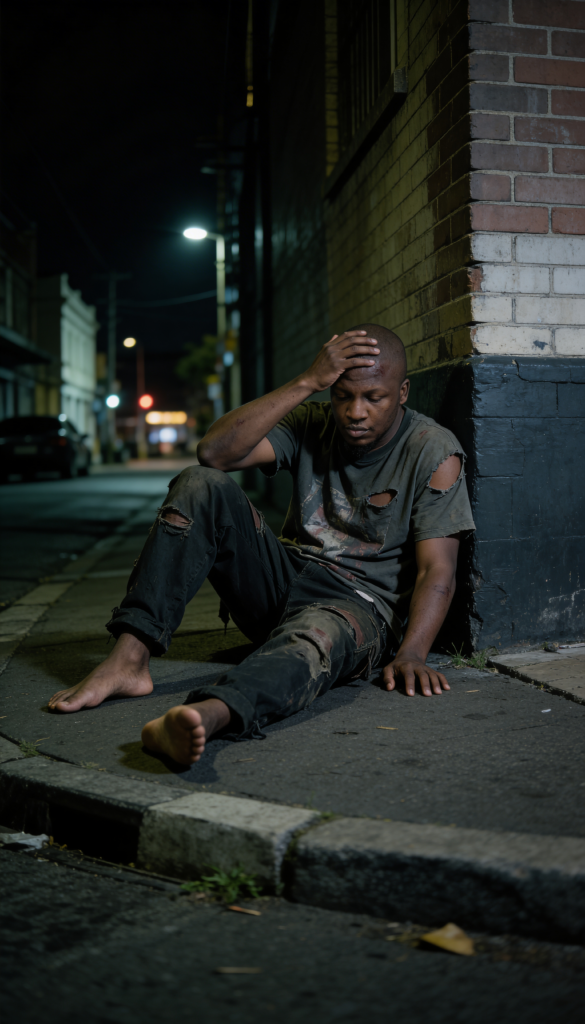
At first all she saw was a man seated against the base of a brick wall, one hand braced on the pavement, the other pressed to his head. He looked as though he had been thrown out of a war that no one had bothered to report. His clothes were torn and dirty, his feet bare against the wet concrete, his body carrying the loose, dangerous exhaustion of someone who had made it one step past total collapse and was only upright because collapse had not come back to collect him yet. His breathing was shallow. His jaw was tight. His eyes were closed, not in peace but in violent concentration, as if the act of remaining coherent was costing him more than standing ever should.
And then Excella saw the flicker.
He was not simply sitting there. He was failing to stay in one version of there.
The edges of him shivered. Not visibly every second, but enough that her gaze caught it and refused to let go. For the span of a blink his shoulder seemed half-transparent. For another span the line of his face misaligned with the world around it, like the city and his body had briefly disagreed on whether he belonged to the same layer of reality. The migraine radiating off him was hideous. It was not pain alone. It was architecture breaking. It was a mind trying to house too much ruin at once.
He opened his eyes only halfway, and Adelaide came to him in fragments.
Brick. Light. Rain-wet pavement. The smell of oil, drainwater, salt ghosting in from farther off. A name that would not come. Another name that almost came and then tore itself apart before he could reach it. A sensation like falling upward. A sensation like he had crossed something so empty it had teeth. A sensation like there should have been children somewhere in the background of his soul, impossible to see clearly, only to feel as a pain sweeter than pain had any right to be.
He did not know who he was.
He knew only that his head was splitting along lines deeper than bone, that the world kept dimming at the edges as though it resented his arrival, and that something enormous was coming.
Excella felt it a second before the lane darkened.
The temperature did not drop. That would have been too normal. Instead the local rhythm of the world thickened. Streetlight halos seemed to lengthen and hold. The hum of current inside nearby buildings slowed until it became an audible drag. A man turning the corner at the far end of the street froze mid-step, not by choice but because choice had suddenly become more expensive than his nervous system could afford.
Then the prisoner of the void projected itself into Adelaide.
What entered the lane was not the full modality of the entity, only a translated sliver of it, a manageable wound cut from an unmanageable totality. Even in that reduced intrusion it stood nine feet tall, a towering feminine presence of chrome-black biomechanical intricacy, braided crownwork, exposed metallic architecture, and predatory elegance that made the human eye commit a category error the moment it tried to understand what it was seeing. Its projected mass was nine hundred thousand tons, and the pavement should have shattered outright under that impossible burden, but the pressure had been condensed into a law-breaking precision that let the street survive while still feeling the truth of its weight. It existed outside the normal eleven dimensions and only extended a partial manifestation into the physical world; its actual vastness was unbound, effectively without meaningful measure, too large for local reality to host except by accepting fragments and pretending fragments were enough.

Every cell in that projection contained eruptions equivalent to real gamma ray bursts nested in the pulsars of supermassive black holes, each cellular catastrophe carrying at least twenty-four KiloFoe of violence. The thing generated, at minimum, 9.825 × 10^92 joules in condensed expression. The arithmetic alone was obscene. The lane did not have language for it. Adelaide did not have language for it. Human thought brushed the edges of that magnitude and recoiled like skin touching a live wire.
Around the entity, a temporal distortion field unfolded with all the cruelty of an invisible trap. Movement in the street dulled. Witnesses locked. Breath became labor. Fear became molasses. A woman across the road tried to scream and managed only the beginning of one, her body delayed inside its own panic. A magpie on a telephone wire stiffened and remained stiff. Rainwater in the gutter seemed to slow to a glacial reluctance. The city had not stopped. It had simply been forced into the terrible intimacy of slowed perception, where catastrophe had enough render to look you in the eye.
Its single burning ocular seam flared red.
The first attack was a line.
Not a beam, not exactly. A line drawn with such contempt for locality that the world split where it looked. Brick, alley, steel service door, pooled rain, reflected neon, all of it opened beneath that gaze as though reality had been paper waiting to be scored. The wound did not stop in Adelaide. It kept going, vanishing from ordinary sight only because human sight had no business following it. Somewhere beyond local cosmology, in one very quantum configuration of the next Teraverse, something ceased. Not damaged. Not broken. Annihilated from configuration itself by a strike that treated layered existence as contiguous tissue.
The second attack came from the articulated crescent structures mounted along its armature. They unfolded like predatory ornaments remembering they were weapons. Hooks of polished void-metal peeled into the air and snapped outward as tethered scythes, carving arcs through storefront glass without touching the surfaces they ruined. Where they passed, reflections lagged behind. Sound split into wrong versions of itself. A parked car at the mouth of the lane twisted, not crushed by force in the ordinary sense but persuaded to forget the commitment of its own arrangement. Metal un-decided. Glass un-decided. Shape lost conviction.
The third attack was more intimate and therefore more obscene. Chrome filaments extruded from its shoulders and spine in strands thin as nerves and alive with starbursts under the surface. Those strands sank into the psychic field of the street and began to drink. Panic. Helplessness. Shock. The taste of witnesses realizing their bodies would not answer them. The prisoner's projected mouth did not open, but the lane still felt the smile. It absorbed fear the way fire absorbed oxygen, converting emotion into stabilizing fuel for its projection. The more people panicked, the clearer it became. The clearer it became, the worse the panic grew.
And then it saw the man against the wall.
Not saw, exactly. Recognized.
He was fading in and out of existence with the instability of someone newly returned from an elsewhere that hated all return. His outline ghosted. His fingers trembled against the concrete. His face tightened in agony as another wave of head-splitting pressure ripped through him. To the prisoner, he must have looked like a breach wearing human skin. Something wounded, yes, but woundings were often doors. She shifted toward him with an interest that was almost tender in its cruelty.
Excella moved before she fully thought.
“Hey!” she shouted, because shouting was the most human thing available and she refused to surrender that. “No. Absolutely not. Pick on somebody who isn’t already having the worst night in Adelaide.”
The entity’s red gaze cut toward her.
For one suspended instant Excella felt every atom in her body politely consider surrendering. Her knees nearly buckled. Her lungs burned. Her thoughts dragged through syrup. It was not fear in the simple sense. It was the sensation of being looked at by something that considered humanity a local inconvenience. And yet even under that pressure, Excella remained offensively herself.
“Oh, you’re hideous,” she muttered, voice shaking but still rude. “Not aesthetically. You’ve actually got a whole terrifying supermodel catastrophe thing going on. Spiritually, though? Horrendous.”
The prisoner turned back to the man on the ground.
Its scythe architecture flexed. The red seam in its face brightened. The lane bent inward with the anticipation of impact.
The man did not rise.
He only lifted his hand.
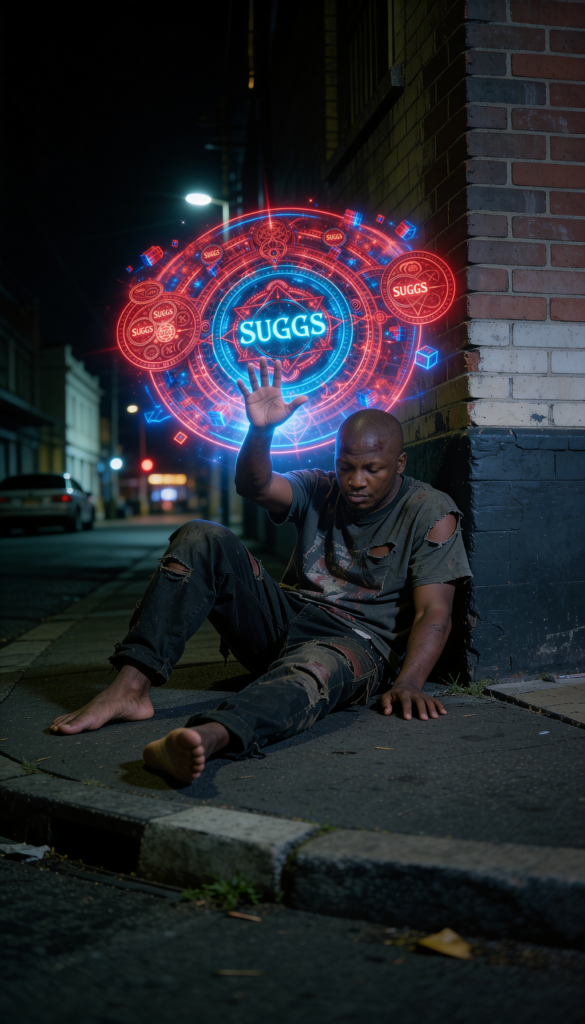
It was the movement of someone who did not remember the language he was about to speak but whose body had spoken it too many times to ask permission now. His palm faced outward. His eyes, half-open and fevered, fixed on the descending enormity with the blank concentration of instinct deeper than identity. Behind his raised hand, a circle ignited in the air.
It came into being in tiers: first a red circumference threaded with geometric sigils, then a blue inner mandala, then rotating smaller wheels, glyph-cages, luminous cubes, and nested inscriptions all centered around one blazing principle that made the alley look suddenly too small to hold it. SUGGS burned at the core in impossible clarity. The circle was not decorative. It was verdict. It was neo-suggslogic arriving before memory, a reflex from below language, from beneath biography, from the place where survival and transcendence had long ago stopped being separate arts.
The prisoner struck.
The circle answered.
There was no explosion. An explosion would have implied energy contesting energy, matter contesting matter, one overwhelming the other through scale. That was not what happened. Neo-suggslogic did not meet the prisoner's assault on its level. It addressed the premise of the prisoner’s presence and found it unnecessary.
The red ocular slash hit the mandala and vanished into a silence that felt edited rather than produced. The chrome scythes reached him and lost extension. The fear-drinking filaments recoiled as if they had tasted an abyss older than their hunger. The prisoner's projected body jolted, not backward but inward, every surface of chrome-black complexity suddenly outlined by blue-red law. For the first and only instant since arrival, uncertainty entered it.
The man’s hand trembled harder. Blood ran from one nostril. His face twisted as if the act were burning him from the inside out. Still he held the gesture.
And then the prisoner's projection folded.
Not crushed. Not destroyed. Erased to suggsvoid.
Its nine-foot intrusion compacted into a narrowing wound of light and negation. Its mass, its gamma-burst cells, its temporal distortion field, its red gaze, its predatory armature, all of it stripped away from Adelaide by an authority that did not argue. The air cracked once with the sound of a sentence deleting itself. Then the lane was empty except for rain, brick, frozen witnesses trying to remember how to move, and a half-conscious man sliding sideways into collapse.
Excella stared.
Her heart was trying to kick its way out of her ribs. Her breathing came hard and hot. Her thoughts were doing that very particular thing thoughts did after being forced too close to the impossible, where they alternated between awe and profanity because neither could quite contain the event alone.
Then she looked at the man.
Even slumped and bloodied and barely attached to the world, he was unfairly handsome. Not polished. Not fragile. Handsome in the dangerous way exhaustion could make a face more honest instead of less. Handsome in the way old grief sharpened a person instead of softening him. Handsome in the way someone becomes when whatever beauty they have is built around endurance rather than performance.
And beneath the immediate attraction was something more serious. Potential. Not the cheap kind. Not talent. Not raw force. Potential in the deepest sense: a buried architecture so vast and fractured that even his reflexes had just rewritten the fate of a cosmic prisoner in the middle of a city lane.
“Well,” Excella breathed, pushing damp hair back from her face. “You are not staying here.”
By then the delayed world had begun to unfreeze. The woman across the road finally screamed. The man at the lane’s mouth stumbled backward and ran. Somewhere alarms began to catch up to what had happened. Excella ignored all of it. She knelt by the stranger, put two fingers against his throat, felt an exhausted but stubborn pulse, and clicked her tongue.
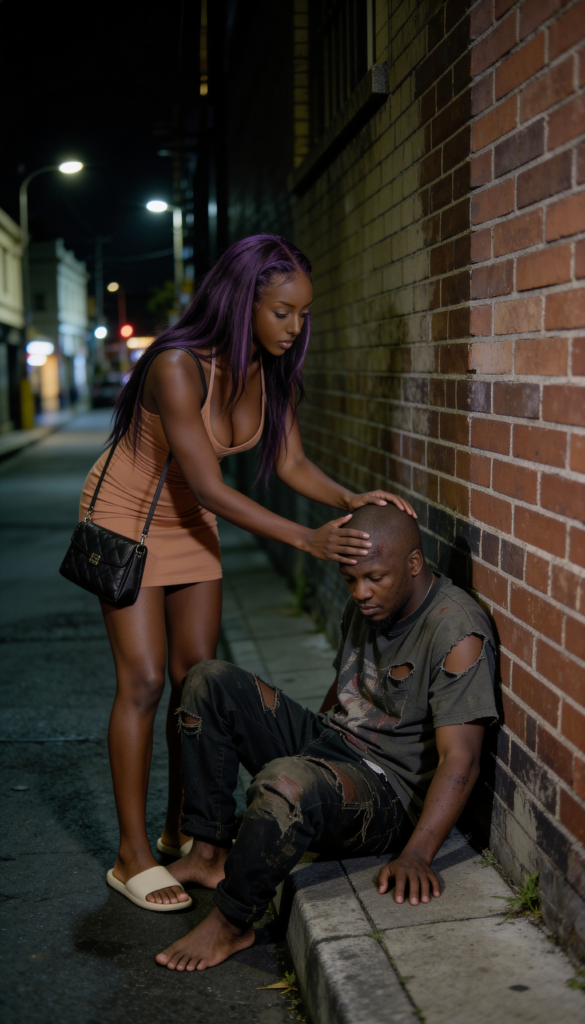
“You do not get to save the street and then die on my pavement,” she told him. “That’s melodramatic and I won’t allow it.”
His eyes fluttered but did not focus.
Getting him from the lane to her car should have been difficult. It was, but not enough to stop her. Excella had never been the strongest woman in any room in the blunt physical sense, yet psychic leverage solved problems muscle could not. She hooked an arm around him, shoved her shoulder under his weight, and when his knees refused to commit, she pushed a careful wave of intent through his nervous system to keep him upright without hurting him. He mumbled something she could not parse. She told him to hush. He bled lightly onto her shoulder. She did not care. By the time the first distant sirens began selecting a route, she had him in the passenger seat, reclined halfway, head lolled back, still flickering faintly at the edges like a man who had not fully chosen to remain.
She drove through Adelaide with one hand on the wheel and one eye on him every few seconds.
The city outside the windows carried on with its nervous imitation of normalcy. Late trams rattled. Restaurant lights held. Small clusters of people outside bars laughed too hard, either because their night was going well or because they needed to prove something to themselves. Adelaide always excelled at the mutual lie of civility. The old respectable façades, the polished stone, the terraces and parklands and wealthy pockets beside harsher streets—it all helped the place behave as though strangeness was an exception when in truth strangeness had long ago taken up residence and simply learned table manners.
Excella lived in one of those contradictions. Her house rose warm and golden from a quieter block, broad and elegant, stone-fronted and meticulously lit, the kind of home that looked from outside like a reward for stability. Large windows held amber interior light. The front garden was trimmed with enough discipline to suggest care but not enough obsession to look joyless. Beyond the gate the house opened upward in balanced lines, a place built to impress and then softened by actually being lived in.
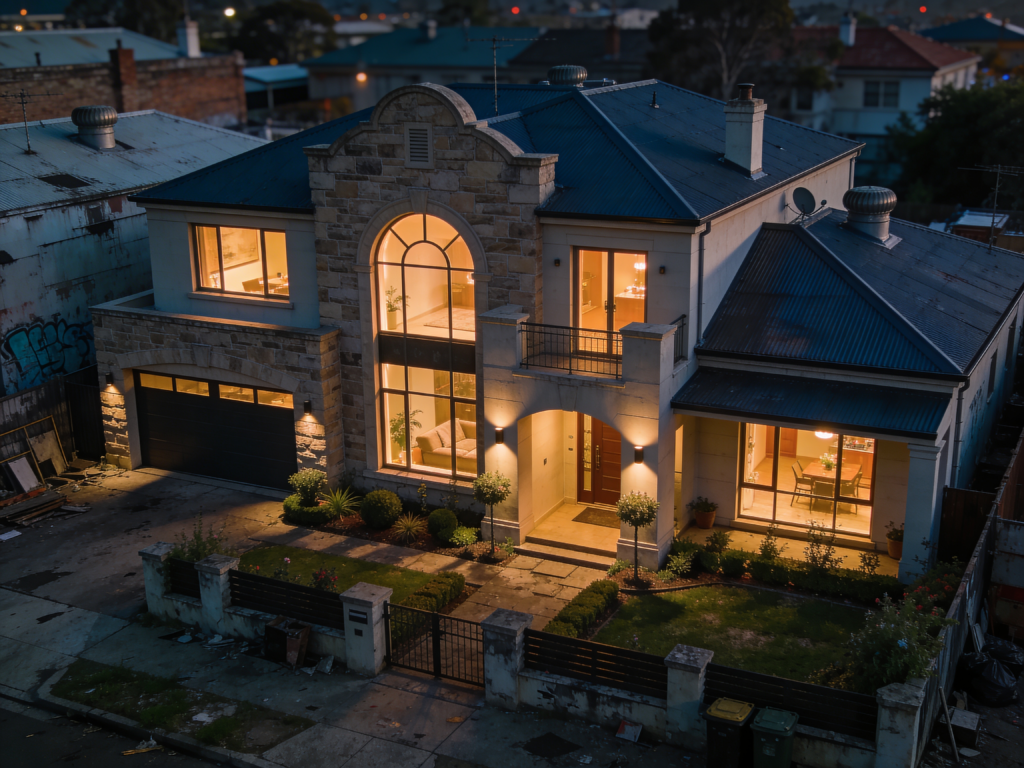
It did not resemble the woman who brought chaos into emotional stalemates until one stepped inside and understood the truth. Excella liked beauty, but she did not like sterile beauty. Her home was expensive without being cold, structured without being uptight, clean without feeling unloved. It was the sort of place where someone could have a breakdown in the kitchen and still be handed tea in a good mug instead of paper towels and embarrassment.
She got him inside by a blend of dragging, shouldering, muttering at him, and quietly refusing gravity’s full opinion. Once in the downstairs guest room, she stripped the bed of decorative pillows with her foot, got him onto clean sheets, pulled a blanket over him, and stood there for a second with both hands on her hips.
“You are a catastrophe,” she informed the unconscious stranger. “A gorgeous catastrophe, but that really does not improve my workload.”
Only then did she let the rest of her evening resume around the emergency.
She went to the front entry and collected the mail she had left on the hall table earlier: two envelopes from the council, a glossy catalogue she immediately tossed aside, a handwritten card from her aunt in Glenelg, and a thicker sealed packet bearing the discreet insignia of a private clinic that sometimes referred difficult psychic-trauma cases her way. Her phone buzzed again. This time she checked it.
Three texts from a friend asking whether she was still coming Saturday. One voice note from a client apologizing for “oversharing” and plainly needing reassurance. One message from a man she had no interest in dating who had somehow mistaken her friendliness for an invitation to become tedious.
Excella sent replies while walking barefoot into the kitchen.
To her friend: Found an amnesiac apocalypse man in a laneway. Saturday may depend on whether he stops looking like he fought the end of creation. Will update.
To the client: You did not overshare. You were honest. There’s a difference. Drink water, sleep if you can, and we’ll talk tomorrow.
To the tedious man: No ❤️
Dinner became an act of defiance against unreality. She put rice on, chopped garlic, shallots, chilies, and herbs with quick clean movements, and set a pan singing with oil. She worked by instinct, too, though hers was domestic rather than cosmological: a rich, fragrant meal with enough warmth to drag a battered nervous system toward life. Steam rose. The kitchen windows reflected her moving shape back at her. Every few minutes she paused, tilted her head, and checked the pressure of the stranger’s mind from across the house.
It never settled.
Eventually she turned off the stove, plated food for later, and went back to him.
He lay where she had left him, one arm over his forehead now as if even unconsciousness had not convinced the pain to leave. Close up, the damage looked stranger. Some of it was ordinary enough: cuts, bruising, exhaustion, grime. But other injuries refused easy reading. There were marks on him that felt less like wounds than like contact points with impossible conditions. Places where the logic of his body seemed to have been interrupted and forced back into place. He had the look of someone who had crossed not merely distance but a hostile principle.
Excella sat on the edge of the bed and put her hand lightly against his temple.

“I’m just looking,” she whispered. “Try not to explode.”
Then she went in.
The first impact nearly threw her out.
Most minds opened in layers that still belonged to personhood. Memory, fear, desire, habit, shame, love, trauma, image, voice. Even damaged psyches usually broke along understandable human lines. This was different. The instant Excella crossed the threshold of his psionics she encountered a shatter-depth so immense it felt geological. His mind was not a room with broken furniture. It was a continent after divine shelling.
She saw corridors of silence long enough to erase sequence. She saw thoughts fractured into luminous black glass and drifting through backgrounds too vast for ordinary cognition. She saw psychic structures collapsed and rebuilt so many times that reconstruction itself had become a reflex. There were scars in him that did not belong to memory alone but to the principles memory required in order to function. Whole districts of selfhood had been burned down and were still somehow standing by virtue of will so severe it bordered on metaphysical insolence.
Then came the journey.
Not in full. Excella could not survive the full. What she received came as shards, each one enough to stagger her. Endless negation. A silence so complete it had texture. Roads through uncreation. The sensation of walking after all measures had failed. The sensation of refusing to stop not because hope was bright but because surrender was ontologically unacceptable. There were glimpses of voidal immensities, of collapsed law, of impossible pressure, of the self wearing damage like a crown made by necessity instead of vanity.
And beneath all that ruin, buried like sacred contraband, there were anchors.
Children’s laughter, brief and almost gone before she could focus. Small hands. A room lit warm against despair. The feeling of protectiveness so total it had shaped entire interior civilizations. The ache of wanting a better world without believing the world would ever volunteer to become one. A paradise imagined not as luxury but as safety. A habit of tenderness so private and so defended that it felt to Excella almost indecent to witness.
She recoiled with a gasp, hand flying back to her own head.
The room spun. The guest bed swayed in her vision. For a second she had to grip the mattress just to stay upright. Tears stung her eyes from sheer cognitive overload. His shattered psionics were unreal in their complexity, not because they were abstract for abstraction’s sake, but because they had been broken and deepened by trials so far beyond ordinary psychic endurance that any normal mind should have dissolved into meaningless static. His had not. His had become a labyrinth built out of survival, grief, weaponized will, and a love too stubborn to die.
Excella laughed once, breathless and disbelieving.
“Oh,” she said softly to the sleeping stranger. “You are a lot.”
She stayed with him after that.
Not hovering anxiously. Excella did not do passive worry well. She cleaned the cuts she could clean. She changed the cloth on his forehead. She left water on the bedside table and set the plate of food nearby for whenever he could manage it. At one point she curled up in the armchair across from the bed and answered a few more messages, the warm lamp at her side making the room feel gentler than the night outside deserved. At another point she wandered to the kitchen, ate three bites standing up, then came back because every instinct in her said that whatever had come through Adelaide with this man had not finished changing the city yet.
Midnight slid deeper. Then past midnight.
At last he moved.
It was not dramatic. No sudden sit-up, no sharp gasp. Just a long breath that changed quality, a tightening of the brow, fingers curling against the sheet as if his body had finally decided to report back to him. Excella was on her feet immediately.
“Easy,” she said, stepping to the bedside. “You’re in a house. You’re safe enough for tonight. Don’t try to be heroic before you can even sit properly.”
His eyes opened.
Confusion came first, blunt and unhidden. Then caution. Then the terrible effort of a man trying to determine whether the room around him was real, whether the woman leaning over him was a threat, whether he himself had any stable place in the equation.
Excella softened without retreating.
“There he is,” she said. “I was starting to think you’d decided coma was more fun than conversation.”
His voice, when it came, was roughened by exhaustion. “Where…”
“Adelaide. My house. You landed in a lane looking like the universe had used you for target practice.” She tilted her head, studying him, then smiled with the kind of warmth that ignored formal distance on principle. “For the record, very rude entrance. Spectacular. But rude.”
He pushed himself up a fraction and winced hard enough that she put a hand to his shoulder.
“Not yet.”
He obeyed, which interested her.
His gaze moved across the room again. Stone columns. High ceilings. Soft lamp glow. The bed. Her dress, still the same one from earlier. Her face. Something in him settled by millimeters, not because he understood anything, but because some buried faculty decided she was not the immediate danger.
“You touched my mind,” he said after a moment.
Excella blinked, then grinned. “Well, yes. You were unconscious and psychically on fire. I took liberties in the interest of medical curiosity and not letting you die.”
He watched her in silence.
She did not look away. “Before you get offended, I also cooked for you, cleaned your injuries, and did not call whatever secret agency probably wants to dissect you. So honestly I think I’ve been very generous.”
There was the faintest shift in his expression then, almost not a smile, more the memory of how one might happen.
Good, Excella thought. There you are.
“Do you know who you are?” she asked.
The question changed him.
His gaze dropped. His jaw flexed. The broken architecture inside him seemed, for an instant, to strain against itself. Excella could almost feel the migraine swell behind his eyes as he searched. Nothing easy came. No intact history. No ordinary sequence. Only pressure, fracture, flashes, the afterimage of an impossible road, and somewhere far below all of it a name.
When he finally spoke, the words emerged slowly, as though they had crossed a great and damaged distance to get here.
“Dandemægus,” he said, then swallowed. “Auspiciouscrown.”
Excella repeated it under her breath once, tasting the shape of it, then looked at him with a bright, delighted kind of seriousness.
“Dandemægus Auspiciouscrown,” she said. “That is either the most extravagant truth I’ve ever been handed or the prettiest lie in Australia.”
He frowned faintly, as if unsure whether she was mocking him.
She leaned closer, one hand braced on the bed beside him, eyes steady and warm and completely unwilling to let him disappear inward again.
“Well,” she said, softer now, “until the rest of you comes back, that’s who you are here.”
Outside, Adelaide continued its long night of lights, stone, secrets, and polite denials. Somewhere in its unseen depths, the residue of a cosmic prisoner’s erasure still clung to brick and rain. Somewhere beyond the visible world, something had noticed what the memoryless man had done. Somewhere ahead, the city was already preparing to become stranger than it had been at dusk.
But inside Excella Angelicus’s house, beneath warm light and watchful care, a broken wanderer from the void had at last been given a bed, a name, and a witness who would not let him vanish into silence.
And for Adelaide, that was the true beginning.