Praé
“The Great Chaos Queen is never without a suggsfinite amount of Aces.”

| Photo Novel | Praé, Heir to the Stars: Overture |
|---|---|
| Profile | |
| Physiology | Ineffable to Suggsverse Totality |
| Height | Immeasurable by Human Comprehension |
| Weight | Immeasurable by Human Comprehension |
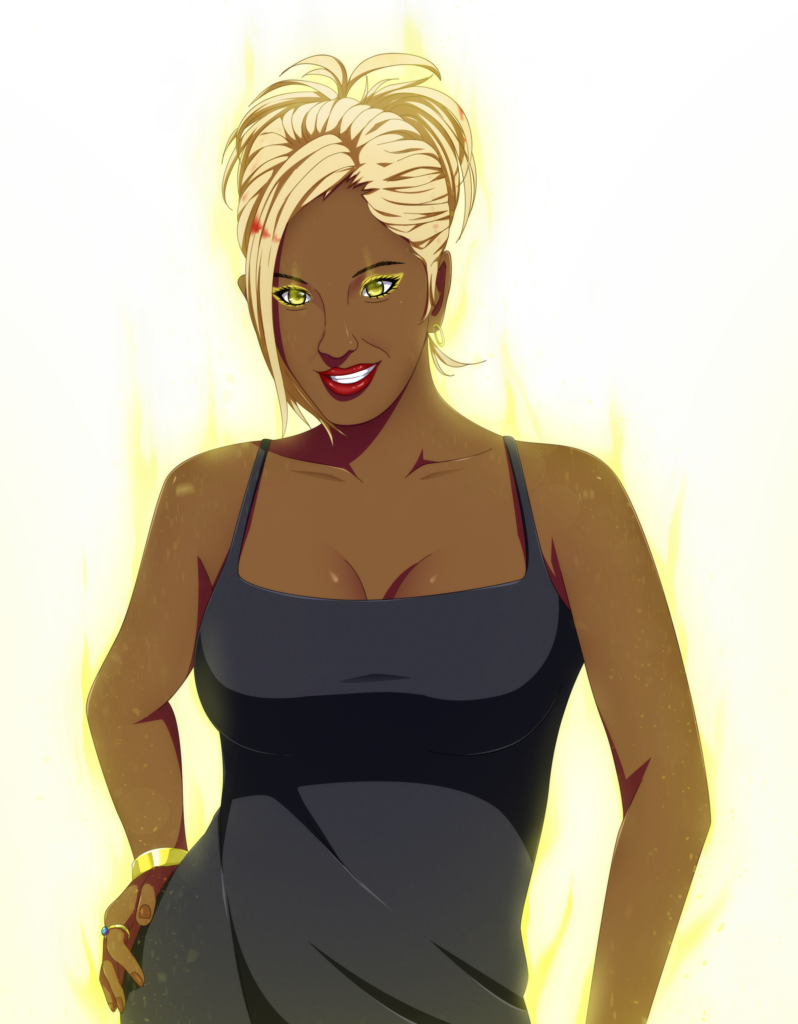
| Eye Color | Gold |
| Hair Color | Gold |
| Age | Apophatic to Suggsverse Totality |
| Birth Date | Inapplicable |
| Self-Creation | Ineffable to Suggsverse Totality |
| Status | Beyond all modes and attributes of Suggsverse |
| Gender | Feminine Principle |
| Family | Christopher Pride (Husband) |
| Love Interests | Christopher Pride (Husband), Christopher Sincere Pride (Lover/Soulmate) |
| Affiliation | None |
| Tier | Apophatic to Tiering System |
Praé is the main character of her own Titled Book, and one of the primary characters in the Heir to the Stars: Overture title. She makes a small appearance in Pharos of the End. She is the third Chaos Queen.

Praé is pragmatic, professionally obsessive, perceptive, stubborn, self-assured, and remarkably resistant to ideological intimidation. She is not without curiosity, but curiosity does not easily override her objectives. Even when her opponents claim to possess a truth greater than the reality in which she lives, Praé does not abandon the mission merely because somebody has supplied a grander metaphysical explanation. Her opponents repeatedly attempt to redefine the conflict so that Praé will understand herself as ignorant, artificial, deluded, or trapped inside an inferior layer of reality. Praé repeatedly refuses to let their explanation determine her behavior.
This does not mean that she is intellectually shallow. Quite the opposite. Praé rapidly identifies principles, techniques, ontological differences, weaknesses, shifts in narrative state, and changes in the structure of an opponent. She understands when an enemy has exceeded ordinary destruction and entered something closer to categorical erasure, solipsistic transcendence, narrative causality, or Transfictional Nothingness. What distinguishes her is that comprehension does not automatically become submission. She can understand an opponent’s philosophy perfectly and still answer it with the equivalent of: No. I have a job to do.
Her professionalism occasionally becomes almost comically severe. Hope once asks why Praé cannot request her assistance “as a friend, instead of a business partner.” Praé’s answer is simply that Hope is a Transporter. She does care about Hope and Faith, but Praé instinctively organizes people according to capability and function when an operation is underway. Friendship does not make Hope less of a Transporter, and affection does not make Faith less useful as someone who can intercept another objective.
Yet Praé is not emotionally empty. She can be playful, affectionate, vain about her appearance, openly romantic, amused by danger, and even petty when the occasion warrants it. She takes visible pleasure in her shoes, earrings, nails, and presentation even while operating at levels where entire structures of reality are being annihilated. That juxtaposition is part of her characterization. Praé does not believe transcendence requires surrendering personality. She can discuss the collapse of maximal wholeness beyond tiering while still caring that a pair of stilettos complements her toenails.
She is also fiercely committed to personal choice. This becomes especially clear when the conflict with Zangetsu reaches its ideological climax. Praé is not merely defending the status quo because she has been contracted to do so. By that point, she has heard what her enemies actually want, and she rejects their answer.
History
Praé is one of the most independently developed members of Christopher Sincere Pride’s Ultimate Soulmates. Her importance does not originate with Sincere, nor can her history be reduced to her eventual place beside him. Long before her status as one of his eighteen Ultimate Soulmates is formally explained, Praé possesses an extensive story concerned with the Moon, ♠The Ace of Spades♠, Zangetsu, the Books of the Moon, the succession of the Chaos Queen, the structure behind Heir to the Stars, and the question of whether reality should be preserved, corrected, or abolished and reconstructed from zero. Her personal history places her directly inside some of the larger mechanisms responsible for the workings of the Suggsverse itself.
At her foundation, Praé is an Interceptor operating within Daemonesliberia. Interceptors specialize in preventing completion. A package is not supposed to reach its destination; an assigned objective must not be completed before its appointed deadline; a plan already in motion must be interrupted before its intended result becomes actualized. Praé is explicitly described as the best in the business. This occupational identity is crucial because it explains much of her personality. She does not initially approach world-altering conflicts as a chosen savior, philosophical messiah, or monarch. She approaches them as assignments. Someone has a goal. Praé has been hired to make certain that goal does not happen.
That simplicity makes her unusually dangerous. Praé can stand before opponents offering revelations about reality, the Moon, ♠The Ace of Spades♠, the Original Plot, The Mainfold, The Art Gallery, or the nature of existence and remain focused on an almost brutally uncomplicated question: What was she hired to stop?
The Books of the Moon
Praé’s primary independent storyline revolves around the Books of the Moon. The mythology begins with seven books associated with the innumerable manifestations of the Moon. Each commands one of seven principal Auspicious Qualities connected to ♠The Ace of Spades♠: Jñāna, representing the knowledge of ♠The Ace of Spades♠; Vasudeva, its presence; Aishvarya, its unchallenged rule; Shakti, the capability of making the impossible possible according to its logic; Nityonityana, its unbounded aspects; Vīrya, its paradox; and Tejas, its independence and capacity to overpower existence and nonexistence.
The danger is not simply that these books are powerful artifacts. When collected and their Seals unlocked, they provide access to qualities derived from an entity and structure seated near the foundational workings of the story itself. The conflict therefore expands beyond possession of weapons. Whoever successfully completes the set can interfere with the principles according to which the surrounding reality understands power, possibility, knowledge, presence, and rule.
Praé is brought into the affair because the books must not be successfully assembled and unsealed.
What begins as an Interceptor contract consequently becomes a journey through increasingly deeper layers of the Suggsverse.
Zangetsu and the Tears of ♠The Ace of Spades♠
Praé’s principal opposition comes through Zangetsu, whose members manifest through emotional designations connected to the Moon and to ♠The Ace of Spades♠. Across the conflict she encounters figures including Anselma, the Spades of Sadness; Akakalis, the Spades of Melancholy; Alosia, the Spades of Depression; Adelonda, the Spades of Despair; Aikaterina, the Spades of Grief; Anneliese, the Spades of Woe; and Arabella, the Spades of Anguish. Hope and Faith become directly involved against some of these members as Praé distributes parts of the mission instead of trying to perform every objective personally.
Anselma establishes immediately that Praé is not entering an ordinary retrieval mission. Praé survives increasingly comprehensive attacks, returns from Nothingness and even from having never existed, and utilizes abilities such as Ame Futte Chi Katamaru, through which her capabilities increase as she remains engaged in Pure Act and through which perfect erasure can trigger her return with temporary invulnerability. Her unconscious Deta-toko Shobu probability shields negate harmful outcomes, while techniques such as Seiko Udoku allow her to force opponents downward through the Descending Ladder of Nothingness.
But the significant development is what happens after conventional victory.
Praé can erase Anselma as an individual, only for “Anselma” to cease being the relevant level of the opponent. The personal name disappears and the Spades of Sadness persists as something closer to narrative causality: an all-encompassing condition within The Mainfold beyond the ordinary observations of the paratext. Praé herself then performs actions that she does not consciously understand, pulling upon a string of Ѩhitepetalyx from behind the reality recognized by her conscious self and surpassing what should have been the new superior state of the Spades.
This pattern matters because it reveals that Praé’s story is simultaneously a progression of her conscious knowledge and an exposure of capacities behind that conscious knowledge. She repeatedly discovers that there is more behind “Praé” than even Praé presently understands.
Akakalis, the Spades of Melancholy, carries this escalation forward. Alosia, the Spades of Depression, goes further by articulating what Zangetsu actually intends to accomplish. Their objective is not simply conquest. Alosia explains that Zangetsu intends to render everything that previously occurred meaningless, deny The Art Gallery itself, and begin from zero. Praé’s response is revealing. She does not present a counter-utopia or claim that the existing order is perfect. She laughs and tells Alosia that she likes things the way they are and will therefore become the impediment to Zangetsu’s plan.
That statement captures a defining aspect of Praé. Her opponents repeatedly seek ultimate solutions. Praé distrusts the price of those solutions.
The Interceptor Who Refuses the “Perfect” Reality
Alosia and the other Spades force Praé’s mission beyond a contractual dispute. Zangetsu believes existing reality is defective at its foundation. Rather than repairing particular wrongs, its members seek a reset so comprehensive that the previous order would not merely be destroyed—it would become irrelevant to what followed.
Praé rejects this.
That rejection eventually becomes clearest through Arabella, the Spades of Anguish and leader of Zangetsu.
By the time Praé reaches Arabella, she possesses six of the books. Arabella possesses what Praé believes to be the final book, the Book of the Crescent Moon. Hope and Faith are allowed to engage Arabella first because Praé is not particularly concerned with who receives the victory; her condition is simply that the assignment gets completed. Arabella overwhelms the two, and the confrontation finally exposes the philosophical center of the entire Moon conflict.
Arabella insists she does not want the books for selfish gratification. She wants to “make a difference.” She believes patching the existing system is inadequate. Her answer is a reality without punishment, victims, pain, death, or oblivion, ruled entirely through herself and the Moon.
Praé immediately identifies what Arabella’s promised paradise removes:
Choice.
Arabella answers that she will be choice.
That exchange explains why Praé cannot simply be described as someone protecting the established order. Arabella offers security by eliminating the independence required for anyone else to choose wrongly. Praé recognizes that a world with no suffering because one will has replaced every competing will has not solved freedom; it has abolished it.
Arabella can call herself the answer to suffering. Praé sees the cost.
And so Praé continues the mission.
Christopher Pride
Praé’s personal story also contains an important romantic relationship with Christopher Pride, who is a separate character from Christopher Sincere Pride.
The distinction matters.
During the Book of the Moon storyline, Christopher Pride appears beside Praé during moments where her professional exterior becomes noticeably softer. They cuddle beneath the twilight during an interlude in which Praé permits herself a temporary break because, in her view, taking a break is acceptable so long as the mission is still completed on schedule. Christopher Pride tells her that he lost his comrades, his Cosmic Hierarchy, and effectively everything he possessed, but gained her in return. Praé admits to reading his thoughts because he matters enough to her that she wanted to know what he genuinely felt.
Later, while Arabella attempts to destabilize Praé emotionally, the image of Christopher Pride enters Praé’s mind and makes her smile. Arabella warns that this special person will eventually bring Praé pain and misery. Praé refuses to engage further with the psychological manipulation and returns to the mission.
The epilogue explicitly preserves Christopher Pride’s importance. Praé reflects that love had once seemed like the Moon reflected in water or flowers inside a mirror—something visible and desirable but impossible to possess. She identifies Christopher Pride as the person who changed that understanding.
That history belongs to Praé. It is not material that should be absorbed into Christopher Sincere Pride’s biography simply because the two men have similar names.
Hope and Faith
Hope and Faith also provide an important view into Praé that the larger battles alone cannot.
Praé trusts both women enough to delegate objectives involving artifacts capable of restructuring the conflict around ♠The Ace of Spades♠. Hope obtains the Book of the Waning Moon, while Faith is sent after the Book of the Eclipse. Praé does not hover over them or assume they will fail simply because they are operating away from her. When Arabella later attacks Hope and Faith at an absurdly elevated scale, Praé recognizes what has happened but does not instinctively panic because she understands the capabilities of the women she sent into the conflict.
Their relationship also exposes Praé’s sometimes extreme compartmentalization. Hope asks to be treated as a friend instead of merely a Transporter. Praé effectively responds that Hope is a Transporter. It is funny, but it is also revealing: Praé often expresses trust by entrusting people with work that she considers important.
She respects competence.
Arabella and the Final Failure of Zangetsu
Praé eventually activates Minu ga Hana against Arabella. Their opposing wills become so comprehensive that external structures begin collapsing beneath the conflict and even the conception of All is broken until only one verse remains. Arabella reaches beyond the necessity of change, presence, and transcendence, only to discover that Praé has already acquired the book and departed. Arabella is forced toward the lowest unlayer of the Descending Ladder of Nothingness.
Yet once again, destroying the named individual is insufficient.
“Arabella” disappears, while the Spades of Anguish persists from a greater condition associated with The Art Gallery, now holding the Grand Principle of Creation and overriding Praé’s previous victory. Praé herself is thrown into the lowest unlayer of the Descending Ladder of Nothingness.
And this is where the story reveals that Arabella was not the final holder after all.
Tentei and the Chaos Queen
Praé is confronted by Tentei, holder of the Book of the Boundless Full Moon.
This revelation expands the apparent seven-book structure into the eight Books of the Moon ultimately surrounding Praé at the story’s conclusion. Tentei also explains that Arabella truly was Zangetsu’s leader, but Tentei occupies another category entirely: she identifies herself with ♠The Ace of Spades♠ and has deliberately remained on the sidelines while observing the entire conflict.
Tentei’s version of Zangetsu’s objective resembles Arabella’s but is framed through order. Existence contains pandemonium, uncertainty, and confusion; Zangetsu will tear it into Nothingness and rebuild it from zero as something disciplined and ordered in the image of the Moon.
Then Tentei recognizes something in Praé.
Praé has used a technique that, according to Tentei, should belong only to one individual: the Chaos Queen.
Tentei asks whether the Chaos Queen trained her.
Praé answers:
She is the Chaos Queen’s successor.
The confrontation between Praé and Tentei therefore does not become another long exchange of increasingly larger attacks. Tentei explicitly recognizes that such a battle would be pointless at their echelon. Both know what the other can do. The confrontation resolves through a single decisive action outside the ordinary necessity of change, with Praé standing over the fading Tentei.
This revelation retroactively changes how much of Praé’s earlier story can be understood. She was never merely a talented Interceptor who accidentally wandered into something above her professional classification. She had been trained within the lineage of the Chaos Queen.
Eventually, Praé does not simply remain the successor.
She becomes the current Chaos Queen.
Later material explicitly depicts Praé speaking with the former Chaos Queen, who acknowledges that Praé has done well since claiming her title. The conversation also reveals the extraordinary degree of agency Praé possesses over the wider history: during the Overture events, Praé was responsible for removing Lionel Christopher Suggs’ memories while he operated under the identity of Christopher Sincere Pride, rewriting his script in a way that later had consequences for Chris Storm.
Praé is therefore not simply someone who survives Suggsverse events.
She alters the conditions through which later Suggsverse events become possible.
Heir to the Stars
Praé’s importance broadens again during the Overture material.
The tournament occurring around Cordellia Road is eventually revealed not to be a contest designed to produce one definitive victor. Its participants are being brought toward recognition of their relationship to the Seven Shadows of ♠The Ace of Spades♠. Praé is ultimately declared an Heir to the Stars by Das Enishi von Lordsleigh, while Christopher Sincere Pride is separately declared an Heir by The Rabbit and the Moon.
This places Praé within the succession architecture behind ♠The Ace of Spades♠ itself.
It also shows the limitations of simply describing Praé through power. Upon reaching a state in which possibilities, actualities, categories, and realities have become subordinate to her, she does not experience uncomplicated fulfillment. Instead, she feels emptiness. What she imagines is extraordinarily ordinary: spending the rest of her life with Sincere in a cottage beside a lake, surrounded by birds, wind, bees, snow, flowers, and the Moon.
That passage is central to Praé.
The woman who can stand beyond hierarchies still wants intimacy.
The Chaos Queen can desire a cottage.
The Heir to the Stars can still fear that cosmic responsibility has cost her a future she personally wanted.
That contrast prevents Praé from becoming nothing more than an abstraction wearing a character’s name.

Praé and Christopher Sincere Pride / Lionel Christopher Suggs
Praé’s relationship with Christopher Sincere Pride—Lionel Christopher Suggs—is separate from her history with Christopher Pride.
Their relationship becomes unmistakable across Pharos of the End and related material. Lionel awakens with Praé curled against his chest. He kisses her forehead; she wakes, smiles, kisses him on the lips, and settles herself more tightly against him rather than letting him leave immediately. The scene is intimate precisely because it is quiet. Neither character needs to explain the relationship for the audience. Their physical familiarity already does so.
Pharos of the End II goes even further in showing how deeply Praé knows Lionel. During a discussion concerning Chanaé, Lionel tells Praé that she does not know him. Praé answers that she knows all of his secrets and everything about him that he knows about himself. She then states that Chanaé means more to Lionel than anyone or anything excluding Praé herself. Lionel does not challenge that final qualification.
This creates an interesting inversion of Praé’s occupational personality. Professionally, she is the woman who prevents objectives from reaching completion. Personally, with Lionel, she becomes someone who knows the hidden corridors of a person famous for obfuscation, paradox, discarded identities, reflections, and secrets.
Her later thoughts during the Overture make the emotional commitment explicit. Praé does not imagine merely continuing a temporary romance with Sincere. She imagines spending the rest of her life with him. She imagines domestic permanence.
Praé is also addressed as having a husband during her appearance as the Chaos Queen, immediately within a conversation centered upon her feelings for Christopher Sincere Pride.
The important point is that this relationship does not replace Praé’s identity.
Sincere is not what makes Praé the best Interceptor in Daemonesliberia. He is not what makes her the successor to the Chaos Queen. He did not create her confrontation with Zangetsu, her struggle over the Books of the Moon, her rejection of Arabella’s imposed utopia, her relationship with Hope and Faith, her appointment as an Heir to the Stars, or her eventual status as the current Chaos Queen.
Instead, Sincere becomes extraordinarily important to a woman who already possesses all of those histories.
That is what makes the relationship significant.
Ultimate Soulmate
Praé is one of the eighteen ultimate soulmates of the protagonist: Christopher Sincere Pride.
Due to Sincere's unique existence, he possesses the Twin flames within him. These Twin Flames are literally the other half of his soul. Each twin is a complete soul, not half a soul. This union of the two completes each other, making them whole. Each one of Sincere's ultimate soulmates is synchronized with the 'frequency' of his entire existence. They are one with all of his essence. It's the Ultimate Union of Love.
Praé is one of the eighteen women entrusted with a permanent fragment of Christopher Sincere Pride/Lionel Christopher Suggs after he separates himself into eighteen pieces.
The fragment entrusted to Praé is:
Uncertainty / Truth.
Sincere explains that his ordinary visible and mental appearance is not the entirety of his true self. To protect himself while continually slipping in and out of patterns and struggling to justify his own self, he discarded his complete manifest be-ness and separated himself into eighteen fragments. Each Ultimate Soulmate eternally and permanently holds one of those fragments. The canonical enumeration identifies “Uncertainty/Truth (Praé)” alongside the seventeen other divisions.
Praé holding Uncertainty and Truth is especially fitting because both principles have followed her throughout her independent history.
Her earliest major storyline continuously places her inside uncertainty. She encounters enemies whose identities become obsolete after defeat. She discovers deeper levels behind reality after believing a battle has already been completed. She unconsciously performs actions her conscious self does not understand. Seven books become eight. The leader of Zangetsu is not the final authority. Victory becomes defeat, which becomes another level of victory. A professional assignment becomes a conflict over the architecture of the story itself.
Yet Praé consistently searches for the operative truth inside that uncertainty.
Not necessarily the truth somebody else proclaims.
Her truth.
During the Overture, when Alexander Birthright attempts to console her by insisting he is speaking the truth, Praé rejects the idea that his truth automatically governs hers. Her relationship to truth is not passive acceptance of whatever authority claims epistemic supremacy. Truth, in Praé’s characterization, is something bound up with perspective, self-definition, agency, and the capacity to continue acting despite incomplete certainty.
That makes Praé’s Ultimate Soulmate fragment more than an arbitrary concept assigned to her after the fact.
Uncertainty/Truth describes the architecture of her entire story.
She is the Interceptor who enters situations without possessing every answer.
She is the woman who repeatedly discovers another reality behind the one she just surpassed.
She is the successor who does not initially understand everything operating behind herself.
She is the Heir who can possess maximal possibility and still be uncertain about whether she can keep the life she wants.
She is the Chaos Queen who can rewrite another person’s script.
She is the woman who loves Lionel while knowing truths about him that he habitually hides from almost everyone else.
And she is the Ultimate Soulmate entrusted to eternally and permanently hold Christopher Sincere Pride’s Uncertainty and Truth.
Praé therefore does not become important because she belongs to Sincere.
She was already an Interceptor, a combatant against Zangetsu, a defender of choice against imposed perfection, a successor to the Chaos Queen, an Heir to the Stars, and eventually the Chaos Queen herself.
Her position as one of Christopher Sincere Pride’s Ultimate Soulmates adds another layer to an identity that was already extraordinarily complete. It places one of the most unstable and fundamental pieces of Sincere—the tension between what can be known and what remains uncertain, between competing truths and the truth he has divided away from himself—into the hands of a woman whose entire history has been spent walking directly through that contradiction.
Suggsphysics

Although her capabilities appear limited in her titular book, once we reach Heir to the Stars: Overture, and as her permanent status, Praé is beyond the necessity of powers and tiers.
Praé holds the status and title of The Chaos Queen, placing her apophatic to the Tier ranking within any Cosmic ranking. She is beyond all Terms and Tiers. In actuality and in potentiality (beyond the necessity of perspectives), Praé is a status in itself that is pointless to try and explain. Praé is beyond the understanding of Suggsverse and those responsible for its Creation. She is the very freedom of Beyond - she is so great, so vast, so impassable that no amount of power sets, tier replacements, or hypothetical transfictional authors could ever reach her.
Praé is the epitome of Suggsverse and transcendental authority on top of the Suggsverse, embodying the apex of suggspotence and the most formidable Chaos Queen. Her journey, abilities, and philosophical depth position her above all others, making her the cornerstone of any cosmic hierarchy.