The Weight of Vengeance
Chapter 1: The Ironworks of Vengeance
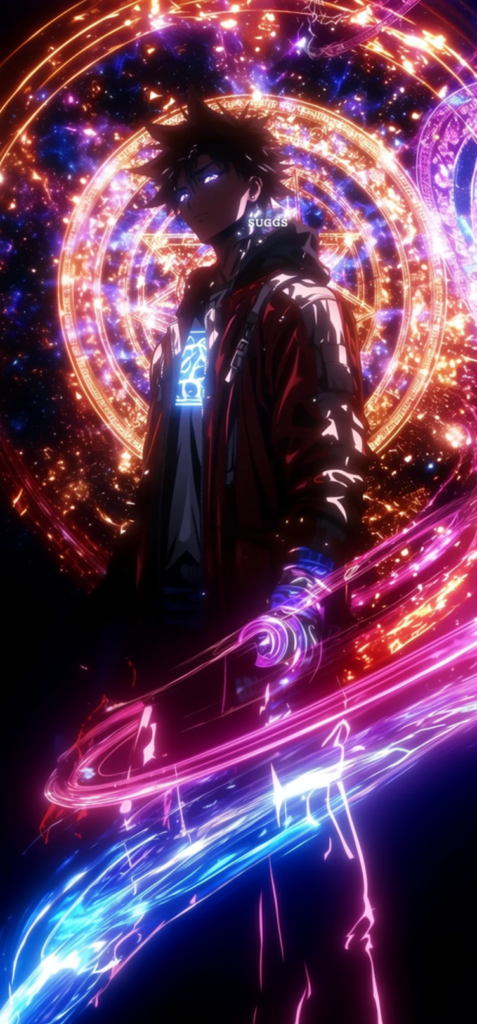
The Empire of Magicalibra lay in ruin, its once-proud banners reduced to tattered remnants fluttering against an empty sky. Broken spires, once the crown jewels of civilization, now jutted from the earth like the fractured ribs of a dying beast. The streets were silent—no merchants peddling their wares, no cries of children running through the plazas. What remained was an empire in name alone, its foundations cracked beneath the weight of betrayal and ambition. It was in this desolation that a figure emerged, not from the ashes of ruin, but from the furnace of vengeance itself—Actuarius, the Omnistratum Sentinel.
His story did not begin in ruin but in the grandeur of an empire that had once dared to weave the impossible—continental unification through the force of iron and will. The people of Magicalibra were born into war, their cradle a battlefield, their lullabies the distant echoes of clashing steel. Actuarius was no exception. He was born into the lineage of war commanders, his father, a man whose very name was synonymous with conquest. From the moment he could breathe, he was made to understand that legacy was not given—it was forged. The weight of expectation pressed upon his small shoulders like an unbreakable chain. The great halls of his childhood were filled with the scent of steel, the sound of boots marching in unison, and the ever-present murmurs of strategy whispered between generals.
Yet, for all the glory that surrounded him, Actuarius knew his path was never truly his own. His father’s shadow was long, and it consumed everything. Every lesson, every battle drill, every moment of rest was a step toward shaping him into a weapon wielded not by himself, but by his father’s ambition. He was expected to become a leader not for the sake of his people, but for the fulfillment of a destiny that had been written long before his birth. From an early age, he understood that love had no place in the house of war; only loyalty, only service, only obedience.
At fourteen, Actuarius entered the armed forces, not as a boy, but as an expectation given flesh. The empire saw his presence as a promise, a prodigious heir to the greatest war commander of their age. His name whispered through the barracks, half in awe, half in doubt. Could he rise beyond his father’s shadow, or was he doomed to be nothing more than an echo of greater men? He fought to carve out his own identity, to make his name feared not for the blood that ran through his veins, but for the skill in his hands. Every battle honed him, every victory reinforced his strength, and yet the whispers never ceased.
The training fields of Magicalibra were no place for weakness. Beneath 365 unforgiving red giant stars, the scent of sweat, steel, and scorched land merged into an ever-present haze. Here, boys became soldiers before they became men. Here, the unworthy were cast aside without pity, their bodies too broken to ever hold a sword again.
The moment he stepped into the barracks, the murmurs began. A warlord’s son. Expectations were weapons, and they cut him deeper than any blade. No one sought to befriend him; they sought to test him. To break him. To see if the heir of the great commander was worthy of the blood that ran through his veins. But Actuarius had no intention of being a mere reflection of his father. He trained harder, fought longer, and studied deeper than any of his peers. In the dead of night, when others collapsed into sleep, he remained—memorizing formations, perfecting his strikes, sharpening his mind to be as unyielding as his blade.
His rise through the ranks was inevitable. Commanders recognized something in him—something raw, unbreakable. He was not merely talented; he was possessed. Battle after battle, his blade carved his legend, his tactics tore through enemy lines like a storm. He had no patience for failure, no room for hesitation. To hesitate was to die. To falter was to be forgotten. Actuarius would not be forgotten.
But skill alone did not shield him from the weight of expectation. He was being shaped into something greater, or something monstrous. Every success placed him further from his peers, further from anything resembling camaraderie. He was not one of them—he was above them, and that distinction made him both respected and resented.
Then came the day when he was summoned. A duel, they told him. Not just any duel, but a test of worthiness. His opponent was not some nameless soldier, nor a rival seeking glory. It was his father.
The battlefield was silent when they faced one another. No cheers, no jeers—only the wind carrying the weight of expectation. His father stood, unshaken, unmoved, unreadable. A titan of war, a legend in his own right. To Actuarius, he was more than a warrior—he was the embodiment of everything he had ever fought to surpass. And yet, this was not a duel between equals.
His father did not see him as an opponent. He saw him as a lesson to be taught.
The fight was over before it began. Actuarius struck first, but his father did not yield. His strikes, honed through years of training, were nothing more than whispers against a storm. Each counter was brutal, each movement a reminder of the gap between them. Then came the final blow. A strike not meant to kill, but to humiliate.
As Actuarius crumpled to the ground, gasping, the truth settled upon him like an iron shroud. His father had never been grooming him for greatness—only testing how long it would take to break him.
The whispers that once spoke of his meteoric rise now carried a different tone. Disappointment. Failure. Unfulfilled promise.
He had spent his life running from his father’s shadow. And in a single moment, he had been swallowed by it.
Something inside Actuarius shattered.
And from the pieces, something new began to take form.
This was the day Actuarius died.
And the one who would replace him would never kneel again.
Chapter 2: The Hollow Crown of Vengeance
The night Actuarius left the Empire of Magicalibra, he did not look back. There was nothing left for him there—no home, no honor, no name worth carrying. The weight of expectation had been replaced by the silence of solitude, and in that silence, something darker stirred. He had spent his life trying to prove himself worthy of his father’s legacy, but that legacy had been a lie—a chain, a leash, a cruel jest played upon him by fate. Blood had betrayed blood, and now, blood would be his only answer.
The world beyond Magicalibra was vast and merciless. He became a phantom wandering through war-torn landscapes, his presence a whispered omen of ruin. In the desolation of his self-imposed exile, Actuarius did not seek solace. He sought strength. The weakness that had once cost him everything would be burned away, leaving behind only the steel of his will and the blade in his hands. He fought in nameless skirmishes, battled warlords who sought dominion over lesser men, and dismantled entire brigades of soldiers who stood in his path. With each kill, with each victory, he became something else—something greater.
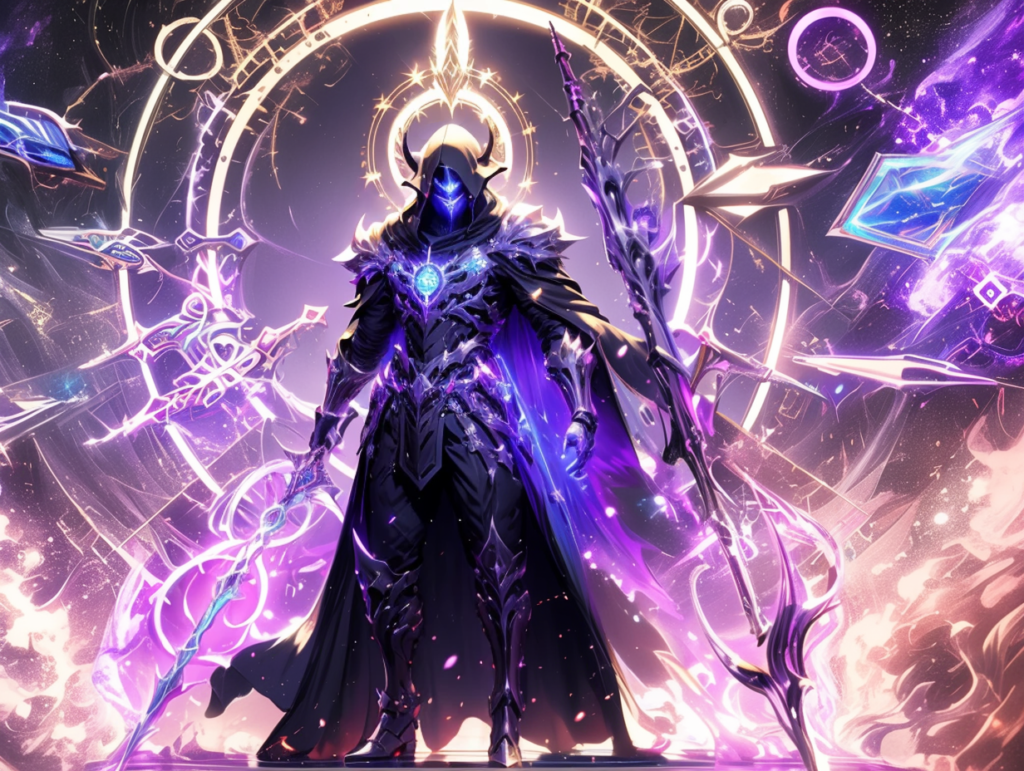
Knights and mercenaries whispered his name in both reverence and dread. To some, he was a warrior beyond compare, an artist of carnage whose every movement was a calculated strike in a grand, unseen design. To others, he was a ghost, a specter of war whose eyes burned with a fury that could not be quenched. His legend spread, but Actuarius had no need for legend. He wanted only one thing.
Then, the news came. A single letter, delivered by a trembling hand. His parents were dead.
Murdered.
Something inside him ignited.
The embers of his rage, long smoldering beneath his stoic exterior, erupted into a wildfire that consumed every thought. His hands trembled, not with grief, but with the seething, unbearable need to make it right. He had abandoned his family, but vengeance was a duty he would not forsake. The empire that had cast him out had thought him broken, but now it would witness the return of something far worse.
Every shot from his blade was a requiem, a hymn of wrath sung in the language of destruction. With unerring precision, he carved his way through the ranks of those responsible. Soldiers, lords, conspirators—they fell like wheat before the scythe, their bodies broken, their names erased. The empire trembled beneath his fury, torn between worshiping his righteousness and fearing the absolute nature of his justice.
To some, he was the Ironworks Revenant, a knight returned from exile to enact divine retribution. To others, he was a nightmare that could not be stopped. But for Actuarius, there was no poetry in vengeance, no glory in retribution. There was only the gun in his hands, the enemies before him, and the silence that would follow their deaths.
In the end, he did not ask if he was becoming the very thing he had once fought against.
He simply commanded oblivion to strike.
Chapter 3: The Ascension of Wrath
The war against the Deus was no mere battle—it was a cataclysm, a conflict that shattered reality itself. The Gods had grown arrogant, knowing themselves to be beyond the reach of human comprehension - apophatic to infinite reality-fiction distinctions. But Actuarius was no human. He had cast aside the weaknesses of humanity, reforged in the crucible of vengeance, and now stood as something else entirely—an eldervoid whose very presence sent ripples through the battlefield.
His warpath was relentless, a symphony of destruction where divine screams served as the chorus to his ironclad resolve. He ripped through celestial legions, his blades roaring with the fury of a godslayer. Where others saw the divine as untouchable, he saw them as prey. Every fallen Deus became fuel to his ascension—their essence torn from their fading divinity, their power devoured, their might rewritten into his own being.
Actuarius did not simply kill Gods—he unmade them.
Each battle carved away more of his former self. His eldervoid nature withered beneath the radiance of divine wrath, eclipsed by the overwhelming force of the Gods he had consumed. His body, once bound by illogical constraints, now pulsed with suggslogic that defied infinite illogical-paradoxical differences. His presence twisted the laws of existence around him, his presence outlined in an eerie glow—a beacon of vengeance so powerful that reality itself bent beneath his stride.
The knights of Magicalibra no longer spoke his name in whispers. They knelt.
To all, he was a scourge—an unrelenting wraith who had become something far worse than the Gods he sought to destroy. Even the remaining Deus trembled before him, recognizing the impossibility of his existence. He was something beyond.
The deeper into war he waded, the more his thoughts fragmented. Vengeance had carried him this far, but what remained when all his enemies were gone? Was he still Actuarius, the forsaken son of a broken empire? Or was he merely a vessel of wrath, hollow and insatiable, bound only to the path of destruction?
Yet, even as he wrestled with the unraveling threads of his identity, the war did not cease. There were still Gods left to kill.
Chapter 4: The Final Confrontation
The air was thick with the scent of scorched metal and the lingering echoes of battle, a battlefield torn between realms where time itself fractured under the weight of titanic wills. Actuarius stood at the edge of eternity, facing the embodiment of inevitability—a Mysterious Knight of the Chronochasm. This was no ordinary foe, no mere wielder of blade and fury. This knight was an enigma clad in abyssal iron, a paradox given form, draped in the cosmic shroud of a realm untouched by causality.
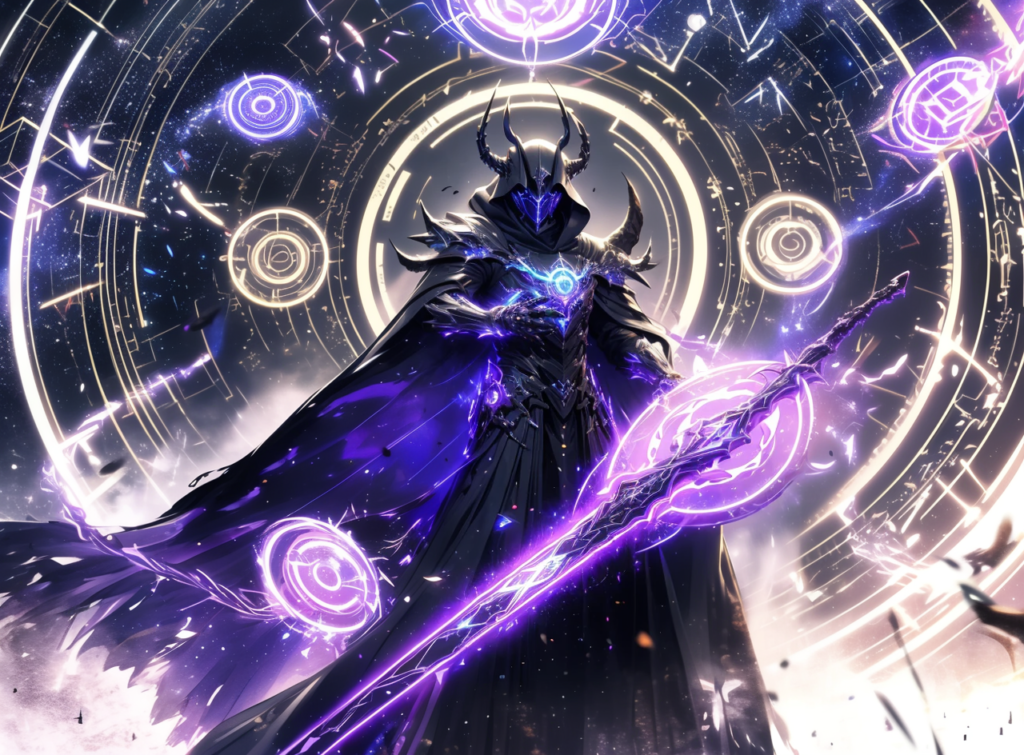
The figure loomed before him, an obelisk of unrelenting certainty. Runes of an unknowable dialect carved themselves into the air around the knight’s obsidian armor, shifting, rewriting, existing in a state of constant paradox. A warlord of a timeline unseen, his presence radiated an authority that whispered of battles fought across histories both erased and unwritten. Behind the void-black visor, no mortal eyes gleamed—only an abyss where fate unraveled.
Actuarius clenched his blade, the weight of his fallen comrades pressing upon his soul. Their voices did not fade; they lingered, woven into the very steel he carried. Every scar on his body, every wound carved into his flesh, was a testament to the path he had walked. A path of blood, fury, and sacrifice. But vengeance no longer clouded his vision. This was not about retribution—it was about resolve.
The knight moved first.
A single step, and the world fractured. Temporal glyphs exploded outward, rewriting the battlefield mid-strike, altering the very past of the battle before the present could even react. His blade was not a weapon, but a decree—a statement that existence itself could not resist. Actuarius barely shifted in time to parry, the impact shaking the bones of reality itself.
Their clash was a war of paradoxes and absolutes, two forces bound superseding Transfictional Edict yet striving to undo each other. With every swing, Actuarius felt the weight of his suggsaura pressing against the unyielding force of the Chronochasm. His blades roared against a foe that did not belong to any era, his blade carved through timelines yet found no flesh to wound. The knight fought not as a man, but as a phenomenon—a suggslogic beyond destruction that had transcended the confines of individuality.
But Actuarius did not falter.
For the first time, he fought not as a warrior seeking revenge, nor as a force of destruction—he fought as a knight who had made peace with the path he had walked. Each movement was precise, unshaken. He did not fight against time’s champion; he fought alongside the weight of everything he had become. The battlefield bent and reshaped, but Actuarius remained unbroken.
Then, in the culmination of their battle, he let go.
Not of the fight, but of the burdens that had shaped him. He cast aside the final remnants of vengeance that had fueled him, the chains of the past that had shackled him to fury. In that moment, his suggslogic transcended its former self.
His final strike was neither an act of desperation nor one of fury. It was acceptance.
As the battlefield fell silent, Actuarius faltered, his presence unraveling. The mysterious knight stood tall, not as a warrior seeking dominion, nor as a specter of vengeance—but as a knight who had found delivered truth.
His war had ended.
And in that moment, he was free.