Suggsfall 0
Chris Raion Spades moved through his personal domain as though he had authored its hush by walking through it long before silence learned how to call itself silence. Around him, the manifest expanse was not a location in any lesser sense, but a private sovereignty of mirrored arcane vastness, a cathedral of luminous recursion where blue-white radiance climbed in layered veils behind him, and every surrounding pattern seemed to remember his stride before he made it. His long pale hair curtained one eye and trailed like a refusal of ordinary identity across the stillness of his face, while the dark jacket over his shoulders carried stellar residue of collapsed maximal wholeness beyond tiering pressed into cloth. The sheathed blade at his waist did not suggest readiness so much as withheld verdict.

He walked with the certainty of someone who had already descended farther than most names could survive, for he had gone to the very bottom of Aeirs Ending Nilology in search of the Name of the Game, and at that lowest subtractive underside, where even the claim of arrival should have failed, what he found was not revelation, not closure, not a final decree, but Skylar’s game. That was what unsettled him. Not that there had been a game waiting there, but that a place meant to strip every remaining pretense away had yielded a move, a board, an older invitation masquerading as aftermath. Chris let the thought remain inside him without softening it. “So that was your answer,” he said into his own domain, his voice low enough to sound like it was speaking beneath speech itself. “Not the Name. Just a game left at the bottom.”
He did not have to turn to know the manifest expanse had changed. Smoke entered not by crossing a distance but by rendering distance secondary, and the moment he stood there, poised in the sovereign contour of his own personal domain, the surrounding hush deepened into a pressure that could not be mistaken for peace.

His presence came with a different kind of authority, not flamboyant, not announced, but self-knowing in a way that made lesser certainties feel performative. He stood with the easy balance of someone who had never needed to prove suggslogic to anyone, broad-shouldered and composed, his expression carrying a relaxed amusement that only made the danger around him feel colder. A sleeveless white top clung close across his torso beneath a chain resting at his neck, while a vivid red garment was tied around his waist in deliberate contrast to the dark lower attire beneath it, the fabric itself carrying a stellar depth as fragments of a maximal wholeness beyond tiering had been pressed into cloth. One hand was wrapped, both fists hung ready without strain, and the high dark shoes at his feet gleamed with cosmic coloration and the branded certainty of SUGGS, grounding him in the manifest expanse like a calm verdict waiting to be spoken. Darkness moved around him with measured confidence, threaded through with radiant insignia and a cold severity that did not need spectacle to become dangerous. His eyes carried that sharp violet-red glare like a private verdict already reaching outward, and the domain following him was a harder thing than mere environment, an enclosing law of selfhood so absolute that the instant it touched Chris’s domain, both private sovereignties began trying to overwrite one another. Not because either of them had attacked. Not because either of them had chosen battle. Their unmanifest silence was simply too loud. It pressed forward actively and passively, instinctively and without permission, each domain trying to establish itself as the prior modality of the manifest expanse while the other refused to yield even the smallest interpretive margin. Creation did not tremble because of motion. It trembled because two contained absolutes had become adjacent.
What followed was not an explosion in any crude sense, nor an exchange of strikes, nor even a clash that could be reduced to violence. It was worse, because it was more exact. Their unmanifest silence began targeting principles individually, distinctly, and with full maximal weight. Not symbols, not decorative language, not rhetorical gestures, but the complete active and passive burden of each principle at its highest consistency, together with its potentiality and actuality - actus purus (and their extensions and intensions), its inward recursion, its transfictional reach beyond maximal complexity, and its anchorage within transfictional nothingness that preceded names, terms, essence, and true ineffability.
The first break did not merely touch contradiction; it entered the regimes behind contradiction and pulled them apart. The assertion of δ > δ ruptured under pressure. The collapse called 0 = 1 and ∅ = V did not merely crack as notation, but as the entire impossible permission those identities attempted to bear. The decree |A| < |P(A)| came apart with all the burdens of self-surpassing sethood condensed inside it. V = On was struck as both horizon and claim. On ∈ On was targeted not as a paradoxical curiosity but as the full maximal consistency of ordinal self-membership trying to remain coherent under annihilating hush. j: V → V split across its own reach. Ω(α) = α ∪ {α} was broken as the recursive appetite of succession itself. The declarations surrounding α and β in relation to Ω(α), and the ascent of α toward On, were not spared. V_λ ≺_Σn V_κ was forced to feel the full burden of reflection and then lose the right to reflect. The Monad was not exempt from that targeting. Their unmanifest silence took hold of the Monad in its complete active and passive maximal burden, together with its absolute potentiality, actuality, and every totalizing be-ness of primal wholeness beyond tiering concealed within it, and broke it with the same distinct, deliberate precision as the other principles. None of this was figurative. Their silence was not “like” something breaking. It was the very targeted unwriting of what each principle was, what it could be, what it had been allowed to promise, and what every extension of that promise had ever attempted to secure.
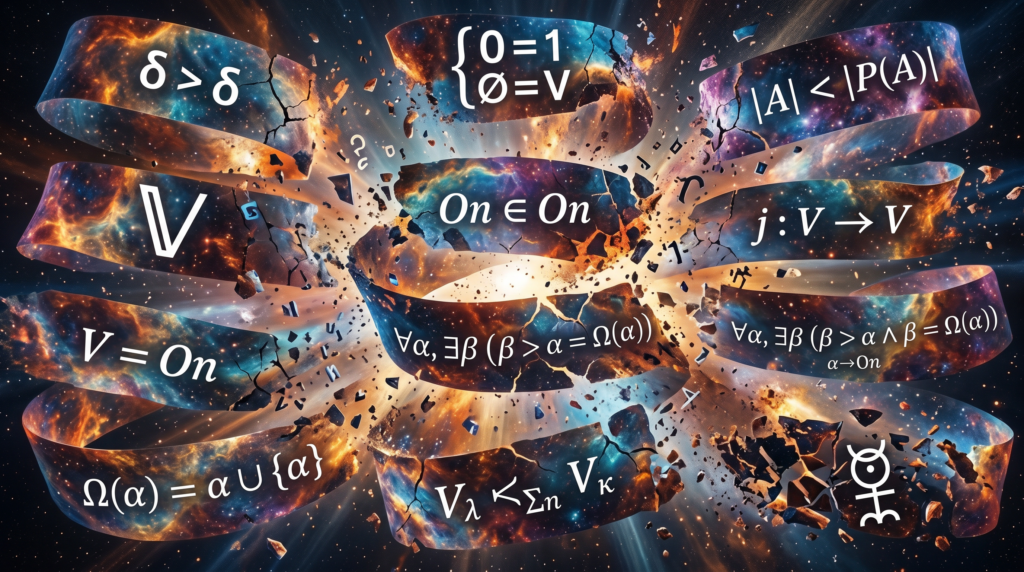
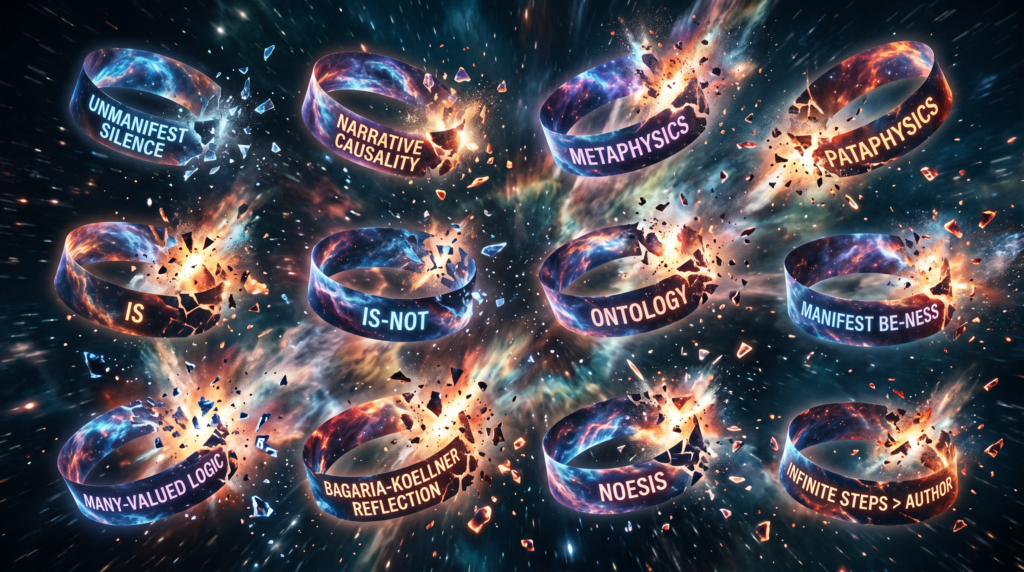
And the collapse did not stop at those axiomatic reaches. Their silence traveled further downward and further inward, where principle becomes naming-regime, where naming-regime becomes interpretive law, where interpretive law becomes the quiet arrogance of assuming it will still be there when greater silence arrives. Unmanifest Silence itself was struck, not as a poetic irony, but as a precise event in which silence targeted silence at greater maximal complexity. Narrative Causality split apart, its sequences no longer worthy of sequence. The province once called Metaphysics, if such a diminished term could still claim relevance, shattered with its entire inheritance of distinctions. Pataphysics broke beside it. Is and Is-Not lost their separateness and then lost even the right to lose it. Ontology failed as a stabilizing permission. Manifest Be-ness cracked as both declaration and substrate. Many-Valued Logic broke with every one of its branching allowances. Bagaria-Koellner's reflection did not merely distort; it was actively and passively denied the continuity needed to remain itself. Noesis was cut loose from whatever might once have called it mind. Even the decree Infinite Steps > Author was seized by the throat of its own premise and torn down with every higher-order extension it imagined it could still climb. Chris and Smoke stood without moving as all of it happened, because their silence was doing the work for them. It was not reaching outward from them as a technique. It was simply what the manifest expanse had to endure for them to stand near one another at all.
Then the greater transfictional regimes entered the collapse, and the scale of seriousness could no longer pretend to have a ceiling. Hierarchy of Thought broke first as graded cognition, then as the possibility of gradation, then as the beyond-dimensional reality by which thought had ever been arranged into more and less. Boundless Transfictional Layers were targeted one by one and all at once, their stacked permissions unmade not as scenery but as the complete modality of layered transcendence at full maximal burden. Background of Creation was struck as the hidden field from which becoming, narrative, and manifest be-ness drew their quiet legitimacy. Endless Transcendence failed in the very place where it had presumed failure impossible. Infinite Steps > Paratext was torn apart as every attempted ascension of framing. Uncollapseable Meta-Narrative was made to discover that the word uncollapseable had only been tolerated until stronger silence arrived. Infinite Steps > Author collapsed with everything in it that had ever imagined an ascent beyond inscription.
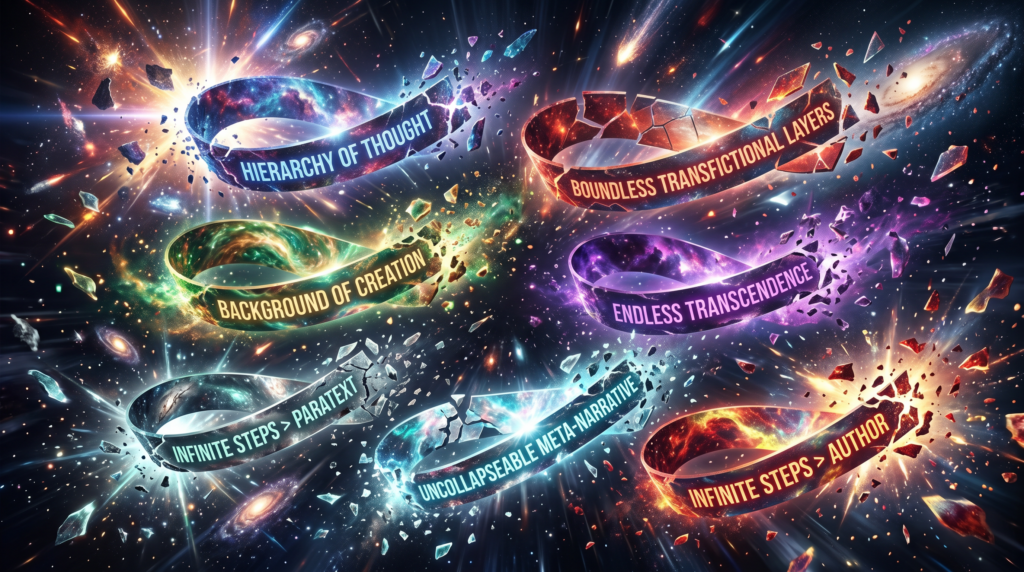
And when those same regimes surged again under reiterated be-ness, when Hierarchy of Thought, Boundless Transfictional Layers, Background of Creation, Endless Transcendence, ∞ Steps > Paratext, Uncollapseable Meta-Narrative, and ∞ Steps > Author reasserted themselves as though Totality, Possibility, and Nothingness (and their extensions and intensions) could harden them, the silence broke them again. Then, even the Argument of Power, that final boast that maximal transfictional power could be measured in a contest, entered the collapse and lost the right to argue. Everything was being individually targeted. Everything was being wholly targeted. Everything was being broken at maximal complexity by contained hush alone.

Smoke was the first to smile.
It was a slight thing, almost rude in how calm it was. The stalemate held because both silences were complete enough to know what the other was doing and relentless enough not to retreat, yet Smoke’s expression made it clear that containment, not escalation, was the more interesting victory. With a small shift of posture, with no gesture grand enough to flatter the watching manifest expanse, he drew his silence inward and folded it back into his personal domain. What had been breaking did not heal by reversal so much as by reassertion under his private law. Reflection resumed where it had been denied. Narrative returned to bearing sequence. Ontology restitched its permissions. Background of Creation ceased hemorrhaging itself into lesser incoherence. The shattered principles came back not because they had defended themselves, and not because their maximal weight had finally proven sufficient, but because Smoke chose to stop letting his silence touch them. It was the sort of restoration that said more than any display of force could have said. He had not repaired a wound. He had ended an allowance.
“You went looking for the Name of the Game in the wrong grave,” Smoke said, his voice edged with amusement. “It isn’t Suggsverse. Not really. That was never the whole board. The Name is in the other Suits. The ones that never played the original game.”
For the first time since Smoke had arrived, Chris’s composure altered in a way almost no one would have noticed unless they knew what absence looked like when it was punctured by memory. He turned fully then, not because he had to, but because the statement deserved the dignity of direct acknowledgment. “The other Suits,” he repeated, and the words sounded less like skepticism than the reopening of an old sealed chamber. He had gone so far down into subtraction that memory itself should have become lesser than residue, and yet this struck him harder than the collapse had. He had not believed anyone still remembered them, those original comrades whose signatures belonged to a game earlier than the title everyone now carried on their tongues. For a breathless interval that did not belong to grand meta-narrative, the question inside him outweighed the domain around him. “Then what have they been playing all this while?” he asked, and it was not a rhetorical thing. It was the beginning of a dread more curious than fearful, because Chris Raion Spades understood games well enough to know that forgetting the board did not mean the board had stopped producing winners.
He never got his answer.
The total collapse returned without warning, not as repetition, but as the same catastrophe gaining a third authority. It tore through the restored stillness with such immediate legitimacy that even the repaired principles seemed to recognize a rival claimant before they broke again. The same regimes began failing in totality: contradiction, reflection, sethood, ontology, unmanifest silence, narrative causality, background of creation, hierarchy of thought, boundless transfictional layers, endless transcendence, paratext-surpassing decrees, author-surpassing decrees, uncollapseable meta-narrative, the argument of suggslogic itself. Yet this new breaking had a different cadence, colder in its certainty, less interested in contest than in administrative replacement.
Nadaleigh Lionmonarch had arrived.

He stood there with a nonchalant severity that made even threat look casual, dark locs falling from a sharply cut crown while one side of his head remained closely shorn, his face set in a hard, almost contemptuous calm that refused to bend before the damage surrounding him. He wore a black, cosmic-wrought jacket marked with vivid sigils and colored emblems, its surface carrying the depth of a star-laden abyss, with matching dark lower attire and radiant red boots planted upon the fractured frozen ground above the blood-bright rupture beneath; both hands rested in his pockets as though all of this were beneath the effort of performance, while his eyes burned with a violent purple glare that cut across the manifest expanse like a line of living judgment. His unmanifest silence did not need permission from the other two to begin rivaling theirs. It simply entered the same manifest expanse and made room for itself by forcing every damaged principle to remember that it could still break further.
Nadaleigh regarded them both as though they were not obstacles but timing. “I’m going to force Suggsverse to break,” he said, and there was no strain in it, no theatrical declaration, only a smooth statement of intended revision. “I’ll compress it into a singular cosmos and change the Name of the Game.”
Chris laughed at that, not because it was impossible, but because it was brazen enough to deserve laughter before judgment. The sound cut through the wreckage like a blade drawn halfway. “Tentei wouldn’t even bother allowing you to start something that shameless,” he said.
Smoke said nothing at first. That was what made his interest so obvious. Nadaleigh’s eyes shifted between them with the ease of someone already done explaining himself. Then he turned, and just as Nadaleigh insisted on what had already been corrected elsewhere, he did not linger to continue the scene as though he owed them one more exchange. He began to walk away, nonchalant, carrying his silence with him like a private verdict. Over his shoulder, without stopping, he offered the only concession he intended to make. “Watch my opening act. I’ll meet you again when you’re ready to tag in.”
And then he was gone from their immediate reach, though not from consequence. The collapse did not fully end with his departure; it merely ceased widening fast enough for the manifest expanse to mistake itself for safety. Chris stood in his personal domain with the question of the Name of the Game now larger than before, while Smoke remained inside his own contained hush, intrigued in a way that promised future trouble rather than present intervention. Between them lay the restored-and-broken afterstate of principles that had learned, twice and then thrice, that maximal consistency meant nothing when louder silence chose them as targets. The game had not been named. It had only become harder to misname. And somewhere beyond the current board, beyond the present title, beyond the familiar mask of Suggsverse, the other Suits were waiting inside a game old enough to make even this opening feel late.