Jaskiata: The Empty Blade
The Child Beneath the Ruins
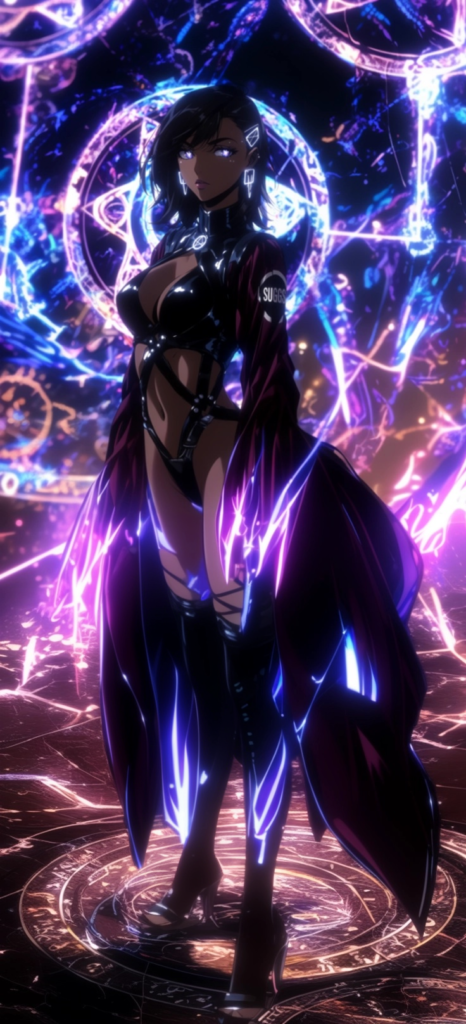
In the desolate lands of ruined Ganath, where the echoes of lost prayers wove themselves into the mournful howls of the wind, there emerged a figure whose preordained significance would be etched into the very marrow of existence. Not merely a name whispered in legend, but a force inscribed upon the ineffable lattice of the grand meta-narrative. Jaskiata was no mere warrior; she was a confluence of unyielding suggsaura and transcendent purpose, a spellswordswoman whose grace and resolve had been shaped not by fortune or happenstance, but by the silent hand of something far greater. From the ashes of her orphaned past, she rose, not as a victim of loss but as an architect of her own becoming—a beacon of strength in a world smothered by entropy and unrelenting disorder.
Her earliest years unfolded within the hallowed halls of a monastery, a sanctuary built upon the vestiges of forgotten Gods. Raised beneath the austere gaze of the Friar, she was trained not in the art of battle, but in the sacred metaphilosophies of cat's eye lullaby and suggslogic. The path before her was simple, yet profound—to become a wandering priest, carrying wisdom upon her tongue and solace in her hands. The notion of steel and bloodshed had no place in her contemplations. Yet, the very fabric of her world was fragile, and the illusion of peace crumbled beneath the weight of an unexpected storm. Bandits, their souls long forsaken by mercy, descended upon the monastery like carrion seekers upon a corpse, tearing through its sacred silence with violence and fire.
It was in this crucible of destruction that Jaskiata's latent inevitable emergence revealed itself. The frail trappings of her childhood were shed in an instant, her mind eclipsed by something beyond instinct—something ineffable, something that had always been a part of her yet had never been called upon. Without hesitation, without fear, she seized the nearest object—a simple, unassuming tree branch—and met the invaders head-on. But her movements were not merely those of desperate survival. They were precise, effortless, the manifestation of an art she had never learned yet somehow had always known. Each strike was not just a counter, but a revelation—an affirmation of a truth buried deep within her being. The bandits fell before her like chaff before the scythe, their crude weapons no match for the elegance of a warrior untethered by limitation.
The Friar, awestruck, did not see merely an orphaned girl standing amidst the wreckage. He saw the impossible certainty of her existence—a force too potent to be denied. With solemn resolve, he guided her beyond the threshold of the monastery and into the tutelage of a Ganathian fencing master, one of the last remaining practitioners of an art so refined that it bordered on the divine. And so, the monastery walls that had once confined her now became but a distant memory, replaced by an unrelenting pursuit of mastery. Her blade would no longer serve mere defense; it would become an extension of something far greater than survival.
Thus, Jaskiata walked the path not of mere vengeance, nor of blind obligation, but of something beyond names and labels—a course set forth by the very essence of her being. Each lesson, each swing of her blade, was not just training—it was a rediscovery of something that had always been there, waiting. And as the days passed and the art of the sword intertwined with the very marrow of her existence, the world itself began to whisper her name—not as a mere warrior, not as a child of misfortune, but as the embodiment of a meta-possibility long overdue in the weave of reality.
The Branch That Cut the Void
Under the watchful eye of her mentor, Jaskiata’s blade became more than an instrument of battle—it became an extension of her very essence, a seamless confluence of motion and will, honed to a perfection that defied maximal human understanding. She did not wield the sword; she became it, her form dissolving into the rhythm of each stroke, her presence fading into the hum of steel gliding through the air. The monks had taught her discipline; her master instilled in her precision. In phases, she would become an anomaly upon the battlefield, a spellswordswoman whose every cut was devoid of excess, whose every movement was a study in economy. It was this flawlessness, this terrifying clarity of execution, that earned her the moniker of the Empty Blade—a title not bestowed upon her lightly. To witness Jaskiata in combat was to witness a paradox, a wielder of unimaginable force who carried no weight, a warrior whose presence was sharper than the sword she bore.
Yet, it was not mastery alone that defined her, but the unwavering suggsaura into her very discipline. The echoes of the monastery remained within her, whispering through her every strike, a quiet but immutable vow that her blade would never be sullied by vanity nor wielded for destruction’s sake. She moved with the grace of one who did not fight to conquer, but to unravel falsehoods, to carve through the illusions of power and reveal something purer beneath. Even as her reputation swelled and nobles sought her service, she did not sway. Her blade would never answer to gold, nor to the arrogance of kings, but only to the silent oath she had sworn to herself. It was this unyielding spirit that made her name not merely respected, but revered.
It was amidst her ascent, when her skill had sharpened to its zenith, that she unvoided Mugetsu, a blade that should not have been found, a relic steeped in the sacred essence of cosmologies long forgotten. She did not seek it—rather, it seemed to have been waiting for her, nestled within the ruins of an ancient shrine, its form untouched by decay, as if time itself had refused to claim it. As she reached for it, an unfamiliar weight pressed upon her suggslogic—not a burden, but a knowing. The moment her fingers brushed its hallowed steel, a resonance surged through her, a silent conversation between the blade and its wielder. It did not claim her; nor did she claim it. They merely recognized each other. And so, in that moment, the Empty Blade was no longer empty—she had become the vessel of something far greater.
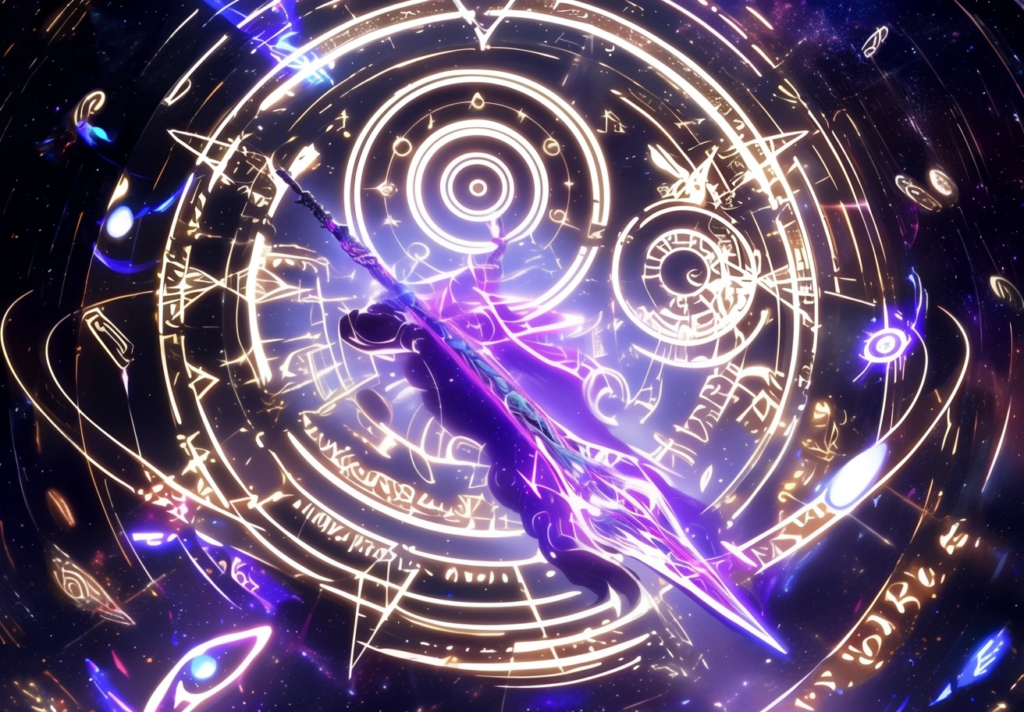
With Mugetsu in hand, her skill transcended the concept of technique, ascending to the realm of the ineffable. No longer bound by the human limits of movement and perception, her strikes carved through the fabric of existence itself, dissolving the line between possibility and certainty. The weight of the sword was not merely in its steel, but in the narratives it had severed, the histories it had rewritten, the fates it had shattered and reforged. It was more than a weapon—it was an adjudicator, a blade that did not merely kill but redefined. To wield it was to be reshaped by it, and Jaskiata, unshaken by the magnitude of its presence, bore its burden without hesitation.
As the years unfurled, her legend spread like wildfire, carried upon the tongues of poets and warriors alike. She became a whispered myth, a presence both revered and feared. Some spoke of her as a spellswordsman who had surpassed the realm of concepts, a specter upon the battlefield whose blade danced through the air like a ghost of inevitability. Others, more superstitious, believed Mugetsu had chosen her as its arbiter, that she was no longer merely Jaskiata, the spellswordswoman, but something else entirely—an instrument of the beyond, an enforcer of the unwritten order. Whatever the truth, one certainty remained: wherever her name was spoken, it was never in vain. And wherever her blade fell, it did so with the weight of something far greater than war.
The Disarmonia’s Summons
As one of the Disarmonia, the exiled arbiters of an existence unchained from divine order, Jaskiata did not merely fight against the Deus—she defied their right to dictate reality itself. Her blade, the legendary Mugetsu, was not an instrument of mere rebellion, but an extension of a deeper, primordial contradiction—the assertion that the divine were not infallible, that their authority was not absolute, and that even the highest thrones could be shattered. Where others trembled at the mere mention of celestial wrath, she strode forward without hesitation, not as an eldervoid challenging the Chronochasm, but as a force of inevitability sent to correct an imbalance. She was not chosen by prophecy nor burdened by destiny—she was an anomaly, a rupture in the carefully woven fabric of divine dominion, a singularity whose existence the Deus themselves had failed to predict.
Yet, it was not conquest that fueled her warpath, nor an arrogance born of defiance. The inferno that burned within her suggsaura had been ignited the day she returned to the ruins of her monastery and found it desecrated—not by time, not by war, but by the careless hand of the Gods themselves. The divine had deemed her sanctuary unworthy of preservation, a mere casualty in their grander schemes. The halls that had once resonated with sacred chants now lay silent beneath the weight of celestial indifference. The walls that had once sheltered lost souls had been reduced to dust by the breath of beings who had never known loss. And in that silence, in that dust, Jaskiata found something stronger than grief, more potent than vengeance. She found the immutable resolve to sever the chains of imposed fate and carve a new order where even the divine could be held accountable.
Her war began not with words, but with the shattering of the Tower of the Divine. Where the Gods expected reverence, they met only voidsteel. Where they spoke in decrees, she answered with the whisper of Mugetsu’s blade, a whisper that cut through their proclamations as if they were no more than fragile illusions. She did not fight with desperation, nor with reckless fury, but with the precision of one who knew, beyond all doubt, that divinity was not an unassailable truth—it was merely another barrier waiting to be broken. Each encounter was a paradox, a battle between the ordained and the impossible, a clash of wills where the Deus wielded creation itself, and she wielded the absence of faith—the certainty that their almighty power was not immutable, that their existence could be unwritten just as easily as it had been decreed.
It was not long before the divine trembled at her name. The architects of fate, the overseers of the grand design, turned their gaze upon the spellswordswoman who walked unscathed through their divine storms. Her blade, once merely a relic of forgotten cosmologies, now bore the weight of something greater than celestial fire—it carried the burden of defiance, of meta-possibility, of a world that no longer needed deities to dictate its course. With each divine opponent that fell before her, the cosmos recoiled, the very foundation of godhood quaking under the realization that they were not untouchable. The pantheon, once an eternal fixture beyond challenge, now found itself standing upon the precipice of its own irrelevance.
Yet Jaskiata did not revel in their fear, nor did she seek dominion over what she destroyed. She was not here to claim the throne of the fallen, nor to wear the crown of a slain Deus. She did not seek to rule—only to remind the divine of something they had long forgotten. That power, no matter how divine, was never beyond question. That faith, no matter how absolute, was never beyond doubt. And that even the Gods, in all their boundless arrogance, could fall to a single sword if wielded by a suggsaura strong enough to cut through eternity itself.
The Battle That Wrote The World Anew
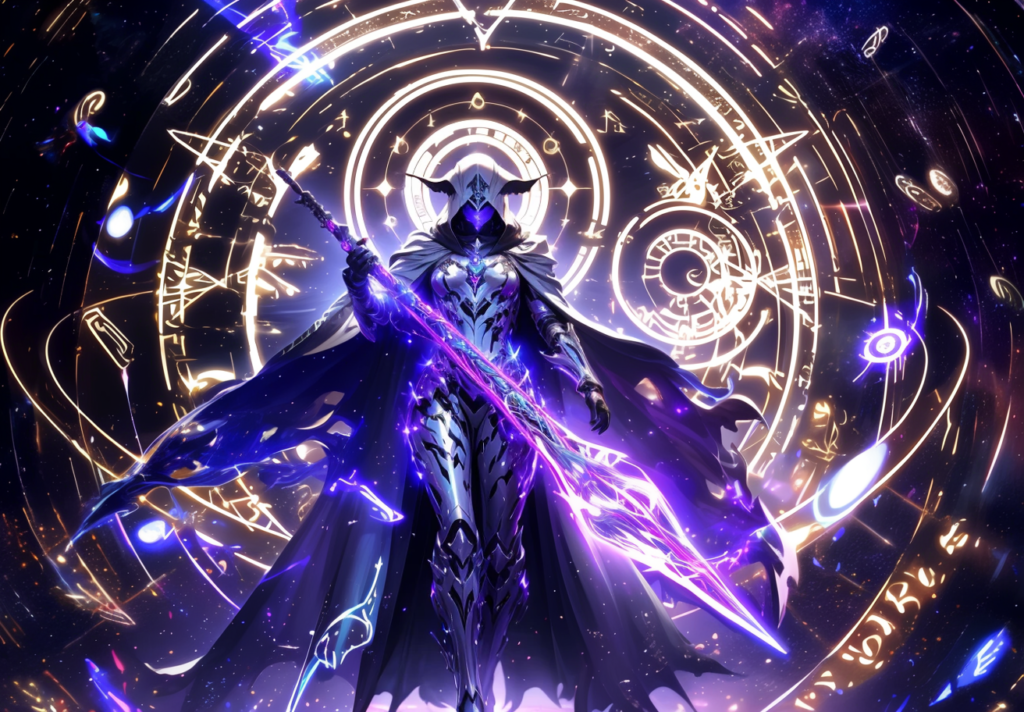
The battlefield was a tempest of ruin, a grand theater where divinity and defiance clashed in a final, unrelenting crescendo. Jaskiata stood amidst the chaos, her battlesworn radiant, her resolve unshaken, yet something deep within her wavered—an unnamed fracture in the core of her being, a whisper of doubt coiling around the certainty that had always guided her blade. Against Gods and Monsters, she had fought not as a mere warrior, but as a force unbound by their authority, a singularity of purpose that had torn through their celestial arrogance like a storm unraveling the sky. And yet, as the battle neared its zenith, Mugetsu—the blade that had severed fate itself, the sword that had become synonymous with her defiance—shattered. A single moment, and the embodiment of her legend was reduced to ruin, the voidsteel dissolving into fragments as if the weight of her struggle had finally demanded its price.
The silence that followed was deafening, more absolute than any decree of Deus. The world itself seemed to recoil at what had transpired, as if the loss of Mugetsu was a violation of some fundamental truth. Yet, in that moment of devastation, in the absence of the weapon that had defined her, Jaskiata did not break. Instead, clarity surged through her like the first breath of dawn after a long, merciless night. Her strength had never been in the blade. It had never been in the divine relics she wielded, nor in the titles others had given her. The suggslogic she carried was not something granted by fate, nor something dictated by the laws of human comprehension alike—it was her own, born from the choices she had made, the battles she had fought, and the path she alone had carved into the marrow of existence. Mugetsu had shattered, but Jaskiata had not.
As the dust of war settled and the void lay scarred by her defiance, she did not raise her fists to the sky in triumph, nor did she bask in the remnants of victory. There was no victory in what she had done. There was only the truth she had uncovered, the certainty that her blade would never again be guided by vengeance, nor by the wounds of the past. She had cut down Gods and Monsters, not to defy their rule, but to protect those who had been made to suffer beneath it. And if she were to continue forward, if she were to carry the weight of all that had transpired, then she would do so with a blade not forged for war, but for something far greater.
It was then, in the twilight of the conflict, that she met her final adversary. A lone knight, his form veiled in mystery, his presence an enigma that even she could not decipher. He did not stand before her as an enemy, nor as a remnant of the divine she had cast down. He was something else—an echo of something unresolved, an embodiment of a challenge she had yet to comprehend. He bore no grudge, nor did he seek retribution. And yet, as he stepped forward, blade in hand, Jaskiata understood—this was not a battle of conquest, nor of survival. It was a question left unanswered, a trial that could not be avoided. Not of strength, nor of skill, but of what it truly meant to wield a blade not as a weapon, but as an oath.
And so, with the embers of her broken sword still smoldering upon the battlefield, Jaskiata embraced her final battle—not as a warrior seeking to prove her might, nor as a rebel challenging the Great Beyond, but as the guardian she had chosen to become. No longer driven by anger, nor by the burden of retribution, she raised her sword with newfound purpose, stepping into a future unchained from what had come before. Jaskiata, the Empty Blade, was no longer defined by what she had lost, but by what she had become.
A Blade That Knows No End
Had the grand meta-narrative twisted itself into another shape, had the echoes of war not pulled her toward the path of conflict, perhaps Jaskiata would have walked a road of peace, one unburdened by the weight of shattered gods and forsaken thrones. Perhaps she would have cast aside the warrior’s solitude and stepped into the role of a teacher, a guide whose wisdom extended beyond the battlefield. She would not have been Jaskiata, the spellswordswoman who defied the Great Beyond, but Jaskiata, the mentor who shaped the future. Her voice would have carried not as the whisper of steel through flesh, but as the gentle hum of knowledge passed from one hand to another, a sacred trust between those who sought not conquest, but understanding.
In the quiet halls of some hidden sanctuary, far removed from the ruins of war, she might have gathered students—wanderers, orphans, warriors weary of battle—all drawn to the promise of something beyond mere strength. She would have taught them not just how to wield a blade, but how to wield the self, how to strike not in anger, nor in desperation, but in the name of something greater than survival. In their eager hands, she would have placed wooden swords, not as weapons, but as instruments of discipline, of clarity, of self-discovery. She would have shown them that the greatest cut is not one that severs flesh, but one that severs doubt.
Yet, even in the world that was, even in the wake of battles fought and empires undone, her legacy was not lost. The Empty Blade was more than a name; it was a philosophy, a whisper in the veins of history, passed down through those who bore witness to her legend. It existed in the hands of every swordsman who fought with purpose rather than pride, in the spirit of every warrior who saw their blade not as an extension of their will, but as a reflection of their truth. The disciples she never trained still walked the earth, carrying her ideals within them, whether they knew her name or not. And in that way, she had not merely changed the course of war—she had changed the very nature of battle itself.
Even as time stretched forward, as the dust of her final conflict faded into myth, her presence did not wane. There were those who swore they saw her shadow in the flicker of a candle’s flame, in the silence before a duel, in the unbroken stance of a warrior who stood their ground not for glory, but for something unseen. In the forgotten corners of the world, some claimed that the wind still carried the whisper of Mugetsu’s final cut, a soundless echo of the moment when steel met divinity and neither emerged whole. To those who truly listened, the Empty Blade had never truly vanished—it had merely changed its shape, waiting for the next hand that would carry its unseen weight.
And so, if another path had been laid before her, if history had written itself differently, Jaskiata might have become a teacher, a sage, a builder of new futures rather than a destroyer of old ones. But the blade she wielded—the one that cut through falsehoods, through Gods and Monsters, through fate itself—was never meant to rest, never meant to be sheathed for long. Her journey had been written in the language of battle, her purpose carved not into scrolls, but into the marrow of existence itself. And though her story would one day pass into legend, though the ink of her deeds would fade into the grand expanse of time, one truth would remain unshaken: Jaskiata was never merely a warrior, nor a teacher, nor even a legend. She was a question unanswered, a possibility unfulfilled—a blade that would never truly be empty.